Is CBD Safe for Kids? What the Evidence Actually Shows
No, cannabidiol has not been established as safe for children. Here is what the one approved label actually says, what the poison-center record actually counted, and why a 250 mg/mL bottle belongs behind a latch, written by a company that sells one.
No. Cannabidiol has not been established as safe for children, no Planntz tincture is intended for anyone under 18, and nothing on this page is a serving, a dose or a suggestion that you give a child CBD. That is the same answer every children's hospital on this search gives. What follows is the part they leave out: the concentration math, the poison-center record, the storage argument and the sixty-second check on what is actually in a bottle.
People searching "CBD for kids" are asking one of two very different questions. The first is whether to give it, and the answer above covers that. The second is urgent: a child got into a bottle. If that is why you are here, call Poison Help at 1-800-222-1222 now, then come back to the five-minute list below. This page is written by a company that sells 250 mg/mL CBD tinctures to adults, and that concentration is our own best argument for keeping the bottle locked away. There is no link to anything we sell anywhere on it. If cannabidiol itself is new to you, what cannabidiol is and where it comes from is the background this page assumes.
Is CBD safe for kids? The short answer, and who is saying it
Five of the six results on page one come from children's hospitals, pediatric institutes or medical reference sites, and they converge: cannabidiol has not been shown to be safe for children, and a parent considering it should ask the child's clinician first. We agree, and we are not going to pretend a hemp company knows more about pediatric safety than a children's hospital does. The regulator's own position is narrower than most people assume. Under a heading listing what it does not know, the FDA's consumer update on cannabis and cannabis-derived compounds asks: "What is the effect of CBD on the developing brain (such as on children who take CBD)?" Children appear again further down the same page, among the special populations the agency is "actively working to learn more about". We read it on August 9, 2026 and both lines were still there. A regulator that put children on its list of open questions and left them there is not endorsing anything, and it is not warning about anything either. It is describing a blank space.
So the honest framing is not that cannabidiol has been shown to hurt children. It is that the question has barely been asked. The adverse effects that have been documented, including sedation, diarrhea, reduced appetite and changes in liver enzymes, were documented in monitored patients at prescription amounts, and the side effects that show up in the trial data have their own page. The pediatric question is not "what are the side effects" but "what happens in a body nobody has measured".
The one cannabidiol medicine approved for children, and what it actually is
There is exactly one. A query to the FDA's Drugs@FDA database for approved applications with cannabidiol as the generic name, run on August 9, 2026, returns a total of one: NDA 210365, EPIDIOLEX, an oral solution. Its full prescribing information is public, and section 1 reads, verbatim: "EPIDIOLEX is indicated for the treatment of seizures associated with Lennox-Gastaut syndrome (LGS), Dravet syndrome (DS), or tuberous sclerosis complex (TSC) in patients 1 year of age and older." Section 8.4 adds that safety and effectiveness below 1 year of age have not been established. We read SPL version 35, updated May 29, 2026.
Read that next to what page one of this search tells you, because several of the strongest results say the approval covers two syndromes in children aged 2 and over. That was true of an earlier version of the label. What you are looking at is a superseded label copied forward, year after year, by pages that are otherwise careful and correct. It is the clearest argument there is for opening the primary document rather than trusting any summary of it, including this one. The link and the version number are above; check us.
Section 2.1 instructs prescribers to obtain serum ALT, AST and total bilirubin in every patient before the first dose, because of the risk of hepatocellular injury, and section 5.1 repeats that blood work at 1, 3 and 6 months. The reason sits in the same section: ALT above three times the upper limit of normal occurred in 13% of treated patients at 10 and 20 mg/kg/day and 12% at 25 mg/kg/day, against 1% on placebo, in patients also taking other antiseizure medicines. What the liver signal on that label does and does not mean has its own page.
The arithmetic nobody runs: mg/mL against mg/kg/day
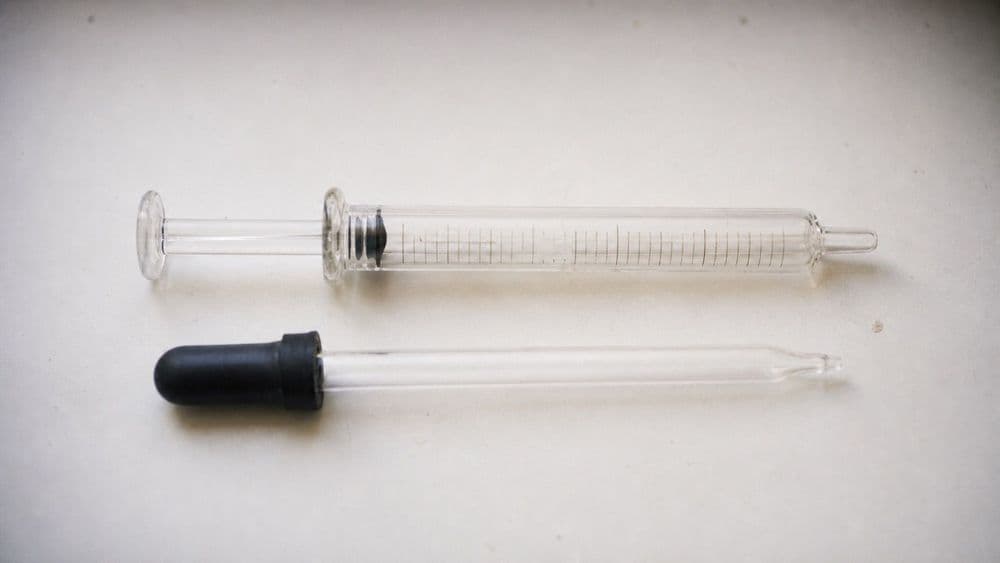
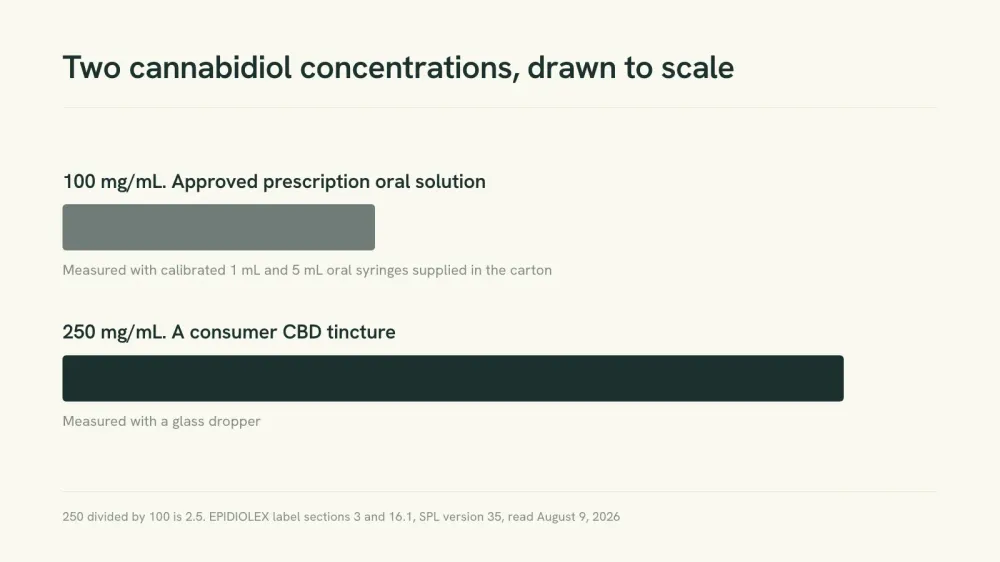
Here is where a company that thinks in milligrams per milliliter all day can add something. The prescription medicine is 100 mg/mL (label section 3), packaged with two 1 mL and two 5 mL calibrated oral dosing syringes (section 16.1). A Planntz tincture is 250 mg/mL, which is 15,000 mg of CBD in a 60 mL bottle, and it is measured with a glass dropper. Two and a half times the concentration: 250 divided by 100 is 2.5, exactly.
| EPIDIOLEX oral solution (prescription) | A 60 mL Planntz tincture (consumer) | |
|---|---|---|
| Concentration | 100 mg/mL (sections 3 and 16.1) | 250 mg/mL, 15,000 mg of CBD in the bottle |
| How it is measured | Calibrated 1 mL and 5 mL oral syringes in the carton (16.1). Section 2.4: a household teaspoon or tablespoon is not an adequate measuring device | A glass dropper. Roughly 0.05 mL and about 12.5 mg per drop, and drop size varies with the dropper and the technique |
| The amount is expressed in | Milligrams per kilogram of body weight per day (2.2 and 2.3) | Milligrams per serving. There is no body-weight axis anywhere on a consumer CBD label |
| Who it is for | Patients 1 year of age and older with one of the three seizure syndromes named in section 1 | Adults |
| Blood work | Serum ALT, AST and total bilirubin before the first dose (2.1), then at 1, 3 and 6 months and periodically after that (5.1) | None |
| Who decides the amount | A prescriber, titrating in weekly increments (2.2) | Whoever is holding the bottle |
The unit is the part to notice. That label expresses everything in milligrams per kilogram of body weight per day: section 2.2 sets a starting dosage of 2.5 mg/kg twice daily (5 mg/kg/day) and a maximum recommended maintenance dosage of 10 mg/kg twice daily (20 mg/kg/day), reached in weekly increments. Those are the label's figures, in the label's voice, for a prescription medicine. They are not a dose for anyone reading this and they never convert into milliliters of a tincture. Now look at a consumer CBD label: there is no body-weight axis on it at all. That absence is the answer to "how much can I give". The amount is written per serving for an adult, and nothing on the bottle was designed to scale to a small body. How to read the milligram figures on a CBD label is the skill page, and the per-drop math for a 250 mg/mL tincture belongs there rather than here.
One more note about units, because the error is out there in the wild. A seller page ranking for a closely related query tells readers that children can safely take up to "20 mg of CBD per body weight" daily. Per body weight is not a unit. What that garbles is section 2.2's maximum of 20 mg per kilogram of body weight per day, for a prescription oral solution, under liver monitoring. Strip the kilogram out of an amount expressed per kilogram and you have written a number with no meaning and pointed it at a child. We are not naming the site, because the error matters and the seller does not.
What has actually been measured: children in the poison-center record
Most pages on this topic say children's exposure is rising and stop there. A number exists, because four epidemiologists at the FDA's Center for Drug Evaluation and Research went and counted. In a case series published in Clinical Toxicology in 2023, Perez-Vilar and colleagues pulled every cannabidiol exposure case in the National Poison Data System between July 2014 and June 2021: 6,496 of them, 85.2% involving CBD products that were not the approved medicine, peaking at 336 cases in March 2021. And 36.2% of all 6,496 cases involved children aged 2 to 12.
Within that age band, 94.1% of exposures were unintentional, the child-finds-the-bottle case. The authors separately identified therapeutic errors (3.9%), intentional use (3.0%) and adverse reactions (1.6%) in cases involving non-FDA-approved CBD products; those four figures are reported for different groupings and are not a breakdown of the age band, so do not add them up. The record contains children who were handed cannabidiol on purpose, alongside children who found it themselves.
Now the part a frightening version of this article would leave out. Among the 5,248 single-product cases in that series, the authors identified 44 major medical outcomes, all of them related to exposures to CBD that was not the approved medicine. Those 44 cases had a median age of 27, interquartile range 19 to 48: the severe end of this dataset is overwhelmingly adult. What the data shows for children is frequency of exposure, not severity of outcome, and where the exposure was to the approved medicine every medical outcome was mild or moderate. A page that gives you only one half of that is selling you something.
Two limits, in the authors' own terms. Poison-center data captures only exposures somebody phoned in, has no population denominator, and relies on self-reported and electively shared information. The substance is classified from what the caller says rather than from an assay, so the exact content and concentration of non-approved CBD products is unknown. These are counts of calls, not rates of harm, and a rising count partly tracks a rising number of bottles in American homes. An earlier analysis of the same database in the American Journal of Emergency Medicine covered the first year cannabidiol had its own substance code, April 2019 to March 2020: 1,581 cases, 44.0% of patients under 13, about 13% coded moderate or severe, and no fatalities.
Hemp-derived is not a safety statement
The scariest paediatric numbers in this conversation are not cannabidiol numbers, and the label on the package is why. A 2026 analysis in the Journal of Pediatrics compared 2,169 single-substance exposures to hemp-derived cannabinoids against 9,667 to delta-9-THC in children aged 5 and under, using 2023-2024 poison-center data, and found the hemp-derived group ran higher on critical-care admission, 11.3% against 8.58% (P < .001), with no deaths reported. Read the definition before the result: that paper's hemp-derived group is delta-8-THC, delta-10-THC and THC-O acetate, intoxicating THC analogues rather than cannabidiol. So the word on the front of the box describes where a molecule started, not what it does in a body, and none of these are cannabidiol figures. How delta-8 differs from cannabidiol, the legal line between hemp and marijuana and whether cannabidiol itself is intoxicating are three separate questions from what a child may actually have swallowed.
If a child has swallowed CBD: what to do in the next five minutes
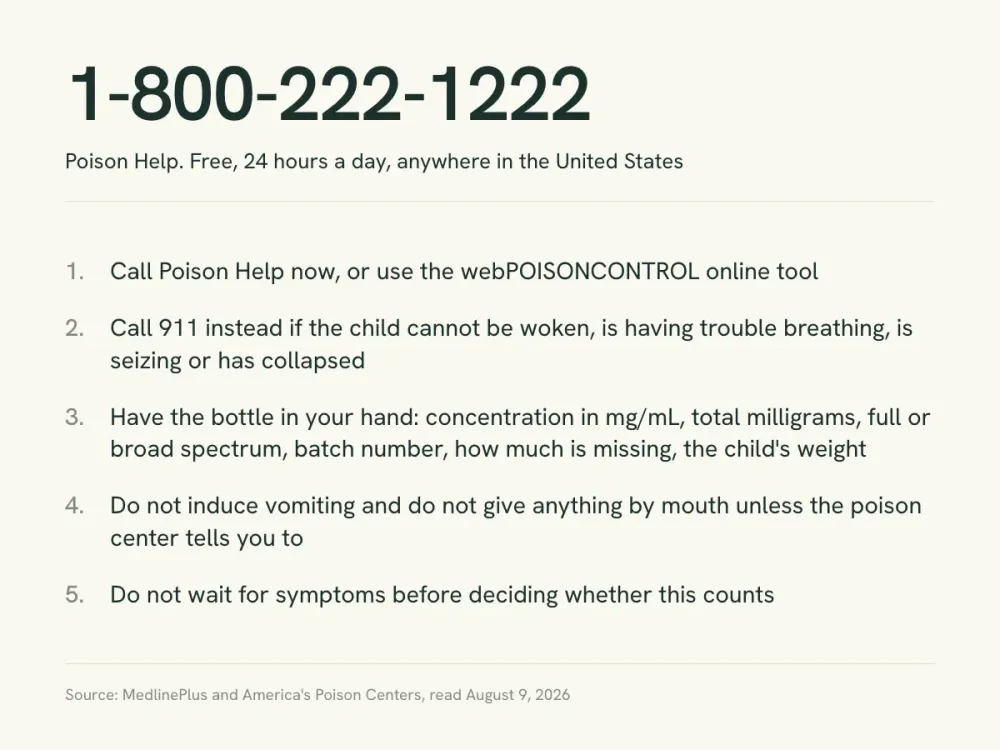
Stop reading and make the call. MedlinePlus, the NIH's consumer health service, prints the number: if you suspect someone has been poisoned, call your local poison control center at 1-800-222-1222 right away. America's Poison Centers, the national association behind that line, describes 53 accredited centers answering 24/7/365 at no cost. You do not need to be certain anything is wrong before you call.
- 1Call Poison Help at 1-800-222-1222 now, or use the webPOISONCONTROL online tool. It is free, staffed around the clock, and the people answering handle this every day.
- 2Call 911 instead if the child cannot be woken, is having trouble breathing, is seizing or has collapsed.
- 3Have the bottle in your hand. You will be asked for the concentration in mg/mL, the total milligrams, whether it is full or broad spectrum, the batch number, how much is missing, and the child's weight.
- 4Do not induce vomiting and do not give anything by mouth unless the poison center tells you to.
- 5Do not wait for symptoms before deciding whether this counts. The call costs nothing, and the answer is often that no treatment is needed.
The National Capital Poison Center's page for a parent whose child has eaten a cannabis edible lists what those centers see: vomiting, dizziness, difficulty walking, a rapid heart rate, drowsiness, confusion and breathing difficulties, with hallucinations, an abnormally slow heart rate and low blood pressure in severe cases. That guidance is about cannabis edibles, meaning THC, and we are labeling it that way rather than letting it pass as a cannabidiol list. For the adult version, what happens when an adult takes too much CBD carries the full emergency route.
Storage: what selling a 250 mg/mL bottle obliges us to say
Here is the one calculation on this page, and it runs in the direction of alarm rather than reassurance. A Planntz tincture holds 250 mg of CBD in every milliliter. Section 2.2 of the EPIDIOLEX label sets a maximum recommended maintenance dosage of 20 mg per kilogram of body weight per day. Divide one by the other: 250 divided by 20 is 12.5. A single milliliter of a 250 mg/mL tincture contains as much cannabidiol as the entire maximum daily amount that label authorizes for a patient weighing 12.5 kg, and it would arrive in one unmeasured swallow, without the weekly titration, without the baseline blood work, without the calibrated syringe and without the prescriber. That is an exposure comparison and nothing else: no amount of a consumer CBD tincture is an appropriate dose for a child, and EPIDIOLEX is a prescription medicine at a different concentration, for the three seizure syndromes named in section 1, measured with a syringe that comes in its carton. We are attaching no age to 12.5 kg of body weight, because we have no sourced weight-for-age reference and inventing one would be a fabricated fact.
One more step, from printed numbers again. A 60 mL bottle holds 15,000 mg of CBD; at that body weight and that maximum, a full day would be 250 mg; and 15,000 divided by 250 is 60. One bottle on a kitchen shelf holds sixty of those maximum days. That is the entire storage argument. Storage that keeps a tincture chemically stable is a separate question, and how long a tincture keeps and what degrades it answers that one.
Storage, rather than intention, is the weak point, and a 2026 survey shows why. A cross-sectional survey in Frontiers in Public Health asked 796 analyzed adults at an emergency department and a pediatric clinic in eastern North Carolina what they believed about CBD. 37% reported CBD in the household, most often as gummies (61.9%). Among those, 44.3% answered TRUE to the statement that CBD is safe for use in children for specific medical conditions and 25.8% answered FALSE, and they were significantly more likely than households without CBD to believe it is safe for children (p < 0.001). One site, one rural region, a voluntary hospital sample: it does not describe the country. It does describe the pattern that matters here, which is that the belief that makes storage feel optional is concentrated in the homes that have a bottle in them.
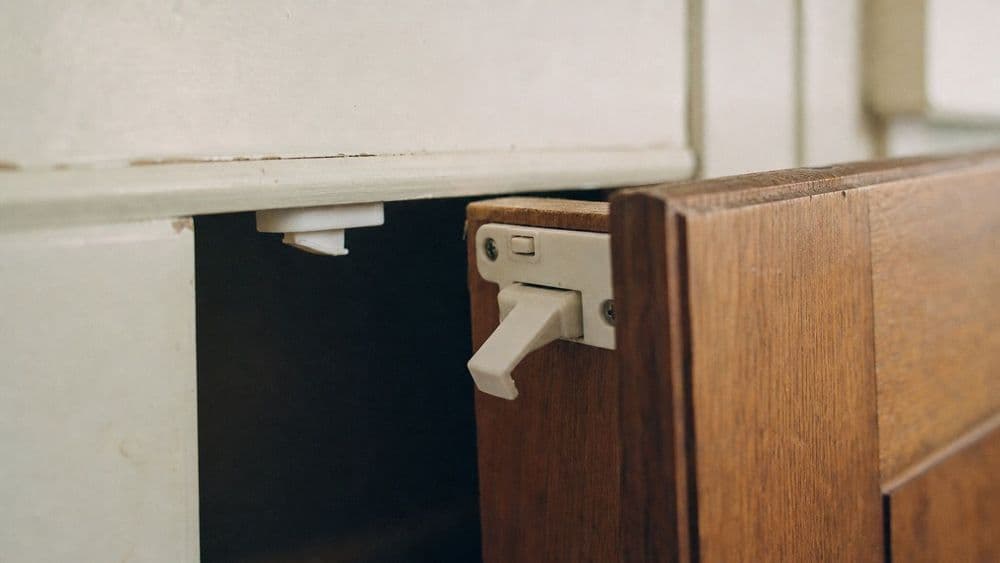
- Locked or latched, not merely high up. A child who can climb a counter has already defeated out of reach, and out of sight matters as much: what a child never sees is what a child never goes looking for.
- Never in a handbag, a backpack, a nightstand or a car door pocket, including a visiting relative's bag.
- Never decanted into another container. An unlabeled bottle is unanswerable at 2am and close to useless to a poison center.
- Treat anything that looks like food as the highest-risk format in the house. A gummy is indistinguishable from candy to a four-year-old.
- Keep the batch number and the certificate of analysis findable. If you ever make the call, the person on the line wants figures, not a brand name.
- The prescription version of cannabidiol ships with a child-resistant closure, per section 16.1 of its label. A dropper bottle is not a lock, and we are not going to imply otherwise about ours.
What is actually in the bottle: the sixty-second check
Every pediatric page on this topic says the same true, unhelpful thing: consumer CBD products are inconsistently labeled and may contain THC. Here is that sentence with a method attached. Find the batch or lot number printed on the bottle or the carton. Find that exact batch's certificate of analysis, the report an independent laboratory issues for one production run. Then check four things: the cannabidiol figure in mg/mL against what the front of the bottle claims; the delta-9-THC row; the date on the report; and the name of the laboratory that signed it. If the report does not name your batch, it is a report about a different bottle.
That check is why no parent should trust any bottle on the strength of its front panel, ours included. A front panel is a marketing surface; a batch report is a measurement. What third-party testing actually proves covers who is entitled to call themselves independent, how to read a certificate of analysis line by line walks through the document, and the tells of a fake or recycled lab report covers what a bad one looks like. The FDA's consumer update says the agency is investigating reports of CBD potentially containing unsafe levels of contaminants: that is a regulator describing reports it is looking into, not test results it has published, and keeping the distinction intact is part of reading this topic honestly.
What is still not known, and who says so
Two more gaps, named precisely rather than waved at. Section 8.4 of the prescription label carries juvenile-animal findings for cannabidiol and its major metabolite, including the note that a no-effect dose was not established; those are rats in a regulatory dossier, they transfer to no person and no bottle, and they belong to the page that covers cannabidiol and reproductive endpoints. Interactions matter more in a child already taking something, not less, and how CBD interacts with other medicines is the page to bring to a pharmacist. The regulator's broader posture is on what the FDA has and has not said about CBD, and this is the last of our three life-stage pages, alongside CBD in pregnancy and while breastfeeding and CBD and older adults.
Where this leaves a parent
We arrive at the same conclusion as the children's hospital, from the other side of the counter, with the arithmetic shown. Cannabidiol is not established as safe for children. We sell 250 mg/mL tinctures to adults, that concentration is two and a half times the approved pediatric medicine's, our bottle holds 15,000 mg, and every one of those facts is an argument for a latch rather than a reason to experiment. There is deliberately no route from this page to anything we sell. If your real question is about a specific diagnosis your child already has, it belongs with the clinician who made that diagnosis. This page summarizes published evidence and public documents as of August 9, 2026, it was written by an editorial team rather than a clinician, and it is not medical advice. The label we read is SPL version 35; labels change, which is exactly how page one of this search went out of date, and it is how this page will too.
Common questions
It has not been established as safe, which is different from having been shown to cause harm. The only cannabidiol medicine approved for anyone under 18 is a prescription oral solution for seizures associated with three named syndromes, and its label requires liver blood work before the first dose and again at 1, 3 and 6 months. No consumer CBD tincture has a pediatric safety dossier behind it, and no Planntz tincture is intended for anyone under 18. For a specific child, ask that child's pediatrician, who knows the weight, the history and everything else the child is taking.
One drug application is: NDA 210365, an oral solution for seizures associated with three named syndromes in patients 1 year of age and older. A query to the FDA's approved-application database for cannabidiol on August 9, 2026 returned a total of one. Cannabidiol is not approved as a food ingredient or as a dietary supplement for anyone of any age, and an approval for three specific indications is not a general statement that the molecule suits children.
There is no answer, and the reason is structural rather than cautious. The approved medicine is dosed in milligrams per kilogram of body weight per day, titrated over weeks, with liver blood work before the first dose and a prescriber adjusting it. A consumer CBD label has no body-weight axis on it at all, no titration schedule, no monitoring and no prescriber. No amount of a consumer CBD tincture can be presented as appropriate for a child, and any page that gives you a number for one has invented it.
Call Poison Help at 1-800-222-1222 right now, or use the webPOISONCONTROL online tool. It is free, it runs 24 hours a day, and you do not need to be sure anything is wrong. Call 911 instead if the child cannot be woken, is struggling to breathe, is seizing or has collapsed. Have the bottle with you: they will ask for the concentration in mg/mL, the total milligrams, whether it is full or broad spectrum, the batch number, how much is missing and the child's weight. Do not induce vomiting, and do not wait for symptoms before deciding it counts.
Possibly, and the front label is not proof either way. Full-spectrum products carry trace THC below the 0.3% federal limit; our own full-spectrum batches report roughly 0.13% to 0.25% on their certificates of analysis, and our broad-spectrum batches report THC as non-detected on the mango and natural flavors and a 0.019% trace on lemon. The only way to know what one specific bottle holds is that batch's certificate of analysis. Note too that the poison-center research on hemp-derived cannabinoids in young children covers delta-8-THC, delta-10-THC and THC-O acetate, which are intoxicating compounds and not cannabidiol.
Writing about hemp, wellness and the small rituals that keep us balanced.