How Old Do You Have to Be to Buy CBD? State Rules for 2026
There is no single age to buy CBD. Federal hemp law sets none, so the rule comes from your state and depends on the product. We read eight state texts on November 8, 2026: each sets 21 for the products it covers. Plus what 2026 changes and when you need a prescription.
How old do you have to be to buy CBD? In the United States there is no single answer. Federal hemp law does not set an age, so the answer comes from your state, and inside a state it depends on the kind of product: something you swallow, something you smoke, something you put on your skin, and whether it is hemp or marijuana. In the eight state texts we read on November 8, 2026, every buyer-age rule we found was 21. None of them set 18.
Most pages that answer this question print a list of states marked 18 or 21 with no law cited for any row, and the lists contradict each other. We took a slower route. For each state below we read the statute or regulation itself, wrote down which products its age rule covers, and recorded the date we read it. That leaves fewer states than a 50-row list, but every row can be checked against its source. This page describes what the texts said as of November 8, 2026. It is not legal advice. For the wider question of whether CBD is legal where you live at all, our guide to CBD's legal status is the place to start.
How old do you have to be to buy CBD? No federal age, and 21 in every state text we read
Start with federal law. The federal definition of hemp in 7 U.S.C. 1639o says what hemp is; it does not set an age to buy it, and a search of the section for any age wording comes back empty. The FDA's main page on cannabis and CBD, last updated in July 2024, sets no buying age either. On whether a CBD product can be sold legally, FDA's answer is that "it depends, among other things, on the intended use of the product and how it is labeled and marketed." That is a question about the product, not about the person buying it.
The federal 21 rule most people remember is Tobacco 21. The federal tobacco statute makes it unlawful "for any retailer to sell a tobacco product to any person younger than 21 years of age," and the FDA's Tobacco 21 page dates that law to December 20, 2019. It covers tobacco products, not hemp. A wrap or blunt made with tobacco leaf is a different product class with its own rules, which we cover in our blunt vs. joint comparison.
So the age comes from the states. Of the eight state texts we read, every one sets 21 for the products it covers, and none sets 18. That runs opposite to the "most states are 18" line you will find on many list pages. It is still a finding about eight states read on one date, not a national rule: other states may set 18, set nothing for some products, or have changed their law since we read it.
Three kinds of product that the age lists merge
The biggest reason the lists disagree is that they treat "CBD" as one product. State laws do not. Recent laws often set 21 for "consumable hemp products" or for intoxicating hemp, and they define those terms by how the product enters the body and how much THC it carries. A CBD oil, a THC-forward hemp gummy and a CBD tincture sold in a licensed dispensary can fall under three different rulebooks in the same state. If the THC side is new to you, our explainer on hemp-derived THC and the 0.3% math covers it, and where the hemp vs. marijuana line falls explains which side of the law a product starts on.
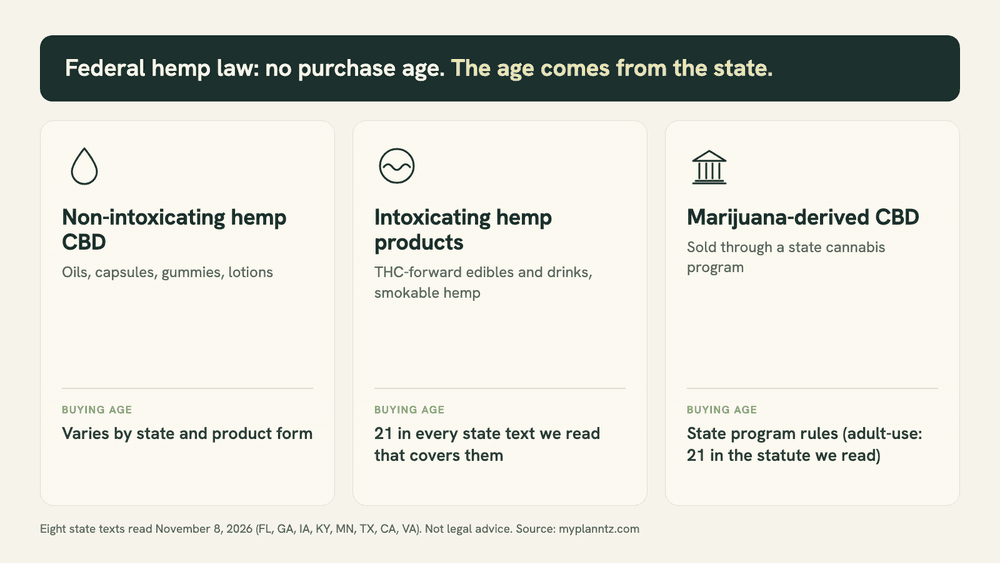
| Product class | Examples | Who sets the age | What the eight texts we read do |
|---|---|---|---|
| Non-intoxicating hemp CBD | Oils, capsules, gummies, lotions | State hemp, food or health law | Varies by product form. Ingestibles are covered at 21 in six of the eight (FL, GA, IA, MN, TX, CA). Topicals are named in the Iowa and Texas texts, not in the Florida, California or Minnesota age texts. Kentucky's 21 rule covers adult-use products, not non-intoxicating ones. |
| Intoxicating hemp products | THC-forward edibles and drinks, smokable hemp | State hemp law | 21 wherever a text we read covers them, for example Kentucky adult-use products, Virginia smokable hemp and Minnesota hemp edibles |
| Marijuana-derived CBD | CBD products sold in a licensed dispensary | State cannabis program (adult-use or medical) | Adult-use sales are legal only under state law, to adults 21 and over; Minnesota, the one cannabis statute we read, sets 21. Medical programs have their own patient and caregiver rules. |
State by state, from the text (as of November 8, 2026)
Each row below comes from the statute or regulation text itself, read on November 8, 2026. The "Type" column matters. A statute is passed by the legislature. A regulation is written by an agency under authority a statute gives it. Texas's rule is an agency rule that has been challenged in court. The last column, what each text leaves out, is the part most lists skip. The links to each text are in the state notes after the table.
| State | Citation | Type | Age | Products the age rule covers | What the text leaves out or adds |
|---|---|---|---|---|---|
| Florida | Fla. Stat. 581.217(7)(d) | Statute | 21 | Hemp-extract products intended for ingestion or inhalation, including snuff, chewing gum and other smokeless products | Does not name topicals |
| Georgia | O.C.G.A. 16-12-241, as enacted by SB 494 (2024) | Statute (enacted act) | 21 | Consumable hemp products: those intended to be ingested, absorbed or inhaled | Also bars purchase and possession under 21. Read from the signed act, effective October 1, 2024 |
| Iowa | Iowa Code 204.14D and 204.14E | Statute | 21 | Consumable hemp products, including food, supplements and topical applications | Consumables are capped at 4 mg total THC per serving and 10 mg per container |
| Kentucky | 902 KAR 45:190, sec. 7 | Regulation | 21 | Adult-use cannabinoid products | The 21 rule does not extend to non-intoxicating or cosmetic products. Read from the Cornell LII copy |
| Minnesota | Minn. Stat. 342.46, subd. 3; 342.09 | Statute | 21 | Lower-potency hemp edibles and hemp-derived consumer products | No age clause for hemp-derived topicals found in a search of the full chapter |
| Texas | 25 TAC 300.701 and 300.101(26) | Agency rule (DSHS) | 21 | Consumable hemp products, defined to include food, drugs, devices and cosmetics | Effective March 31, 2026. Challenged in court |
| California | 17 CCR 23005 | Regulation | 21 | Industrial hemp food products: food, food additives, beverages and dietary supplements | Does not name cosmetics or topicals |
| Virginia | Va. Code 18.2-371.2 | Statute | 21 | Hemp products intended for smoking | A separate label clause (3.2-4123) says THC-containing products may not be sold under 21; we verified no sale clause for non-smokables |
Florida. Section 581.217 of the 2026 Florida Statutes says products "intended for human ingestion or inhalation and that contain hemp extract, including, but not limited to, snuff, chewing gum, and other smokeless products, may not be sold in this state to a person who is under 21 years of age." A violation is a second-degree misdemeanor, and a repeat within one year is a first-degree misdemeanor. Georgia. Senate Bill 494, signed in 2024, rewrote O.C.G.A. 16-12-241 effective October 1, 2024. It bars selling "any consumable hemp product" to anyone under 21 and bars people under 21 from buying or possessing one. The act defines a consumable as "a hemp product intended to be ingested, absorbed, or inhaled by humans or animals." We read the act as signed, because Georgia's code has no free official online copy.
Iowa. Iowa Code 204.14D says "A person shall not sell, give, or otherwise distribute a consumable hemp product to a person under twenty-one years of age," and a violation is a simple misdemeanor. A companion section, 204.14E, covers purchase and possession by people under 21 and carries a civil penalty plus community service. Iowa's definitions in 204.2 count products "absorbed through the skin, such as a topical application" as consumable, which makes Iowa one of two texts we read whose age rule clearly reaches lotions and balms. The same definition caps a consumable at 4 mg of total THC per serving and 10 mg per container.
Kentucky. Kentucky's rule is a regulation, 902 KAR 45:190, which we read from the Cornell Legal Information Institute's copy because the state's own site did not respond. Section 7 says adult-use products may "Not be sold, gifted, or otherwise transferred to any person under the age of twenty-one (21)." The regulation applies its 21 rule to adult-use products; it does not extend it to non-intoxicating and cosmetic products. Under section 3, a product counts as non-intoxicating only if it meets a 25:1 ratio test and holds no more than 2.5 mg of adult-use cannabinoid per serving. The history note on the copy we read lists amendments effective August 1, 2023 and October 13, 2023, both marked as emergency filings, and shows the regulation in effect until June 16, 2028. The scope of a rule is not a recommendation: whether a young person should use CBD at all is a health question, not a legal one, and our guide to CBD and children covers it.
Minnesota. Minn. Stat. 342.46 says a retailer "must verify that the customer is at least 21 years of age" before a sale or a delivery, and Minn. Stat. 342.09 bars anyone under 21 from using, possessing or transporting lower-potency hemp edibles or hemp-derived consumer products. We searched the whole of chapter 342 for an age rule on hemp-derived topical products and found none. Topicals appear only among products that "do not require a license or authorization." That describes the chapter's scope as of November 8, 2026, nothing more.
Texas. Texas's age rule is not a statute. It is an agency rule from the Department of State Health Services, 25 TAC Chapter 300 as adopted, effective March 31, 2026. Section 300.701 prohibits "delivering, selling, or offering to sell a consumable hemp product to a minor," and section 300.101 defines a minor as a person under 21. A consumable hemp product is "Any product processed or manufactured for consumption that contains hemp, including food, a drug, a device, and a cosmetic," so the rule reaches topicals. The rule traces back to a 2025 executive order from Governor Abbott, which we could not read directly. The rules have also been challenged in court: KUT reported on June 9, 2026 on a May 1 temporary injunction against major portions of them, naming the fees and the total-THC rule, and on an appeals court order that paused that injunction while the case went on. That report does not mention the age clause, so we make no claim about whether the court fight ever affected it, and we have not confirmed where the case stands now. The age clause is in the adopted rule as we read it.
California. 17 CCR 23005 says "A person shall not offer or sell industrial hemp final form food products intended for human consumption, including food, food additives, beverages, and dietary supplements, to a person under 21 years of age." It began as an emergency rule on September 23, 2024 and became permanent when the state's Office of Administrative Law approved the regular rulemaking on October 20, 2025, according to the California Department of Public Health's hemp rulemaking page. Pages that still describe California as 18 for hemp CBD are out of date for food, drinks and supplements. The text does not name cosmetics or topicals. CDPH also notes that a 2025 law, AB 8, took effect January 1, 2026 for most provisions; we could not read its age text, so this row rests on the regulation. Hemp drinks sit inside this rule, and our guide to whether THC drinks are legal goes further into beverages.
Virginia. Va. Code 18.2-371.2, in the version effective from October 1, 2026, bars selling to, buying for, or knowingly letting a purchase be made by "any person younger than 21 years of age" of "any tobacco product or hemp product intended for smoking." The code still prints the earlier version, effective until that date, beside it, and both set 21. The sale ban we verified covers smokable hemp only. A separate section, Va. Code 3.2-4123, requires THC-containing regulated hemp products to carry a label saying the product "may not be sold to persons younger than 21 years of age." That is a labeling duty. We did not verify a separate sale clause for non-smokable products, so we do not state what age applies to them.
States we could not verify. Tennessee, Colorado, Louisiana and Ohio often appear on age lists. We could not read their primary texts on November 8, 2026, so we print no age for them here. If you live in one of them, or in any state not in the table, go to your legislature's code site or the state agency that regulates hemp and read the section yourself, using the checklist further down.
What 2026 changes: the hemp definition moves, the age rules do not
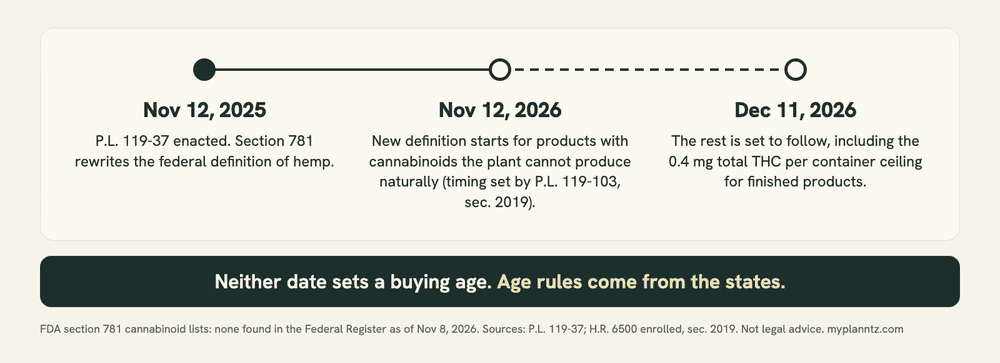
Two federal dates arrive this fall, and neither one sets a buying age. Public Law 119-37, enacted November 12, 2025, rewrites the federal definition of hemp effective 365 days later. Hemp will be measured by "a total tetrahydrocannabinols concentration (including tetrahydrocannabinolic acid) of not more than 0.3 percent on a dry weight basis" rather than by delta-9 THC alone. Cannabinoids made outside the plant will be excluded, and so will a finished consumer product that contains "greater than 0.4 milligrams combined total per container" of total THC and similar cannabinoids.
A later law split that change into two steps. Section 2019 of H.R. 6500, enacted as P.L. 119-103 limits the section 781 changes, until December 11, 2026, to the products described in two of its clauses: the ones covering cannabinoids the plant cannot produce naturally. So from November 12, 2026 the change will reach those cannabinoids; the rest, including the 0.4 mg per container ceiling, is set to arrive on December 11, 2026. Our news report on the hemp ban's delay to December 11 covers how that split happened. Section 781 also gave FDA 90 days to publish lists of cannabinoids that fix the new definition's exact reach. As of November 8, 2026, a Federal Register search found none, and FDA's CBD page does not mention them.
“If intoxicating hemp products persist on the market after the change to their legal status, it is possible they could be subject to the same criminal and collateral issues as marijuana.”
That warning comes from the Congressional Research Service's analysis of the hemp definition change, which also says "it remains unclear if and how federal law enforcement will enforce" the new prohibitions. This is where the federal change touches age, indirectly. If a product stops counting as hemp, the state hemp rules in the table above may no longer be the rules that apply to it. Marijuana products remain controlled substances under federal law, and adult-use sales are legal only under state law, to adults 21 and over, in the states that allow them; Minnesota, the one cannabis statute we read for this page, sets 21. Whether a particular product falls out of the definition is not something we judge here. The federal law itself adds no age.
Buying online or in a store: what the rules make sellers check
Several of the texts put the age check on the seller and say how it must be done. These are duties for retailers. They explain what a compliant store has to do, and why a clerk or a checkout page may ask you for proof of age.
- Texas: sellers must verify each purchaser's age by reviewing a valid proof of identification before completing the sale of any consumable hemp product (25 TAC 300.701(b)).
- Minnesota: a retailer must verify that the customer is at least 21 before a sale or a delivery (Minn. Stat. 342.46, subd. 3).
- Virginia, smokable hemp: photo identification at the counter; for internet or mail sales, age verification through a commercially available database and delivery that requires the signature of a person at least 21 (Va. Code 18.2-371.2).
- Kentucky, adult-use products: proof of age, and shipping only to people 21 or older in packages marked "Adult-use only" (902 KAR 45:190, sec. 7).
Two practical points follow. First, a store or website can set a higher bar than the statute: the law sets the floor for the seller, not a right to be sold to. An online age gate is often the seller's own choice unless a state rule requires one. Second, the buyer's age and the employee's age are separate rules. Kentucky's regulation, for example, allows an employee under 21 only if they are at least 18 and supervised, a distinction our guide to the budtender job also touches on. Shipping adds its own federal and carrier layer, covered in whether you can mail CBD.
Do you need a prescription for CBD?
Not for hemp CBD. No federal rule requires a prescription to buy a hemp CBD product. The prescription requirement attaches to the FDA's approved drugs: FDA's CBD page says "These approved products are only available with a prescription from a licensed healthcare provider." The only approved CBD drug is Epidiolex, approved for seizures associated with Lennox-Gastaut syndrome, Dravet syndrome and tuberous sclerosis complex. Its FDA prescribing label on DailyMed describes an oral solution at 100 mg/mL. How a prescription drug differs from a retail oil is a longer story, told in Epidiolex vs. CBD oil.
"Over the counter" is a related mix-up. CBD is sold at retail without a prescription, but that does not make it an FDA-approved over-the-counter drug. FDA also takes the position that CBD products are excluded from the dietary supplement definition under section 201(ff)(3)(B) of the Federal Food, Drug, and Cosmetic Act, so in FDA's reading CBD cannot be marketed as a supplement. None of that sets an age; it only explains why CBD sits outside the familiar pharmacy categories.
And do you need a medical card?
For hemp CBD, none of the texts we read requires one. A medical card matters for marijuana-derived CBD sold through a state's medical cannabis program, where the state can require a patient to register before buying. Those programs are built differently from hemp rules, including for minor patients. Minnesota's statute is one example of that structure: for medical cannabis that is not smoked or vaporized, section 342.09 exempts a patient, a registered designated caregiver and a "parent, legal guardian, or spouse of a patient" from its under-21 bar. We do not list program rules state by state here. Whether a child should take CBD at all is a medical question for a doctor, and our page on whether CBD is safe for kids walks through what is known.

How to check the rule where you live
If a page gives you an age without a citation, treat it as a lead, not an answer. This is the same routine we used for the table, and it works for any state.
- 1Name the product class. Is it swallowed (oil, gummy, drink), smoked or vaped, or applied to skin? Is it sold as intoxicating or non-intoxicating? Is it hemp, or marijuana from a licensed dispensary?
- 2Find the state's own text. Go to the legislature's code site or the agency that regulates hemp, and read the section itself rather than a summary or a list.
- 3Read which products the age clause names. Florida names ingestion and inhalation, California names food, beverages and supplements, and Virginia's sale clause names smokable hemp.
- 4Check the version date. Virginia prints timed versions of the same section side by side, and Kentucky's copy lists emergency amendments and an end date of June 16, 2028.
- 5Check what kind of rule it is and whether it is in court. A statute, a regulation and an agency rule are made differently, and Texas's rule has been challenged in court.
- 6Check local and store rules. A city, a county or a store can be stricter than the state.
- 7For marijuana-derived CBD, go to the state cannabis program. Its rules, not the hemp rules, apply.
What this page cannot tell you
We read eight states, not fifty, and four commonly listed states (Tennessee, Colorado, Louisiana and Ohio) are not verified here. Georgia comes from the act as signed in 2024 rather than a current code compilation, and Kentucky and California come from the Cornell LII copies of their regulations. Texas's rule has been challenged in court, and we cannot say how the court fight affects its age clause. Every row reflects the texts as read on November 8, 2026; legislatures and agencies keep changing these rules, and the reach of the federal definition change still depends on FDA's cannabinoid lists. Nothing here is legal advice, and nothing here tells you what you personally may buy. For that, read the current text or ask a lawyer licensed in your state.
Frequently asked questions
There is no universal answer. Federal hemp law sets no age, and none of the eight state texts we read on November 8, 2026 sets 18: each sets 21 for the products it covers. Whether a rule applies depends on the state and the product class, and any store can refuse a sale under its own policy.
Not for hemp CBD. The federal hemp definition and FDA's CBD page set no buying age. The federal 21 rule people remember, Tobacco 21, covers tobacco products. Products that fall outside the hemp definition after the 2026 change are a separate question: the Congressional Research Service says they could face the same issues as marijuana, and where states allow adult-use marijuana sales, those sales are limited to adults 21 and over.
Not for hemp CBD under federal law. Epidiolex, the only FDA-approved CBD drug, is prescription-only. Marijuana-derived CBD sold through a state medical program can require registration with that program.
It is sold at retail without a prescription, but it is not an FDA-approved over-the-counter drug, and FDA says CBD cannot be marketed as a dietary supplement.
Gummies are swallowed, so they fall under ingestible rules where those exist. In the texts we read, that is 21 in Florida, Georgia, Iowa, Minnesota (hemp edibles), Texas and California. Kentucky's 21 rule covers adult-use products, so it turns on how the regulation classifies the gummy, and the Virginia sale clause we verified covers smokable hemp only.
Some rules say so. Virginia requires a database age check and an adult signature on delivery for smokable hemp, Minnesota requires age verification before a delivery, and Kentucky ships adult-use products only to people 21 or older in marked packages. Elsewhere an online age gate may be the seller's own choice, and a seller can always be stricter than the law.
It depends on the state. The Iowa and Texas texts include topicals, and Georgia's covers products "absorbed" by the body without naming topicals. The Florida, California and Minnesota age texts do not name them, and Kentucky's 21 rule does not extend to cosmetic products. These describe what each rule covers; they are not advice about use.
If your real question is whether CBD is legal where you are at all, start with our hub on CBD's legal status by state. If you are an adult comparing products, Planntz publishes batch lab results that show what each product contains.
Writing about hemp, wellness and the small rituals that keep us balanced.