Do Hospitals Drug Test Newborns? What Happens at Delivery
Most US hospitals test some parents and newborns at delivery, not everyone. What urine, meconium and cord tests look for, what 2025 guidance says about consent, how often hospitals actually ask, and who gets told after a positive.

Do hospitals drug test newborns? Some do, some of the time. Most US hospitals test a share of parents and babies at delivery, usually because something on a risk checklist applies, such as reported cannabis use. Testing every birth is the exception. Consent is asked for less often than national guidance says it should be, especially for the baby. And a positive result can lead to a notification to child welfare. This guide covers who gets tested, what each test looks at, what the rules on consent say and who gets told, using studies and federal documents current as of November 2026.
The short answer. In a 2026 survey of 217 US birthing hospitals in 43 states, testing at delivery was mostly risk-based: a test is ordered when something on the hospital's list applies to you, not for every birth. About 7 in 10 hospitals said they get consent before testing the birthing parent, but only 27.8% said they do before testing the newborn. Even in Iowa, where state law treats drug use in pregnancy as reportable, a 2017 survey of 69 Iowa birthing hospitals found that no hospital tested every newborn and most tested 25% or fewer. The same survey found that 86.6% of those hospitals reported every positive newborn result to child protective services, and only 35.0% told mothers when a report was made. So the honest answer to "will they test me?" is that it depends on your hospital's written policy, and you can ask for it before you deliver.
Do hospitals drug test newborns? Who gets tested, and how often
Hospitals use one of two approaches. Universal testing means every parent or every baby is tested. Risk-based testing means a test is ordered only when an indication on the hospital's list applies, such as reported substance use or limited prenatal care. The studies agree that risk-based testing is the norm. Across 59,425 deliveries at five Massachusetts hospitals from 2016 to 2020, toxicology testing was done on 1,959 parent-baby pairs, or 3.3%. Who got tested was not random: patients on Medicaid, patients under 25 and non-Hispanic Black patients were more likely to be tested, even after the researchers adjusted for other factors. Among the pairs who were tested, race and ethnicity were not associated with child protective services involvement.
Cannabis is often the reason a test is ordered. In a study of 60,608 births in one Massachusetts network, 614 of the 1,924 tested pairs (31.9%) were tested for cannabis use alone, with no other indication. At three hospitals in Omaha, a review of 509 labor and delivery drug screens found that Black patients made up 11.6% of the patient population but 26.2% of those screened. The 2026 national survey added that hospitals in states without cannabis legalization were significantly more likely to test for cannabis-related reasons, and that state mandatory reporting laws were not significantly associated with how hospitals tested.
That last number comes from a quality-improvement study of 9,396 patients at a St. Louis hospital between 2021 and 2024. When the hospital removed cannabis use alone and limited prenatal care from its list of reasons to test, urine drug screening fell from 23.2% to 4.5% of Black patients and from 11.1% to 3.6% of White patients. It found positives for nonprescribed drugs other than cannabis at about the same rate before and after (2.5% vs 2.0%, a difference that was not statistically significant). In other words, a hospital's list of reasons to test changes who gets tested, and the policy is a choice each hospital makes.
Can the hospital test you or your baby without asking?
Start with what the professional guidance says. In October 2025 the American College of Obstetricians and Gynecologists published Clinical Consensus No. 10 on cannabis use in pregnancy and lactation, which replaced its 2017 committee opinion. It is direct about testing:
“Biologic testing should not be used as a screening assessment for cannabis use. ... All pregnant individuals should be counseled about the risks and benefits of drug testing, and informed consent should be obtained before drug testing of the person or their newborn.”
ACOG also calls routine use of biological samples such as urine or hair "controversial and strongly discouraged." On the pediatric side, the American Academy of Pediatrics' 2020 clinical report on opioid exposure in newborns recommends testing a newborn "when it will inform clinical management," meaning when the result would change the baby's care. A 2024 review in *Pediatrics* on infants with prenatal opioid exposure adds that hospital guidelines should make sure consent is obtained from birth parents before a biologic sample is collected for toxicology testing. And a 2026 ethics paper by nine pediatricians in *Hospital Pediatrics* recommends newborn testing only when results affect clinical management, "not solely for the purpose of CPS referral determination," and notes that most parents consent after an adequate discussion. That paper appears in an AAP journal, but it is the authors' view, not AAP policy.
Practice lags behind that guidance. Besides the 27.8% newborn consent rate in the national survey, a study of 60,718 deliveries at five Massachusetts hospitals found verbal consent documented for 466 of 1,562 maternal tests (29.8%). Consent was about twice as likely at hospitals that had a written consent policy. In the Omaha review, consent was documented in 11.3% of screens, and a reason for the screen in 61.5%. Documentation is not the same as the conversation that happened in the room, but those numbers suggest many tests go ahead without a recorded yes.
What about the law? This is legal information, not legal advice. Guidance from ACOG and the AAP is not law, and hospitals do not all follow it. The Supreme Court drew one constitutional line in Ferguson v. City of Charleston (2001): a state hospital's diagnostic test to obtain evidence of a patient's criminal conduct for law enforcement purposes is an unreasonable search if the patient has not consented. That ruling is narrow. It concerned a public hospital working with police, and it does not stop medical testing or a report to child welfare. Where a hospital asks for your consent, you can in principle say no. What follows a refusal depends on your state's law and the hospital's policy, which is one more reason to ask about the policy ahead of time.
Meconium, umbilical cord and urine: what each test looks at
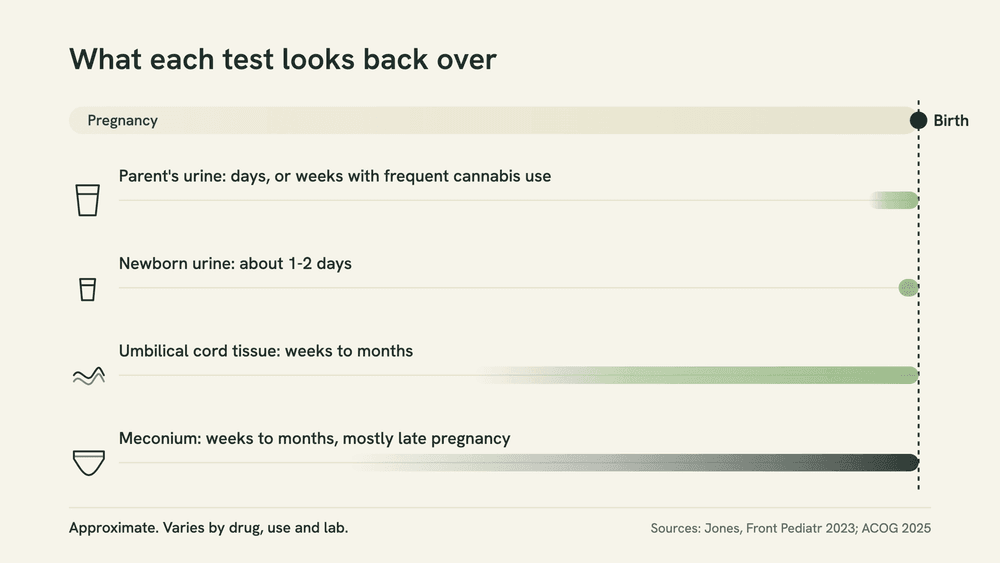
The table below covers four kinds of samples used for parents and newborns at delivery, and they do not measure the same thing. As a 2025 lab-medicine review puts it, "neonatal urine, meconium, and umbilical cord tissue look at different windows of development." The look-back periods below come from a 2023 review of newborn toxicology testing, whose author works for a commercial perinatal testing lab (a conflict of interest the paper discloses). It calls them "commonly accepted" approximations. They are not specific to cannabis, and they describe how each test works, not a precise clock. The same review notes that newborn testing is not standardized: each lab has its own panels and cutoffs. For how screening panels are built in general, see our guide to what a 10-panel drug test checks for.
| Specimen | Taken from | When it is available | Roughly what it reflects | Notes |
|---|---|---|---|---|
| Parent's urine | Birthing parent | At admission or delivery | Recent use: about 2-5 days for most drugs; for the cannabis marker, from days to weeks depending on how often a person uses | ACOG notes that clearance time in pregnancy has not been studied extensively |
| Newborn urine | Baby | After birth | About 1-2 days | Very dilute, so it can miss exposure; in a lab study, baby wash set off a false THC screen in urine |
| Meconium | Baby's first stools | Can take days to pass enough to test | Up to approximately 20 weeks, weighted heavily to the last weeks of pregnancy | Begins to form near mid-pregnancy; most forms late, which dilutes earlier exposure |
| Umbilical cord tissue | A segment of the cord | Immediately after birth | About 12 weeks; developed to mirror meconium | Agreed with meconium on cannabinoids 76% of the time in one hospital's paired samples |
Umbilical cord tissue vs meconium
Cord tissue's advantage is speed: it can be collected right after birth, while meconium may take days. The trade-off is sensitivity. When one hospital compared cord tissue and meconium from the same babies, the two agreed on cannabinoids 76% of the time, the lowest agreement of any drug class (barbiturates agreed 100%), and the author concluded that meconium is the more sensitive specimen. The two specimens also contain different forms of the cannabis marker. Labs do not look for THC itself. In a study of 627 mother-newborn pairs in Spain, the main compounds in meconium were THC-COOH (the inactive breakdown product most drug tests target) and 8,11-dihydroxy-THC, while cord tissue mainly held THC-COOH-glucuronide, a form the body produces to clear THC-COOH. In US lab data, THC-COOH is the most common finding of any kind: among more than 175,000 meconium samples that hospitals in 46 states sent to one national lab, it was the most frequently detected compound every year from 2015 to 2020, in 29.7% to 38.2% of samples. Those are samples hospitals chose to send for testing, not all births.
A screen is not a result: confirmation and false positives
Most drug testing runs in two steps. First comes a presumptive screen, usually an immunoassay, a fast test that uses antibodies to flag a drug class. Then comes a definitive test by mass spectrometry, which identifies the specific compound. The 2025 lab-medicine review calls that sequence "the traditional testing algorithm." ACOG's 2025 consensus says "all positive presumptive test results should be validated by definitive gas or liquid chromatography combined with mass spectrometry," and that a positive result "does not diagnose a substance use disorder nor detect the severity of use." Confirmation is not always automatic. In the Massachusetts network study, meconium positives were confirmed automatically, but urine positives were confirmed only on a clinician's request. That study then looked closely at the 614 pairs tested only because of cannabis use. Seven of them (1.1%) had false positive results for unexpected substances: amphetamines in three, and cocaine, methadone, opiates and fentanyl in one each. The study's false-positive count left THC results out, so it says nothing either way about THC screens. In the same 614 pairs, testing for other drugs turned up about as many false positives (7) as true unexpected positives (8), and only one test result changed the baby's clinical management.
For THC specifically, the documented false-positive route is a product, not a drug. In a 2012 lab study at the University of North Carolina, adding a common baby wash to drug-free urine produced a dose-dependent response on the THC immunoassay, and other baby soaps gave similar results. The authors urged confirmation before any intervention. The study used one testing platform, and products and assays may have changed since 2012, but it shows why a newborn urine screen alone is not a result. The perinatal-lab review makes the same point more firmly: results that are not produced with a documented chain of custody and automatic confirmation of presumptive positives "should not initiate negative action towards the mother and/or child." These are the situations where a screen can mislead:
- Product interference: in a 2012 lab study, common baby washes added to drug-free urine set off a THC immunoassay screen.
- Unconfirmed screens for other drugs: in one Massachusetts network, 7 of 614 pairs tested for cannabis use alone had false positives for drugs such as amphetamines and opiates. THC results were not part of that count.
- Urine positives confirmed only on request: in the same network, meconium was confirmed automatically but urine was not, so a urine screen could stand unconfirmed.
- Medicines you were prescribed or given during your stay: make sure your care team has the full list, so any result is read in context.
Who gets told: a notification is not an abuse finding
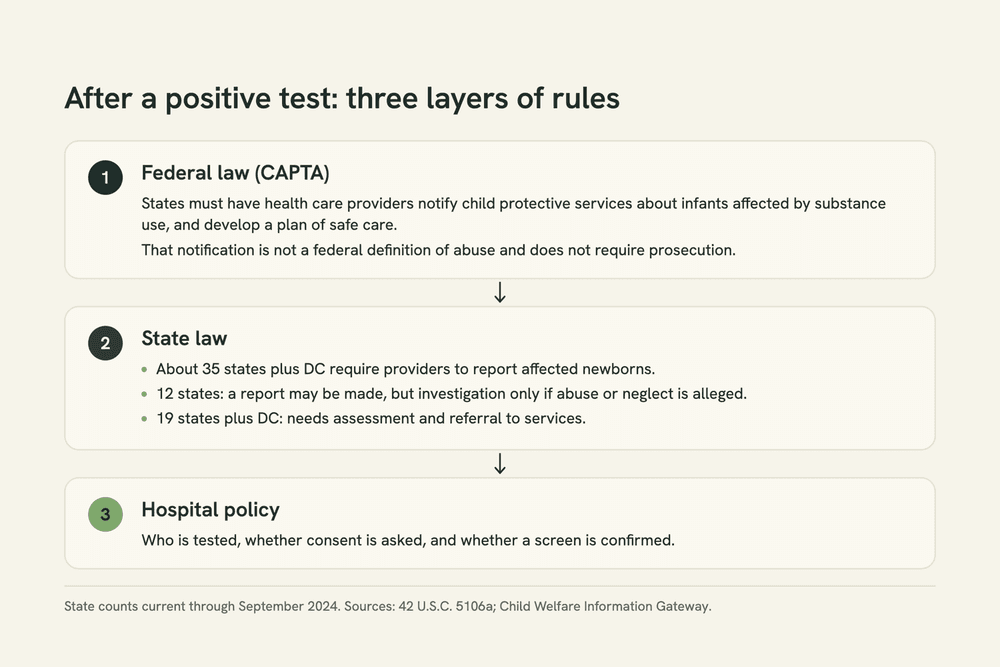
The federal piece is the Child Abuse Prevention and Treatment Act (CAPTA). As a condition of federal child-welfare grants, CAPTA requires each state's plan to include policies for infants born and identified as affected by substance use, including a requirement that health care providers notify the state's child protective services system, and the development of a plan of safe care for the infant. The statute itself limits what that notification means:
“... except that such notification shall not be construed to (I) establish a definition under Federal law of what constitutes child abuse or neglect; or (II) require prosecution for any illegal action.”
The ethics paper quoted above puts it plainly: although CAPTA requires pediatricians to notify child protective services of perinatal substance exposure, "this notification is not equivalent to a report of suspected child abuse or neglect." The federal law does not define what "affected by" substance use means. Each state decides that, and state laws differ a great deal. As of September 2024, the federal Child Welfare Information Gateway's compilation of state statutes counted roughly the following:
- About 35 states plus DC specifically require health care providers to report infants who show evidence at birth of being adversely affected by drug, alcohol or other controlled-substance exposure.
- In 9 states, a report is not required when the exposure came from a medication a physician prescribed to the mother.
- 27 states, 5 Tribes and DC include prenatal exposure to controlled substances in civil definitions of child abuse or neglect.
- In 12 states, a report may be made, but an investigation is conducted only if there is an allegation of abuse or neglect.
- 19 states plus DC require an assessment of needs and a referral to services.
Some states go further than the federal floor. The authors of the 2025 St. Louis study write that in Missouri, "any positive result for federally illegal or nonprescribed substances (including cannabis) during delivery must be reported" to child protective services. Their paper predates April 28, 2026, when a federal rule moved marijuana held under a state medical marijuana license to Schedule III, so if that applies to you, ask the hospital how it handles the reporting rule today. The study shows why the hospital's list of reasons to test mattered so much there: after the policy change, reports to child protective services fell from 368 (8.6% of deliveries) to 165 (3.8%). A notification starts a process, it does not decide the outcome. What child protective services and family courts do after a notification, including how a plan of safe care works, is covered in our guide to how marijuana use affects child custody.
What about CBD and hemp?
Standard newborn and parent drug tests look for THC's breakdown products, mainly THC-COOH, not for CBD. The problem is that a test cannot tell where THC came from. Many CBD products contain some THC, and labels are not always accurate, which our guide to whether CBD can make you fail a drug test explains in detail. The Spanish meconium study above did detect CBD and cannabinol (CBN) in meconium, but that was in babies of people who used cannabis, not a study of CBD products. The closest work we found is a 2026 study of meconium from 19 newborns in Florida, whose mothers answered a questionnaire on cannabis and CBD use; its abstract reports THC-COOH in babies of mothers who reported cannabis use and none in the comparison group, and it does not report results for CBD-only use. In a literature search on November 15, 2026, we found no study that measured how often a CBD product or hemp food leads to a positive newborn test, so there is no honest way to estimate the chance of one. Hemp seeds and hemp foods have their own section in our article on eating hemp seeds during pregnancy, including drug tests at delivery. Whether to use cannabis or CBD while pregnant or breastfeeding is a medical question, and our page on CBD in pregnancy and breastfeeding covers what the evidence shows and who to ask.
Questions to ask before you deliver
Hospital policies differ even within one state, and the best time to learn yours is at a prenatal visit or a hospital tour, not during labor. These are questions about information and rights. You can ask your obstetric clinician, the labor and delivery unit or the hospital's patient-advocate office:
- 1Is your drug-testing policy universal or risk-based? If risk-based, what is on the list of reasons to test, and is cannabis use alone one of them?
- 2Do you ask for consent before testing me, and separately before testing my baby? Is the consent written or verbal?
- 3Which specimen would you use for my baby: urine, meconium or umbilical cord tissue?
- 4Is a positive screen confirmed by mass spectrometry before anyone outside my care team is notified?
- 5Who sees the result, and will I be told if a notification or report is made to child protective services?
- 6In this state, what does a notification usually lead to: a plan of safe care, a needs assessment, a referral to services or an investigation?
- 7Can I see the written policy, and who is the patient advocate if I have concerns?
- 8Do you have the full list of medicines I take as prescribed, so any result can be read in context?

What the evidence does not tell you
This page summarizes guidance, statutes and studies. It cannot tell you what your hospital will do or how your state will respond, and it is not legal advice. Several limits are worth knowing. Most of the hospital studies come from one state or one hospital network, mostly Massachusetts, plus single sites in Iowa, Nebraska and Missouri; the national survey relied on hospitals that chose to answer and on self-reported practice. The specimen look-back periods are approximations from a review by an author who works for a perinatal lab, and they vary with the drug, the amount used and the lab's cutoffs. We found no current, verified count of how many states require hospitals to test, and the federal state-law counts above are frozen at September 2024. State laws change. We found no study that measured how often CBD products or hemp foods lead to a positive newborn test. And several of the guidance documents focus mainly on opioids, not cannabis.
If you have a question about your own situation, start with your obstetric clinician or your baby's pediatrician, who can explain the hospital's policy and what a result means medically. The hospital's patient-advocate office can help with consent and policy questions. For legal questions, especially after a notification, a local legal-aid office or a family-defense organization in your state can look at your actual facts, which no general guide can do.
Frequently asked questions
Not everyone, and not everywhere. Most US hospitals test some patients based on a risk checklist rather than testing every birth. A 2026 survey of 217 hospitals in 43 states found testing was predominantly risk-based, and at five Massachusetts hospitals 3.3% of deliveries were tested. Whether you would be tested depends on your hospital's policy and what is on its list of reasons, so ask for the policy before delivery.
ACOG's 2025 guidance says informed consent should be obtained before drug testing a pregnant person or their newborn, but guidance is not law. In a 2026 national survey, only 27.8% of hospitals said they get consent before newborn testing. The Supreme Court's 2001 Ferguson decision bars a state hospital from testing without consent to gather evidence for police, but it does not stop medical testing or a notification to child welfare. Ask your hospital what its consent policy is.
Meconium, a baby's first stool, starts to form around the middle of pregnancy, but most of it forms in the last weeks. A 2023 review describes its window as up to approximately 20 weeks, weighted heavily toward late pregnancy, because the late meconium dilutes what formed earlier. It is an approximation that varies by drug and lab, not a precise clock.
Labs look for THC's breakdown products rather than THC itself: mainly THC-COOH in meconium and THC-COOH-glucuronide in cord tissue. In lab data from one national lab, THC-COOH was the most common finding in meconium samples hospitals sent for testing. When one hospital tested both specimens from the same babies, cord and meconium agreed on cannabinoids 76% of the time, and meconium was the more sensitive specimen.
It depends on your state. Federal law (CAPTA) requires states to have providers notify child protective services about infants affected by substance use, but says that notification is not a federal definition of abuse and does not require prosecution. As of September 2024, about 35 states plus DC specifically required providers to report substance-affected newborns, and in 12 states an investigation happens only if there is an allegation of abuse or neglect. A 2025 St. Louis study described Missouri as requiring a report of any cannabis positive at delivery.
Yes. A screen is presumptive, and a 2012 lab study found that common baby washes could set off the THC screen used on newborn urine. In a Massachusetts network, 7 of the 614 pairs tested only because of cannabis use had false positives for other drugs, such as amphetamines and opiates. ACOG says presumptive positives should be confirmed by mass spectrometry, so it is reasonable to ask whether a result was confirmed.
Standard newborn drug tests look for THC metabolites, not CBD. But many CBD products contain some THC, and the test cannot tell whether THC came from cannabis or a CBD product. We found no study that has measured how often CBD or hemp food use leads to a positive newborn test, so there is no reliable estimate. Whether to use CBD while pregnant is a medical question for your clinician.
Where to go next. The hospital test at delivery is one of several drug tests that can carry legal weight; for how testing works when a judge or agency orders it, see our guide to court-ordered drug tests. For how federal and state rules treat CBD and hemp products more broadly, start with our hub on whether CBD is legal where you live.
Writing about hemp, wellness and the small rituals that keep us balanced.