Is Kanna Legal? Federal Law, FDA and Louisiana Explained
Kanna isn't on any federal drug schedule, but that's not the whole answer. Here's FDA's 2011 objection to the only kanna supplement filing it reviewed, the Louisiana statute that names its genus, the military rule, and what five small trials actually tested.
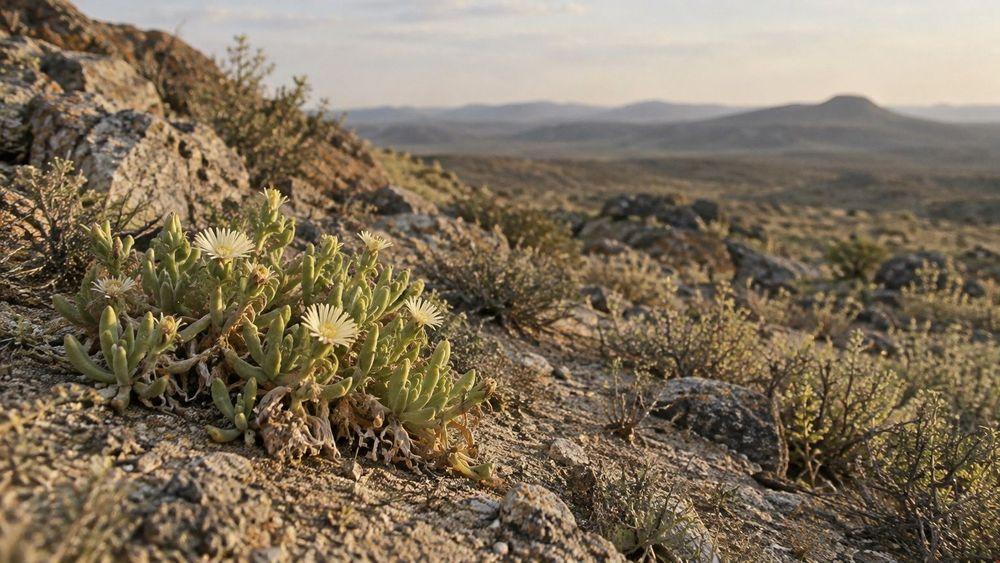
Is kanna legal? In the narrow sense federal drug law cares about, yes: as of November 2026, kanna, the South African succulent sold as Sceletium tortuosum, is not on any federal controlled-substance schedule. That is where the simple answer stops. Not scheduled is not the same as cleared by the FDA, and the only time FDA reviewed a kanna supplement ingredient, in 2011, it objected. Louisiana's 2005 plant law names the genus botanists now file kanna under. And service members can't use it to get high, even though it isn't on the Pentagon's prohibited-supplement list.
Most of what you'll find on this question is written by people who sell kanna, and it answers from their side of the counter. This page reads the law layer by layer, the way it actually reaches you, and for each layer names the record we read, the date we read it and what that record does not prove. Everything here is dated November 2026 and is general information, not legal advice. For the wider picture of how plant-derived products are regulated, our guide to whether CBD is legal covers hemp and marijuana law.
What kanna is, and why its name matters
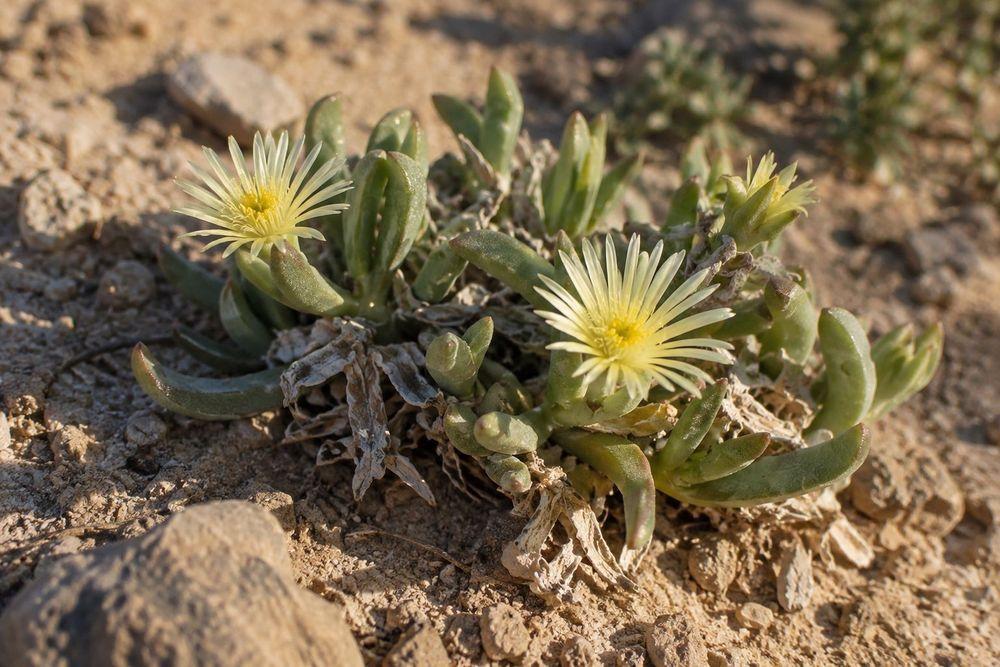
Kanna is a low, sprawling succulent native to South Africa, a member of the ice-plant family, Aizoaceae. The name kanna (also channa or kougoed) traditionally refers to the dried or fermented plant material rather than the living plant. San and Khoi peoples used it long before it reached a supplement shelf: a 2008 review in the Journal of Ethnopharmacology describes it being chewed "for the relief of thirst and hunger, to combat fatigue, as medicines, and for social and spiritual purposes." One of that review's two authors later directed medical affairs at the company that developed the leading commercial extract, which is worth knowing when you read the rest of the research.
The plant's best-studied compounds are alkaloids called mesembrine and mesembrenone. A 2017 review of the chemistry and pharmacology describes them as serotonin reuptake inhibitors in lab studies, and reports that mesembrenone also blocks an enzyme called PDE4. You'll also see the name Zembrin. It is a trademarked, standardized kanna extract, and it is the extract used in every placebo-controlled human trial we found.
The name is the part that matters for the law. Most labels and most of the research call the plant Sceletium tortuosum. Botanical databases now file it under a different genus: GBIF's taxonomic backbone lists Mesembryanthemum tortuosum L. as the accepted name and treats Sceletium tortuosum as a synonym. The "L." stands for Linnaeus, who first named the plant in Mesembryanthemum, and a 2026 critical review in Planta Medica uses the newer name in its title. That is a taxonomic opinion, not a court ruling, and both names are still in use. But it changes how one state's law reads, as you'll see in the Louisiana section.
Is kanna legal in the US? The answer by layer
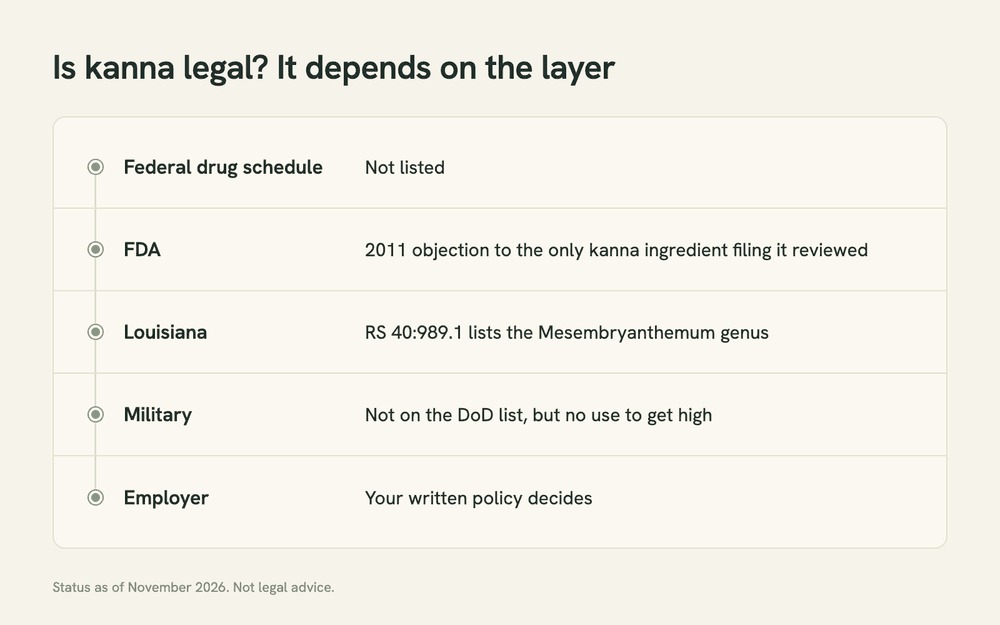
Whether kanna is "legal" depends on who is asking: the DEA, the FDA, your state, your commanding officer, your employer or a customs officer. Each has its own rulebook, and a yes from one says nothing about the others. Here is each layer as it stood in November 2026, with the record it rests on; the sections below explain each row.
| Layer | Status, November 2026 | Record we read |
|---|---|---|
| Federal drug law (DEA) | Not a controlled substance. Kanna, Sceletium and mesembrine appear on no federal schedule. | 21 CFR 1308 and our search of the federal code, November 2026 |
| FDA (supplements) | Not FDA-approved. FDA's only recorded review of a kanna supplement ingredient, in 2011, ended in an objection. We found no later review. | FDA's NDI filing list (updated July 2026); FDA letter of June 30, 2011 |
| Louisiana | Its 2005 hallucinogenic-plant law lists the Mesembryanthemum genus, where botanists now place kanna, so it very likely applies. Labeled dietary supplements have an exemption. No court ruling found. | La. R.S. 40:989.1(C)(2)(m), text read November 13, 2026 |
| Other states | Not surveyed. The sources we read point only to Louisiana, but that is not a 50-state check, so search your own state's code. | Our reading, November 2026 |
| Military | Not on the DoD prohibited-ingredient list, but using it to get high breaks service policy, according to OPSS. | OPSS kanna page, current as of December 15, 2025 |
| Workplace drug tests | Standard federal panels don't target mesembrine. Employers set their own policies. | HHS testing guidelines (90 FR 4662, 2025) |
| Air travel | TSA screens for security threats, not drugs. The law where you land still applies. | TSA screening guidance |
| Canada | Listed as an approved herbal ingredient for licensed natural health products. Says nothing on possession or import. | Health Canada NHPID record, modified March 1, 2019 |
Federal law: not scheduled, and what that doesn't mean
The federal controlled-substance schedules live in 21 CFR Part 1308. On November 13, 2026 we searched the full Code of Federal Regulations for kanna, Sceletium, Mesembryanthemum and mesembrine and found no section that contains any of them, in Title 21 or anywhere else. The Schedule I list at 21 CFR 1308.11 does not name them. We also found no proposal to schedule Sceletium or mesembrine in the Federal Register. That is a dated absence, not a federal statement that kanna is legal, but it is the honest basis for "not a controlled substance".
Most kanna is sold as a dietary supplement, which puts it under FDA's supplement rules, and those rules don't work the way many people assume. FDA's dietary supplement overview says supplement firms "are responsible for evaluating the safety and labeling of their products before marketing," and that FDA can act against an adulterated or misbranded product "after it reaches the market." Federal law puts the safety check on the seller. So "not a controlled substance" does not mean any of the following:
- That FDA approved it. FDA doesn't approve supplements, and its only recorded review of a kanna ingredient ended in an objection.
- That anyone checked what's in the package before it went on sale. That check is the seller's job.
- That it's legal in every state. Louisiana's plant law very likely reaches it.
- That you can use it in uniform for its effects. Service policies bar using any substance to get high.
- That it's been shown to be safe with your medicines. Its alkaloids act on serotonin in lab studies, and we found no human study of it alongside any medicine.
What FDA said about kanna in 2011
One more federal rule matters here. Under 21 U.S.C. 350b, a supplement ingredient that was not sold in the US before October 15, 1994 is a "new dietary ingredient". Unless it was already in the food supply in an unaltered form, the maker must send FDA its safety evidence at least 75 days before the product goes on sale. FDA keeps a public list of every new-dietary-ingredient filing. Its table, last updated in July 2026, runs to 1,460 entries. Exactly one is for kanna: NDI 705, a branded extract called Zembrin, filed by HGH Pharmaceuticals on April 20, 2011. The table logs FDA's response on July 1, 2011; the letter itself is dated June 30.
“FDA has concluded that it is likely that components of this plant can have significant effects on the CNS and the mechanisms through which these effects are mediated are not known.”
FDA's response letter, dated June 30, 2011, said the agency "has significant concerns about the evidence" the company relied on to conclude its product would reasonably be expected to be safe. In plain terms, FDA said the 90-day rat study wasn't dosed up to a maximum tolerated dose and showed dose-related blood changes in female rats, and that the human study lacked proper endpoints for effects on the nervous system and never tested a dose higher than the highest one on the proposed label. FDA concluded the product "may be adulterated" under federal food law, and noted that introducing an adulterated product into interstate commerce is prohibited. The filing's own proposed label is telling too. It said the product was not for pregnant or nursing women and told buyers to "Consult your physician if you are taking any prescription medication before taking this or any dietary supplement."
We found no later kanna filing in FDA's table and no later FDA letter in the federal docket system (searched November 13, 2026). Several human trials were published after 2011, and so was a 90-day rat toxicology study, co-authored by the extract's developer, that reported no treatment-related adverse effects at the doses tested. That is animal data, and we found no FDA statement responding to it. FDA handles CBD through a different path again, which our explainer on what the FDA says about CBD walks through; the comparison is about process, not about the two plants.
Louisiana: what the statute actually says
Louisiana is the state sellers mention, usually without a section number or a single word of the law. The statute is Louisiana Revised Statutes 40:989.1, the state's "hallucinogenic plants" law. It was enacted by Acts 2005, No. 159 and amended in 2015, 2018 and 2023, most recently by Acts 2023, No. 201. We read the text as posted by the Louisiana Legislature on November 13, 2026. It lists 40 plants, items (a) through (nn), from Brugmansia arborea to Amanita pantherina. Item (m) reads, in full:
“(m) Mesembryanthemum spp.”
"Spp." means every species in the genus. The words kanna and Sceletium appear nowhere in the statute, so whether it reaches kanna turns on botany: botanists now file kanna as Mesembryanthemum tortuosum, so the entry very likely reaches it. But the law never says "kanna", and we found no court ruling on the question: a CourtListener search for "Mesembryanthemum" on November 13, 2026 returned no published opinions from any court. The statute makes it a crime to make, distribute or possess "a material, compound, mixture, or preparation intended for human consumption which contains a hallucinogenic plant." The same law lists Salvia divinorum, which is why our guide to whether salvia is legal covers it too.
| Question | What RS 40:989.1 says |
|---|---|
| What does it list? | 40 hallucinogenic plants, items (a) to (nn). Item (m) is "Mesembryanthemum spp.", the whole genus. The words kanna and Sceletium do not appear. |
| What does it cover? | Material "intended for human consumption" that contains a listed plant. |
| Making or selling | Not less than 2 and not more than 10 years, plus a possible fine of up to $20,000. |
| Possession | Up to 5 years, plus a possible fine of up to $5,000. |
| Exemptions | Plants grown strictly for decoration; certain FDA-recognized over-the-counter homeopathic forms; products labeled as dietary supplements and made in compliance with three federal FD&C sections. |
| Court rulings | None found applying item (m) to kanna (CourtListener, November 13, 2026). |
| On the books since | 2005 (Act 159); most recently amended in 2023 (Act 201). |
The exemption no seller we read mentions is the dietary-supplement one. The law does not apply to "any dosage form which is labeled as a dietary supplement and is manufactured in compliance with" sections 402(g)(2), 415 and 761 of the federal Food, Drug, and Cosmetic Act, the provisions on supplement manufacturing practices, facility registration and serious adverse-event reporting. The exemption is written for dietary supplements. Whether a particular kanna capsule, gummy or powder fits it depends on its label and how it was made, and that is a question for a Louisiana attorney, not for us. Don't confuse this law with RS 40:989.2, Louisiana's 2010 "prohibited plant products" statute. That one lists 13 plants, including kratom and blue lotus, whose legal status we cover separately, and it does not name kanna, Sceletium or Mesembryanthemum.
Kanna in the military
For service members the answer has two parts. Operation Supplement Safety's kanna page, the Defense Department's supplement-safety resource, current as of December 15, 2025, gives its status as "NOT prohibited" and explains: "Kanna is not on the DoD Prohibited Dietary Supplement Ingredients List." The next sentences are the ones that matter: "However, Service-specific policies prohibit the use of any substance intended to 'get you high' or alter your state of mind. Service Members using kanna for these purposes would be in violation of Uniform Code of Military Justice (UCMJ) policy according to those specific policies." That is OPSS's summary; we did not read each service's own regulation.
The same page notes reports of kanna products adulterated with hordenine and ephedrine, "which are ingredients on the DoD Prohibited Dietary Supplement Ingredients List." So a kanna product can put a service member in trouble even when kanna itself is allowed. Not being on the list is not permission. The same mechanism, a DoD list and service rules layered on top of civilian law, is why hemp products are a problem in uniform, as our guide to using CBD in the military explains.
What the human research does and doesn't show
Sellers lean on research to market kanna, and FDA's 2011 letter turned on the quality of that research, so it's worth knowing exactly what exists. On November 13, 2026 we searched PubMed for placebo-controlled or randomized studies of kanna, Sceletium, mesembrine or Zembrin. After removing two name clashes and one rat study, five human trials remain: a three-month safety trial in 37 adults, a 16-person brain-imaging study, a three-week crossover study in 21 adults, two small lab-stress experiments in 20 volunteers and an eight-day trial in 60 young adults. All five tested the same trademarked extract, and all five enrolled healthy volunteers. This is context for the legal question, not a reason to take kanna.
| Study | Who and how long | What it measured | What it found | Tie to the extract's maker or distributor |
|---|---|---|---|---|
| Nell 2013 | 37 healthy adults, 3 months | Safety only; no efficacy measures | Well tolerated; no differences from placebo in vital signs, heart tracings (ECG) or blood tests | Yes: a co-author directed the developer's medical affairs |
| Terburg 2013 | 16 healthy adults, single dose | Brain-scan response of the amygdala to pictures of fearful faces | Smaller response under low-load conditions; anxiety as a condition was not tested | Yes: same developer co-author |
| Chiu 2014 | 21 healthy adults (average age 54.6), 3-week crossover | Scores on thinking tests | Better scores on two tests; 5 people dropped out | Yes: funded by the developer and the North American distributor |
| Reay 2020 | 20 healthy volunteers, two experiments, single dose | Reactions to a lab stress task | Experiment 1: no effect. Experiment 2: lower self-rated anxiety before the stress task began | Yes: an author described elsewhere as a past director at the distributor |
| Hoffman 2020 | 60 adults aged 20-35, 8 days | Reaction-task performance and mood | Better on a complex reaction task; no change in mood | None listed in the abstract |
Four of the five trials have an author or funder tied to the extract's developer or its North American distributor, as the papers themselves disclose. The positive findings are measurements in healthy people (a brain-scan marker, test scores, a reaction task), and the nulls sit right beside them: no effect in Reay's first experiment, no change in mood in Hoffman's trial. A 2021 review noted that kanna "has not yet been studied in a clinical population," and that is still true of every trial above. The 2026 Planta Medica review called the evidence mixed, pointing to "small sample sizes and studies conducted in clinically irrelevant populations," and called for larger trials. None of this shows kanna treats any condition, and none of it answers the question FDA raised in 2011 about effects on the nervous system.
Serotonin, medications and what's actually in the bag
The 2017 review describes kanna's main alkaloids as serotonin reuptake inhibitors in lab studies, the same target as SSRI antidepressants such as sertraline. A 2016 cell study suggests the picture is more complicated, with a high-mesembrine extract acting more as a releaser of these brain chemicals than as a pure reuptake blocker. Either way, this is lab pharmacology. We found no human study of kanna taken with an antidepressant, and our PubMed search on November 13, 2026 found no published human case of serotonin syndrome or poisoning linked to kanna. That is a gap in the record, not evidence of safety. The lab findings, FDA's 2011 sentence about the nervous system and the maker's own proposed label line about prescription medicines are three reasons to talk to a clinician before combining kanna with anything that acts on serotonin. For how prescribers think about mixing a common SSRI with a different plant, cannabis, see our guide to Zoloft and weed.
Talk to your prescriber or pharmacist before using kanna if any of these apply to you:
- You take an SSRI or SNRI antidepressant, or an MAOI.
- You take tramadol, a triptan for migraine, or another medicine that raises serotonin.
- You take any other prescription medicine for a mental health condition.
- You are pregnant or nursing. The extract maker's own proposed label said the product was not for you.
- You have a heart condition, given reports of stimulant adulterants in some kanna products.
- You're thinking of changing a prescribed medicine to make room for kanna. Don't change or stop it on your own; ask the prescriber first.
What's in the bag is a separate question from what kanna does. Federal law leaves the safety check to the seller, and a 2016 forensic analysis of commercial kanna products confirmed ephedrine, a stimulant that "has been banned in herbal products and supplements," in one sample. One sample from one paper is not a market rate, but it shows that a label doesn't tell you everything. A batch-specific certificate of analysis from an independent lab is the closest thing a buyer has to a check, and our guide to reading a certificate of analysis explains what one should show.
Drug tests and travel
Standard workplace drug panels don't look for kanna. Under the federal workplace drug-testing guidelines, the authorized urine panel targets specific drug classes, such as the THC metabolite, and nothing on it targets mesembrine. That doesn't make kanna invisible. A 2015 forensic study tracked mesembrine's breakdown products in urine with a targeted lab method; the work was done in rats and with human liver preparations, and the authors say monitoring use in people should be possible if the body handles it the same way. A product with an adulterant such as ephedrine is a separate risk again. Private employers set their own panels and policies, so read yours. Our explainer on the 10-panel drug test lists what standard panels do cover.
At the airport, TSA's screening guidance says its officers "do not search for illegal drugs," but refer any illegal substance they discover to a law enforcement officer. TSA has no item page for kanna. What matters is the law where you land: Louisiana's statute covers possession, not only sale, and service members carry their rules with them. Our guide to flying with cannabis explains how TSA screening works in practice. Abroad, rules differ. In Canada, Health Canada's natural health products ingredient database lists Sceletium tortuosum as an approved herbal name with a medicinal role, meaning it can be used in licensed natural health products. That record says nothing about possession or import. For any other country, check its rules before you travel.
How to check before you buy, carry or use it
Plant laws change, and kanna's two botanical names mean a quick search can miss the one law that applies. These steps matter more than any list a seller publishes.
- 1Search your state's code for all three names: kanna, Sceletium and Mesembryanthemum. A law can reach a plant through its genus without ever using its common name, as Louisiana's does.
- 2Search for the category terms states use for plant bans, such as "hallucinogenic plant" and "prohibited plant".
- 3Check city and county rules, which can be stricter than state law.
- 4If you serve in the military, read the OPSS kanna page and your service's own policy before using any product that contains it.
- 5If you're drug-tested at work, read your employer's written policy. It can bar substances that no law does.
- 6Read the label: is it sold as a dietary supplement, who made it, and is there a batch-specific certificate of analysis from an independent lab?
- 7Tell your prescriber or pharmacist, especially if you take a medicine that acts on serotonin.
- 8Write down the date you checked. A seller's claim that kanna is legal everywhere is marketing, not a legal opinion; if the stakes are real, ask a lawyer licensed in your state.
What we couldn't verify
- We did not survey all 50 state codes. Louisiana's RS 40:989.1 is the only statute we read that reaches kanna's genus.
- No court has applied Louisiana's Mesembryanthemum entry to kanna, so its reach rests on the statute's text plus current botany.
- We can't tell whether kanna was sold in the US before October 15, 1994, which decides whether a given product needed an FDA notification.
- We found no FDA statement on kanna after 2011. That is silence, not clearance.
- We found no human trial of kanna in people with a diagnosed condition, or alongside any medication.
- Laws and agency pages can change after November 2026. Check the date on anything you rely on.
Frequently asked questions
At the federal level it is not a controlled substance: as of November 2026, kanna, Sceletium and mesembrine appear on no federal drug schedule. That is not FDA approval, and FDA's only recorded review of a kanna supplement ingredient, in 2011, ended in an objection. Louisiana's hallucinogenic-plant law very likely reaches it, service members may not use it to get high, and employers can set their own rules. This is general information, not legal advice.
Not under federal law. We searched the federal code for kanna, Sceletium, Mesembryanthemum and mesembrine in November 2026 and found no schedule entry, and no scheduling proposal appears in the Federal Register. At the state level, Louisiana lists the Mesembryanthemum genus in its 2005 hallucinogenic-plant law, which very likely covers kanna.
The state's 2005 hallucinogenic-plant law very likely covers it. La. R.S. 40:989.1 lists "Mesembryanthemum spp." as item (m), and botanists now place kanna in that genus, but the statute never says "kanna" and we found no court ruling on it. The law covers material intended for human consumption; possession carries up to five years and a $5,000 fine. It exempts decorative growing and products labeled and made as federal dietary supplements. Whether a specific product qualifies is a question for a Louisiana attorney.
No. FDA does not approve dietary supplements before sale; sellers are responsible for safety and labeling. The one kanna ingredient FDA reviewed, the Zembrin extract in 2011, drew an objection: FDA said it had significant concerns about the safety evidence and that the plant likely has significant effects on the central nervous system through mechanisms that are not known. That letter is not a ban, and we found no later FDA review.
Kanna is not on the DoD Prohibited Dietary Supplement Ingredients List. But according to Operation Supplement Safety, service-specific policies prohibit using any substance to get high or alter your state of mind, and using kanna that way would violate UCMJ policy. OPSS also notes reports of kanna products adulterated with ingredients that are on the prohibited list.
Standard federal workplace panels don't test for mesembrine, kanna's main alkaloid. A targeted lab method can detect its breakdown products in urine (shown in rats), and a product adulterated with something like ephedrine carries its own risk. Employers set their own panels and policies, so check yours.
Ask your prescriber first. In lab studies, kanna's main alkaloids block serotonin reuptake, the same target as SSRI antidepressants. We found no human study of the combination and no published human case of serotonin syndrome linked to kanna, which is a gap, not proof of safety. The extract maker's own proposed label told anyone on prescription medicine to consult a physician first. Don't change or stop a prescribed medicine on your own.
No. Kanna is a South African succulent (Sceletium tortuosum, now often listed as Mesembryanthemum tortuosum). Kava is Piper methysticum, a different plant in the pepper family. The names sound alike, but the plants, compounds and rules are separate.
Kanna is one more plant that can be unscheduled at one layer and restricted at another. For the same layered reading applied to hemp and marijuana, start with our federal and state guide to CBD law. For how a plant compound moves toward the federal schedules, see our report on the DEA's proposed 7-OH threshold.
Writing about hemp, wellness and the small rituals that keep us balanced.