Court-Ordered Drug Tests: Probation, Pretrial and Family Court Rules, and Where CBD Fits
On federal probation or supervised release, the law requires a test within 15 days and at least two more, and refusing testing or more than three positives in a year triggers mandatory revocation unless a treatment exception applies. Here is where CBD fits.
A court-ordered drug test is not one thing. Federal probation, federal supervised release, federal pretrial release, state probation and parole, drug courts and family courts each run testing under their own rules, and what a positive result can trigger depends on which of them ordered yours.
The short answer: federal probation and supervised release run on a short statute. You get one drug test within 15 days of release and at least two more, and refusing testing or testing positive more than three times in one year requires the court to revoke, after it has considered whether treatment is the better answer. Other courts set their own rules. State-legal cannabis has not been a defense under federal supervision, and a CBD product with trace THC can produce a positive that the test cannot tell apart from cannabis.
Which court ordered it? Five regimes, five rulebooks
Before you can know what a positive means, you need to know who ordered the test. The same urine cup can sit inside very different legal machinery: a federal statute with fixed revocation triggers, a release order written before trial, a state probation agreement, a drug court's participant contract, or a custody judge's order. Workplace testing is a separate world again, with its own rules, which we cover in what happens at work after a failed drug test.
| Forum | Who runs the test | Governing source | Typical specimens | What a positive can trigger |
|---|---|---|---|---|
| Federal probation | U.S. Probation Office | 18 U.S.C. 3563 and 3565, plus your written judgment | Urine; sweat patch | Changed conditions or revocation. Revocation is mandatory for refusing testing or more than 3 positives in 1 year, after the judge considers treatment |
| Federal supervised release (after prison) | U.S. Probation Office | 18 U.S.C. 3583(d) and (g), plus your written judgment | Urine; sweat patch | Same triggers as probation; mandatory revocation means a term of imprisonment |
| Federal pretrial release | Pretrial Services | 18 U.S.C. 3142(c) and your release order (form AO 199B) | Urine, sweat patch, breath | A report to the judge and the prosecutor. The judge can modify your conditions or, under 18 U.S.C. 3148, revoke release and order detention |
| State probation and parole | State or county probation, or the parole agency | State law and your order; varies by state | Usually urine | Varies. Example: Minnesota bars sanctioning state parolees solely for a positive tied to its medical cannabis registry |
| Drug or treatment court | The court team and treatment provider | Local program rules; federally funded courts must test (34 U.S.C. 10611) | Urine by default; sweat, oral fluid or hair in some cases | Graduated sanctions, which can include jail, more frequent testing or termination from the program |
| Family court | The custody judge, often through a private lab | State family law | Varies; often urine or hair | Weighed in custody and visitation decisions |
Federal probation and supervised release: the statute, step by step
If a federal judge sentenced you to probation, or you are on supervised release after a federal prison term, drug testing is written into the law itself. The federal probation statute, 18 U.S.C. 3563(a)(5), makes it a mandatory condition that you "refrain from any unlawful use of a controlled substance and submit to one drug test within 15 days of release on probation and at least 2 periodic drug tests thereafter (as determined by the court)." The supervised release statute, 18 U.S.C. 3583, carries the same condition in subsection (d) for people leaving prison.
Two details change how this plays out. First, "at least 2" is a floor, not a schedule. The federal courts' guide to substance use testing in practice says that "under Judicial Conference policy, the frequency of testing should continuously be adjusted based on the identified risks of the individual being tested." The statute sets no weekly number. Second, the condition is not automatic for everyone: the same subsection lets the judge ease or suspend it when the presentence report or other reliable information "indicates a low risk of future substance abuse." Federal judgment forms carry a checkbox for this, so look at whether yours is ticked.
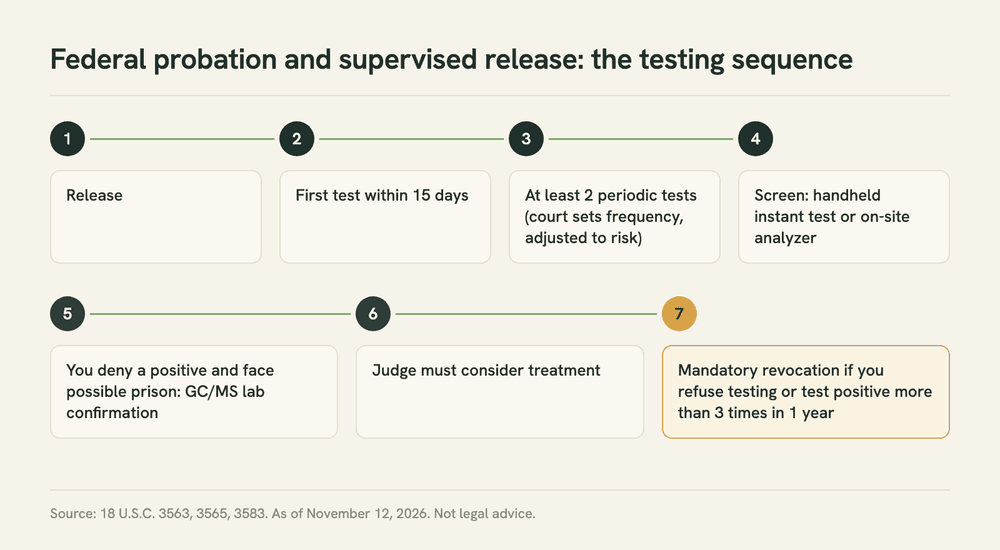
Testing is not always free. The U.S. Courts overview of supervision conditions says defendants "should be required to pay for these services to the degree that they are able," so you can be ordered to contribute to the cost, scaled to what you can pay. Here is the whole federal sequence in order.
- 1Release: the clock starts on the day you are released on probation or supervised release.
- 2First test within 15 days, required by statute unless the judge suspended the condition because you are low risk.
- 3At least 2 periodic tests after that. The court sets the real frequency, and your officer adjusts it to your assessed risk.
- 4Screening: federal officers screen first, with a handheld instant test device or an on-site analyzer.
- 5Confirmation: if you deny a positive and could go to prison over it, the sample goes to a lab for GC/MS confirmation. On probation, you may be held while that happens.
- 6Treatment consideration: before acting on failed tests, the judge must consider whether treatment warrants an exception.
- 7Mandatory revocation: refusing testing, or testing positive more than 3 times in 1 year, requires revocation and prison time unless that exception applies.
“(3) refuses to comply with drug testing imposed as a condition of supervised release; or (4) as a part of drug testing, tests positive for illegal controlled substances more than 3 times over the course of 1 year; the court shall revoke the term of supervised release and require the defendant to serve a term of imprisonment ...”
Probation has its own mirror image. 18 U.S.C. 3565(b) uses the same two drug-testing triggers, and when either is met "the court shall revoke the sentence of probation and resentence the defendant ... to a sentence that includes a term of imprisonment." Both sections also make possession of a controlled substance and firearm violations mandatory triggers, which are outside the scope of this article. Notice the exact wording: the count is positives "more than 3 times over the course of 1 year," which the U.S. Sentencing Commission's 2026 primer on supervised release, a staff explainer rather than binding law, restates as "four or more positive drug tests over the course of one year." Fewer positives do not make revocation mandatory, but each one can still be treated as a violation. For any probation violation, section 3565(a) lets the court "continue him on probation, with or without extending the term or modifying or enlarging the conditions," or revoke, and the same primer notes that on supervised release the court may modify the conditions or revoke and impose prison time.
The safety valve sits in the testing sections themselves. When a defendant fails a drug test, the court "shall consider whether the availability of appropriate substance abuse treatment programs, or an individual's current or past participation in such programs, warrants an exception" from the mandatory revocation rule. The verb matters: the judge must consider treatment, not grant it. The Sentencing Commission primer notes that the exception "is not expressly provided if a court finds that a defendant possessed illegal drugs."
If you think a positive is wrong: the confirmation right
Federal law gives you a way to challenge a screen, but it is narrower than "any time you disagree." Under section 3563(e), and the matching language in 3583(d), a drug test result is "subject to confirmation only if the results are positive, the defendant is subject to possible imprisonment for such failure, and either the defendant denies the accuracy of such test or there is some other reason to question the results of the test." The confirmation itself must be "a urine drug test confirmed using gas chromatography/mass spectrometry techniques or such test as the Director of the Administrative Office ... may determine to be of equivalent accuracy."
In practice: if you deny a positive and you could go to jail over it, you can insist on a lab confirmation. The U.S. Courts explainer on how testing and treatment work describes the routine: "If a result is positive and contested by the person under supervision, the sample must be submitted to the national drug testing laboratory for GC/MS confirmation." One more line in the probation statute is worth knowing before it surprises you: "A defendant who tests positive may be detained pending verification of a positive drug test result."
Federal pretrial release: what a judge can order before trial
Before trial, you have not been convicted, and the rules reflect that. The Bail Reform Act, 18 U.S.C. 3142(c), tells the judge to choose the least restrictive conditions that will reasonably assure you appear and keep the community safe. One listed option is that you "refrain from excessive use of alcohol, or any use of a narcotic drug or other controlled substance ... without a prescription by a licensed medical practitioner." The statute has no stand-alone testing clause. The testing language lives on the court's release form, AO 199B, where the judge ticks it case by case.
“Submit to testing for a prohibited substance, if required by the pretrial services office or supervising officer. Testing may be used with random frequency and may include urine testing, wearing a sweat patch, submitting to a breathalyzer, and/or any other form of prohibited substance screening or testing.”
The federal courts' reference guide lists situations in which a court may impose these restrictions, including when you are charged with an alcohol- or drug-related offense, you have a history of such charges, you test positive for illegal drugs, or you have a history of substance abuse. A positive test does not trigger an automatic penalty the way 3583(g) does after sentencing. Instead, Pretrial Services must, under 18 U.S.C. 3154, "inform the court and the United States attorney of all apparent violations of pretrial release conditions" and recommend changes to those conditions where appropriate. What happens next is the judge's call: under 18 U.S.C. 3148, a person who violates a release condition "is subject to a revocation of release, an order of detention, and a prosecution for contempt of court."
State probation, parole and drug courts: what varies, and where your rules live
If your case is in state court, a state or county agency runs your probation or parole, and the rules vary by state, by court and sometimes by judge. No single article can give you your state's rule. What you can do is find the documents that actually bind you:
- Your written judgment or sentencing order, including any special conditions sheet.
- The probation or parole agreement you signed at intake.
- A drug court participant contract or handbook, if you are in a treatment court.
- Any written instructions from your officer about how and when you will be tested.
- Your state's statute on medical cannabis, which may or may not say anything about people under supervision.
Some states have written protections. Minnesota is a clear example: under Minn. Stat. 342.57, subdivision 8 (checked November 12, 2026), the commissioner of corrections may not revoke "parole, supervised release, or conditional release or otherwise sanction an individual solely" for participating in the state's medical cannabis registry or "for a positive drug test for cannabis components or metabolites." Read the scope carefully: it covers release from state corrections, not court probation and not federal supervision. More broadly, the national treatment-court standards note that "appellate courts in some jurisdictions have held that the use of cannabis products in a manner authorized by state statute cannot be prohibited even among probationers or court-involved individuals."
Drug courts (also called treatment courts) pair treatment with close, frequent monitoring. Federal money comes with a testing string: under 34 U.S.C. 10611, a drug court qualifies for a federal grant "only if" it has "mandatory periodic testing" and imposes graduated sanctions "whenever a participant fails a drug test." The listed sanctions include incarceration, termination from the program and increased drug screening. The detailed practice comes from the All Rise Adult Treatment Court Best Practice Standards (January 2026), the national standards body for these courts. These are recommended standards, not law, but many programs build their rules on them.
The same standards recommend that urine collection be observed, and that a result be confirmed by GC/MS or LC/MS/MS if a participant denies use. On medical marijuana they say: "In jurisdictions that have legalized marijuana for medical purposes, staff adhere to the provisions of the medical marijuana statute and case law interpreting those provisions." Your local program may test more or less often than these recommendations. Its written rules are what count.
Family court is its own world
Custody judges can order drug tests under state family law, often through a private lab. There is no revocation statute here; a result is one piece of evidence about a child's best interests. What a positive does and does not prove in that setting, and how judges tend to weigh cannabis use, is covered in our guide to marijuana and child custody. The rest of this article focuses on criminal courts.
What kind of drug test does probation use?
Urine is the workhorse. The national treatment-court standards say drug courts use it "in most cases," and the U.S. Courts overview puts it plainly: "The most reliable method of drug testing is urinalysis. Random testing may be implemented by the probation officer during unannounced visits to the home." It also describes the sweat patch as "a means of continuous detection" that is "less intrusive." The federal courts' administrative office has approved the sweat patch as a confirmation method of equivalent accuracy under 3563(e): "Sweat patch testing has met this approval."
| Specimen | Where courts use it | What it shows |
|---|---|---|
| Urine | The most common specimen in drug courts and probation programs; the federal default | Drug metabolites. Screened first, confirmed by GC/MS if contested in federal cases |
| Sweat patch | Federal supervision and pretrial; some drug courts | Continuous detection while the patch is worn |
| Oral fluid | Some drug courts, mainly when recent use is suspected | Recent use; the standards call it a short detection window |
| Breath | Federal pretrial and supervision; alcohol conditions | Alcohol only |
| Hair | Some drug courts, for case-specific reasons; family courts (see our custody guide) | A longer window than urine, per HHS, with contamination concerns |
| Blood | Not listed in the federal guidance or treatment-court standards we reviewed | Not covered by those sources; see our blood guide |
Each specimen has its own guide on this site. The urine screen and confirmation cutoffs are in our explainer on what a 10-panel drug test screens for. How a patch collects drug over days, and why courts like it, is covered in the sweat patch drug test guide. For saliva, see how a mouth swab test works, and for blood, how long THC stays detectable in blood.
Hair deserves a caution. Courts can order it, but federal workplace rules have not adopted it: HHS proposed hair testing guidelines in 2020 and had not finalized them as of November 2026. And a 2015 forensic study in Scientific Reports found that cannabinoids can reach the hair of people who do not use cannabis, through transfer from others. If a hair result is the only evidence against you, that limitation is worth raising with your lawyer.
Is state-legal marijuana a defense?
Under federal supervision, the appeals courts that have ruled on it said no, for both medical and adult use, but the medical ruling came before 2026. The clearest medical case is United States v. Schostag (8th Cir. 2018). A man on supervised release told his officer that his physician had prescribed vaporized oil containing THC for chronic pain under Minnesota law, and he tested positive in May 2017. The district court did not find him in violation; it added a condition expressly banning medical marijuana. The appeals court affirmed, holding that "courts cannot amend conditions to contradict federal law" and that "the district court had no discretion to allow Schostag to use medical marijuana while on supervised release." One important limit: Schostag was decided while all marijuana was Schedule I, and the court reasoned from that status, which partly changed in April 2026 (more below).
Adult-use legalization has not worked as a defense either. In United States v. Francis (2d Cir. Aug. 8, 2023), the Second Circuit affirmed a supervised-release revocation that rested in part on marijuana possession in New York, holding that the possession was a federal crime and noting that "although New York and many other states have legalized adult use of marijuana, possession of the drug continues to be a federal crime." The possession happened in January 2021, about two months before New York's repeal took effect, and the court did not decide whether the repeal reaches back. Adult-use marijuana stayed in Schedule I under the April 2026 order, so that order does not touch the premise of this reasoning. A third case, United States v. Doolin (8th Cir. 2024), shows an Iowa medical card did not stop a revocation, though that case turned on sharing and smoking, which Iowa's own law forbids.
Then there is the April 2026 order. The DEA's Schedule III order (91 FR 22714), effective April 28, 2026, moved marijuana "subject to a state medical marijuana license" to Schedule III, and states that marijuana outside an FDA-approved product or a state medical license "remains a schedule I controlled substance." The order never mentions probation, supervised release, parole or drug testing. As of November 12, 2026, we found no court that has decided whether it changes what counts as "unlawful use" for someone under federal supervision. The litigation and the order itself are covered in our explainer on the medical marijuana Schedule III ruling.
Where CBD fits
A court drug test does not test your product. It tests your body for THC's metabolite. As a 2007 review of human cannabinoid pharmacokinetics by a National Institute on Drug Abuse scientist put it, "A positive urine test for cannabinoids indicates only that drug exposure has occurred. The result does not provide information on the route of administration, the amount of drug exposure, when drug exposure occurred, or the degree of impairment." So a positive from a CBD product looks the same on paper as a positive from smoking cannabis.
Full-spectrum hemp products are legally allowed up to 0.3% THC by dry weight. That is not zero, and the difference between full-spectrum, broad-spectrum and isolate is explained in our CBD spectrum guide. A label that says "THC-free" is a claim, not a guarantee, and no product can guarantee a drug-test outcome. We walk through the controlled study on CBD and urine tests on our CBD drug test page, and the clearance timeline in how long CBD stays in your system. The national treatment-court standards describe the court's side of this problem directly:
“The ability to differentiate between a positive urine cannabinoid drug test resulting from cannabis use versus the use of CBD is extremely problematic. Treatment courts can resolve this dilemma by prohibiting the use of CBD by participants where such a policy is legally permissible.”
Federal judges are doing the same thing. A federal judgment in Case 1:24-cr-00328 (N.D.N.Y.), filed August 17, 2026, includes this special condition: "You must not possess, use, or sell marijuana or any marijuana derivative (including any product containing cannabidiol (CBD) or THC) in any form (including but not limited to edibles) or for any purpose (including medical purposes)." The same wording appears in other 2026 judgments from that court, signed by several judges. Not every court writes it this way, and this is one district's practice, not a national rule. But your court can, and if your conditions say it, CBD is a violation whether or not you ever test positive.
Refusals, missed tests, dilute samples and shy bladder
Refusal is the trigger people underestimate. Under 3583(g) and 3565(b), refusing "to comply with drug testing" requires revocation on the same footing as repeated positives. The statutes do not define what counts as a refusal, so no one can promise you that a missed or incomplete test will not be treated as one. In the Doolin case above, for example, the revocation petition cited both "ongoing marijuana use and his failure to comply with substance-abuse testing." Here is how the edge cases are handled where rules exist:
- Missed or late tests: the All Rise model participant contract warns you may receive a sanction if you are late or fail to report.
- Not enough urine: the same model contract calls failing to provide a sample, or not providing enough, a violation of program rules.
- Dilution: the standards say all urine samples are analyzed for creatinine to detect possible tampering by dilution, and a diluted sample can be sanctioned.
- Tampering: federal sample conditions and form AO 199B both forbid obstructing or tampering with testing.
- Secondhand smoke: the All Rise commentary says a claim that a positive came from passive inhalation should not be credited.
If you have a medical reason you struggle to give a sample on demand, read our explainer on what happens with a shy bladder at a drug test, then tell your officer in advance. What a lab means by a dilute result is explained in negative-dilute drug test results, and the science on passive exposure is in can you fail a drug test from secondhand smoke. The practical rule: if you are going to miss a testing window, call your officer before it closes, not after, and keep proof of any emergency.
After a positive: your checklist
- 1Get the exact wording of your conditions: the special conditions sheet of your judgment, your release order, or your drug court contract.
- 2If you believe the result is wrong, say so right away and ask for lab confirmation. In drug courts, you can ask for the original sample to be retested.
- 3Call your lawyer right away. Federal standard conditions require you to answer your officer's questions truthfully, so ask your lawyer how to handle that conversation.
- 4Give your officer a written list of every prescription and any hemp or CBD product you used.
- 5Keep receipts, packaging and the batch certificate of analysis for anything you took.
- 6Ask your lawyer whether the treatment exception applies, and whether a treatment program is available to you.
- 7Show up to every hearing and every scheduled test while the question is open.
What we could not confirm
Some of the rules that shape federal testing sit in internal judiciary policy that is not published, so we do not describe it here. State probation rules vary too much to summarize, and we verified only one state statute for this article. The effect of the April 2026 Schedule III order on people under supervision has not been decided by any court we could find as of November 12, 2026. And the All Rise figures are recommendations, not requirements: your local drug court may differ. If any of these gaps matter to your case, they are questions for your lawyer, not for a search engine.
Court-ordered drug test FAQ
Under federal supervision, appeals courts have said no: Francis (2d Cir. 2023) for adult use and Schostag (8th Cir. 2018) for medical use, decided while all marijuana was Schedule I. The April 2026 Schedule III order left adult-use marijuana in Schedule I and does not mention supervision, so its effect on medical use under supervision is an open question as of November 12, 2026. On state probation it depends on your state's law and your written order. Minnesota, for example, bars sanctioning state parolees solely for a medical registry positive. Read your conditions and ask your officer in writing. This is general information, not legal advice.
Only if your conditions allow it, and some say no in plain words. Some 2026 federal judgments from the Northern District of New York ban any product containing cannabidiol, for any purpose. Even where CBD is not banned, a product with trace THC can cause a positive that the test cannot tell apart from cannabis use. Ask your officer first, in writing, and keep the answer.
For federal probation and supervised release, the statute requires one test within 15 days of release and at least 2 more after that, with the court setting the frequency and adjusting it to risk. A judge can suspend the condition for someone assessed as low risk. State programs set their own schedules.
Federally, the officer reports it and the court can change your conditions or revoke. Refusing testing, or testing positive more than 3 times in 1 year, requires revocation and prison time, after the judge considers whether treatment warrants an exception. In drug court, failed tests bring graduated sanctions that can include jail or termination from the program. In family court, the result is weighed in custody decisions.
Say so immediately and tell your lawyer. Federal law gives a confirmation right when you deny a positive and face possible imprisonment: the urine is confirmed by GC/MS or an approved equivalent. Drug court standards also let you ask for the original sample to be retested. On federal probation you can be held while the result is verified.
Treat it as if it could. Federal law makes refusing testing a mandatory revocation ground but does not define refusal. The national model drug court contract allows sanctions for late or missed tests and for insufficient samples. Call your officer before you miss a window, not after, and keep proof of any emergency.
Yes. Custody judges can order testing under state family law, often through a private lab. What a result does and does not prove in a custody case is a separate question, covered in our guide to marijuana and child custody.
If you are trying to understand where hemp products stand legally beyond the courtroom, start with our hub on whether CBD is legal. If your question is about how a specific product type shows up on a test, our guide to CBD and drug tests walks through the evidence.
Writing about hemp, wellness and the small rituals that keep us balanced.