Are THC Drinks Legal? Two Dates in 2026 Decide the Answer
The sentence most pages still print, federally legal under the 2018 Farm Bill at under 0.3 percent by dry weight, is accurate through November 11, 2026. Two laws set two different dates, Congress changed the unit to milligrams per container, and a second statute never moved.
Ask whether THC drinks are legal in the United States and you get two different answers with a date between them. The sentence most pages are still printing, that hemp-derived THC beverages are federally legal under the 2018 Farm Bill as long as they stay under 0.3 percent delta-9 THC by dry weight, is accurate through November 11, 2026. After that, two separate laws replace the definition it rests on, on two different dates, under two different public law numbers. And a third thing, a federal statute neither of those dates touches, has been sitting underneath the whole category the entire time.
This page is about legal status, not about what is in the can. The drink in question is the formulated kind: a beverage with a cannabinoid added on purpose, sold in a cooler rather than at a dispensary. Everything below is dated to our own reading of the primary records on September 11, 2026, and every legal sentence carries the document it came from.
How to read every legal sentence on this page
Three rules, so you can audit us. Every legal sentence here carries its date and the primary document it came from, and where the document is online you can click it. Anything that is pending, proposed or unpublished is labeled with that word and with the date we checked it, which throughout this article is September 11, 2026. And nothing here is legal advice: this is a status explainer about federal texts, and the rule that actually decides your purchase is the one written by the state you are standing in.
The answer page one is printing, and its expiry date
Start with the rule everyone quotes, because it is real and it is still in force. Section 297A of the Agricultural Marketing Act of 1946, codified at 7 U.S.C. 1639o, defines hemp as Cannabis sativa L. and its parts and derivatives "with a delta-9 tetrahydrocannabinol concentration of not more than 0.3 percent on a dry weight basis". Read what that sentence is measuring. It names one molecule, delta-9 THC, and one unit, a percentage of dry weight, and it describes a plant and the things made from it. It was written to be run on a crop.
That definition has an expiry date, and the expiry date is printed inside a different statute. Public Law 119-37, the FY2026 Agriculture appropriations act enacted on November 12, 2025, carries a section 781 in division B that opens "Effective 365 days after the enactment of this Act, Section 297A of the Agricultural Marketing Act of 1946 (7 U.S.C. 1639o) is amended". Three hundred and sixty-five days after November 12, 2025 is November 12, 2026. The replacement definition measures "a total tetrahydrocannabinols concentration (including tetrahydrocannabinolic acid) of not more than 0.3 percent on a dry weight basis", which is a different test on a different set of molecules. The mechanics of that rewrite belong to our walk-through of what the 2026 rewrite actually changes; this page states it once and moves to the part that sorts drinks.
So how is page one still printing the old sentence? We read the ten results for this question on September 11, 2026. Seven of them could be string-counted; two blocked automated reading and one renders its body in JavaScript. Every string count below is scoped to those seven. The first line, which is about who publishes these pages rather than what is inside them, covers all ten.
- Six of the ten results sell THC drinks. The remaining four are an encyclopedia stub, a drug-testing vendor, an affiliate round-up and one news organization.
- Three of the seven readable pages lead with the 2018 Farm Bill and never print the date November 12, 2026. One prints "2018 Farm Bill" thirteen times.
- Two of the seven carry the November date and one carries both dates. None of the seven names Public Law 119-103, the law that actually set December 11.
- None of the seven mentions the Food, Drug, and Cosmetic Act. The strongest of them never prints the three letters FDA anywhere in its body.
- The only journalism on the page was published November 28, 2025, which is nine months before the law that moved the date was signed.
Two dates, and the clause that separates them
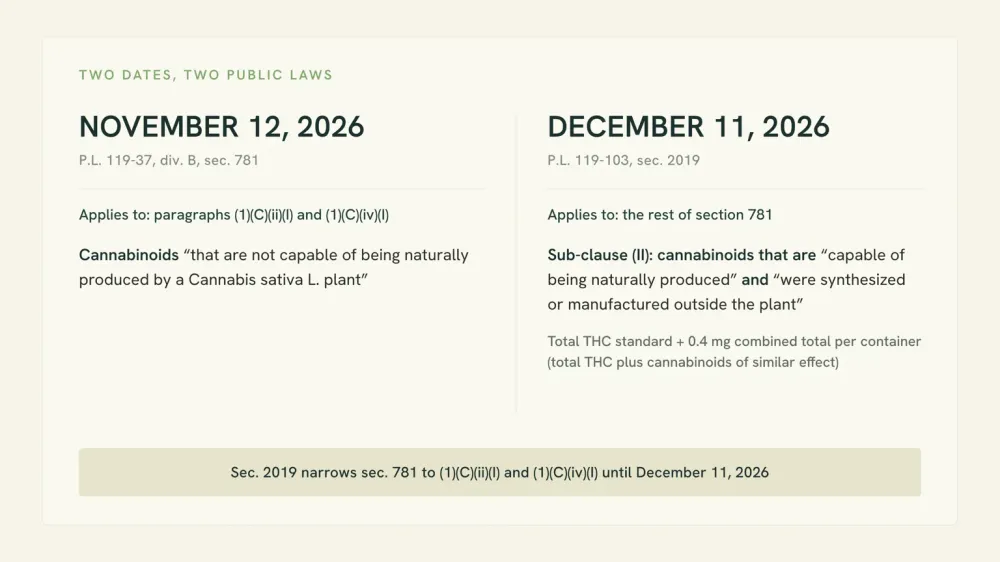
On September 2, 2026 the President signed Public Law 119-103, the Continuing Appropriations and Extensions Act, 2027, which began life as H.R. 6500. The House agreed to the Senate amendments 370 to 48 on September 1, recorded as Roll no. 286, and the bill became Public Law No: 119-103 the following day. Under the heading SEC. 2019. SECTION 781 EXTENSION, the enrolled text carries one operative sentence:
“Until December 11, 2026, the amendments made by section 781 of division B of Public Law 119-37 (7 U.S.C. 1639o note) shall only apply with respect to products described in paragraphs (1)(C)(ii)(I) and (1)(C)(iv)(I) of section 297A of the Agricultural Marketing Act of 1946 (7 U.S.C. 1639o) (as amended by such section 781).”
That sentence is the whole calendar. It does not delay section 781; it narrows it, to two paragraphs named by number, and lets the rest arrive when the narrowing runs out. The roll calls, the full section and the calendar around it are worked through in the newsroom item on the September 2 signing. Here is what it leaves for each date.
| Date | Which law puts it there | What the statute says applies on that date | The clause, in the statute's words | What this date does not reach |
|---|---|---|---|---|
| November 12, 2026 | P.L. 119-37, division B, section 781, enacted November 12, 2025, effective 365 days after enactment | Only products described in paragraphs (1)(C)(ii)(I) and (1)(C)(iv)(I), the two paragraphs Section 2019 names by number | Cannabinoids "that are not capable of being naturally produced by a Cannabis sativa L. plant" | Every other amendment made by section 781, which is held back until December 11 |
| December 11, 2026 | P.L. 119-103, Section 2019, enacted September 2, 2026, which narrows section 781 only "Until December 11, 2026" | The rest of section 781's amendments once that narrowing expires, including the total tetrahydrocannabinols standard and the 0.4 milligrams combined total per container figure for finished products | Sub-clause (II): cannabinoids that are "capable of being naturally produced" and that "were synthesized or manufactured outside the plant" | Does not supply the four lists section 781(3) required FDA to publish, still unpublished when we checked on September 11, 2026 |
Now look at the two sub-clauses side by side, because this is where most coverage goes wrong. Paragraphs (1)(C)(ii)(I) and (1)(C)(iv)(I), the two Section 2019 names, both describe cannabinoids "that are not capable of being naturally produced" by the plant. The next sub-clause along in each list, (II), describes something different: cannabinoids that are "capable of being naturally produced" and that "were synthesized or manufactured outside the plant". Section 2019 does not name (II). So "converted in a lab" and "the plant cannot make it" are two different categories in this statute, and only the second one is on the November calendar. The Congressional Research Service reads the split the same way: in an In Focus product updated August 17, 2026, it writes that "Effective on November 12, 2026, would be the exclusion of intermediate and final hemp-derived cannabinoid products that contain cannabinoids that are not capable of being naturally produced by" the plant. CRS is nonpartisan congressional staff, not a regulator, and that document was written before H.R. 6500 was signed, so it describes the bill as prospective.
Which side of that line a given molecule falls on is exactly the question a federal list was supposed to settle, and the list does not exist. Section 781(3) told FDA to publish four lists "Within 90 days of the enactment of this act": the cannabinoids capable of being naturally produced according to peer-reviewed literature, the THC-class cannabinoids that occur naturally in the plant, "a list of all other know cannabinoids with similar effects to" that class or marketed to have them (the misspelling is in the enrolled law, and there is a second one in the class name), and more specificity on what counts as a container. The deadline was February 10, 2026. We queried the Federal Register four ways and read FDA's own cannabis page on September 11, 2026: none of the four lists has been published, 213 days past the deadline, and FDA's page still defines hemp in the 2018 wording under a footer reading "Content current as of: 07/16/2024". The verb there is "has not published", and we impute no reason for it.
You can see how hard the line is by reading FDA's own description of one molecule. On its consumer page, FDA says delta-8 THC "is one of over 100 cannabinoids produced naturally by the cannabis plant but is not found in significant amounts in the cannabis plant", and that "As a result, concentrated amounts of delta-8 THC are typically manufactured from hemp-derived cannabidiol (CBD)". That single description sits on both sides of the statute's dividing line at once: naturally produced, and manufactured outside the plant. So this article does not tell you that any named cannabinoid becomes illegal on November 12, and you should be skeptical of any page that does, because the statute does not make that call on its own and the document that would has not been published. The chemistry behind that conversion is a separate subject, and so is the one legal line between hemp and marijuana. What tranche a specific drink is in is a legal question this page does not answer.
Percent of dry weight is the wrong unit for a can
Here is the quiet reason the stale sentence is not merely out of date but the wrong shape for the product. A beverage is mostly water, and "dry weight" means the water comes out before you measure, so a percentage of dry weight on a can is a number about the sugar and the flavoring rather than about the drink. Congress appears to have reached the same conclusion, because when section 781 gets to finished products it stops using a percentage at all. At (1)(C)(iv)(III) it would exclude a final hemp-derived cannabinoid product containing "greater than 0.4 milligrams combined total per container" of total THC and other cannabinoids with similar effects, a set the Secretary of Health and Human Services was left to determine. Its own definition of that word reaches "the innermost wrapping, packaging, or vessel in direct contact with a final hemp-derived cannabinoid product", with examples that include "a jar, bottle, bag, box, packet, can, carton, or cartridge". Congress wrote the word can into the definition. That figure is pending, not in force, and it arrives on December 11, 2026 with the rest. Why the denominator does so much work in this area is the subject of what "hemp-derived" actually names.
That last line is our own arithmetic on two primary texts, and it is the argument for reading the container total instead of the percentage. Minnesota Statutes 342.01, subdivision 50 defines a lower-potency hemp edible to include a product that "is intended to be consumed as a beverage and contains no more than ten milligrams of delta-9 tetrahydrocannabinol in a single container", against five milligrams per serving for things you do not drink. Two legislatures looked at the same object, agreed that the honest unit is milligrams per container, and landed 25 times apart. They are not counting the same molecules, and that is part of the point: Minnesota's ten milligrams is delta-9 THC, while the federal 0.4 milligrams is total THC together with other cannabinoids of similar effect. The comparison is about the unit, not about an equivalence. Both of those numbers are ceilings written by a legislature. Neither is a recommendation, neither is a serving size, and this page gives no dose guidance in any direction. Minnesota's figure is Minnesota's, read on September 11, 2026, and it is not the law where you live unless you live there.
The other federal law nobody on page one mentions
Everything above is one statute: the definition of hemp in the agriculture code. There is a second federal track running underneath it, and neither 2026 date touches it. A drink is a food. Foods are governed by the Federal Food, Drug, and Cosmetic Act, which is a different title of the United States Code, a different agency and a different question from whether the plant in the supply chain met a THC threshold. FDA has published its position on this for years, and it is not ambiguous.
“FDA has therefore concluded that it is a prohibited act to introduce or deliver for introduction into interstate commerce any food (including any animal food or feed) to which THC or CBD has been added.”
That sentence is from FDA's page on the regulation of cannabis and cannabis-derived products, including cannabidiol, whose footer reads "Content current as of: 07/16/2024". The statutory hook is section 301(ll) of the FD&C Act, which you can read as 21 U.S.C. 331(ll). It prohibits introducing into interstate commerce any food to which has been added a drug approved under section 355, or a drug for which substantial clinical investigations have been instituted and made public. There are exceptions written into the provision, and one of them is a regulation FDA could issue; on the same page the agency notes that "To date, no such regulation has been issued for any substance". This is FDA's stated position, not a court ruling and not a verdict on any particular drink, and the agency's posture and its dates are traced in what the FDA has actually said about CBD, and when.
Note what this does to the usual framing. Even a reader who works all the way through both 2026 dates, gets the clause split right and concludes that a given drink still fits the federal definition of hemp has answered only one of the two federal questions. The food question was never about the hemp definition, so it does not change on November 12 and it does not change on December 11. FDA also says out loud how it decides whether to act: in the same Q&A it writes that when a product violates the Act it "considers many factors in deciding whether or not to initiate an enforcement action", and that those factors include "agency resources and the threat to the public health". That is an agency describing a triage decision, not granting permission.
Your state: three questions and who to ask
You will find a lot of 50-state tables for this category. We do not publish one, and the last paragraph of this section shows you why with a worked example. What travels better than a table is a method, because the three questions below have the same answer structure in every state and you can run them in about ten minutes.
- 1Is a hemp-derived THC beverage sold outside a dispensary here at all? Ask the state department of agriculture, or the state's cannabis or hemp office if it has one.
- 2Is there a milligram cap, and is it written per container or per serving? Read the statute or the rule itself in the state code, not somebody's summary of it.
- 3Who may sell it, and may it be shipped to me? That is usually the alcoholic beverage control or liquor authority, plus the state health department.
Two things about this method matter more than the answers. First, a state may be stricter than the federal floor, and several are: federal law setting a threshold has never meant a state has to allow the product. Second, the shipping question is separate again and often answered by a carrier's own policy rather than by a statute, which is covered in what the carriers' rules actually say about mailing hemp products. Nothing in this section tells you what your state allows. It tells you which office is holding the document that does.
Now the worked reason we publish no table. The Minnesota beverage rule that consumer pages have cited for years lived in Minnesota Statutes 151.72, a pharmacy-chapter section. 2026 Minnesota Laws, chapter 123, section 118 is a repealer, and it names that section subdivision by subdivision: 1, 2, 4, 5, 5b, 5c, 6 and 7 from the 2024 statutes, then 3 and 5a from the 2025 supplement. Read the Revisor's own page for 151.72 today and all ten of those subdivisions are still printed there, each under a recent-history line saying it has been repealed by chapter 123, section 118, because the 2026 edition of the statutes is not published yet. The live per-container number is the one we read in chapter 342 above, on September 11, 2026. One state moved its beverage rule from one chapter of its code to another inside a single legislative session, and the blogs citing the old chapter have not noticed. A table that is correct on publication day is wrong by spring, and it is wrong silently, which is worse than being absent.

"Unenforced" is not "legal"
The most common thing said about this whole area is that nobody is going to enforce it. Congress's own research service addressed that directly. In an Insight product dated December 3, 2025, the Congressional Research Service wrote about the change to the hemp definition, and this is its sentence on enforcement:
“While the change to the hemp definition will seemingly alter the legal status of many hemp products currently available on the market, it remains unclear if and how federal law enforcement will enforce the new prohibitions when the new definition goes into effect.”
The same document says that "Both FDA and DEA may lack the resources to broadly enforce the laws prohibiting intoxicating hemp products on the market", and that if such products stay on the market after their legal status changes, "it is possible they could be subject to the same criminal and collateral issues as marijuana". Read those quotations together. They describe uncertainty about agency capacity and about what happens next, which is not the same thing as permission, and CRS does not say it is. That document is dated December 3, 2025, so it predates Public Law 119-103 and describes November 12 as the effective date for the whole rewrite.
One more status check, because the internet is full of confident forecasts. Other bills would delay, amend or repeal the change, and we pulled the official status record for seven of them on September 11, 2026: H.R. 6209, H.R. 7010, H.R. 7024, H.R. 7567, H.R. 10079, S. 3686 and S. 3474. None of them carries a law element, which is how the record shows a bill that has been enacted. As of September 11, 2026, none has become law. A bill is not a law, a vote in one chamber is not a delay, and this page does not predict what Congress, FDA or DEA will do next.
What you can actually do before December 11
None of the above tells you what to buy, and this section does not either. What it does is give you six things you can check that are true regardless of how the calendar resolves, because each one is about a document rather than about a prediction.
- 1Read the container total, not the per-serving figure. If the can prints only milligrams per serving, find servings per container and multiply the two.
- 2Find which cannabinoid the label actually names. The two 2026 dates sort on the cannabinoid, not on whether the product is a drink.
- 3Run the three questions above at your own state's regulator. A state can be stricter than the federal floor, and several already are.
- 4Ask for the batch certificate of analysis and compare the total THC per package on it against what the label claims. A printed milligram figure is a claim until a laboratory checks it.
- 5Remember that a workplace drug test does not care that the source plant was called hemp. It looks for THC metabolites.
- 6Treat impairment as impairment. A per se THC limit in traffic law measures what is in you, not what was legal to buy.
Step four is the one people skip, and there is measured reason not to. When a team from Johns Hopkins, ElSohly Laboratories, RTI International and SAMHSA's workplace-programs division bought 97 hemp-derived products and measured them by gas chromatography-mass spectrometry, 71 carried a specific total CBD figure on the label, and only 12.7 percent of those were within 10 percent of their own claim: 49 percent contained more than advertised and 38 percent contained less. A third-party testing claim on the package made no measurable difference to accuracy. Carry the limits with the number: those products were bought in 2020, in Baltimore-area stores and online, and they were measured for CBD, not for THC, so this is a structural point about printed milligrams and not a statement about any THC beverage sold today. Steps five and six have pages of their own: what a drug test is actually looking for and how per se THC limits work in traffic law.
What this page cannot tell you
The honest limits are as useful as the findings, and on a legal page they are load-bearing. Here is everything this article is deliberately not doing.
- No legal advice, and no ruling on whether any specific drink is compliant, now or after either date.
- No prediction about Congress, FDA or DEA. Seven tracked bills exist and, as of September 11, 2026, none has become law.
- No "legal in all 50 states" in either direction, and no 50-state table on this page or any other Planntz page.
- No statement that any beverage is safe or unsafe, and no dose guidance of any kind.
- No tranche assignment for any named cannabinoid, because the statute does not make that call on its own.
The largest unknown is the simplest to state: the four lists section 781(3) required are unpublished as of September 11, 2026, so the exact scope of the definition arriving in December is not fully knowable today by anyone, including us. One dated item sits nearby without changing that. FDA's proposed rule on how ingredients are recognized as safe, published August 11, 2026, closes for comment on December 9, 2026, two days before the hemp definition's remaining pieces take effect. It is a proposal, it is not in force, its effect depends on whether and how it is finalized, and it is a different process from the statute above. Our write-up of that proposal covers it; this page only notes where the two dates fall on the same calendar.
There is no single yes or no, and anyone giving you one is answering a smaller question than you asked. Federally, the hemp definition in force through November 11, 2026 is the 2018 one, a percentage of delta-9 THC measured on a dry weight basis, and that is the sentence most pages are quoting. Two other things are equally true today. FDA's stated position is that introducing a food with THC or CBD added into interstate commerce is a prohibited act, and a drink is a food. And your state has its own rule, which can be stricter than the federal floor. All three have to be true for a given can in a given place, and the third one is the one that decides your purchase.
On November 12, 2026, section 781 of Public Law 119-37 takes effect, but Public Law 119-103's Section 2019 says that until December 11, 2026 those amendments "shall only apply with respect to products described in paragraphs (1)(C)(ii)(I) and (1)(C)(iv)(I)". Both of those paragraphs describe cannabinoids that are not capable of being naturally produced by a Cannabis sativa L. plant. On December 11, 2026 the narrowing expires and the rest arrives, including the total tetrahydrocannabinols standard, the sub-clause about cannabinoids that can be naturally produced but were synthesized outside the plant, and the 0.4 milligrams combined total per container figure for finished products.
We cannot tell you, and we deliberately publish no 50-state table, because state rules move faster than any table can. Minnesota is the worked example: the section consumer pages still cite was repealed subdivision by subdivision in 2026 Minnesota Laws chapter 123, section 118, while the live per-container number sits in a different chapter of the code. Instead, run three questions at your own regulator. Is this product sold outside a dispensary here at all (state department of agriculture, or the state cannabis or hemp office)? Is there a milligram cap, and is it written per container or per serving (the statute or rule itself, in the state code)? Who may sell it and may it be shipped to me (the alcoholic beverage control or liquor authority, plus the state health department)?
The statute does not sort by product name, it sorts by a clause, and the clause is whether a cannabinoid is capable of being naturally produced by the plant. The November 12 tranche covers only the sub-clause about cannabinoids the plant cannot make. The sub-clause about cannabinoids the plant can make but that were synthesized or manufactured outside it is not in that list and arrives December 11. FDA's own description of delta-8 sits on both sides of that line: naturally produced by the plant, but not in significant amounts, so concentrated delta-8 is typically manufactured from hemp-derived CBD. The four lists that would resolve which sub-clause applies had not been published when we checked on September 11, 2026, so this page does not assign any cannabinoid to a date and you should distrust pages that do.
An immunoassay screen is looking for THC metabolites and has no way of knowing whether the plant they came from was legally called hemp. No product can guarantee a test outcome in either direction, and the result depends on the amount, the frequency, the test and its cutoff. The detail belongs to our article on what a drug test actually detects, linked in the six-step section above.
We are not going to fill that gap, so here is the gap itself. The statute sets an effective date for a definition. Nothing in the text quoted on this page describes what happens to stock already produced, already shipped or already bought, and one of the four unpublished lists is specifically about what counts as a container. The Congressional Research Service, writing in December 2025, said that "it remains unclear if and how federal law enforcement will enforce the new prohibitions when the new definition goes into effect". That is the state of the record on September 11, 2026, and anything more definite you read about your own refrigerator is somebody's guess.
If you take one thing from this page, take the shape of the question rather than an answer: a federal definition with two 2026 dates inside it, a separate federal food statute that neither date touches, and a state rule that outranks your assumptions. The rest of each layer lives on its own page. The federal rule and the state exceptions is the hub for the legal side, and what the four things called hemp drinks actually are sorts the products themselves and shows you how to read what is printed on the can. None of this is legal advice, and Planntz does not make or sell a beverage, so the only thing we have to gain here is that you read the statute instead of a seller's summary of it.
Writing about hemp, wellness and the small rituals that keep us balanced.