Why Does Weed Make Your Mouth Dry? Cottonmouth, Explained
Cottonmouth comes from THC, not smoke: it shows up with swallowed THC and in placebo-controlled saliva studies. See how common it is, whether weed dehydrates you (modern human studies have not measured it), and why your teeth are the real concern.

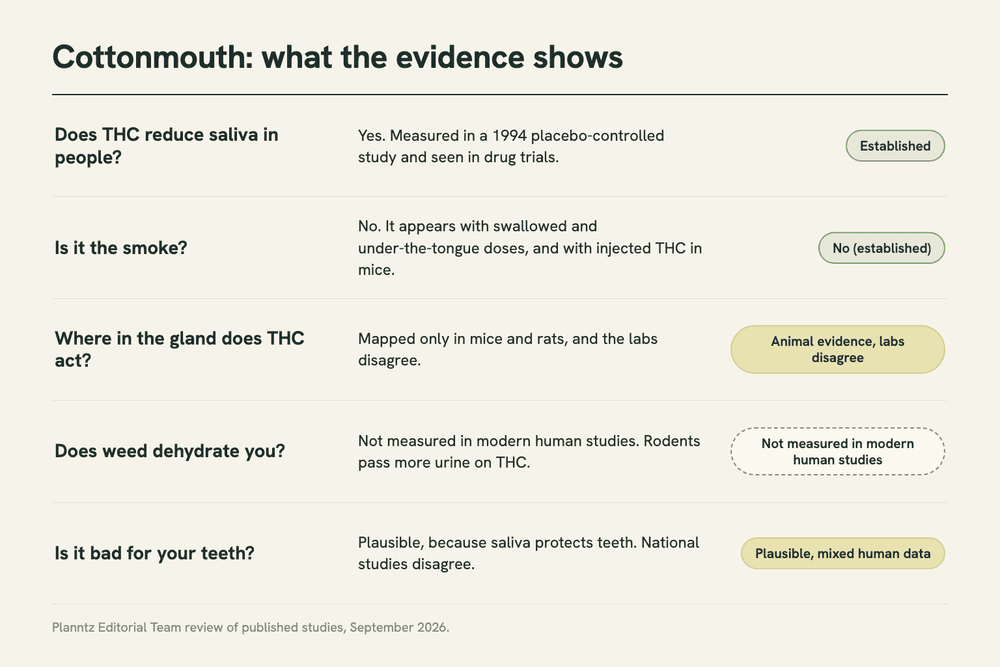
Why does weed make your mouth dry? Short answer: THC acts on the cannabinoid receptors that help control your salivary glands, and saliva production drops. It is not the smoke. In a placebo-controlled human study that included swallowed, under-the-tongue and smoked doses, saliva flow fell as blood levels of the drug rose. Exactly where THC acts has only been mapped in animals (on the nerve that switches the gland on, and possibly the gland cells too), and nobody has shown that a dry mouth after cannabis means you are dehydrated.
Cottonmouth (not the snake) is one of the most common effects people notice, and most explanations online stop at one line. Here each part is checked against the studies that measured it: how saliva is made, what THC does to it, how often it happens, whether weed dehydrates you, and why the part that matters over time is your teeth. It is part of a series on everyday THC effects, next to why weed turns your eyes red and why cannabis can make you paranoid. This is general information for adults 21 and over, not medical advice.
How your mouth makes saliva
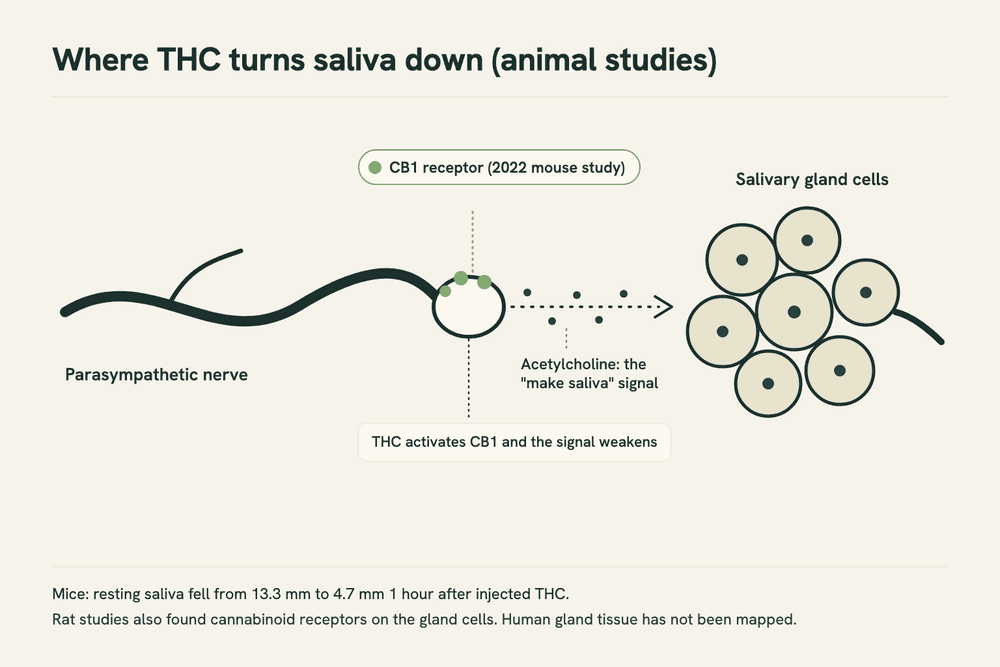
Your salivary glands do not produce saliva at a fixed rate. They run on a nerve signal. According to a 2007 review of how nerves control the salivary glands, all of them are supplied by parasympathetic nerves that release a messenger called acetylcholine, which binds to receptors on the gland and switches secretion on. At rest you make a slow trickle. Taste or chewing can raise the flow up to tenfold. That is why cutting the nerve signal, rather than damaging the gland, is enough to leave your mouth feeling like paper.
Saliva is not just lubrication. The NIH's dental institute (NIDCR) explains that it washes away food particles, contains minerals such as calcium and phosphate that help keep teeth strong and fight decay, and helps keep harmful germs in check. Keep those jobs in mind: they are why a dry mouth that happens often is more than a comfort problem.
Why does weed make your mouth dry? What THC does at the gland
The best-mapped evidence comes from mice. In a 2022 mouse study in Scientific Reports, researchers stained the submandibular gland (one of the main salivary glands, under the jaw) for CB1, the receptor THC acts on. They found CB1 on the nerve fibers that carry the acetylcholine signal into the gland, and no staining in the gland's own secretory, duct or muscle-like cells. Injected THC then cut the mice's resting saliva by about two-thirds within an hour. A drug that activates the other main cannabinoid receptor, CB2, had no effect. Mice bred without FAAH, the enzyme that breaks down the body's own cannabinoid anandamide, also made less saliva, which suggests the endocannabinoid system uses this same brake on its own.
Not every lab agrees on the exact location. A 2006 rat study found both CB1 and CB2 in the submandibular gland, and anandamide injected into the gland reduced stimulated secretion, an effect blocked by drugs that shut either receptor. A 2012 study of rat gland cells reported both receptors on the secretory (acinar) cells themselves. The studies used different species and different methods, so their maps are hard to compare directly. So the honest summary is this: in animal studies, THC turns down salivation through CB1, and researchers still debate whether it acts on the nerve, the gland cell or both. The direction is not in dispute. Human gland tissue has not been mapped this way, which is why the human evidence below matters.
Is it the smoke or the THC?
It is the THC. The key human evidence is a 1994 double-blind, placebo-controlled study in Chemical Senses. Researchers dosed 57 light cannabis users by mouth, compared swallowed, under-the-tongue and smoked doses in 11 more people, and dosed 6 others by mouth and rectally twice a day for 3 days. They collected stimulated saliva at baseline and at 2, 4 and 6 hours. Salivary flow was significantly negatively correlated with blood drug levels and with reported "high" at 2 and 4 hours after dosing: the more drug in the blood, the less saliva. Taste was not affected. Two limits: the study is from 1994, and its abstract does not state the dose, so no dose is given here.
Drug trials point the same way, with no smoke anywhere. A 2022 meta-analysis of 16 placebo-controlled trials of dronabinol (a prescription THC capsule) and nabilone (a synthetic relative) found that patients on dronabinol had about five and a half times the odds of reporting dry mouth compared with placebo (odds ratio 5.58), and those on nabilone about 17 times the odds (odds ratio 17.23, with a very wide confidence interval). An odds ratio is not the same as "times as likely", but either way the gap is large. The dry-mouth result held when each trial was removed in turn; for nabilone, the dizziness and drowsiness results did not. A 2015 JAMA review of 79 trials also listed dry mouth among the common short-term adverse events of cannabinoid medicines. These were patients on prescription drugs, so the numbers do not transfer to any consumer product. Smoke may add some irritation of its own, but the dryness appears without it. That is also why edibles cause cottonmouth; they just run on a different clock, as our explainer on 11-hydroxy-THC and edibles covers.
| How THC was given | Who | What was found | Design |
|---|---|---|---|
| Injected | Mice (2022) | Resting saliva cut by about two-thirds at 1 hour | Animal experiment |
| Swallowed, under the tongue, smoked, rectal | 57 + 11 + 6 people (1994) | Less saliva with higher blood drug levels, at 2 and 4 hours after dosing | Human, placebo-controlled |
| Swallowed prescription capsules | Patients in 16 trials (2022 pooled) | Dry mouth far more common than on placebo | Meta-analysis of randomized trials |
| Smoked, vaped or eaten (not separated) | 2,905 users (2019); 29,721 adults (2022-2023) | Dry mouth widely reported; more common with daily use | Surveys, self-report |
How common is cottonmouth?
Very common, but the size of the number depends on how you ask. In a 2019 online survey of 2,905 cannabis users, 63% said cannabis gives them a dry mouth, placing it fifth among all the acute effects they reported. Older and medical users described their acute effects differently from younger and recreational users. The sample was self-selected, so it describes people who answer cannabis surveys, not all users.
A national sample asks a harder question: not "have you ever" but "is your mouth frequently or always dry?" In a 2026 analysis of the PATH Study, a nationally representative survey of 29,721 US adults in 2022-2023, 9.7% of all adults reported frequent dry mouth. People who used cannabis daily had about twice the odds (adjusted odds ratio 2.1, 95% CI 1.7-2.7), after adjusting for other factors. Using cannabis, cigarettes and e-cigarettes together in the past 30 days was linked to the highest odds (3.8). The survey is cross-sectional, so it shows association, not cause, and it did not separate smoked from eaten cannabis. The author disclosed consulting fees from Westat for work on the survey's measures.
Dental clinics see it too. In a 2025 review of 1,600 patient charts at a Nevada dental school, covering patients aged 30 and over from 2014 to 2023, 44% had a recorded diagnosis of hyposalivation (measurably low saliva) or xerostomia (the feeling of dry mouth). Self-reported cannabis use at least weekly, which only 7.75% of patients reported, was the strongest single predictor. Read the size with care: the paper reports a relative risk of 3.10 but an odds ratio of 1.70 for the same factor, figures that do not sit comfortably together, and the authors note that some patients may have been less likely to disclose cannabis use before Nevada legalized it in 2017. The American Dental Association's journal also ran a 2025 piece titled "Cannabis Use and Hyposalivation", a sign the profession is paying attention.
Does weed dehydrate you?
Most pages answer this with confidence in one of two directions: "a dry mouth means you're dehydrated" or "weed never makes you pee more, so you're fine". Neither is backed by a measurement in people. What has been measured is in animals. In a 2013 rat study, THC and other CB1 activators produced dose-dependent increases in urine output; the researchers got comparable effects from a 10 mg/kg dose of furosemide, a prescription diuretic, and rimonabant, a drug that blocks CB1, blocked the effect in a dose-dependent way. In a 2016 mouse study, a week of daily THC produced tolerance, shifting the dose needed for the same effect about ninefold, and the effect was back near baseline within 14 days of stopping. These are injected, animal-scale doses, and none of them translates into a human figure.
A 2024 kidney-physiology paper showed one mechanism in mice: a synthetic CB1 activator lowered signaling from vasopressin, the hormone that tells your kidneys to hold on to water, and the mice passed large volumes of dilute urine. The authors note that old human reports, published between 1947 and 1981, describe more urination after cannabis. They are also explicit about the limit, and their practical advice is modest: drink water as needed to quench thirst. When we searched PubMed on September 21, 2026, we found no modern human study that measured hydration, blood concentration or urine output after cannabis use.
“...the effects of cannabinoid consumption on water balance in humans remain to be studied.”
So the fair answer to "does weed dehydrate you" is: not established either way. The practical answer is simpler. A dry mouth after cannabis is, first, a saliva problem. MedlinePlus, the National Library of Medicine's health site, does list a dry or sticky mouth among the signs of dehydration, but the signs that tell the two apart are how much you urinate, the color of your urine, dizziness and your heart rate. Alcohol dries the mouth too (NIDCR lists it alongside tobacco), which is worth knowing if you are mixing cannabis and alcohol.
| Sign | Is it part of cottonmouth itself? | What MedlinePlus says about it |
|---|---|---|
| Dry or sticky mouth | Yes | A mild to moderate sign |
| Thirst | A dry mouth can feel like thirst | A mild to moderate sign |
| Not urinating much, or darker yellow urine | No, that is about fluid, not saliva | Mild to moderate signs |
| Headache, muscle cramps, dry and cool skin | No, not a saliva effect | Mild to moderate signs |
| No urine, or very dark yellow or amber urine | No, not a saliva effect | Severe signs |
| Dizziness or lightheadedness, rapid heartbeat | No, not a saliva effect | Severe signs |
| Irritability or confusion | No, not a saliva effect | Severe sign; call 911 for confusion or loss of consciousness |

Why cottonmouth matters for your teeth
The thirst passes. The effect on your teeth is the part that can add up. NIDCR states the mechanism plainly: dry mouth increases the risk of tooth decay and fungal infections in the mouth, because saliva helps keep harmful germs in check. In the Nevada chart review, a dry-mouth diagnosis was strongly associated with an elevated cavity-risk rating. Note what that link is: dry mouth and cavity risk, measured in the same patients, not cannabis and cavities. A 2021 systematic review of 32 studies links cannabis use to gum disease and mouth infections, while noting that the mechanisms have not been worked out.
When researchers look at cannabis and cavities directly, the results split. A 2025 analysis of 5,656 US adults in the NHANES survey found that people who used cannabis at least monthly for a year were more likely to have untreated cavities (prevalence ratio 1.17) and root cavities (odds ratio 1.55), but the study could not fully separate cannabis from tobacco, diet or brushing. An earlier look at 2011-2014 national data found that current cannabis smokers had more decayed, missing and filled teeth before adjustment, and no significant difference after it. And in a small Swiss study comparing 43 young cannabis users with 42 tobacco smokers, saliva flow did not differ, but the cannabis users had significantly more decayed tooth surfaces, brushed less, saw a dentist less and drank more sugary drinks. Habits travel with the high, and nobody has yet followed users over years to untangle them.
What helps a dry mouth
No step here has been tested on cannabis cottonmouth specifically. They are NIDCR's standard advice for any dry mouth, and Oregon's cannabis regulator puts the same message on a poster: smoked, vaped or eaten, cannabis can cause cotton mouth, which raises the chance of tooth decay and oral infections. One cannabis-specific point: if the munchies send you toward sweet snacks and soda, the sugar arrives at exactly the moment your mouth has the least saliva to clear it.
- 1Drink water through the day. NIDCR's general dry-mouth guidance is plenty of water, 8 to 12 cups a day (64-96 ounces, or 2-3 liters), plus sips of water with meals.
- 2Chew sugarless gum or suck on sugarless hard candy to get saliva flowing. NIDCR notes that some contain xylitol, which may help prevent cavities.
- 3Skip sugary drinks and sticky sweets while your mouth is dry, or rinse with water afterward.
- 4Limit caffeinated drinks, which NIDCR lists among the things to cut back on.
- 5Avoid tobacco and alcohol. NIDCR says both dry out the mouth, and the national survey linked combined cannabis, cigarette and e-cigarette use to the most dry mouth.
- 6Run a humidifier at night if you wake up with a dry mouth.
- 7Keep up brushing and regular dental check-ups. The national survey's authors advise dental professionals to expect more dry mouth in people who use cannabis, so tell your dentist you use it.

When a dry mouth is not just cottonmouth
The rare exception worth knowing about: some long-term heavy users develop cycles of relentless vomiting, and emergency physicians have reported acute kidney injury from the dehydration that follows. That is not cottonmouth, and it needs medical care. Our guide to greening out and when to call for help covers what to do when too much THC brings on more than a dry mouth.
Does CBD dry your mouth too?
Much less, as far as the evidence goes. CBD does a different job at CB1 than THC does, which our comparison of CBD and THC explains. In the 2022 mouse study, CBD on its own had no effect on salivation, and it blunted THC's effect. That is a mouse result, not a reason to take CBD for cottonmouth, and it is not evidence that any cannabinoid treats a dry mouth. In people, the clearest data come from an FDA-run trial of 201 healthy adults registered on ClinicalTrials.gov: one of 151 people on prescription CBD reported dry mouth over 28 days, against none of 50 on placebo. CBD's full side-effect profile lives in our guide to CBD side effects.
What is still unknown
A lot of the everyday questions have not been studied directly. One hint on tolerance: in a small study of 16 medical cannabis patients, the volume of saliva collected over 5 minutes did not change significantly across 4 weeks of use. That fits the idea that the effect is tied to the hours after use, but the study did not control when samples were taken relative to the last dose, so it cannot settle the question.
- Where THC acts in human salivary glands. The receptor maps come from mice and rats, and those labs disagree.
- Whether regular users grow tolerant to the dryness. Tolerance has been shown for the urine effect in mice, not for saliva in people.
- Whether cannabis shifts fluid balance in people. No modern human study we found measured it.
- Whether cannabis causes cavities, or travels with habits and tobacco that do. The national analyses disagree.
- How long cottonmouth lasts after a modern edible. We found no controlled study that timed it.
Questions people ask about weed and dry mouth
Yes. Dry mouth shows up reliably in trials of swallowed prescription THC, and the 1994 placebo-controlled study that tied lower saliva to blood drug levels included swallowed and under-the-tongue doses as well as smoked ones. Edibles take longer to kick in and last longer, so the timing differs, but the dryness comes from the THC, not the smoke.
It tracks THC in your blood. In the 1994 study, lower saliva flow went with higher blood drug levels at the 2- and 4-hour measurements after dosing. The popular figures for smoking versus edibles online come without sources, and we found no controlled study that timed dry mouth after a modern edible.
Not by itself. MedlinePlus lists a dry mouth as one possible sign of dehydration, but the signs that point to low fluid are passing little urine, dark urine, dizziness and a racing heart. Whether cannabis changes fluid balance in people has not been measured in modern studies. Drinking water when you are thirsty is sensible either way.
It can be if it happens often. Saliva protects teeth, and NIDCR says dry mouth raises the risk of decay. One national analysis linked frequent cannabis use to more untreated cavities; another found no link after adjusting for other factors. Brushing, sugarless gum, water and skipping sugary drinks cover the part you can control.
In the human study, a higher blood level of the drug went with less saliva. Tobacco and alcohol dry the mouth too, and in the national survey people using cannabis, cigarettes and e-cigarettes together had the highest odds of frequent dry mouth.
Rarely, as far as the evidence shows. In a trial of 201 healthy adults, one of 151 people on prescription CBD reported dry mouth, against none on placebo, and CBD alone did not reduce saliva in mice. That does not make CBD a remedy for cottonmouth.
If you want the chemistry underneath all of this, the next step is how THC and CBD do different jobs at the same CB1 receptor. For transparency, Planntz sells a tablet that contains delta-9 THC; nothing on this page describes that product's effects.
Writing about hemp, wellness and the small rituals that keep us balanced.