What Does Organic Hemp Mean? A Label, Not a Lab Test
In federal law, organic is a labeling term about how a crop was grown and handled. Four labeling categories, one phrase that is not one, one database you can search, and no heavy-metal limit for a finished product anywhere in the organic rule. We are not certified organic.
What does organic hemp mean on a CBD label? It means a claim about how the plant was farmed and handled, and in the top tiers it means a certifying agent signed off on that claim and left a record you can search. What it does not mean is that anybody measured what ended up in your bottle. In the federal rule, the word organic is defined as a labeling term.
Here is the whole article in one paragraph. A package can mean four different things by the word organic, three of which have to print a certifier's name on the information panel and only two of which may show the USDA seal. A certificate of organic operation contains five pieces of information and not one of them is a laboratory value. We searched the full text of the organic rule on August 25, 2026 and there is no heavy-metal limit for a finished product anywhere in it. So if your question is what was applied to that land and who audited it, the certificate answers that. If your question is what is in this bottle, a batch certificate of analysis answers that. Ask for both, and read what each one actually covers, including ours.
We read the first page of results for this question on August 25, 2026. Almost all of it is written by companies that sell certified organic CBD, three of the results being product collections rather than articles at all. The two exceptions we found were a trade association and a market analyst, and neither of them cites a section of the regulation. The seller pages are broadly right about the thresholds and uniformly silent on the same three things: what the seal does not cover, how organically grown differs from USDA Organic as a legal object, and which test actually answers the heavy-metal question they raise in order to sell the seal. Two of them also state something the regulation contradicts. Both corrections are below, by section number, and no publisher or brand is named in either one.
Before anything else: Planntz is not USDA certified organic
No Planntz product is certified organic by the USDA National Organic Program or by any accredited certifying agent, and nothing on this page should be read as a claim that one is. We sell CBD tinctures, so we have an obvious interest in how you weigh a certification we do not hold. The only honest way to handle that is to say it first, keep our own paperwork inside the article instead of in a footnote, and name its gaps where they fall. Section five does exactly that: our batch reports cover potency, heavy metals and microbials, and they carry no pesticide panel and no residual-solvent panel.
What the rule actually says the word means
Start with the definition, because it settles more than it looks like it settles. In the National Organic Program's definitions at 7 CFR 205.2, the word gets one line.
“Organic. A labeling term that refers to an agricultural product produced in accordance with the Act and the regulations in this part.”
A labeling term. Produced in accordance with. Read that as a specification and you can see what kind of promise it is: it describes a process that was followed and documented, not a property that was found in a laboratory. USDA says the same thing to shoppers. Its consumer explainer on organic certification calls organic "a label that indicates that a food or agricultural product has been produced according to the USDA organic standards", and describes the seal as "the only government-backed marketing claim for organic food sold in the United States". Government-backed marketing claim is USDA's own phrase, not ours. It is not the same thing as government-tested, and that gap is the whole subject of this article.
The same page carries two facts worth holding on to, because they cut the other way. The seal is a registered trademark, which is what allows USDA to pursue criminal penalties against uncertified operations that use it falsely. And specially trained organic inspectors visit organic farms and businesses yearly, with additional unannounced inspections and testing on top of that. So there is real enforcement behind the mark, and anyone telling you the seal means nothing has not read the rule either. What is missing from all of it is a measurement of the product you bought.
Four label tiers, and where "organic hemp" actually sits
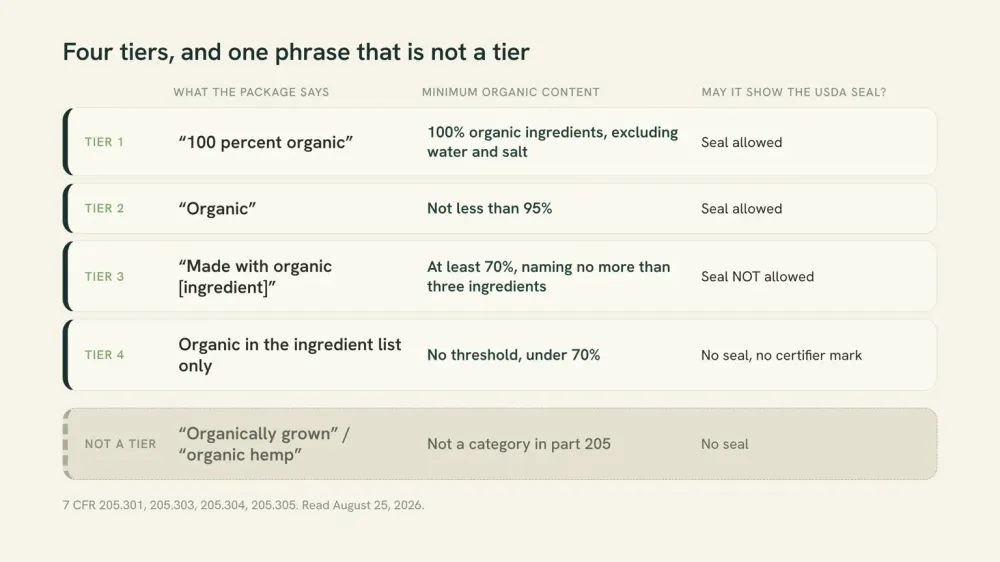
Most pages treat USDA Organic, made with organic ingredients and organically grown as degrees of one idea, milder and stronger versions of the same claim. In 7 CFR 205.301 the first two are separate categories with separate composition thresholds, different rules about the seal, and different obligations to name a certifier. And the third, the phrase shoppers see most often on hemp packaging, is not a category at all. Read the table by column rather than by row: the last column is the one that changes what you can actually do next.
| What the package says | Minimum organic content | May it show the USDA seal? | Must a certifier be named on the label? | What you can look up |
|---|---|---|---|---|
| "100 percent organic" | 100 percent organically produced ingredients, by weight or fluid volume, excluding water and salt (205.301(a)) | Yes (205.303(a)(4)) | Yes: "Certified organic by ___" on the information panel (205.303(b)(2)) | The named certifier and the operation, in the INTEGRITY database |
| "Organic" plus the USDA seal | Not less than 95 percent; the remainder organic if commercially available, or on the National List (205.301(b)) | Yes (205.303(a)(4)) | Yes (205.303(b)(2)) | The same record, searchable by operation name |
| "Made with organic [named ingredient]" | At least 70 percent, and the statement may name no more than three ingredients or food groups (205.301(c), 205.304(a)(1)) | No. 205.304(c): "must not display the USDA seal" | Yes, the certifier of the finished-product handler (205.304(b)(2)) | The handler's certifier |
| Organic named only in the ingredient list (under 70 percent) | No threshold, though the organic ingredients must still be produced under subpart C (205.301(d), 205.305(a)) | No, and no certifier mark either (205.305(b)) | No | Nothing on the package |
| "Organically grown", "organic practices", "organic hemp" used as description | No defined threshold. These are not label categories in part 205, although 205.300(a) still restricts the term organic to product produced and handled under the rule | No | No | Nothing, unless the brand hands you a certificate |
Two rows do most of the damage in real shopping. Made with organic ingredients sounds like the strongest phrase on a shelf and it is the third tier: at least 70 percent organic content, a statement that may name no more than three ingredients or food groups, and a package that under 7 CFR 205.304 must not display the USDA seal. The missing seal there is a rule being followed, not a corner being cut. The other row is the last one, and it is where the checkable record disappears: organically grown is a description, and the practical consequence is not that it is false, it is that it hands you nothing to look up.
A common summary of that last row says the word organic is unregulated outside the USDA seal, so anyone can print it on anything. The regulation says otherwise. 7 CFR 205.300(a) restricts the term organic on labels and in labeling to raw or processed agricultural products, ingredients included, that have been produced and handled in accordance with the rule, and there is a civil penalty of up to $22,974 for knowingly labeling or selling a product as organic except in accordance with the Act, which is the figure printed when we read it on August 25, 2026 and which is adjusted for inflation each year. We have no data on how often that penalty is applied and are not claiming any. The real difference between the tiers is not regulation against a free-for-all. It is that only the certified tiers hand you a certifier, a scope and a record.
What the seal certifies: land, inputs, inspections and records
If the certificate is not a measurement, it is worth being precise about what it is. Certification is an audit of a farming and handling system, and the requirements are specific enough to be checked.
- Three years of land history. Under 205.202(b), the parcel must have had no prohibited substances applied to it for three years immediately preceding harvest of the crop.
- Physical separation. 205.202(c) requires distinct, defined boundaries and buffer zones between certified land and whatever is happening next door.
- A defined list of what is out. 205.105 rules out synthetic substances except those on the National List, plus excluded methods (genetic engineering), ionizing radiation and sewage sludge.
- An organic system plan and records. The operation writes down what it does, and has to be able to produce the paperwork on demand.
- An annual on-site inspection, required by 205.403(a)(1) for every certified operation, every year.
- Unannounced inspections of a minimum of 5 percent of the operations a certifying agent certifies each year, rounded up to the nearest whole number, per 205.403(b)(1).
- A mass-balance check. 205.403(d)(4) has the inspector verify that inputs account for outputs, which is how a certifier catches an operation selling more organic product than it could have grown.
That audit regime is real, it is annual, and 7 CFR 205.403 is where you can read it end to end. It is also the reason this article treats certification as useful information rather than as decoration. What it is not is a laboratory test of the thing you bought, and one very common summary blurs exactly that line.
You will often read that organic land has to pass three years of soil laboratory tests proving there are no pesticides in it. Section 205.202(b) does not say that. It requires three years with no prohibited substance applied, which is verified through the operation's records, its history and the inspection, not through an assay of every field. The prohibited list at 205.105 is a list of inputs, not a list of results. That distinction is not a technicality: it is the same distinction the rest of this page turns on. The standard governs what may be used and it is enforced by audit.
What no organic certificate contains: a number about your bottle
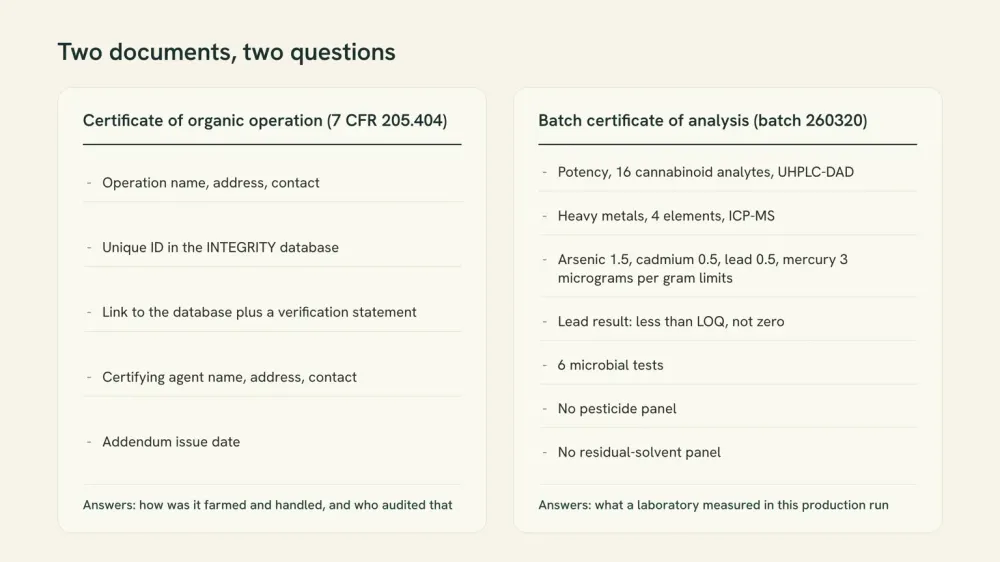
So what is actually printed on the document? 7 CFR 205.404 answers that, and it is short. The certifying agent must issue a certificate of organic operation, and that certificate must be generated from the Organic INTEGRITY Database. The addendum must contain five things: the certified operation's name, address and contact information; its unique ID number in the INTEGRITY database; a link to that database along with the statement "You may verify the certification of this operation at the Organic Integrity Database" or something similar; the certifying agent's name, address and contact information; and the addendum issue date. Five items, and not one of them is a measurement. Section 205.404(d) also keeps the certificate in effect until it is surrendered, suspended or revoked, so it is not a per-batch document by design.
We went looking for a number anyway, and the search is easy to repeat. On August 25, 2026 we pulled the full text of 7 CFR part 205 from the eCFR versioner API, stripped the tags and searched it: 106 sections, 39,440 words. The phrase heavy metal appears six times, and every one of them is a duty not to contaminate soil, crops or water through manure, compost or mushroom substrate, plus one National List condition. Cadmium appears zero times. Mercury zero. Arsenic appears once, at 205.602(b), where it is a prohibited crop input rather than a limit. The string mg/kg appears zero times. The only parts-per-million figures in the entire rule are ammonia in a poultry house and sulfur dioxide in wine. That is an absence in a regulation and nothing more: it is not evidence about any product, and it does not mean organic crops go unmeasured.
There is residue testing in the organic rule, and it deserves to be read precisely, because this is the most misread pair of sections in the category. 7 CFR 205.670(d) requires a certifying agent to sample and test, on an annual basis, from a minimum of 5 percent of the operations it certifies. Operations, per certifier, per year. That is not 5 percent of batches and it was never meant to be. Sampling is done by an inspector, testing must be performed in an accredited laboratory, and results are available for public access unless they form part of an ongoing compliance investigation. Then 7 CFR 205.671 sets the exclusion trigger: a product must not be sold as organic when residue testing detects prohibited substances at levels greater than 5 percent of the EPA's tolerance for that specific residue, or of unavoidable residual environmental contamination. A threshold keyed to a fraction of a pesticide tolerance is a rule that anticipates detectable residue. That is not a scandal and it is not a loophole; it is how a standard that governs inputs handles drift, background and a shared landscape. It is also precisely why the certificate cannot be the document that answers what is in this bottle.
Which brings this back to us, because we are asking you to read documents. Our batch reports are produced by Infinite Chemical Analysis Labs in San Diego and published in full at our lab results page. Take Broad Spectrum Mango & Peach, batch 260320. Potency runs by UHPLC-DAD across 16 cannabinoid analytes. Heavy metals run by ICP-MS on four elements, against limits of 1.5 µg/g for arsenic, 0.5 for cadmium, 0.5 for lead and 3 for mercury. Six microbial tests. Arsenic, cadmium and mercury come back ND. Lead is printed as "< LOQ", meaning below the limit of quantitation, which is a reporting floor rather than a zero. And the compliance line on that panel reads, verbatim, "Compliance requirements for this test are taken from CA Cannabis/Hemp (Based on Submission Type) regulations". So the number has a source, and the source is a state cannabis rule rather than an organic standard. There is no pesticide panel and no residual-solvent panel on that report.
Does "organic" mean pesticide free? No
This is the question underneath most searches about organic CBD, and the rule answers it in two places, neither of which promises absence. Section 205.105 prohibits synthetic substances except those on the National List, so the standard is a defined set of permitted inputs, not none at all. And 205.671 excludes a product from organic sale when residue testing finds a prohibited substance above 5 percent of the EPA tolerance for that residue, which is a threshold rather than a guarantee. Both of those are sensible rules for governing agriculture. Neither of them is a statement about your bottle.
So a certificate tells you something specific and useful: this operation is on record as not applying prohibited substances, an inspector visits every year, and a share of operations gets residue tested. It does not tell you what is on or in the finished extract, because nothing about your batch was measured in order to issue it. The document that answers that is a pesticide panel on a batch certificate of analysis, run by a laboratory, with a named analyte list and reporting limits printed beside the results. The correct move is the same for a certified brand and an uncertified one: ask for the panel and read what is on it. We do not run one, which is why you will not find a pesticide statement about our products anywhere on this site.
The bioaccumulator argument, and what the agronomy actually shows
Every page selling organic CBD reaches for the same argument: hemp is a bioaccumulator, so it takes up whatever is in the soil, so buy certified. The literature behind the first half is real. A 2022 review in the journal Plants, Potential of Industrial Hemp for Phytoremediation of Heavy Metals, describes industrial hemp as a promising phytoremediation candidate with deep roots and tolerance for accumulating different metals. Note what kind of document that is: a review of the agronomy literature, written about cleaning up contaminated land, not a measurement of any consumer product. Phytoremediation research is interested in hemp precisely because it can be planted on ground nobody wants to eat from.
The 2026 greenhouse work is more specific, and it does not point in a single direction. In a controlled greenhouse experiment on four drug-type medical cannabis cultivars, plants were exposed to a cocktail of cadmium, lead, nickel and cobalt at 0, 1 and 5 micromolar. The roots accumulated the highest levels of heavy metals, which the authors read as an avoidance strategy excluding metals from sensitive shoot organs, and the root-to-shoot translocation factor ran nickel first, then cadmium and cobalt, then lead. At the 5 micromolar exposure the authors report that the inflorescences' cadmium and nickel concentrations were above the WHO-permitted threshold for medical plant consumption. Read the conditions with the result: drug-type cannabis rather than industrial hemp, dosed exposure rather than field soil, pots in a greenhouse, and no extract or finished product was measured at any point.
A second 2026 greenhouse study points the other way, and it grew plants on genuinely contaminated ground: pseudo-total soil concentrations of cadmium 13.0, lead 664 and zinc 1,048 mg/kg. Hemp flowers grown on that soil turned out to be the lowest-accumulating tissue on the plant for cadmium and lead, at 0.45 and 1.1 mg/kg, which the authors describe as remaining below most commercial limits for herbal drug products, while flower biomass and cannabinoid synthesis stayed comparable to reference plants. The same paper reports a limited capacity for phytoextraction with low removal rates for all three metals. And in an analytical survey of 90 Cannabis sativa samples from Greece measured for 29 macro and trace elements, toxic elements contributed below 1 percent of the total trace-element concentration, the most toxic elements came in below WHO limits, and leaves and flowers carried more than seeds.
Put those together and the honest reading is narrow: hemp does take up metals, how much reaches the flower depends on the metal, the dose, the soil and the plant, and none of these studies measured a finished extract. Which is why the question does not resolve at the level of farming philosophy. It resolves at the level of one batch, on an instrument. A 2026 single-laboratory method validation comparing ICP-OES against AOAC criteria for arsenic, cadmium, mercury and lead in hemp found cadmium and lead spike recoveries of 92.7 and 96.2 percent, inside the 80 to 115 percent acceptance range, while mercury recovery came in at 47 percent, well below it, and concluded that ICP-MS is the recommended instrument for mercury and arsenic at regulatory trace levels. That is a method note rather than a market claim, and it is the reason we bothered to tell you which instrument our own panel runs on.
Why so much CBD is not certified, without excuse-making
Certification attaches to an operation, not to a plant. 7 CFR 205.100(a) requires each operation, or portion of an operation, that produces or handles agricultural products intended to be sold or labeled as organic to be certified. Now follow a bottle of CBD oil backwards and count the operations: the farm that grew the hemp, the extractor, the supplier of the carrier oil, the handler that blends, bottles and labels. Each one needs its own certificate, and the finished-product handler's certifier is the name that has to appear on the information panel. One uncertified link and the finished product cannot carry the top tiers, however the hemp itself was grown.
- The 95 percent threshold is by weight or fluid volume, so the carrier oil is inside the calculation, not outside it. A tincture is mostly carrier oil, and ours is coconut MCT.
- Hemp gets no special organic standard. It is certified as a crop under the general rules, and only hemp produced under the federal hemp program may be certified at all.
- Processing aids are constrained. 205.270(c)(2) bars a handler from using a volatile synthetic solvent not allowed under 205.605.
- Very small operations sit outside the paperwork entirely. 205.101(a) exempts operations with $5,000 or less in annual gross organic sales from certification, though not from the production and labeling rules.
- CBD's status as a food or supplement ingredient is unresolved at the FDA, which complicates labeling decisions all the way downstream of the farm.
Three of those deserve a source and a hand-off. USDA's one-page hemp instruction, NOP 2040, effective November 26, 2019, is marked Page 1 of 1 and its only references are part 205 and section 205.501, which is exactly the point: there is no special hemp organic standard to look for. On solvents, the National List of allowed synthetics at 7 CFR 205.605(b) includes carbon dioxide, and we searched that section for ethanol and for alcohol and found neither word in it; what any given extractor does with that is a question for how the extract is actually made rather than something to assume here. And the agency has not approved CBD as a food additive or a dietary supplement while having approved one CBD drug, which is a knot with its own page: where CBD sits with the FDA. None of this is an excuse for skipping the question. It is the structure and the cost that explain the answer you will get when you ask it.
There is one more way to watch the word travel. NIH's Dietary Supplement Label Database is a public archive of supplement labels, and we have used it here before to show that the same ingredient is written 79 different ways across 489 hemp-extract products. This run reads a different field on that same population: Seals and Symbols, which transcribes the certification marks actually printed on the package. The database rate-limited us on 23 of the 489 products even after retries with backoff, so the counts below are computed on the 466 full label records we did retrieve, and the query was run on August 25, 2026.
Read those carefully, because they are evidence about labels and not about companies. The database is an archive rather than a market census: 94 of the 489 records are flagged off-market and entry dates run from 2015 to 2025. The seals field is a transcription of what a record shows, so an absent mark is not proof that an operation is uncertified, only that the record does not show one, which makes every count above a floor rather than a total. We name no brand from this dataset and never will. What the counts support is narrow and useful. Across the 466 records we retrieved, 211 use the word organic somewhere in the ingredient list while 52 print a USDA Organic mark, which is roughly four to one. Of the 57 labels that put the word organic in the brand or the product name, 28 show no organic certifier mark anywhere in the record, just under half of them. And on the full 489, the carrier oil is written as organic about twice as often as the hemp extract itself is, 87 labels against 43, which is worth knowing if you assumed the word on the front was about the hemp. That is not an accusation about anybody. It is a reason to look up the certifier instead of reading the adjective.
How to check an organic claim in 60 seconds
None of this costs money and none of it requires calling anyone. It is the same shape as how to check the laboratory itself, applied to a farm certificate instead of a lab report, and it ends where every quality question on this site ends, at how to read the batch report. The tool you need is USDA's Organic INTEGRITY Database, which is searchable by operation name and free.
- 1Classify the phrase. Find the exact wording on the front panel and put it in one row of the table above. The seal, made with organic ingredients, and organically grown are three different legal objects.
- 2Look for the certifier line. For anything in the top three tiers the information panel has to read Certified organic by, followed by the certifying agent's name. A seal with nobody named beside it is where you stop and ask.
- 3Search the operation in the INTEGRITY database. Search the certified operation's name, which is often a legal entity rather than the brand printed on the bottle.
- 4Read the status field, not just the presence of a record. Certified, Surrendered, Revoked and Suspended are four different answers and only one of them is the one you want.
- 5Read the scope: Crops, Livestock, Wild Crops or Handling. A farm certified for Crops does not make a finished tincture certified. The company that blends and bottles needs a Handling scope.
- 6Read the certified products list and check that it covers the thing you are buying rather than a neighboring product from the same operation.
- 7Ask for the certificate. It must be generated from the INTEGRITY database, and an addendum must carry the operation's ID number and a database link. A certificate with neither is worth a follow-up question.
- 8Ask for the batch certificate of analysis anyway, and read which panels are on it. Nothing in steps 1 to 7 produced a single number about the bottle.
Red flags, and what this page is not about
None of these means somebody is lying. Each one means the claim in front of you cannot be checked from where you are standing, which is a different and more useful observation.
- A USDA seal printed with no certifying agent named on the information panel. The rule requires the name, so its absence is a question worth asking.
- Organic in the brand name and nowhere else on the package: no certifier line, no tier statement, no certificate offered on request.
- Organically grown or organic practices offered as the entire answer, with neither a certificate nor a batch report behind it.
- A certificate with no operation ID number and no link to the INTEGRITY database. Under 205.404, an addendum is supposed to carry both.
- Organic used to imply purity or a health outcome. It is an agricultural and supply-chain standard and it says nothing about what a product does for a person.
- A certificate handed over in place of a certificate of analysis when you asked what is in the bottle. They are not substitutes for one another.
Two honest limits, ours included. Label accuracy in this category has been measured and it is uneven: a 2017 JAMA analysis of 84 CBD extracts bought online from 31 companies found only 30.95 percent were labeled within 10 percent of their actual CBD content, with THC detected in 18 of the 84. That is a 2017 online sample and a potency finding, not a contaminant or an organic finding, and it is exactly why a checkable record beats an adjective. And a document is not automatically a fact: in NIST's 2021 interlaboratory study, NISTIR 8385, 116 laboratories measured three hemp oils, and for CBD in the first oil 31 of 68 reporting laboratories fell outside NIST's range of tolerance. That was an educational, anonymized exercise run in 2020 against a strict metrological yardstick, with no pass or fail attached, and the laboratory side of the question belongs to its own article. Forged and recycled paperwork is a third problem again, distinct from a legal but misleading phrase, and it has its own page.
And what this page is not: it is one criterion out of many. If you are working through a purchase from the start, the full buyer's checklist covers spectrum, concentration, cost per milligram and testing in one place, and every other number printed on the panel has a guide of its own. The habit transfers, too. We ran the same exercise on a religious certification and arrived at the same shape of answer: read what the certificate covers, notice what it does not, and then go and find the document that measures the thing you actually asked about.
Frequently asked questions
Some of it is certified and most of it is not. Organic on a CBD label can mean four different things: 100 percent organic, the USDA seal at not less than 95 percent organic content, made with organic ingredients at 70 percent, or the word appearing only in an ingredient list. Only the certified tiers put a certifying agent's name on the information panel and a record in USDA's Organic INTEGRITY Database, which is what makes the claim checkable. Descriptions like organically grown and organic hemp are not tiers in the regulation and carry no threshold. Planntz is not USDA certified organic, and we say so here rather than in a footnote.
No, and the rule does not use that phrase. Section 205.105 prohibits synthetic substances except those on the National List, so organic production allows a defined set of permitted inputs rather than none. And 205.671 excludes a product from being sold as organic when residue testing detects a prohibited substance above 5 percent of the EPA's tolerance for that residue, which is a threshold rather than a guarantee of absence. Certification is a standard about what may be applied and what may be found. A pesticide panel on a batch certificate of analysis is what answers the measurement question, and not every brand runs one. Ours does not.
USDA Organic is a certification. It has a certifying agent whose name must appear on the label, a scope (Crops, Livestock, Wild Crops or Handling), a status (Certified, Surrendered, Revoked or Suspended) and a public record in the INTEGRITY database. Organic hemp and organically grown are descriptions: no threshold in 7 CFR part 205 and nothing attached that you can look up. That does not make them unregulated. Section 205.300(a) restricts the term organic on any label to product produced and handled under the rule, and 7 CFR 3.91(b)(1)(xxxvi) attaches a civil penalty of up to $22,974 for knowingly labeling or selling a product as organic outside the Act. The practical difference is the record, not the presence of a rule.
In the regulation the phrasing is made with organic followed by a named ingredient or food group. It requires at least 70 percent organic content by weight or fluid volume, the statement may name no more than three ingredients or food groups, and the package must not display the USDA seal. It does have to name the certifying agent of the finished-product handler. So it is a real certified category with a real threshold, and it is also the tier most often read as stronger than it is, because the phrase sounds emphatic while the missing seal is a rule being followed.
No. Section 205.404 lists what a certificate of organic operation and its addendum must contain: the operation's name and contact details, its unique ID in the INTEGRITY database, a link to that database with a verification statement, the certifying agent's details, and the issue date. Five items, none of them a laboratory value. We also searched the full text of the organic rule on August 25, 2026, 106 sections and 39,440 words: cadmium appears zero times, mercury zero times, and there is no heavy-metal limit for a finished product anywhere in it. That is an absence in a regulation, not a statement about any product. Heavy-metal numbers live on a batch certificate of analysis.
Hemp is a recognized phytoremediation candidate, which is why buyers ask. The plant science points in more than one direction. A 2026 greenhouse experiment dosing four drug-type cannabis cultivars with cadmium, lead, nickel and cobalt found the roots holding the highest levels and, at the 5 micromolar exposure, inflorescence cadmium and nickel above the WHO-permitted threshold for medical plant consumption. A second 2026 greenhouse study grew hemp on soil containing cadmium 13.0, lead 664 and zinc 1,048 mg/kg and found the flowers accumulating the least cadmium and lead of any tissue, at 0.45 and 1.1 mg/kg. Neither measured a finished extract. For one specific bottle, the question is answered by a heavy-metal panel on that batch.
They answer different questions, so better depends on which question you are asking. A certification tells you about the land, the inputs, the handling chain and an annual audit, verified through records and inspections. A batch certificate of analysis tells you what a laboratory measured in a specific production run, on a stated list of analytes with stated reporting limits. Neither substitutes for the other, and neither says anything about what a product does for a person. The useful move is to ask for both documents and read what each one actually covers, including ours: potency, four heavy metals and six microbial tests, with no pesticide panel and no residual-solvent panel.
Read the panel list, not the adjective
Every Planntz batch is tested by an independent laboratory and the full report is published, panel list and all. We are not USDA certified organic, and our reports carry no pesticide panel and no residual-solvent panel. Read what they do cover and decide for yourself.
See our lab resultsWriting about hemp, wellness and the small rituals that keep us balanced.