Can Babies Eat Hemp Seeds? Age, Choking, Allergy and THC
US guidance lists seed-containing foods among first foods at about 6 months, in a safe form, and puts whole seeds on choking lists. Here is what that means for hemp, the THC trace on a baby's body weight, and who FDA's hemp seed files cover.
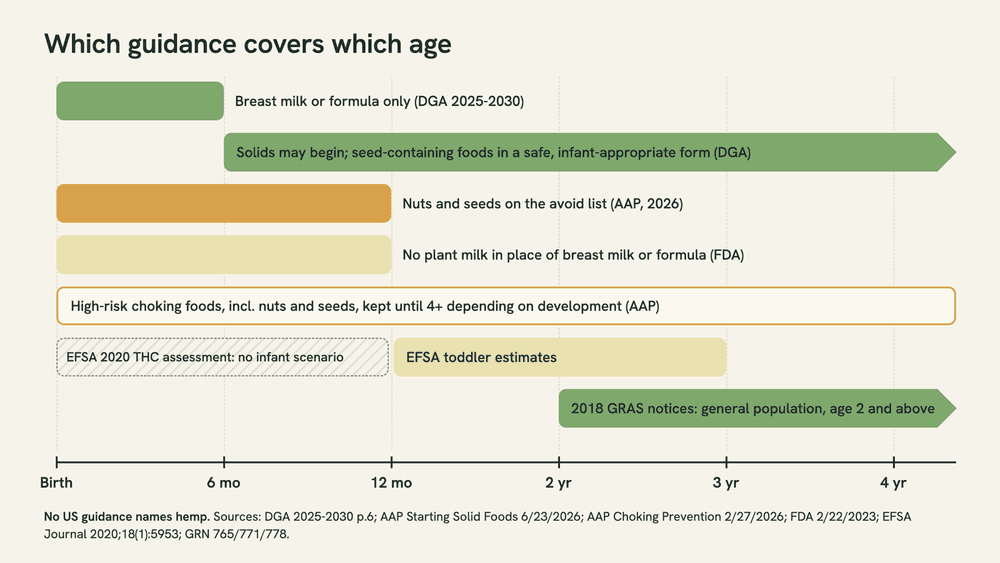
Can babies eat hemp seeds? US feeding guidance never names hemp, but it does answer the question in two parts. The 2025-2030 Dietary Guidelines say babies may begin solid foods at about 6 months and list "nut- or seed-containing foods prepared in a safe, infant-appropriate form" among the foods to introduce. The American Academy of Pediatrics and the CDC, meanwhile, put seeds on their choking-hazard lists. So the form of the seed decides. Hemp then adds two questions other seeds do not raise: a trace of THC that varies by batch, and a US safety file that was written for people aged 2 and older.
Page one for this search mostly repeats "about 6 months, sprinkle it on soft food", and none of it quotes the documents that advice should rest on. This guide reads them, with dates: what federal and pediatric guidance says about seeds and choking, how it tells you to introduce a food that could cause an allergy, what the THC trace looks like on a baby's body weight against Europe's reference dose, and who FDA's 2018 hemp seed reviews actually covered. It ends with a four-line check you can take to your pediatrician. We make no nutrition, growth or development claim for hemp seed at any age, and nothing on this page is a serving suggestion. For what hemp hearts contain and how they compare with other seeds, see our hemp hearts and chia seeds comparison.
Can babies eat hemp seeds? What US feeding guidance says
The current federal reference is the Dietary Guidelines for Americans, 2025-2030, published by HHS and USDA in January 2026. Its infancy chapter says: "At about 6 months of age, infants may begin to have solid foods." It adds that breast milk or infant formula "continues to be the main source of nutrition for your infant up to 12 months of age", so solids are added alongside milk, not in place of it. On allergy, it tells parents to "introduce potentially allergenic foods, including nut butters, eggs, shellfish, and wheat, with other complementary foods at about 6 months" and to "ask your infant's health care professional about their risk for food allergies and safe ways to introduce these foods."
The same page lists "legumes and nut- or seed-containing foods prepared in a safe, infant-appropriate form" among the foods to introduce. The condition is the point. The guidelines do not say "seeds"; they say seed-containing foods, in a form that is safe for an infant. They do not name hemp, and we are not going to attach any nutrition label to it on their behalf. The American Academy of Pediatrics (AAP) adds the pacing rule on its starting-solids page, updated June 23, 2026: "Introduce one 'single-ingredient' new food from any food group every 3 to 5 days. Look out for any reactions." The same page says "foods should be soft or pureed to prevent choking."
About 6 months is an age, not a switch. The Dietary Guidelines list the signs that a baby is developmentally ready for solid food:
- Sits up alone or with support
- Controls head and neck
- Tries to grasp small objects
- Brings objects to the mouth
- Opens the mouth when food is offered
- Moves food from the front to the back of the tongue to swallow
- Swallows food instead of pushing it back out
Those signs are about the baby, not about hemp. A baby who is not showing them is not ready for any solid food, seed-containing or otherwise.
Whole seed, hemp hearts, ground seed: what the choking lists say
Three US documents name seeds as a choking risk, and they are worth reading word for word. The AAP starting-solids page lists "nuts and seeds" among "foods to avoid under 1 year of age", in the same line as popcorn, whole grapes and hot dogs, and says not to give a baby "any food that requires chewing at this age." The AAP's choking-prevention guidance, updated February 27, 2026, lists "nuts and seeds (especially sunflower seeds)" as high-risk foods and says to "keep high-risk foods from children until 4 years of age or older, depending on each child's development and maturity level." It also notes that "two-thirds" of children who die from choking "are babies under a year old." The CDC's infant and toddler choking-hazards page, last reviewed March 11, 2026, lists "whole or chopped nuts and seeds", "chunks or spoonful of nut and seed butters" and "crackers or breads with seeds". Notice the word chopped: CDC does not treat a seed as safe just because it is in pieces.
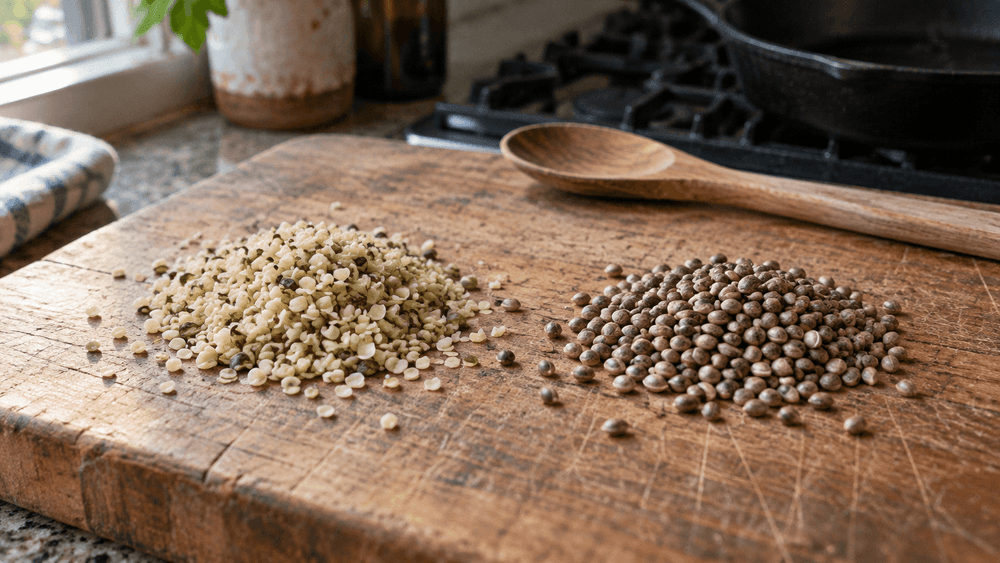
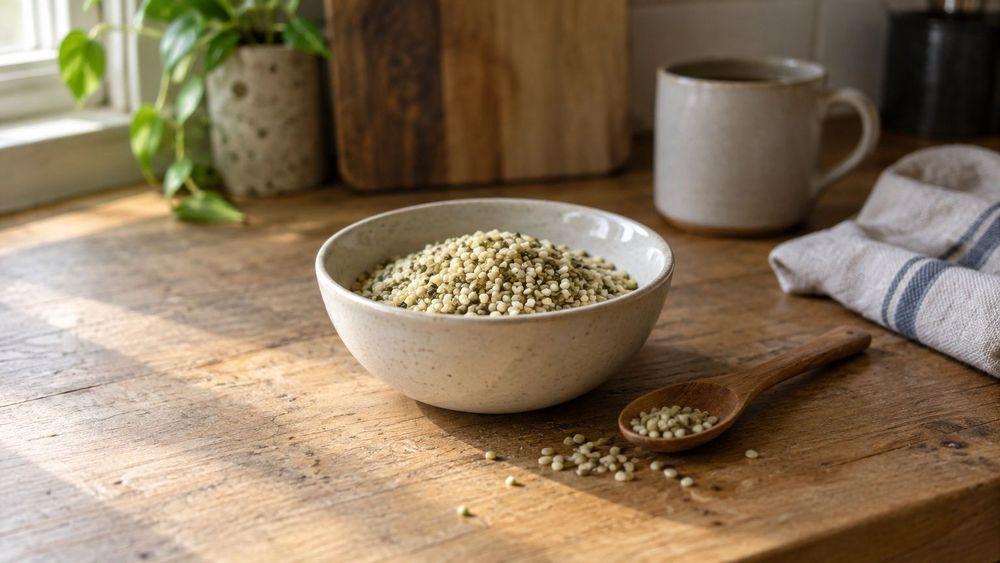
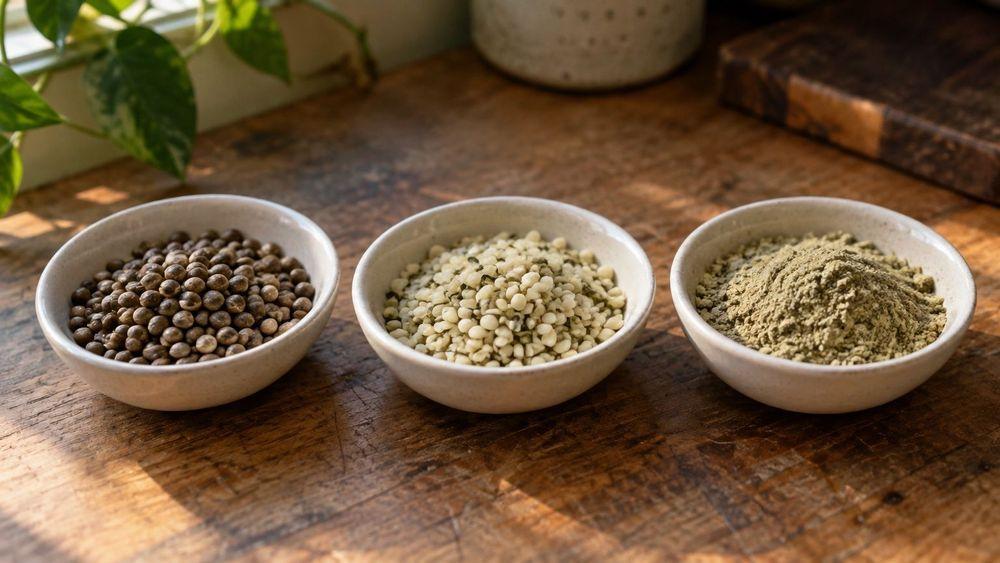
None of these lists names hemp, and none separates a hulled hemp heart from a whole seed. Hemp reaches a kitchen in three main forms: whole seed in its hard shell, hulled seed (sold as hemp hearts), and ground or blended seed (flour, protein powder, seed butter). The table sets each form against what the guidance actually says. Where a cell says "no guidance names it", that is the honest answer, not a gap we filled.
| Form | What it is | What the guidance says | Source |
|---|---|---|---|
| Whole seed, in shell | The intact seed with its hard, crunchy outer shell | A seed in the plain sense of every list: "nuts and seeds" to avoid under 1 year; "whole or chopped nuts and seeds" | AAP Starting Solids; AAP Choking Prevention; CDC |
| Hulled seed (hemp hearts), loose and dry | The soft inner kernel with the shell removed | No list separates hulled from whole. A loose dry kernel is still a seed, and CDC includes chopped seeds | AAP; CDC |
| Seeds on bread or crackers | Whole or hulled seed baked onto or into a cracker or loaf | "Crackers or breads with seeds, nut pieces, or whole grain kernels" are listed hazards | CDC |
| Ground seed, flour or powder in soft food | Seed milled fine and mixed into a soft or pureed food | No guidance names it. The nearest lines: "seed-containing foods prepared in a safe, infant-appropriate form"; foods "soft or pureed"; mashing can help | DGA 2025-2030; AAP Starting Solids; CDC |
| Hemp seed butter | Ground seed paste | No hemp line. CDC lists "chunks or spoonful of nut and seed butters"; AAP, writing about nut butters, says "spread thinly instead" of thick chunks | CDC; AAP Choking Prevention |
Read across the rows and one thing stands out: every form the guidance explicitly lists is a piece a baby could inhale, whole, chopped or stuck to bread. The only language that points toward a usable form is general: "soft or pureed" (AAP) and "a safe, infant-appropriate form" (Dietary Guidelines), with CDC noting that mashing and cutting food to the right "shape, size, and texture" for the child's development can help. We stop there. No source we found gives preparation instructions for hemp, so we do not either. If you are looking at spreads, our guide to hemp seed butter covers what is in the jar, and baking with hemp flour covers the milled form.
Allergy: not a major allergen, and not "hypoallergenic" either
Hemp is not one of the nine major food allergens on FDA's list (the chia seed and hemp heart allergy section names them). That is a labeling category, not a safety rating, and it does not make hemp "hypoallergenic". Even the company that sought FDA's 2018 review of hulled hemp seed acknowledged it: FDA's reply letter records Fresh Hemp Foods' summary that "instances of allergic reactions to hemp seed-derived ingredients have been documented in the scientific literature", alongside the company's view that hemp seed "would not be a concern for the general population", a population its notice defined as age 2 and above. One documented case is a 2003 report of anaphylaxis after eating hempseed, published in the Journal of Allergy and Clinical Immunology, in an adult. Allergies to other parts of the cannabis plant are a separate subject, covered in our guide to cannabis and CBD allergy.
What about babies specifically? We searched PubMed on November 8, 2026 for hemp seed or hempseed together with infant, toddler, child or pediatric, and allergy or anaphylaxis, in titles and abstracts. The search returned zero records. A broader search for hemp seed and allergy returned 13, all adult case reports, letters or laboratory work on hemp proteins. That means nobody has published a measurement of hemp seed allergy in infants or toddlers. It does not mean it cannot happen, and no one can give you a rate.
So hemp falls under the general rules for introducing any food. The Dietary Guidelines put potentially allergenic foods at about 6 months, with other foods. The AAP's starting-solids page says "there is no evidence that waiting to introduce baby-safe (soft) foods, such as eggs, dairy, soy, peanut products or fish, beyond 4 to 6 months of age prevents food allergy", and asks for one new single-ingredient food every 3 to 5 days so a reaction can be traced to its cause. The only formal "ask first" rule in US guidance is written for peanut: babies with severe eczema, egg allergy or both are considered high risk, and the Dietary Guidelines tell their parents to talk with a health care professional about peanut introduction "as early as 4 to 6 months." That rule comes from the 2017 NIAID addendum guidelines, which set out separate approaches for infants at different risk levels. No equivalent exists for hemp. Applying the same caution to a baby with severe eczema or a known food allergy is a sensible default, not a hemp-specific rule.
The THC trace, worked out on a baby's body weight
This is the part no other page on this question does. Hemp is cannabis grown for fiber and seed, and THC is the plant's intoxicating compound. According to FDA, the seed itself does not naturally contain THC; the trace on a bag of hemp hearts comes from contact with other parts of the plant during harvest and processing. FDA put it this way in its December 20, 2018 statement on three hemp seed ingredients:
“The seeds themselves do not naturally contain tetrahydrocannabinol (THC) ... contain only trace amounts of THC and CBD, which the seeds may pick up during harvesting and processing when they are in contact with other parts of the plant. Consumption of these hemp seed-derived ingredients is not capable of making consumers "high."”
Two things about that statement matter here. First, it was written about the uses in those three notices, which were assessed for people aged 2 and older (more on that below). Second, "trace" has no number in it, and the United States sets no THC limit for a finished hemp seed food. Europe does. Commission Regulation (EU) 2023/915 caps hemp seeds, and ground or processed hemp seed products, at 3.0 mg per kg of THC equivalents, and hemp seed oil at 7.5 mg per kg. "THC equivalents" means THC plus its acid form, THCA, multiplied by 0.877. A 2000 lab analysis found most of a hemp seed's THC on the outside of the seed, which is one reason hulled hearts typically test lower than whole seed.
The yardstick for "how much is too much" comes from the European Food Safety Authority (EFSA). Its 2015 opinion, restated in its 2020 acute THC exposure assessment, set an acute reference dose of 1 microgram of THC per kilogram of body weight in a day. EFSA started from 2.5 mg a day, the lowest dose at which effects (on the central nervous system and heart rate) were seen in adults, then divided by 30 for safety: 3 to get from "lowest dose with effects" to "no effect", and 10 for differences between people. So the reference dose sits 30 times below the lowest effect dose in adults. Reaching it is not the same as an effect: it means the safety margin regulators build in is used up. And the starting point for that margin came from studies in adults, not babies.
Now the arithmetic. USDA FoodData Central (entry 170148, "Seeds, hemp seed, hulled") lists 3 tablespoons as 30 g, so a teaspoon is about 3.3 g. A 9 kg baby (about 20 lb) has a reference dose of 9 micrograms; a 12 kg toddler (about 26 lb), 12 micrograms. Both weights are illustrations, not targets. Here is what one teaspoon of hulled hemp carries at four THC levels:
| THC level in the seed | THC in one teaspoon (about 3.3 g) | Share of the reference dose, 9 kg baby (9 µg) | Share of the reference dose, 12 kg toddler (12 µg) |
|---|---|---|---|
| EFSA median of European samples (0.39 µg/g) | about 1.3 µg | about 14% | about 11% |
| EU legal maximum (3.0 µg/g) | about 10 µg | about 110% | about 83% |
| EFSA 95th percentile, samples before the EU limit (3.96 µg/g) | about 13 µg | about 145% | about 110% |
| US notifier's own maximum specification, GRN 765 (4 µg/g) | about 13 µg | about 150% | about 110% |
Read both halves, because both are true. At the level EFSA found in a typical European sample, a teaspoon is about one-seventh of the reference dose for a 9 kg baby. At the EU legal maximum, the same teaspoon is about the whole reference dose, and the two highest rows go past it. The honest answer is not "far below". It is not proof of harm either, because the reference dose is a protective line, not the point where effects begin. Where a given spoonful sits depends on the batch, and the batch is the one thing you cannot see from the bag. Germany's official food-control lab, after testing 511 hemp food samples from 2008 to 2021, concluded that hemp seeds "typically do not contain amounts of THC that can exceed toxicological thresholds", but its scenarios were for adults, not infants. The practical consequence is limited and neutral: whole seed in shell carries more surface THC and is also the form on every choking list, and a brand that publishes a THC test result for each batch answers the question a parent otherwise cannot.
What EFSA's own toddler table shows
EFSA's 2020 assessment is the closest thing to a real-world answer, and two details in it are rarely mentioned. First, it left babies under 12 months out of every scenario: there is no infant estimate at all. Second, it did break out toddlers (12 to under 36 months), but only in a table, not in its summary. For hemp seeds, EFSA's occurrence data covered 127 European samples, with a median of 390 µg THC per kg of seed and a 95th percentile of 3,960 µg per kg. Its toddler estimates, in micrograms of THC per kg of body weight on the days a toddler ate seeds:
| THC level in the seed samples | Average toddler seed eater (range across 11 surveys) | Heaviest toddler seed eaters (1 survey) |
|---|---|---|
| Median (390 µg/kg) | 0.04 to 0.34 | 0.43 |
| 75th percentile | 0.09 to 0.76 | 0.96 |
| 90th percentile | 0.25 to 2.09 | 2.63 |
| 95th percentile (3,960 µg/kg) | 0.41 to 3.44 | 4.33 |
At a typical or 75th-percentile THC level, every toddler estimate stays under the reference dose of 1. The line is crossed only when the seed sits at the contaminated end of the samples (90th and 95th percentile), and then in the upper part of the average-eater range and for the heaviest eaters. EFSA flags three limits itself: the consumption data are a proxy ("oil seeds", not hemp specifically), the samples predate the 2023 EU ceiling, and the results are "expected to represent an overestimation". The heaviest-eater column rests on a single survey. For comparison, EFSA's earlier assessment of milk and dairy from hemp-fed animals put toddlers at no more than 13% of the reference dose.
What FDA's 2018 GRAS notices cover, and who they leave out
GRAS stands for "generally recognized as safe", a US pathway that lets a company tell FDA why it considers an ingredient safe for specific food uses. On December 20, 2018, FDA answered three notices from one company, Fresh Hemp Foods, with "no questions" letters: GRN 765 (hulled hemp seed), GRN 771 (hemp seed protein powder) and GRN 778 (hemp seed oil). The intended uses in the hulled hemp seed notice, GRN 765, are "ready-to-drink beverages, soups, sauces, nutritional beverages, smoothies, dairy product analogs, grain products, baked goods, baking mixes, spreads, dressings, cereals, snacks, and nutrition bars" at 1% to 40%. No baby food category is listed. And each of the three notices, in its intended-use section, says the same thing about who it was written for: "The food products are intended for the general population (age 2 and above)." Each adds that the ingredient "is not intended to be added to any infant formulas."
FDA's reply letter on hulled hemp seed records the company's intake estimate, made only "for the general population, aged 2 years and older" (a mean of 7.03 g and a 90th percentile of 14.07 g per person per day), says FDA has "no questions at this time" about the company's conclusion, and states that the letter "is not an affirmation" that the ingredient is GRAS. So two common readings are both wrong. FDA did not approve hemp seed for babies, and FDA did not ban it for babies. The notices and the letters were written about people aged 2 and older.
There is one more document in FDA's public file, and it does carry numbers for children under 2. FDA asked the company to "derive a margin of exposure for infants/toddlers". In its November 2, 2018 response, the company modeled toddlers eating hemp foods "at every meal and snack" at its maximum THC specification and got 11.5 to 12.7 micrograms per kg of body weight a day, or 3.3 to 3.5 using its historical THC data (5.8 to 6.2 by its Monte Carlo model). It said the worst case "may be an overestimation". The same response's table has rows for babies aged 6 to 11 months: 6.7 to 7.1 at the maximum specification, 2.5 to 2.7 by Monte Carlo, and 0.6 using historical THC data. The company compared all of these with an EFSA benchmark from a rat study, 0.73 mg per kg a day, and reported margins of "57 to 1285 fold". Set against EFSA's human reference dose of 1 microgram per kg instead, the 6-to-11-month figure based on historical THC data (0.6) is below the line, and every other infant and toddler figure is above it. Both yardsticks are public, and they point in different directions. Two limits to keep in mind: these are one company's notices, and other suppliers can treat their ingredients as GRAS without notifying FDA at all.
Hemp milk and hemp seed oil are different questions
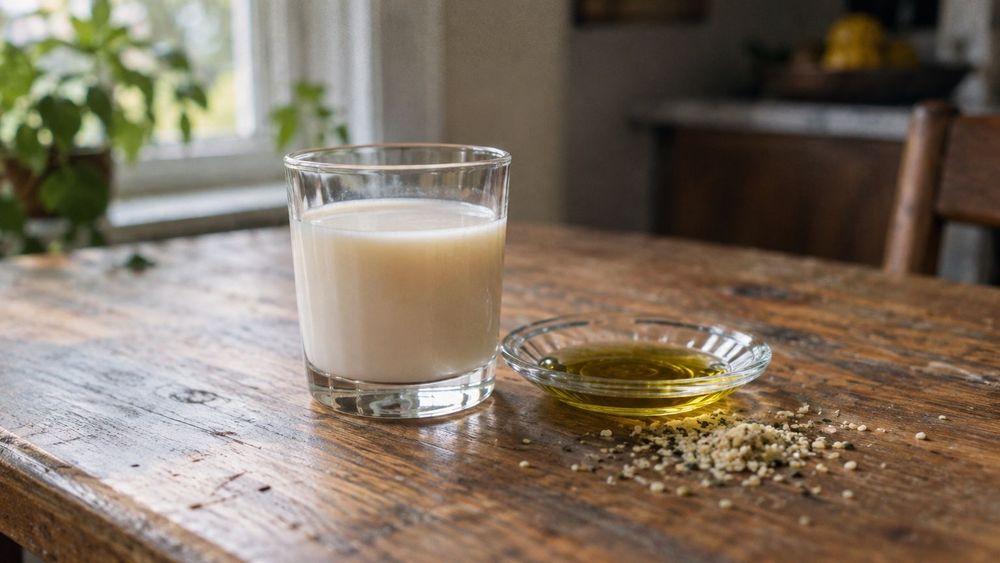
Hemp milk. FDA's consumer guidance on milk and plant-based milk alternatives is direct: "Infants should not consume milk or plant-based milk alternatives before age 12 months to replace human milk or infant formula." The Dietary Guidelines say to move from formula to whole milk at 12 months. For toddlers, the AAP's guidance on recommended drinks for children 0 to 5, updated October 3, 2023, drawn from a Healthy Eating Research consensus supported by the AAP, the American Heart Association, the Academy of Nutrition and Dietetics and the American Academy of Pediatric Dentistry, says that "other than soy milk, plant-based milks are not recommended for children to drink in place of dairy milk." The same page says added sugars "should be avoided in children less than 2 years of age", which matters because many plant milks are sweetened. How hemp milk compares with other plant milks for adults is in our hemp milk and oat milk comparison.
Hemp seed oil. Hemp seed oil is pressed from the seed, the way flaxseed oil is; GRN 778 describes whole seeds that "are cold pressed to extract the oil". It is not CBD oil, which is extracted from the flowers and leaves, a difference laid out in hemp seed oil vs CBD oil. It does carry more trace THC than the seed. GRN 778 says that THC "comes from contact between the seeds and cannabinoid-containing resins from other plant parts", and the oil is pressed from whole seed. Europe's ceiling is 7.5 mg per kg for the oil against 3.0 for the seed, EFSA's median for hemp oil samples was 1,890 µg per kg, and a 2024 test of 30 European retail hemp seed oils found THC from 0.2 to 6.7 mg per kg, with 3 oils above the EU maximum once THCA was counted in. EFSA's toddler table for hemp oil (Table 9) shows that heavy users could pass the reference dose even at a typical THC level (0.70 to 4.49 µg per kg at the median), though its consumption figures are again a proxy that EFSA expects to overestimate. There is also one published case: a 2017 Italian report of a preschool child with mild, temporary neurological symptoms after three weeks of hemp seed oil that a pediatrician had prescribed "to strengthen his immune system". It is one case, and no rate can be drawn from it. It is also a reason this page makes no immunity claim for hemp, at any age. For the oil as an adult food, see what the evidence says about hemp seed oil.
CBD products for children are a separate question with their own evidence and rules, and we cover it in is CBD safe for kids?.
A four-line check before the first taste
If you and your pediatrician decide a hemp-containing food belongs on the plate, this is what the guidance above adds up to. Each line traces to a named source; none of it is a hemp-specific rule, because none exists.
- 1Form: no whole or chopped seeds, loose dry seeds, or seeded breads or crackers (CDC; AAP). The alternative the guidance names: a seed-containing food "prepared in a safe, infant-appropriate form" (DGA) that is "soft or pureed" (AAP).
- 2First taste: one new single-ingredient food at a time, every 3 to 5 days, so a reaction can be traced (AAP Starting Solid Foods, June 2026).
- 3Watch: look for the FDA symptom list: hives, rash, swelling of the face or lips, vomiting, coughing or wheezing, trouble breathing. Symptoms usually appear within minutes to a few hours. Trouble breathing is an emergency.
- 4Ask first if your baby has severe eczema or a known food allergy. US guidance writes that rule for peanut (Dietary Guidelines; NIAID 2017); applying it to hemp is a sensible default, not a hemp rule.
One optional line, for the THC question: if you can, choose a hemp seed product whose maker publishes a THC test result for each batch. In the US, that result is the only way to know where a bag sits in the arithmetic above.
What nobody has measured yet
The honest limits of this page are the limits of the record. There is no published study or case report of hemp seed allergy in an infant or toddler (PubMed, November 8, 2026), so no one can tell you how common it is. EFSA's THC assessment did not model babies under 12 months at all, and its toddler figures rest on proxy consumption data from before the EU's 2023 limit. The 2018 hemp seed notices FDA answered were scoped to people aged 2 and older and excluded infant formula; the only infant figures in that file are the company's own exposure models, built on eating hemp foods at every meal and snack. The United States has no THC limit for a hemp seed food and no requirement to print one. And no US feeding guidance names hemp: everything here applies general rules for seeds, choking and allergens to a food with no infant-specific guidance of its own. None of that makes hemp seed unsafe. It means the evidence for babies is thin, and you should weigh it as thin.
Frequently asked questions
US guidance does not name hemp. The Dietary Guidelines for Americans 2025-2030 say solid foods may start at about 6 months and list seed-containing foods "prepared in a safe, infant-appropriate form" among the foods to introduce. The AAP lists nuts and seeds among foods to avoid under 1 year, because of choking. So age is only half the answer; the form is the other half, and your pediatrician is the right person to confirm your baby is ready.
Seeds are. CDC lists "whole or chopped nuts and seeds" and "crackers or breads with seeds" as choking hazards for babies and toddlers, and the AAP's choking guidance lists nuts and seeds and says to keep high-risk foods from children until 4 years or older, depending on development. None of these lists names hemp or treats a hulled hemp heart differently from a whole seed.
Possibly, though no one has measured it. Hemp is not one of FDA's nine major allergens, but allergic reactions to hemp seed, including a 2003 report of anaphylaxis, are documented in adults. A PubMed search on November 8, 2026 found no study or case report of hemp seed allergy in an infant or toddler. If you and your pediatrician decide to offer a hemp-containing food, the general rule for any new food applies: one new food at a time, every 3 to 5 days, watching for symptoms over the following minutes to hours.
Hemp seeds carry trace THC picked up from the plant during harvest. FDA says consuming the hemp seed ingredients it reviewed in 2018 is "not capable of making consumers 'high'", but those uses were assessed for people aged 2 and older. On a body-weight basis, a teaspoon of hulled hemp at a typical European THC level is about 14% of EFSA's reference dose for a 9 kg baby, and at the EU legal maximum about 110%. That is arithmetic, not a serving suggestion, and the reference dose sits 30 times below the lowest effect dose seen in adults. US bags print no THC number.
Not as a drink to replace breast milk or formula before 12 months: FDA says infants should not have milk or plant-based milk alternatives in place of human milk or infant formula before that age. For toddlers, the AAP's drinks guidance says that other than soy milk, plant-based milks are not recommended for children to drink in place of dairy milk.
That is a question for your pediatrician, and we make no recommendation either way. What the record shows: hemp seed oil is a pressed food oil, not CBD oil; it carries more trace THC than the seed (Europe caps it at 7.5 mg per kg against 3.0 for seeds); EFSA's tables suggest heavy toddler users could pass the reference dose even at a typical THC level; and one 2017 case report describes mild, temporary symptoms in a preschool child after three weeks of prescribed hemp seed oil.
Hemp hearts are hemp seeds with the hard outer shell removed. They are softer, and because most of a seed's THC sits on the outside, they typically test lower in THC than whole seed. US choking lists do not separate the two: a loose, dry hemp heart is still a seed.
No. Hemp seeds and hemp seed oil are foods made from the seed, which carries only trace cannabinoids. CBD products are extracts made from the flowers and leaves. Our guide to hemp seed oil vs CBD oil explains the difference.
This page covers the baby-specific questions only. For what hulled hemp seed actually contains, how it compares with chia, and the adult allergy record in full, read our side-by-side guide to hemp hearts and chia seeds.
Writing about hemp, wellness and the small rituals that keep us balanced.