Hemp Seed Butter: Nutrition, THC and the Soap-Shop Mix-Up
Hemp seed butter is usually ground hulled seed, a food and not a CBD product. See it next to peanut, almond and sunflower butter at the same weight, what FDA's 2018 letter does and does not cover, the THC figures and who set them, and what to check on the jar.
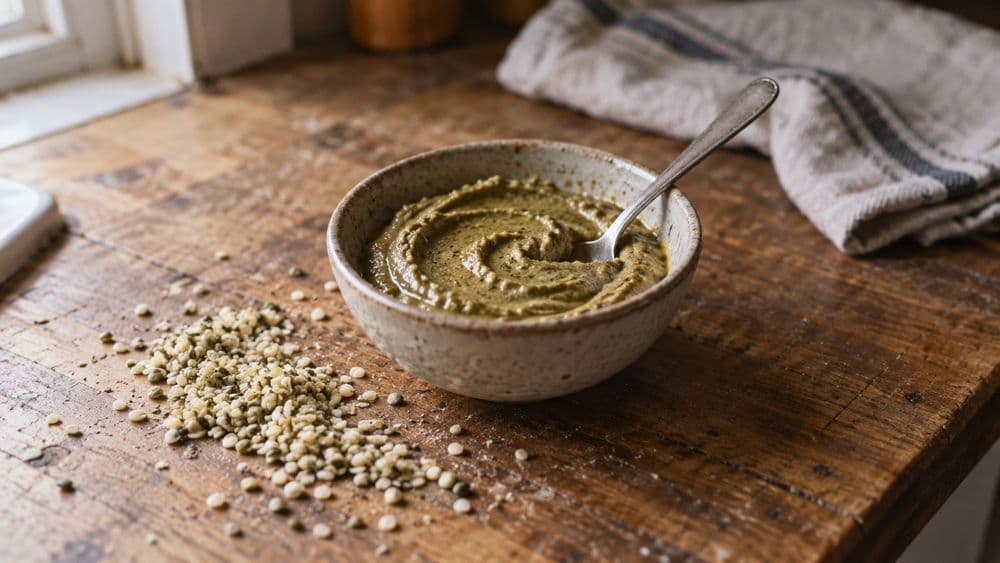
Hemp seed butter is usually hulled hemp seed ground into a spread. It is a food, not a CBD product. By USDA's seed figures it has more protein, iron and magnesium than peanut butter at the same weight, and far less vitamin E. It can carry trace THC, we found no published measurement of a jar, and it is not automatically safe for people with food allergies.
Search for it and you get three things under one name: a green spread, a soap-making ingredient and an edible infused with cannabis. Page one is recipes, shops and soap supplies, and no result we read cites a primary source. This page sets the numbers side by side, reads FDA's 2018 letter down to the line that matters for a jar, and ends with three label checks. This is food composition and label reading, not a health claim.
What hemp seed butter is
Most hemp seed butter is hulled hemp seed ground until the oil loosens it into a paste. Hulling means cracking the seed and removing its coat. The soft kernel left behind is what you buy as hemp hearts, and our gram-for-gram comparison of hemp hearts and chia seeds covers that seed in detail. Hemp seed oil is the pressed fat alone, with its own uses and human trials. The butter keeps protein and fat together. One maker describes the taste as earthy, with wheatgrass notes. The green color is likely chlorophyll, which has been measured in pressed hemp seed oil; we found no source on the color of the spread itself.
That word "most" matters. One US jar lists "organic whole ground hemp seeds", and that is a different food. In a 2010 analysis of commercial hemp products grown in Western Canada, protein came in at 24.0% for whole seed and 35.9% for dehulled seed. If you want the hulled version, look for "hulled" or "hearts" on the ingredient list.
The ingredient list is the only guide you have, because nothing defines this food. The federal standard for peanut butter gives it a recipe: at least 90 percent peanut ingredients by the rule's arithmetic, and no more than 55 percent fat. Part 164 of the same regulations, as we read it in November 2026, has no such entry for almond, sunflower or hemp butter.
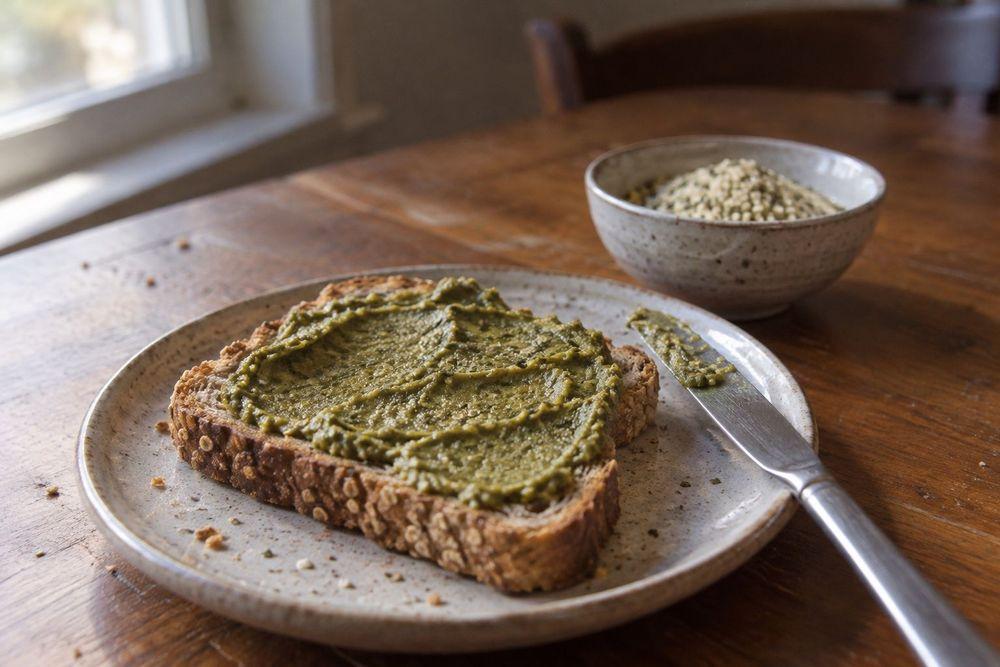
Which hemp butter is this?
Three products answer to nearly the same name, so check which one you are looking at.
| Name on the page | What it is | Where you see it | Is it food? |
|---|---|---|---|
| Edible hemp seed butter | Usually hulled hemp seed, ground. Some jars use whole seed | Grocery and health-food shops | Yes. It is a spread |
| Cosmetic hemp butter | Usually hemp seed oil blended with hydrogenated oil | Soap-supply and skin-care ingredient sites | No. It is a skin ingredient |
| Cannabutter or an infused seed spread | Dairy butter, oil or a spread infused with cannabis | Cannabis recipes and edibles | An edible that can intoxicate, not a seed food |
The cosmetic version is the easiest to land on by accident. One soap-supply listing gives its ingredients as "Cannabis Sativa (Hemp) Seed Oil (and) Hydrogenated Soybean Oil": a skin ingredient sold in the same words as the food, and using hemp seed oil on skin is a separate topic. The infused version is the one to take seriously. If a label gives a THC milligram figure, it is an infused product, not a seed butter.
None of the three is CBD oil. The spread comes from the seed, one small branch of a crop with many uses, and hemp seed products and CBD oil differ mainly in which part of the plant they come from.
Hemp seed butter vs peanut, almond and sunflower butter
Two tablespoons is FDA's reference amount for nut and seed butters. We use 32 grams, the weight USDA gives for peanut butter. Every figure comes from USDA FoodData Central, scaled to 32 grams, with percentages from FDA's Daily Values. USDA has no entry for hemp seed butter, so the hemp column is hulled seed at the same weight. It is the same gap we hit with hemp milk and hemp flour.
| Per 32 g | Hulled hemp seed, not a spread | Peanut butter, smooth | Almond butter | Sunflower seed butter |
|---|---|---|---|---|
| Calories | 177 (seed entry; see note) | 191 | 196 | 197 |
| Protein | 10.1 g (20%) | 7.1 g (14%) | 6.7 g (13%) | 5.5 g (11%) |
| Total fat | 15.6 g | 16.4 g | 17.8 g | 17.7 g |
| Saturated fat | 1.5 g | 3.3 g | 1.3 g | 1.5 g |
| Monounsaturated fat | 1.7 g | 8.3 g | 10.4 g | 12.5 g |
| Polyunsaturated fat | 12.2 g | 4.0 g | 4.4 g | 3.1 g |
| Carbohydrate | 2.8 g | 7.1 g | 6.0 g | 7.5 g |
| Fiber | 1.3 g (5%) | 1.6 g (6%) | 3.3 g (12%) | 1.8 g (7%) |
| Iron | 2.5 mg (14%) | 0.6 mg (3%) | 1.1 mg (6%) | 1.3 mg (7%) |
| Magnesium | 224 mg (53%) | 54 mg (13%) | 89 mg (21%) | 100 mg (24%) |
| Calcium | 22 mg (2%) | 16 mg (1%) | 111 mg (9%) | 20 mg (2%) |
| Vitamin E | 0.3 mg (2%) | 2.9 mg (19%) | 7.7 mg (52%) | 7.3 mg (49%) |
Read across and no spread wins. Hemp leads on protein, iron and magnesium by weight and is lowest in carbohydrate. It is also lowest in fiber in these entries, trails almond butter on calcium, and loses vitamin E by a wide margin, 0.3 mg against 7.7 mg in almond butter. It carries roughly three to four times the polyunsaturated fat of the others, which is mostly a storage fact, covered below. These are amounts, not benefits. Grams of protein also say nothing about protein quality; how hemp protein scores, and why lysine matters, belongs to the seed page.
Treat the hemp column as a sketch. In USDA's entry, protein and fat rest on 17 data points, but magnesium and vitamin E rest on one, and iron, fiber and polyunsaturated fat on two. Peanut butter's magnesium and iron rest on 18. Jars vary too: fiber runs from 1.9 to 3 g per 100 g on two European labels, against 4.0 g in USDA's seed entry, and labels list 2 tablespoons as 28 g or 30 g. Protein is the closest match, with two US brands at 10 g per 2 tablespoons against 10.1 g here. The sunflower entry is NuSun, a mid-oleic seed, which explains its high monounsaturated fat, and USDA notes some brands differ.
The fat, as amounts
- Polyunsaturated share of total fat: hemp 78%, peanut 24%, almond 25%, sunflower 18%.
- Hemp at 32 g: 8.8 g of linoleic acid (an omega-6), 2.8 g of alpha-linolenic acid or ALA (a plant omega-3) and 0.43 g of GLA, another omega-6.
- Peanut butter at 32 g: 0.01 g of ALA.
That works out to about 3 parts omega-6 to 1 part omega-3. A lipid researcher's 2006 review of the ratio and cardiovascular risk concluded it is "of little value" on both theoretical and evidential grounds. That is one author's review, not a guideline, but it is reason enough to treat 3-to-1 as a description rather than a score. ALA is also a plant omega-3, not the EPA and DHA in fish oil; the seed page has the detail.
Does hemp seed butter have THC or CBD?
Trace amounts are possible, so do not assume zero. FDA's cannabis Q&A says "The seeds of the plant do not naturally contain THC or CBD." The next sentences matter as much:
“The hemp seed-derived ingredients that are the subject of these GRAS notices contain only trace amounts of THC and CBD, which the seeds may pick up during harvesting and processing when they are in contact with other parts of the plant. Consumption of these hemp seed-derived ingredients is not capable of making consumers 'high.'”
Two things to hold onto. "Trace" is FDA's word, and it comes with no number. And "these" means the three ingredients in FDA's December 2018 update: hulled hemp seed, hemp seed protein powder and hemp seed oil. So the "high" sentence is about those ingredients, not a finding about 32 grams of a spread that is nearly all seed.
What FDA's letter does and does not cover
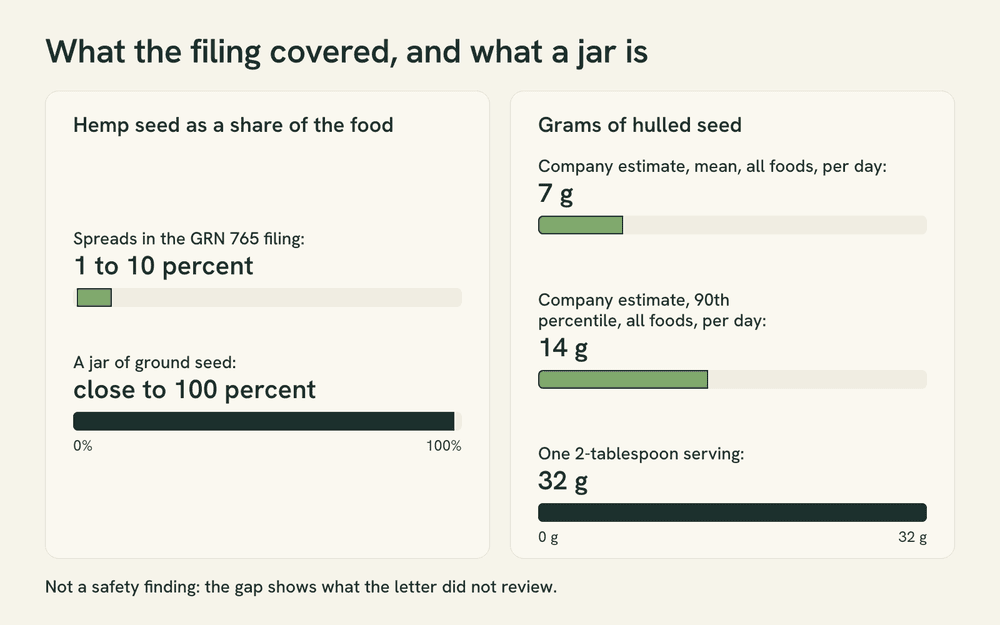
FDA's response letter on GRN 765, dated December 20, 2018, is a "no questions" reply to one company's notice about dehulled hemp seed as an ingredient, at "levels of 1-40%" in foods including spreads. It is not a sign-off: in FDA's words, "This letter is not an affirmation" that the ingredient is generally recognized as safe. FDA's inventory record for the notice names dehulled hemp seed, and we found no notice for a hemp butter in that inventory.
The filing behind that letter, from Fresh Hemp Foods, breaks the range down by food, and it lists "Spreads, salad dressings, etc." at 1 to 10 percent hemp seed. A jar of ground seed is close to 100 percent. That does not make the jar unsafe or unlawful; it means the letter is not a review of it. The intake estimate shows the same gap. The company estimated about 7 grams of hulled seed a day on average and 14 grams at the 90th percentile, across all foods. Two tablespoons of butter is about 32.
The THC figures, and who set each one
Here is what the available figures work out to at 32 grams. All of them are seed figures. We found no published measurement of THC in a jar of hemp seed butter, and nothing shows that grinding removes it, so do not read this as a lab result for your spread.
| Figure | Who set it | THC at 32 g | What it is |
|---|---|---|---|
| 0.3 mg/kg, mean | A footnote in the company's filing to FDA | About 0.01 mg | Mean for hulled seed, printed as 0.3 µg/g. Batches not stated there; Canada-grown seed, before 2019 |
| 0.39 mg/kg median, 3.96 mg/kg 95th percentile | EFSA, the EU food safety agency: 127 hemp seed samples | About 0.01 mg and 0.13 mg | Hemp seed, not spread. Upper-bound figures, before EU limits existed |
| 3.0 mg/kg, maximum | EU law, entry 2.6.2 | At most 0.10 mg | Legal ceiling in the EU, not the US. Counts THC plus 0.877 times THCA |
| 4 mg/kg, specification | The company, for its dehulled seed, THC plus THCA | At most 0.13 mg | One company's spec, not a federal limit |
A specification or a legal maximum is a ceiling, not a measurement. The EFSA row comes from EFSA's 2020 exposure assessment. The European ceiling for ground hemp seed and products derived from it, set in Regulation (EU) 2023/915, is 3.0 mg/kg of THC equivalents. As of November 2026 the United States sets no equivalent number for a seed food: the federal 0.3 percent figure decides what counts as hemp, and it is not a limit written for a finished food.
Seed is also not flower. The line between hemp and marijuana is drawn on the plant, and leaf foods such as hemp tea are a separate THC question from a seed spread.
Drug tests and military service
No food can guarantee a test result. In a 2001 controlled study of 15 THC-naive adults, nobody taking 0.45 mg of THC a day screened positive at the 50 ng/mL cutoff, and one specimen did at 0.6 mg a day. It used blends of hemp and canola oil, not butter, and the products of that year, so it is not a safe-amount line and should not be converted into tablespoons. Our review of hemp seed foods and drug tests covers what that work can and cannot tell you. If you serve, OPSS, the Defense Department's supplement safety program, said in its November 14, 2022 update that "All products containing hemp are prohibited for use by Service Members", and its summary of Army policy names food products.
Allergies: what "nut-free" does not tell you
Some brand pages pitch hemp butter as an option for people with nut allergies or for nut-free schools. Be careful with that. Hemp is not on FDA's list of nine major allergens. That is a labeling rule, not evidence that hemp is low-risk. A "Contains" statement need not mention hemp, though FDA says products with these hemp seed ingredients must declare them by name on the ingredient list. The GRN 765 letter, summarizing the company's notice, records that allergic reactions to hemp seed ingredients "have been documented in the scientific literature", and FDA's own footnote there says "sensitive individuals avoid allergenic foods through product labeling."
Case reports exist, including anaphylaxis: one in 2003 after hempseed and one in a 2024 Italian case series of three people, where a 45-year-old woman reacted five minutes after eating a homemade cake containing hemp flour. She had smoked cannabis before, and the authors hypothesize that sensitization to a cannabis protein, Can s 3, played a role. That was flour in a cake, not butter. These are individual cases, and we found nothing that measures how often this happens. If you hear that hemp is "less allergenic", a 2019 study of hemp protein isolates noted the claim had "never been experimentally verified". If you already react to cannabis, ask an allergist before trying hemp foods.
Two more things "hemp" on a jar does not settle. First, French researchers found possible cross-reactivity with hazelnut in lab tests of patient sera; whether that matters to a person eating hemp seed is not known. Second, the shared line. In June 2021, Canada recalled a raw hemp butter for undeclared cashew. That was one lot in 2021 and says nothing about today's shelves, but the word "hemp" does not rule a nut out. Three jars we read carry a peanut or tree-nut line, and FDA says such statements "are not required by law", so a jar without one proves nothing.
Read the jar: three checks
With no federal recipe and a name shared by three products, the label does the work. Read these lines in order.
- 1The first ingredient. Look for hemp seed, and for "hulled" or "hearts" if you want the numbers above; "whole ground" is a lower-protein food by weight.
- 2What else is in it. Added oil, hydrogenated fat, sugar and salt all change the panel, and nothing limits them the way the peanut butter rule does. Compare panels by weight, not by tablespoon.
- 3The storage and allergen lines. Follow the storage line on your jar, and read any "may contain" or shared-facility line, remembering that those lines are voluntary.
Also check that it is hemp at all. One jar in USDA's branded data, Sunflower Hemp Butter with Hemp Oil (FDC 2283334), reads "dry roasted sunflower seeds, organic sugar, organic hemp oil, salt". The name is honest, but that is a sunflower butter with no hemp seed listed.
Storing it
Storage matters here because of the fat. In USDA's seed entry, 78% of hemp's fat is polyunsaturated, against 18 to 25% in the other three spreads. A 2024 storage study of hemp seed oil says polyunsaturated fats are "particularly prone to oxidation" and describes the oil's "high sensitivity to oxidative and photo-oxidative degradations that can lead to rancidity". That research does not transfer to a shelf-life number, but the fat is the same fat. We found no study of how hemp seed butter itself keeps, so we give no months figure.
Labels differ. Three of the four jars we read tell you to refrigerate, two of them after opening, while one European jar says a cool, dry place away from light. Follow yours. Expect the oil to separate, as one label says plainly: "Stir it up! Natural oils separate." The same oil study says oxidation can produce off-flavors, so discard a jar that smells or tastes off. A normal smell proves nothing, though: the study describes the first oxidation products as odorless.
Making it at home
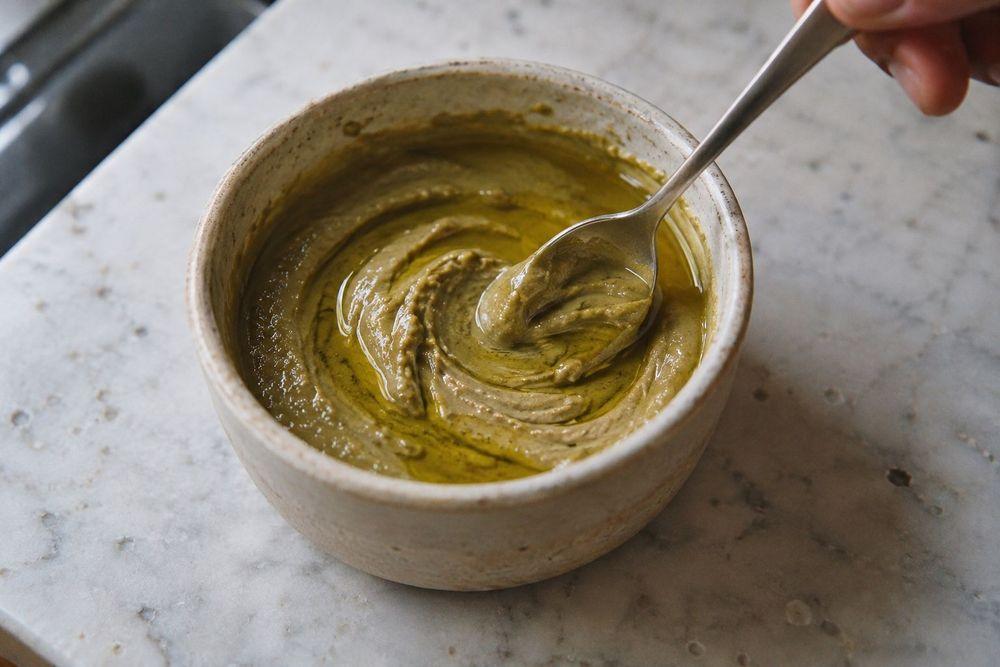
It takes one ingredient. Blend hulled seeds, scraping down the sides, until the oil releases; one recipe we read took 5 to 6 minutes. A little neutral oil may be added. Keep it in the fridge. Your homemade spread has the same seed questions as a jar, on THC and on allergies.
What we could not find
PubMed searches on November 5, 2026 for hemp seed butter and paste terms, and for THC in hemp food spreads, returned 0 records. That is a search result, not proof that nothing exists. We also found no USDA entry for hemp seed butter, no THC measurement of a jar, no study of how the spread keeps and no rate for hemp seed allergy, and we make no health claim because no study we found tested this food. What the record does support is practical: know which hemp butter you have, read the ingredient list, and do not assume about THC or allergens.
Frequently asked questions
Here is what is in it rather than a verdict. At 32 g, USDA's hulled seed entry shows 10.1 g of protein, 224 mg of magnesium (53% of the Daily Value, from one data point), 12.2 g of polyunsaturated fat and only 0.3 mg of vitamin E. We found no study of hemp seed butter itself. Whether it fits your diet is your call, and a dietitian can help.
Trace amounts are possible, so do not assume zero. FDA says the seeds do not naturally contain THC or CBD, and that the three hemp seed ingredients in its 2018 notices contain only trace amounts, which the seeds may pick up during harvesting and processing. We found no published measurement of a jar.
FDA says the hemp seed ingredients in its 2018 notices are not capable of making consumers 'high'. That is about those ingredients. The filing behind the hulled seed letter lists spreads at 1 to 10 percent, so the statement is not a finding about a 100% jar, which does not make the jar unsafe or unlawful. If a label gives a THC milligram figure, it is an infused product and a different thing.
No one can promise either way. No food can guarantee a test result, we found no published measurement of a jar, and a 2001 controlled study on the question used hemp and canola oil blends, not butter. If you are tested for work, sport or treatment, weigh that before making it a daily food. OPSS, as of its 2022 update, says all hemp products are prohibited for service members.
By weight, yes on the data we have: 10.1 g against 7.1 g per 32 g, comparing USDA's hulled seed entry with smooth peanut butter. Two US brands show about 10 g per 2 tablespoons, which is in the same range. A jar made from whole seed will be lower.
We cannot say that it is. Jars can share lines with nuts, three jars we read carry a peanut or tree-nut line, those lines are voluntary, and a hemp butter was recalled in Canada in 2021 for undeclared cashew. Ask your allergist before trying it.
Follow your label. Most jars we read say to refrigerate, and one European jar says a cool, dry place. Its fat is mostly polyunsaturated, which is prone to oxidation, and we found no study giving a shelf life for the spread.
On our reading of the 2025 federal hemp law, foods made from hemp grain, oil, cake, nut or hull will count as industrial hemp, and the new limits are written for cannabinoid products made from hemp other than industrial hemp. A 2026 law, Public Law 119-103, splits that section's start into two steps, November 12 and December 11, 2026. As of November 2026 we know of no agency guidance on seed foods. This is our reading, not legal advice.
If you came here looking for CBD, a seed food is not where it is. Hemp seed butter, hemp hearts and hemp seed oil all come from the seed, and CBD oil comes from a different part of the plant. For CBD itself, start with what human research has and has not shown.
Writing about hemp, wellness and the small rituals that keep us balanced.