Kava and Weed: What the Labels, Liver Warnings and Driving Data Say
No study has measured what happens when people take kava and THC together. Here is what is known instead: a THC label's warning about stacking sedating drugs, an enzyme kava blocks in a dish, kava's own crash data and its liver warnings.

You drink kava, maybe at a kava bar, and you also use weed. Is mixing kava and weed a bad idea? Here is the short answer as of November 13, 2026. No human study has measured what happens to THC or to kava when the two are taken together, and no clinical trial of the pair is registered. What does exist: a THC prescription label that warns other sedating drugs can add to its impairment, lab-dish work showing kava extract blocks the enzyme that activates THC, and a real driving record for kava on its own. That adds up to reasons for caution, not a verdict either way. This is general information for adults 21 and over where cannabis is legal under state law, not medical advice.
This page is about THC, the compound in cannabis that makes you high. If your question is CBD with kava, our guide to CBD and kava covers that pairing, along with what kava is and the long history of its liver warnings. Here we sort what is known into three piles, because most pages on this topic blend them together: what was measured in people, what was seen in lab dishes, and what an interaction checker inferred from the two.
Two different plants, one shared effect
Kava is a drink made from the root of Piper methysticum, a pepper plant grown across the Pacific islands. Its active compounds are called kavalactones, and they are not cannabinoids. According to the NIH's National Center for Complementary and Integrative Health, kava can cause digestive upset, headache and dizziness, has been linked to "rare cases of liver injury, some of which have been serious or even fatal," and "should not be used together with other substances that have sedative effects, such as benzodiazepines or alcohol." That page does not mention cannabis either way.
THC works mainly through CB1 receptors in the brain, and the prescription label for synthetic THC warns that it can impair your ability to drive. The overlap that matters is not the mechanism. It is the result: both can leave you drowsy, dizzy and slower to react, and effects like that can add up when you take more than one sedating substance. Our gabapentin and weed guide walks through how stacking sedating drugs works in general, and whether weed counts as a depressant has its own page.
The closest official warning sits on a THC prescription label
Dronabinol is synthetic THC, sold by prescription as MARINOL capsules and SYNDROS oral solution. The MARINOL prescribing information on DailyMed (page marked "Revised: 1/2023") warns in section 5.1 that dronabinol can impair the abilities needed to drive a motor vehicle or operate machinery, and that other drugs that cause dizziness, confusion, sedation or somnolence, "such as CNS depressants may increase this effect." The same passage lists examples: barbiturates, benzodiazepines, ethanol (alcohol), lithium, opioids, buspirone, scopolamine, antihistamines, tricyclic antidepressants, other anticholinergic agents and muscle relaxants. Section 7.1 puts the interaction in one sentence:
“Additive CNS effects (e.g., dizziness, confusion, sedation, somnolence) may occur when MARINOL is taken concomitantly with drugs that have similar effects on the central nervous system such as CNS depressants.”
Kava is not on that list. We checked: the word "kava" appears zero times in the MARINOL label and zero times in the SYNDROS label (November 13, 2026). So the FDA has not warned about kava and THC as a pair. The link is an inference, made by interaction checkers from what kava is known to do. Drugs.com, a widely used checker, rates prescription dronabinol with kava as "moderate" for added dizziness, drowsiness, confusion and trouble concentrating, and notes that its ratings are only a guideline. That rating covers a prescription capsule, not flower, vapes or edibles, and no study sits behind it. For what a moderate rating does and does not tell you, see how we read interaction ratings in our Zoloft and weed guide.
The enzyme question, checked both ways
Your liver activates THC. The same dronabinol label, in section 12.3, says "CYP2C9 appears to be the enzyme responsible for the formation of the primary active metabolite," which is 11-hydroxy-THC, and, citing published in vitro data, it names CYP2C9 and CYP3A4 as the primary enzymes in dronabinol's metabolism. Our explainer on 11-hydroxy-THC covers what that metabolite does. Lab work agrees on the first point: in a 2019 study using pooled human liver microsomes, CYP2C9 accounted for nearly all formation of THC's active metabolite.
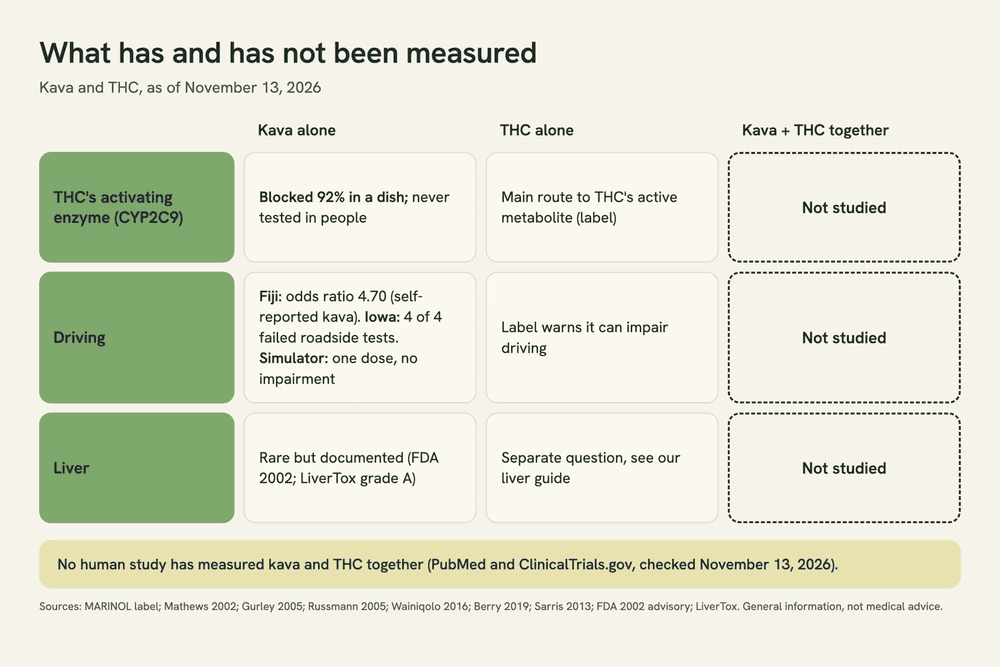
Now kava. In a 2002 study in human liver microsomes, which are enzyme preparations made from donated liver tissue, a whole kava extract blocked CYP2C9 by 92%, CYP2C19 by 86%, CYP3A4 by 78%, CYP2D6 by 73% and CYP1A2 by 56%, and left CYP2A6, CYP2C8 and CYP2E1 unaffected. Kavain, the best-known kavalactone, did not inhibit the enzymes on its own; methysticin and dihydromethysticin did. The authors wrote that kava had a "high potential for causing drug interactions." Read those numbers with the setup attached: an organic solvent extract, at test-tube concentrations, in a dish. A dish is not a person.
What happens in people? Two small probe-drug studies have checked, using test medicines that each report on one enzyme. In a 2005 study of 12 healthy volunteers who took a kava supplement for 28 days, only one of the four enzymes tested moved: CYP2E1 dropped by about 40%, with no significant change in CYP1A2, CYP2D6 or CYP3A4. In a second 2005 study, six regular drinkers of traditional water-based kava in New Caledonia showed slower CYP1A2 and, according to FDA's 2020 review of the published kava literature, no effect on CYP2C19, CYP2D6, CYP2E1 or CYP3A4. Notice the mismatch. CYP2E1 was untouched in the 2002 dish study and was the one enzyme that fell in the volunteers. And CYP2C9, the enzyme kava hit hardest in the dish and the one THC relies on most, was not tested in either study.
NIH's LiverTox, the federal reference on drug-induced liver injury, sums up the kava enzyme research in one sentence: "Although in vitro studies suggest that kavalactones inhibit several cytochrome P450 isoenzymes, human studies suggest that it is a inhibitor of CYP 2E1 alone, and that its effects are modest." That chapter was last updated in April 2018. We found no human study since that has tested CYP2C9 with kava.
| Enzyme | Role for THC | Kava extract in a dish | Kava in people |
|---|---|---|---|
| CYP2C9 | Main route to THC's active metabolite | Blocked 92% | Never tested |
| CYP3A4 | Second route named on the dronabinol label | Blocked 78% | No significant change in either study |
| CYP2C19 | Not named on the label for THC | Blocked 86% | No effect in 6 traditional drinkers; not tested in the 12 |
| CYP2D6 | Not named on the label for THC | Blocked 73% | No significant change in either study |
| CYP1A2 | Not named on the label for THC | Blocked 56% | Slowed in 6 traditional drinkers; no significant change in 12 supplement users |
| CYP2E1 | Not named on the label for THC | Not affected | Down about 40% in 12 supplement users; no effect in 6 traditional drinkers |
Why this question is sharpest for edibles is an inference, not a finding. The dronabinol label says swallowed THC is 90% to 95% absorbed, but only 10% to 20% reaches your bloodstream, because the liver processes so much of it on the first pass. If a liver-enzyme effect from kava mattered at all, swallowed THC is where it would show first. Nobody has checked whether it does, so this is not a claim that kava makes edibles stronger. Run the other way, THC itself inhibited CYP1A2, CYP2B6, CYP2C9 and CYP2D6 in a 2021 study using engineered enzyme preparations, and no one has measured kavalactone levels in people who use cannabis. Put together, this is a gap, not a risk finding and not a reassurance. Our guide to CBD and medications explains the CYP enzyme system in more depth.
Kava has a driving record of its own
This is where the real-world risk lives, and it is the part the pages we read on this topic skip. As recently as 2015, a systematic review of kava and road crashes found no study that had quantified kava's effect on crashes. Four simulator studies had found no significant impairment, with weak evidence of slower reaction times, and one found impairment when kava was taken with alcohol. The reviewers concluded that kava's contribution to motor vehicle crashes was "unknown." Several studies have been published since.
The one that measured crash risk directly is a population-based case-control study from Fiji, published in 2016. Researchers compared 140 drivers involved in serious-injury crashes on the island of Viti Levu, between July 2005 and December 2006, with 752 control drivers. Of the crash drivers, 23% reported drinking kava in the previous 12 hours, against 4% of the control drivers. After adjusting for alcohol, speed and other factors, kava drinkers had about four to five times the odds of a serious-injury crash (adjusted odds ratio 4.70, 95% confidence interval 1.90 to 11.63). The limits are real: kava use was self-reported and never measured in blood, amounts were not standardized, and Fiji is a setting with heavy traditional drinking. It shows an association, not proof that kava caused the crashes.
Closer to home, an Iowa crime lab described four drivers stopped between November 2011 and April 2018 after drinking kava. According to the lab's 2019 conference abstract on the cases, all four failed standardized field sobriety tests and showed horizontal gaze nystagmus, an involuntary jerking of the eyes that officers check at the roadside. Standard urine immunoassay screens were negative for common drugs, and kava compounds turned up in two of the drivers only when the lab looked for them specifically. One driver had alcohol below 0.02 g/dL. The drug recognition experts judged each driver to be under the influence of a central nervous system depressant, although the published paper notes the drivers also showed signs officers associate with other drug categories. Four selected cases with no blood testing prove little on their own, but they show what kava impairment looked like at the roadside in these cases.
Controlled studies are mixed. In a 2013 randomized, double-blind crossover trial of 22 adults, a single medicinal-strength kava dose did not impair simulated driving compared with placebo, while the sedative oxazepam slowed braking. The authors said larger recreational amounts still needed testing. Two later studies looked at traditional sessions. In a 2020 study of 20 kava drinkers and 20 controls, standard traffic-psychology tests after a six-hour session showed no statistically significant difference, even though observers saw the drinkers' movement and speech slow down. A 2022 follow-up with 20 drinkers and 19 controls found one significant decline at the end of the session, in temporal order judgement (telling which of two events came first, a skill tied to the executive function driving relies on), and no significant change in five other areas.
None of these studies included cannabis. For what research shows on the THC side, see what the research says about THC, CBD and driving. Setting the two records side by side does not tell you what the combination does. It does tell you that each one, on its own, has been linked to impaired driving.
Your liver: two separate questions, no combined answer
Kava's liver history is why many people know its name. The FDA's March 25, 2002 consumer advisory, which the agency no longer hosts, warned of potential severe liver injury from kava-containing dietary supplements, said in the same document that "liver damage appears to be rare," and advised that people with liver disease or liver problems, or who take drug products that can affect the liver, consult a physician before using kava supplements. In its 2020 memorandum, FDA's food-additive office concluded that indiscriminate use of kava as a recreational or relaxation beverage is not safe, and that kava is an unapproved food additive in conventional foods. Kava is still sold in the US as a dietary supplement. Neither document is a ban.
LiverTox gives kava its top likelihood grade, A, which means a well-known cause of clinically apparent liver injury. In the same paragraph it estimates the frequency at less than 1 in 1,000,000 daily doses, notes that spontaneous reporting is believed to capture less than 1% of severe adverse events from dietary supplements, and records that advocates of the herb strongly reject those numbers. When injury happens, it typically appears 2 to 24 weeks after starting kava. Our CBD and turmeric guide explains what an A grade does and does not mean. And in a 2026 MMWR report by University of Virginia toxicologists, covering 26 years of US poison-center data, a moderate rise in liver enzymes (AST/ALT) was recorded in 1.7% of kava-only exposures and 6.3% of exposures involving both kava and kratom.
Cannabis and the liver is its own question, with its own evidence, covered in is weed bad for your liver? No study has tested kava and THC together for liver effects, so there is no combined answer to give. If you have liver disease, a history of liver problems, or take medicines that affect the liver, the FDA's advice to talk to a physician before using kava applies whatever else you use.
What else may be on the menu at a kava bar
The MMWR report notes that kava is sold "through retail outlets and dedicated kava bars," and that commercial products can carry kavalactones at "2-10 times" the concentrations found in traditional preparations. From 2000 to 2025, US poison centers logged 3,101 kava exposure reports, 203 of them in 2025. The share with serious medical outcomes rose from 12% in 2000 to a high of 39% in 2024, and eight deaths were reported over the whole period. Reporting is voluntary, a report is a call rather than a count of users, and the data cannot separate product types.
The report's main finding is about kratom. Kratom emerged as a common co-exposure in kava reports in 2017, overtook alcohol and benzodiazepines in multiple-substance kava exposures by 2019, and in 2025 appeared in 61 of the year's 203 kava reports, about 30%. Cannabis is not named in the report at all. If you are offered kratom alongside kava, our kratom and weed guide covers that pairing with THC.
Some menus may also list hemp-derived THC drinks. We have no data on how common that is, so treat it as something to check, not an assumption. Federal hemp rules are changing. Starting November 12, 2026, products containing cannabinoids that a cannabis plant cannot naturally produce fall outside the federal definition of hemp, and the rest of the new definition, including a total-THC standard, is set to apply on December 11, 2026 (federal status last checked November 13, 2026). State law varies, and THC products are for adults 21 and over. Are THC drinks legal? tracks the rules for drinks, and our explainer on the 2026 hemp ban covers the federal change. This is general information, not legal advice. Before you order, read the menu and the label for three things:
- Traditional kava or an extract? The MMWR report notes commercial products can carry 2 to 10 times the kavalactone concentrations of traditional preparations.
- Kratom or mitragynine? The MMWR report ties the recent rise in kava poison-center reports to kava products that also contain kratom.
- THC? A THC drink is a second impairing substance on top of the kava. Check the label's THC content and whether the product is legal where you are.
Before you combine them: a checklist
None of the evidence gives a safe amount, a ratio or a waiting time, and we will not invent one. What the sources do support is a short list of situations that raise the stakes. Each line below traces to a document named on this page.
- 1Other sedating substances. The dronabinol label lists alcohol, benzodiazepines, opioids, antihistamines and muscle relaxants among drugs that add to THC's effects; NIH says not to combine kava with sedatives like benzodiazepines or alcohol.
- 2Driving or machinery. The dronabinol label warns that THC can impair driving, and kava has its own crash and roadside-test record. Plan not to drive after using either one, let alone both.
- 3Liver history or liver-affecting medicines. FDA's kava advisory says people with liver disease or liver problems, or who take drugs that can affect the liver, should consult a physician before using kava.
- 4Prescription medicines. Kava blocks several drug-processing enzymes in a dish, and the human data are thin. Bring your medicine list, your kava product and your cannabis product to a pharmacist and ask.
- 5Edibles. Swallowed THC is heavily processed by the liver before it reaches your blood, which is where an enzyme effect would show if one exists. No one has measured it, so the question is open.
- 6Age and the law. THC is for adults 21 and over where it is legal under state law, and the federal hemp definition is changing in two steps, on November 12 and December 11, 2026.
If something goes wrong, the line between an emergency and a phone call matters. The split below follows MedlinePlus's list of medical emergency warning signs, the symptom list in the FDA's kava advisory, and Poison Help, the national line for exposure questions.
What the evidence does not show
On November 13, 2026, a PubMed search for kava with cannabis, THC, marijuana or dronabinol returned 35 records. The 7 that touched on interactions or pharmacokinetics were surveys, reviews and lab work, and none gave people both substances. A filter for clinical trials returned none, and ClinicalTrials.gov lists no registered trial of the pair. So nobody has measured THC levels with kava, or kavalactone levels with THC. No driving study we found has included both. CYP2C9 has not been tested in people taking kava. The Iowa cases are four selected drivers, and the Fiji study relies on self-report. We also found no source on how often people combine the two.
None of this means the combination is harmless, and none of it means it is dangerous. It means the question has not been studied, and the documented effects of each substance on its own are what you have to go on. Those effects point the same way: more drowsiness, slower reactions, and a reason to keep the car keys out of reach.
Kava and weed: questions people ask
No study has measured what happens when people take them together, so nobody can give you a tested answer either way. Both can cause drowsiness, dizziness and slower reactions. The dronabinol label warns that other sedating drugs can add to THC's effects, NIH advises against combining kava with other sedating substances, and an interaction checker rates prescription THC with kava "moderate". If you take prescription medicines or have liver problems, talk to a pharmacist or doctor first.
They are different plants with different active compounds: kavalactones in kava, cannabinoids such as THC in cannabis. In the Iowa driving cases, drug recognition experts judged the drivers to be under the influence of a central nervous system depressant, though the published paper notes signs of other drug categories too. One kavalactone, yangonin, binds the CB1 receptor that THC acts on, but only in a lab dish; that does not show kava acts like THC in people.
The research is mixed, but the real-world data point one way. In Fiji, drivers who reported kava in the previous 12 hours had about 4.7 times the odds of a serious-injury crash (use was self-reported). Four Iowa drivers stopped after kava all failed roadside sobriety tests. A single medicinal-strength dose did not impair driving in a 22-person simulator trial, and recreational amounts were not tested there. Add THC and the dronabinol label's driving warning applies too. Do not drive.
Unknown. Your liver activates swallowed THC mainly through CYP2C9, and kava extract blocked that enzyme by 92% in a lab dish. But we found no study that tested CYP2C9 in people taking kava, and none has measured THC levels with kava. The question is sharpest for edibles because the liver processes so much swallowed THC on the first pass, but it has not been answered.
Liver injury from kava is rare but documented. The FDA warned about it in 2002 while saying liver damage appears to be rare. LiverTox grades kava A, estimates fewer than 1 case per 1,000,000 daily doses, notes that probably under 1% of severe events from supplements are reported, and records that advocates dispute the numbers. People with liver disease or on liver-affecting medicines should talk to a physician first. Cannabis and the liver is covered in our separate guide.
In the Iowa cases, standard urine immunoassay screens were negative for common drugs, and kava compounds were found only with targeted lab tests (GC/MS and LC-MS/MS). We found no source showing that kava changes a THC test result in either direction, so do not count on it to cause or prevent a positive.
Kava is one of many things people use alongside cannabis. For how cannabinoids meet medicines and supplements through the same liver enzymes, read our guide to CBD and medications. For a prescription example of stacking a sedating drug with THC, see gabapentin and weed.
Writing about hemp, wellness and the small rituals that keep us balanced.