Does CBD Cause Headaches? What the Placebo Arm Says
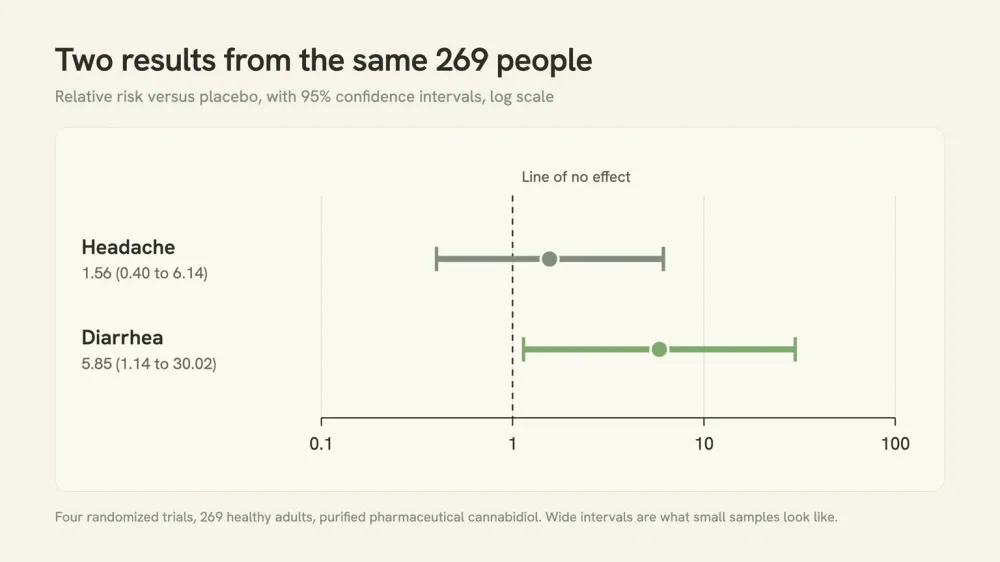
Page one says no clinical trials indicate CBD causes headaches. Four placebo-controlled trials counted them in both arms, and a 2026 meta-analysis pooled the result at a relative risk of 1.56 with a 95% confidence interval from 0.40 to 6.14. Here is every number, and its limit.
Page one of this search says there are no clinical trials indicating that CBD causes headaches. That is checkable, and it is wrong. Four randomized placebo-controlled trials counted headaches in a cannabidiol arm and in a placebo arm, a 2026 meta-analysis pooled them with headache as its declared primary outcome, and the prescribing information for the only FDA-approved cannabidiol drug does not contain the word at all. Here is every number, with the placebo denominators attached.
The short answer is that nobody can tell you yet, and the reason is more useful than the answer would have been. "Does X cause Y" is not settled by counting the people who took X and then got Y. It is settled by comparing them against the people who took nothing and got Y anyway, which for headache is a great many people. That comparison has now been run on cannabidiol four times, across 269 healthy adults, and the result came back too wide to read in either direction. This page stays on that one effect and takes it from the evidence down to a method you can run yourself. The wider list of what CBD does to people lives in our roundup of CBD side effects, and if you are still working out what cannabidiol actually is, start there and come back.
Why "some people report headaches" is not evidence, and what is
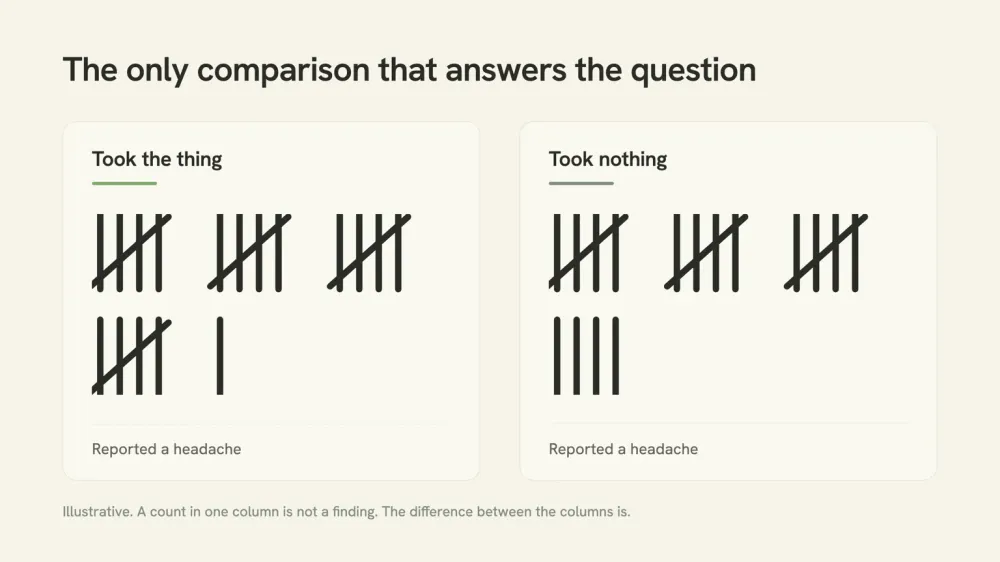
Start with a definition that most product pages skip. In a clinical trial, an adverse event is anything unpleasant that happens to a participant while the trial is running, whether or not the study drug had anything to do with it. A sunburn is an adverse event. So is a bruise at the spot where blood was drawn. Investigators write them all down, because the only way to find out which ones the drug actually caused is to record them in both groups and then look at the difference. That is why a side-effect count with no placebo column beside it is not yet a finding, and it is the most useful single thing to know when you read anything at all about side effects.
So how big is the background? The largest clean measurement of it comes from vaccine research, not from CBD, and it has to be read as vaccine research. A 2022 meta-analysis in JAMA Network Open pooled 12 randomized COVID-19 vaccine trials covering 45,380 participants, of whom 22,578 received a placebo injection. After the first dose, 35.2% of those vaccine-trial placebo recipients reported a systemic adverse event, and the single most common one was headache, at 19.3% (95% confidence interval 13.6% to 25.1%). Roughly one placebo recipient in five reported a headache in a vaccine trial after receiving no vaccine at all. That number describes injections in vaccine trials using solicited symptom checklists, and it says nothing whatsoever about CBD. What it establishes is the principle: a symptom that common in a placebo arm cannot be pinned on anything without a placebo arm to compare it against.
Here is what happens when that comparison is not available. A 2023 randomized trial of cannabidiol in adults recruited at one academic center because they already had a diagnosed digestive condition reports, in its abstract, that the most common adverse events included headache in 8 patients. Eight patients out of how many, in which arm? The trial's results posting on ClinicalTrials.gov uses a 5% reporting threshold and lists only three non-serious adverse-event terms: diarrhea, fatigue and nausea. Headache is not in the registry table, so those 8 headaches cannot be split into cannabidiol and placebo by any public document that exists. The sentence "eight patients had headaches in a CBD trial" therefore carries no information at all. The appetite question makes the same point about a different symptom, and it is the habit worth stealing from this page: when you meet a side-effect number, look for the column next to it before you look at the number.
What the placebo-controlled trials counted
Four randomized trials have counted headache in a cannabidiol arm and a placebo arm. Three of them are worth going through in detail, and a fifth trial, which is not part of that set, belongs at the end of this section because of how strange its placebo arm turned out to be. The largest and most recent of the four belongs to the FDA. In 2025 the agency's Division of Applied Regulatory Science ran a randomized, double-blind, placebo-controlled trial in 201 healthy adults with a median age of 36, giving cannabidiol as an oral solution at 2.5 mg per kilogram twice a day, which is 5 mg/kg/day, for 28 days. The paper it produced is paywalled, and the text that can be retrieved from it contains no headache data at all. The counts live somewhere else: in the trial's registered results on ClinicalTrials.gov, which posts every event at a frequency threshold of zero. In the placebo-controlled part of that trial, headache: 4 of 151 participants on cannabidiol and 0 of 50 on placebo. The registry prints no percentage for that row, and four events is four events, with no confidence interval and no statistical test attached. Worth noticing in the same table: the placebo arm was not event-free. It recorded two upper respiratory infections, two cases of insomnia, a viral syndrome, back pain, cervical lymphadenopathy, a sunburn, a hematoma at a blood-draw site and nasal congestion.
Two phase 1 trials in healthy adults go back further and dosed far higher. A 2018 trial in CNS Drugs gave single doses of 1,500, 3,000, 4,500 or 6,000 mg of purified cannabidiol to groups of six, against a placebo group of eight, and reported headache in 8 of 24 people on cannabidiol (33%) against 0 of 8 on placebo. Its multiple-dose arm gave 750 or 1,500 mg twice daily and reported headache in 8 of 18 (44%) against 0 of 6 on placebo. Read those placebo denominators before you read anything else: eight people, and six people. Zero out of eight is not evidence of zero risk, it is a very small denominator, and it is exactly why the pooled estimate further down is so wide. Then a 2020 trial in the European Journal of Drug Metabolism and Pharmacokinetics gave 5, 10 or 20 mg/kg of a lipid-based cannabidiol formulation to 24 healthy volunteers after a high-fat meal and reported headache in 3 of 18 on cannabidiol and 1 of 6 on placebo: 17% in each arm, identical. Its investigators judged one of those headaches related to cannabidiol, and judged the single moderate one unrelated. Both trials also appear in our guide to how much CBD is too much, where they are used for a different argument.
One more trial is stranger than any of those, and it is the one that should make you cautious about the whole set. A randomized trial published in Epilepsy and Behavior in 2020 gave 30 healthy volunteers 750 mg of purified cannabidiol twice daily for four weeks, then randomized them to two more weeks of either cannabidiol or matching placebo, in order to look for a withdrawal syndrome. It did not find one. In the placebo arm of twelve people, 9 volunteers (75%) reported an adverse event of any cause, and the most commonly reported was headache, at 58%. That is a placebo arm in which more than half the people reported a headache. It is also not a naive placebo arm, because everyone in it had been taking 1,500 mg of cannabidiol a day for the four weeks immediately before, and the trial's own conclusion is that no withdrawal syndrome was found. So it cannot be read as a background rate, and it cannot be read as withdrawal either. It can be read as a warning about how noisy this measurement is. It is also not one of the four trials in the pooled analysis further down, which is worth holding on to when you get there.
| Trial | Who was in it | What they took | Headache, CBD arm | Headache, placebo arm | The catch |
|---|---|---|---|---|---|
| FDA 2025, registry record NCT06192589 | 201 healthy adults, median age 36 | 5 mg/kg/day for 28 days | 4 of 151 | 0 of 50 | Four events. The registry prints no percentage, no interval and no test |
| Phase 1, 2018, single-dose arm | Healthy adults in groups of six | 1,500 to 6,000 mg, once | 8 of 24 (33%) | 0 of 8 | The placebo arm is eight people |
| Phase 1, 2018, multiple-dose arm | Healthy adults in groups of nine | 750 or 1,500 mg twice daily | 8 of 18 (44%) | 0 of 6 | The placebo arm is six people |
| Phase 1, 2020, fed state | 24 healthy volunteers, mean age 24 | 5, 10 or 20 mg/kg once, after a high-fat meal | 3 of 18 (17%) | 1 of 6 (17%) | Identical rates. One event in six is arithmetic, not statistics |
| Withdrawal trial, 2020 | 30 healthy volunteers | 1,500 mg a day for 4 weeks, then placebo for 2 | Not applicable | 58% of an arm of 12, the arm's most common event | Everyone in that placebo arm had taken cannabidiol for four weeks first, and it is not in the pooled analysis |
One property runs through all four, and it matters more than any single count in the table. Every one of these trials used purified pharmaceutical cannabidiol, and the amounts are not consumer amounts: 5 mg/kg/day works out at roughly 350 mg a day for a 70 kg adult, and the 2018 single-dose arm went up to 6,000 mg in one sitting under medical supervision. Nobody has run a placebo-controlled trial of a consumer hemp product and counted headaches. Those figures are here to characterize the evidence, not to suggest anything: this page publishes no amount of its own, and our dosage guide is where amounts belong.
The pooled number, and what "not statistically significant" actually means
In March 2026 a systematic review and meta-analysis did the thing nobody on page one has noticed: it made headache its primary outcome. Published in Annals of Medicine and Surgery, pre-registered on PROSPERO, following PRISMA and assessed with the Cochrane risk-of-bias tool, it pooled four randomized trials covering 269 healthy adults aged 18 to 55, at doses running from 1,500 to 6,000 mg or 5 to 20 mg/kg, with follow-up between 7 and 35 days. Three of those four are the trials described above: the FDA trial, the 2018 phase 1 trial and the 2020 fed-state trial. The fourth is a smaller 2019 randomized trial in 13 healthy men who took cannabidiol for seven days, and its per-arm counts are not reproduced here. The withdrawal trial further up is not in the pool. Headache, in the review's own words, "was reported by all four included studies". The pooled result: a relative risk of 1.56, with a 95% confidence interval from 0.40 to 6.14, a P value of 0.53, and heterogeneity of 7%. The authors state that the research received no external funding and declare no conflict of interest.
Now the sentence that decides how you should read the rest of this page. A relative risk of 1.56 with an interval running from 0.40 to 6.14 is not a finding that CBD causes 56% more headaches. It is a measurement of how little anyone knows. The interval includes 0.40, which would mean headache is less than half as common on cannabidiol as on placebo. It also includes 6.14, which would mean it is six times as common. And 269 people spread across four small trials cannot tell those two worlds apart. "Not statistically significant" here does not mean "no effect". It means the evidence was not big enough to detect an effect if one exists, and not big enough to rule one out either. Anybody who converts that into a yes or a no is adding something the data did not supply.
The proof that the method works sits inside the same analysis. Using the same four trials and the same 269 people, diarrhea came out at a relative risk of 5.85, with a 95% confidence interval from 1.14 to 30.02, a P value of 0.03 and zero heterogeneity. That interval is enormous as well, because 269 people is 269 people, but it does not cross 1, so the signal separated from placebo. Abdominal pain (3.60), upper respiratory infection (1.38), dizziness (1.00) and fatigue (0.62) did not separate. So this is not a machine that returns "inconclusive" for everything you feed it. On this sample, for this one symptom, it returned inconclusive. The digestive side of that result, including the numbers from a different trial registry and the arithmetic on carrier oil, is treated properly on our page about CBD and diarrhea.
One more absence is worth naming, because it is the paper you would expect to settle this. The first meta-analysis of cannabidiol's adverse effects, published in Neuropsychopharmacology in 2020, pooled 12 double-blind randomized placebo-controlled trials across all medical indications, covering 803 participants, and reported odds ratios against placebo for ten outcomes: withdrawal for any reason, withdrawal due to adverse events, any serious adverse event, abnormal liver function tests, pneumonia, any adverse event, decreased appetite, diarrhea, somnolence and sedation. Headache is not among them. We searched its full text on August 14, 2026 for the string "headach", case-insensitive, across 36,026 characters after stripping the markup, and got zero hits, while the controls in the same pass returned somnolence 4 times and placebo 30 times, which is how we know the search was working. That absence is missing data, not a null result. The trials it pooled did not report enough headache to analyze, and "it did not analyze headache" is a different sentence from "it found no headache signal". Every page that quietly upgrades the first into the second is telling you something the paper never said.
The document check nobody on page one ran
The FDA has approved exactly one cannabidiol drug product, and has done since 2018: a prescription oral solution for rare, severe seizure disorders. We re-queried the agency's own drug application database on August 14, 2026, and it still returns a single application for cannabidiol as an active ingredient. Its prescribing information is public, it runs to tens of thousands of words, and because that is the only approved cannabidiol product, its label is the only cannabidiol labeling in which a regulator has tabulated adverse reactions with a placebo column beside them. It is hosted on the National Library of Medicine's DailyMed. Here is the check, with its counting rule, so that you or anyone else can re-run it and get the same answer. On August 14, 2026 we downloaded the full structured product label XML for setid 8bf27097-4870-43fb-94f0-f3d0871d1eec, version 35, effective May 29, 2026, stripped every tag, unescaped the HTML entities and collapsed the whitespace, which left 89,739 characters. A case-insensitive count of "headache" returned 0. So did cephalalgia, migraine and head pain. In the same pass, somnolence returned 18, sedation 13, diarrhea 7, vomiting 7, fatigue 6, rash 6, insomnia 4, and the phrase "adverse reactions" 28. Those controls are the point: they show the extraction worked, so the zero is a real zero and not a broken script.
Then the limit, in the same breath, because the label prints the rule that produced that zero. Tables 3 and 4 of section 6.1 each carry the same sentence: they list "the adverse reactions that were reported in at least 3% of EPIDIOLEX-treated patients, and at a rate greater than those on placebo". Read that twice. A reaction is missing from those tables if it happened in fewer than 3% of treated patients, or if it happened at no greater a rate than on placebo, and the table cannot tell you which of the two applies. So the zero is equally compatible with "headache was uncommon in this program" and with "headache happened just as often on placebo", and there is no way to distinguish them from the document. For contrast, the reactions that did clear both bars at 10% or more were somnolence, decreased appetite, diarrhea, transaminase elevations, fatigue, rash, sleep problems and infections. That label is also the anchor for what the FDA has actually said about CBD; the complete adverse-reaction list is not this page's job.
"A low-quality product with solvents" is not a check. Here is one that is
The most repeated explanation on this search result runs like this: if you are getting headaches as a side effect, it is possible that you consumed a lower quality CBD product containing solvents and chemicals. Look at what that sentence actually hands you. It names no solvent, no concentration, no test, no threshold and no document. You cannot act on it, you cannot check it, and whoever wrote it did not check it either. It is also extremely convenient, because it moves the cause off the cannabinoid and onto somebody else's bottle. The version of that idea that is worth something is a document check, and the document is the certificate of analysis: the batch-level lab report a manufacturer publishes for what it actually made. How to read a COA walks through one line by line, and what "third-party tested" really certifies covers the gap between the phrase and the paperwork. The single most important thing to understand is this: a COA tells you about the tests that are on it, and nothing at all about the tests that are not.
- A batch or lot number on the report that matches the number printed on your bottle. If they do not match, the report describes a different batch.
- A date. A certificate describes one production run at one moment, and an undated report describes nothing in particular.
- A named laboratory with a license or accreditation number, not just a logo. Independent means somebody else's credential is on the line.
- The potency panel, and whether the cannabinoid figure the lab measured is close to the figure printed on the label.
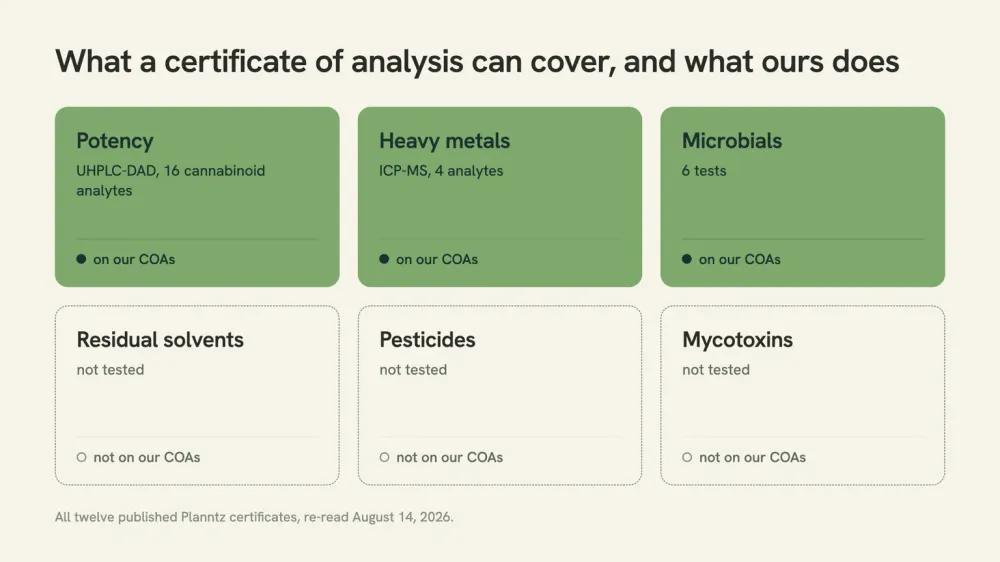
- Which panels are on the report at all. Potency, heavy metals, microbials, residual solvents, pesticides and mycotoxins are six different tests, and most certificates in this industry carry three.
- A limit of detection printed beside any "not detected" result. Not detected at what sensitivity is the entire question.
- Named analytes inside each panel. "Heavy metals: pass" with no metals listed is a claim rather than a measurement.
Now the part we owe you, because we sell the thing this page is about. On August 14, 2026 we re-read all twelve of our own published certificates, the ones on our lab results page, and searched every one of them. Each carries three panels and only three: potency by UHPLC-DAD across 16 cannabinoid analytes; heavy metals by ICP-MS across four analytes, arsenic, cadmium, lead and mercury, at limits of 1.5, 0.5, 0.5 and 3 micrograms per gram; and microbial testing across six tests, coliforms, yeast and mold, aerobic bacteria, E. coli, S. aureus and Salmonella. The lab is Infinite Chemical Analysis Labs in San Diego, California, license C8-0000047-LIC. And then the three sentences that matter here. None of the twelve carries a residual-solvent test. None carries a pesticide test. None carries a mycotoxin test. So if the solvents explanation were true, our own certificates could not rule it out for our own bottles, and we are not going to lean on an explanation that happens to flatter us and that nobody can check. What our panel does cover is real and worth reading. What it does not cover is worth knowing before you decide what any certificate proves.
See what our lab reports actually cover
Every Planntz batch has a public certificate of analysis: potency by UHPLC-DAD, four heavy metals by ICP-MS and six microbial tests, run by an independent California laboratory. Read one, including the panels it does not contain, before you decide what a lab report proves.
View the lab resultsThe explanations that have something behind them, and the ones that do not
Start with how common headaches are when nothing has been taken at all. The Global Burden of Disease analysis of headache disorders, published in Lancet Neurology in 2025, estimates that 2.9 billion people were affected by headache disorders in 2023, an age-standardized prevalence of 34.6% (95% uncertainty interval 31.6% to 37.5%), and that the prevalence has been broadly stable for three decades. Be careful with that figure, because it is easy to inflate: 34.6% is the share of people who have a headache disorder, such as migraine or tension-type headache, not the share who get a headache in any given week. Used correctly it does exactly one job here. Headache is a high-base-rate event, so coincidence is the default hypothesis, and a placebo arm is the only thing that beats coincidence.
Now the explanations you will read elsewhere, checked one at a time and dated so you can re-run them. A mechanism. As of a PubMed search run on August 14, 2026, no published work proposes a mechanism by which cannabidiol causes a headache. The papers that pair the two words are about cannabinoids as a possible treatment, which is a different question and one this page does not cover. Dehydration. A PubMed search for cannabidiol and dehydration on the same date returns five records, and every one of them is about growing hemp under drought stress, about salt chemistry, or about a facial skin cream. Nobody has measured whether taking CBD changes how hydrated you are. Dry mouth, which is usually where the dehydration story starts, appeared in the FDA trial's registered adverse-event table in 1 of 151 participants on cannabidiol against 0 of 50 on placebo, and a sensation in the mouth is not a measurement of body water. Nocebo. As of August 14, 2026, PubMed returns no records at all for cannabidiol and nocebo. The general placebo-arm literature is large, as the vaccine meta-analysis further up shows. Nobody has run it on CBD.
One ordinary interaction deserves a sentence, because it is the mundane explanation most likely to be sitting in your morning. A human trial has reported that cannabidiol changes how the body clears caffeine, so if your CBD routine changed in the same week as your coffee routine, that is two variables moving at once and neither of them is isolated. The measurements, the sample size and the enzyme involved belong to CBD and caffeine. Nobody has connected that interaction to headache, and this page is not going to be the first to try.
A troubleshooting sequence you can actually run
None of the evidence above tells you what happened to you, because a trial average is not a person. What it does hand you is a method, and it is the same method the trials use, run on a sample size of one. Change one variable at a time, write things down before you decide what they mean, and be honest about your own base rate. This page publishes no amounts, and amount is the wrong lever to reach for first anyway, because changing it changes everything else about a routine at the same moment. And if a new prescription arrived in the same week as the headaches, that question belongs to the person who wrote it and to CBD and medications, not to the bottle.
- 1Write down when the headache started relative to when you took it, and whether this has happened once or several times. One event is a coincidence until it repeats.
- 2List everything else that changed that day: sleep, caffeine, meals, alcohol, screen hours, a skipped lunch, a new medicine, the weather.
- 3Work out how often you were getting headaches before you started. That is your own placebo arm, and nobody else can build it for you.
- 4Pull the certificate of analysis for your batch and read which panels are actually on it, instead of assuming what a lab report covers.
- 5Check whether anything else you take appears on a cannabidiol interaction list, and raise it with the person who prescribed it.
- 6If you are reaching for pain relievers more than a couple of days in most weeks, medication-overuse headache is a documented and treatable cause, and a clinician can sort it out.
- 7If it keeps happening, stop, and take the bottle and its certificate to a clinician. A pause that resolves it and a restart that brings it back is the strongest evidence you can generate alone.

What would actually settle this
The honest limits here are larger than the findings, so here they are in one place. Every trial described above used purified pharmaceutical cannabidiol, not a whole-plant hemp extract in a carrier oil, and every one of them dosed far above ordinary consumer use. The placebo arms are 6, 8 and 50 people, and 269 participants across four small trials is not enough to resolve a symptom that roughly a fifth of placebo recipients reported in unrelated vaccine trials. None of the trials described above pre-specified headache as an outcome or asked anyone to keep a headache diary, so what got recorded was either spontaneous reporting, which undercounts, or checklist reporting, which overcounts, and the papers do not always make clear which. Nobody has looked at the nocebo effect in cannabidiol at all. And no mechanism has been proposed by anyone, which means there is not currently even a hypothesis to test.
A study that could actually answer this is not exotic, and by trial standards it is not expensive. Randomize several hundred healthy adults to a consumer-scale hemp product or to a placebo that looks, tastes and pours identically. Pre-specify headache as an outcome instead of collecting it as an afterthought. Collect a daily headache diary through a run-in period before anyone takes anything, so every participant carries their own baseline into the trial. Run it long enough to cover a month of ordinary life, with its bad sleep and its skipped meals. Then report the counts arm by arm. Until somebody does that, the correct answer to "does CBD cause headaches" is that four trials looked, the counts leaned higher on cannabidiol in some of them and came out identical in another, the pooled interval was too wide to read, and nobody knows. That is a smaller claim than either side of this argument likes to make, and it is the only one the evidence supports.
Common questions
Nobody has shown that it does, and nobody has shown that it does not. Four randomized placebo-controlled trials counted headaches in both arms, and a 2026 meta-analysis pooled them at a relative risk of 1.56 with a 95% confidence interval running from 0.40 to 6.14. That interval includes "less common than placebo" and "six times as common as placebo", which is what happens when the entire evidence base adds up to 269 people. Across the individual trials the counts leaned higher on cannabidiol in some and came out identical in another, and the placebo arms were as small as six and eight people, so that pattern is not worth much on its own.
No published work proposes a mechanism. A PubMed search run on August 14, 2026 for cannabidiol together with headache and mechanism returns records that are all about cannabinoids as a possible treatment, which is a different question and not one this page covers. So the honest answer is that nobody has established a mechanism, and any page that offers you a confident receptor story is guessing. That does not mean nothing happened to you. It means the explanation, if there is one, has not been found yet.
Every trial with placebo-arm headache data used purified pharmaceutical cannabidiol given as an oral solution, not a gummy. Nobody has run a placebo-controlled trial of a consumer gummy and counted headaches, so there is no gummy-specific number anyone can honestly give you. What is different about a gummy is mostly everything else in it: sweeteners, sugar alcohols, colors, flavor systems and gelling agents, none of which has been studied for this.
That is the most repeated explanation on the internet and it is asserted without a source, without a named contaminant and without a test. If you want to check it rather than believe it, pull the certificate of analysis for your batch and read which panels are actually on it. Most certificates in this industry, including ours, carry potency, heavy metals and microbials, and do not carry residual solvents, pesticides or mycotoxins. A certificate is silent about every test that is not on it, which cuts both ways: it cannot convict a product and it cannot clear one.
In the fed-state phase 1 trial, the investigators recorded that the treatment-emergent adverse events were of mild severity and resolved within a short duration, less than one day. In the larger phase 1 trial, all adverse events were of mild or moderate severity and none were severe or serious. Both of those sentences describe what happened to those participants at pharmaceutical doses under supervision. Neither is a prediction about you, and neither trial was designed to measure duration.
That is a decision for you and a clinician, and this page will not make it for you. What is worth doing first is the ordinary work of ruling out coincidence, because headache disorders affect roughly a third of the world's population and have done for three decades, so most headaches that follow anything are headaches that were going to happen. Pausing is the cheapest test available to you: if it settles on the pause and returns when you restart, you have generated real evidence. If the headache is sudden and severe, or comes with fever, vision changes, weakness or confusion, that is a medical question and not a supplement question.
The trials that reported headaches used amounts far above ordinary consumer use, and in the single-dose arm of one of them the counts did rise across the dose groups, from one person at the lowest dose to four at the second-highest. That is a pattern across four groups of six people, which is not a threshold and not a dose-response curve. This page publishes no milligram figure at all. Amounts are covered in our dosage guide, and acute overconsumption in our guide to taking too much CBD.
Writing about hemp, wellness and the small rituals that keep us balanced.