Can Weed Delay Your Period? What the Cycle Studies Measured
If your period is late, take a pregnancy test first. Then here are the human studies that have looked at cannabis and the menstrual cycle, what each one measured, and why the results point in different directions.
Can weed delay your period? No study we found shows that cannabis reliably makes a period late, and nobody can honestly tell you it will, or will not, move yours by a set number of days. The human research is small, mostly decades old, and points in different directions: one cohort found later ovulation in occasional users, another found a shorter second half of the cycle and no change in total cycle length. If your period is late right now, the first step is a pregnancy test, not a cannabis study.
Where that advice comes from. The testing advice is from MedlinePlus's guide to the urine pregnancy test, and the red flags are from the federal Office on Women's Health page on period problems. If the test is positive, our page on cannabis, CBD, pregnancy and breastfeeding covers what the FDA and obstetric groups advise. We are a CBD company, and this article sits in our safety section next to our overview of CBD side effects. It is about THC and cannabis: what each human study actually measured, what it found, and where the evidence stops.
Can weed delay your period? How a period actually gets late
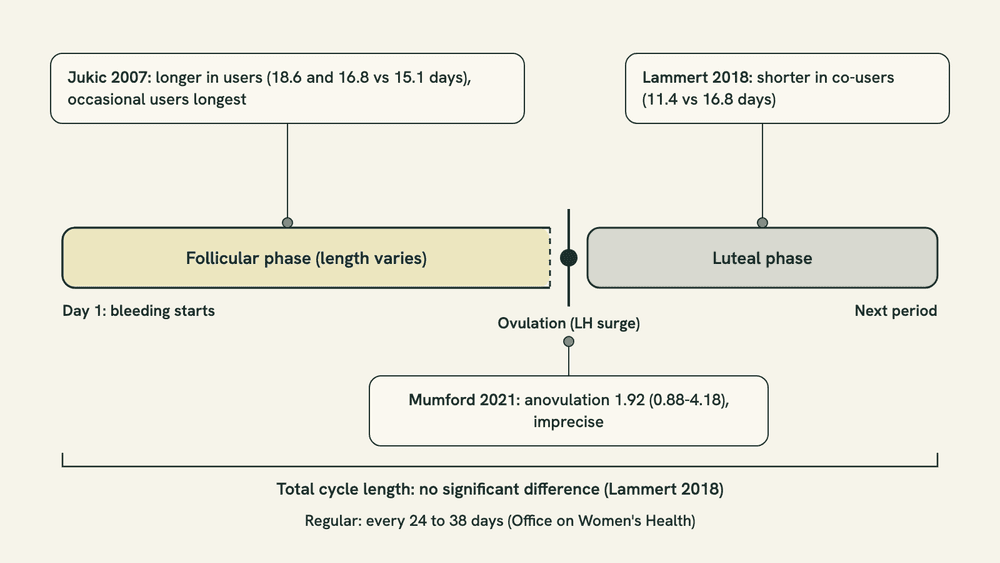
A menstrual cycle has two halves, split by ovulation, the day an ovary releases an egg. The first half, the follicular phase, runs from the first day of bleeding until ovulation, and its length varies from cycle to cycle and from person to person. The second half, the luteal phase, runs from ovulation until the next period starts. Luteinizing hormone (LH) is the signal that sets off ovulation: a surge of LH mid-cycle releases the egg. So when a period arrives later than you expected, it is usually because ovulation came later than usual, or did not happen at all in that cycle (an anovulatory cycle). A study that wants to show cannabis makes periods late has to show one of those things in people, not only a change in a hormone reading.
“Your periods are still 'regular' if they usually come every 24 to 38 days.”
That range, from the Office on Women's Health guide to the menstrual cycle, matters for anyone counting days. A period that comes a few days after the date you expected can still sit inside a normal cycle. The table below maps each part of the cycle to what a cannabis study would have to change to make a period late, and to the studies that actually looked.
| Part of the cycle | What happens | What would make a period late | Cannabis studies that measured it |
|---|---|---|---|
| Follicular phase | From day 1 of bleeding to ovulation; an egg matures | A longer phase, meaning later ovulation | Jukic 2007 (longer in users); Lammert 2018 (no difference) |
| Ovulation | An LH surge releases the egg | No ovulation in that cycle | Mumford 2021 (imprecise estimate); Jukic 2007 (a count of 7 cycles) |
| Luteal phase | From ovulation to the next period | A longer phase | Lammert 2018 (shorter in users, not longer) |
| Hormones at one moment | LH, prolactin and other hormones rise and fall day to day | Only indirectly; one reading does not date a period | Mendelson 1984-1986 (lab); Block 1991; Mumford 2021 |
| Total cycle length | Both phases added together; 24 to 38 days counts as regular | A longer total cycle | Lammert 2018 (no difference); Ryan 2021 (monkeys only) |
What else makes a period late (start here)
Before you look at cannabis, look at the common causes. MedlinePlus's page on absent menstrual periods and the NIH child health institute's list of amenorrhea causes both start in the same place, and the NIH page says it plainly: pregnancy is the most common natural cause of periods stopping. The MedlinePlus list includes:
- Pregnancy, and breastfeeding after a birth.
- Hormonal birth control, including the pill and the Depo-Provera shot.
- Severe anxiety or emotional stress.
- Sudden weight loss, or obesity.
- Excessive exercise.
- An overactive thyroid gland.
- Polyendocrine metabolic ovarian syndrome, the condition long known as polycystic ovary syndrome (PCOS).
- Some medicines, including cancer treatments and medicines for schizophrenia or psychosis.
- Less common causes, such as pituitary tumors or reduced ovarian function, which a clinician can check for.
Cannabis is not on either federal list. That does not prove it never plays a part; it means the reference pages clinicians use do not name it as a cause. Stress is on the MedlinePlus list, and if you have wondered whether cannabis changes your stress hormones, our look at what the cortisol studies measured covers that separately. MedlinePlus also advises seeing your provider if you have missed more than one period.
What THC does to cycle hormones in a lab
The most-cited human hormone data come from one research team in the 1980s, led by Jack Mendelson. In a 1986 double-blind, placebo-controlled study, women who smoked one 1-gram joint containing 1.8% THC during the luteal phase had about 30% lower LH afterward; a placebo joint did not lower it. The same team had earlier studied women in the days around ovulation, in a 1984 report whose results we could not verify: PubMed carries no abstract, and the original monograph was unreachable when we checked. We describe what it studied and nothing more.
Two more studies from the same lab add a pattern. In 16 women tested in either the follicular or the luteal phase, prolactin, another reproductive hormone, was lower from about 60 to 180 minutes after smoking in the luteal phase and did not change in the follicular phase. In 10 menopausal women, the same kind of joint changed pulse and intoxication but not LH. The authors of the 2007 cohort study discussed below summed up this lab work in two lines: the timing of cannabis exposure in the cycle may modulate its effect on LH, and the lab studies found no acute effect on progesterone or estradiol. In other words, where you are in your cycle at the moment of use seems to change the short-term hormone response.
Then the counterweight. A 1991 Iowa study of 56 women and 93 men compared frequent, moderate and infrequent users with non-users and found no significant differences in testosterone, LH, FSH, prolactin or cortisol. In the authors' words, chronic use 'showed no significant effect on hormone concentrations in either men or women.' It took one blood sample per person, which is a limit of its own: hormones change across the cycle, and a single draw can miss that.
Read the lab studies for what they are. They measured a hormone for a few hours after one joint of 1980s cannabis at 1.8% THC, well below the potency of much of the cannabis sold today. None of them recorded when anyone's next period came. A short dip in LH is a lab reading, not a later period. We found no repeat of these studies with modern flower, vapes or edibles, so whether stronger cannabis would show bigger effects is simply unmeasured.
What studies of real cycles found
If the question is whether weed affects your period at all, the best evidence would come from following real cycles. Only a handful of studies have done that in people who use cannabis. Each one measured something different, and that matters more than any headline built on them.
Later ovulation, but in the wrong order. A 2007 analysis of 201 women's cycles from the North Carolina Early Pregnancy Study, a 1980s cohort, used daily urine hormone samples to date ovulation. The 14 women who said they had smoked marijuana one to three times in the previous three months had an average follicular phase (geometric mean) of 18.6 days; the 15 who had smoked more than three times, 16.8 days; the 172 non-users, 15.1 days. So the occasional users ovulated about 3.5 days later on average and the more frequent users about 1.7 days later. That runs backwards from a dose effect, it rests on 29 users, and use was measured with one question about the past three months, with no data on when in the cycle anyone used. The women had also just stopped hormonal contraception to try to conceive, and in the same table recent pill use lengthened the follicular phase too (17.7 versus 15.4 days). Three of the seven cycles without ovulation belonged to users, a count far too small to test.
A shorter second half, and no longer cycles. A 2018 study of women who smoked both tobacco and cannabis points the other way. Using home LH test strips, it compared 13 co-users with 39 women who smoked tobacco only. The luteal phase was shorter in the co-users (11.4 versus 16.8 days), the follicular phase was about the same (15.0 versus 14.7 days), and total cycle length did not differ significantly (26.4 versus 31.5 days). If anything, that points away from a later period. Cannabis use was a yes-or-no answer with no data on frequency or timing, everyone smoked tobacco, and the tobacco-only group included a luteal phase as long as 70 days, which shows how noisy that comparison average is.
Higher LH, and an imprecise anovulation signal. A 2021 cohort of 1,228 women trying to conceive after a pregnancy loss measured cannabis with urine tests as well as self-report. The 62 users (5%) had higher LH, 64% higher, with a 95% confidence interval from 3% to 161%, and a 39% higher ratio of LH to FSH. That is the opposite direction to the acute LH drop in the 1986 lab. Their estimated risk of a cycle without ovulation was 1.92 times that of non-users, but the confidence interval ran from 0.88 to 4.18. An interval that includes 1 includes the possibility of no difference at all, and the authors call the result 'suggestive, though imprecise.' It is the only human study we found that printed an anovulation estimate, and it comes from a specific group of women, not the general population.
The monkey data behind the seller claims. Much of what you read about THC delaying ovulation traces back to animal work. In a 2021 study of eight rhesus monkeys given a daily THC edible, cycles got longer as the dose went up and FSH rose, while LH showed no trend. Older monkey studies from the 1980s, cited in the 2007 cohort paper, reported that the effect faded as the animals kept being dosed. That is animal data. We found no human version of this experiment, and a monkey dose does not convert to a human product.
| Study | Who and how many | How use was measured | What was measured | Finding | The catch |
|---|---|---|---|---|---|
| Mendelson 1986, US | Women in the luteal phase, lab setting | One 1-gram joint at 1.8% THC vs placebo | LH in the hours after smoking | About 30% lower LH | Acute, small, 1980s potency |
| Block 1991, US | 56 women and 93 men | Frequency categories vs non-users | Hormones in one blood sample | No hormone differences | Single draw; cycle phase not standardized |
| Jukic 2007, US | 201 women's cycles; 29 users | One question about the past 3 months | Follicular phase length from urine hormones | 18.6 days (occasional) and 16.8 (frequent) vs 15.1 (none) | Backwards dose pattern; just off the pill |
| Lammert 2018, US | 13 co-users vs 39 tobacco-only | Yes or no | Phase lengths from home LH strips | Shorter luteal phase; total cycle no different | Everyone smoked tobacco; tiny group |
| Mumford 2021, US | 1,228 women after a pregnancy loss; 62 users | Urine test plus self-report | LH, FSH, anovulation | Higher LH; anovulation 1.92 (0.88-4.18) | Imprecise; one specific population |
| Ryan 2021 (monkeys) | 8 rhesus macaques | Daily THC edible | Cycle length | Longer cycles at higher doses | Animal data, not human |
Why nobody can tell you weed delays your period by X days
Search results and AI summaries for this question often state numbers: that regular use delays menstruation by 1 to 3 days, or that heavy use stretches a 28-day cycle to 32 to 35 days. We could not trace either figure to any human study. The closest real numbers are the 2007 follicular-phase averages, in which the occasional users, not the heavy ones, had the longer phase. Here is what the actual studies add up to.
- 1The directions disagree. The 2007 cohort found a longer first half of the cycle; the 2018 study found a shorter second half and no change in total length.
- 2The hormone signals disagree. LH fell for a few hours after one joint in a 1986 lab, was higher in the 2021 cohort's users, and did not differ in the 1991 study.
- 3The dose pattern runs backwards. In the 2007 cohort, occasional users had the longer phase, not the frequent users.
- 4The confounders are large: women who had just stopped the pill, a comparison where everyone also smoked tobacco, and a group recruited after pregnancy loss.
- 5Exposure was crude: a yes-or-no answer or a three-month recall, never dose, product, or when in the cycle people used.
- 6The samples are tiny: 29, 13 and 62 users in the three cycle studies.
Even a 2025 review that argues cannabis harms reproduction concedes that 'the exact mechanisms of its reproductive toxicity remain unclear,' and it mixes animal and human research. The honest reading is this: THC can briefly change some reproductive hormones in a lab, and a few small studies found differences in cycle timing that do not agree with each other. That is not enough to predict what will happen to your cycle, in either direction. The claim that THC 'causes anovulatory cycles' narrows, on the evidence, to one imprecise estimate in one group of women, a count of three cycles, and monkeys.
Can you smoke weed on your period?
This is a different question, and it has a more direct answer than you might expect. A 2022 University of Chicago study gave 60 healthy women who used cannabis occasionally 7.5 mg and 15 mg of oral THC and a placebo, in separate double-blind sessions. Half were tested on days 1 to 5 of their cycle, counted from the first day of bleeding, which means during their period; the other half on days 10 to 14. The authors' summary: 'On most measures, responses to THC were similar during the two phases.' The only differences were that ratings of wanting more, and anxiety, rose slightly earlier in the group tested during their period.
A second analysis of the same women found THC impaired impulse control on a computer task just as much whether their estradiol, a form of estrogen, was low or high. That undercuts a line you will find on dispensary sites: that estrogen is lowest during your period, so cannabis hits differently then. In this test it did not, and being on your period did not make anyone less impaired. How hormones shape THC effects more broadly is a separate question; this page covers the period itself.
Does the cycle change how much people use? The studies split by era. A 1986 diary study of 30 women collected 2,715 daily diaries over three cycles (the women averaged 1.4 joints a day) and found no link between how much they smoked and where they were in the cycle. A 2025 study of 40 women, who looked back over 65 days and reported their use day by day, found use was more frequent in the days before a period, though not during it. That describes behavior, not a benefit or a harm.
People also ask whether cannabis does anything for cramps or PMS, and the research there counts use rather than results: in a 2026 Johns Hopkins survey of 634 people, 30% said they had used cannabis for premenstrual mood symptoms, and the authors conclude that whether it works has not been tested, so pain or mood changes that disrupt your life are a conversation for a clinician.
We found no study showing harm from using cannabis during menstruation itself, and none showing a benefit. The usual effects still apply on any day of your cycle: THC is intoxicating and impairing, and how it affects your mood and alertness does not switch off because you are bleeding. If you notice your use climbing at one point in your cycle, taking a tolerance break is one way to see what changes.

If you are trying to conceive
Conception is its own question with its own page, so here are only the two cohorts that measured it. In PRESTO, a North American study of 4,194 women trying to conceive, cannabis use was not linked to how quickly they got pregnant (fecundability ratios of 0.99 for less than weekly use and 0.98 for weekly or more, where 1 means no difference). In the 2021 pregnancy-loss cohort above, users had lower odds of conceiving in a given cycle (fecundability odds ratio 0.59, interval 0.38 to 0.92). Two cohorts, two answers, two different groups of women. Our guide to CBD and fertility covers conception, sperm and what has and has not been measured, and if you are trying to conceive, the person to plan with is your clinician.
Is CBD different? And what about birth control?
CBD and THC are different compounds: THC is the one that gets you high, and CBD is not intoxicating (the full comparison of CBD and THC lays out the rest). Every human cycle study on this page was about cannabis containing THC. For CBD on its own, we found no human study of ovulation, cycle length or time to pregnancy, and the CBD fertility guide linked above answers that question in its FAQ. If you use hormonal birth control, the interaction question has its own page, what is known about CBD and birth control, and this article makes no claim either way about THC and contraception.
What has not been measured
To check how thin this literature is, we searched PubMed on October 5, 2026. These are the results on that date. A search shows what is indexed in one database on one day, not that no research exists anywhere.
- Cannabis, marijuana or THC plus cycle length, follicular phase length or luteal phase length: 5 records. Three were the 2007, 2018 and monkey studies above; two were unrelated.
- The same cannabis terms plus menstrual cycle, menstruation or ovulation, limited to randomized controlled trials: 2 records, neither a trial of cannabis on the cycle.
- Cannabis or marijuana plus edibles plus menstrual or ovulation: 1 record, the monkey study.
- Cannabis or marijuana plus heavy menstrual bleeding: nothing that measured menstrual flow in people who use cannabis.
So the gaps are concrete. We found no randomized trial of cannabis and cycle timing, and no human study of edibles and the cycle. No study we found measured menstrual flow, so claims that weed makes periods heavier or lighter have nothing behind them in either direction; if heavy bleeding is your worry and you also take CBD, whether CBD thins your blood is covered separately. And no cycle study we found used today's higher-potency flower, vapes or concentrates.
Frequently asked questions
No study we found gives a number of days for a period. The closest real figures measure ovulation timing: in a 2007 cohort, 14 occasional users ovulated about 3.5 days later on average than non-users and 15 more frequent users about 1.7 days later, a backwards pattern resting on 29 people. A 2018 study found a shorter second half of the cycle and no change in total cycle length. We could not trace the '1 to 3 days' figure that circulates online to any human study. If you are late, take a pregnancy test.
The only human estimate we found comes from a 2021 cohort of women with a past pregnancy loss: users had 1.92 times the estimated risk of a cycle without ovulation, with a confidence interval from 0.88 to 4.18, which the authors called suggestive and imprecise. Monkey studies found longer cycles with daily THC. Whatever the cause might be, the Office on Women's Health says to see a clinician if you have gone three months without a period and are not pregnant or breastfeeding.
The studies do not agree. In a 1986 lab study, one joint briefly lowered LH, the hormone that sets off ovulation, in the second half of the cycle. In a 2007 cohort, users ovulated later on average, but occasional users more so than frequent ones, and only 29 users were studied. In a 2021 cohort, users had higher LH, not lower, and an imprecise signal of more cycles without ovulation. None of this can predict what will happen in your cycle.
No study we found measured menstrual flow in people who use cannabis, so there is no evidence either way. What matters is the threshold: bleeding that lasts more than eight days, or that soaks through a pad or tampon every one to two hours, is a reason to call a clinician, according to the Office on Women's Health.
Mostly not, in the one experiment we found that tested people during their period. In a 2022 University of Chicago study, 60 women took 7.5 mg and 15 mg of oral THC and a placebo in separate sessions; half were tested on days 1 to 5 of their period, half on days 10 to 14, and responses were mostly the same. A second analysis found THC impaired impulse control just as much whether estradiol was low or high. The study used oral THC in occasional users, so it does not cover every product or pattern of use.
The only study we found of THC edibles and the menstrual cycle was in eight rhesus monkeys, whose cycles lengthened as the daily dose rose. We found no human study of edibles and cycle timing. A monkey result cannot be turned into a human dose or a prediction for your cycle.
We found no human study of CBD on its own and ovulation, cycle length or time to pregnancy. Every cycle study on this page involved cannabis with THC. Our guide to CBD and fertility covers what has and has not been measured for CBD.
Where to go next. If you use CBD as well as, or instead of, THC, start with what CBD is and how it differs from the cannabis that gets you high. If you are trying to conceive or think you might be pregnant, the fertility and pregnancy pages linked above go deeper, and your clinician is the right person to decide with.
Writing about hemp, wellness and the small rituals that keep us balanced.