CBD and Levothyroxine: The Interaction Runs the Other Way
Page one says CBD and levothyroxine compete for cytochrome P450, and cites a 2017 study. Four FDA levothyroxine labels contain the words CYP, cytochrome and P450 exactly zero times, and no 2017 study exists. Here is what has been measured, and why it points the other way.

If you take levothyroxine every morning and you are curious about CBD, the first pages you find will almost all tell you the same story: the two compete for the same liver pathway, cytochrome P450, and a 2017 study showed that thyroxine piles up as a result. Read on August 13, 2026, the FDA prescribing information for Synthroid contains the words CYP, cytochrome and P450 exactly zero times. There is no 2017 study. And the human research that does exist runs in the opposite direction from the one page one describes.
That last sentence is the part nobody on page one has. Two published reports describe children who took pharmaceutical cannabidiol while they were also taking levothyroxine, and in both of them the concentration that moved was the cannabidiol, not the thyroid hormone. That is a small, retrospective observation in a handful of children, and this page will keep saying so. What it is not is nothing. The honest summary of this topic is not that the question has never been looked at. It is that somebody looked, and the arrow on their diagram points the other way. If you want the general framework for CBD and prescription drugs first, it lives in our guide to CBD and prescription medications, and this page explains why that framework does not reach this particular drug.
The enzyme page one names is not in the levothyroxine label
Here is the check, written so you can run it yourself. We downloaded the full structured product label for levothyroxine sodium tablets from DailyMed, the National Library of Medicine's label archive, and searched the concatenated text of the whole document case-insensitively, counting one hit per match. The primary document is Synthroid, from AbbVie, label version 1537. Because a count is only as good as the document it came from, the identical search was run on three more brand labels: Unithroid from Amneal, Levoxyl from Pfizer and Euthyrox from Provell. CYP: zero, on all four. Cytochrome: zero. P450: zero. Cannabidiol, cannabis, marijuana, hemp and CBD: zero, on all four. One more zero is worth having early, because it comes back later: the word oil does not appear in any of the four labels either. A selection note, since this is a generic with hundreds of labels behind it. A DailyMed lookup for levothyroxine returns 433 labels across five pages, and the first page of that list is almost entirely repackagers. The four above are the brand or first-party manufacturer documents.
| String searched | Synthroid (AbbVie) | Unithroid (Amneal) | Levoxyl (Pfizer) | Euthyrox (Provell) |
|---|---|---|---|---|
| CYP | 0 | 0 | 0 | 0 |
| cytochrome | 0 | 0 | 0 | 0 |
| P450 or P-450 | 0 | 0 | 0 | 0 |
| cannabidiol, cannabis, marijuana, hemp, CBD | 0 | 0 | 0 | 0 |
| oil (whole word) | 0 | 0 | 0 | 0 |
| deiodin (deiodination, deiodinated) | 6 | 6 | 6 | 6 |
| glucurono (glucuronosyltransferase) | 1 | 1 | 1 | 1 |
| UGT (whole word) | 1 | 1 | 1 | 1 |
| conjugat (conjugation, conjugated) | 2 | 2 | 2 | 2 |
| enzyme or enzymes | 2 | 2 | 2 | 2 |
| narrow therapeutic index | 1 | 1 | 1 | 1 |
| empty stomach | 3 | 3 | 4 | 3 |
| 4 hours | 5 | 5 | 7 | 5 |
| grapefruit | 1 | 1 | 2 | 1 |
| biotin | 15 | 0 | 0 | 0 |
Two traps are hiding in that table, and both are worth your time, because they are how a check like this goes wrong. The first is a false positive, which is why one row is missing. A search for sulfate returns 17 hits on the Levoxyl label, which looks like a pharmacology finding until you open them: nearly all are calcium sulfate in the list of inactive ingredients. An excipient is not a metabolic route. The second is a false negative, and it is the more dangerous one, because it hides evidence rather than manufacturing it. The string glucuronid does not appear inside the word glucuronosyltransferase. A search for glucuronid therefore misses the one place in the entire label where an enzyme family is named by name. Search for glucurono, and for UGT as a whole word, and the sentence appears. That matters, because that sentence is the honest version of the mechanism argument, and it gets a section of its own further down.
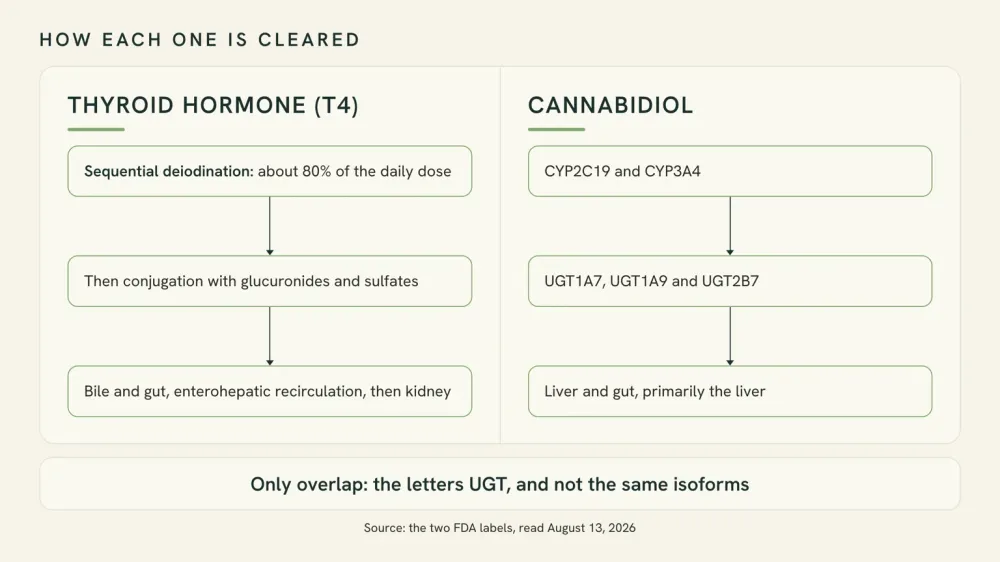
So what does the label say happens to thyroid hormone? Section 12.3, under Metabolism, is direct: the major pathway of thyroid hormone metabolism is through sequential deiodination. Deiodination means an enzyme removes an iodine atom; T4 carries four of them, and taking one off produces T3, the more active form. The label puts numbers on it. Approximately 80% of the daily dose of T4 is deiodinated, yielding equal amounts of T3 and reverse T3, and approximately 80% of circulating T3 is derived from peripheral T4. The liver is very much involved, and that has to be said clearly, because the liver has nothing to do with it would be its own false claim: the label calls the liver the major site of degradation for both T4 and T3, with deiodination also occurring in the kidney and other tissues. Then comes the second route, which is the one that makes an enzyme argument legitimate at all: thyroid hormones are also metabolized via conjugation with glucuronides and sulfates and excreted directly into the bile and gut, where they undergo enterohepatic recirculation. Cannabidiol's route is a different one. Its own FDA-approved label reports that cannabidiol is metabolized in the liver and the gut, primarily in the liver, by CYP2C19 and CYP3A4 enzymes and by the UGT1A7, UGT1A9 and UGT2B7 isoforms. FDA also keeps a reference table of substances known to interact with those cytochrome enzymes; it lists grapefruit juice and three dietary supplements, and cannabidiol is not on it, although FDA says the table is not exhaustive. The two molecules overlap in exactly one place, the three letters UGT, and that overlap is a section of its own.
The 2017 study does not exist, and here is the search that shows it
Run the search yourself, and print the date, because this is a moving number. On August 13, 2026, a PubMed query for cannabidiol AND levothyroxine returned 4 records in total. The same two terms restricted to 2017 returned 0. A query for cannabidiol AND thyroid restricted to 2017 returned 0 as well. For scale: cannabidiol AND thyroid without the year restriction returns 13, cannabidiol AND thyroxine returns 3, and widening the drug term to cannabis AND levothyroxine returns 6. That last query matters, because it surfaces a large cohort study the narrow one misses, and this page uses it below. So there is no 2017 record at the intersection of cannabidiol and levothyroxine, and none at the intersection of cannabidiol and the thyroid. Two honest limits on that. PubMed is not the whole of the scientific literature, and a database count is a dated snapshot rather than a proof of absence. But a citation that cannot be found in the largest index of biomedical papers, by anyone, in either of the two obvious searches, is not a citation. It is a sentence that got copied.
- PMID 37631333, 2023, Pharmaceutics. A retrospective real-world study of what moves cannabidiol blood levels in 22 children with drug-resistant epilepsies. Directly about the pair.
- PMID 33280111, 2021, Epilepsia. A prospective pharmacokinetic study in 12 children, from the same hospital and the same investigators. Also directly about the pair.
- PMID 40622698, 2025, JAMA Internal Medicine. A randomized, double-blind, placebo-controlled trial in 201 healthy adults, run by FDA scientists, which measured thyroid hormones as secondary endpoints.
- PMID 35872737, 2022, Journal of Food Science and Technology. A rat study in a vitamin-D3-deficiency model, and the only record in that search in which cannabidiol raises thyroxine.
- What is not in the set: a trial that gave cannabidiol to people taking levothyroxine and then measured what happened to either drug. No such trial has been published, and none was found in the wider cannabis search either.
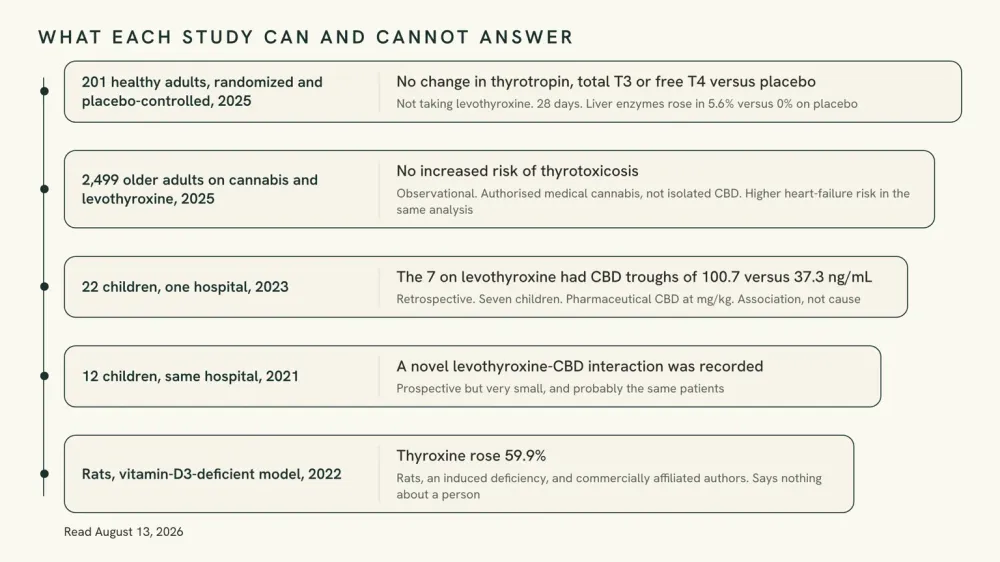
One of those four records is the likely ancestor of everything page one says about thyroid hormone rising, and it is a rat study. A 2022 paper in the Journal of Food Science and Technology put rats on a vitamin-D3-deficient diet, gave them cannabidiol, and reported thyroxine up 59.9% and calcitonin up 213.59% against the deficient group, with thyrotropin down 36.15% and parathyroid hormone down 38.64%. Three things have to travel with those numbers. They are rats, not people. The model is an induced vitamin-D3 deficiency, which is not the physiology of an adult on stable replacement therapy. And the authors are affiliated with a commercial research company, Trivedi Global, Inc. and the Trivedi Science Research Laboratory. Their conclusion is that cannabidiol can be considered to use in hypothyroidism conditions and to maintain bone health. That is their sentence about their rats, quoted here rather than adopted: nothing on this page says or implies that CBD does anything for a thyroid condition, in either direction.
CBD and levothyroxine: what has actually been measured in people
The larger of the two human reports is a 2023 study in Pharmaceutics from a children's hospital in Buenos Aires. It followed 22 children, median age 12.8 years, with drug-resistant developmental and epileptic encephalopathies, all taking a pharmaceutical cannabidiol oral solution at a median of 8.5 mg/kg/day, and asked which real-world factors moved their blood levels. Seven of the 22, or 31.8%, were also taking levothyroxine, at a median of 50 micrograms a day. Those seven had a median cannabidiol trough concentration of 100.7 ng/mL. The children who were not on levothyroxine had 37.3 ng/mL. In the final model, which adjusted for the other factors at the same time, levothyroxine co-treatment was associated with a cannabidiol concentration 109.6% higher, with a 95% confidence interval running from 49.2% to 194.5%. Two other factors came out alongside it: a ketogenic diet at 116.0%, and taking the dose with food at 56.8%. That food effect is its own subject and belongs to our page on taking CBD with food rather than here.
The same group had already flagged this once. In a 2021 report in Epilepsia, a prospective pharmacokinetic study in 12 children on an oil-based cannabidiol solution at a median of 12.2 mg/kg/day, the abstract states that cannabidiol administration was generally safe and well tolerated, and that a novel levothyroxine-CBD interaction was recorded. Same hospital, same investigators, and the patient groups very likely overlap. That is worth being precise about, because two papers look like two confirmations, and this is one clinical signal reported twice. The 2023 authors say as much themselves: their findings and their previous report are, in their words, the only evidence of the influence of levothyroxine on CBD exposure.
The authors do offer an explanation, and it is worth reading closely, because they present it as a hypothesis rather than a finding. In their discussion they write that experimental results from in vitro and animal studies strongly suggest that thyroid hormones reduce CYP3A activity in humans, affecting the main pathway for CBD metabolization, and that levothyroxine-mediated UGT inhibition has also been described. Notice the direction: thyroid hormone slowing the enzymes that clear cannabidiol. That is the exact reverse of the page-one story, and even so it rests on in-vitro and animal work rather than on a human experiment. The in-vitro half is real, and it is small. A 2018 study in Xenobiotica reported that T4 inhibits several UGT enzymes in recombinant preparations, two of which, UGT1A7 and UGT2B7, are among the enzymes that clear cannabidiol. The inhibition constants were in the low micromolar range, the probe was a generic laboratory substrate rather than cannabidiol, the whole experiment happened in glassware, and the authors' own recommendation is about monitoring patients with an elevated T4 level, not about people on a stable replacement dose.
The randomized trial that measured thyroid hormones
The best available evidence on the question people actually type, whether CBD changes thyroid hormone levels, is a randomized, double-blind, placebo-controlled trial published in JAMA Internal Medicine in 2025 and run by scientists at FDA's Division of Applied Regulatory Science. It enrolled 201 healthy adults, median age 36, 44% of them women, and gave them either cannabidiol at 5 mg/kg/day, split as 2.5 mg/kg twice daily, or placebo, for 28 days, with laboratory tests every week. For a 70 kg adult that daily amount works out to roughly 350 mg, far above what consumer products are typically used at. The result, in the authors' words: no differences in change from baseline were observed between the CBD and placebo groups for thyrotropin, total triiodothyronine, and free thyroxine in all participants. Thyrotropin is TSH, the test your prescriber orders. Total triiodothyronine is total T3, and free thyroxine is free T4. That is the closest thing that exists to a direct test of the hyperthyroidism story, at a dose most people never approach, and it came back null.
That trial's headline finding was not about the thyroid, and leaving it out would be the same failure this page exists to correct. The primary endpoint was liver enzymes. Eight participants in the cannabidiol group, 5.6% of them with a 95% confidence interval of 1.8% to 9.3%, had alanine or aspartate aminotransferase above three times the upper limit of normal, against none on placebo, and seven met the trial's withdrawal criteria for potential drug-induced liver injury. Both halves of that trial are true at the same time, and they came from the same 5 mg/kg/day. Note the other limit too: these were healthy adults who were not taking levothyroxine, for 28 days, so the null says nothing about what happens when the two are combined. The liver question is its own topic, covered in what CBD does to the liver.
One more human dataset is worth having, and the narrow search misses it. Widening the drug term to cannabis returns a 2025 cohort study in Age and Ageing that followed 12,599 older adults in Ontario who held an authorised cannabis prescription between 2014 and 2019. The authors looked specifically at the 2,499 of them who were also taking levothyroxine, and reported that this group had a significantly higher risk of heart failure but not thyrotoxicosis, acute coronary syndrome or stroke. Read the whole sentence, not the reassuring half. The absence of a thyrotoxicosis signal across 2,499 people is the largest piece of evidence against the hyperthyroidism claim that exists anywhere. The heart-failure signal in the same analysis is real and unexplained. And the study has three limits that have to travel with it: it looked at authorised medical cannabis rather than isolated cannabidiol, its design is observational and open to confounding by indication, and several of its authors disclose ties to cannabis companies.
The enzyme question, done properly: UGT, and which isoform
Here is where the correction has to stop short of overreaching. It would be easy, and wrong, to write that levothyroxine has no liver-enzyme interactions at all. The label has an entire table for them. Section 7.1 carries Table 7, titled Drugs That May Alter Hepatic Metabolism of T4, and its stated concern is that stimulation of hepatic microsomal drug-metabolizing enzyme activity may cause increased hepatic degradation of levothyroxine, resulting in increased Synthroid requirements. The table has exactly two entries, phenobarbital and rifampin, and for phenobarbital the label names the enzyme family outright: phenobarbital increases L-thyroxine metabolism by inducing uridine 5'-diphospho-glucuronosyltransferase, UGT, and leads to lower T4 serum levels. So a hepatic enzyme route does exist. It is UGT rather than a cytochrome, and the one documented direction is induction, which lowers thyroid hormone rather than raising it. That is the honest version of the mechanism argument, and it is the version worth testing against what is actually known about cannabidiol.
| UGT isoform | Carries T4 glucuronidation? (2008 study, in vitro) | Clears cannabidiol? (cannabidiol label, 12.3) | Does cannabidiol inhibit it? |
|---|---|---|---|
| UGT1A1 | Yes, and one of only two whose levels tracked with activity across seven human livers | No | No, per the label's in-vitro assessment |
| UGT1A3 | Yes, the other of those two | No | No, per the label's in-vitro assessment |
| UGT1A9 | Showed activity, but a UGT1A9 inhibitor did not slow T4 glucuronidation | Yes | Measured in people: a UGT1A9 probe drug rose 35% in total exposure |
| UGT2B7 | Not identified as a carrier | Yes | Measured in people: a UGT2B7 probe drug rose 19% in total exposure, which the label calls not expected to be clinically significant |
| UGT1A7 | Not identified as a carrier | Yes | Not among the isoforms the label's in-vitro assessment reports on |
| UGT1A4, UGT1A6, UGT2B17 | Not identified as carriers | No | No, per the label's in-vitro assessment |
A 2008 enzyme study in Drug Metabolism and Disposition went isoform by isoform. Working with twelve recombinant human UGTs and with microsomes from seven individual human livers, it found definite T4 glucuronidation activity in UGT1A1, UGT1A3, UGT1A9 and UGT1A10, but only the levels of UGT1A1 and UGT1A3 tracked with activity across the seven livers, and propofol, a UGT1A9 inhibitor, did not slow T4 glucuronidation at all. So the isoforms that carry thyroid hormone are mainly UGT1A1 and UGT1A3. The cannabidiol label addresses those two by name, in the subsection it calls In Vitro Assessment of Drug Interactions: cannabidiol does not inhibit the UGT enzymes UGT1A1, UGT1A3, UGT1A4, UGT1A6, or UGT2B17 isoforms. Say the words in vitro out loud on both sides of that comparison, because both sides are glassware, and a negative result in glassware is not a safety guarantee. Where cannabidiol's UGT inhibition has been measured in people, the label reports it against completely different substrates: a UGT1A9 probe, mycophenolic acid, rose 16% in peak concentration and 35% in total exposure alongside pharmaceutical cannabidiol at 7.5 mg/kg twice daily, and a UGT2B7 probe, zidovudine, rose 7% and 19%, which the label describes as not expected to be clinically significant. Neither probe is thyroid hormone, and neither dose is a consumer product.
There is one more way to size this lever. If UGT activity were a large determinant of how much levothyroxine a person needs, then people born with less of it should need visibly different doses. A 2014 study in the British Journal of Clinical Pharmacology tested exactly that in 268 patients who had had their thyroid removed and had been on levothyroxine for at least six months. UGT1A haplotypes did associate with dose, and the authors attributed it to reduced UGT1A1 expression. The size of the effect: about 2% of the total variability in dose, in the population where a lifelong difference in that enzyme should be easiest to see. Their conclusion was that pre-emptive genotyping is not warranted, and the deiodinase genotypes they also tested had no influence at all. Those were thyroid-cancer patients on suppressive dosing rather than routine replacement, and a genetic difference is not a drug interaction, but the order of magnitude is the useful part.
What the label actually regulates: absorption and timing
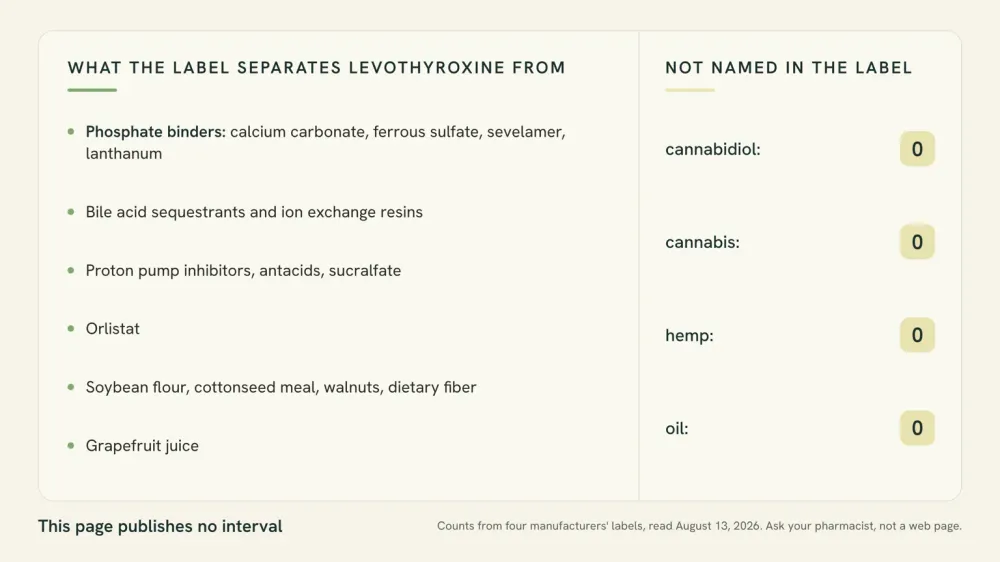
Underneath the wrong mechanism there is a real question, and it is the one most readers are actually asking: does taking an oil in the morning get in the way of a tablet that has to be absorbed on an empty stomach? Levothyroxine absorption is genuinely fragile, and the label says so. Section 12.3 puts the range at 40% to 80% of an oral dose, absorbed mostly from the jejunum and upper ileum, increased by fasting, and decreased by malabsorption syndromes, by certain foods such as soybeans, by dietary fiber and by age. Two more numbers explain why small differences matter here. T4 has a half-life of 6 to 7 days, and it is more than 99% bound to plasma proteins, with only the unbound fraction metabolically active. That is why the administration instructions in section 2.1 are as specific as they are. The label's instruction to its own patient is to take it as a single daily dose, on an empty stomach, one-half to one hour before breakfast, and at least 4 hours before or after drugs known to interfere with its absorption. Section 5.1 opens by stating plainly that Synthroid has a narrow therapeutic index, which is the label's own phrase for a drug where small differences in exposure count.
- Phosphate binders, the label's own examples being calcium carbonate, ferrous sulfate, sevelamer and lanthanum. Table 5 says to administer levothyroxine at least 4 hours apart from these agents.
- Bile acid sequestrants and ion exchange resins, with the same instruction: at least 4 hours prior to these drugs, or monitor TSH.
- Proton pump inhibitors, antacids and sucralfate. The label gives the reason in one sentence: gastric acidity is an essential requirement for adequate absorption of levothyroxine.
- Orlistat, which appears in the same absorption table.
- Foods, from section 7.9: soybean flour, cottonseed meal, walnuts and dietary fiber may bind and decrease absorption, and grapefruit juice may delay absorption and reduce bioavailability.
- Not on any of those lists: cannabidiol, hemp, cannabis, or oil of any kind. Cannabidiol and the word oil each appear zero times in all four labels. Absence from a named list is not proof of safety; it means the question was never submitted.
Now the part this page will not do. Several of the results that sit above this one in search hand you a number of hours to leave between the tablet and the oil, and one of them explains that the gap helps ensure your medication is absorbed properly without interference from other substances in the liver. That sentence does not hold together on its own terms. A gap between two things you swallow can only act on what happens in your gut, and it is being offered as protection against something happening in the liver. Page one is not merely wrong about which enzyme; it has fused two different pharmacological ideas into a single instruction. The label's 4-hour rule is real, and it belongs to the specific agents the label names. There is no cannabidiol entry for an interval to attach to, no study has measured a CBD product against levothyroxine absorption, and inventing a better-sounding number would repeat the exact mistake this page exists to correct. So there is no interval here, and there will not be one. That question goes to your pharmacist, who can see your actual product, your actual tablet and your actual morning. The general questions of when and how live on when to take CBD and how to take CBD oil under the tongue; amounts live in our dosage guide. This page publishes no schedule and no dose of its own.
Is it any different with Synthroid, or with another thyroid medication?
Synthroid is the brand most people search for, and the brand question resolves to the same document. Synthroid, Unithroid, Levoxyl and Euthyrox are all levothyroxine sodium, and all four carry the same section 12.3 pharmacology, the same 4-hour instruction and the same zeros. The one real difference this read turned up has nothing to do with CBD: only the Synthroid label carries the detailed content about biotin interfering with thyroid laboratory tests, 15 mentions against zero on the other three, which is worth knowing if you take a biotin supplement and your test results look strange. One limit on the wider phrase, thyroid medication: everything here was read off levothyroxine labels, so it speaks for levothyroxine and nothing else, and liothyronine, desiccated thyroid extract and antithyroid drugs such as methimazole were not part of this read. The neighbouring question people ask alongside this one, whether a herbal supplement can move thyroid hormone, has its own page: what is known about CBD and ashwagandha covers the supplement that does have published thyroid case reports attached to it.
Why this is one of the few interaction questions with an instrument
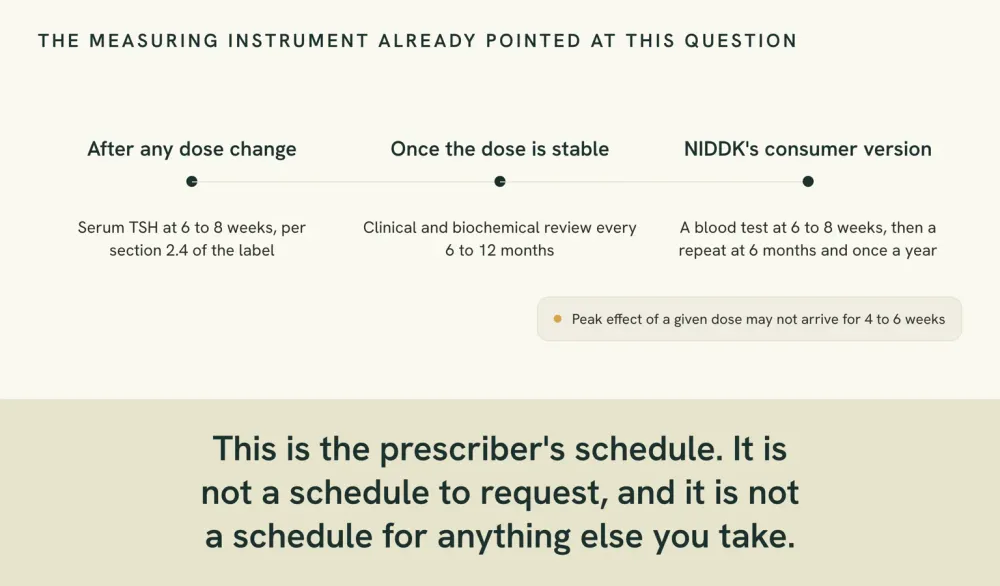
Here is what makes this question different from most interaction questions, and none of the pages above it in search says it. Thyroid replacement comes with a measuring instrument built into the treatment. Section 2.4 of the label tells prescribers to monitor serum TSH after an interval of 6 to 8 weeks after any change in dosage, and, in patients on a stable and appropriate replacement dosage, to evaluate clinical and biochemical response every 6 to 12 months and whenever there is a change in the patient's clinical status. Section 2.2 adds that the peak therapeutic effect of a given dose may not be attained for 4 to 6 weeks, which is why the check is scheduled that far out rather than the following week. NIDDK, the federal institute for diabetes and digestive and kidney diseases, describes the same cadence in consumer language: a blood test about 6 to 8 weeks after you begin taking the medicine, then a repeat at 6 months and once a year once you have reached a dose that works. Neither of those is a schedule to request on your own. The point is simply that whatever happens, or does not happen, somebody can measure it.
The label goes further and names the situation outright. Section 2.4 states that persistent clinical and laboratory evidence of hypothyroidism despite an apparent adequate replacement dose may be evidence of inadequate absorption, poor compliance, drug interactions, or a combination of these factors. Drug interactions are already on the list of things the routine monitoring is looking for, which is why the useful move here is disclosure rather than adjustment. A prescriber who knows what you are taking can read your next TSH result in light of it. A prescriber who does not know is reading it blind. The same logic runs through our page on CBD and blood pressure medication, the other prescription in this cluster with a number attached to it.
What to do before you do anything else
- 1Tell your levothyroxine prescriber, and tell your pharmacist. The label instructs its own patients to report any other medications they take, including over-the-counter preparations, and the Levoxyl leaflet adds vitamins and herbal supplements.
- 2Bring the actual bottle and its batch certificate of analysis. Nobody can advise on a product whose contents they cannot see, and consumer CBD products differ enormously in what they contain.
- 3Ask about timing rather than deciding it yourself. That is the one question a pharmacist can answer with your real morning in front of them, and it is the question this page deliberately leaves open.
- 4Keep your levothyroxine routine exactly as it is while you ask. Same time, same empty stomach, same tablet, same dose. Nothing on this page is a reason to move any of it.
- 5Know what the label asks its own patients to report: rapid or irregular heartbeat, chest pain, shortness of breath, leg cramps, headache, nervousness, irritability, sleeplessness, tremors, change in appetite, weight gain or loss.
- 6The list continues: vomiting, diarrhea, excessive sweating, heat intolerance, fever, changes in menstrual periods, hives or skin rash, or any other unusual medical event. That is the label speaking to its patient, not a self-diagnosis checklist.
- 7Ask when your next TSH is due. If anything is going to be visible, that blood test is where it would show up, and your prescriber is the one who reads it.
- 8Do not use a hemp product to postpone a clinical question. That instruction is NCCIH's, about cannabinoids in general, and it applies here as well as anywhere.
What is still unknown
The list of things this page cannot tell you is longer than the list of things it can. No randomized trial has given cannabidiol to people who take levothyroxine and then measured either drug, so there is no exposure ratio, no threshold and no interval, which is why none is printed here. Nobody has measured a consumer hemp tincture against a TSH result. The human signal that does exist is seven children and twelve children from one hospital, described rather than tested, on a pharmaceutical product at milligram-per-kilogram doses. Both halves of the isoform argument are in vitro, on both sides of the comparison. And label silence cuts both ways: cannabidiol appears zero times in all four levothyroxine labels, and thyroid, thyroxine, levothyroxine and TSH appear zero times in the cannabidiol label, which is a fact about what has been submitted to a regulator rather than a finding about what happens in a body. What the federal agencies do say is general and worth repeating. NCCIH states that CBD use has been associated with liver injury, male reproductive harm, and interactions with other drugs, and tells readers not to use cannabis or cannabinoids to postpone seeing a health care provider about a medical problem. FDA's consumer update says CBD can affect how other drugs you are taking work, potentially causing serious side effects. If this pattern feels familiar, it is the second time this cluster has run into it: CBD and lithium is the other page where the enzyme explanation everyone repeats turns out not to apply to the drug in question. And if cannabidiol itself is new to you, start with what cannabidiol is and is not.
That is a question for the person who prescribes your levothyroxine and for your pharmacist, and it is a reasonable one to raise. What can be said here is what the documents say. Neither the levothyroxine label nor the FDA-approved cannabidiol label mentions the other, in either direction. The only human reports of the two together describe cannabidiol concentrations rising in children who were also taking levothyroxine, not thyroid hormone rising, and that is seven children in one hospital on a pharmaceutical product. It is not a safety conclusion in either direction, and nothing here is a reason to change either medicine on your own.
Read on August 13, 2026, the words CYP, cytochrome and P450 appear zero times in the FDA prescribing information for Synthroid, and the same is true of the Unithroid, Levoxyl and Euthyrox labels. Section 12.3 says the main route of thyroid hormone metabolism is sequential deiodination, with conjugation to glucuronides and sulfates as the second route. Cannabidiol's own clearance does run partly through CYP2C19 and CYP3A4, but thyroid hormone does not use those enzymes, so there is no shared cytochrome pathway for the two to compete over.
There is no sourced answer, and the pages that give you a number are inventing it. The label's 4-hour rule attaches to the specific products the label names, such as calcium carbonate, ferrous sulfate, bile acid sequestrants and antacids. There is no cannabidiol entry for an interval to attach to, and the word oil appears zero times in all four labels read for this article. Your pharmacist can see your actual product and your actual morning routine, which is the level at which this question is answerable. Do not change your levothyroxine timing on your own while you ask.
No. On August 13, 2026, a PubMed search for cannabidiol and levothyroxine returned four records in total and zero published in 2017, and a search for cannabidiol and thyroid returned zero for 2017 as well. The four records that do exist are two pediatric pharmacokinetic studies from one Argentine hospital, an FDA randomized trial in healthy adults, and a rat study. None was published in 2017, and none reports thyroxine accumulating in a person given CBD.
In the only randomized placebo-controlled trial to measure it, 201 healthy adults took 5 mg/kg/day of cannabidiol or placebo for four weeks and there was no difference from placebo in thyrotropin, total T3 or free T4. A 2025 Ontario cohort looked at 2,499 older adults taking both cannabis and levothyroxine and reported no increased risk of thyrotoxicosis, although the same analysis reported a higher risk of heart failure and it studied authorised medical cannabis rather than CBD on its own. The one study in which thyroxine rose was done in vitamin-D3-deficient rats. None of that makes CBD safe with levothyroxine. It makes the specific hyperthyroidism story unsupported.
The brand questions resolve to the same document. Synthroid, Unithroid, Levoxyl and Euthyrox are all levothyroxine sodium, and all four labels returned the same zero counts for CYP, cytochrome, P450, oil and cannabidiol on August 13, 2026. Everything here was read off levothyroxine labels, so it does not speak for liothyronine, desiccated thyroid extract or antithyroid drugs such as methimazole.
Writing about hemp, wellness and the small rituals that keep us balanced.