Can Teachers Smoke Weed? License, District and State Law
Not at school, not at a school event, not on duty: every US rule we read draws that line. Off duty, your teaching license, your district's policy and your state's job law answer separately. Here is what the boards, the federal statute and the courts actually say.

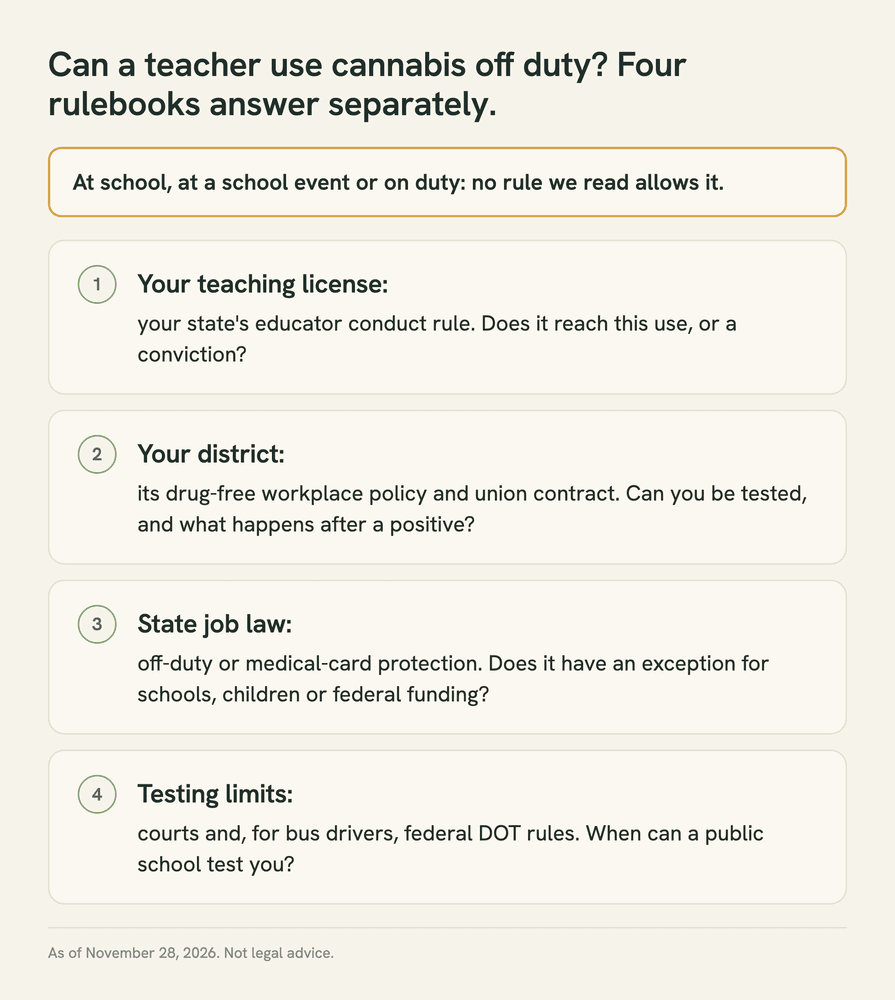
Can teachers smoke weed? Not at school, not at a school event, not on duty and not impaired at work: every rule we read draws that line, including in states where adults can buy cannabis legally. Off the clock, four rulebooks answer separately: your state's educator-licensing rules, your district's drug-free workplace policy, your state's cannabis job-protection law, and the limits on who can be drug tested. This guide reads each one from the statute, rule or court opinion, as of November 28, 2026. It is general legal information, not legal advice.
Can teachers smoke weed? Four rulebooks, four separate answers
About 3.5 million teachers worked in traditional public schools in 2020-21, plus 251,000 in public charter schools and 466,000 in private schools, according to the federal education statistics office's teacher fast facts. Most of what ranks for this question was written in 2017-2019 by principals' associations, before most adult-use laws took effect, or comes from Canadian and British sources whose rules do not apply to a US school. The federal baseline has moved since then. Since April 28, 2026, a DEA final rule has placed marijuana held under a state medical license in Schedule III; everything else, including adult-use marijuana, remains in Schedule I. The rule does not mention workplaces or drug testing. On top of that baseline, four rulebooks apply to you off the clock, and a yes from one is not a yes from the others.
| Rulebook | Who writes it | What it usually covers | Where to find yours |
|---|---|---|---|
| Your teaching license | State educator-licensing board or standards commission | Conduct at school and on duty; drug convictions | Your state's educator code of ethics or conduct rule |
| Your district | The school board, with testing terms often bargained with the union | Drug-free workplace policy; testing at hiring, on suspicion or after an incident | The board policy manual and your union contract |
| State job law | Your state legislature | Off-duty or medical-card protection, and its exceptions | Your state's cannabis or employment statute |
| Testing limits | Courts (Fourth Amendment) and, for drivers, federal DOT rules | When a public school may test you; random tests for commercial drivers | Court rulings for your region; 49 CFR Part 382 for drivers |
Other licensed jobs face the same layered problem with their own twists: see our guides on whether nurses can smoke weed, the board and DEA rules for doctors, cannabis rules for firefighters and EMTs and what police departments allow. For teachers, the twist is children. Courts that upheld testing teachers pointed to their role with students, and at least two state legislatures wrote exceptions for jobs that teach or supervise children into their cannabis employment laws.
At school, every rule we read says no
Start with the part that does not depend on where you live. Washington's educator-conduct rule makes use on school premises or at a school-sponsored activity unprofessional conduct (quoted in the next section). Michigan's voter-approved adult-use law, Mich. Comp. Laws 333.27954(1)(h), does not authorize "possessing or consuming marihuana on the grounds of a public or private school where children attend classes in preschool programs, kindergarten programs, or grades 1 through 12, in a school bus." Arizona's medical-marijuana law, A.R.S. 36-2802, bars medical use "On a school bus" and "On the grounds of any preschool or primary or secondary school," and does not authorize any task "under the influence of marijuana that would constitute negligence or professional malpractice." Every rule we read, including those in states where adults can buy cannabis legally, draws the same line: not at school, not at a school event, not on duty. In the texts we read, that line covers:
- School premises and grounds (Washington, Michigan, Arizona).
- A school-sponsored or district-sponsored activity, wherever it is held (Washington, Oregon).
- A school bus (Michigan, Arizona).
- Being on duty while under the influence (Oregon).
- District property, district vehicles and time on duty away from district property (one Colorado district's policy, covered below).
The federal "drug-free school zone" law is a different thing. 21 U.S.C. 860 sets "twice the maximum punishment" for "distributing, possessing with intent to distribute, or manufacturing a controlled substance" in or within 1,000 feet of a school. It is a dealing statute. That does not make possession on campus lawful under federal law; it simply is not what section 860 covers. The state rules above are what reach a teacher's own use at school. And legalization does not stop an employer from acting: Michigan's law says in so many words that it "does not prohibit an employer from disciplining an employee for violation of a workplace drug policy or for working while under the influence of marihuana."
Your teaching license: what the boards actually say
Each state licenses teachers through a board or commission with its own conduct code, and a license problem is the one that can follow you from district to district. We read four of those codes. Washington, where adults can buy cannabis legally, wrote marijuana into its educator-conduct rule, WAC 181-87-055, effective April 29, 2021, and the line it draws is the school:
“The use or consumption of marijuana or marijuana-infused product on school premises or at a school sponsored activity.”
Two more parts of the Washington rule cover possession "on school premises or at a school sponsored activity involving students if such possession violates Washington law or is contrary to written policy," and being under the influence on school premises after the employer has given notice and a referral to counseling. The rule says nothing about off-duty use at home. That silence is not permission from your district, but it shows where the licensing line sits in that state. Oregon's licensing commission rule, OAR 584-020-0040, treats "Appearing on duty or at any district-sponsored activity while under the influence of alcohol, marijuana, or any controlled substance" as evidence of gross neglect of duty, and separately reaches a conviction "of a crime involving the illegal use, sale or possession of controlled substances."
In Georgia, where adult-use cannabis is not legal, the Professional Standards Commission's Code of Ethics for Educators, effective January 1, 2024, tells educators to "refrain from the use of alcohol or illegal or unauthorized drugs during the course of professional practice," and its first standard reaches a conviction "of any other criminal offense involving" possession "of a controlled substance or marijuana." So in Georgia the code reaches a marijuana-possession conviction, not just on-campus use. Texas has no adult-use program, and its Educators' Code of Ethics, last amended effective August 2, 2026, says: "The educator shall refrain from the illegal use, abuse, or distribution of controlled substances, prescription drugs, and toxic inhalants." That standard turns on what Texas law allows.
| State | Rule | What it reaches | Effective |
|---|---|---|---|
| Washington (adult use legal) | WAC 181-87-055 | Use or possession on school premises or at school activities; being under the influence at school | April 29, 2021 |
| Oregon (adult use legal) | OAR 584-020-0040 | On duty or at a district activity under the influence of marijuana; drug convictions | Current rule, read November 28, 2026 |
| Georgia (no adult use) | GaPSC 505-6-.01, Standards 1 and 3 | Drugs during professional practice; marijuana-possession convictions | January 1, 2024 |
| Texas (no adult use) | 19 TAC 247.2, Standard 1.12 | "Illegal use" of controlled substances, as defined by Texas law | Amended August 2, 2026 |
| Arizona (medical) | A.R.S. 36-2811(B) | Bars licensing-board discipline of registered patients for lawful medical use; not for working impaired | Current statute |
Arizona adds a shield the others lack. Its medical-marijuana law, at A.R.S. 36-2811, says a registered patient is not subject to discipline "by a court or occupational or professional licensing board or bureau" for lawful medical use. It does not cover working under the influence. Notice what none of the four conduct codes says in words: none regulates lawful off-duty use. In the rules we read, a license problem starts with a conviction or something that happens at school, not with a quiet weekend. Your district may have a duty to report an on-duty incident to the state, and those reporting rules vary, so check yours.
Your district: the drug-free workplace policy
This is the layer most teachers actually meet, and the one most search results get wrong. Several pages that rank for this question say a district can lose its federal money if a teacher uses marijuana in any form. The 1988 federal law districts cite, 41 U.S.C. 8103, asks grant recipients to publish a statement that the unlawful "manufacture, distribution, dispensation, possession, or use of a controlled substance is prohibited in the grantee's workplace," run a drug-free awareness program, require employees to report a conviction for a drug crime in the workplace "no later than 5 days" after it, notify the funding agency within 10 days, and apply sanctions. The word "test" does not appear in the section. It does not appear in the government-wide grant rule that carries it out, 2 CFR Part 182, either, which defines the drug-free workplace as "a site for the performance of work done in connection with a specific award."
Under the Act's own words, a grant is at risk when the grantee skips the required steps, or when "the number of employees of the grantee who have been convicted of violations of criminal drug statutes for violations occurring in the workplace" shows it has not made a good-faith effort. That is a workplace-and-conviction test. It does not stop a district from writing a stricter rule, and many do. St. Vrain Valley School District's drug-free workplace policy in Colorado, revised November 11, 2015, says: "As a recipient of federal funds, the district has an obligation to maintain a drug-free workplace. Thus, marijuana is an illicit drug for purposes of this policy." Note what that policy covers: conduct "on district property, in or on district vehicles, or off district property when the employee is on duty." The same policy says "federal law still prohibits" marijuana. That was the district's wording in 2015; since April 2026, marijuana under a state medical license sits in Schedule III and everything else in Schedule I, and districts have not had to rewrite their policies because of it.
Policies like that have consequences. In 2021 a Florida school board voted 3-2 to fire a teacher who used medical marijuana. Her use came to light through a drug test after a student shoved her down a flight of stairs. The district's general counsel tied the decision to federal grants: as the report paraphrases him, the district must be drug-free to receive certain federal grants and so cannot allow teachers to use marijuana. According to the teacher, the district's policy, not updated since 2003, barred "illegal drugs" without mentioning medical marijuana. That is a lawyer's view reported in the news, not a court ruling.
Two more pieces complete the district layer. First, the Drug-Free Schools and Communities Act that some pages cite now binds colleges: under 34 CFR 86.1, an "institution of higher education (IHE) must certify that it has adopted and implemented a drug prevention program." For K-12 districts, the federal hook is the Drug-Free Workplace Act. Second, testing rules for teachers are usually written into board policy and bargained with the union, and unions have taken the strictest ones to court, as the testing section shows. In one example, Education Week reported in 2007 that Hawaii teachers ratified a contract, by a 61.3% vote, that tied random drug testing to 4% raises.

State off-duty and medical-card laws, and the school carve-outs
Some states protect workers who use cannabis off duty or hold a medical card. Read the exceptions before you rely on one, because several are written with schools in mind. Connecticut protects most workers' off-duty use "outside of the workplace," but its 2021 law, Conn. Gen. Stat. 21a-422o and 21a-422p, exempts any employer whose primary activity is "educational services" (federal industry code 61) and any position "Requiring the supervision or care of children, medical patients or vulnerable persons," as well as positions "Funded in whole or in part by a federal grant." For those employers and jobs, the off-duty protection does not apply. Minnesota generally bars cannabis testing of job applicants "unless otherwise required by state or federal law," but its drug-testing statute, Minn. Stat. 181.951, lists positions where "cannabis and its metabolites are considered a drug and subject to the drug and alcohol testing provisions." The list includes "a position requiring face-to-face care, training, education, supervision, counseling, consultation, or medical assistance to: (i) children," commercial-driver positions, and "a position of employment funded by a federal grant."
Arizona's job protection for medical patients, A.R.S. 36-2813, bars an employer from penalizing a registered patient's card or positive test "unless the patient used, possessed or was impaired by marijuana on the premises of the place of employment or during the hours of employment." It gives way where honoring it "would cause an employer to lose a monetary or licensing related benefit under federal law or regulations." Whether that reaches a school district's federal grants is a question for a lawyer, not a blog. California (Gov. Code 12954, operative January 1, 2024) and New York (Labor Law 201-d) protect off-duty use with no carve-out for schools, but both step aside where federal law or federal funding requires otherwise, and neither protects use or impairment on the job. New York's labor department guidance adds that "a test for cannabis usage cannot serve as a basis for an employer's conclusion that an employee was impaired." Michigan, as quoted above, leaves employers free to enforce a workplace drug policy.
| State | What it protects | School or child-related carve-out | Where it gives way |
|---|---|---|---|
| Connecticut | Off-duty use outside the workplace | Educational-services employers and jobs supervising children are exempt | Positions funded by a federal grant are exempt too |
| Minnesota | Limits on cannabis testing of applicants | Face-to-face education of children stays testable | Federal-grant-funded and commercial-driver jobs stay testable |
| Arizona (medical) | Card status and a positive test, absent use or impairment at work | No medical use on school grounds or a school bus | Loss of a federal monetary or licensing-related benefit |
| California | Off-the-job use; tests for nonpsychoactive metabolites | None found | Testing required for federal funding or federal licensing benefits |
| New York | Lawful off-duty use | None found | Loss of a federal contract or federal funding |
| Michigan | Adult use under state law | No use on school grounds or a school bus | Employers may enforce a workplace drug policy |
For the general rules on cannabis and employment in each state, see our guide to whether you can be fired for failing a drug test. The carve-outs above are what make a teacher's answer different from an office worker's.
Do teachers get drug tested?
A public school is the government, so a drug test of its employees is a search under the Fourth Amendment, and testing without suspicion needs a special justification. The Supreme Court upheld suspicionless testing of railroad workers in Skinner v. Railway Labor Executives' Association and of customs officers in drug-interdiction jobs in NTEU v. Von Raab, both in 1989, then struck down Georgia's drug test for political candidates as "symbolic" in Chandler v. Miller in 1997. Students are a different question with their own Supreme Court cases, covered in our guide to whether schools can drug test students. For school staff, these are the rulings that matter.
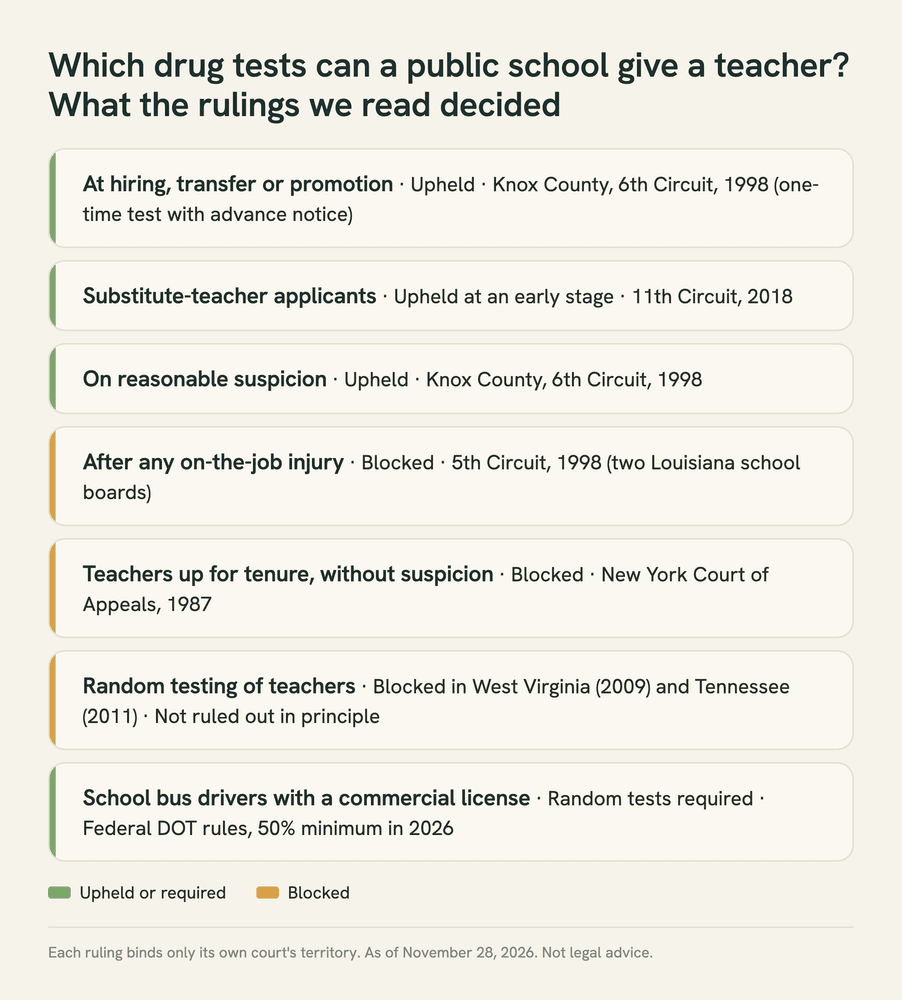
The case everyone cites is Knox County Education Association v. Knox County Board of Education, decided September 29, 1998, by the federal appeals court covering Tennessee, Kentucky, Ohio and Michigan. It upheld two things: "suspicionless drug testing for all individuals who apply for, transfer to, or are promoted to, 'safety sensitive' positions," "including teaching positions," and "reasonable suspicion" testing of all school employees. The court justified it "by the unique role they play in the lives of school children and the in loco parentis obligations," and pointed out that the policy was "a one-time test, with advance notice and with no random testing component." The Supreme Court declined to hear the case in 1999. Most pages cite Knox County as "teachers can be drug tested" and stop there.
Courts have drawn limits since. In 1998, the federal appeals court for Louisiana, Mississippi and Texas ordered two Louisiana school boards, in Orleans and Jefferson parishes, to stop requiring urine tests of teachers, aides and clerical workers after any on-the-job injury "absent adequate individualized suspicion," saying the testing "does not respond to any identified problem of drug use by teachers." In 2009, a federal judge in West Virginia blocked Kanawha County's random testing, finding the evidence did not show "that these employees have a reduced expectation of privacy by virtue of their employment in a public school." In 2011, a federal judge in Tennessee struck down Smith County's random policy, which tested 10% a year, as it was drafted, while saying, as Education Week reported, that he was not ruling random testing of teachers unconstitutional by itself. Going the other way, in 2018 the federal appeals court for Florida, Georgia and Alabama upheld, at an early stage of the case, suspicionless testing of substitute-teacher applicants in Palm Beach County. It reasoned that teachers "have a diminished privacy interest in this unique setting," and distinguished "a janitor who simply cleans a school building in the evening." Earlier still, in 1987, New York's highest court rejected drug testing of teachers up for tenure without reasonable suspicion.
| Case | Year | Court | What was tested | Result |
|---|---|---|---|---|
| Patchogue-Medford (N.Y.) | 1987 | New York Court of Appeals | Teachers up for tenure | Not allowed without reasonable suspicion |
| United Teachers of New Orleans | 1998 | 5th Circuit (LA, MS, TX) | Teachers, aides and clerks after any on-the-job injury | Blocked absent individualized suspicion |
| Knox County | 1998 | 6th Circuit (KY, MI, OH, TN) | One-time test at hiring, transfer or promotion; reasonable suspicion | Upheld; no random component |
| AFT-West Virginia v. Kanawha County | 2009 | Federal district court, S.D. W. Va. | Random testing | Blocked |
| Smith County (Tenn.) | 2011 | Federal district court, M.D. Tenn. | Random testing, 10% a year | Struck down as drafted; random testing not ruled out in principle |
| Friedenberg v. School Board of Palm Beach County | 2018 | 11th Circuit (FL, GA, AL) | Substitute-teacher applicants | Upheld at an early stage of the case |
In practice, the tests a teacher is most likely to meet are at hiring, after an incident, or when a supervisor documents signs of impairment. We found no national survey of how many districts test teachers, and no federal appeals ruling on random testing of all teachers after 2018. Drivers are the exception. Under 49 CFR 382.103, the exceptions that free school bus operations and government vehicles from other federal trucking rules "do not apply to this part," so school bus drivers who need a commercial driver's license are covered by federal DOT testing, random tests included. DOT's 2026 random testing rates notice left every rate except one rail category unchanged from 2025, which keeps the FMCSA minimum random drug-testing rate for these drivers at 50% a year. If you coach and drive the team bus on a commercial license, that part of your job runs under federal rules. Our guide to how a random drug test works covers selection and rates.
Medical cards, CBD and a positive test
A medical card is a defense in some states' licensing and job laws, and a weak one where the employer cites federal funding: Arizona bars licensing-board discipline for lawful medical use, Connecticut exempts schools from its off-duty protection, Minnesota keeps cannabis testable for jobs educating children, and a Florida board fired a medical patient. The April 2026 move of state-licensed medical marijuana to Schedule III does not settle it either, because the rule says nothing about workplaces or drug tests; our explainer on the medical marijuana Schedule III ruling covers what it did change. If you hold a card, ask HR in writing how your district's policy treats it before you rely on it. The rules also travel with you: your license and your district policy do not change on vacation, and a positive test does not say where you used.
CBD is not what a workplace test looks for, but CBD can carry THC. In a 2020 study with SAMHSA scientists, six adults took 100 mg of pure CBD and none of 218 urine samples confirmed positive; after a CBD-dominant cannabis with 3.7 mg of THC, four samples from two of the six did. Six people and single doses make a small study, and full-spectrum hemp items contain trace THC by design. Tests look for THC's metabolite, so the THC in what you take is the variable. Our guide to CBD and drug tests explains where that THC comes from.
Substitutes, student teachers and private schools
Three groups get the question in a slightly different form. Substitute teachers can be tested at the application stage in at least one federal circuit: the 2018 Palm Beach County ruling upheld suspicionless testing of substitute applicants, reasoning that teachers, substitutes included, have a reduced expectation of privacy at school. Student teachers are usually not district employees. Their college's own drug and alcohol standards, required by 20 U.S.C. 1011i, prohibit unlawful use "by students and employees on the institution's property or as part of any of the institution's activities," and the placement school's rules apply while you are on site. Private schools are not the government, so the Fourth Amendment limits above do not bind them; their rules come from your contract and the faculty handbook. The license layer can still apply: Washington requires most private-school classroom teachers to hold state certification.
- Substitutes: expect a pre-employment test in some districts, and the same on-duty rules as any teacher.
- Student teachers: your college's standards plus the placement school's rules on site. No case law we found addresses testing student teachers.
- Private-school teachers: your contract and handbook decide testing; a state license, if you hold one, still carries its conduct rule.
A checklist before you decide
This checklist is about knowing which rules apply to you, not about passing or contesting a test. Work through it before you rely on your state's legalization.
- 1Read your district's drug-free workplace policy (many are coded GBEC) and note its scope words: "on duty," "district property," "illicit drug."
- 2Read the testing article of your union contract: when you can be tested, by whom, and what happens after a positive.
- 3Find your state's off-duty or medical-card statute and look for an exception for education, children or federal funding.
- 4Read your state's educator code of ethics or conduct rule, including what it says about convictions and conduct at school.
- 5List any driving duty. If you drive a school bus or team vehicle on a commercial license, federal DOT testing applies, random tests included.
- 6If you hold a medical card, ask HR in writing how district policy treats it before you rely on it.
- 7Never use before or during school, a school event or any trip where you supervise students.
- 8If a test or an investigation starts, call your union representative or an employment lawyer early.

What this page cannot tell you
This guide reads four state educator-conduct rules (Washington, Oregon, Georgia and Texas), the cannabis job laws of six states, the federal drug-free workplace, school-zone and college drug-prevention laws, one district policy, one news report of a firing, and six court rulings on testing school staff. That is not a 50-state survey, and each court rules only for its own territory. Several questions are open: whether a district's federal grants trigger the federal-funding clauses in Arizona, California and New York; how Minnesota's off-duty protection interacts with its testing list; and whether the Schedule III rule changes any district's policy. We did not read your district's policy or your union contract, and those usually decide the day-to-day answer.
Frequently asked questions
Off duty it may be lawful under state law, but your district policy, your license rules and your state's job law answer separately. Some districts treat marijuana as an illicit drug because they take federal money, Connecticut exempts schools from its off-duty protection, and Minnesota keeps cannabis testable for jobs educating children. At school, at a school event or on duty, every rule we read says no, including in Washington, Oregon and Michigan, where adults can buy cannabis legally.
Usually at hiring, on reasonable suspicion, or after an incident. A 1998 federal appeals ruling upheld a one-time test for new, transferred or promoted teachers plus testing on reasonable suspicion. We found no national survey of how many districts test teachers. School bus drivers who need a commercial license are under federal DOT testing, including random tests.
Where districts tried random testing of all teachers, federal judges in West Virginia (2009) and Tennessee (2011) stopped it, and a federal appeals court blocked a Louisiana rule that tested teachers after any on-the-job injury (1998). The Tennessee judge said random testing of teachers is not automatically unconstitutional, so a differently written policy could fare differently. CDL bus drivers face random DOT testing at a 2026 minimum rate of 50% a year.
Getting the card is a state matter. Whether it protects your job depends on the state and on federal-funding clauses. Arizona bars licensing-board discipline for lawful medical use, but its job protection gives way where an employer would lose a federal benefit. Connecticut exempts schools from its off-duty protection, and Minnesota keeps cannabis testable for jobs educating children. In 2021 a Florida school board fired a teacher who used medical marijuana. Ask HR in writing before you rely on a card.
It is possible. The rules we read target convictions and use or impairment at school or on duty: Washington lists use on school premises or at school activities as unprofessional conduct, Oregon treats being on duty under the influence of marijuana as gross neglect, and Georgia's code reaches a marijuana-possession conviction. None of the four codes we read regulates lawful off-duty use in words. Arizona shields registered medical patients from board discipline for lawful use.
The same layers apply, and testing can start earlier. In 2018 the federal appeals court for Florida, Georgia and Alabama upheld suspicionless drug testing of substitute-teacher applicants in Palm Beach County, at an early stage of the case. On duty or at a school event, the answer is no in every rule we read.
CBD itself is not what workplace tests look for, but CBD items can carry THC. In a 2020 study of six adults, 100 mg of pure CBD produced no confirmed positive urine sample, while a CBD-dominant cannabis with 3.7 mg of THC produced four, from two of the six people. If your job tests you, no product can guarantee a drug-test result.
Not in the text we read. The Drug-Free Workplace Act asks grant recipients to publish a policy banning unlawful drug use in the workplace, run an awareness program and act on workplace drug convictions; the word test does not appear in it or in the grant rule that carries it out. Districts may choose to test, within the limits the courts have set, and federal DOT rules require testing of commercial bus drivers.
Your license and your district policy do not switch off over the summer or across a state line, and a positive drug test does not show where or when you used. Whether off-duty use in a legal state is protected depends on your state's job law and its exceptions for schools, children and federal funding.
Colleges are a separate rulebook: under the Drug-Free Schools and Communities Act, each institution must certify a drug-prevention program with standards that prohibit unlawful use by students and employees on its property or at its activities. Start with your institution's policy.
Teacher rules sit inside a larger legal map. Our guide to whether CBD is legal covers the federal hemp rule and the state exceptions that sit beside the license and workplace rules above.
Writing about hemp, wellness and the small rituals that keep us balanced.