Can Police Officers Smoke Weed? Off Duty, Guns and Hiring
No state we checked lets officers use cannabis on duty. Off duty, the answer turns on state law, department policy, the union contract and a federal gun law with an official-use exemption. Here is what the statutes, the 2026 rulings and hiring rules say.
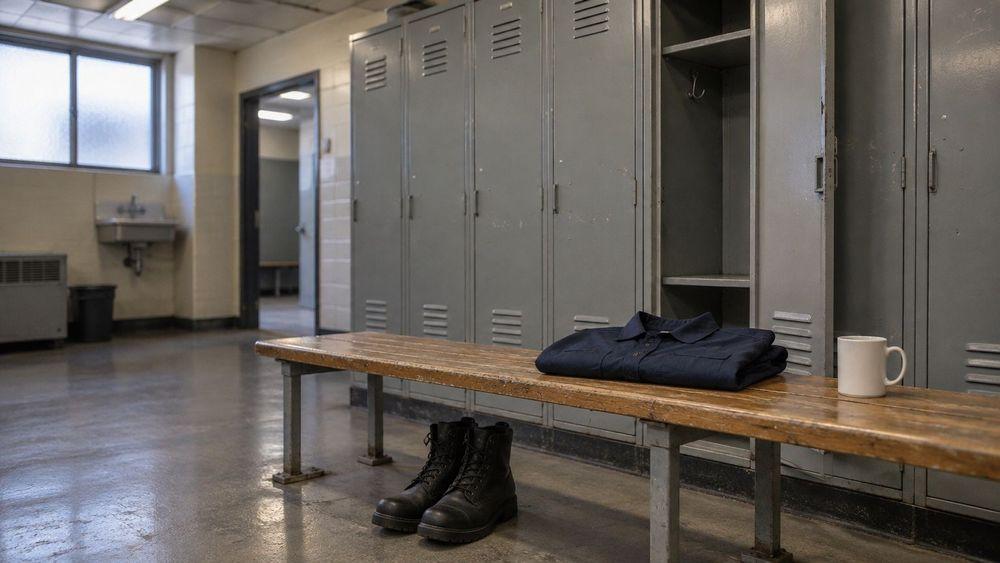
Can police officers smoke weed? Not on duty, in any state we checked. Off duty, the answer depends on four layers: your state's law, your department's written policy and union contract, the federal gun law every armed officer carries, and whether you work for a federal agency. This guide reads each layer from the primary documents, as of November 23, 2026. It is general legal information, not legal advice.
Can police officers smoke weed? On duty, no; off duty, four layers decide
Most answers online pick one state, or one Canadian city, and generalize. The real answer for a US officer is stacked. Start with the federal baseline: since April 28, 2026, a DEA final rule has placed marijuana held under a state medical license, and marijuana in FDA-approved drugs, in Schedule III. Adult-use marijuana is still in Schedule I. Either way, it remains a controlled substance under federal law. State legalization then sits on top of that, and four layers decide what applies to you:
- 1State law. Some states protect lawful off-duty use by employees and say nothing to exclude police. Others write officers out of the protection, or write in an employer's right to ban use.
- 2Department policy and the union contract. General orders can add rules, and in at least one state, Illinois, a conflicting collective bargaining agreement wins over the statute.
- 3Federal gun law. Section 922(g)(3) bars an unlawful user of a controlled substance from possessing a gun, with an exemption for guns issued for official use.
- 4Your employer. Federal agents work under a 1986 executive order that treats illegal drug use on or off duty as incompatible with federal service.
The third layer is what makes an officer's question different from a nurse's or a warehouse worker's. Our parent guide on whether you can be fired for failing a drug test lists law enforcement among the roles some state off-duty protections leave out. This page explains why that matters for an armed officer, and what applies instead.
Which states protect an officer's off-duty use, and which let departments ban it
The table covers the states where we could read a statute or an official policy that reaches police, plus the federal rule. It is not a 50-state survey. Each row is explained below.
| Jurisdiction | Law or rule | For officers | Source and date |
|---|---|---|---|
| New Jersey | CREAMMA, N.J.S.A. 24:6I-52 | Lawful off-duty use protected; on-duty use 'strictly prohibited' | Statute 2021; AG policy February 2023; appeals rulings May 1, 2026 |
| California | Gov. Code 12954 | Off-job use protected; no peace-officer exception | In force January 1, 2024; POST Bulletin December 7, 2023 |
| New York | Labor Law 201-d | Protected, with exceptions for state or federal mandates and impairment at work | DOL guidance October 2021; NYC rule July 25, 2022 |
| Illinois | 410 ILCS 705/10-35(a)(8) | Police employers may ban use on or off duty unless their policies say otherwise; union contract prevails | Last amended effective July 15, 2021 |
| Washington | RCW 49.44.240 | Hiring protection does not cover police applicants | In force as read November 2026 |
| Minnesota | Minn. Stat. 181.951, subd. 9 | Cannabis counts as a drug for testing peace officers | In force as read November 2026 |
| Federal agencies | Executive Order 12564 | Illegal drug use on or off duty is 'contrary to the efficiency of the service' | Signed September 15, 1986 |
California protects off-duty use and does not exclude police. Government Code section 12954, in force since January 1, 2024, bars most employers from penalizing off-the-job cannabis use. Its carve-outs are building and construction trades, jobs that require a federal background investigation or security clearance, and jobs under a federal testing mandate. None names peace officers. The state's police standards board treats officers as covered: POST Bulletin 2023-67, dated December 7, 2023, applied the law to the peace officer background form. The law still lets a department ban use or impairment on the job. Whether a particular assignment, such as some task-force roles, requires a federal background investigation is a case-by-case question. We last read the full statute in September 2026; the legislature's site blocked a re-check on November 23, 2026, and we did not check 2026-session amendments.
Illinois wrote officers into its legalization law. Section 10-35(a)(8) of the Cannabis Regulation and Tax Act says nothing in the Act prevents "a public employer of law enforcement officers, corrections officers, probation officers, paramedics, or firefighters from prohibiting or taking disciplinary action for the consumption, possession, sales, purchase, or delivery of cannabis" while "on or off duty, unless provided for in the employer's policies." The same section adds that where it conflicts with a collective bargaining agreement, "the provisions of the collective bargaining agreement shall prevail." So in Illinois, read your department policy and your contract before anything else.
Washington and Minnesota carve officers out in narrower ways. Washington's hiring protection, RCW 49.44.240, covers only initial hiring and "does not apply to an applicant seeking" a position with "a general authority Washington law enforcement agency." Minnesota's testing statute, section 181.951, lists "a peace officer position" among the jobs where "cannabis and its metabolites are considered a drug" for workplace testing.
New York protects "legal use of consumable products, including cannabis in accordance with state law, prior to the beginning or after the conclusion of the employee's work hours, and off of the employer's premises." Under Labor Law 201-d, an employer may still act when a state or federal statute, regulation or mandate requires it, when an employee shows "specific articulable symptoms" of impairment while working, or to avoid violating federal law or losing a federal contract or funding. New York's labor department guidance from October 2021 walks through those exceptions. New York City went further for its own workforce: the city's personnel rule, PSB 100-15, issued July 25, 2022, tells city agencies to stop pre-employment and random marijuana screening except for federally regulated transportation jobs, and its title list marks "Police Officer" as not subject to marijuana screening. Testing on reasonable suspicion stays. We could not confirm from a public NYPD document whether the NYPD's internal rules match.
Federal officers are a different case. Executive Order 12564, signed in 1986, says that "the use of illegal drugs by Federal employees, whether on duty or off duty, is contrary to the efficiency of the service" and that people who use illegal drugs "are not suitable for Federal employment." State legalization does not help an FBI, DEA or Border Patrol employee. We found no federal guidance on how the 2026 Schedule III rule interacts with that order, so do not assume it changes anything.
New Jersey, the test case: what the 2026 appeals rulings decided
New Jersey is where the conflict between state protection and federal gun law was actually litigated. The state's legalization law, CREAMMA, says at N.J.S.A. 24:6I-52 that no employer may fire or take adverse action against an employee because that person uses cannabis items, and that an employee "shall not be subject to any adverse action by an employer solely due to the presence of cannabinoid metabolites" from lawful conduct. In April 2022, New Jersey's attorney general told departments that the law protects officers too. We could not obtain that memo; an appeals opinion describes the attorney general's policy as prohibiting "adverse action against officers who use cannabis off duty." The same month, Jersey City issued its own order banning use "on or off duty, as it is illegal under federal law for cannabis users to possess, carry, or use firearms."
Two Jersey City officers tested positive for THC on random tests in September 2022 and were fired. One produced dispensary receipts for purchases in June, July and August 2022. No one alleged on-duty use or impairment. The state Civil Service Commission ordered them reinstated in July 2024, and on May 1, 2026, the Appellate Division affirmed in In re Mansour and In re Polanco (Nos. A-3876-23 and A-3886-23). The department argued that the federal Gun Control Act, which includes section 922(g)(3), made it impossible to employ an armed cannabis user. The panel disagreed:
“We discern no conflict here. In summary, we conclude the JCPD may comply with both the GCA and CREAMMA.”
The same day, the same court upheld a third officer's firing, in In re Patten (No. A-3126-23). He tested positive on a random test in January 2023 and said he had smoked cannabis off duty, two or three weeks earlier, to manage pain. His positive result alone was not the problem. He had bought the cannabis from a friend rather than a licensed retailer, and New Jersey's protection covers conduct permitted under the state law. The court affirmed the Commission's May 10, 2024 decision in its entirety, and also rejected the department's federal preemption argument. Both opinions are unpublished, which under New Jersey's court rules means they bind only the parties and are not precedent for other officers or departments. They are still the most direct court answer to this question that we found.
The federal gun law every armed officer carries
Section 922(g)(3) of the federal criminal code makes it a crime for any person "who is an unlawful user of or addicted to any controlled substance" to possess or receive a firearm. Who counts as an unlawful user changed this year. Since January 22, 2026, ATF's interim final rule has defined an unlawful user as "a person who regularly uses a controlled substance over an extended period of time continuing into the present," without a lawful prescription. The current text of 27 CFR 478.11 adds that a person is not an unlawful user if the use is "isolated or sporadic." The rule dropped the old examples, such as a drug conviction within the past year, that let ATF infer use, and says enforcement will "require evidence of regular and recent use." It is an interim rule: comments closed June 30, 2026, no final rule had been published as of November 23, 2026, and ATF said it may revisit the definition after Hemani.
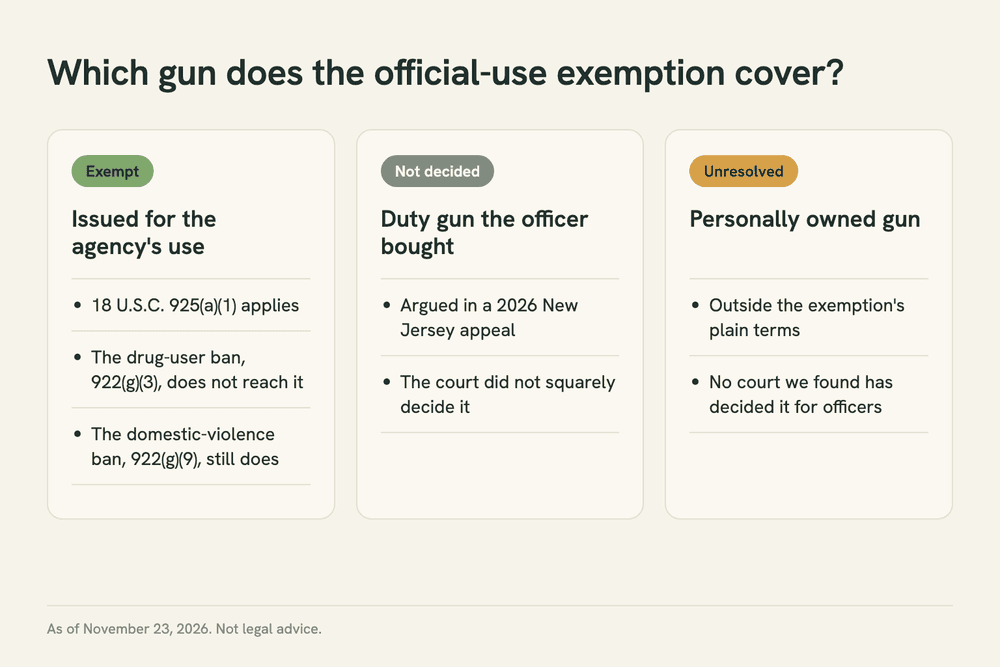
Then comes the part none of the page-one results we read on November 23, 2026 mentions. Section 925(a)(1) says the federal gun chapter's limits "shall not apply" to the possession of any firearm "issued for the use of" the United States, "any State or any department, agency, or political subdivision thereof." The statute lists its own exceptions, and among them the domestic-violence misdemeanor ban, section 922(g)(9), still applies to issued guns. The drug-user ban, section 922(g)(3), is not on that list, so the exemption covers it.
The cases we found read the exemption as covering government guns. The 2026 New Jersey opinion, quoting a 1978 federal appeals decision, Hyland v. Fukuda, said it removes "firearms owned by the state and used exclusively for its purposes" from the ban. It also quoted a 2017 federal district court case, Keyes v. Sessions, in which a state trooper could carry duty weapons but not "in his personal capacity under federal law." We read both cases only as the New Jersey court quotes them. Jersey City argued that its officers buy their own duty guns; the panel found no conflict without squarely deciding whether an officer-purchased duty gun counts as issued.
What United States v. Hemani changed, and what it did not
On June 18, 2026, in United States v. Hemani, the Supreme Court held that the government's prosecution of a man under section 922(g)(3) "is inconsistent with the Second Amendment." He kept a gun at home and, by his own account, used marijuana about every other day. The government prosecuted him "relying solely on" that admitted use and said it could imprison him for up to 15 years. The Court affirmed the Fifth Circuit, so the dismissal stands. Justice Gorsuch wrote for seven justices; Justice Alito, joined by Justice Kagan, concurred in the judgment. No justice voted to uphold the prosecution. The Court's docket shows the judgment issued on July 20, 2026.
The Court was careful about scope. "In many respects, this case is a narrow one," it wrote. "We do not address efforts to ban addicts ... or those presently intoxicated, from possessing a firearm." Nor did it decide whether the government could bring a 922(g)(3) prosecution "accompanied by individualized proof" that a person's drug use makes them dangerous. The statute is still in the code. The opinion does not mention section 925 or the official-use exemption, and it is not an employment ruling: it says nothing about whether a department may discipline an officer. Where state law lets a department ban off-duty use, Hemani does not stop it.
One passage connects to the rescheduling. The Court noted that "after we heard oral argument, the government moved some marijuana products to Schedule III," and said the government was "awkwardly positioned to suggest that the millions of Americans who now regularly use marijuana are categorically and unusually dangerous." That is reasoning, not a holding about Schedule III. For an officer who holds a medical card, the question is open. The federal definition of unlawful user turns on use "without a lawful prescription," and the April rule changed how state medical marijuana is classified, but no court or ATF guidance we found has said it takes a patient outside the gun ban. Treat it as unresolved. Our explainer on the medical marijuana Schedule III ruling covers what that rule did and the challenges to it.
How officers get tested, and why a positive is not proof of impairment
New Jersey publishes the most detailed testing rules we found. The attorney general's statewide police drug-testing policy, revised in February 2023, states that "consuming or being under the influence of cannabis while at work or during work hours is strictly prohibited." Agencies must randomly test at least 10% of sworn officers each time, at least twice in every calendar year. (Our guide to how random drug tests at work are selected explains the mechanics.) An officer who tests positive for illegal drugs, or is found using or under the influence of cannabis at work, is suspended, terminated, reported to the state's Central Drug Registry and permanently barred from law enforcement work in New Jersey. But routine random and applicant tests do not screen for cannabis at all. Under the policy, cannabis goes on the lab panel only in these situations:
- The officer is assigned to a federal task force.
- The officer holds a federally regulated license that requires testing, such as a pilot's or commercial driver's license.
- A federal contract or federal grant specifically requires the agency to test.
- There is reasonable suspicion of use while on duty, or observable signs of intoxication. Then the test adds a physical evaluation by a Workplace Impairment Recognition Expert (WIRE) alongside the urinalysis.
Why the extra evaluation? Because a urine test for THC metabolites shows past use, not impairment. New York City's personnel rule says such tests "cannot establish the recency of use adequately to distinguish between recreational use and use close in time to or during an employee's presence in the workplace." New York's labor department says a cannabis test "cannot serve as a basis for an employer's conclusion that an employee was impaired." New Jersey's cannabis regulator told employers in September 2022 that a metabolite test "alone is insufficient." Detection windows are their own topic, and our guide to how long THC stays in your blood covers that science.
CBD is not a way around any of this. If a department tests for THC, a full-spectrum CBD or other hemp product can contain enough THC to trigger a positive, as our guides to CBD and drug tests and hemp-derived THC products explain. DOT's February 2020 CBD notice says "CBD use is not a legitimate medical explanation for a laboratory-confirmed marijuana positive result." DOT rules govern transportation jobs, not police, but they show how one federal testing program treats the claim.
Can you be a cop if you smoked weed?
Often yes, after a waiting period, but there is no national rule. Each agency or state sets its own look-back, and California has taken past use off the application. These are the standards we could read in primary documents, each with its date.
| Agency or state | Rule on past cannabis use | Source and date |
|---|---|---|
| FBI | No marijuana in any form within 1 year of applying; no other illegal drug within 10 years; hemp or CBD above 0.3% THC counts as marijuana | FBI Employment Eligibility guide, last updated February 2025 |
| New Jersey | A positive applicant test for illegal drugs means removal, a registry report and a 2-year statewide bar; the panel includes cannabis only in limited cases | AG Drug Testing Policy, revised February 2023 |
| California | Employers may not ask about prior cannabis use; criminal history questions remain | POST Bulletin 2023-67, December 7, 2023; law effective January 1, 2024 |
| Washington | The state's hiring protection for off-duty use does not apply to law enforcement applicants | RCW 49.44.240, as read November 2026 |
| New York City | Police applicants were exempt from the city's 2019 pre-employment THC-test ban; the 2022 rule lists Police Officer as not subject to marijuana screening | DCAS PSB 100-15, July 25, 2022; NYPD practice not confirmed |
The FBI's Employment Eligibility guide, last updated February 2025, says candidates "cannot have used marijuana or cannabis in any form (natural or synthetic) and in any location (domestic or foreign) within the one (1) year preceding the date of their application." California's bulletin says SB 700 "makes it unlawful for an employer to request information from an applicant relating to their prior use of cannabis," while "general inquiries about an applicant's prior criminal history will remain unchanged." Whatever the look-back, answer the background form honestly. The FBI treats deliberate misrepresentation of drug history as an automatic disqualifier, which can end an application that the past use itself would not.
Before you decide: a checklist for officers
If you are a sworn officer in a state where adult or medical use is legal, these are the documents and facts to pin down first. None of this is about passing a test; it is about knowing which rules apply to you.
- 1Read your department's written drug and alcohol policy and general orders, not a news story about another city.
- 2Read the drug and discipline sections of your collective bargaining agreement. In Illinois, a conflicting contract prevails.
- 3Look up your state's law and check whether it protects off-duty use, names officers, excludes them, or says nothing. The table above covers six states.
- 4Confirm whether your duty weapon was issued by the department or bought by you. Do not assume a personally owned gun is covered by the official-use exemption.
- 5If you serve on a federal task force, hold a federally regulated license or work under a federal grant that requires testing, expect cannabis on your test panel; New Jersey adds it in exactly those cases.
- 6Where state law protects lawful use, buy only from a licensed retailer and keep the receipt. In New Jersey, an officer who bought from a friend lost his job.
- 7Do not use on duty, on call, or in a way that leaves you impaired at work. No state we checked protects that.
- 8If you hold a medical card, treat the federal gun question as unresolved and ask your union representative or an employment lawyer before relying on it.
What this page cannot tell you
This guide is dated for a reason. Several pieces are provisional: the New Jersey opinions bind only their parties, ATF's definition is an interim rule, the Schedule III rule is being challenged in court, and the Hemani text we read is the preliminary print. We could not read the attorney general's April 2022 memo itself, any ATF guidance on the scope of 925(a)(1), or a public NYPD policy. We did not cover every state: Colorado, for example, is not in the table because we did not verify a statute or official policy that addresses officers there. If you lose a job over a test, our guide to unemployment after a failed drug test covers the next question. For service members, see the rules on CBD in the military. And for the other side of the badge, when an officer may search you, read whether the smell of weed is probable cause.
Frequently asked questions
It depends on your state, your department's policy and federal gun law. New Jersey, California and New York protect lawful off-duty use without carving out police. Illinois lets police employers ban it on or off duty unless their own policy says otherwise, and federal agents may not use it under Executive Order 12564.
State law protects off-the-job use, and Government Code 12954 has no peace-officer exception. A department can still ban use or impairment at work, and the federal gun law still applies. Since January 2024, agencies may not ask applicants about past cannabis use.
New York's Labor Law 201-d protects legal off-duty use, with exceptions for state or federal mandates and for signs of impairment at work. The city's July 2022 personnel rule marks the Police Officer title as not subject to marijuana screening, but we could not confirm the NYPD's internal rules. Reasonable-suspicion testing stays.
Illinois law lets a public employer of police officers prohibit or discipline cannabis use on or off duty, unless its own policies provide otherwise. If that conflicts with the officers' collective bargaining agreement, the contract prevails. On-duty use is not permitted.
Not for a gun issued for the agency's use: section 925(a)(1) exempts those firearms from the drug-user ban in section 922(g)(3). A personally owned gun falls outside the exemption's plain terms. The Supreme Court's June 2026 Hemani ruling blocked one prosecution based only on regular marijuana use and called itself narrow.
Often yes, after a waiting period. The FBI requires no marijuana use in the year before applying and no other illegal drug in the prior 10 years. California employers may not ask about prior cannabis use. Local departments set their own standards, and at the FBI, lying about drug history is an automatic disqualifier.
State law and your department's policy decide the employment side, so check whether your state's protection covers officers. The federal gun question is open: the April 2026 rule moved state-licensed medical marijuana to Schedule III, but no court or ATF guidance we found says that takes a patient outside the federal gun ban. Federal officers remain under Executive Order 12564, and we found no guidance that the April rule changes that.
If the department's test screens for THC, yes, it can. Full-spectrum CBD and other hemp products can contain enough THC to cause a positive, and DOT's federal testing program does not accept CBD use as an explanation for a confirmed marijuana result. The FBI's hiring standard counts CBD or hemp products above 0.3% THC as marijuana.
Officer rules are one piece of a larger map of what is legal and where. Our guide to whether CBD is legal covers the federal hemp rule, the state exceptions and flying with CBD.
Writing about hemp, wellness and the small rituals that keep us balanced.