Can Nurses Smoke Weed? License, Employer and Federal Rules
No rule we read lets a nurse work impaired. Off duty, your board of nursing, your employer and federal rules answer separately. Here is what four states' license rules, Oklahoma's 2026 zero-tolerance rule and VA policy actually say.
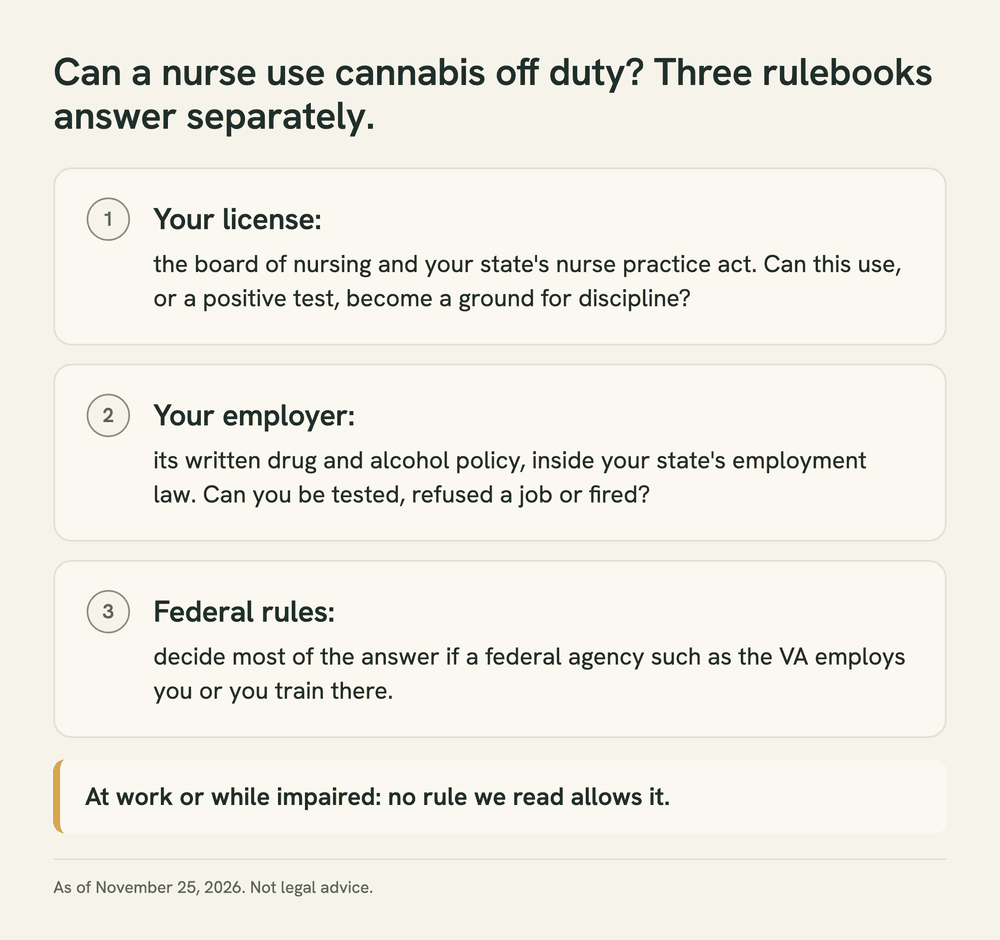
Can nurses smoke weed? Never at work, and never while impaired: every rule we read, including the laws that protect off-duty or medical use, keeps working while impaired off limits. Off duty, three different rulebooks answer separately: your state's nurse practice act and board of nursing, your employer's drug policy and your state's job-protection law, and federal rules if a federal agency employs you. This guide reads each one from the primary documents, as of November 25, 2026. It is general legal information, not legal advice.
Can nurses smoke weed? Three rulebooks, three separate answers
Search this question and you mostly get forum threads and law-firm pages that say "it depends" without saying on what. It depends on three things, and each one is enforced by a different body. Start with the federal baseline. Since April 28, 2026, a DEA final rule has placed marijuana held under a state medical license, and marijuana in FDA-approved drugs, in Schedule III; everything else, including adult-use marijuana, stays in Schedule I. Either way it remains a controlled substance under federal law, and our explainer on the medical marijuana Schedule III ruling covers what the rule did. On top of that baseline, three rulebooks apply to you:
- 1Your license. Your state's board of nursing enforces the nurse practice act. The question it answers: can this use, or a positive test, become a ground for discipline against your license?
- 2Your employer. The hospital, clinic, staffing agency or school sets a written drug and alcohol policy, inside the limits of your state's employment law. The question: can you be tested, refused a job or fired?
- 3Federal rules. They decide almost everything if a federal agency such as the VA employs you or you train on its premises, and they add policy duties for employers that hold federal contracts or grants.
Police officers and firefighters face a similar split with their own twists: a federal gun law for officers, an EMS certification for firefighters. Our guides on whether police officers can smoke weed and the rules for firefighters and EMTs cover those. For nurses, the license is what raises the stakes. A positive test at work is an employment problem first, and in some states the nursing statute names it as a route into the board's own process.
Your license: what boards of nursing actually regulate
Boards of nursing discipline under their state's nurse practice act, the law that defines nursing and lists the grounds for action against a license. The two practice acts we read in full, Missouri's and California's, speak of controlled substances and impairment rather than cannabis by name, and they draw the line in very different places. West Virginia's board addressed cannabis directly. In a January 2023 article on cannabis use in the nursing profession, it wrote that nurses are "not prohibited" from getting a medical cannabis certification "simply by virtue of their profession," and in the same sentence warned that a nurse "may be subject to certain restrictions and prohibitions under the act." It quotes the state's medical cannabis law: an employer may bar a certified patient from "performing any duty which could result in a public health or safety risk while under the influence of medical cannabis," and that bar "shall not be deemed an adverse employment decision even if the prohibition results in financial harm." The law also offers no protection for "undertaking any task under the influence of medical cannabis when doing so would constitute negligence, professional malpractice or professional misconduct." West Virginia allows medical cannabis only, and the article says nothing about drug screens or federal law.
Missouri's board takes a different route. Its marijuana page (Missouri State Board of Nursing, Marijuana page, undated) points nurses to RSMo 335.066, the statute that lists grounds for license discipline or denial. The first ground reads:
“Use or unlawful possession of any controlled substance, as defined in chapter 195, by the federal government, or by the department of health and senior services by regulation, regardless of impairment, or alcoholic beverage to an extent that such use impairs a person's ability to perform the work...”
Ground (14) adds "violation of the drug laws or rules and regulations of this state, any other state or the federal government." The board's page also tells nurses, in its own words, that "marijuana, in any form, is still federally illegal." It says employers and nurses who receive funds from federal sources "(like Medicare) will have to address possession on the premises and the administration of marijuana," and, in a separate sentence, that employers "will also have to determine how to manage staff and their personal use/possession of medical marijuana." The page is undated and does not mention the 2026 Schedule III rule. It does not say how the board applies these grounds to cannabis use that Missouri law allows, so ask before you assume.
California's nurse practice act is written the other way. Under Cal. Bus. & Prof. Code 2762, as amended effective January 1, 2024, using a controlled substance is unprofessional conduct when it happens "to an extent or in a manner dangerous or injurious" to you, another person or the public, or "to the extent that such use impairs" your ability to practice safely. The same section separately covers obtaining or possessing a controlled substance "in violation of law"; we do not interpret how that applies to lawful adult possession. Two state laws, two very different tests, which is why your own state's practice act matters more than any national answer. Oklahoma answers from the other side, in its medical marijuana law rather than its nursing act. Enrolled House Bill 3127 keeps a sentence saying a licensed patient shall not be subject to "disciplinary action by a business, occupational or professional licensing board or bureau, for the medical use of marijuana in accordance with this act." That reaches lawful medical use only. It does not cover impairment or on-duty use, and, as the employer section shows, the same section now holds patient-care jobs to a zero-tolerance standard.
| State | What the text says | What it means for off-duty use | Source and date |
|---|---|---|---|
| West Virginia | Nurses are "not prohibited" from a medical cannabis certification because of their profession; employers may bar certified patients from duties that create a safety risk | Certification alone is not barred; negligent or impaired practice is not protected | Board of Registered Nurses article, January 10, 2023 (medical-only state) |
| Missouri | Discipline ground covers controlled-substance use "regardless of impairment" and violating the drug laws of any other state or the federal government | The board page does not say how it applies these grounds to cannabis use Missouri law allows | RSMo 335.066.2(1) and (14), quoted on the board's undated marijuana page |
| California | Use is unprofessional conduct when dangerous or injurious, or when it impairs safe practice | The test turns on danger or impairment | Bus. & Prof. Code 2762, amended effective January 1, 2024 |
| Oklahoma | No licensing-board discipline for medical use "in accordance with this act" | Covers lawful medical use under an Oklahoma license; not impairment, not the employer | 63 O.S. 427.8(F), text kept in HB 3127 (in force November 1, 2026) |
You may see the National Council of State Boards of Nursing cited as if it set a national rule for nurses' own use. It has not. Its national nursing guidelines for medical marijuana, published in the Journal of Nursing Regulation in July 2018, cover four things: nursing care of patients who use medical marijuana, medical marijuana education in pre-licensure programs, education in advanced practice (APRN) programs, and APRNs who certify a qualifying condition. They set no rule for a nurse's personal use; that is left to each state. One more search trap: the College of Nurses of Ontario ranks for this question, and it is a Canadian regulator whose guidance does not apply to a US license.
What a positive drug test can trigger at the board
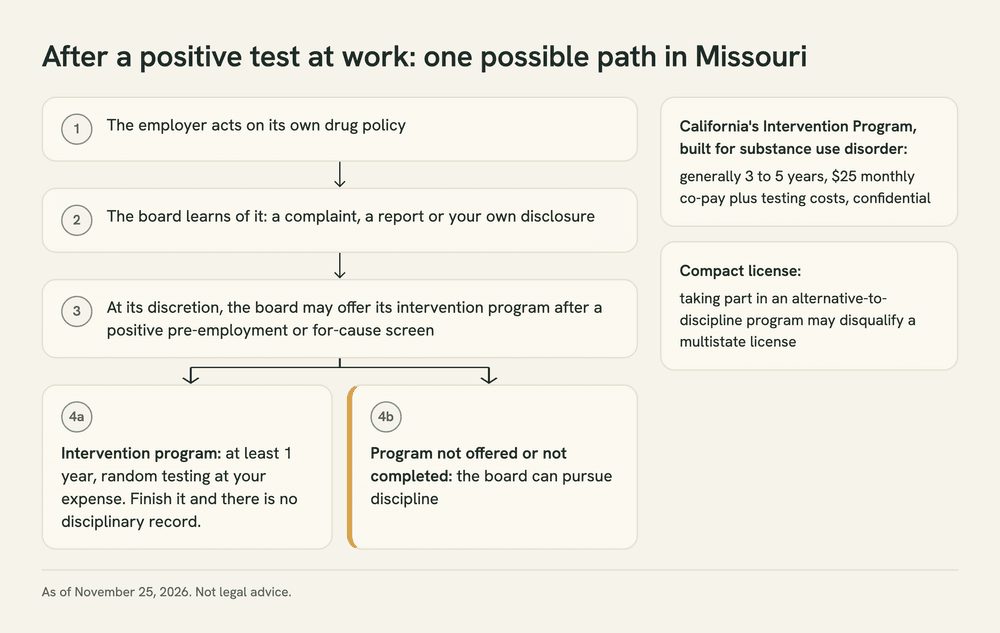
A positive test at work is an employer event first. Whether it becomes a license event depends on your state's statute and your board's practice, and reporting duties differ by state (we did not survey them). Missouri is the clearest example we read, because its nursing statute names the route. In outline, it runs like this:
- 1The employer acts on its own policy: a job offer withdrawn after a pre-employment screen, or removal from duty and discipline after a for-cause test.
- 2The board learns of it, for example through a complaint, a report or your own disclosure.
- 3The board screens the case. In Missouri it may, at its discretion, offer a monitored program instead of opening discipline.
- 4The program or formal discipline follows. Missouri's terms for both are below.
Missouri's statute, RSMo 335.067, makes the intervention program available "upon board discretion" to licensees and applicants who self-refer or "test positive in a pre-employment or for-cause drug or alcohol screen." It lasts at least one year and requires random drug and alcohol testing at your own expense. If you finish, you are deemed to have no disciplinary action and do not have to disclose that you took part. Violate its terms and your license is suspended indefinitely until you show a year of negative screens; fail it and the board can still pursue discipline. A separate alternative program for nurses with an admitted substance use disorder runs three to five years.
Programs like these are built for substance use disorder, not for a single positive test. The National Council's page on alternative-to-discipline programs describes their aims as "promoting earlier identification," "requiring immediate removal from the workplace" and treatment "in a non-disciplinary and non-public manner." California's version, the Board of Registered Nursing's Intervention Program, is "a voluntary and confidential recovery and monitoring program for RNs whose practice may be impaired by substance use disorder or mental illness," set up by state law in 1984 as an alternative to discipline. Its FAQ says the program generally lasts three to five years, charges a $25 monthly co-pay plus other costs including random drug testing, and that the board "will NOT make public" that you are enrolled or have completed it. It also says participation "will not necessarily prevent" the board from acting on a practice-act violation, and a nurse previously disciplined by the board for alcohol or drug misuse or for mental illness may not be eligible.
Your employer: hospitals can be stricter than state law
The employer layer is where most nurses actually meet the rule. A hospital's written drug and alcohol policy decides who gets tested and what a positive means, inside whatever limits your state's employment law sets. Our state-by-state guide to being fired for failing a drug test covers those general protections. What it does not show is that several states write patient care out of them, or make patient-care jobs testable for cannabis.
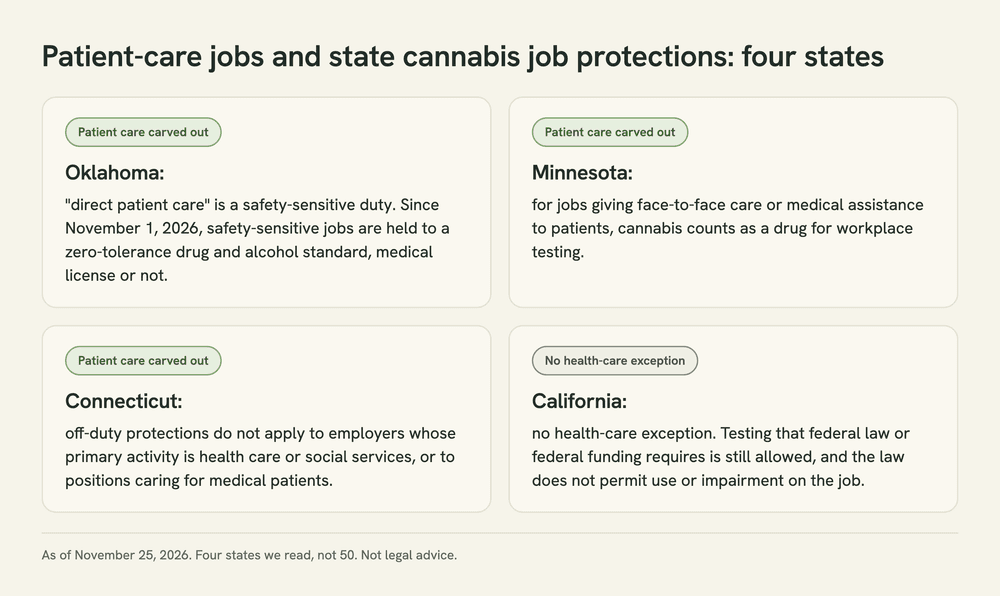
Oklahoma went furthest. Its medical marijuana law already listed "direct patient care or direct child care" among the duties that make a job safety-sensitive, alongside "dispensing pharmaceuticals." Since November 1, 2026, it adds that an applicant or employee in a safety-sensitive position "shall be subject to a zero-tolerance drug and alcohol standard," "regardless of any employer policy permitting impairment-based testing." The sentence opens with "notwithstanding any other provision of this section," so it reaches holders of an Oklahoma medical license too. The governor approved HB 3127 on April 17, 2026, and the bill's legislative history records a 41-5 Senate vote. The same section still bars licensing-board discipline for lawful medical use, so in Oklahoma your license and your job can now point in opposite directions. We found no Oklahoma guidance or court ruling applying the new rule yet.
Minnesota and Connecticut carve out patient care in different ways. Minnesota generally bars cannabis testing of job applicants, but its drug-testing statute, section 181.951, lists jobs where "cannabis and its metabolites are considered a drug" for workplace testing. One is any position requiring face-to-face care or "medical assistance" to children, vulnerable adults or "patients who receive health care services from a provider." Another is any job "funded by a federal grant." Random testing is limited to safety-sensitive positions. Minnesota also has an off-duty statute, section 181.938, that protects lawful consumable products, including cannabis, used off the employer's premises during nonworking hours. We found no appeals ruling on how the two fit together for a nurse. Connecticut's 2021 law protects most workers' off-duty use, but Conn. Gen. Stat. 21a-422o exempts employers whose primary activity is health care or social services, and any position "requiring the supervision or care of children, medical patients or vulnerable persons."
California is the counterexample. Its job-protection law, Cal. Gov. Code 12954, in force since January 1, 2024, has no health-care exception. It bars discrimination based on "use of cannabis off the job and away from the workplace" or on a test that finds "nonpsychoactive cannabis metabolites." It does not override state or federal laws that require testing "as a condition of employment, receiving federal funding or federal licensing-related benefits, or entering into a federal contract," and it "does not permit an employee to possess, to be impaired by, or to use, cannabis on the job." Whether a particular hospital's federal funding triggers that carve-out is a question for its lawyers; the statute does not name hospitals either way.
Why do these laws separate metabolites from impairment? A urine test finds THC metabolites, which shows past use, not impairment. New York's labor department guidance puts it plainly: a cannabis test "cannot serve as a basis for an employer's conclusion that an employee was impaired." Where a law allows zero tolerance, though, a positive can still end a nursing job. For how random selection works, see our guide to random drug tests at work; for detection, see how long THC stays in your blood.
Federal disability law does not fill the gap. The Americans with Disabilities Act says a qualified individual does not include an employee or applicant "currently engaging in the illegal use of drugs" when the employer acts on that use. It does protect a worker who has completed, or is in, a supervised rehabilitation program and no longer uses, and it lets employers test that worker. Whether a state medical card changes the first part after the 2026 Schedule III rule has not been decided.
Federal nurses: the VA and other federal employers
If a federal agency employs you, most often the Department of Veterans Affairs, state law is not the deciding layer. Executive Order 12564, signed in 1986, says the use of illegal drugs by federal employees, "whether on duty or off duty, is contrary to the efficiency of the service," and that people who use illegal drugs "are not suitable for Federal employment." It requires agencies to test employees in sensitive positions. In 2015, the federal personnel office told agencies that state marijuana law changes "do not alter Federal law, existing suitability criteria, or Executive Branch policies regarding marijuana." We found no newer guidance. The order covers nurses at other federal health agencies too; for this guide we read only VA documents.
VA puts nurses inside that program. A 2015 VA inspector general audit describes the department's drug-free workplace handbook as designating safety-sensitive occupations, "such as physicians, nurses, police officers," as testing-designated positions, which carry pre-employment testing of final selectees and random monthly testing of employees. Current postings match. A VA registered nurse announcement open from August 25 to September 30, 2026, now closed, lists "Drug test: Yes" and says applicants tentatively selected for a testing-designated position "are subject to urinalysis to screen for illegal drug use prior to appointment," and that applicants who refuse "will be denied employment with VA." What those tests look for has not changed: HHS's March 2026 notice on the federal drug testing panels keeps marijuana metabolite on the panel. Service members face a parallel rulebook, covered in our guide to CBD in the military.
Most private and nonprofit hospitals are not federal employers, but some hold federal contracts or grants. The Drug-Free Workplace Act, 41 U.S.C. 8102, part of a 1988 law, requires a covered contractor to publish a statement that unlawful controlled-substance activity is prohibited in the workplace, run a drug-free awareness program, give a copy of the statement to each employee on the contract, require employees to report a workplace drug conviction within 5 days, notify the agency within 10 days, and sanction or refer the convicted employee to rehabilitation. It covers contracts above the simplified acquisition threshold, other than contracts for commercial products or commercial services; a companion section, 8103, applies the same structure to grantees. Read it and you find a written policy, an awareness program and conviction reporting, but no drug-testing requirement. Testing comes from the employer's own policy or another rule. We found no Medicare rule requiring hospitals to test staff for cannabis, and we do not treat Medicare payments as grants or contracts under the Act.
Travel nurses: whose rules apply on assignment
Travel nursing multiplies the layers. The Nurse Licensure Compact, now 43 jurisdictions, lets a nurse with a multistate license practice in other member states. Its 2025 fact sheet for employers is clear on whose law governs: a nurse must be licensed or hold the privilege to practice "in the state where the patient is located at the time care is directed or service is provided," in person or by telehealth, and "when practicing in a remote state, the nurse is accountable for complying with the nurse practice act of that state." The compact standardizes who may hold a multistate license. Nothing in that fact sheet or in the compact's FAQ mentions cannabis, so a legal weekend at home and a shift in a stricter state are judged by two different rulebooks. Before an assignment, account for each of these:
- The practice act of the state where your patient is, not only the state that issued your license.
- Your home board, which may look beyond its border: Missouri's discipline grounds include violating the drug laws of "any other state or the federal government."
- Your staffing agency's drug policy and the facility's policy. Each has its own; ask for both in writing before the contract starts.
- Your multistate status. The compact's FAQ lists participation in an alternative-to-discipline program among possible disqualifiers for a multistate license, and a restriction or disciplinary action can change a multistate license to a single-state one.
- Your duty to tell employers. The fact sheet says it is the nurse's responsibility to notify the employer of any board action, and employers can enroll in Nursys e-Notify to hear of changes in licensure status, including discipline.
Medical cards, nursing students and CBD
A medical card is not a general shield for a nursing license. Only two of the texts we read speak to it, and both narrowly: West Virginia's board says certification alone is not barred for nurses, and Oklahoma's law bars licensing-board discipline for lawful medical use while, since November 1, 2026, holding direct-patient-care jobs to zero tolerance. Neither covers impairment or on-duty use, neither changes federal employment rules, and Missouri's discipline ground speaks of controlled-substance use "regardless of impairment." Get your employer's position in writing before you rely on a card.
Nursing students answer to their program and to each clinical site, and each sets its own rules, so read the student handbook and every site's onboarding policy. VA rotations are the clearest federal case. VA's 2019 guide for health professions trainees says trainees are exempt from pre-employment drug testing, but "most VHA HPTs are in testing designated positions (TDPs) and subject to random drug testing." It says VA will initiate termination of the appointment or dismissal from the rotation of a trainee found to use illegal drugs on a verified positive test, "even if a drug is legal in the state where training."
CBD is not a workaround for a THC test. In a 2020 controlled study of six participants with a SAMHSA co-author, 100 mg of pure CBD, taken orally or vaporized, produced only 1 positive screen among 218 urine specimens and none above the confirmation cutoff, while vaporized CBD-dominant cannabis containing 3.7 mg of THC produced four confirmed positive specimens. The study was small, used single doses of pure material, and retail products with unknown THC content can behave differently. For a nurse under a zero-tolerance policy, that residual risk is the whole question, and no product can guarantee a drug-test result. Our guides to CBD and drug tests and hemp-derived THC products explain where the THC comes from.
Before you use: a checklist for nurses
This checklist is about knowing which rules apply to you, not about passing a test. Work through it before you rely on any state's legalization.
- 1Find the drug-use ground in your state's nurse practice act. Does it turn on danger or impairment, like California's, or reach use "regardless of impairment," like Missouri's?
- 2Read your employer's written drug and alcohol policy: which tests it uses, how it treats cannabis and what it asks of a medical-card holder.
- 3Check whether your state names patient care as an exception to its cannabis job protections, as Oklahoma, Minnesota and Connecticut do.
- 4If a federal agency employs you or you rotate through a VA facility, assume federal rules apply on and off duty. If your job is funded by a federal grant or contract, ask how your employer's policy handles it.
- 5On a travel assignment, check the practice act of the state where your patients are, plus the agency's and the facility's policies, in writing.
- 6If you hold a medical card, confirm in writing what your state's law and your employer say. Never use on duty, and never work impaired.
- 7If you use CBD in a zero-tolerance job, accept that residual THC can produce a positive. No product can guarantee a result.
- 8If a test comes back positive, talk to a nurse attorney or your union before you answer the board, and answer truthfully.
What this page cannot tell you
This guide reads seven states and federal rules, not 50: the board and practice-act texts of West Virginia, Missouri, California and Oklahoma; the employment laws of Oklahoma, Minnesota, Connecticut and California; and New York's labor guidance. Statute text is not the same as how a board decides cases, and Missouri's page does not say how it applies its grounds to cannabis use the state allows. We did not read other states' board positions, any state's employer reporting duties, or Connecticut's separate medical-patient statute, so we say nothing about them. How the Schedule III rule interacts with Executive Order 12564 and the ADA is open. If you lose a job over a test, our guide to unemployment after a failed drug test covers the next question.
Frequently asked questions
It depends on three layers. Your state's practice act may reach controlled-substance use without impairment (Missouri's text says "regardless of impairment") or only use that is dangerous or impairs safe practice (California). Your employer may test and act within your state's law: Oklahoma holds direct-patient-care jobs to zero tolerance, Minnesota makes cannabis testable for patient-care jobs and Connecticut exempts health-care employers from its off-duty protections, while California's law has no health-care exception. If a federal agency such as the VA employs you, a 1986 executive order treats illegal drug use on or off duty as contrary to the efficiency of the service.
Only narrow statements hold. West Virginia's nursing board says nurses are not prohibited from a medical cannabis certification because of their profession, though employers may bar certified nurses from duties that could create a safety risk. Oklahoma's law bars licensing-board discipline for medical use that follows the law, but holds direct-patient-care jobs to a zero-tolerance standard. For federal nurses, what the 2026 Schedule III rule means has not been decided. A card never covers on-duty use or working impaired.
First, the employer acts under its own policy. The board may then learn of it. In Missouri, a positive pre-employment or for-cause screen can lead, at the board's discretion, to an intervention program of at least one year with random testing at your own expense; finishing leaves no disciplinary record, and failing lets the board pursue discipline. Alternative-to-discipline programs such as California's, which generally last three to five years, are designed for substance use disorder. For a multistate compact license, taking part in such a program may be a disqualifier.
It is possible under some practice acts, and the standard varies by state. Missouri's discipline grounds include controlled-substance use "regardless of impairment," though its board page does not say how that applies to cannabis use Missouri law allows. California's law turns on use that is dangerous or impairs safe practice. Oklahoma bars licensing-board discipline for lawful medical use. The outcome depends on your state's text and your board's decision.
On assignment you answer to the practice act of the state where your patient is, not only the state that issued your license. The Nurse Licensure Compact, now 43 jurisdictions, has no cannabis rule in its employer fact sheet or FAQ. Your staffing agency and the facility each have a drug policy, so ask for both in writing before the contract starts. Some home boards look beyond their border: Missouri's grounds include violating the drug laws of any other state.
Your nursing program and each clinical site set their own rules, so read the student handbook and each site's policy. At VA facilities, most health professions trainees are in testing-designated positions subject to random testing, and VA's 2019 trainee guide says a verified positive leads to termination of the appointment or dismissal from the rotation even if the drug is legal in the state where you train.
The risk is residual THC. In a 2020 study of six participants, pure CBD rarely triggered a urine screen (1 of 218 specimens screened positive, none confirmed), while vaporized CBD-dominant cannabis with 3.7 mg of THC produced confirmed positives. Retail products with unknown THC content can behave differently. In a zero-tolerance job, no product can guarantee a negative result.
Yes. A 2015 VA inspector general audit describes VA's drug-free workplace handbook as listing nurses among its testing-designated positions, which carry pre-employment testing of selectees and random testing. A 2026 VA registered nurse job announcement lists "Drug test: Yes" and requires a urine screen before appointment.
Nursing rules are one part of a larger legal map. Our guide to whether CBD is legal covers the federal hemp rule and the state exceptions that sit beside the workplace rules above.
Writing about hemp, wellness and the small rituals that keep us balanced.