Can Firefighters Smoke Weed? Off-Duty, EMS and Federal Rules
No law we read lets firefighters or EMTs use cannabis on duty. Off duty, the answer turns on who employs you: a city department, a volunteer company or a federal agency. Here is what the statutes, Maryland's 2026 law and wildland testing rules say.
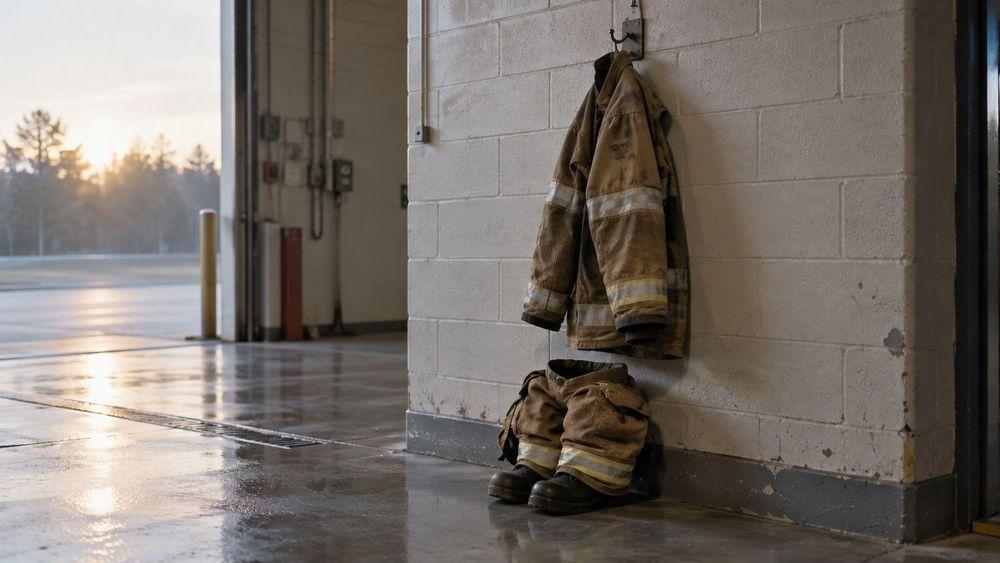
Can firefighters smoke weed? Not on duty: no law we read lets a firefighter, EMT or paramedic use cannabis on the job or work impaired. Off duty, the answer depends on who employs you (a city or county department, a volunteer company or a federal agency), what your state's law says about fire and EMS jobs, and the rules attached to your EMS certification. This guide reads each layer from the primary documents, as of November 24, 2026. It is general legal information, not legal advice.
Can firefighters smoke weed? On duty, no; off duty, it depends on who signs your paycheck
Page-one answers to this question contradict each other. One says firefighters may not use cannabis on or off duty, even where it is legal. Another reports a Maryland county that allows off-duty medical use. Both describe something real, because they describe different employers. A firefighter's answer is stacked in layers, and the first question is who you work for.
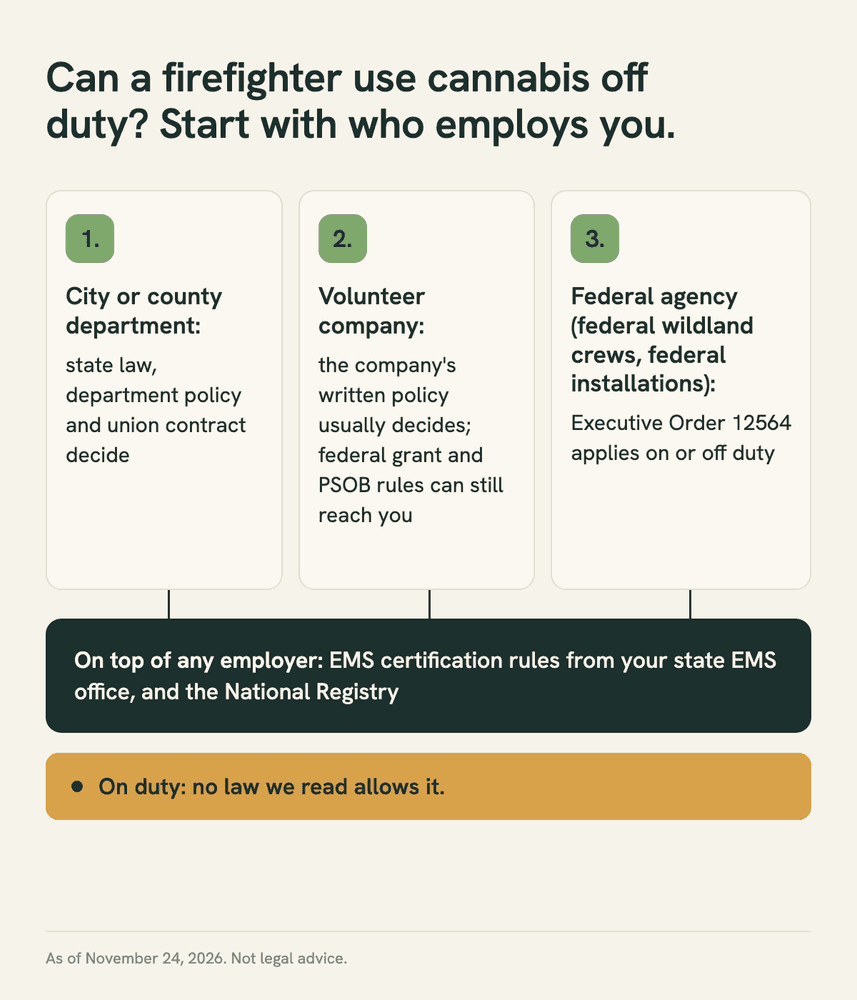
Start with federal law. Since April 28, 2026, a DEA final rule has placed marijuana held under a state medical license, and marijuana in FDA-approved drugs, in Schedule III. Adult-use marijuana stays in Schedule I. Either way, cannabis remains a controlled substance under federal law; our explainer on the medical marijuana Schedule III ruling covers what that rule did. State law sits on top of that baseline, and four layers decide what applies to you:
- 1Career city or county department. Your state's employment law, your department's written substance policy and your union contract decide off-duty use. Several states write fire and EMS jobs out of their protections.
- 2Volunteer company. Your company's own written policy usually sets the rule. Federal grant conditions and a federal line-of-duty benefit can still reach you.
- 3Federal agency. Federal wildland crews and firefighters on federal installations work under a 1986 executive order that applies on or off duty. State legalization does not change it.
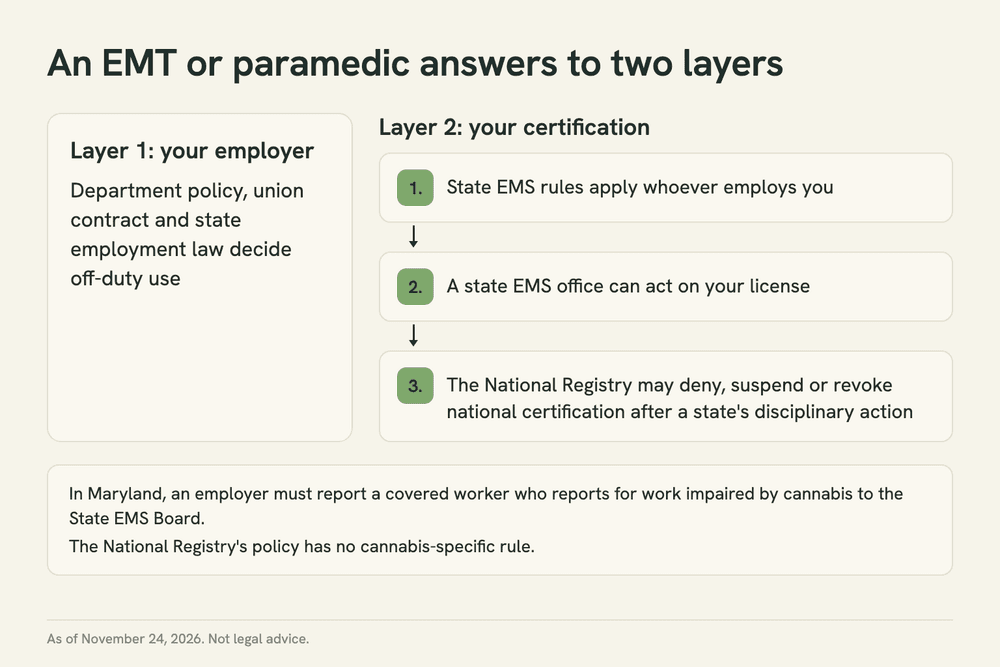
- 4EMS certification. If you hold an EMT or paramedic certification, your state's EMS rules apply on top of your job, whoever employs you.
One layer that dominates the police version of this question mostly drops out here. Most firefighters do not carry a gun on duty, so the federal firearms ban that shapes the answer for officers rarely comes up. Our guide on whether police officers can smoke weed covers that gun law in detail.
Why state cannabis protections usually leave firefighters out
Our state-by-state guide to getting fired for failing a drug test notes that several off-duty protections exclude fire departments, first responders, 911 dispatch and emergency medical services. Here is what those exclusions actually say, and which states went the other way. The table covers the states where we read the statute; it is not a 50-state survey.
| State | What the law says about fire and EMS | What it covers | Source and date |
|---|---|---|---|
| Washington | Hiring protection does not apply to fire department, fire protection district, 911 dispatch or EMS applicants | Initial hiring only | RCW 49.44.240(3)(c)-(d), in force January 1, 2024 |
| Nevada | Applicant protection does not apply to firefighter or EMT positions | Hiring only | NRS 613.132(2)(a)-(b), added 2019 |
| Connecticut | Firefighter and EMT are listed as exempted positions | Off-duty, prior-use and metabolite-only protections do not reach them | Conn. Gen. Stat. 21a-422o(4), in force July 1, 2022 |
| Illinois | Public employers of firefighters and paramedics may prohibit use on or off duty unless their own policies provide otherwise | Employment; a conflicting union contract prevails | 410 ILCS 705/10-35(a)(8), effective July 15, 2021 |
| Minnesota | Off-duty law does not name firefighters; testing law makes cannabis a testable drug for a firefighter position | Drug testing | Minn. Stat. 181.938 and 181.951 subd. 9, 2026 Statutes |
| California | No firefighter or public safety exception | Off-the-job use and nonpsychoactive metabolites | Gov. Code 12954, in force January 1, 2024; last read September 2026 |
| New York | No fire or EMS exception; state guidance says the law does not cover volunteers | Lawful off-duty use by employees, with impairment and federal-mandate exceptions | Labor Law 201-d; Senate bill S4618 still in committee |
| Maryland | Protects fire and EMS employees who hold a medical cannabis certification | Discipline of public fire and EMS employees | Chapter 183 of 2026, in force October 1, 2026 |
Washington and Nevada protect job applicants, then write fire and EMS out. Washington's RCW 49.44.240, in force since January 1, 2024, makes it unlawful to discriminate "in the initial hiring for employment" based on off-the-job cannabis use or a test that finds nonpsychoactive cannabis metabolites. It then says it "does not apply to an applicant seeking" a position "with a fire department, fire protection district, or regional fire protection service authority," or a first-responder job "including a dispatcher position with a public or private 911 emergency communications system or a position responsible for the provision of emergency medical services." Nevada's NRS 613.132, added in 2019, bars most employers from refusing to hire an applicant because a screening test shows marijuana, but not for a position "as a firefighter" or "as an emergency medical technician." It also yields to a collective bargaining agreement and does not reach jobs funded by a federal grant. Both laws cover hiring only. Neither protects a firefighter already on the job.
Connecticut and Illinois go further. Connecticut's 2021 adult-use law protects most workers' off-duty use, but Conn. Gen. Stat. 21a-422o(4) lists "a firefighter" and "an emergency medical technician" first among its exempted positions. As a result, the off-duty and prior-use protections, and the rule that a metabolite-only positive cannot be the sole basis for action, do not reach those jobs. Illinois wrote firefighters and paramedics straight into its legalization law. Under 410 ILCS 705/10-35(a)(8), nothing in the Act prevents "a public employer of law enforcement officers, corrections officers, probation officers, paramedics, or firefighters" from prohibiting or disciplining cannabis use "while on or off duty, unless provided for in the employer's policies." Where that conflicts with a collective bargaining agreement, the contract prevails.
Minnesota is the mixed case. Its off-duty statute, section 181.938, bars discipline for using lawful consumable products, including cannabis flower and cannabis products, "off the premises of the employer during nonworking hours," and it does not name firefighters. But its drug-testing statute, section 181.951, lists "a firefighter position" among the jobs where "cannabis and its metabolites are considered a drug" for workplace testing, and the off-duty law has its own exception for a bona fide occupational requirement. We found no Minnesota appeals ruling on how those pieces fit together, so read your department's written policy alongside both statutes.
California and New York have no firefighter exception. California's Government Code 12954, in force since January 1, 2024, protects off-the-job use and bars action based on nonpsychoactive metabolites. Its carve-outs are building and construction trades, jobs that require a federal background investigation or security clearance, and federal testing mandates. A 2024 legal note for California cities put it plainly: "There is no such exception for firefighters or other public safety employees." Departments can still ban on-duty use and act on impairment. We last read the statute in full in September 2026 and could not re-check 2026 amendments. New York's Labor Law 201-d protects lawful off-duty use, with exceptions, as the state labor department's guidance lists them, when a state or federal law or mandate requires action, when a worker shows "specific articulable symptoms" of impairment, or to avoid losing a federal contract or funding. New York Senate bill S4618, introduced February 10, 2025, would amend the state's cannabis law to carve volunteer firefighters and EMS employees of fire departments out of its use protections and let those departments test them before hiring, at random and for cause. As of November 2026 it had not left committee.
Maryland now protects firefighters' off-duty medical use
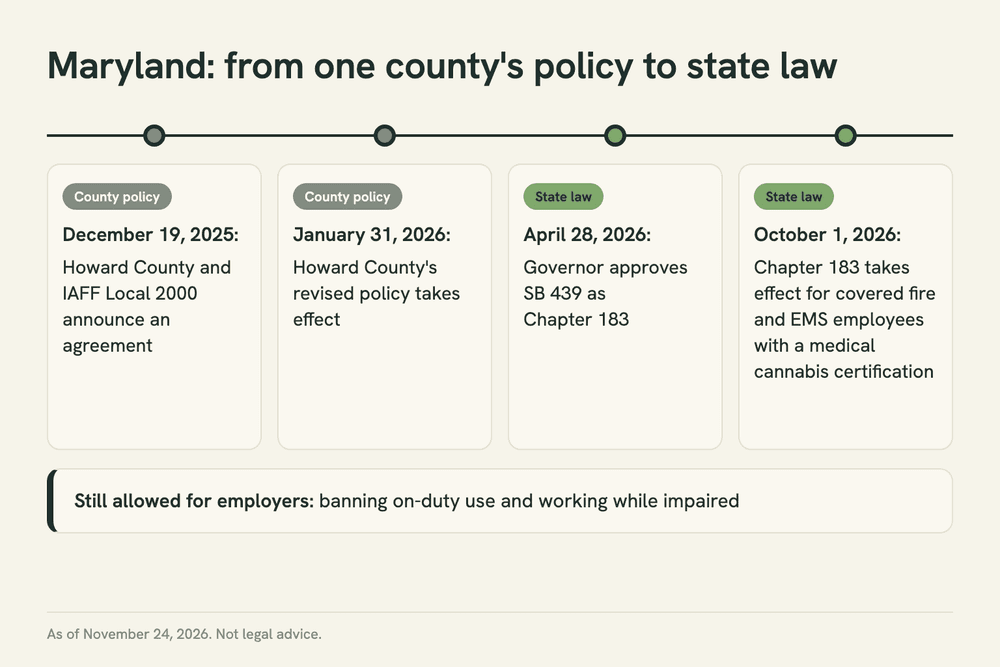
Maryland is the clearest answer to anyone who says firefighters can never use cannabis off duty. Howard County went first. Under a December 2025 agreement with its firefighters' union, IAFF Local 2000, the county revised a substance abuse policy that "had not been revised since 1991." The revised policy, effective January 31, 2026, lets uniformed fire and rescue personnel use medical cannabis off duty if they have presented a valid medical cannabis authorization form to the county's human resources office and do not use it within 12 hours of reporting for work. It also added reasonable-suspicion testing standards and expanded post-accident testing. That is a county policy for one department, not state law. We did not find the policy document itself published, so the county's announcement is the primary record.
Four months later, Maryland passed a statewide law. Chapter 183 of 2026, Senate Bill 439, passed the Senate 33-11 and the House 108-23, was approved by the governor on April 28, 2026, and took effect October 1, 2026. Several page-one results still describe it as a pending bill. Its core rule:
“Subject to paragraph (3) of this subsection, on the basis of a fire and rescue public safety employee's possession of a valid written certification, or on the basis of a fire and rescue public safety employee testing positive for cannabis components or metabolites while holding a valid written certification, an employer may not: (i) discipline, discharge, or otherwise discriminate...”
The law defines a "fire and rescue public safety employee" as a firefighter, emergency medical technician, cardiac rescue technician or paramedic employed by a municipal corporation, a county, the state, the State Airport Authority or a fire control district. It is written for employees of those public employers and covers medical certification only. It also adds a duty: if a covered worker reports for work impaired by cannabis, the employer must report the incident to the State Emergency Medical Services Board, which oversees EMS certification. The federal tension is on the record: the legislature's fiscal and policy note records Baltimore City's warning of a "potential loss of significant federal grant funding."
Federal firefighters: wildland crews and federal stations
If a federal agency signs your paycheck, state law is not the layer that decides. Executive Order 12564, signed in 1986, says federal employees "are required to refrain from the use of illegal drugs," that such use "whether on duty or off duty, is contrary to the efficiency of the service," and that people who use illegal drugs "are not suitable for Federal employment." It requires each agency to test employees in sensitive positions and authorizes testing of any applicant. In 2015, the federal personnel office told every agency that state marijuana laws "do not alter Federal law, existing suitability criteria, or Executive Branch policies regarding marijuana." We found no newer OPM guidance.
The Forest Service puts its fire jobs inside that program. USDA's drug-free workplace regulation, Departmental Regulation 4430-792-2 (April 14, 2011), lists fire protection and prevention personnel among the positions designated for random testing, explaining that drug use "by a fire fighter could endanger fire victims, employees in the fire vicinity, other fire fighters and all property threatened by fire." Wildland postings say the same in practice. A Forest Service wildland firefighter announcement that closed in January 2026 states that the job is a testing-designated position, that selected applicants must pass a urinalysis "prior to appointment," and that incumbents are tested "on an ongoing random basis." An apprentice posting that closed in September 2026 adds that appointment is based on a negative result. A 2022 Forest Service notice told employees to stay drug-free "whether on or off duty regardless of state laws," and said a positive brings discipline "up to removal for the first finding of illegal drug use."
Interior's wildland firefighters now work for its U.S. Wildland Fire Service; they are federal employees under the same 1986 order. We did not find Interior's own list of testing-designated fire positions, so we do not describe its testing rules here. What federal programs test for is clear: HHS's March 2026 notice on the federal drug testing panels keeps marijuana metabolite on the panel and says the current panels "remain in effect." Federal medical review guidance (the 2025 MRO Guidance Manual) does not accept a legal hemp product as an explanation for a positive. Service members face a parallel set of rules, covered in our guide to CBD in the military.
Volunteer firefighters: your company's policy, and a federal benefit
The state laws above are written in terms of employees and job applicants. New York's labor department says plainly that its off-duty law does not apply to people who are not employees, and it lists volunteers among them. Maryland's Chapter 183 names workers employed by public employers. We did not check how every other state treats volunteers. In practice, your company's or district's written policy is usually the rule you live under.
In New York, the general counsel of the Firemen's Association of the State of New York advised volunteer companies in a 2021 magazine article that "the Act allows a governing board to adopt rules or a policy governing marijuana at the firehouse." He recommended a written policy that addresses off-premises consumption and "whether any level of impairment will be tolerated should a firefighter respond to an alarm." That is an association's legal commentary for New York, not law, and not a statement about other states. New York's S4618, still in committee, would add testing rules for volunteers.
Federal grants add a condition. A department that takes federal grants must keep a drug-free workplace under the Drug-Free Workplace Act, 41 U.S.C. 8103: it publishes a statement that unlawful use of a controlled substance "is prohibited in the grantee's workplace" and specifies the actions that will follow. The statute is about the workplace. It does not by itself require testing or an off-duty ban, which is why many departments decide that question in their own policy.
There is also a federal benefit at stake, and it reaches volunteers. The Public Safety Officers' Benefits (PSOB) program pays benefits when a public safety officer is killed or catastrophically injured in the line of duty, and its statute defines a firefighter to include an officially recognized or designated member of a legally organized volunteer fire department. The program's limitations section says no benefit is paid "if the public safety officer was voluntarily intoxicated at the time of his fatal or catastrophic injury." Its regulation on voluntary intoxication treats the presence in the body of a Schedule I controlled substance as evidence of intoxication, unless convincing evidence shows that taking it was not a culpable act under the criminal laws. How that rule applies to marijuana under a state medical license, now in Schedule III, is open: we found no guidance on it. This page does not predict how any claim would be decided.
Can EMTs and paramedics smoke weed? The certification layer
An EMT or paramedic has two questions to answer: what the employer allows, and what the certification allows. The employer layer works like a firefighter's: Washington, Nevada, Connecticut and Illinois name EMS jobs in their exceptions (see the table above), while Maryland's 2026 law protects covered EMTs, cardiac rescue technicians and paramedics who hold a medical certification.
The certification layer follows you to every employer, career or volunteer. Maryland's EMS rules are one example. COMAR 30.02.04.01 lists "habitual intoxication" as prohibited conduct, along with providing emergency medical services while using a controlled dangerous substance "in excess of therapeutic amounts or without valid medical indication." Maryland's new law ties the two layers together: an employer that sees a covered worker report for work impaired by cannabis must report it to the State EMS Board.
At the national level, the National Registry's disciplinary actions policy has no cannabis rule. It does let the Registry deny, suspend or revoke national certification after "limitation, suspension, revocation or other disciplinary action by a licensing or authorizing agency relating to practice," and it treats intentional, material misrepresentation on an application as a separate ground. So a state case can follow you to the Registry, and an untruthful application is its own problem.
How firefighters get tested, and what a positive does not prove
Testing comes in four forms, and which ones apply to you is set by your state's testing law, your department's policy and your contract. Our guide to how random drug tests at work are chosen explains the selection mechanics.
- Before hiring. Forest Service wildland postings require a negative urine test before appointment.
- At random. Minnesota allows random testing only for safety-sensitive positions, and Forest Service testing-designated positions are tested at random after appointment.
- On reasonable suspicion. New York City allows it for all city employees, fire and EMS included, and Howard County adopted new standards for it in 2026.
- After an accident. Howard County's 2026 policy expanded post-accident testing.
New York City shows how these combine. The city's July 2022 personnel rule tells agencies they "must desist from pre-employment, and random screening of applicants and employees for marijuana" outside federally regulated transportation jobs. As we read its title list, it marks Firefighter, Emergency Medical Specialist (EMT) and Paramedic as subject to other random drug testing but not to marijuana screening. Testing on reasonable suspicion of impairment remains. We did not find an FDNY document confirming its internal practice.
The reason for these limits is that a urine test for THC metabolites shows past use, not impairment. New York's labor department says a cannabis test "cannot serve as a basis for an employer's conclusion that an employee was impaired," and New York City's rule says current testing "cannot establish the recency of use." Washington's law and Maryland's both address metabolite positives directly. How long THC stays detectable is its own topic, covered in our guide to how long THC stays in your blood.
CBD is not a way around a THC test. If your department or agency tests for THC, a hemp product or a mislabeled CBD product can produce a positive. The 2022 Forest Service notice warned that CBD "can be inaccurately labeled as having no to low levels" of THC and yet contain high levels, and federal programs do not accept a hemp product as an explanation. Our guides to CBD and drug tests and hemp-derived THC products explain why.
Before you use or apply: a checklist
Whether you are a career firefighter, a volunteer, an EMT or an applicant, pin these down first. This is about knowing which rules apply to you, not about passing a test.
- 1Identify your employer: a city or county department, a fire district, a volunteer company, a federal agency or a contractor. The answer changes with each.
- 2Read your department's written substance abuse policy and general orders, not a news story about another county.
- 3Read the drug and discipline sections of your union contract. In Illinois and Nevada, a collective bargaining agreement can control.
- 4Find your state in the table above, and note whether its protection covers hiring only, names your job, or says nothing about it.
- 5If you work for a federal agency, assume Executive Order 12564 applies on and off duty. If your department takes federal grants, ask how its policy handles the drug-free workplace condition.
- 6If you are in Maryland and hold a medical cannabis certification, confirm how your employer wants it documented. The on-duty and impairment rules still apply.
- 7If you hold an EMS certification, read your state EMS office's conduct rules. They apply whoever employs you.
- 8Never use on duty or on call. Howard County's 12-hour window is one county's rule, not a general standard; ask your department what its own policy requires.
- 9Answer applications and background forms truthfully.

What this page cannot tell you
This guide covers nine jurisdictions, not 50: eight states and the federal government. Several of those laws hand the details to department policy and union contracts, so those documents matter as much as the statutes. Open questions: how the Schedule III rule interacts with Executive Order 12564 and the PSOB intoxication rule, how Minnesota's off-duty and testing laws fit together, and whether California changed its statute in 2026. We did not read Interior's testing designations, an FDNY policy, any national fire standard on cannabis, or Connecticut's separate medical-patient protection, so we say nothing about them. If you lose a job over a test, our guide to unemployment after a failed drug test covers the next question.
Frequently asked questions
It depends on who employs you and where. Since October 1, 2026, Maryland protects firefighters, EMTs and paramedics employed by public employers who hold a valid medical cannabis certification. Illinois lets public fire employers ban use on or off duty unless their own policy says otherwise. Connecticut exempts firefighters from its off-duty protections, and Washington and Nevada exclude fire jobs from their applicant protections. Federal firefighters fall under Executive Order 12564, which reaches on-duty and off-duty use.
Two layers apply. The employer layer works like a firefighter's: Washington, Nevada and Connecticut exclude EMS or EMT jobs from their protections, Illinois lets public employers of paramedics ban use on or off duty, and Maryland protects covered EMTs and paramedics who hold a medical certification. The certification is the second layer: Maryland's EMS rules, for example, prohibit providing care while using a controlled dangerous substance without valid medical indication, and the National Registry can act after a state disciplines you.
Usually your company's or district's written policy decides. State protections are written in terms of employees and applicants: Maryland's 2026 law names employees of public employers, and New York's labor department says its off-duty law does not cover volunteers. In New York, the state firefighters' association has advised volunteer companies to adopt a written cannabis policy, and a pending Senate bill would allow random testing of volunteers. The federal PSOB benefit covers volunteers and is not paid if the officer was voluntarily intoxicated at the time of the injury.
Federal wildland firefighters are federal employees under Executive Order 12564, which treats illegal drug use on or off duty as contrary to the efficiency of the service. Forest Service wildland firefighter jobs are testing-designated positions, with a urine test before appointment and random tests after it, and a 2022 agency notice said a first positive can bring discipline up to removal. State legalization does not change that. State and local wildland crews follow their own employer's rules.
There is no national rule. Washington's and Nevada's applicant protections do not cover fire and EMS jobs, and Connecticut's prior-use protection does not apply to exempted positions such as firefighter and EMT. Forest Service wildland jobs require a negative urine test before appointment. Department standards vary, so ask the hiring agency, and answer applications truthfully: the National Registry treats intentional, material misrepresentation on an application as a ground for action.
In Maryland, since October 1, 2026, holding one is protected for firefighters, EMTs, cardiac rescue technicians and paramedics employed by public employers, though employers may still ban on-duty use and working while impaired. Elsewhere, your state's law and your department's policy decide. For federal firefighters the question is open: marijuana under a state medical license moved to Schedule III in April 2026, but no federal personnel guidance we found says what that means under Executive Order 12564.
Yes, if the test screens for THC. Full-spectrum CBD and other hemp products can contain THC, and a 2022 Forest Service notice warned that CBD can be mislabeled as having little or no THC. Federal testing programs do not accept a legal hemp product as an explanation for a positive result.
Testing varies by employer and comes in four forms: before hiring, at random, on reasonable suspicion and after an accident. Minnesota makes cannabis a testable drug for firefighter positions, New York City lists its firefighter and EMS titles for random drug testing other than marijuana screening, and Forest Service wildland jobs test before appointment and at random. Which tests apply to you depends on your state, your department and your contract.
Firefighter rules are one piece of a larger legal map. Our guide to whether CBD is legal covers the federal hemp rule and the state exceptions that sit beside the workplace rules above.
Writing about hemp, wellness and the small rituals that keep us balanced.