Can Doctors Smoke Weed? Board, Hospital and DEA Rules
No board text we read lets a doctor practice impaired. Off duty, your medical board, your hospital, your DEA registration and any federal employer answer separately. Here is what two state boards, physician health programs and the DEA form actually say.
Can doctors smoke weed? Never in a way that leaves them impaired at work: every board text we read, including the ones that tolerate off-duty or medical use, draws that same line. Off duty, four rulebooks answer, each on its own terms: your state medical board, your hospital and employer, your DEA registration, and federal rules if the government employs you. This guide reads each one from its primary documents, as of November 27, 2026. It is general legal information, not legal advice.
Can doctors smoke weed? Four rulebooks, four separate answers
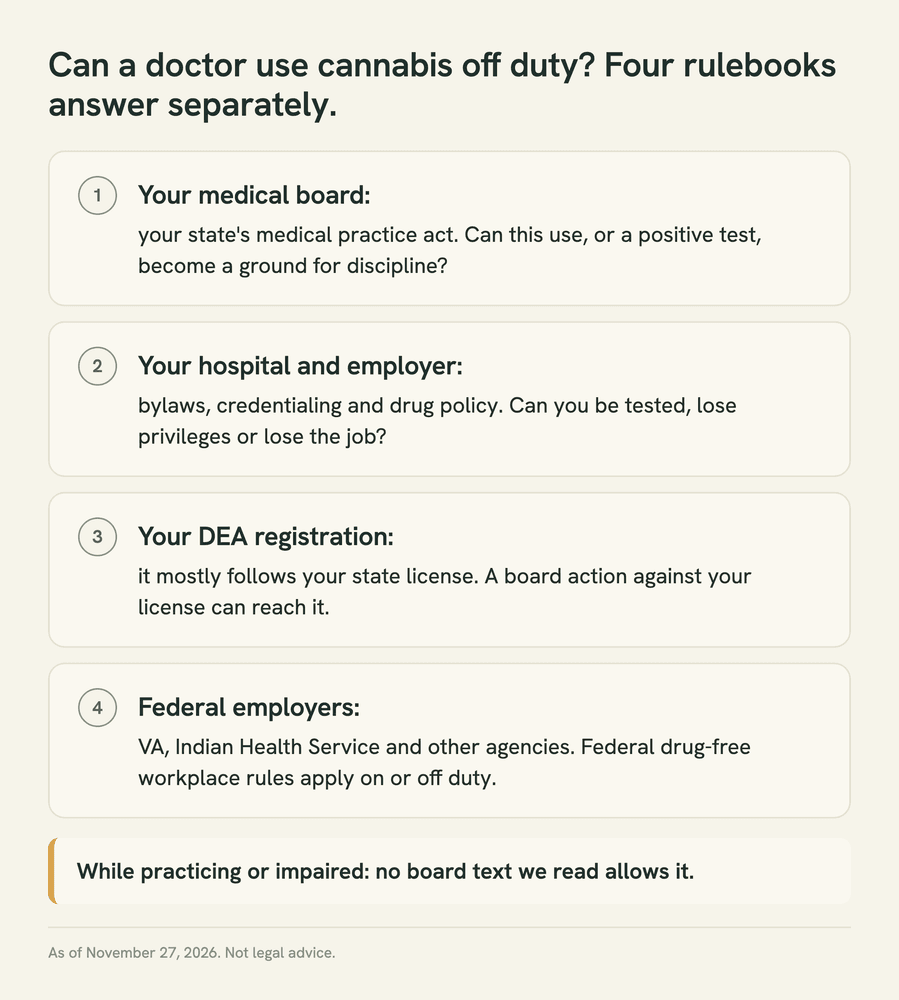
Most of what ranks for this question comes from personal-finance blogs and trade news, and the only regulator they quote is one California board line, reported second-hand. The real answer depends on four bodies, and each enforces its own rules. Start with the federal baseline. Since April 28, 2026, a DEA final rule has placed marijuana held under a state medical license, and marijuana in FDA-approved drugs, in Schedule III; everything else, including adult-use marijuana, remains in Schedule I. Either way it is still a controlled substance under federal law, and our explainer on the medical marijuana Schedule III ruling covers what the rule did. On top of that baseline, four rulebooks apply to you:
- 1Your medical board. It enforces your state's medical practice act. The question it answers: can this use, or a positive test, become a ground for discipline against your license?
- 2Your hospital and employer. Medical-staff bylaws, credentialing and a written drug policy, inside your state's employment law. The question: can you be tested, lose privileges or lose the job?
- 3Your DEA registration. It lets you prescribe controlled substances and mostly follows your state license. The question: can anything about your use reach the registration?
- 4Federal employers. If the VA, the Indian Health Service or another federal agency employs you, or you train in a VA hospital, federal drug-free workplace rules decide most of the answer, on or off duty.
Whether you can recommend or certify cannabis for patients is a different question, and this page does not cover it. Other licensed and safety-sensitive jobs face the same layered problem with their own twists; see our guides on whether nurses can smoke weed, the rules for police officers and cannabis rules for firefighters and EMTs. For physicians, two things raise the stakes: a board that, in at least one state, looks at use off the job as well as on it, and a DEA registration that depends on the license that board controls.
Your medical board: what it actually says about off-duty use
State medical boards discipline under their medical practice act, the law that licenses physicians and lists the grounds for action against a license. Most boards have published nothing on doctors' own cannabis use. Of the ten boards we checked (California, New Mexico, Oregon, Washington, Colorado, Michigan, Illinois, Arizona, Nevada and Maine), only California and New Mexico had personal-use text we could read, and the two read differently. The Medical Board of California's cannabis resource page answers the question in a section titled "Physician Use":
“The Board does not have a policy regarding a physician's use of cannabis for medicinal and/or recreational purposes, but views the use of cannabis like it does the use of other controlled substances and alcohol. The Board must follow the law, which states if a physician is impaired, the Board can take disciplinary action.”
The same page says the board "investigates all complaints it receives regarding a physician who may be impaired (including from cannabis use - medical or recreational)," can require an evaluation, can petition for an interim suspension order, and "is alerted when a physician is arrested, including for driving under the influence." A cannabis conviction is handled the way the board handles "any crime committed by physicians." The law behind the page is California's Medical Practice Act. Cal. Bus. & Prof. Code 2239 makes a doctor's own use of a controlled substance, a dangerous drug or alcohol unprofessional conduct when it happens "to the extent, or in such a manner as to be dangerous or injurious" to the doctor or anyone else, or "to the extent that such use impairs the ability of the licensee to practice medicine safely." The board reads it as an impairment test. The section just before it, Cal. Bus. & Prof. Code 2238, is the clause most articles skip: "A violation of any federal statute or federal regulation or any of the statutes or regulations of this state regulating dangerous drugs or controlled substances constitutes unprofessional conduct." The board's cannabis page does not mention 2238, and does not say how, or whether, it applies that clause to off-duty use that California law allows. We found no case applying it that way, and we do not guess.
New Mexico's board wrote its position down. Its Policy on Cannabis Use by Licensees, issued June 2, 2022 and revised August 25, 2025, says the law prohibits licensees from using drugs, including cannabis, or alcohol "to the extent or in such a manner as to be impaired while practicing medicine, or use that is habitual or excessive on or off the job, whether they are using cannabis for medical purposes or for recreational use." It applies to licensees "whether in clinical practice, training, or administrative roles," and its scope includes "positive drug screening results, regardless of impairment." A positive cannabis screen "may prompt investigation," and a positive "even in the absence of impairment or a state-issued medical cannabis card" may complicate a malpractice or credentialing defense. In deciding a case, the board weighs whether use was recreational or medically authorized, any evidence of impairment, compliance with employment and institutional policies, and "the licensee's candor, insight, and cooperation." Listed sanctions run from reprimand and probation to suspension, revocation or denial of licensure. The policy also ties the layers together: the board "will consider non-compliance" with an employer's, hospital's or training institution's cannabis policy "as potential evidence of unprofessional conduct if patient safety is compromised." Written before the April 2026 rule, it describes cannabis as a Schedule I substance.
Above the states sits the Federation of State Medical Boards (FSMB), the national body of state medical and osteopathic boards. In House of Delegates Resolution 16-3, adopted April 30, 2016, it asked boards to "advise their licensees to abstain from the use of marijuana, for medical or recreational purposes, while actively engaged in the practice of medicine," and to add marijuana to the model practice act's list of substances that impair ability. One of its stated reasons: "There is known difficulty in determining and monitoring the amount of marijuana that would impair a physician's ability to practice medicine." It is advice to boards, not a law. It was adopted when four states allowed adult use, and it does not define "actively engaged." We quote the phrase rather than read it as "on shift only" or as "total abstinence."
| Source | Date | What it says | What it means off duty |
|---|---|---|---|
| Medical Board of California, cannabis page | Undated | No cannabis policy; cannabis treated "like it does the use of other controlled substances and alcohol"; impairment triggers discipline | Off-duty use is not named; impairment is the test the board describes |
| Cal. Bus. & Prof. Code 2239 | Statute, amended effective January 1, 1999 | Self-use is unprofessional conduct when dangerous or injurious, or when it impairs safe practice | Turns on danger or impairment |
| Cal. Bus. & Prof. Code 2238 | Statute, amended 1984 | Violating "any federal statute" on controlled substances is unprofessional conduct | The board has not said how, or whether, it applies this to off-duty use California allows |
| New Mexico Medical Board policy | Issued June 2, 2022; revised August 25, 2025 | Bars impaired practice and use that is "habitual or excessive on or off the job"; a positive screen "may prompt investigation" | Reaches habitual or excessive off-duty use; a medical card is a factor, not a shield |
| FSMB Resolution 16-3 | April 30, 2016 | Boards should advise licensees to abstain "while actively engaged in the practice of medicine" | Advice to boards, not law; "actively engaged" is undefined |
One search trap: results that cite a "College of Physicians and Surgeons" or the Canadian Medical Association Journal describe Canadian regulators, and their rules do not apply to a US license.
Physician health programs: where a positive test can lead
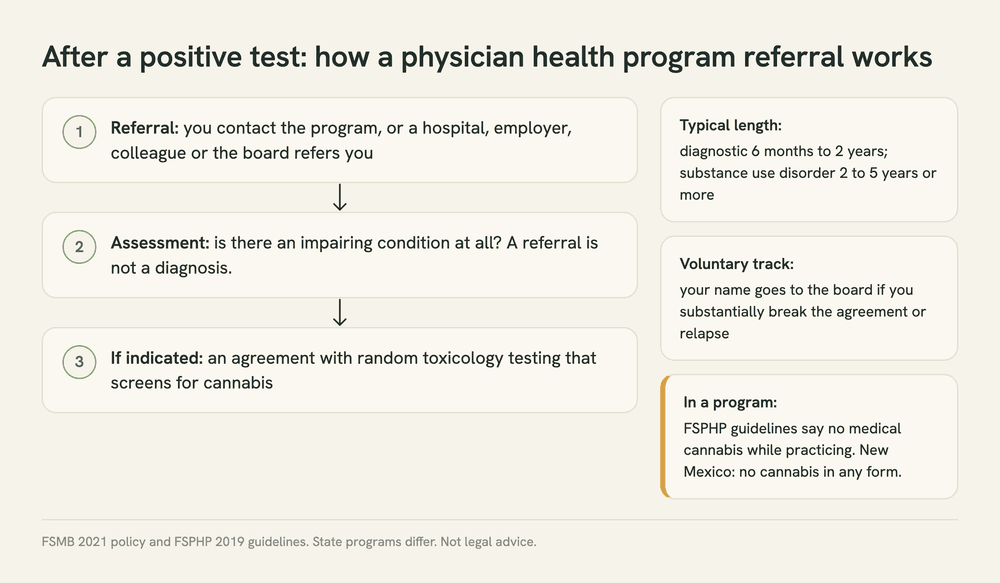
When a doctor's substance use reaches a board's or a hospital's attention, the next stop can be a physician health program, or PHP. The Federation of State Physician Health Programs, a nonprofit established in 1991, says its member programs "provide confidential assessment, referral to treatment, resources and monitoring for physicians/healthcare professionals, and those in training," and calls them "a confidential, therapeutic alternative to discipline." The FSMB's April 2021 policy on physician illness and impairment defines a PHP as a confidential program of "prevention, detection, intervention, rehabilitation and monitoring" that the state medical board approves or recognizes. It recommends two doors in: a voluntary track "without required personal identification to the state medical board," and a board-mandated track. On the voluntary track, "substantive non-adherence or relapse" is "promptly reported to the licensure board by name."
Among the FSMB's criteria for referring a doctor for assessment is "positive toxicology results for substances that are not prescribed by a treating healthcare professional." A state medical cannabis certification is not a prescription in the usual sense, and the policy does not say how boards should treat one. A referral is for an assessment, not a diagnosis. In outline, the path looks like this:
- 1Referral: you contact the program yourself, or a hospital, employer, colleague or the board refers you.
- 2Assessment: the program evaluates whether there is an impairing condition at all. A referral is not a finding.
- 3If indicated, an agreement: treatment where needed, then a monitoring contract with random toxicology testing.
- 4Reporting: on the voluntary track, the board hears your name if you substantially break the agreement or relapse.
Agreements are long and specific. The FSPHP's 2019 Physician Health Program Guidelines list provisions such as remaining "abstinent from mood-altering substances," "random toxicology testing" and "quarterly reports by a practice liaison," and say "all participants should have some screening for alcohol and cannabis." A missed specimen "may be interpreted as a presumptive positive test." Typical lengths: diagnostic monitoring runs "generally, 6 months to 2 years"; an agreement for a mild substance use disorder "generally, 2 to 5 years"; for moderate or severe, "generally minimum of 5 years." On cannabis, the guidelines are direct: "Until there are further developments in science and law, PHP Guidelines recommend that PHPs do not allow the use of medical marijuana or cannabis by medical or healthcare professionals who are actively engaged in the practice of medicine." If cannabis is the only option that works for a participant, the guidelines say the doctor should be required to voluntarily step away from practice, keep testing, and return after "two to four consecutive urine drug tests negative for marijuana and marijuana metabolites." New Mexico is blunter. Licensees in its Health Professional Wellness Program "may not use cannabis in any form under any circumstances," and use during monitoring "may result in immediate referral for disciplinary action or petition for interim suspension." Both rules apply to doctors already in a program, not to every physician, and the FSPHP text dates from 2019, before the Schedule III rule.
Boards use these programs largely because of their outcome data. In a 2008 BMJ study of 904 physicians in 16 state programs, all admitted between 1995 and 2001, 631 (78.7%) were licensed and working five years later and 87 (10.8%) had their licenses revoked. A 2009 national survey of PHP medical directors, sent to all 49 state programs (86% responded), described monitoring that usually lasted five years or more. Read those numbers for what they are: doctors with diagnosed substance use disorders, mostly involving alcohol and opioids, followed before legal adult use existed, in a study with a co-author who directed a program (a declared conflict of interest). They are not a cannabis study, and they say nothing about a doctor whose only issue is a single positive test.
Your hospital: credentialing, drug tests and state job laws
Your clinical privileges come from the hospital's medical staff, and that layer runs on its own process. Under Joint Commission standard MS.11.01.01, the medical staff of an accredited hospital must have a process "to identify and manage matters of individual health for licensed independent practitioners which is separate from actions taken for disciplinary purposes," open to self-referral and referral by others. If that process finds a practitioner "is unable to safely perform the privileges they have been granted," the matter goes to corrective action "that includes strict adherence to any state or federally mandated reporting requirements." The standard says nothing about cannabis. The copy we read, hosted by a law firm, took effect January 1, 2022; the current manual sits behind a paywall, so its numbering may have changed.
The cannabis rule itself, and the testing behind it, come from the hospital's own policy, and state legalization does not override it. A Nevada medical school's resident handbook, effective July 1, 2026, puts it plainly: "State legalization of marijuana does not exempt residents/fellows from employer, hospital, federal, or training site drug screening requirements," and participating hospitals "may continue to prohibit marijuana use regardless of state law." A positive without documentation "may result in" removal from clinical duties, delayed or denied credentialing, referral for assessment or treatment, and discipline "up to and including dismissal." That is one institution, in a state that allows adult use, but it shows how the layers stack. Our state-by-state guide to being fired for failing a drug test covers the general protections employees have. What it does not show is that several states write patient care out of them.
Oklahoma lists "direct patient care or direct child care" and "dispensing pharmaceuticals" among safety-sensitive duties, and since November 1, 2026, Enrolled House Bill 3127 holds safety-sensitive positions to "a zero-tolerance drug and alcohol standard," "regardless of any employer policy permitting impairment-based testing." Minnesota generally limits cannabis testing, but its drug-testing statute, section 181.951, treats cannabis as a testable drug for any position requiring face-to-face care or "medical assistance" to "patients who receive health care services from a provider." Connecticut's off-duty protections, under Conn. Gen. Stat. 21a-422o, exempt employers whose primary activity is health care or social services, and any position "requiring the supervision or care of children, medical patients or vulnerable persons."
Arizona runs the other way for registered patients. A.R.S. 36-2813 bars an employer from discriminating against a cardholder over "a registered qualifying patient's positive drug test for marijuana components or metabolites, unless the patient used, possessed or was impaired by marijuana on the premises of the place of employment or during the hours of employment." Two limits matter for doctors. The protection gives way where honoring it "would cause an employer to lose a monetary or licensing related benefit under federal law or regulations," and whether a given hospital's federal funding triggers that clause is not settled in anything we read. And a companion section, A.R.S. 36-2814, says no employer has to allow an employee to work while under the influence.
Why do these laws separate a positive test from impairment? A urine test finds THC metabolites, which show past use, not impairment or timing. New York's labor department guidance says a cannabis test "cannot serve as a basis for an employer's conclusion that an employee was impaired," and the FSPHP guidelines note there are "no scientifically developed reliable measures to confirm the time of actual use." Where zero tolerance applies, though, a positive can still cost the job. For how random selection works, see our guide to random drug tests at work; for detection, see how long THC stays in your blood. Federal disability law does not fill the gap: the Americans with Disabilities Act excludes an employee or applicant "currently engaging in the illegal use of drugs" when the employer acts on that use, and whether a state medical card changes that after the 2026 Schedule III rule has not been decided.
Your DEA registration, and doctors who work for the government
Several pages that rank for this question imply that personal cannabis use puts your DEA registration directly at risk. The application does not ask about it. As DEA describes its own form in a June 2024 decision published in the Federal Register, it contains four "liability questions" that require a yes or no answer and ask whether the applicant:
- 1Has a criminal background, including controlled-substance convictions and exclusion from Medicare or a state health care program.
- 2Has previously surrendered a registration for cause.
- 3Has issues with a state license, such as revocation, suspension, restriction or probation.
- 4Has affiliations with entities or corporations that have criminal histories.
A September 2025 DEA decision quotes the first question in full: "Has the applicant ever been convicted of a crime in connection with controlled substance(s) under state or federal law, or been excluded or directed to be excluded from participation in a Medicare or state health care program, or [is] any such action pending?" An October 2025 decision quotes the license question: "Has the applicant ever surrendered (for cause) or had a state professional license or controlled substance registration revoked, suspended, denied, restricted, or placed on probation, or is any such action pending?" None of the four asks whether you use a controlled substance. What the form does ask, and what DEA treats as material when the answer is false, is whether your state license has been restricted or placed on probation. We read the questions as DEA quotes them in its decisions, because the live application sits behind a login, and the wording can change.
That is the real path from cannabis to the registration: it runs through your license. Under 21 U.S.C. 824, DEA may suspend or revoke a registration if the registrant materially falsified an application, was convicted of a felony relating to a controlled substance, "has had his State license or registration suspended, revoked, or denied by competent State authority and is no longer authorized by State law" to dispense, committed acts inconsistent with the public interest, or was excluded from federal health care programs under 42 U.S.C. 1320a-7(a). The public-interest factors in 21 U.S.C. 823(g)(1) include "the recommendation of the appropriate State licensing board" and "such other conduct which may threaten the public health and safety." That last factor is broad. We found no DEA rule or decision about a registrant's lawful off-duty cannabis use, but our search was not exhaustive, and no one should treat the registration as out of reach.
The April 2026 rule did not change this layer. Marijuana under a state medical license now sits in Schedule III, and everything else, including adult-use marijuana, remains in Schedule I. The rule mentions physicians twice, both times about patient qualification and dispensing, and says nothing about a physician's own use, workplaces or drug tests. When we checked the Federal Register on November 27, 2026, DEA had published no new rescheduling action since November 1.
If the government employs you, state law is not the deciding layer. Executive Order 12564, signed in 1986, says the use of illegal drugs by federal employees, "whether on duty or off duty, is contrary to the efficiency of the service," and requires agencies to test employees in sensitive positions. In 2015, the federal personnel office told agencies that state marijuana law changes "do not alter Federal law, existing suitability criteria, or Executive Branch policies regarding marijuana." VA puts physicians inside that program: a 2015 VA inspector general audit describes VA's handbook as designating safety-sensitive occupations, "such as physicians, nurses, police officers," as testing-designated positions, with pre-employment testing of selectees and random monthly testing of employees. Current postings match. A 2026 VA emergency medicine physician announcement, which closed April 2, 2026, lists "Drug test: Yes" and says applicants tentatively selected for a testing-designated position "are subject to urinalysis to screen for illegal drug use prior to appointment." The executive order reaches physicians at the Indian Health Service and other federal agencies too. Military physicians answer to a parallel rulebook, covered in our guide to CBD in the military.

Residents, medical students and pharmacists
Residency accreditation leaves the cannabis rule to your institution. The ACGME's Institutional Requirements, effective July 1, 2026, say only that "the Sponsoring Institution must have a policy, not necessarily GME-specific, which addresses physician impairment," alongside access to confidential counseling and behavioral health services. The document does not mention cannabis, marijuana or drug testing. So your program's handbook, and every hospital you rotate through, sets the actual testing and cannabis rules; the Nevada handbook quoted above is one example. Your training license matters too: New Mexico's board policy covers licensees in training as well as in clinical practice.
Many trainees also pass through a federal hospital. VA's Office of Academic Affiliations says its physician education program runs "in collaboration with 151 allopathic medical schools and 39 osteopathic medical schools." VA's 2019 guide for health professions trainees says trainees are exempt from pre-employment testing, but "most VHA HPTs are in testing designated positions (TDPs) and subject to random drug testing," and that VA will end the appointment or rotation of a trainee found to use illegal drugs on a verified positive test "even if a drug is legal in the state where training." Medical students answer to their school's technical standards and student handbook, and to each clinical site's policy; a VA rotation adds the federal rules on top.
Pharmacists face the same structure, with a pharmacy board in place of a medical board. California's pharmacy law, Cal. Bus. & Prof. Code 4301, mirrors the physicians' version: self-use becomes unprofessional conduct "to the extent or in a manner as to be dangerous or injurious," or "to the extent that the use impairs the ability of the person to conduct with safety to the public the practice authorized by the license," and a separate clause, 4301(j), covers violating the drug laws "of this state, of any other state, or of the United States." Oklahoma names "dispensing pharmaceuticals" as a safety-sensitive duty, so pharmacy jobs there fall under the zero-tolerance standard in force since November 1, 2026. Federal pharmacy jobs are tested too: a 2026 VA clinical inpatient pharmacist announcement, open February 5-20, 2026, lists "Drug test: Yes" with the same urinalysis language as the physician posting.
Medical cards and CBD
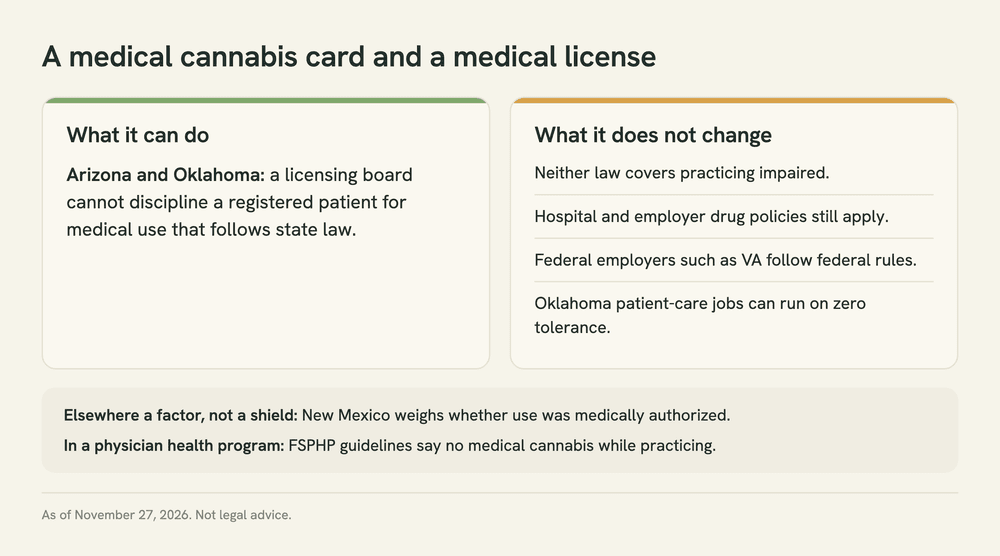
A medical card is not a general shield for a medical license. Two states write a narrow protection into law. Arizona's A.R.S. 36-2811 says a registered qualifying patient is not subject to "disciplinary action by a court or occupational or professional licensing board or bureau" for medical use under the chapter, and Oklahoma's law has a similar sentence for medical use "in accordance with this act." Neither covers practicing impaired: Arizona's 36-2802 says the law does not authorize "undertaking any task under the influence of marijuana that would constitute negligence or professional malpractice," and Oklahoma's same section now lets patient-care jobs run on zero tolerance. Neither reaches hospital policy or a federal employer. Elsewhere, a card is a factor, not a shield: New Mexico lists "whether use was recreational or medically authorized" as one thing it weighs, and the FSPHP guidelines say programs should not allow medical cannabis for participants who are practicing. Get your employer's position in writing before you rely on a card.
CBD is not a workaround for a THC test. In a 2020 controlled study of six adults, 100 mg of pure CBD, taken orally or vaporized, produced only 1 positive screen among 218 urine specimens and none above the confirmation cutoff, while vaporized CBD-dominant cannabis containing 3.7 mg of THC produced four confirmed positive specimens. The study was small, used single doses of pure material, and retail products with unknown THC content can behave differently. For a doctor in a monitoring agreement or a zero-tolerance job, that residual risk is the whole question, and no product can guarantee a drug-test result. Our guides to CBD and drug tests and hemp-derived THC products explain where the THC comes from.
Before you use: a checklist for physicians
This checklist is about knowing which rules apply to you, not about passing a test. Work through it before you rely on your state's legalization.
- 1Find your board's written position, if it has one, and the drug-use ground in your practice act. Is it an impairment test, like California's 2239, or is there also a federal-law clause, like 2238?
- 2Read your hospital's medical-staff bylaws and drug policy, and those of every affiliate where you hold privileges or rotate.
- 3Check whether your state carves patient care out of its cannabis job protections, as Oklahoma, Minnesota and Connecticut do.
- 4If the VA, the Indian Health Service or another federal agency employs you, or you train at a VA hospital, assume federal rules apply on and off duty.
- 5If you are in a physician health program agreement, read its cannabis clause and assume no cannabis is allowed unless it says otherwise in writing.
- 6If you hold a medical card, confirm in writing what your state's law and your employer say. Never use on shift, and never practice impaired.
- 7If you use CBD under zero tolerance or monitoring, accept that residual THC can produce a positive. No product can guarantee a result.
- 8Answer every license, DEA and credentialing question truthfully. If a test comes back positive, talk to a health-law attorney before you answer the board.
What this page cannot tell you
This guide reads two state medical boards (California and New Mexico), two national federations, the DEA statute and its decisions, and the cannabis employment laws of four states (Oklahoma, Minnesota, Connecticut and Arizona), plus New York's labor guidance. That is not 50 states. Board practice can differ from board text, California has not said how it applies 2238 to off-duty use, and the FSMB has not defined "actively engaged." How the Schedule III rule interacts with Executive Order 12564 and the ADA is open. We did not read disability or malpractice insurance policies, which carry their own drug-use language, so read yours. If you lose a job over a test, our guide to unemployment after a failed drug test covers the next question.
Frequently asked questions
State legalization answers only part of it. Your board may focus on impairment (California) or also on use that is "habitual or excessive on or off the job" (New Mexico), and California's practice act separately makes violating a federal drug statute unprofessional conduct, without the board saying how it applies that to off-duty use the state allows. Your hospital can still test and prohibit use: a 2026 Nevada residency handbook says state legalization does not exempt residents from hospital drug screens. If the VA or another federal agency employs you, a 1986 executive order treats illegal drug use on or off duty as contrary to the efficiency of the service.
Only narrow statements hold. Arizona and Oklahoma bar professional licensing boards from disciplining registered patients for medical use that follows state law, but neither covers practicing impaired, and Oklahoma now lets patient-care jobs run on zero tolerance. New Mexico treats a card as one factor it weighs. For doctors in a physician health program, the FSPHP's 2019 guidelines say programs should not allow medical cannabis while the doctor practices. For federal physicians, what the 2026 Schedule III rule means has not been decided.
Some do, at different points. Hospitals and training programs set their own pre-employment, credentialing and for-cause testing. VA lists physicians among its testing-designated positions, and a 2026 VA emergency physician posting says "Drug test: Yes," with a urine screen before appointment. Doctors in a physician health program agreement face random toxicology testing that screens for cannabis. We found no rule setting a testing frequency for private hospitals.
It is possible, and the standard varies by state. In New Mexico, impaired practice or use that is "habitual or excessive on or off the job" can lead to sanctions from reprimand to revocation, and a positive screen may prompt an investigation. California's board acts on impairment and treats cannabis convictions like other crimes. Breaking a monitoring agreement can also lead to board action. Arizona and Oklahoma bar licensing-board discipline for lawful medical use. The outcome depends on your state's law and your board's decision.
First, the employer or hospital acts under its own policy, which can mean removal from clinical duties or a credentialing delay. The board may learn of it; in New Mexico a positive screen may prompt an investigation. The FSMB's model lists a positive test for a substance not prescribed by a treating clinician as one reason to refer a doctor for an assessment by a physician health program. A referral is for an assessment, not a diagnosis, and a monitoring agreement follows only if the program finds one is indicated.
Not directly through the form: the DEA application's four liability questions ask about drug convictions and Medicare exclusion, past registration surrenders, state license actions and affiliated companies, not your own use. The risk runs through your state license. DEA can act if a board suspends or revokes you, if you are convicted of a drug felony or if you falsify the application, and its public-interest test includes "such other conduct which may threaten the public health and safety."
Your institution decides. The ACGME's 2026 requirements only say each sponsoring institution must have a policy that addresses physician impairment. A 2026 Nevada residency handbook says state legalization does not exempt residents from hospital or training-site drug screens. VA trains doctors with 151 allopathic and 39 osteopathic medical schools, and its trainee guide puts most trainees in random-testing positions, where a verified positive ends the rotation even where cannabis is legal. Students follow their school's technical standards and each clinical site's policy.
The structure is the same, with a pharmacy board in place of a medical board. California's pharmacy law makes self-use unprofessional conduct when it is dangerous or impairs practice, and separately covers violating the drug laws of the United States. Oklahoma lists dispensing pharmaceuticals as a safety-sensitive duty held to zero tolerance since November 1, 2026, and a 2026 VA pharmacist posting says "Drug test: Yes."
The risk is residual THC. In a 2020 study of six adults, pure CBD rarely triggered a urine screen (1 of 218 specimens screened positive, none confirmed), while vaporized CBD-dominant cannabis with 3.7 mg of THC produced confirmed positives. Retail products with unknown THC content can behave differently. Under zero tolerance or a monitoring agreement, no product can guarantee a negative result.
Physician rules are one part of a larger legal map. Our guide to whether CBD is legal covers the federal hemp rule and the state exceptions that sit beside the license and workplace rules above.
Writing about hemp, wellness and the small rituals that keep us balanced.