Can Schools Drug Test Students? What the Law Allows and What the Evidence Shows
Public schools can randomly test student athletes and students in competitive activities, but the Supreme Court has never approved testing everyone. Here is what the cases say, how four states differ, and what the research shows about whether testing works.
Can schools drug test students? A public school can randomly test students who play sports or join competitive extracurricular activities, and many school policies also allow a test when officials have reasonable grounds to suspect a particular student. The U.S. Supreme Court has never approved random testing of an entire student body, some states set tighter rules, and private schools mostly follow their own enrollment contracts. Here is what the law allows, where it differs, and what research says about whether testing reduces drug use.
The short answer: yes, within limits. Public schools are part of the government, so the Fourth Amendment's ban on unreasonable searches applies to them. Two Supreme Court decisions, from 1995 and 2002, allow random, suspicionless urine tests for student athletes and for students in competitive extracurricular activities such as band, choir or academic team. The Court has not decided whether a school may randomly test every student. Beyond that floor, the answer depends on your state, whether the school is public or private, and the district's written policy. On whether testing works, the evidence is mixed and short-term.
This page covers public and private schools from middle school through high school. College students face a different rulebook, which our guide to drug convictions and federal student aid explains, and the anti-doping rules that govern college and elite athletes are in our guide to CBD in sports.
Can schools drug test students? Why the Fourth Amendment applies
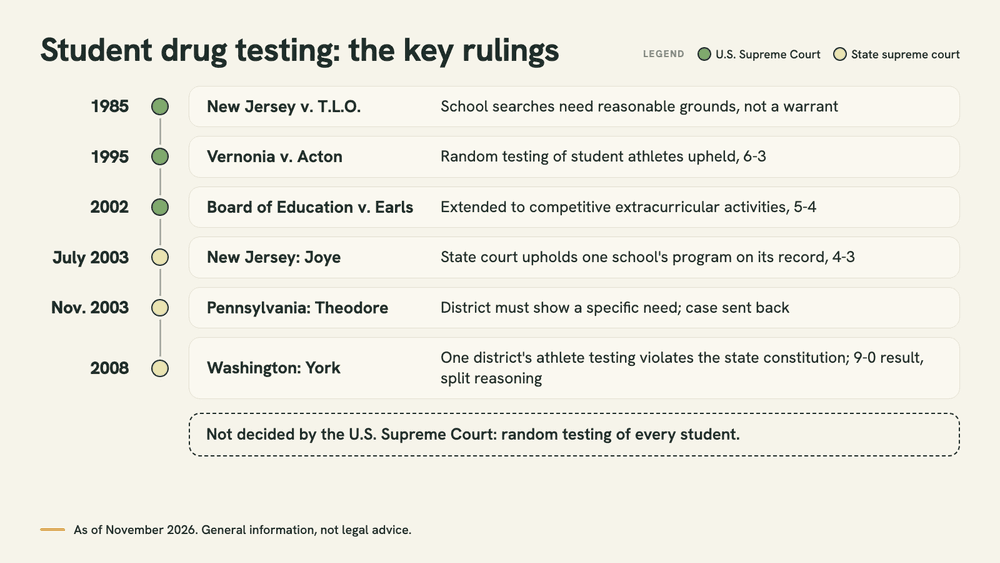
The starting point is New Jersey v. T.L.O., decided January 15, 1985. A school official had searched a 14-year-old student's purse for cigarettes and found evidence of marijuana. The Supreme Court held that public school officials "act as representatives of the State, not merely as surrogates for the parents." That is why the Fourth Amendment reaches them. But the Court set a lower bar than the one police face: no warrant and no probable cause. Instead, "the legality of a search of a student should depend simply on the reasonableness, under all the circumstances, of the search." A search is justified at the start when there are "reasonable grounds for suspecting that the search will turn up evidence that the student has violated or is violating either the law or the rules of the school."
T.L.O. was a search of a bag, not a drug test, and the Court was careful about what it left open. In a footnote it wrote, "We do not decide whether individualized suspicion is an essential element" of the standard it adopted. The opinion also left open searches carried out "in conjunction with or at the behest of law enforcement agencies." Both gaps matter here. A random drug test is, by design, a search with no individual suspicion: the student is tested because a name was drawn, not because of anything that student did. Our guide to how random selection works in workplace testing explains the mechanics; the school cases below apply the same idea to students.
Vernonia (1995): random drug tests for student athletes
The first school drug-testing case came from Oregon. In Vernonia School District 47J v. Acton, decided June 26, 1995, the Court reviewed a policy for student athletes. To play, a student and a parent had to sign a written consent form. Athletes were tested at the start of the season, and each week 10% of them were drawn blind for a urine test, which a lab routinely checked for amphetamines, cocaine and marijuana. The results were "not turned over to law enforcement authorities or used for any internal disciplinary function." If a second test confirmed a positive, the student chose between a six-week assistance program with weekly urinalysis or suspension from athletics for the rest of that season and the next. James Acton, a seventh grader, was kept off the football team because he and his parents refused to sign the consent form.
The Court upheld the policy 6-3, with Justices O'Connor, Stevens and Souter dissenting. Justice Scalia's majority opinion put the conclusion in one line: "we conclude Vernonia's Policy is reasonable and hence constitutional." The same opinion added a warning that most summaries leave out:
“We caution against the assumption that suspicionless drug testing will readily pass constitutional muster in other contexts.”
Vernonia also left a state question unanswered. The federal appeals court below had ruled on the Oregon Constitution as well as the Fourth Amendment. The Supreme Court said that state ruling "rested on a flawed premise," vacated the judgment and sent the case back, without deciding what Oregon law requires. That detail matters for every reader outside Oregon too: a Supreme Court ruling on the Fourth Amendment sets a floor, and it does not settle what a state's own constitution allows.
Earls (2002): band, choir, Future Farmers and every competitive activity
Seven years later the Court went further. Board of Education of Independent School District No. 92 of Pottawatomie County v. Earls, decided June 27, 2002, involved a policy in Tecumseh, Oklahoma, that covered students in any "competitive extracurricular activities." In practice that meant the Academic Team, Future Farmers of America, Future Homemakers of America, band, choir, pom pon, cheerleading and athletics. Students gave urine samples tested for amphetamines, marijuana, cocaine, opiates and barbiturates. The vote was 5-4: Justice Thomas wrote for the Court, Justice Breyer added a concurrence, and Justices Ginsburg, Stevens, O'Connor and Souter dissented.
The results were not given to police and did not touch grades. In the Court's words, "the only consequence of a failed drug test is to limit the student's privilege of participating in extracurricular activities." Tecumseh's policy set a ladder of consequences:
- 1First positive: a meeting with the student's parents. The student could stay in activities by showing proof of drug counseling within 5 days and taking a second test within two weeks.
- 2Second positive: a 14-day suspension from activities, 4 hours of counseling and monthly tests.
- 3Third positive: suspension from all extracurricular activities for the rest of the school year or 88 school days, whichever is longer.
Two lines in Earls rarely make it into summaries. First, the Court refused to make a district prove a serious local drug problem before testing: "we refuse to fashion what would in effect be a constitutional quantum of drug use." Second, the holding is narrow and says so. The Court held only that Tecumseh's policy was "a reasonable means of furthering the School District's important interest in preventing and deterring drug use among its schoolchildren," and it left the choice to local boards: "Within the limits of the Fourth Amendment, local school boards must assess the desirability of drug testing schoolchildren."
“In upholding the constitutionality of the Policy, we express no opinion as to its wisdom.”
What the Supreme Court has not decided
Neither case approved random testing of every student. In Vernonia, Justice Ginsburg wrote separately: "I comprehend the Court's opinion as reserving the question whether the District ... constitutionally could impose routine drug testing not only on those seeking to engage with others in team sports, but on all students required to attend school." In Earls, Justice Breyer's concurrence relied partly on the fact that the program "avoids subjecting the entire school to testing." He also noted that it "preserves an option for a conscientious objector." Such a student, he wrote, "can refuse testing while paying a price (nonparticipation)."
That gap is not academic. In a spring 2005 survey answered by 1,343 district drug-prevention coordinators, about 14% of districts with high school grades ran random testing. Almost all of them tested athletes, 65% tested students in other extracurricular activities, and 28% randomly tested all students, which the authors described as "exceeding the current sanction of the US Supreme Court." Those districts were working in territory the Court has not ruled on.
T.L.O.'s open questions also remain: whether individualized suspicion is required, and how the analysis changes when a search is done with or for the police. None of this means testing all students is unconstitutional. It means the Supreme Court has not decided it, and state courts and state legislatures fill much of the space, as the next section shows.
States that drew the line somewhere else
The Supreme Court sets the federal floor. A state constitution can protect students more than the Fourth Amendment does, and a state legislature can add its own conditions. The four examples below show how far apart the results can be. They are examples, not a 50-state survey, each carries its date, and none replaces checking the current law in your own state.
Washington. In York v. Wahkiakum School District No. 200, decided March 13, 2008, the Washington Supreme Court struck down one district's random testing of student athletes under article I, section 7 of the state constitution: "No person shall be disturbed in his private affairs, or his home invaded, without authority of law." All nine justices agreed on that result, but no majority agreed on the reason. Four justices rejected the federal approach outright: "We decline to adopt a doctrine similar to the federal special needs exception." Four others would allow "a narrowly drawn special needs exception" and concluded only that "on this record there is no special need." The ninth justice agreed this program was unconstitutional and would allow testing on reasonable suspicion. So a Washington program built on a stronger record has not been tested in that court. Our search found no later decision overruling York.
Pennsylvania. The Delaware Valley School District randomly tested students in voluntary extracurricular activities and students who held parking permits. In Theodore v. Delaware Valley School District, decided November 20, 2003, the Pennsylvania Supreme Court held that under article I, section 8 such a policy "will pass constitutional scrutiny only if the District makes some actual showing of the specific need for the policy and an explanation of its basis for believing that the policy would address that need." General goals were not enough on their own: "those generic factors alone do not justify any and all drug testing programs for purposes of Article I, Section 8." The ruling came at an early stage of the lawsuit. The court let the students' challenge proceed and sent the case back, and three concurring justices were less certain the targeting was unreasonable. It did not hold that school testing is banned in Pennsylvania, and the district could still try to prove its need.
New Jersey. A stricter state constitution does not always mean no testing. In Joye v. Hunterdon Central Regional High School Board of Education, decided July 9, 2003, the New Jersey Supreme Court upheld random testing of students in extracurricular activities and students with parking permits: "We hold that the program before us does not violate the New Jersey Constitution." The school had documented its problem with a student survey showing that "a third of the students in the upper grades have used illegal drugs." A positive test meant suspension from the activity and loss of parking privileges until the student finished a prevention program and passed a retest, plus counseling, and students were not prosecuted or exposed to criminal liability. The vote was 4-3. The court approved that school's program on that record; it is not a blanket approval of every program.
New York. Here the limit comes from a statute, not a court. New York Education Law section 912-a applies to "all children attending grades seven through twelve, inclusive, in the public and private schools." An examination under the section "may be made only upon the written request or consent of a parent of, or person in parental relation to, a child." It is a supervised urine sample taken without notice to the child. If the result is positive, the school reports it to the parent and to the local social services department, and the information "shall not be used for law enforcement purposes." Identifying records are destroyed when the student graduates, and families with a religious objection are exempt. The official text we read carries a September 22, 2014 revision date, and it governs examinations made under that section.
| Jurisdiction | Source and date | Rule | What it did not decide |
|---|---|---|---|
| Federal floor | Vernonia (1995) and Earls (2002), U.S. Supreme Court | Random urine tests of athletes and competitive extracurricular students are reasonable under the Fourth Amendment | Random testing of the whole student body |
| Washington | York v. Wahkiakum, Washington Supreme Court, 2008 | One district's random athlete testing violated article I, section 7; result 9-0 | No majority for a categorical ban; a program built on a stronger record |
| Pennsylvania | Theodore v. Delaware Valley, Pennsylvania Supreme Court, 2003 | A district must make "some actual showing of the specific need" for random testing | Case sent back at an early stage; testing not banned statewide |
| New Jersey | Joye v. Hunterdon Central, New Jersey Supreme Court, 2003 | One school's program upheld on a documented record | Not a blanket approval of every program |
| New York | Education Law section 912-a (text revised 2014) | Grades 7-12, public and private: parent's written request or consent; results not for law enforcement | Testing not done under section 912-a |
Can private schools drug test students?
The Fourth Amendment limits the government, and it reaches public schools for the reason T.L.O. gave: their officials act for the state. A private school is in a different position. In Rendell-Baker v. Kohn, decided June 25, 1982, the Supreme Court looked at staff dismissals at a privately run school that drew at least 90% of its budget, and in one year 99%, from public funds. It held that "the school's receipt of public funds does not make the discharge decisions acts of the State." That case was about firing staff, not testing students, but it shows where the constitutional line sits.
So a private school's drug-testing rules come mainly from its enrollment contract and student handbook, plus any state statute that reaches private schools. New York's section 912-a is one example: it names private schools expressly, so its parental-consent rule applies there too. If your child attends a private school, the handbook and enrollment agreement are the documents to read. Charter schools raise their own question, which this page does not try to answer.
What a school drug test involves
Both drug-testing policies the Supreme Court reviewed used urine, and New York's statute specifies a supervised urine sample. The federal government's 2004 guide for schools, What You Need to Know About Starting a Student Drug-Testing Program, said "the majority of schools with drug-testing programs continue to use urine tests," while noting that schools were increasingly using hair and oral fluid. Its advice: when a specimen screens positive, "regardless of the testing method, a confirmation test should be done," using gas chromatography/mass spectrometry (GC/MS), and a medical review officer (MRO) should check whether a prescription explains the result. The same guide says "random drug testing should never be used to punish students." Keep in mind what this document is: an advocacy guide from the White House Office of National Drug Control Policy, written to encourage schools to start programs. It uses "should," not "must," and it noted that some schools confirm a positive only at a parent's request.
Policies decide the details. Tennessee's state board model drug testing policy, last revised January 27, 2017, says the specimen type "shall depend on the substance in question," keeps specimens for 10 days and expunges negative results. The panel also varies: Vernonia's lab routinely looked for three drugs, Earls' for five. For what a standard panel includes, see our guide to the 10-panel drug test. For saliva testing, read how a mouth swab drug test works, and for the confirmation and review steps, our explainer on chain of custody in drug testing.
How many schools test at all? The national figures are old. A 2013 analysis of Monitoring the Future survey data pooled 89,575 students in 883 middle schools and 157,400 students in 1,463 high schools from 1998 to 2011. Over that period, 28% of high school students attended a school with some form of drug testing (22% with for-cause testing, 10% with any random testing), as did 14% of middle school students. Only 2% of students attended schools that randomly tested all students. We found no newer national figure.
What happens if a student fails a school drug test?
There is no single answer. The written policy decides, and real policies differ a lot. In Vernonia and Earls, results stayed away from police and school discipline; the cost was activity eligibility. A 2005 national survey of districts that ran random testing shows how far practice ranged. Of 1,612 district drug-prevention coordinators who responded (an 83.9% response rate), 205 were in districts with random testing in high school grades. After a student's first positive test, those districts reported:
- A meeting with parents: 88.4%
- Suspension from an athletic team: 65.0%
- Education, counseling or treatment: 60.8%
- Notifying law enforcement: 45.1%
- Suspension from school: 31.0%
The authors caution that "some respondents may have conflated their districts' responses to for cause and random tests," and the data are from 2005. Still, the survey is the reason this page does not tell you that schools never involve the police. Tennessee's model shows how one current template combines these pieces. A principal may order a test on reasonable suspicion and must notify the parent. The student may decline, but "if the test is not taken the penalty shall be suspension from school and a hearing." Random testing applies to students in voluntary extracurricular activities, with parent and student consent as a condition of joining, and the policy says: "No student who tests positive under a random drug-testing program shall be suspended or expelled from school solely as the result of the positive test."
The stakes are still real. Under the same model, "Each confirmed incident will result in a referral to the Youth Services Officer (YSO)." A first offense means suspension from all extracurricular activities for one calendar year, and a second means suspension for the rest of the student's enrollment. It is a model, and each Tennessee district adopts its own version. In New York, by contrast, a positive under section 912-a goes to the parent and the local social services department, and the statute bars law-enforcement use.
Does random drug testing in schools reduce drug use?
This is the question the legal summaries skip. The honest answer is that the evidence is mixed and short-term. No study shows that school testing stops drug use, but the evidence does not show it has no effect either: the best trial found a modest one-year drop among tested students, while other studies found no difference or mixed results. So "testing works" and "testing doesn't work" are both overstatements. Here is what each major study found, and what kind of study it was.
The first large look was a University of Michigan analysis of Monitoring the Future data from 1998 to 2001, published in 2003. About 18% of the schools studied tested students. The authors reported that "Drug testing was not associated with students' reported illicit drug use, or with rate of use among experienced marijuana users." Testing athletes was not associated with lower drug use among male high school athletes either. This was a survey snapshot comparing schools, not a trial, so it cannot show cause in either direction.
SATURN, a two-year randomized trial in 11 Oregon high schools, published in 2007, assigned 5 schools to test athletes and 6 to defer a testing policy. Positive results were reported to parents and led to mandatory counseling. Tested athletes did not differ from untested athletes in past-month drug use at any of the four follow-ups. Past-year drug use was lower among tested athletes at two of the four. Some risk factors moved the wrong way: tested athletes reported less athletic competence, less belief that authorities opposed drug use, and more risk-taking. The trial had few schools and relied on self-report, and a correction to the paper was published in 2008.
The largest randomized trial is a 2010 federal evaluation of mandatory random student drug testing from the U.S. Department of Education's Institute of Education Sciences, later published in the Journal of Adolescent Health. It randomly assigned 36 high schools in 7 districts across 7 states during the 2007-08 school year and surveyed 4,723 students in grades 9 to 12. Among students subject to testing, 16% reported using a tested substance in the past 30 days, versus 22% in schools without testing, a statistically significant difference. Other measures of use pointed the same way but were not statistically significant. Testing did not change students' stated plans to use (34% vs 33%), had no effect on students who were not subject to testing, and participation in activities was about the same (53% vs 54%). Across the year, 38 of 3,476 tests came back positive. Six of the seven districts tested for marijuana, amphetamines, methamphetamines, opiates and cocaine; the seventh tested for three of those five.
The evaluators were clear about the limits. The districts volunteered and were grant-funded, "clustered in mostly Southern states," so the results "cannot be generalized to all high schools nationally." The trial ran one year and relied on what students reported. Larger reductions went with testing for more substances and with testing for alcohol or tobacco, and the evaluators could not separate the two because the same districts did both.
The 2013 Monitoring the Future analysis, covering 1998 to 2011, found a split picture. Its abstract reports: "Moderately lower marijuana use was associated with any random testing." But school drug testing "generally was associated with increased use of illicit drugs other than marijuana." The authors wrote that "no strong causal conclusions can be drawn" and that "schools should approach SDT with caution" (SDT means student drug testing). As of November 2026, we found no Cochrane or Campbell systematic review of school drug testing, so there is no pooled estimate to point to.
| Study | Design | Who | Main finding | Main limit |
|---|---|---|---|---|
| Yamaguchi, Johnston and O'Malley, 2003 | Survey comparison of schools (cross-sectional) | Monitoring the Future students, 1998-2001 | No association between testing and reported drug use | Snapshot; cannot show cause |
| SATURN (Goldberg et al., 2007) | Randomized trial, 2 years | Athletes in 11 Oregon high schools | No difference in past-month use; lower past-year use at 2 of 4 follow-ups; some risk factors worse | Few schools; self-report |
| Federal evaluation (James-Burdumy et al., 2010; journal 2012) | Randomized trial, 1 year | 4,723 students in 36 high schools, 7 districts | 16% vs 22% past-30-day use of tested drugs among students subject to testing; no effect on untested students | Volunteer districts, mostly Southern; one year; self-report |
| Terry-McElrath, O'Malley and Johnston, 2013 | Survey comparison of schools, 1998-2011 | Middle and high school students nationwide | Moderately lower marijuana use with random testing; higher use of other illicit drugs | Authors: no strong causal conclusions |
What pediatricians recommend
“Although school drug testing has hypothetical benefits, and studies have noted modest reductions in self-reported student drug use, the American Academy of Pediatrics opposes widespread implementation of these programs because of the lack of solid evidence for their effectiveness.”
That sentence comes from the abstract of the AAP policy statement on adolescent drug testing policies in schools by Levy, Schizer and the AAP Committee on Substance Abuse (Pediatrics, 2015; DOI 10.1542/peds.2015-0054). Note what it concedes: studies "have noted modest reductions." Its third recommendation says the AAP "supports effective substance abuse services in schools but opposes widespread implementation of drug testing as a means of achieving substance abuse intervention goals because of the lack of evidence for its effectiveness." Its fourth asks schools that do test to watch for "decreased participation in sports, breach of confidentiality, increases in use of substances not included on testing panels, and increases in the number of students facing disciplinary action."
The statement names other concerns: a privacy breach when a prescribed medication shows up, suspension or expulsion, and "school dropout or increased truancy." It also points out that testing "generally does not include the substance most commonly used by adolescents: alcohol." It is candid that the frequency and impact of these harms "remain unknown." A companion AAP technical report reviews the research behind the position. The AAP reaffirmed both documents in July 2021. AAP statements "automatically expire 5 years after publication unless reaffirmed, revised, or retired," so the next decision was due around July 2026. As of November 2026, we could not confirm a newer action.
CBD, hemp and a school drug test
School drug tests look for a THC metabolite, not for where the THC came from. In a small 2020 study with federal scientists, six adults took single doses of different products. After 100 mg of pure CBD, no urine specimen confirmed positive. After a CBD-rich cannabis product carrying 3.7 mg of THC, four urine specimens confirmed positive. The study was tiny and enrolled adults, not teenagers. School policies usually do not carve out hemp products, so a positive is treated as a positive, and no product can guarantee a drug-test result. Our full guide to CBD and drug tests covers how that happens, and our page on whether CBD is safe for kids covers the separate question of giving CBD to a child. Whether a school nurse may give a student a state-authorized medical cannabis product is a different question again, and this page does not cover it.
Reading your school's drug testing policy: a checklist
Court cases set the outer limits, but the document that governs a particular student is the district's written policy and any consent form attached to it. Ask the school or district office for both, then look for the answers below. This is a guide to reading a document, not legal advice, and it is current as of November 2026.
- 1Who is covered: athletes only, all competitive extracurricular activities, students with parking permits, or every student?
- 2What triggers a test: random selection, reasonable suspicion about a specific student, or both?
- 3Consent: is a signed form a condition of joining an activity, and who must sign it (the student, a parent or both)?
- 4Specimen and panel: urine, saliva or hair, and which drugs are on the panel?
- 5Confirmation: is a positive screen confirmed by a lab method such as GC/MS and reviewed by a medical review officer, and who pays for it?
- 6Prescriptions: how is a prescribed medication reported, and who sees that information?
- 7Who receives results: parents, coaches, administrators, social services or law enforcement? Does the policy say?
- 8Consequences: what follows a first and a second positive, and what follows declining a test? Is there any school suspension or academic penalty?
- 9Records and appeals: how long are results kept, when are they destroyed, and how is a result challenged?
- 10State law: does your state have a statute or court ruling that adds conditions, like the four examples in this article?
What this page cannot tell you
Several gaps are worth naming. The national counts of school testing come from 2005 and from surveys pooled over 1998 to 2011. The best trial lasted one year in volunteer districts. No systematic review pools the studies. The four state examples are not a 50-state survey, and state law can change with a single ruling or bill. The AAP position is confirmed only through its July 2021 reaffirmation. If a court or legislature in your state has acted recently, that controls over anything here.
Frequently asked questions
The Supreme Court has approved random testing only for student athletes (1995) and students in competitive extracurricular activities (2002). It has never ruled on random testing of the whole student body, and Justice Ginsburg wrote in 1995 that the question was reserved. Testing a particular student on reasonable suspicion is a separate route that policies such as Tennessee's model allow. State law can add limits.
It depends on the state and the policy. The programs upheld in Vernonia and Earls made signed consent a condition of joining; in Vernonia both the student and a parent signed, and a seventh grader whose family refused was kept off the football team. Refusing generally means not joining the activity. New York's Education Law section 912-a requires a parent's written request or consent for the testing it authorizes. Under Tennessee's model, a student may decline a reasonable-suspicion test, but the penalty is suspension from school and a hearing. Check your state law and the district's written policy.
Generally yes, under the terms of the enrollment contract and handbook. The Fourth Amendment limits the government, and in a 1982 case about staff dismissals the Supreme Court held that public funding alone did not make a private school's decisions acts of the state. State statutes can still reach private schools: New York's section 912-a covers them expressly.
The written policy decides. In Earls, the only consequence was a limit on extracurricular participation. In a 2005 national survey of districts with random testing, 88% required a parent meeting after a first positive, 65% suspended the student from a team and 31% suspended the student from school. Tennessee's model bars school suspension solely for a random positive, but a first confirmed offense removes the student from all extracurricular activities for one calendar year.
Not necessarily, but you cannot assume they won't. In Vernonia and Earls, results were not given to law enforcement, and New York's statute bars law-enforcement use of results under section 912-a. But 45% of districts in the 2005 survey reported notifying law enforcement after a first positive (the authors note some answers may include for-cause tests), and Tennessee's model refers each confirmed positive to a Youth Services Officer. Read the part of the policy on who receives results.
Usually urine. The 2004 federal guide said most schools with programs used urine tests, with hair and oral fluid in growing use. It recommended confirming any positive screen with GC/MS and having a medical review officer check for prescriptions, but it is guidance, and not every policy requires confirmation. The panel varies: Vernonia's lab routinely looked for three drugs, Earls' for five.
It can, if the product contains THC. In a small 2020 study of six adults, pure CBD did not produce a confirmed positive urine result, while a CBD-rich product carrying 3.7 mg of THC did. School policies usually do not distinguish hemp products, and no product can guarantee a drug-test result. Our guide to CBD and drug tests has the details.
The evidence is mixed and short-term. In the largest randomized trial, 16% of students subject to testing reported recent use of tested drugs, versus 22% in schools without testing, over one year. A smaller trial of athletes found no effect on past-month use, and national survey analyses found no difference or mixed results. The American Academy of Pediatrics opposes widespread school testing, citing a lack of solid evidence for its effectiveness.
If the worry behind this search is a teenager's cannabis use itself, the more useful next read is what research shows about weed and the developing brain. If it is a hemp product showing up on a test, start with how CBD can lead to a positive screen. And for the federal and state rules on hemp itself, see our hub on whether CBD is legal.
Writing about hemp, wellness and the small rituals that keep us balanced.