Chain of Custody Drug Test: The Form You Sign, Step by Step
The chain of custody form is the record that proves a drug-test specimen is yours and untouched. Here is what you sign, which copy you keep, the nine flaws that always cancel a DOT test, the errors that get fixed instead, and why cancelled never means passed.
A collector hands you a multi-part form and a pen, and you want to know what you are signing. Or a result is being questioned and someone says the chain of custody was broken. This guide explains how a chain of custody drug test works from the side of the person holding the pen, not the employer buying a testing program.
The short answer: chain of custody is the documented, unbroken record of who had your specimen from the moment you handed it over to the moment a result was reported, so it can be shown to be yours and untouched. In a DOT test that record is the Federal Drug Testing Custody and Control Form (CCF), and the federal rule on the form, 49 CFR 40.40, says in its first sentence that the CCF "must be used to document every collection required by the DOT drug testing program." The same rulebook sorts mistakes into three lists: nine problems that always cancel a test, a few that cancel it only if nobody fixes them, and a longer list of errors that are not allowed to cancel it at all. And a cancelled test is not a pass.
What chain of custody means in a drug test
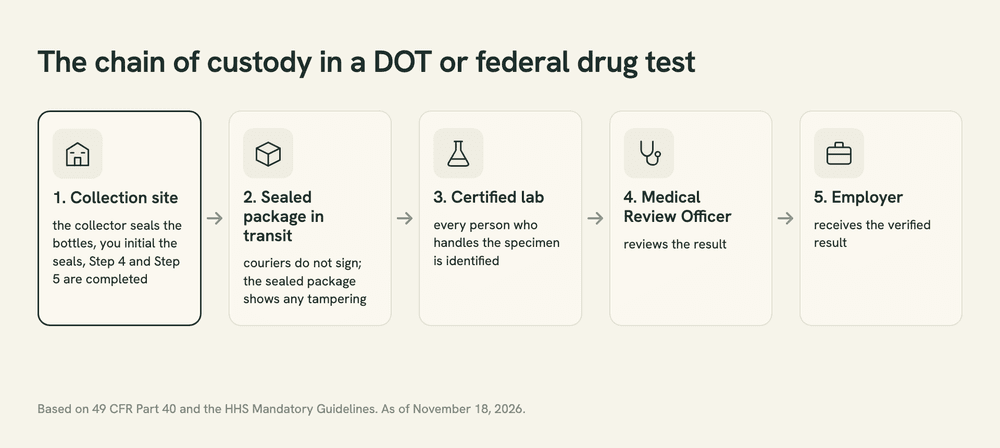
Think of chain of custody as a sign-out sheet that travels with your specimen. Each handoff is recorded: the collector who took it, the sealed package it traveled in, the people at the certified laboratory who opened and tested it, and the Medical Review Officer (MRO), the physician who reviews a result before your employer sees it. If anyone later asks whether that bottle is really yours, and whether anyone could have tampered with it, the paperwork is the answer.
In federal testing, that paperwork is one standard form. An HHS notice in the Federal Register from September 2025 explains that the CCF "is used by all federal agencies and by employers regulated by the Department of Transportation (DOT) and the Nuclear Regulatory Commission (NRC) to document the collection and chain of custody of a urine or oral fluid specimen." It adds that "most hardcopy paper CCFs are provided as a 5-part form using carbonless paper," and that SAMHSA, the HHS agency behind the notice, allows the form on paper or electronically. The volume is large. A December 2025 HHS notice on the form estimates about 6.7 million federal CCFs a year: roughly 6.5 million DOT-regulated specimens, 150,000 from federal agencies and 145,000 regulated by the NRC. That is an agency estimate made for paperwork-burden purposes, not a count, and it budgets about 5 minutes of your time per form.
The chain does not stop at the collection site. Under the HHS Mandatory Guidelines for urine testing, revised in October 2023, couriers and postal workers do not sign the form, because "specimens are sealed in packages that would indicate tampering during transit." Once the package is opened, the lab keeps its own internal chain of custody, in which "every individual in the chain must be identified." Specimens reported as positive, adulterated, substituted or invalid are kept frozen for at least 1 year so they can be retested "during an administrative or judicial proceeding," and records are kept for at least 2 years. Those guidelines govern federal agency testing directly, and DOT builds on them in Part 40. HHS has since proposed further changes to the federal testing guidelines; a proposal is not a final rule.
The Federal CCF, step by step: what you sign and what it certifies
Before any paperwork, the collector has ground rules. 49 CFR 40.43, the collection site security rule, limits a collector to "conducting a collection for only one employee at a time" and requires the collector to "maintain personal control over each specimen and CCF throughout the collection process." For a urine collection, the water in the toilet must be blue. Then the form is completed in steps. We describe each step by what the regulation says happens there, not by the form's printed wording.
- 1Step 1, the employer and test information. In a DOT test, item 1-D names the DOT agency that covers your job. Your name does not go to the lab: the lab's copy identifies you only by Social Security number or Employee ID number.
- 2Step 2, the collection. The collector records the collection itself. Step 2 also holds the Remarks line, where the collector notes anything out of the ordinary, including if you decline to sign or to initial the seals.
- 3Sealing the bottles. Every DOT collection is a split specimen: at least 30 mL goes into Bottle A and at least 15 mL into Bottle B, and the collector places tamper-evident seals over the caps and down the sides. You then initial the seals.
- 4Step 4, the chain of custody. The collector prints their name, records the time and date of the collection, signs, and enters the name of the delivery service. For an oral fluid collection, the device's expiration date is entered here too.
- 5Step 5, your certification. You read and sign the certification statement on Copy 2 and fill in the information Step 5 asks for. Copy 2 goes to the MRO.
- 6At the lab and the MRO. For a result that is not negative, a certifying scientist at the lab signs Copy 1. The MRO receives Copy 2 and reviews the result before your employer is told.
Two items on that list are yours: the initials on the seals and the signature in Step 5. Neither one is consent to a result. Under the split specimen rule, 49 CFR 40.71, you initial the seals "for the purpose of certifying that the bottles contain the specimens he or she provided." Your Step 5 signature is required by the rule on completing the CCF, 49 CFR 40.79, and it certifies the form, not the outcome. The lab never sees your name, because 40.40 says the CCF may not send a lab personal identifying information "other than a SSN or Employee ID No." Specimen volumes and temperature belong to other guides: watched collections are covered in what happens with a shy bladder or an observed collection, temperature and validity results in what a negative-dilute result means, and oral fluid in how a mouth swab drug test works.
The full list of what counts as refusing is in the federal refusal rule, 49 CFR 40.191. Not signing the form is not one of its named items, but "fail to cooperate with any part of the testing process" is broad, so do not treat a blank signature line as a safe protest. What a refusal costs a DOT-covered worker is explained in our guide to being picked for a random drug test.
Where each copy of the CCF goes
A paper CCF separates into five copies, and 40.79 sets where each goes and when. The roles below come from the regulation itself, which is why the table names each copy by its job rather than by its printed title.
| Copy | Who gets it | What it is for | When |
|---|---|---|---|
| Copy 1 | The laboratory, packed with your sealed bottles | The only copy the lab is authorized to receive; identifies you by SSN or Employee ID, not by name | Specimen shipped within 24 hours or during the next business day |
| Copy 2 | The MRO | Carries your Step 5 certification and signature | Sent within 24 hours or during the next business day |
| Copy 3 | The collector | The collection site's own record | Kept for at least 30 days |
| Copy 4 | Your employer's designated employer representative (DER) | The employer's record of the collection | Sent within 24 hours or during the next business day |
| Copy 5 | You | Your own record of the collection | Handed to you at the collection site |
An electronic CCF changes the medium, not the chain. Part 40 allows one, and 40.40(f) requires an employer that uses it to make sure the collection site, both labs and the MRO have compatible systems, and that "the employee and any other program participants in the testing process will receive a legible copy of the CCF." So on an electronic form you still leave with a readable copy. For federal agency specimens, the 2023 HHS guidelines add a gate: before a certified test facility uses an electronic CCF, it must submit its system and procedures to the National Laboratory Certification Program (NLCP) for SAMHSA review and pass an NLCP inspection.
The form itself is controlled by the Office of Management and Budget (OMB No. 0930-0158) and is renewed from time to time. HHS's December 2025 notice said the version then in use carried an August 31, 2026 expiration date. In July 2026, DOT told employers that OMB had approved HHS's revised Federal CCF. The rules on this page apply to the form either way. And if a collector does use an expired or non-federal form for a DOT test, that is one of the correctable flaws described below, not an automatic cancellation.
Fatal flaws: the nine problems that always cancel a DOT test
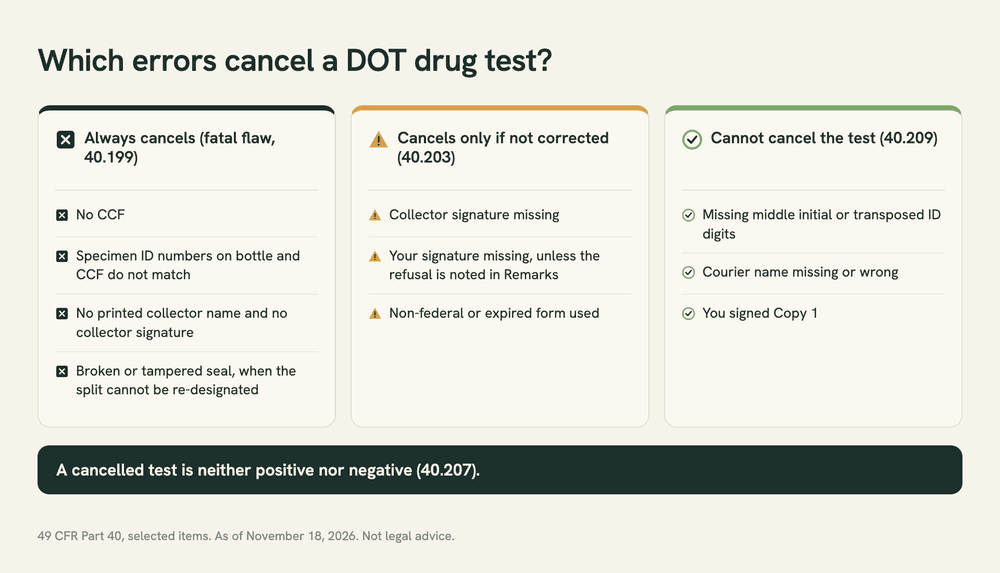
Here is where most of what you read online goes wrong. Many vendor pages say any break in the chain of custody voids a test. Part 40 is more specific than that. The fatal flaw rule, 49 CFR 40.199, lists the problems that cancel a DOT test, and the lab reports these specimens as "Rejected for Testing." The laboratory rule, 40.83, applies the same list at the lab. These are the items in 40.199(b), in the rule's own words:
- 1There is no CCF
- 2In cases where a specimen has been collected, there is no specimen submitted with the CCF
- 3There is no printed collector's name and no collector's signature
- 4Two separate collections are performed using one CCF
- 5The specimen ID numbers on the specimen bottle and the CCF do not match
- 6The specimen bottle seal is broken or shows evidence of tampering (and a split specimen cannot be re-designated, see § 40.83(h))
- 7Because of leakage or other causes, there is an insufficient amount of specimen in the primary specimen bottle for analysis and the specimens cannot be re-designated (see § 40.83(h))
- 8For an oral fluid collection, the collector used an expired device at the time of collection
- 9For an oral fluid collection, the collector failed to enter the expiration date in Step 4 of the CCF and the laboratory confirmed that the device was expired
Two details change how that list reads. Item 3 needs both problems at once: no printed collector name and no collector signature. A missing signature on its own is a correctable flaw, covered in the next section. And a damaged bottle is not automatically fatal. Under 40.83(h), if the primary seal is broken but the split specimen "remains sealed and the laboratory believes a sufficient amount of specimen exists in the split specimen," the lab can redesignate Bottle B as the primary and test it. That is why items 6 and 7 apply only when the bottles cannot be re-designated. After a rejection, 49 CFR 40.201 sends the MRO and the employer to the recollection procedures, and a recollection may be required.
Correctable flaws, and errors that are not allowed to cancel a test
The second list is short. Under the correctable flaw rule, 49 CFR 40.203, these problems cancel a DOT test only if nobody corrects them:
- The collector's signature is missing from the certification statement on the CCF.
- Your signature is missing from the certification statement, unless your failure or refusal to sign is noted on the Remarks line.
- The certifying scientist's signature is missing from Copy 1 for a result that is not negative.
- The collector used a non-Federal form or an expired CCF for the test.
Corrections follow a set procedure in 49 CFR 40.205. The person responsible supplies the missing information in writing, with a statement that it is true and accurate, on the same business day they are told about the problem. A wrong form is fixed with a signed "memorandum for the record." The CCF is then marked, for example with a stamp, so the correction is "obvious on the face of the CCF." While a missing collector signature or a wrong form is being corrected, the lab holds the specimen for at least 5 business days. If the correction does not happen, the MRO must cancel the test. The rule on non-federal forms, 40.41, adds that a non-federal form used "by mistake or as the only means to conduct a test under difficult circumstances" is not, by itself, a reason for the lab to reject the specimen or for the MRO to cancel the result.
Then comes the list almost nobody quotes. 49 CFR 40.209 sets the standard every other error is measured against:
“No person concerned with the testing process may declare a test cancelled based on an error that does not have a significant adverse effect on the right of the employee to have a fair and accurate test.”
The rule then gives examples of errors that do not cancel a DOT test. Among them:
- A minor administrative mistake, such as leaving off your middle initial, transposing digits in your SSN or Employee ID number, or omitting the DOT agency in Step 1-D.
- A collector who was required to be trained but had not met that requirement.
- Not directly observing or monitoring a collection that the rule required to be observed or monitored.
- A courier name that is missing from the CCF or wrong.
- You signing your name on Copy 1.
- A claim that you were improperly selected for testing.
Those errors still have to be documented, and 40.209 leaves room for them to matter somewhere else: their "ultimate impact" is decided "by other administrative or legal proceedings." Inside the DOT testing process, though, they do not cancel the result.
What "cancelled" actually means
49 CFR 40.207 is short and blunt: "A cancelled drug test is neither positive nor negative." In practice, for a DOT test, that means:
- It is not treated as a positive, so the consequences of a positive do not follow.
- It cannot serve as the negative you need after a pre-employment, return-to-duty or follow-up test. You test again before you start or return to safety-sensitive work.
- Your employer may not order a recollection just because a test was cancelled, except where Part 40 requires one.
- A cancelled DOT test is not a valid basis for your employer to run a non-DOT test instead.
- Only the MRO who cancelled a test for a correctable flaw can reverse that cancellation, and must do so within 60 days. A lab cannot reverse a cancellation caused by a fatal flaw.
So a cancellation is a reset, not a result. For a random or post-accident test, it produces no finding either way, unless Part 40 requires a recollection. For a test you needed to pass in order to work, you are back where you started and have to provide a new specimen.
Non-DOT, court and medical tests play by different rules
Everything above is the federal rulebook, and many tests are not federal. DOT keeps the two worlds apart. 49 CFR 40.13 says DOT tests "must be completely separate from non-DOT tests in all respects," and that employers "must not use the CCF" in non-DOT programs, a ban that "includes the use of the DOT forms with references to DOT programs and agencies crossed out." So if the form in front of you is a lab's own non-federal custody form, you are taking a company-policy test, and the rules come from your employer's written policy and your state's law.
Some states write chain-of-custody rules for private employers. Minnesota's drug and alcohol testing statute, section 181.953, requires each employer to "establish its own reliable chain-of-custody procedures." Possession must be traceable to the employee, and the sample "must always be in the possession of, must always be in view of, or must be placed in a secured area by a person authorized to handle the sample." A written chain-of-custody record goes with the sample, and everyone who hands it off or takes it signs and dates that record at the moment of transfer. Minnesota exempts oral fluid testing from those procedures, and gives an employee or applicant 3 working days after notice of a positive confirmatory test to request a retest of the original sample at their own expense. Other states set different rules, or none. Minnesota is one example, not the national standard.
| Setting | Form used | Who sets the rules | Chain of custody |
|---|---|---|---|
| DOT-regulated job | Federal CCF (required) | 49 CFR Part 40 plus the DOT agency's rule | Yes, with fatal, correctable and non-cancelling errors defined |
| Federal agency employee | Federal CCF | HHS Mandatory Guidelines | Yes |
| Private employer, non-DOT test | A lab's non-federal form; the Federal CCF is not allowed | Employer policy and state law | Depends on the state and the policy; Minnesota, for example, requires written procedures |
| Court or probation | The program's own paperwork | The court's or agency's protocol | Set by the program |
| Medical or hospital test | Clinical lab paperwork | Clinical practice | Usually not used, according to the ADLM and Mayo Clinic Laboratories sources below |
The paperwork can also become evidence outside the workplace. Florida's reemployment assistance law makes test results and chain-of-custody documentation from a licensed, approved lab "self-authenticating and admissible" at unemployment hearings, creating a rebuttable presumption of drug use, when the employer meets the statute's conditions. How other states' boards weigh a failed test is in our guide on unemployment benefits after a failed drug test. Courts and probation departments run their own protocols, covered in how court-ordered drug testing works.
Medical testing is different again. In a 2019 ADLM expert column on chain of custody for urine drug testing, Amitava Dasgupta writes that "chain of custody is not needed during medical drug testing," while for legal testing it "is essential." That is one expert's view, not a rule, but reference labs work the same way: Mayo Clinic Laboratories offers chain-of-custody testing for cases where results "could be challenged in a court of law," and states that it "does not perform workplace drug testing." That split is why a hospital screen is a different document from a workplace test, as our article on whether hospitals drug test newborns explains.
Before you leave the collection site: a donor's checklist
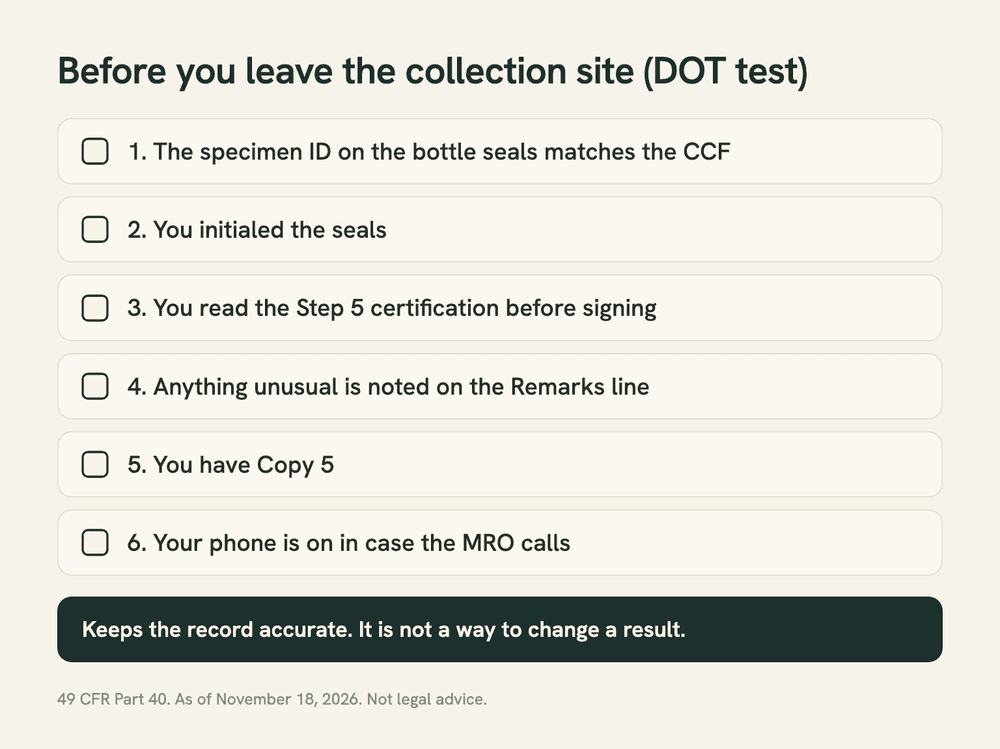
This is not a strategy for getting a result thrown out. It is how you make sure the record matches what actually happened, which protects you whichever way the result goes. In a DOT test:
- 1Check that the specimen ID number on the bottle seals matches the number on the CCF. A mismatch is one of the nine fatal flaws, and it is easiest to catch at the counter.
- 2Initial the seals once the collector has sealed the bottles. Your initials certify the bottles hold your specimen.
- 3Read the Step 5 certification before you sign, and fill in the information it asks for.
- 4If something unusual happened during the collection, ask the collector to note it on the Remarks line.
- 5Take Copy 5 with you and keep it until the matter is fully closed.
- 6Keep your phone on. If the result is not negative, the MRO may contact you before reporting it to your employer.
How the MRO review works, and what the lab screens for, is explained in our guide to what a 10-panel drug test checks. If the MRO tells you a DOT test was verified positive, the split specimen request rule, 49 CFR 40.171, gives you 72 hours from that notification to ask, verbally or in writing, for Bottle B to be tested at a second HHS-certified lab. A later request is allowed only for documented reasons, such as serious injury or illness, or not having actually been notified. There is no split testing for an invalid result. Under the split specimen payment rule, 40.173, your employer cannot make that test depend on you paying up front, though it may seek reimbursement from you afterward. And 40.13 bars an employer from setting aside a verified DOT positive because you bring a negative test from your own doctor or a DNA test questioning whose specimen it was. Outside DOT, the window and the process come from state law and your employer's policy; Minnesota's 3 working days is one example.
CBD, hemp and the chain of custody
If you use CBD or hemp products, it helps to know what chain of custody can and cannot do. It proves the specimen is yours and was not tampered with. It says nothing about where any THC in it came from. In a DOT test, the MRO verification rule, 49 CFR 40.151, bars the MRO from accepting use of "a hemp or other non-prescription marijuana-related product" as a reason to verify a marijuana result as negative. Full-spectrum hemp products can contain trace THC, and no product can guarantee a drug-test result. How products, labels and trace THC interact with testing is covered in our guide to CBD and drug tests.
What this guide cannot tell you
We read Part 40 in the eCFR text current as of November 18, 2026. Our links go to the 2025 annual edition of the Code of Federal Regulations, and none of the sections we cite was amended after that edition. We could not open the 2026 form itself, so we describe each step by what the regulation says happens there, not by the form's printed wording, and we leave out steps we could not verify from a primary text. We found no primary record of how often tests are cancelled, so we give no rate. State law varies widely, and Minnesota and Florida are examples, not a survey. If a specific result is in dispute, your union representative, HR or an employment attorney can tell you what applies to you.
Chain of custody drug test FAQ
A drug test whose specimen is documented from collection to result on a custody and control form, so it can be shown to be yours and untampered. DOT and federal agency tests must use the Federal Custody and Control Form (CCF) under 49 CFR 40.40. Private employers usually use a lab's own non-federal version.
In a DOT test, if you decline to sign, 49 CFR 40.79(a)(1) tells the collector to note it on the Remarks line and finish the collection, and once the refusal is noted there, the missing signature is not one of the flaws that can cancel the test. But 49 CFR 40.191(a)(8) treats failing to cooperate with any part of the testing process as a refusal to test, which DOT handles like a violation. Your signature certifies the form, not the result.
In a DOT test, it depends on the error. Nine listed fatal flaws in 40.199(b) cancel the test. A few problems, like a missing signature or the wrong form, are corrected under 40.203 and 40.205. Minor errors, like a typo in your ID number or a missing courier name, cannot cancel it under 40.209. Outside DOT, state law and the program's own rules decide.
No. Under 49 CFR 40.207(a), a cancelled test is neither positive nor negative. If you needed a negative for a pre-employment, return-to-duty or follow-up test, you have to test again before safety-sensitive work.
Copy 5. Under 49 CFR 40.79(a)(4), the collector gives it to you at the collection site. On an electronic CCF you still receive a legible copy. Keep it until any question about the test is closed.
No. 49 CFR 40.13(g) and 40.41(a) bar employers from using the Federal CCF for non-DOT testing, even with the DOT references crossed out. A company-policy test uses a separate non-federal form.
In a DOT test, 49 CFR 40.171(a) gives you 72 hours from the time the MRO notifies you of a verified positive, or of a refusal to test because of adulteration or substitution, and the request may be verbal or in writing. There is no split testing for an invalid result. Your employer cannot require you to pay first, though it may seek reimbursement later. Non-DOT tests follow state law and policy.
Chain of custody does not change how the lab analyzes the specimen. It documents that the specimen tested is yours and was not tampered with, which is what makes a result usable in a workplace or legal setting. Accuracy comes from the lab's screening and confirmation steps and the MRO review.
This is general information as of November 18, 2026, not legal advice. If you were just called in for a test, start with what happens after you are selected for a random test. For the wider picture on hemp, CBD and the law, our hub on whether CBD is legal is the place to begin.
Writing about hemp, wellness and the small rituals that keep us balanced.