Why Does Food Taste Better When High? What Studies Show
Most pages say THC sharpens your sense of smell. That finding is from fasted mice. In human trials, taste did not change and smell got slightly worse. What rises is the reward of rich food. Here is the evidence, graded by species.

Why does food taste better when you're high? Most pages answer with one 2014 study showing that cannabinoids sharpen the sense of smell. That study was done in fasted mice. When researchers tested people under blinded conditions, taste did not change and smell got slightly worse. What did rise was how much people liked, chose and ate rich, sweet food. The feeling that food tastes better is real and common. The evidence says it most likely lives in your brain's reward and expectation systems, not in sharper taste buds or a sharper nose.
This page takes the usual explanation apart one sense at a time, and it labels every finding with the species it came from: mouse, rat or human. It covers the pleasure side of eating while high, not hunger itself, and it describes an effect of THC, not of CBD. It is general information for adults 21 and over, not medical or nutrition advice, and not a reason to use cannabis.
Two different things people call the munchies
When people say food tastes better when they are high, they are often describing two separate experiences at once. A 2019 study in the Journal of Psychopharmacology asked 591 English-speaking and 163 Dutch frequent cannabis users, 754 in all, to rate 46 statements about eating while high, then used statistics to see which statements clustered together. Two clusters of 14 items each fell out. The researchers called one hedonic: items "related primarily to the enjoyment and altered sensory aspects of eating". They called the other appetitive: items "related to motivational factors that instigate or promote eating". Both scales held together strongly (a reliability score of 0.92 each, on a scale where 1.0 is perfect), and the result became a 28-item questionnaire. The authors summed it up like this:
“[Cannabis] principally influences the motivational factors that lead to the initiation of eating and the hedonic factors implicated in maintaining eating.”
That study validates a questionnaire built on what frequent users remember. It had no dose, no placebo and no control group, so it cannot show that cannabis causes either change. What it gives you is a map. Wanting to start eating is one thing; enjoying food more once you start is another. Almost every page on this topic blends the two. This article is about the second, the hedonic half. The drive to eat, including what research does and does not show for CBD, is covered in our guide to the munchies and whether CBD makes you hungry.
The split shows up in lab data too. In a 1988 residential laboratory study, six men lived in a research unit for 13 days and smoked either marijuana cigarettes containing 2.3% THC or placebo cigarettes. On marijuana days they ate about 40% more calories a day, yet calories eaten at meals did not change significantly: the extra calories came from more snacking occasions. A 2009 review of cannabinoids, food craving and food pleasure describes user reports the same way, as "strong cravings for, and an intensification of the sensory and hedonic properties of food". The real question is whether that intensification happens at the level of the senses. To answer it, you first need to know what the senses involved actually are.
Taste, smell and flavor are not the same sense
In everyday speech, "taste" means everything you experience when you eat. In biology it means something much narrower. A 2006 review in Nature of how taste receptors work describes distinct receptor cells on the tongue, each tuned to one of five basic tastes: sweet, sour, bitter, salty and umami. Everything else, the difference between a strawberry and a raspberry, or between toast and burnt toast, comes from other senses.
- Taste: five basic qualities detected by receptor cells in your taste buds (sweet, sour, bitter, salty and umami).
- Smell from outside: odors you sniff in through your nostrils, like coffee brewing in another room.
- Smell from inside: aromas that rise from your mouth to your nose as you chew and swallow. Most of a food's character lives here.
- Touch and temperature: crunch, creaminess, the heat of chili, the cool of mint.
- The brain's flavor system: where all of these are combined and tied to memory, emotion and expectation.
A companion 2006 Nature review by the neuroscientist Gordon Shepherd describes flavor as involving "almost all of the senses, particularly the sense of smell", and the brain's flavor system as "closely linked to systems for learning, memory, emotion and language." You will often read that 80% of taste is smell. Shepherd gives no such number and we could not find a solid source for it, so we will not repeat it. The plain version is enough: flavor is built mostly from smell, and it is processed by brain networks that also handle memory and emotion. One more distinction matters. The aroma of the cannabis plant itself comes from compounds called terpenes, which our guide to cannabinoids versus terpenes explains. This page is about something else: what THC does to your ability to perceive and enjoy the smell and taste of food.
That gives three places where cannabis could make food seem better: the tongue (taste), the nose (smell) or the brain (how rewarding the whole experience feels). The next three sections test each one, in that order.
Smell: the mouse study everyone cites, and the human test that disagrees
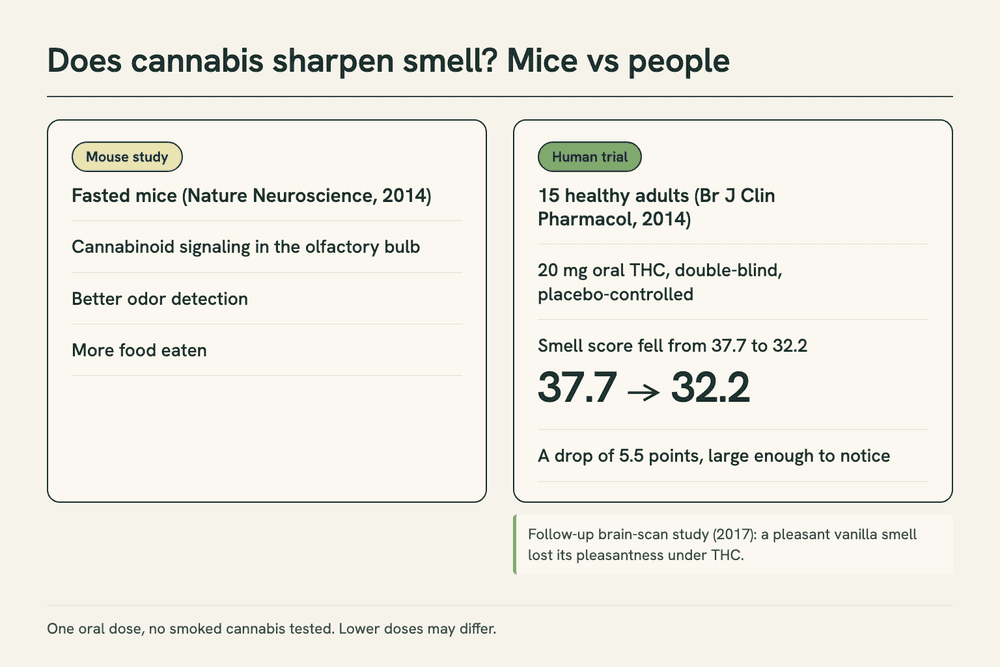
The smell explanation traces back to one well-designed experiment. In a 2014 Nature Neuroscience study from a team in Bordeaux, researchers worked with fasted mice and found that cannabinoid signaling in the olfactory bulb, the brain's first relay station for smell, made the animals better at detecting odors, and they ate more. In the authors' words, CB1 receptors "promote food intake in fasted mice by increasing odor detection." Both the body's own cannabinoids and cannabinoid drugs given by the researchers had this effect. It is careful work, and the headlines it produced were understandable. The catch is the species, and the fact that the mice were hungry to begin with.
Then researchers tested people. In a 2014 randomized, placebo-controlled, double-blind crossover trial, a team in Frankfurt gave 15 healthy adults (7 men and 8 women, average age about 27) either 20 mg of THC by mouth or a placebo, and measured their sense of smell 2 hours later with Sniffin' Sticks, a standard clinical smell test. It scores three things: how faint an odor you can detect, how well you tell odors apart and how well you identify them. Smell got worse, not better. People needed stronger odors before they noticed them and were less able to tell odors apart. The combined score fell by 5.5 points, a drop the authors describe as "known to be a subjectively perceptible impairment": the kind of change a person can notice.
The Frankfurt team offers a reason the human result might run opposite to the mouse result. The authors point out that CB1 receptors, plentiful in the olfactory bulb of animals, were not found in human olfactory bulbs "at either the mRNA or the proteomic level" in the studies they cite, which "may hint at a fundamental difference in the effects of cannabis on olfaction between humans and animals." That is their reading of earlier work, not something this trial measured, and they add that cognitive factors may also have contributed.
The same group followed up with brain imaging. In a 2017 placebo-controlled fMRI study, 15 healthy volunteers again took 20 mg of oral THC and smelled two odors: vanillin, which most people find pleasant, and hydrogen sulfide, the rotten-egg smell. Under THC, "the vanillin stimuli lost their pleasantness and became hedonically inert", and activity fell in brain areas tied to emotion and memory, including the amygdala and hippocampus. The rotten-egg smell was unaffected. So in the human data we have, THC did not make a pleasant smell more pleasant. It made it less so.
Before you conclude that weed dulls your nose, note the limits. Both trials used a single 20 mg oral dose in fewer than 20 people. That is a large dose: the Frankfurt authors point out that the approved starting dose of THC for appetite is 2.5 mg, and that their results "might not apply to these lower doses". Neither trial tested smoked or vaporized cannabis. The fair summary is that human evidence does not support the idea that THC sharpens smell, and the direct human tests we found point the other way.
Sweetness: why sugar seems to win
Ask people what they reach for when high and sweet things come up again and again. Even the 1971 lab report discussed below opens by noting older accounts of "a special craving for sweets". There is a tidy mechanism on offer, and again it comes from mice. In a 2010 PNAS study, researchers gave mice the body's own cannabinoids (anandamide and 2-AG) and recorded from their taste nerves. Responses to sweeteners rose "without affecting responses to salty, sour, bitter, and umami". The CB1 receptor sat on the same taste cells that carry the sweet receptor, and the effect vanished in mice bred without CB1. The hormone leptin, which signals that the body has energy stored, pushed the other way. Two cautions: this was in mice, and it tested the body's own cannabinoids, not THC.
In people, sweet taste itself has been measured, and it did not budge. At the Monell Chemical Senses Center in Philadelphia, a double-blind, placebo-controlled trial published in 1994 gave 57 light cannabis users, balanced by age and gender, an oral cannabinoid dose or a placebo, then had them rate the intensity and pleasantness of sweet, sour, salty and bitter foods at baseline and 2, 4 and 6 hours later. Two smaller arms added 11 people dosed by mouth, under the tongue or by cigarette, and 6 people dosed twice a day for 3 days. The verdict was blunt: "No effects of the drug were observed on taste responses." Saliva flow did fall as blood levels of the drug and ratings of feeling high rose, which is the effect our explainer on why weed makes your mouth dry covers.
The Monell team had a theory for why users still report that food tastes different: "Self-reported shifts in taste responsiveness and hedonics may be related to alterations of memory and cognition, rather than gustatory function." In plain terms, the tongue works the same; what changes is how the brain registers and remembers the experience. The study is more than 30 years old and its participants were light users, but it is the largest blinded human taste test we found.
What does change in people is what they choose. In the 1988 residential study, the extra snacks were mostly sweet solid foods: the authors describe the main increase as "sweet solid items, e.g., candy bars, compared to sweet fluid, e.g., soda, or savory solid items". And in a 1971 experiment at the Veterans Administration hospital in Palo Alto, 12 fasted volunteers drank chocolate milkshake after oral marijuana extract (an average of 32 mg THC) or placebo, then filled in an appetite questionnaire that asked them to rate the taste of the food, from "much worse than usual" to "much better than usual". Compared with their scores after placebo, 8 of the 12 scored higher after marijuana and 4 scored lower; the paper reports this as improved or diminished appetite. The fasted group drank more on average (731 vs 503 mL), but that difference was not statistically significant. A second group of 12 fed volunteers, given a slightly lower dose, did drink significantly more (777 vs 603 mL). In the author's words, "only slightly more than half of all subjects ate more food after marihuana than after placebo." The pull toward sweets is real in behavior, but the measurements point to choice and reward rather than a sweeter-tasting tongue.
Why food tastes better when high: reward, not sharper senses
If the senses are not sharper, the next place to look is the brain's reward system, and here the animal evidence is strongest. Researchers measure "liking" in rodents by filming their faces: a sweet taste triggers rhythmic tongue protrusions and lip licking, while a bitter taste triggers gapes and head shakes. Every number in the next two paragraphs comes from rats.
In a 2012 rat study, THC "increased the hedonic reactions to sucrose but did not affect the aversive reactions to quinine and NaCl", meaning the rats showed more liking for sugar water and no change toward bitter or very salty solutions. Blocking CB1 with a drug called rimonabant cancelled the effect. An earlier rat study from 2005 found the boost to sugar appeared only when low-dose THC was given 120 minutes beforehand, and a CB1 blocker reversed it there too. Most recently, a 2026 study of 24 male rats gave THC in a cookie at 0.05 or 0.5 mg/kg and found that the higher the dose, the more liking reactions the rats showed to sugar water (and to alcohol). Unlike the 2012 study, it also found less aversion to bitter quinine, so the rat record is not uniform on bitterness. On sweetness, it is consistent.
The body's own cannabinoids do this too. In a 2007 rat study from Kent Berridge's lab, a microinjection of anandamide into a hedonic hotspot in the nucleus accumbens, a patch of tissue smaller than a pea, "doubled the number of positive 'liking' reactions elicited by intraoral sucrose, without altering negative 'disliking' reactions to bitter quinine." This is one root of the wanting versus liking idea: dopamine drives the pull toward a reward, while small hotspots like this one help generate the pleasure itself. Our explainer on why weed makes you laugh walks through that split and why calling dopamine the pleasure chemical is misleading. If CB1 and anandamide are new terms, start with how the endocannabinoid system works.
Human evidence for the reward explanation is thinner, but it exists. In a 2019 Belgian trial of 17 healthy adults, people took oral THC or placebo (the trial registry lists dronabinol at 0.1 mg/kg) and rated pictures of food. THC raised "liking" (P = 0.031) and "wanting" (P = 0.0096) ratings for pictures of high-calorie food, but not for low-calorie food. Then came a clever second test. Participants drank more milkshake after THC when they drank it normally (P = 0.0005), but not when the same milkshake was infused straight into the stomach through a tube. The extra intake depended on the food passing through the mouth, where taste and smell happen. Ghrelin, often called the hunger hormone, actually went down under THC before the milkshake. The trial was single-blind (participants did not know which they got, but the researchers did), it was small, and the liking ratings were of pictures, not food people tasted.
One more mouse finding shows why reward and eating are so tangled together. In a 2015 Nature study, activating CB1 in sated mice switched hypothalamic neurons normally linked to fullness into releasing beta-endorphin, one of the body's own opioids, and blocking opioids with naloxone stopped the extra eating. That is about the drive to eat, which belongs to the appetite side of the story, but it shows how closely cannabinoid and opioid reward signals are wired into feeding, at least in mice.
The evidence, graded by species
Here is every main study from this article in one place, with the species, what was actually measured and whether anyone tested taste or smell directly. Read down the last column and the pattern is clear: where taste or smell was measured directly in people, it either did not change or got worse. What rose in people was liking, wanting, snacking and sweet choices.
| Study | Species | Who and dose | What was measured | Result | Taste or smell tested directly? |
|---|---|---|---|---|---|
| Soria-Gómez 2014 | Mouse | Fasted mice; cannabinoid drugs and genetic tools | Odor detection, food intake | Better odor detection, more eating | Smell, yes (in mice) |
| Yoshida 2010 | Mouse | Body's own cannabinoids (anandamide, 2-AG); mice without CB1 | Taste nerve signals | Sweet signals up; salty, sour, bitter and umami unchanged | Taste nerves, yes (in mice) |
| Koch 2015 | Mouse | Sated mice; CB1 activator | Hypothalamic feeding circuit | Beta-endorphin release; extra eating blocked by naloxone | No |
| De Luca 2012 | Rat | Systemic THC | Facial liking reactions | More liking of sugar; bitter and salty unchanged | Reactions to taste (in rats) |
| Laux and Cain 2026 | Rat | 24 male rats; THC cookie, 0.05 or 0.5 mg/kg | Facial liking reactions | Dose-dependent rise for sugar; less aversion to bitter | Reactions to taste (in rats) |
| Hollister 1971 | Human | 12 fasted + 12 fed volunteers; oral extract, mean 32 mg and 26 mg THC | Milkshake intake; one taste rating | Taste questionnaire: 8 of 12 scored higher than on placebo, 4 lower; intake up significantly only in the fed group | One questionnaire item |
| Foltin 1988 | Human | 6 men, 13 days in a residential lab; 2.3% THC cigarettes | Calories and food choice | About 40% more calories, all from snacks, mostly sweet solids | No |
| Mattes 1994 | Human | 57 light users, double-blind, oral (plus 11 by three routes, 6 over 3 days) | Taste intensity and pleasantness | No change for sweet, sour, salty or bitter | Taste, yes |
| Walter 2014 | Human | 15 healthy adults; 20 mg oral THC; double-blind crossover | Sniffin' Sticks smell test | Score fell 5.5 points (37.7 to 32.2) | Smell, yes |
| Walter 2017 | Human | 15 healthy adults; 20 mg oral THC; fMRI | Smell pleasantness and brain response | Vanilla lost its pleasantness; rotten-egg smell unchanged | Smell, yes |
| Weltens 2019 | Human | 17 healthy adults; single-blind; registry lists 0.1 mg/kg dronabinol | Liking of food pictures; milkshake intake | Liking up for high-calorie pictures only; more milkshake only by mouth | Pictures, not tasted food |
| Roberts 2019 | Human survey | 754 frequent users; no dosing | Self-reported eating experiences | Two separate factors: hedonic and appetitive | Self-report only |

Hunger, expectation and company do part of the work
Some of what makes food taste better when you're high would happen without any cannabis. In a 1971 paper in Science, the physiologist Michel Cabanac proposed the word alliesthesia for a pattern seen in temperature, taste and smell experiments: "A given stimulus can induce a pleasant or unpleasant sensation depending on the subject's internal state." The same sweet taste is more pleasant when you are hungry than when you are full. If you are high late at night and have not eaten for hours, hunger alone is turning the pleasure up.
Expectation matters too. In a 2008 Caltech brain-scan study, 20 people tasted wines labeled with different prices, without knowing that some of the pairs were identical. They rated the same wine as more pleasant when told it cost $90 rather than $10 (and $45 rather than $5), and activity in the medial orbitofrontal cortex, a region that tracks pleasantness, rose with the price tag. Nobody in that study was high. The point is that the brain's flavor system is built to be swayed by what you expect, and "everything tastes amazing when you're high" is a strong expectation to bring to the table.
Setting plays a part as well. In a 1986 residential lab study of 9 men, a single marijuana cigarette smoked before a private work period had no effect on food intake, while two or three smoked during social time did raise daily calories, again through snacks between meals rather than bigger meals. The 1971 Palo Alto paper raised the same point decades earlier: its author warned of "the distinct possibility of a positive bias toward reports of enhanced hunger and appetite following marihuana", because volunteers could easily tell when they had taken the drug, and suggested that in social groups marijuana "may have the effect of increasing suggestibility." Put that next to the Monell team's memory-and-cognition hypothesis and a picture forms: hunger, expectation, company and shifts in attention may each add to the feeling, on top of whatever THC does to reward.
Why CBD is a different story
Everything above concerns THC, which switches on the CB1 receptor. CBD works differently. In a 2015 cell study in the British Journal of Pharmacology, CBD "behaved as a non-competitive negative allosteric modulator of CB1 receptors": rather than switching the receptor on, it turned the receptor's response down. That is a cell-line result, not a human taste test, but it is why there is no expected route from CBD to the THC-style effects on food described here. We found no evidence that CBD makes food taste better. What human trials show about CBD and appetite is in the CBD and hunger guide. And if you are wondering whether food tasting better means your CBD is working, our guide to telling whether CBD is working explains why that is not a useful sign.
One label fact belongs here, because it is often stretched. Synthetic THC is an FDA-approved prescription drug called dronabinol. The MARINOL prescribing information lists "anorexia associated with weight loss in patients with Acquired Immune Deficiency Syndrome (AIDS)" among its indications, with a starting dose of 2.5 mg twice daily. That approval covers a prescription drug in a specific medical condition. It says nothing about healthy people, and nothing about hemp products, where full-spectrum CBD extracts carry only trace THC, below 0.3% by dry weight.
How to read the next "weed makes food taste better" headline
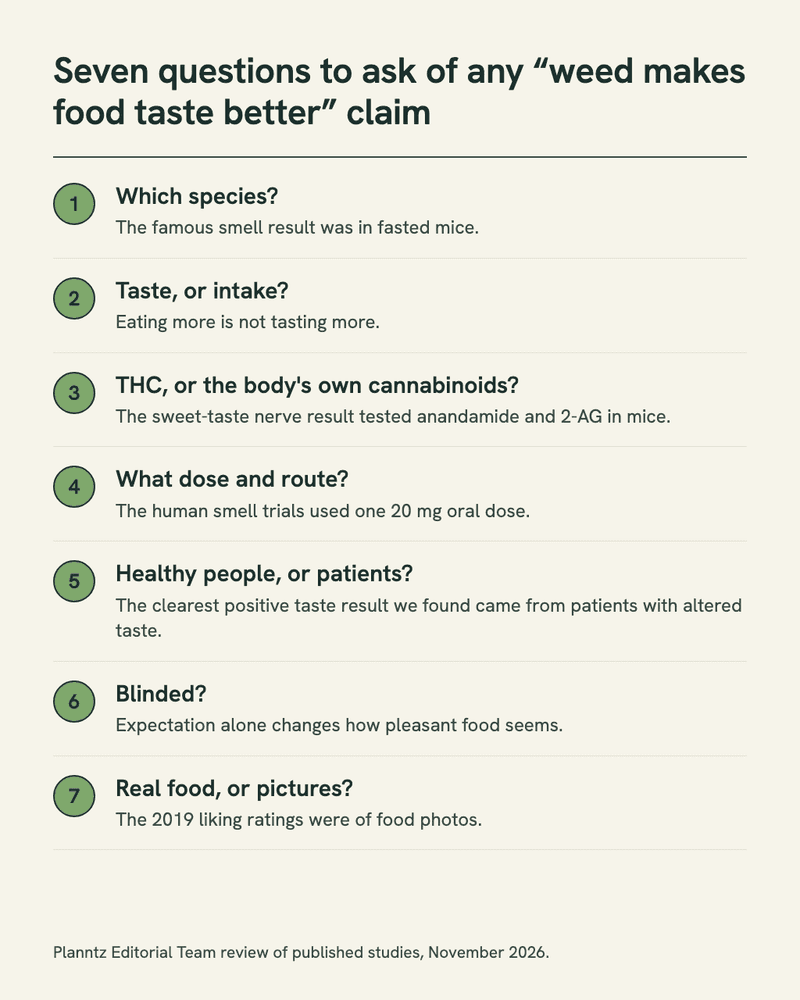
The studies in this article disagree less than they first appear to. Most of the confusion comes from mixing up species, measures and molecules. Before you trust a claim about cannabis and taste, run it through these seven questions.
- 1Which species? Mouse and rat findings show a possible mechanism, not what happens in your mouth.
- 2Was taste or smell measured, or food intake? Eating more is not the same as tasting more.
- 3THC, or the body's own cannabinoids? Several well-known results tested anandamide or 2-AG, not THC.
- 4What dose and route? A single 20 mg oral dose in a lab says little about a lower dose or about smoking.
- 5Healthy volunteers or patients? People whose taste is already disrupted by illness are a different population.
- 6Blinded or not? Expectation alone can change how pleasant food seems.
- 7Real food or pictures? Liking a photo of a burger is not the same as tasting one.
Question five matters for the clearest positive human taste result we found. In a 2011 randomized, double-blind pilot trial in patients with advanced cancer whose taste and smell were already altered, those given low-dose dronabinol reported that food "tasted better" more than those on placebo did, a difference that reached statistical significance. Only 21 patients completed the 18-day trial, the outcomes were self-reported, and it was a prescription drug in seriously ill people. It tells you nothing about healthy people, and it is a clear example of a real finding that gets stretched into a general claim.
What is still unknown
We found only a handful of controlled human experiments that measured taste, smell or food pleasure directly under THC, each with 12 to 57 participants. None of them was done with smoked cannabis at real-world potency in a home setting. That leaves real open questions. We do not know whether lower doses, or inhaled cannabis, affect smell the way 20 mg by mouth did. We do not know whether frequent users respond differently from the light users and healthy volunteers these trials enrolled. And the long-term picture is thin: a cross-sectional analysis of 2,808 US adults aged 40 and over found that current marijuana users rated a bitter solution as weaker on the tip of the tongue than people who had never used it, but a one-time survey like that cannot show cannabis caused the difference. For a broader technical overview, a 2019 review of cannabinoids and the chemical senses summarizes the animal and human work on taste and smell.
What the evidence does support is narrower than page one suggests, and more interesting. The tongue seems to work the same. The nose, at least at one high oral dose, works slightly worse. What changes is the brain's valuation of rich, sweet food, helped along by hunger, expectation and company. The food does not taste different so much as it matters more.
Questions people ask about food and getting high
Not in blinded human testing. In a 1994 double-blind trial of 57 adults at the Monell Chemical Senses Center, cannabinoid dosing did not change how intense or pleasant sweet, sour, salty or bitter foods tasted. The boost to sweet-taste signals that many pages cite comes from mouse studies of the body's own cannabinoids, not THC.
In fasted mice, cannabinoid signaling made the animals better at detecting odors. In a double-blind trial of 15 healthy adults, 20 mg of oral THC lowered smell test scores by an amount people can notice, and a follow-up found a pleasant vanilla smell lost its pleasantness. Lower doses and smoked cannabis were not tested in those trials.
In a residential lab study, men who smoked marijuana ate about 40% more calories a day, mostly as sweet solid snacks like candy bars. In rats, THC increases liking reactions to sugar, and in mice the body's own cannabinoids boost sweet-taste nerve signals. In people, sweet taste itself did not change, so the pull toward sweets looks like reward and choice rather than a sweeter tongue.
We found no evidence of a permanent change. A national survey of 2,808 US adults aged 40 and over found current users rated a bitter solution as weaker on the tip of the tongue than never-users, but a one-time survey cannot show that cannabis caused it.
We found no study showing that it does. CBD does not switch on the CB1 receptor the way THC does; in cell studies it turns that receptor's response down. A change in how food tastes is also not a useful sign of whether CBD is working for you.
No. A 2019 survey of 754 frequent users found their experiences split into two separate clusters: an appetitive one (wanting to start eating) and a hedonic one (enjoying food more and noticing it differently). This page covers the hedonic side; hunger itself is covered in our guide to CBD and the munchies.
We found no trial designed to answer that. In the small route arm of the 1994 Monell study, 11 people took the drug by mouth, under the tongue or by cigarette, and taste did not change by any route.
If you want the wider map behind this page, including how THC, CBD and the minor cannabinoids differ at the receptor level, start with our guide to what cannabinoids are and how they work.
Writing about hemp, wellness and the small rituals that keep us balanced.