What Is THC-JD? The 8-Carbon THC, and What Testing Actually Found
THC-JD is on vape and gummy labels and almost nowhere in the scientific record. Here is the molecule, where it sits on the THC homolog ladder, what three studies of real products found, and where the 19-times figure came from.
If you have seen "THC-JD" on a vape or gummy label, you have met a molecule that is easy to name and hard to find. It is real chemistry: THC with a longer tail. But the research behind it is thin enough to count on one hand, and the labs that tested products sold under the name did not always find it inside.
The short answer: THC-JD is the label name for THC with an eight-carbon side chain in place of THC's five, and it comes in delta-8 and delta-9 forms. Chemists call it tetrahydrocannabioctyl, or THC-C8. Two research groups say it occurs in hemp in trace amounts at most; we could not find a published measurement of it in a cannabis plant, and what is sold is made. No published study has given it to a person. When a US lab tested five products labeled THC-JD, none of them contained it. Planntz does not make or sell THC-JD. This page is an explainer, not medical or legal advice, and every count in it is dated November 26, 2026.
What is THC-JD? The molecule in plain terms
THC is built from three fused rings with a five-carbon tail, called a pentyl side chain, attached at position 3 (C-3). THC-JD keeps the rings and swaps that tail for an eight-carbon one, an octyl chain. Its systematic chemical name differs from THC's in one word: octyl instead of pentyl. That adds three CH2 units, 42 mass units: a molecular weight of 356.5 against THC's 314.5. You can check the record yourself in PubChem's entry for delta-9-THC-C8, which lists "Delta9-THC-JD" among its synonyms.
The name on a label covers two compounds. A 2026 analytical paper from Portland State University puts it plainly: "THC-JD refers to both Δ8-THC-JD and Δ9-THC-JD". The two differ only in where one double bond sits in the ring, the same difference that separates delta-8-THC from delta-9-THC. The UN Office on Drugs and Crime's early-warning database lists THC-JD as one of the names of delta-9-tetrahydrocannabinol-C8 and files it under the substance group "Synthetic cannabinoids". That is a monitoring category, not a legal status. As for the letters, we found no primary source for what "JD" stands for, so we will not repeat the guesses.
Where THC-JD sits on the side-chain ladder
THC belongs to a family of homologs: molecules that share the same ring system and differ only in a side chain that grows one carbon (one CH2 unit, 14 mass units) at a time. THCV, at the short end, has three carbons. THC has five. THCP, the molecule we profile in our comparison of THCP and CBD, has seven. THC-JD has eight. Four-carbon and six-carbon versions, sold as THCB and THCH, fill the gaps.
| Label name | Side-chain carbons | Word in the systematic name | Formula | Molecular weight |
|---|---|---|---|---|
| THCV | 3 | propyl | C19H26O2 | 286.4 |
| THCB | 4 | butyl | not listed here | not listed here |
| THC (delta-9) | 5 | pentyl | C21H30O2 | 314.5 |
| THCH | 6 | hexyl | not listed here | not listed here |
| THCP | 7 | heptyl | C23H34O2 | 342.5 |
| THC-JD | 8 | octyl | C24H36O2 | 356.5 |
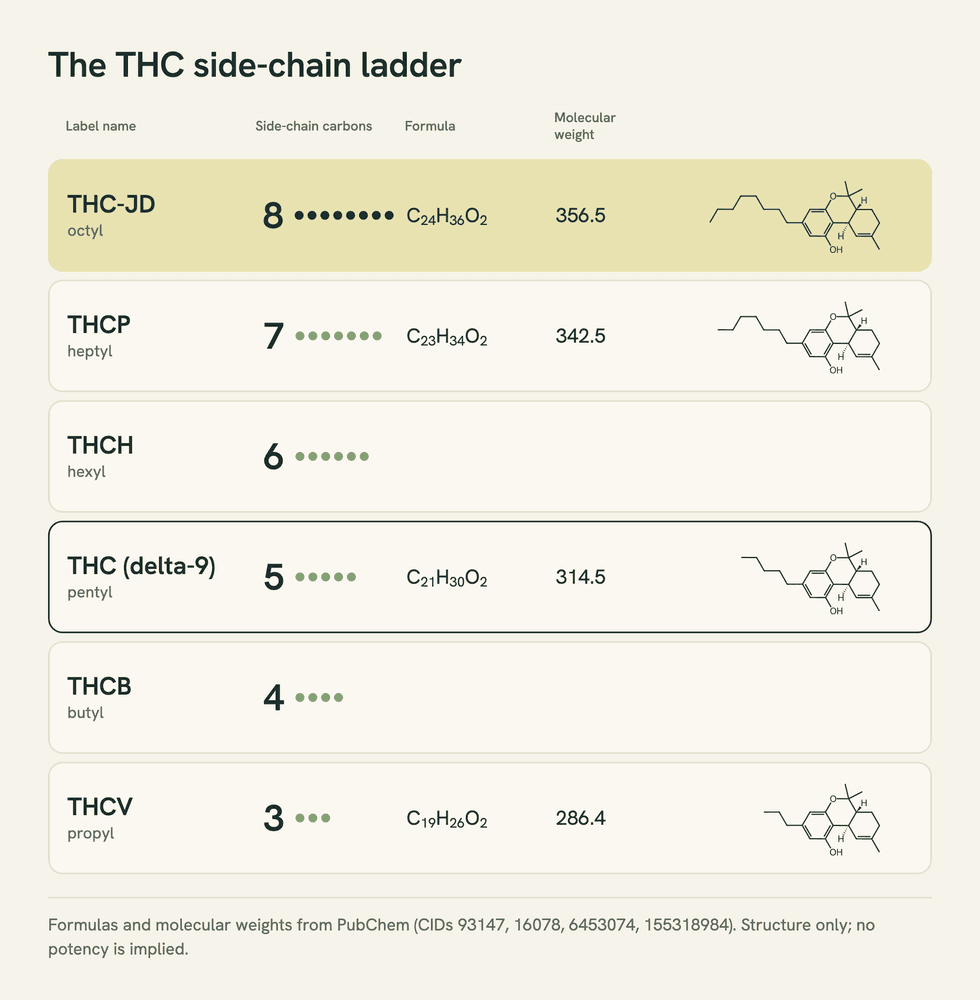
Why no potency column? Because the numbers people attach to this ladder were measured on other rungs. THCP's receptor figures come from experiments on THCP and say nothing measured about an eight-carbon molecule. Chain length does change how these molecules behave at the CB1 receptor, as the cell studies further down show, but the change is not a straight line you can extend by one carbon and read off. A rung on the ladder is a structural fact. How a rung behaves in a person is a separate question, and for THC-JD no published study has asked it yet.
Is THC-JD natural, or made?
Two research groups have said, in passing, that it occurs in hemp in trace amounts at most. The Portland authors write that THC-JD is "present in just trace amounts in hemp and thus needs to be synthesized", without a citation. The Japanese team behind a 2024 study of THC analogs in oils sold online writes, of the six- and eight-carbon homologs together, that there are no reports of isolation from nature, or only trace detection. Our PubMed search on November 26, 2026 found no paper that measured an octyl THC homolog in a cannabis plant. Longer-chain THC homologs are not new to chemistry, either: they were being synthesized and tested in the 1940s (Adams and colleagues, Journal of the American Chemical Society, 1942, doi:10.1021/ja01255a061).
What reaches a shelf is made, and the physical evidence in both product studies points that way. In the Japanese oils, the analysts read two minor compounds, Δ4(8)-iso-THCV and Δ11-THCB, as "reaction byproducts of the synthesis". In the US products, the Portland team identified "precursors used for THC synthesis such as resorcinol and olivetol", indicating, in the authors' words, "that THC analogs in the samples were potentially synthesized and not obtained and purified from plant material." Note the word potentially: it is theirs, and we keep it.
What testing real THC-JD products found
Three studies have looked at THC-JD as it is actually sold. Two put products through a lab. One counted how often the name appears on product listings. Together they are the whole published record, and the table gives each its real sample size.
| Study | Where and when | What was examined | Method | What it found | Main limit |
|---|---|---|---|---|---|
| Munger et al., Cannabis, 2026 (Portland State University) | United States, bought online | 5 products labeled THC-JD: 4 disposable vapes and 1 wax dab | GC-MS against a purchased delta-8-THC-JD reference standard | No THC-JD in any of the 5. Delta-8-THC was the most prevalent compound in 4 of the 5 | 5 products, 1 lab |
| Tanaka and Kikura-Hanajiri, Yakugaku Zasshi, 2024 (Japan's National Institute of Health Sciences) | Japan, oils bought online in 2022 and 2023 | 5 oil products | GC-MS, LC-MS and NMR | Delta-8- and delta-9-THC-JD both identified, in 1 of the 5 products. The other 4 held three-, four- and six-carbon homologs instead | 5 products, 1 market, identification rather than amount |
| Rossheim et al., Cannabis and Cannabinoid Research, 2024 | United States, 3 top-trafficked retail sites, May to August 2023 | 804 product listings from 118 brands | Content analysis of listings | THC-JD named on 55 listings, the 9th most common of 26 intoxicating compounds | Listings, not lab results |
Read across the rows and a pattern appears. The name is common: it was the ninth most listed intoxicating compound in a 2024 survey of 804 products on three major US retail sites, where 54% of products were blends of two to eight compounds. Yet the two labs that went looking found the molecule in 1 of 10 products between them. The Portland result, and what it means for other new acronyms, is told in full in our explainer on PHC and the label test, so we will not repeat it here. The Japanese result is the counterweight: THC-JD is not a fiction, and NMR, the method that settles a structure, confirmed both forms in an oil bought online. Ten products in two countries is not a market survey. It is enough to say that a THC-JD label, on its own, does not tell you what is in the product.
Where the "19 times" figure comes from, and what was actually measured
If you have read about THC-JD anywhere other than a journal, you have probably met a multiplier, most often 19. We traced it. The Portland paper repeats it in its introduction, attributing it to a 2022 industry source. That source is a 2022 white paper, "Pandora's Box", from the California Cannabis Industry Association, a trade group, which says THC-JD "is reportedly 19 times more intoxicating than THC" and footnotes that to an August 3, 2022 LA Weekly article that no longer loads (checked November 26, 2026). So the chain runs from lifestyle web copy, to an industry white paper, to a journal introduction. No binding assay, animal study or human study sits under the number, and no experiment we could find produced it.
Laboratory data for the eight-carbon molecule do exist. None of it involves a person. The oldest is a 1999 mouse study of THC side-chain variants in the Journal of Pharmacology and Experimental Therapeutics, which included octyl and nonyl side chains and concluded that the side chain "plays a crucial role in the activation of the cannabinoid receptor". The Japanese team cites it for delta-8-THC-JD lowering body temperature and movement, and dulling pain responses, in mice. Mice, 1999, and a paper we could read only in abstract. Next, a 2024 cell assay of thirty THC variants in Archives of Toxicology found the eight-carbon homolog among several that "showed higher potential for CB1 activation than Δ9-THC, based on either higher efficacy (Emax) or higher potency (EC50)", in one signaling pathway (beta-arrestin2 recruitment). Most recently, a 2026 receptor-signaling study in Molecular Neurobiology compared three- to eight-carbon homologs of delta-9-THC, delta-8-THC and HHC in cells and reported that "side-chain elongation was the dominant determinant of signaling efficiency, producing progressive potency gains that peaked for C7-C8 homologs". The same compounds stayed partial agonists on a second pathway, and the three-carbon versions acted as CB1 antagonists.
Put those together carefully. In cells, longer side chains up to seven or eight carbons pushed CB1 signaling up. That is the most the data can carry. It is not a statement about a person, an amount or a product, and "peaked for C7-C8" does not rank eight carbons above seven. Chain length is not a universal upgrade, either: a 2024 cell study comparing CBD with its seven-carbon homolog CBDP found that "the heptyl chain of CBDP does not improve the reported activities of CBD". And the Portland authors are blunt about what is missing: "There are no substantive toxicological studies of THC-JD published to date."
What a COA can and cannot show about THC-JD
A certificate of analysis (COA) reports the cannabinoids its lab was asked to measure, and a standard potency panel runs a fixed list. THC-JD is rarely on it. To quantify a compound, a lab needs a reference standard: a certified sample of the pure molecule to compare against. One exists. The DEA's May 22, 2023 exempt chemical preparations notice lists laboratory reference solutions of delta-8-THC-C8 and delta-9-THC-C8 in its approved chart, and the Portland team bought a delta-8-THC-JD standard for their test. So a lab can measure THC-JD when someone asks it to.
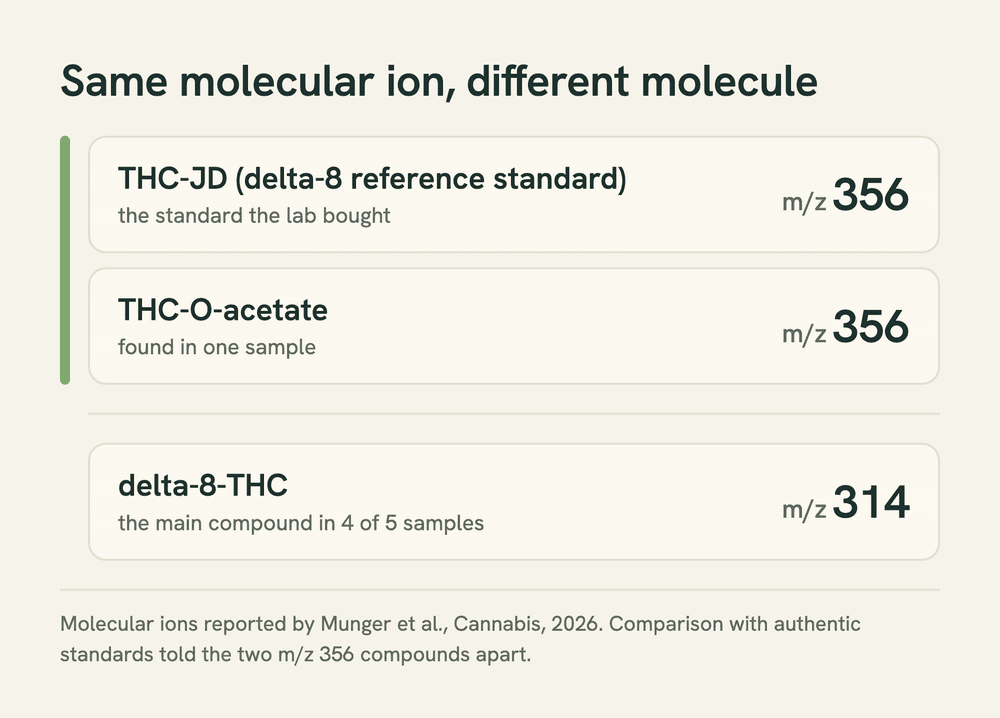
The Portland paper also holds the clearest lesson on why that standard matters. Their THC-JD standard showed a molecular ion of m/z 356, against 314 for delta-8-THC. One sample did contain a molecule with the same molecular ion as THC-JD, m/z 356. It was THC-O-acetate, which the team "unambiguously identified" by comparing it with an authentic standard. Two different molecules, one nominal mass: matching on that number alone would not have told them apart, and the reference standards did. THC-O-acetate has its own profile in our page on THC-O.
- 1A THC-JD line with a number and a unit. A word in the marketing copy, or a line that only says "present", is not a measurement.
- 2The form named: delta-8-THC-JD, delta-9-THC-JD, or both. They are two compounds, and a careful lab reports them separately.
- 3A stated method and a reference standard. Look for the technique (for example GC-MS or LC-MS) and a statement that results were compared against a certified THC-JD standard.
- 4The rest of the panel. If delta-8-THC or THC-O-acetate dominates, that is what the product mostly is, whatever the front of the package says.
- 5The lab's name and accreditation, and a batch code that matches the one printed on the product in front of you.
Those are ordinary COA habits applied to an unusual analyte, and our step-by-step guide to reading a certificate of analysis line by line covers the rest. Planntz publishes a COA for every batch of its CBD tinctures on its lab results page for the same reason: a claim about what is in a bottle is only as good as the document behind it.
Is THC-JD legal? The record, dated November 26, 2026
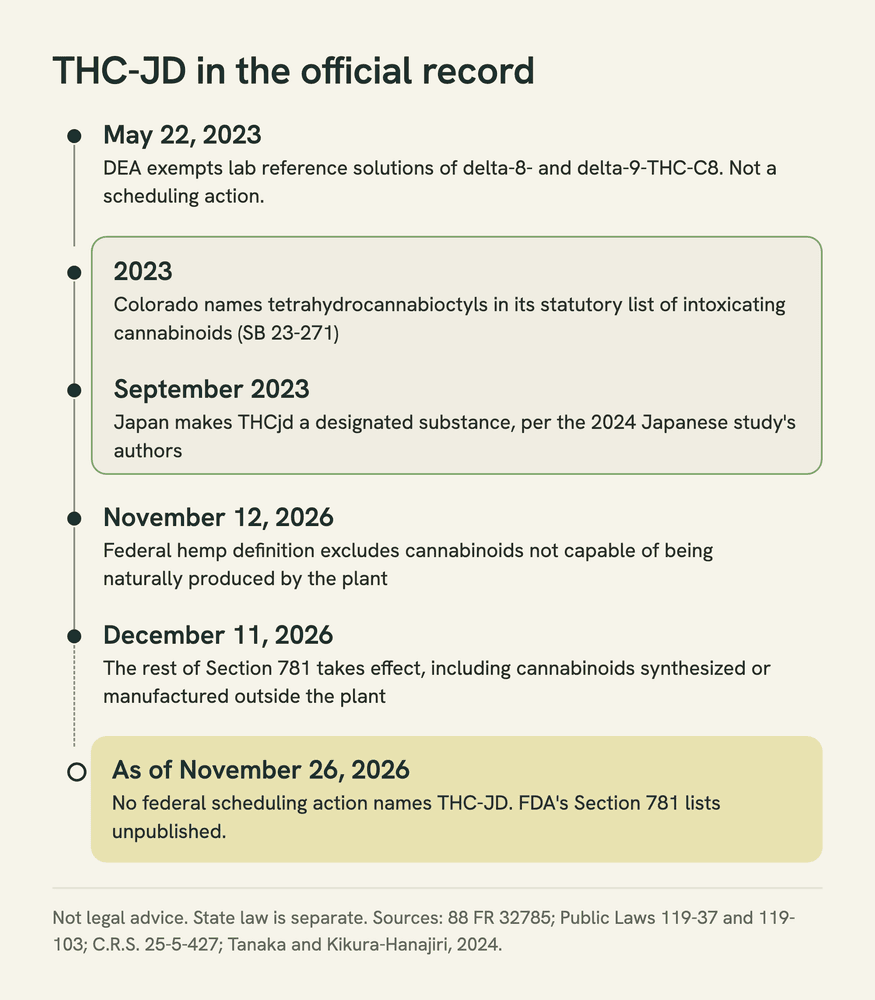
This is not legal advice, and every line below carries a date. Start with the federal record. A Federal Register full-text search on November 26, 2026 found no document naming tetrahydrocannabioctyl, THC-JD or THCjd. The one document naming THC-C8 is the DEA reference-standard notice above, an exemption order for laboratory solutions, not a scheduling action. The Schedule I entry for tetrahydrocannabinols at 21 CFR 1308.11(d)(31) covers "synthetic substances, derivatives, and their isomers with similar chemical structure and pharmacological activity" and excludes material that falls within the federal hemp definition. Whether an eight-carbon homolog fits that wording is a legal question, and we are not answering it.
- Since November 12, 2026: the parts of Section 781 of Public Law 119-37 in force exclude cannabinoids "not capable of being naturally produced by a Cannabis sativa L. plant".
- Until December 11, 2026: Section 2019 of Public Law 119-103 limits Section 781 to those two subclauses.
- On December 11, 2026: the rest takes effect, including the exclusion for cannabinoids "synthesized or manufactured outside the plant", a total-THC basis and a 0.4 mg per container figure.
- As of November 26, 2026: FDA has not published the cannabinoid lists that Section 781 calls for.
- 2023, Colorado: the legislature wrote tetrahydrocannabioctyls by name into its statutory list of intoxicating cannabinoids (SB 23-271, C.R.S. 25-5-427).
- September 2023, Japan: according to the authors of the 2024 Japanese study, THCjd was made a "designated substance" together with THCB, THCH, THCP and delta-8-THCV.
The federal texts are Public Law 119-37, Section 781, and the enrolled H.R. 6500 that became Public Law 119-103. The first bullet is where THC-JD's open question bites. Whether it is "capable of being naturally produced" by the plant is exactly the question the natural-or-made section left open: two groups assert trace amounts, and we found no published measurement. We are not going to resolve it here. The wider mechanics live in what "hemp-derived" actually means for THC and our dated explainer on the December 11 hemp deadline.
Will THC-JD show up on a drug test? What has and has not been measured
We found no published data on how a standard drug-test screen responds to THC-JD (PubMed, November 26, 2026). Screening tests are immunoassays built around THC's carboxylic acid metabolite, and how a homolog registers depends on how its own metabolites react with the test's antibodies. For THC-JD we found no measurement of that. The nearest published figure belongs to the seven-carbon homolog, which we cover in what is known about THCP and drug screens, and that figure stays with THCP.
Confirmation testing is a different tool. A 2025 method from the Armed Forces Medical Examiner System can qualitatively confirm THC-C8 in blood and urine by LC-MS-MS, with a limit of detection of 1 ng/mL for the non-carboxylated compounds. That is a specialist forensic method, not the screen an employer runs, and its authors note that human pharmacological data are lacking. One practical point is less exotic: in the Portland test, four of the five products sold as THC-JD were mostly delta-8-THC, a compound with its own, better-studied drug-test record, covered in how delta-8 shows up on drug tests. We are not predicting a result in either direction.
What is still unknown about THC-JD
Counted on November 26, 2026, the gaps are larger than the record. That puts THC-JD alongside delta-11-THC, which also has no published human study, and a long way from the liver metabolite 11-hydroxy-THC, which every person who uses THC makes and which has been measured in people for decades.
- What it does in people, at what amount and for how long: 0 published human studies.
- Toxicology: no substantive studies, in the Portland authors' words.
- Human metabolism: no published metabolite profile.
- Dependence and long-term effects: not studied.
- Drug-test screens: no published cross-reactivity data.
- Receptor binding: a 1999 paper reports data we could read only in abstract, so we print no number.
- What is actually on sale: 10 products tested in labs worldwide, 1 of which contained it.
THC-JD is the label name for THC with an eight-carbon (octyl) side chain in place of THC's five-carbon one. It comes in delta-8 and delta-9 forms, both with the formula C24H36O2 and a molecular weight of 356.5. Chemists call it tetrahydrocannabioctyl or THC-C8, and the UN Office on Drugs and Crime files it under synthetic cannabinoids. We found no documented source for what the letters JD stand for, so treat it as a trade name.
Two research groups say it occurs in hemp in trace amounts at most, but we could not find a published measurement of it in a cannabis plant (PubMed search, November 26, 2026). What is sold is made. Japanese government analysts found byproducts they read as signs of synthesis, and the Portland team found synthesis precursors such as resorcinol and olivetol in the products they tested.
No one can say, because no human study has been published (PubMed, November 26, 2026). The popular 19-times figure traces to a 2022 trade-association white paper that cited a lifestyle article now offline, not to an experiment. The closest receptor measurements are in cells: one 2026 panel found receptor signaling rose with side-chain length and peaked at seven to eight carbons, and a 2024 panel placed the eight-carbon homolog among several that activated CB1 more than delta-9 by at least one measure. Those are results in a dish, not about people or products, and they do not rank THC-JD above THCP.
They share the eight-carbon side chain and differ in where one double bond sits in the ring, the same difference that separates delta-8-THC from delta-9-THC. They are separate compounds, with separate chemical database records and separate laboratory reference standards. The 2024 Japanese study identified both in the same oil product. Neither has been studied in people, so there is no evidence-based way to compare how they act.
There is no single answer, and this is not legal advice. As of November 26, 2026, no federal scheduling action names THC-JD. The federal hemp definition changed on November 12, 2026 and changes again on December 11, 2026, and whether it reaches THC-JD turns on unresolved questions, including whether the molecule is capable of being naturally produced by the plant. Colorado's legislature named tetrahydrocannabioctyls as intoxicating cannabinoids in 2023, and Japan made THCjd a designated substance in September 2023, according to the Japanese researchers. State law applies on top of federal law.
We found no measurement. No published study we could find (PubMed, November 26, 2026) reports how standard immunoassay screens respond to THC-JD, so a confident yes or no is a guess. A 2025 military forensic method can confirm THC-C8 in blood and urine, but that is a specialist lab tool, not a workplace screen. Separately, in the one US lab test of products sold as THC-JD, four of five were mostly delta-8-THC, which has its own, better-studied drug-test record.
Only a certificate of analysis can show it. Look for a THC-JD line with a number and a unit, the form named (delta-8, delta-9 or both), a stated method run against a certified THC-JD reference standard, the lab's name and accreditation, and a batch code that matches your package. The Portland study shows why the standard matters: one sample held a molecule with the same molecular ion as THC-JD (m/z 356) that turned out to be THC-O-acetate.
THC-JD is one rung on a ladder of THC homologs, and the rest of the family, from the major cannabinoids to the minor ones, is mapped in our guide to what cannabinoids are. Whatever acronym appears on the next label you pick up, the useful question stays the same: is there a quantified line for it on a certificate from a named, accredited lab, matched to your batch? If you want to practice that habit, our COA walkthrough is the place to start.
Writing about hemp, wellness and the small rituals that keep us balanced.