What Is THC-X? A Label Name, Not a Molecule
THC-X is on product labels, but no paper identifies a molecule by that name. Here are the three definitions in circulation, what the one certificate on record showed, and what the 2026 hemp law and drug tests mean for it.

THC-X, also written THCX, turns up on product labels and in seller copy that describes its effects in confident detail. Look for it in the chemistry literature and you find something odd: no published paper identifies a molecule called THC-X. The honest answer to "what is it?" starts with that gap.
The short answer: THC-X is a name printed on labels, not a cannabinoid chemists have identified. No peer-reviewed paper describes a single molecule called THC-X, and the sources that try to define it disagree. The most traceable version is one seller's proprietary blend of three esters made from delta-8 THC. Other web pages call it rebranded delta-10, or a fluorinated delta-9. The one certificate of analysis on record for a THC-X product showed mostly delta-8 THC, delta-8 THC-O and THCP. No study has given THC-X, or any of the esters it is said to contain, to a person. Planntz does not make or sell THC-X; this page is an explainer, not medical or legal advice, and every count in it is dated November 27, 2026. For the wider family THC-X borrows its name from, start with our guide to what cannabinoids are.
What is THC-X (THCX)? A name in search of a molecule
We started where a chemist would: the databases. On November 27, 2026, a PubMed search for "THC-X" returned exactly one paper, and it is a count of product listings, not a study of a substance. A full-text search of Europe PMC, which also reads the body of articles, returned 63 hits. After reading each relevant one, we found four papers that actually discuss the product name; the rest were false matches such as "THC x dose". PubChem, the US government's chemical database, has no record under the names "delta8-THC acetoacetate", "THC butyrate" or "delta8-tetrahydrocannabinol isovalerate". That was a name lookup, not a structure search, so the fair statement is that we found no record under those names, not that the molecules cannot exist.
The most useful of the four papers is a 2024 review of "designer THC" by the Italian group that first described THCP, published in the Journal of Cannabis Research. Its authors write that "there is significant confusion surrounding the true identity of THC-X, with various websites presenting different interpretations of this cannabinoid." They found agreement on one point only, that it is made rather than grown. Beyond that, they recorded three definitions that cannot all be true at once, and one lab document. The table sets them side by side.
| Claim | Where it comes from | What has been published to support it |
|---|---|---|
| A blend of three delta-8 THC esters: acetoacetate, butyrate and isovalerate | One seller's proprietary "Formula X", described in trade coverage; repeated in a 2024 South Dakota legislative briefing | No published analysis of the blend. No PubMed or PubChem record for the three esters under those names |
| A branding term for delta-10 THC | A consumer cannabis website | None |
| A fluorinated version of delta-9 THC | A reseller web page | None |
| What one certificate actually showed | A certificate of analysis for one THC-X product, cited by the 2024 review | Mostly delta-8 THC, delta-8 THC-O and THCP, with small amounts of delta-9 THC-O and CBD. The detector used was not specified |
Read the last row twice. The only document on record that measured a THC-X product found a blend of other, separately named compounds. None of them was a fourth thing called THC-X, and none of them was any of the three esters. That is one product and one certificate, not a survey, and the reviewers themselves flag that it did not say which detector the lab used. It still makes the central point: the name alone told the buyer nothing about what was inside. THCP, one of the compounds on that certificate, has its own profile in our comparison of THCP and CBD. The pattern of one acronym meaning different things to different sellers is the same one we found in our explainer on PHC.
Where the name came from: Formula X
The earliest traceable use of the name is a single seller's proprietary "Formula X", described in 2023 trade coverage (Vaping360, by H. Heidelbaugh) as a blend of three esters made from delta-8 THC: delta-8 THC acetoacetate, delta-8 THC butyrate and delta-8 THC isovalerate. The 2024 review lists that coverage among its sources. We are not naming the seller, and there is little left to name: its website no longer resolved when we checked on November 27, 2026. So the one definition with a traceable origin traces back to a brand's own description of its own product, which no independent lab has published a test of.
The ester story then traveled into a government record. When South Dakota's Medical Marijuana Oversight Committee was briefed on alternative cannabinoids on August 19, 2024, a slide deck in the committee's record described THC-X in the same terms:
“THC-X includes D8-acetoacetate, D8-butyrate, D8-isovalerate.”
The same deck says THC-X "is touted as the 'latest innovation' from the cannabis industry" and puts the selling point, "enhanced bioavailability", in quotation marks. That is the right instinct. The slide repeats the marketing; it does not test it, and it gives no source. We found no published study, in PubMed or Europe PMC on November 27, 2026, testing the bioavailability claim or any claim that THC-X acts faster or harder than THC. A state briefing that repeats a seller's description is a record that the description circulated. It is not evidence that the description is accurate.
What an ester is, in plain chemistry
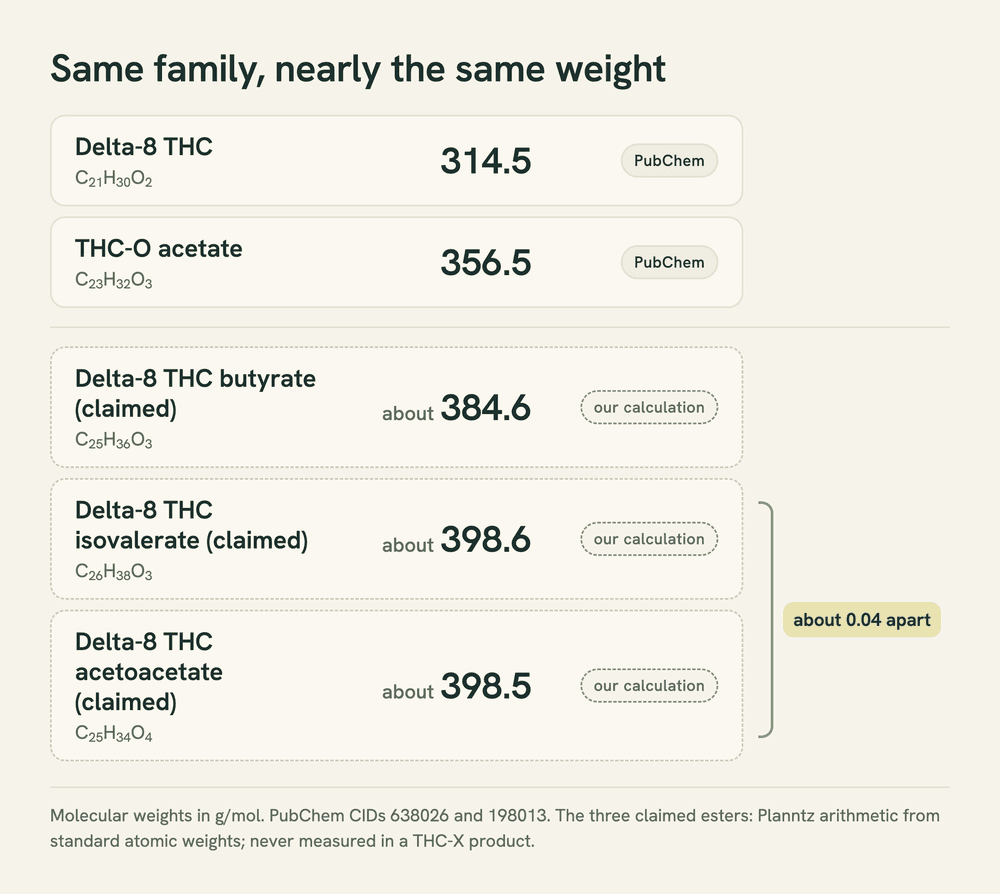
An ester is what you get when an acid is joined onto an -OH group, the oxygen-hydrogen pair chemists call a hydroxyl. THC has one on its ring. Cap that -OH with the two-carbon group from acetic acid and you get THC-O acetate, the best-known THC ester. The numbers are public: PubChem lists delta-8 THC as C21H30O2 with a molecular weight of 314.5, and THC-O acetate as C23H32O3 at 356.5. The three esters said to be in THC-X follow the same recipe with different acids: butyric acid (four carbons), isovaleric acid (five carbons, branched) and acetoacetic acid (four carbons with an extra oxygen). Our full profile of THC-O covers the acetate in depth, including its safety record.
| Compound | Formula | Molecular weight (g/mol) | Source |
|---|---|---|---|
| Delta-8 THC | C21H30O2 | 314.5 | PubChem CID 638026 |
| THC-O acetate | C23H32O3 | 356.5 | PubChem CID 198013 |
| Delta-8 THC butyrate (claimed in THC-X) | C25H36O3 | about 384.6 | Our calculation |
| Delta-8 THC isovalerate (claimed in THC-X) | C26H38O3 | about 398.6 | Our calculation |
| Delta-8 THC acetoacetate (claimed in THC-X) | C25H34O4 | about 398.5 | Our calculation |
How we did the arithmetic: start from delta-8 THC's formula, remove the hydrogen on the -OH, and add the acid's acyl group, using standard atomic weights (carbon 12.011, hydrogen 1.008, oxygen 15.999). The result is a structural estimate, not a measured product. It is still revealing. Two of the three claimed esters land within about 0.04 g/mol of each other, near 398.5, and both come out at 398 as a whole number, the resolution a routine mass detector reports. Matching on that number alone would not tell them apart; a high-resolution instrument can, but identifying either still takes a method that separates the compounds first and compares each one with a certified reference standard, and a label that says "THC-X" gives you neither.
The ester also changes how the molecule behaves in the body, at least for the one ester that has been studied. In a 2025 test-tube study by researchers in Japan and China, delta-8 and delta-9 THC-O were incubated with pooled human liver microsomes (human liver enzymes in a tube, not a person), and after 60 minutes almost none of the acetylated compound was left. Carboxylesterase enzymes had cut the acetate off and left ordinary THC. The authors say this "provides scientific support" for the same thing happening in the body. We found no study that has run that experiment on the butyrate, isovalerate or acetoacetate esters, so whether they behave the same way is an assumption, not a finding.
Heating is a separate question. Bench experiments published in 2026 found that heated acetate esters such as THC-O release ketene, and our THC-O guide covers that record. That finding is about the acetate group specifically. We found no published data on what the three esters attributed to THC-X produce when heated, so the acetate result cannot be carried over to them, in either direction: it is not evidence that they are safer, and it is not evidence that they do the same thing.
What testing has found on real shelves
The best evidence that THC-X is real, as a product, comes from studies that counted what was for sale. A 2024 study that catalogued 804 products on three of the most-trafficked US online retailers between May and August 2023 counted THC-X on 46 of them, tenth among 26 intoxicating compounds, and found that 54% of all products were blends of two to eight intoxicating compounds. It counted names on listings; it did not test what was inside. The same dataset anchors our profile of delta-11 THC, which appeared on 37 of those listings.
A local snapshot points the same way. A 2023 survey of 109 San Diego online vape-shop websites, published in Preventive Medicine Reports, found that 35.8% offered derived cannabinoid products, and THC-X turned up at two of the 109 shops. The researchers' table footnote calls it, simply, "a manufactured cannabinoid." Two shops in one metro area is not a prevalence estimate. It is a record that the name was on sale.
Those studies count names. The studies that tested contents are about the ingredient THC-X is said to be built from, and they are not reassuring. When researchers analyzed 27 delta-8 vape products from 10 brands bought in 2021, none had accurate delta-8 labeling and all contained reaction side-products, leftovers of the chemical conversion that turns CBD into delta-8. If THC-X is an ester blend made from delta-8, as the Formula X description says, it starts from that same chemistry and adds another reaction step.
THC-X is also not the only acronym with an identity problem. In 2025, chemists in Athens examined three products sold in Europe under names like "CBx" and found their main ingredients were THC analogs that "have never been identified in Cannabis plants, and cannot be identified by standard chromatographic forensic analytical methods" without spectroscopic techniques, for lack of reference standards. That is a different market and a different acronym, an analogy rather than evidence about THC-X. It shows how far a label name can drift from any known compound.
Does THC-X get you high? What is known and what is claimed
As of November 2026, PubMed indexes exactly one paper with "THC-X" in its record, and it is a count of product listings. No study has given THC-X, or any of the three esters it is said to contain, to a person. So any statement about how THC-X feels, how strong it is or how long it lasts, including the potency multipliers on seller pages, has no experiment behind it. What can be said rests on the contents, not the name.
If a THC-X product is mostly delta-8, as the one certificate on record suggests, it should be expected to be intoxicating. In two 2025 controlled trials in healthy adults, one with vaporized delta-8 in 20 people and one with oral delta-8 in 19, delta-8 produced clear drug effects, and the vaporized trial's authors described them as comparable to delta-9 at the doses studied, while the oral trial found them similar in kind to delta-9 but less potent. Those trials used material of known content. A THC-X label does not tell you what you have, so it does not tell you which of those results applies, or at what amount.
There is a second gap underneath the first. The conversion chemistry that makes delta-8 from CBD leaves byproducts, and a 2023 review of delta-8 chemistry in Cannabis and Cannabinoid Research noted that these byproducts "have not been subjected to any human toxicological evaluation." That is a statement about missing evidence, not a finding of harm. For a product built on delta-8 and then put through a further reaction, the unknowns add up rather than cancel out.
There is an adverse-event record for this family of products, just not under the name THC-X. Between January 1, 2021 and December 31, 2022, US poison centers logged 5,022 cases in which delta-8, delta-10 or THC-O acetate was the primary substance; delta-8 was 98.1% of them. Earlier, the FDA reported 104 adverse-event reports involving delta-8 products between December 1, 2020 and February 28, 2022, and 2,362 poison-center exposure cases from January 1, 2021 to February 28, 2022. These are calls and reports, not a measure of how many people were harmed: the systems are passive and have no count of users. THC-X has no category of its own in these systems. Our reading, not a published finding, is that any THC-X exposure would be filed under whatever the caller or clinician reported.

Is THC-X legal? The federal picture as of November 27, 2026
This is not legal advice, and every line carries a date. Congress rewrote the federal definition of hemp in 2025, in Section 781 of Public Law 119-37, and a law signed on September 2, 2026 split its start into two steps. Since November 12, 2026, hemp products containing cannabinoids the plant cannot produce naturally are excluded from the definition. On December 11, 2026 the rest arrives, including a total-THC standard and a 0.4 milligram per container limit. As of November 27, 2026, the FDA had not published the cannabinoid lists the new law calls for. The step-by-step mechanics are in our guide to the 2026 hemp changes, and the arithmetic behind the word "hemp-derived" is in what hemp-derived THC actually means.
Where does THC-X land? An ester made in a reactor is the kind of compound the November 12 step is aimed at. But whether a particular THC-X product falls under it depends on what is actually in it, and the name does not tell you. DEA has not addressed THC-X by name. It has addressed the closest relative: in a February 2023 letter, it said the acetate esters of delta-8 and delta-9 THC "do not occur naturally in the cannabis plant and can only be obtained synthetically, and therefore do not fall under the definition of hemp." A letter answers one request and is not a rule. For marijuana itself, the April 2026 rescheduling order moved some state-licensed medical marijuana to Schedule III and says synthetic THC remains in Schedule I. How the agency has reasoned about another converted cannabinoid is laid out in our explainer on whether HHC is legal.
Will THC-X show up on a drug test?
No study has tested THC-X on a drug screen, and none has measured how the three claimed esters are broken down in people. Everything in this section that goes beyond the measured facts is inference from related compounds, and we label it that way. Here is what is measured. Standard urine screens are immunoassays built around THC's carboxylic acid metabolite. In a 2023 cross-reactivity study using urine samples fortified by the federal program that certifies workplace drug-testing labs, delta-8's version of that metabolite cross-reacted at 87% to 112% at 50 ng/mL in kits from three manufacturers. In a second 2023 study of six commercial immunoassays, all six detected delta-8 metabolites. Both studies used urine spiked in the lab, not samples from people who had used a product.
Now the inference, clearly marked. For the acetate ester, human liver enzymes in a test tube return the parent THC, as described above. If a THC-X product contains delta-8 or THC-O, as the one certificate on record did, it is reasonable to assume it can produce a positive cannabinoid screen. Whether the butyrate, isovalerate or acetoacetate esters behave the same way has not been studied. A screen is not the last word: in workplace programs, a positive screen typically goes for a confirmation test that identifies specific metabolites, such as Labcorp's delta-8 and delta-9 THC metabolite urine test, which uses LC-MS/MS and reports the two separately. The details of screens, cutoffs and confirmation are in our guide to delta-8 and drug tests.
A label check for THC-X or any acronym product
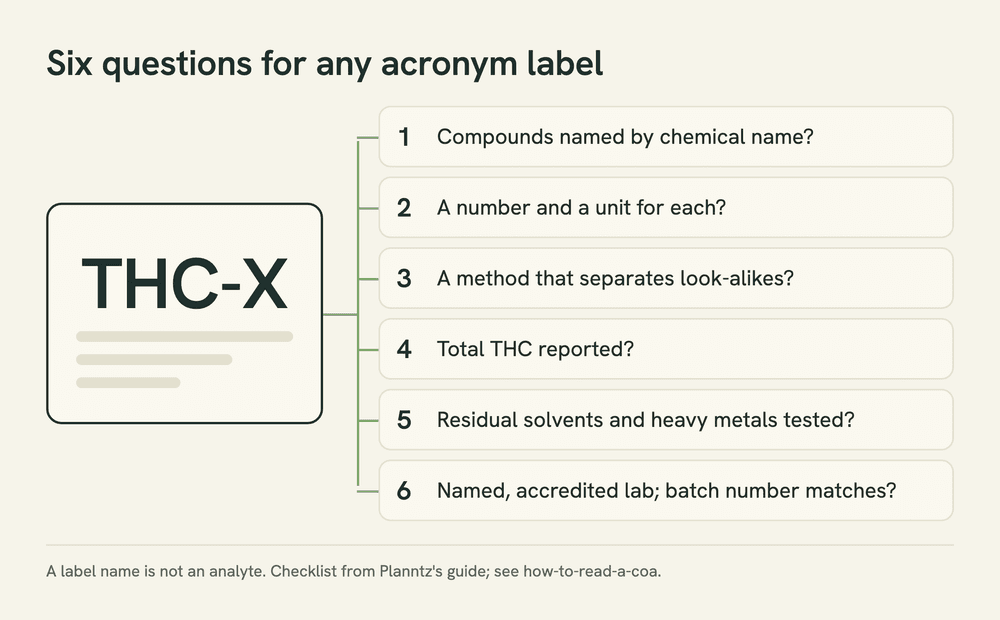
You do not need to settle what THC-X "really" is to protect yourself. You need the product's certificate of analysis (COA), the lab report that says what was measured in a specific batch, and you need it to answer six questions. The checklist works for THC-X and for every other acronym on the same shelf.
- 1Are the compounds named by chemical name? Look for lines like delta-8 THC or delta-8 THC-O acetate. A line that reads only "THC-X" is a brand word, not an analyte.
- 2Does each compound have a number and a unit, in mg per serving or percent? "Present" or a check mark is not a measurement.
- 3Is the method named, and can it separate look-alikes? In the delta-8 vape study above, the authors' data suggested one brand's HPLC-UV method could not tell delta-8 apart from a reaction byproduct.
- 4Is total THC reported, not only delta-9? The federal standard arriving December 11, 2026 is built on total THC.
- 5Are residual solvents and heavy metals tested? Converted and esterified products go through extra reaction steps, so these panels matter more, not less.
- 6Is the lab named and accredited, and does the batch number on the COA match the one on your package?
If a THC-X product cannot answer those questions, you have learned what you need to know about it. Our line-by-line guide to reading a COA shows what each section of a certificate should look like. The same checks apply to the rest of the acronym shelf, including THC-JD, which two labs found in only 1 of 10 products sold under that name. Planntz publishes a COA for every batch of its CBD tinctures on its lab results page for the same reason: a claim about what is in a bottle is only as good as the document behind it.
What is still unknown about THC-X
Counted on November 27, 2026, the gaps are larger than the record. That puts THC-X in the same position as most of the acronyms that arrived with it: a name with sales behind it and almost no science.
- What THC-X is: no paper identifies a single molecule, and three definitions compete.
- What it does in people, at what amount and for how long: 0 human studies of THC-X or of the three claimed esters.
- How the butyrate, isovalerate and acetoacetate esters are metabolized: not studied, in people or in a test tube.
- What they produce when heated: not published.
- How THC-X registers on a drug screen: not measured.
- What is actually inside products sold under the name: one certificate, for one product, with an unspecified detector.
We found no report of THC-X in any plant. Every definition in circulation describes a manufactured product: a 2024 peer-reviewed review found consensus on its synthetic nature, and a 2024 San Diego study footnoted it as "a manufactured cannabinoid". The esters it is said to contain would be made by chemically modifying delta-8 THC, which on the market is itself typically converted from CBD.
THC-X is a name, not a compound, so it can be the same as whatever is in the package. The one certificate of analysis on record for a THC-X product showed mostly delta-8 THC, delta-8 THC-O and THCP. Some websites call THC-X a rebranded delta-10; others describe a blend of delta-8 esters. Only a lab report for your batch tells you which, if any, applies.
No study has given THC-X to a person, so no potency figure for it has any experiment behind it. If a product is mostly delta-8, expect it to be intoxicating: in two 2025 controlled trials, delta-8 produced clear drug effects in healthy adults. Those trials used material of known content, and a THC-X label does not tell you the content.
There is no single answer, and this is not legal advice. As of November 27, 2026, no federal action names THC-X. Since November 12, 2026, hemp products containing cannabinoids the plant cannot produce naturally are outside the federal hemp definition, and the rest of the change, including a total-THC standard, arrives December 11, 2026. Whether a given THC-X product is caught depends on what is actually in it. State law applies on top.
No study has tested it. What is measured is that delta-8's metabolite reads as cannabinoid-positive on standard urine screens, and that for the acetate ester, liver enzymes in a test tube return the parent THC. If a THC-X product contains delta-8 or THC-O, as the one certificate on record did, assume it can produce a positive screen. No product can promise a result either way.
Formula X is a single seller's proprietary name for a blend of three esters made from delta-8 THC (acetoacetate, butyrate and isovalerate), according to 2023 trade coverage. It is the earliest traceable use of the THC-X name. No independent analysis of the blend has been published, and the seller's website no longer resolved when we checked on November 27, 2026.
THC-O acetate is a defined molecule: delta-8 or delta-9 THC with its -OH group capped by an acetyl group, formula C23H32O3, molecular weight 356.5, with its own PubChem record. THC-X is a name with three competing definitions. The one certificate on record for a THC-X product did contain delta-8 THC-O, so a product labeled THC-X may contain THC-O, but only a lab report for that batch would tell you.
THC-X is one of a growing shelf of acronyms whose names run ahead of their chemistry, and the real compounds behind them, from the major cannabinoids to the minor ones, are mapped in our guide to the cannabinoid family. Whatever acronym appears on the next label you pick up, the useful question stays the same: is there a quantified line for each compound on a certificate from a named, accredited lab, matched to your batch? If you want to practice that habit, our walkthrough of certificates of analysis is the place to start.
Writing about hemp, wellness and the small rituals that keep us balanced.