What Is 10-OH-HHC? The Label Said 80%. The Lab Found None
A vape liquid labeled 80% 10-OH-HHC was tested by forensic chemists and held none of it. What the compound is, where it came from, why it is not a known HHC metabolite, and what US law says as of November 2026.
Forensic chemists in Japan opened a vape liquid whose label promised 80% 10-OH-HHC, analyzed it with a battery of laboratory instruments, and found none of it. That single result says more about this compound than most of what is written about it online. Here is what 10-OH-HHC actually is, what has and has not been measured, and where it stands in US law as of November 28, 2026.
The short answer: 10-OH-HHC (also written 10-hydroxy-HHC, short for 10-hydroxyhexahydrocannabinol) is HHC with one extra hydroxyl group attached at carbon 10. It is not a new molecule: chemists made forms of it in 1980, and one form was isolated in trace amounts from a cannabis plant in 2015. The products sold since 2024 are manufactured, because a trace of about one part per million in a plant is not a source anyone can sell from. As of November 28, 2026 we found no study in which a person was given 10-OH-HHC, no published measurement of how it binds to cannabinoid receptors, and no study of how it behaves on a drug test. It is also not an established metabolite of HHC: the one controlled human study that looked for it did not detect it. Planntz does not make or sell HHC or any HHC derivative, and this page is an explainer, not medical or legal advice. If the wider family is new to you, start with our guide to what cannabinoids are; for HHC itself, see how HHC compares with CBD.
What is 10-OH-HHC? HHC with one more oxygen
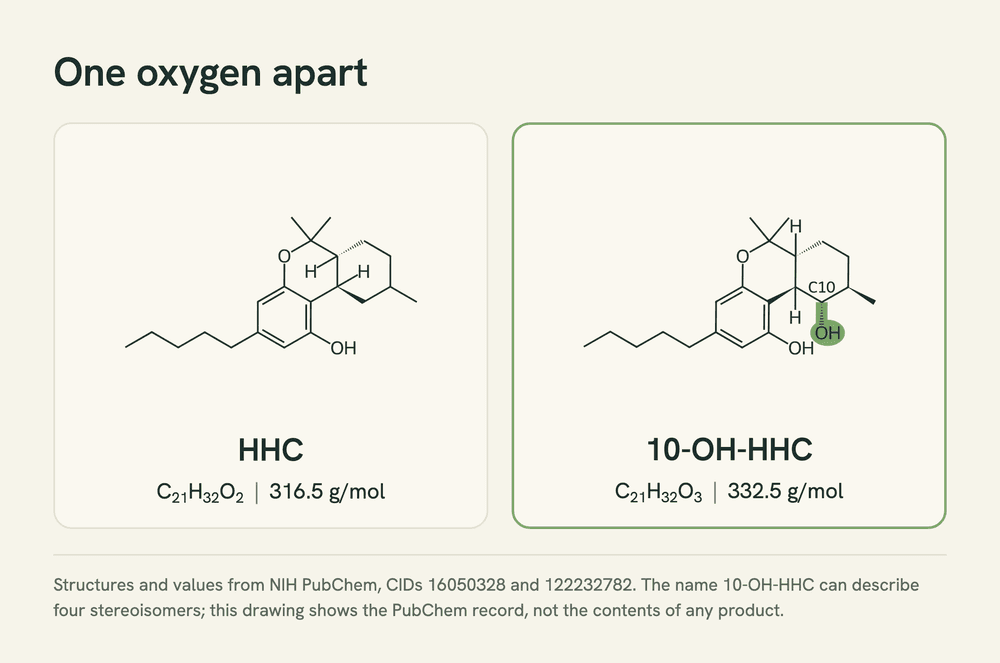
Start with HHC. Delta-9 THC has a double bond in its top ring; HHC is the version in which that double bond has been filled in with hydrogen. 10-OH-HHC takes HHC and bolts a single hydroxyl group (an oxygen-hydrogen pair, written -OH) onto carbon 10, on the same ring where THC keeps its double bond. In NIH's PubChem database, HHC is recorded as C21H32O2 with a molecular weight of 316.5, and a 10-hydroxy-HHC record as C21H32O3 at 332.5, under the synonym 10(S)-hydroxy-9(R)-hexahydrocannabinol and CAS number 73648-83-6. The whole difference between them is one oxygen atom.
| Compound | Formula | Molecular weight (g/mol) | What is different |
|---|---|---|---|
| Delta-9 THC | C21H30O2 | 314.5 | A double bond in the top ring |
| HHC (hexahydrocannabinol) | C21H32O2 | 316.5 | That double bond filled in with two hydrogens |
| 10-OH-HHC | C21H32O3 | 332.5 | HHC plus one -OH group on carbon 10 |
The name also hides more than one molecule. Carbons 9 and 10 in that ring can each point their attached group one of two ways in three dimensions, so, holding the rest of the skeleton in its natural arrangement, "10-OH-HHC" can describe four different molecules. That count is ours, worked out from the structure. Chemists call forms like these stereoisomers (or, when only one position differs, epimers), and they are not interchangeable: they can fit a receptor differently, and they can come out of a lab instrument at slightly different times. When a 2026 study went looking, commercial reference standards were available for only two of the four, and the authors said so when they explained why they could test only two. Even PubChem holds two separate records for this structure, one pinning down a single form and one leaving part of its 3D arrangement open, so neither is "the" 10-OH-HHC. When a product label says 10-OH-HHC, it does not say which form it means, and no published analysis tells you which form is in any product.
Where 10-OH-HHC came from: 1980, 2015 and 2024
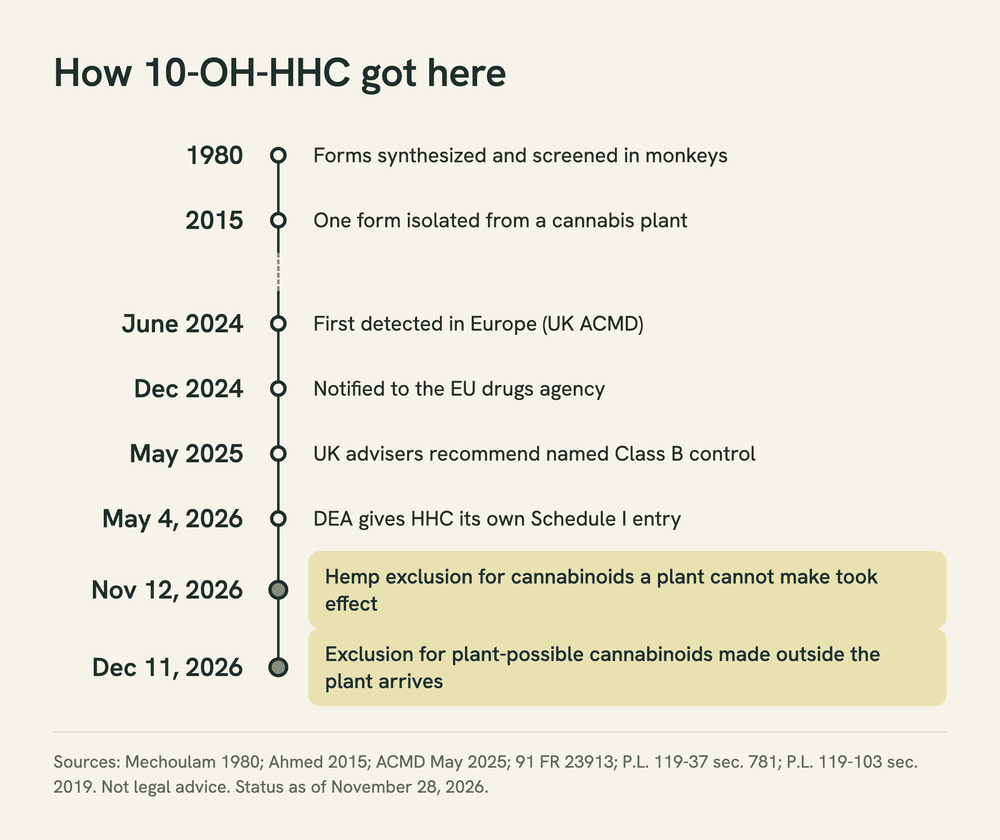
The molecule is older than the market it appeared in. In 1980, Raphael Mechoulam's laboratory synthesized several pairs of cannabinoid isomers, including forms of 10-OH-HHC, and screened them in rhesus monkeys in a paper on the stereochemical requirements for cannabinoid activity. The 3D shape decided everything. As EMBL-EBI's ChEMBL database records that paper's results, one form was clearly active at the lowest level tested, another needed about ten times as much to do anything, and a third showed no change at any level tested. Delta-9 THC was active an order of magnitude lower still. These are 46-year-old animal observations on a qualitative rating scale, read here through a database's curation because the full paper sits behind a publisher wall. Nobody has repeated them, and nothing in them translates into a human dose or tells you what a product does.
It is also not purely a lab invention. In 2015, chemists at the University of Mississippi's National Center for Natural Products Research isolated nine previously unreported oxygenated cannabinoids from a high-potency cannabis plant, and one of them was 10-alpha-hydroxy-HHC. They recovered 10 milligrams of it from 9.0 kilograms of dried buds and small leaves. By our arithmetic that is about one part per million, and it is a floor rather than a true concentration, because some is always lost across many purification steps. It was one plant variety in one laboratory. So "never found in nature" is wrong. And "natural" on a product label is still misleading, because nobody builds a product out of one part per million: every bottle and cartridge on sale is manufactured. Whether the plant form is even the same stereoisomer as the commercial one has not been established. Neither half of that history makes a product safer, and neither makes it lawful.
The retail product is recent. Britain's Advisory Council on the Misuse of Drugs (ACMD), in its May 2025 report on semi-synthetic cannabinoids, logs 10-OH-HHC as first detected in Europe in June 2024 and notified to the EU drugs agency in December 2024, with zero UK detections at the time. The table gives no country, which is why we do not repeat the "first identified in Germany" line that circulates online: we could not trace it to a source. The council recommended adding 10-OH-HHC to UK drug law by name as a Class B drug, and the government accepted that recommendation in August 2025, to be implemented "when parliamentary time allows". This page makes no claim about the compound's current UK status. The wider pattern is a market that moves faster than the lists: by the end of 2024, the EU drugs agency had identified 24 semi-synthetic cannabinoids on European markets, a count the Irish Department of Health cites in its notice that HHC and 13 other substances became controlled drugs there in July 2025.
Does 10-OH-HHC get you high? Why "OH" in the name says nothing about strength
Here is the honest answer: nobody knows, because it has not been studied in people. As of November 28, 2026 we found no human administration study, no case report, no pharmacokinetic study and no adverse-event series for 10-OH-HHC. There is no receptor data either. A 2024 review of designer THC compounds in the Journal of Cannabis Research, written by the Italian group that first described THCP, puts it plainly: "No studies are present on its in vitro CB1R binding affinity." CB1 is the brain receptor that THC acts on, so that is the measurement you would want first. The same review notes that "Companies selling this cannabinoid claim to follow a semi-synthetic route starting from CBD, but they do not give any other information." Seller pages that describe the effects, onset or duration of 10-OH-HHC are describing something no study has measured.
The letters in the name are where people go wrong. "OH" sounds like a family resemblance to 11-hydroxy-THC, the well-known THC metabolite, and it is tempting to read potency off that. But the position of the hydroxyl, and the 3D shape around it, decide what the molecule does. The ACMD report makes exactly that distinction in its discussion of how to write a generic ban. It calls 11-hydroxy forms of HHC derivatives "likely to be potent agonists", and says this of the 10-hydroxy ones:
“Other hydroxy derivatives, such as 10-hydroxy variants, are also known to be psychoactive, have been identified as components of mixtures containing other SSCs and are being offered for sale by some webshops. However, their psychoactivity is reported to be relatively mild and they may therefore be more appropriate to remain under PSA control.”
Read that carefully. "Reported to be relatively mild" does not say reported by whom, and no study is cited at that sentence. (SSCs are semi-synthetic cannabinoids; the PSA is the UK's Psychoactive Substances Act, a blanket law for new substances.) The same report's formal recommendation still lists 10-OH-HHC for named Class B control, so the discussion and the recommendation pull in different directions. Neither is a measurement in a person, and "relatively mild" is not something we can repeat as fact. The 1980 monkey screen makes the same point from the other side: three forms sharing one name ranged from clearly active to no observed change at all. If you want the THC side of the hydroxy story, including what is and is not known about how 11-OH-THC forms and acts, it is in our explainer on 11-hydroxy-THC. The lesson does not transfer to 10-OH-HHC in either direction: a hydroxyl at a different carbon is a different question.
Is 10-OH-HHC a metabolite of HHC? What the human studies found
Sellers like to call 10-OH-HHC "a metabolite of HHC", as if that borrowed it some history and familiarity. The human record does not support the shortcut. In a 2026 controlled study in Scientific Reports, researchers went back to stored samples from six volunteers who had taken HHC (three by mouth, three by inhalation), with blood collected for up to 48 hours and urine for up to five days. They searched for two forms of 10-OH-HHC with a method sensitive to roughly 0.1 ng/mL, a tenth of a nanogram per milliliter. Their result: "Neither of the two examined 10-OH-HHC epimers was detectable." Not in serum, not in urine. A sibling compound, 8-OH-HHC, turned up in the urine of every volunteer but one. The authors note that other papers had reported 8- and 10-hydroxy forms, and they offer low concentrations or 9 to 16 months of sample storage as possible explanations for their null.
When toxicologists catalogue what the body actually makes from HHC, the hydroxyl lands on carbon 11, on carbon 8, on carbon 9, or out on the side chain. A Swedish study of human liver cells and 16 real urine samples, published in Drug Testing and Analysis in 2025, identified 18 HHC metabolites in total, found 11-OH-HHC and two side-chain hydroxy forms in all 16 urine samples, and reported that 99.3% of the hydroxylated metabolites were bound to glucuronic acid, the body's usual tag for excretion. Its review of earlier work names 8-OH-HHC and a 9-alpha-hydroxy form as well. Carbon 10 was not among the positions it reported; we checked the full text and found no mention of 10-hydroxy forms. The HHC side of this story, including what blood tests have found in real cases, lives in our guide to whether HHC gets you high.
The label problem, measured once
Now the finding that should change how you read any 10-OH-HHC label. In a paper published online in 2024 in Drug Testing and Analysis, forensic chemists from the RIKEN SPring-8 Center and the Ishikawa Prefectural Police forensic laboratory in Japan analyzed two commercial e-liquids with GC-MS, GC-QTOF-MS, LC-HRMS and NMR. The one labeled "80% 10-OH-HHC" contained CBD, CBN and two caryophyllene terpenes, plus two peaks the authors could only estimate as tetrahydrocannabidiol isomers, a hydrogenated form of CBD. It contained no detectable 10-OH-HHC at all. The other liquid, labeled "60% HHCPM", held none of that either; instead it contained a cannabinoid never before reported in a product, an acetate ester whose family is covered in our profile of THC-O and other acetates. The authors closed by warning that "the package labels cannot be trusted". That is one product, not a survey, and we cannot say what fraction of 10-OH-HHC products contain none. It is also the only published test of a 10-OH-HHC product we could find.
Wider testing of this market points the same way. German forensic toxicologists who analyzed 80 seized semi-synthetic cannabinoid products, from flowers and resins to edibles and vape liquids, pointed to recent reports of a "further generation" of these cannabinoids that existing bans did not yet cover because a hydroxyl group had been added, such as 10-OH-HHC, sold under the shorthand "10-HC". They did not test the 80 seized products for 10-OH-HHC. They did measure HHC, and its content showed what they called "extreme fluctuations", from below the limit of quantification up to 70.9% by weight. In a market that variable for a compound labs already know how to measure, an unverified 80% claim for its hydroxylated cousin earns no trust by default.
There is a technical reason this is hard to police. A reference standard sitting in a supplier's catalogue is not the same as a laboratory owning it and running it. In the 2026 human study, researchers could obtain commercial standards for only two of the four forms. The 2024 review notes that the mass spectra of these isomers are very similar and that their retention times differ only slightly, so telling them apart takes a method that separates them first, and NMR to settle the 3D arrangement. That is the gap a certificate of analysis on a vape product has to close, and a certificate that does not name its method and its standard has not closed it. Before trusting any certificate, read our walkthrough of what a COA should show; for vape hardware specifically, our guide to spotting a fake cart covers the packaging side. Every Planntz CBD tincture has a public, per-batch third-party COA on our lab results page, because a claim about what is in a bottle is only as good as the document behind it.
Is 10-OH-HHC legal in the US? The picture as of November 28, 2026
This is not legal advice, and every sentence here carries a date. Start with HHC itself. A DEA final rule published May 4, 2026 gave hexahydrocannabinol its own Schedule I entry, and in the same rule the agency explained that HHC "is a schedule I controlled substances [sic] in the United States under drug code 7370 because it meets the definition of tetrahydrocannabinols, a schedule I hallucinogen". The rule also says that "tetrahydrocannabinols produced through chemical conversion, even when hemp derived are considered synthetically produced for purposes of the CSA". Both statements are about tetrahydrocannabinols. When we searched the Federal Register on November 28, 2026, no DEA document named 10-OH-HHC or any other hydroxy-HHC. That is a description of what has been published, not a conclusion: silence from the agency does not make a compound lawful, and it does not make it controlled. Our explainer on whether HHC is legal covers the HHC rule in depth.
The federal hemp definition is changing in two steps, and 10-OH-HHC sits awkwardly across them. Section 781 of Public Law 119-37 excludes from hemp two kinds of cannabinoids: those "not capable of being naturally produced by a Cannabis sativa L. plant", and those that are capable of being naturally produced but "were synthesized or manufactured outside the plant". A later law, P.L. 119-103, split the start date. The first exclusion, for cannabinoids a plant cannot make, took effect on November 12, 2026. The second, for plant-possible cannabinoids made outside the plant, arrives on December 11, 2026. One form of 10-OH-HHC has been isolated from a plant, while every product version is manufactured, so which clause reaches it is an open question no agency has answered. Section 781 also told the FDA to publish lists, including "all cannabinoids known to FDA to be capable of being naturally produced by a Cannabis sativa L. plant, as reflected in peer reviewed literature". As of November 28, 2026, those lists had not been published. The 2015 isolation paper is the kind of peer-reviewed literature those words point at, but that is our reading of the statute's text, not a ruling, and reading words is not the same as knowing how they will be applied. The step-by-step dates are in our explainer on the hemp ban's December 11 start.
State law does not wait for a federal list. Colorado's statute, for example, defines "intoxicating cannabinoids" by category, and its list includes "Metabolites of THC, including 11-hydroxy-THC, 3-hydroxy-THC, or 7-hydroxy-THC" and "Hydrogenated forms of THC, including hexahydrocannabinol, hexahydrocannabiphorol, and hexahydrocannabihexol". It does not name 10-OH-HHC. Whether a hydroxylated HHC falls inside one of those categories is a question for a lawyer licensed in that state. Categories like these are exactly why a compound no federal document mentions can still be restricted where you live, and why checking your own state matters more than any federal headline, or any seller's claim that a product is legal everywhere.
Will 10-OH-HHC show up on a drug test? And what sport rules say
Nobody has published anything on how 10-OH-HHC behaves on a drug test: no cross-reactivity study, no detection window, nothing. What is on record is how the second half of a workplace test works. In the federal mandatory guidelines for urine testing, the confirmation step for cannabis targets one named molecule, delta-9-tetrahydrocannabinol-9-carboxylic acid (THC-COOH), and that panel does not mention HHC at all. Private employers are not bound by that federal panel and may use other methods. The first-step screen is a different technology, and what three real devices found in people who took HHC is in our HHC drug test guide. Given that the one product tested under this name turned out to contain other cannabinoids entirely, treat any product in this family as capable of triggering a cannabinoid screen, and never treat a label as a prediction about a test result.
If you are tested in sport, note that the anti-doping rules do not work from a closed roster of molecules. Section S8 of WADA's 2027 Prohibited List, valid from January 1, 2027, prohibits "semi-synthetic and synthetic cannabinoids that mimic the effects of delta-9-THC" and gives hexahydrocannabinols as an example. It does not mention 10-OH-HHC, and that is the point of writing a rule by effect rather than by name. We cannot tell you how it would be applied to this compound, and neither can a label. WADA's own advice is to ask your anti-doping organization. The details of the 2027 wording are in our breakdown of WADA's 2027 cannabinoid rules.
What we still do not know about 10-OH-HHC
Counted on November 28, 2026, the gaps are larger than the record. Each item below is something we searched for and did not find, not something we assume.
- What it does in people, at what amount and for how long: no human study of 10-OH-HHC has been published.
- How it binds to the CB1 and CB2 receptors: no published measurement, and the three ChEMBL database records for its forms carry only the 1980 animal observations.
- How the body absorbs, breaks down and clears it: no pharmacokinetic study.
- How it registers on a drug screen or confirmation: no study.
- Which of the four possible forms is in any product: no published analysis says.
- Whether the form isolated from a plant in 2015 is the same form sold commercially: not established.
- Which of the two federal hemp exclusions applies to it, if either: no agency has said, and the FDA lists are unpublished.
A six-point reality check for any new cannabinoid acronym
You do not need to settle what 10-OH-HHC does to protect yourself from a label that is not telling the truth. You need the product's certificate of analysis, the lab report for a specific batch, and you need it to pass these six checks. They work for 10-OH-HHC and for every other acronym on the same shelf.
- 1Is the compound named by its systematic chemical name, with the stereoisomer stated, and not only by an acronym such as 10-OH-HHC or 10-HC?
- 2Is each compound quantified with a number and a unit, in mg per serving or percent by weight? A check mark or the word present is not a measurement.
- 3Does the certificate name its method, and is it one that can separate look-alike isomers before identifying them?
- 4Does the lab state that it ran a reference standard for that exact compound? A 2026 study could obtain commercial standards for only two of the four 10-OH-HHC forms.
- 5Is the lab named and accredited, and does the batch number on the certificate match the one on your package?
- 6Is there any peer-reviewed record of the compound being studied in a person? For 10-OH-HHC, as of November 28, 2026, the answer is no.
A product that cannot answer those questions has told you what you need to know. 10-OH-HHC is not alone in this: the same gap between label and chemistry shows up in our explainer on PHC, in THC-X, a name with no agreed molecule behind it, in THC-JD, which testing found in only a fraction of the products sold under that name, and in the confusing numbering behind delta-11 THC.
10-OH-HHC, or 10-hydroxyhexahydrocannabinol, is HHC with one hydroxyl group attached at carbon 10. In PubChem it is C21H32O3 with a molecular weight of 332.5, against HHC's C21H32O2 at 316.5. Because two carbons in that ring can each point two ways, the name can describe four different stereoisomers (our count), not one molecule.
Partly, and that is the confusing bit. In 2015, chemists isolated one form, 10-alpha-hydroxy-HHC, from a high-potency cannabis plant: 10 mg from 9.0 kg of dried plant material, about one part per million by our arithmetic. No product is made at that level, so every product on sale is manufactured. Being found in a plant says nothing about whether a product is safe or lawful.
That is a seller's framing, not an established fact. In a 2026 controlled study in which six volunteers took HHC, neither of the two tested forms of 10-OH-HHC was detected in blood or urine, while 8-OH-HHC was found in the urine of five of the six. The documented human HHC metabolites carry the hydroxyl at carbon 11, 8 or 9, or on the side chain. A small study cannot rule it out, but the label claim is unproven.
No study has given it to a person, and no receptor measurement has been published. A 1980 screen in monkeys found that the effect depended entirely on the 3D form, from clearly active to no change. The UK's drug advisers describe 10-hydroxy variants as psychoactive with effects "reported to be relatively mild", without citing a study. Any potency comparison you see is not based on a measurement.
There is no settled answer, and this is not legal advice. As of November 28, 2026, no Federal Register document names 10-OH-HHC. HHC got its own Schedule I entry on May 4, 2026. The hemp exclusion for cannabinoids a plant cannot make took effect November 12, 2026; the exclusion for plant-possible cannabinoids made outside the plant arrives December 11, 2026. The FDA lists the law requires are unpublished, and state laws apply on top.
No study has tested it on any screen or confirmation, so no one can promise a result either way. The one product tested under this name turned out to contain other cannabinoids, so treat any product in this family as capable of triggering a cannabinoid screen. If you are subject to testing, staying away from products in this family removes this source of risk, and no cannabinoid product, CBD included, can guarantee a negative result.
They are hydroxy siblings with the -OH on carbon 8 or carbon 9. 8-OH-HHC is a documented human metabolite of HHC and was detected in the 2026 controlled study. A 9-alpha-hydroxy form has also been reported as a human HHC metabolite, and the UK ACMD logs 9-OH-HHC as first detected in Europe in December 2022, with zero UK detections at the time. Neither has been studied as a product in people.
10-OH-HHC is a real molecule with a real history, sold under a name that promises more than any study has shown. If you want the compound it is built from, our look at HHC's effects and what forensic blood tests have found is the next read. And whatever acronym appears on the next label you pick up, the question that protects you stays the same: does a named, accredited lab show a quantified line for that exact compound, matched to your batch? Our line-by-line guide to reading a certificate of analysis shows you how to check.
Writing about hemp, wellness and the small rituals that keep us balanced.