Delta-11 THC: What It Is, How It Differs From Delta-9, and What Nobody Has Measured
Delta-11 THC is on product labels and almost absent from the literature. Here is the molecule it actually is, the three names it goes by, what the animal studies from 1985 to 1993 measured, and the two 2026 dates that changed the federal hemp definition.
Delta-11 THC shows up on vape and gummy labels, in press releases, and in blog posts that cannot agree on whether it is three times stronger than delta-9 or barely active at all. The molecule itself is not mysterious. It has a chemical database record, two CAS numbers, a 1971 synthesis paper and about five animal pharmacology studies from the 1980s and early 1990s. What it does not have is a single published human study.
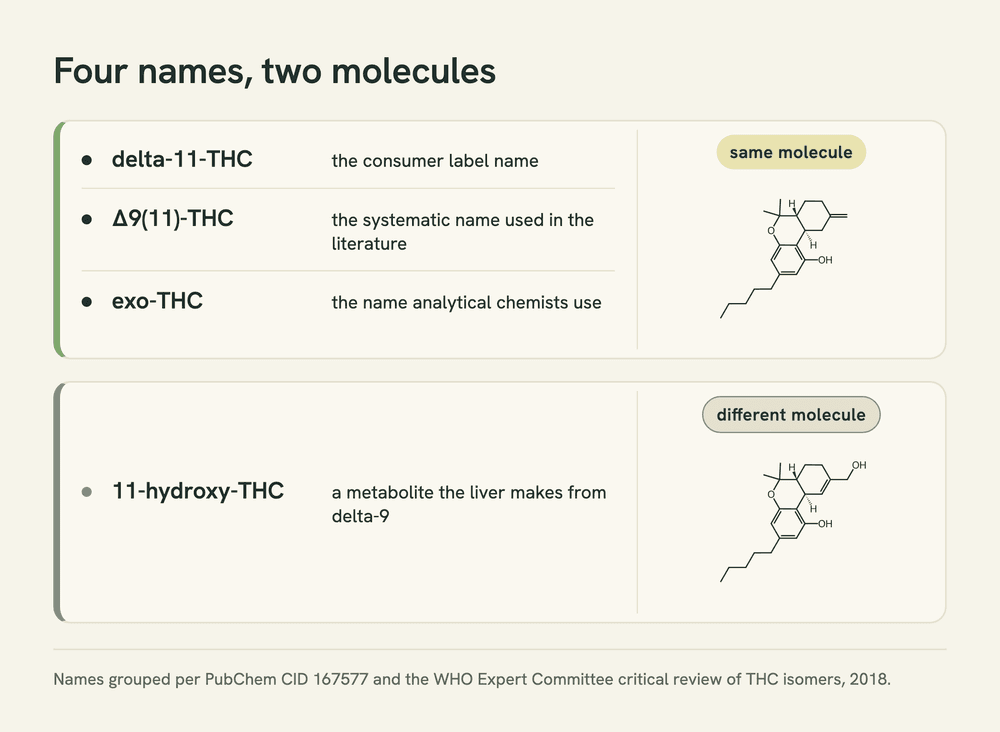
The short answer: delta-11-THC is an isomer of THC whose double bond sits at C-11 instead of C-9. It is the same molecule that analytical chemists call exo-THC and Δ9(11)-THC, and it is not 11-hydroxy-THC, the metabolite your liver makes out of delta-9. It is not listed as a naturally occurring cannabinoid in the only authoritative table of THC isomers; it is made from delta-8-THC, or it appears unintentionally as a byproduct of manufacturing. Every animal study that compared it to delta-9 found it less potent, by roughly 3-fold to 100-fold depending on the species and the endpoint. No human administration study, no toxicology study and no receptor-binding constant for the molecule itself has been published. Hold those gaps in mind for the rest of this page, because most of what circulates about delta-11 is filling them in with guesses.
What is delta-11 THC? Three names for one molecule, and a fourth that is something else
The single biggest source of confusion about delta-11 is that it travels under several names, and one of the names people reach for belongs to a different compound. The search results disagree about this. The literature does not. Three independent authorities put the names on the same record.
The PubChem compound record CID 167577 is one entry whose synonym list carries delta-11-Tetrahydrocannabinol, exo-Tetrahydrocannabinol, delta9(11)-Tetrahydrocannabinol and both CAS numbers, 16849-44-8 and 27179-28-8. Formula C21H30O2, molecular weight 314.5, and an IUPAC name that contains the fragment 9-methylidene, which is the chemistry's own way of saying the double bond hangs off the ring rather than sitting inside it. The 2018 critical review of THC isomers from the WHO Expert Committee on Drug Dependence files the molecule under Δ9(11)-THC and lists Δ11-THC and Δ11-Tetrahydrocannabinol among its other chemical names, with CAS 27179-28-8. And a 2025 method-validation paper from the Armed Forces Medical Examiner System, a comprehensive LC-MS-MS panel for THC isomers, analogs, homologs and metabolites in blood and urine, simply writes the identity in one string in its own abstract: "Δ9,11-THC (exo-THC)".
- Delta-11-THC: the consumer-facing name, the one that ends up on labels and in marketing copy.
- Δ9(11)-THC, also written delta-9,11-THC: the systematic name the pharmacology literature and WHO use, which spells out that the bond runs between C-9 and C-11.
- Exo-THC: the name forensic and analytical chemists use, because the double bond is exocyclic. Same molecule.
- 11-hydroxy-THC, or 11-OH-THC: NOT the same molecule. This is a metabolite, made by the liver out of delta-9-THC, and the difference is a hydroxyl group rather than a double bond.
If you want the metabolite rather than the isomer, we treat it separately in our page on the liver metabolite 11-hydroxy-THC. And if you are here because an acronym you had never seen appeared on a label, the pattern is a general one: see acronyms sellers use without a settled molecule behind them.
Where it comes from, and the answer to "is delta-11 natural?"
Annex 1 of the WHO critical review is a table of the seven double-bond isomers of THC and their thirty stereoisomers, with a column for natural occurrence. Two rows are marked yes: delta-8-THC and delta-9-THC. The Δ9,11-THC row, four stereoisomers, CAS 27179-28-8, is marked no, along with Δ6a,10a, Δ6a,7, Δ7 and Δ10. That is the authoritative answer to a question the search results guess at. The careful phrasing matters: this is a 2018 compound table that records no reported natural occurrence, which is not the same as a proof that no molecule of it has ever existed in a plant. It is, however, the best evidence there is, and nothing contradicts it.
So where does it come from? The first published synthesis appeared in the Journal of Organic Chemistry in 1971. WHO records only a short list of preparation routes, and both of the ones it names start from delta-8-THC: ultraviolet irradiation of delta-8, with a reported yield of 30%, or an acid-then-strong-base sequence on the same starting material. That is as much chemistry as belongs on a consumer page, and it is deliberately not a procedure. The relevant point for a reader is the starting material. Delta-11 sits downstream of the same cannabinoid-conversion chemistry that produces the delta-8 on the shelf, which is the context we cover in the acid-catalyzed conversion that makes delta-8.
It also turns up without anyone intending it. FDA's Forensic Chemistry Center profiled roughly 300 cannabis-based vaping liquids drawn from more than 1,000 submitted samples, including products collected from EVALI patients, and identified delta-8, delta-6a,10a, delta-10 and exo-THC among them. The paper puts the title words "unnatural THC isomers" on that whole group, and it reports that significant or major amounts of unnatural isomers were found in over 10% of the THC vaping liquids, with lesser amounts in another 60%. Read that carefully: the 10% and 60% figures describe the isomer group, not exo-THC on its own, and the sample is a 2019 to 2021 forensic caseload rather than today's retail market. The authors propose the cause as chemical and thermal treatments during manufacturing. A 2024 analysis from Japan's National Institute of Health Sciences points the same way from a different angle: in five oil products bought online, the analysts identified THC analogs with different alkyl chain lengths and reported Δ4(8)-iso-THCV and Δ11-THCB as minor components considered to be reaction byproducts of the synthesis. Note the molecule there is Δ11-THCB, the butyl homolog, not Δ11-THC itself. It is evidence that Δ11 double bonds appear as synthesis byproducts in this product class, which is the claim it supports and the only one.
What the pharmacology actually measured
Delta-11 has a real pharmacology literature. It is small, it is old, and it is entirely in animals. Five papers published between 1985 and 1993 did the measuring, two more from the same era argued about the molecule's shape, and two in-vitro papers from the same laboratory mapped its metabolism: a 1990 survey of delta-11's metabolism in liver microsomes from seven species and a 1991 comparison that ran eight cannabinoids side by side. Every one of them deserves to be read with its species, its route and its endpoint attached, because that is exactly what gets dropped when a number travels onto a product page.
| Study | Species and route | What was measured | Reported result |
|---|---|---|---|
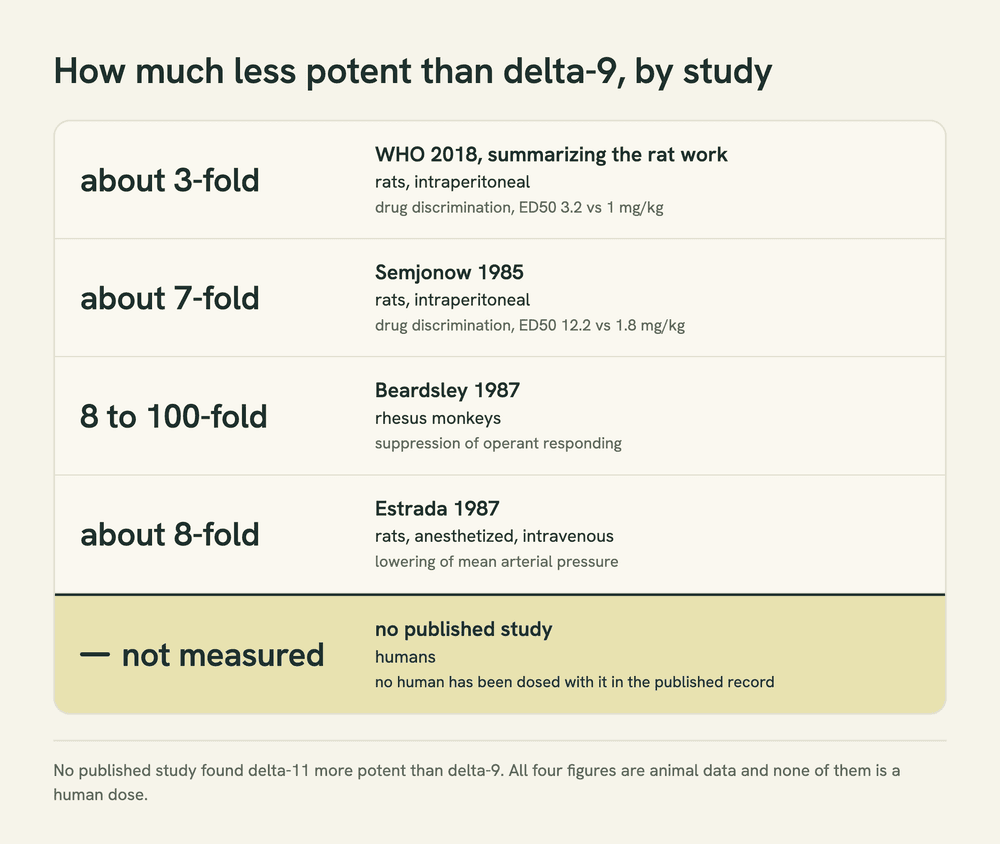
| Semjonow 1985 | Rats, intraperitoneal, trained on 3 mg/kg delta-9 | Drug discrimination (does the animal treat it like the training drug) | ED50 12.2 mg/kg for delta-9(11) against 1.8 mg/kg for delta-9. The authors also note that in rhesus monkeys delta-9(11)-THC is at least 100 times less potent, and that 50 mg/kg given 48 hours beforehand completely blocked drug-appropriate responses. |
| Beardsley 1987 | Mice, 15 dogs, rhesus monkeys | Hypothermia, analgesia, activity, lethality, operant responding | Mice: similar to but less potent than delta-9. Dogs: no classical cannabimimetic signs. Monkeys: no ptosis, sedation or ataxia, and 8 to 100 times less potent at suppressing operant responding. Pretreatment raised the delta-9 doses needed. |
| Estrada 1987 | Rats under pentobarbital anesthesia, intravenous, 0.078 to 5.0 mg/kg | Mean arterial pressure, heart rate, respiratory rate | Delta-9 reduced all three by up to roughly 50%. Delta-9(11) was approximately 8-fold less potent hypotensively. Both potentiated epinephrine and produced arrhythmias when it was co-administered. |
| Kriwacki 1989 and Reggio 1989 | No animals: solution NMR and molecular mechanics | Conformation, and the orientation of the C9 substituent | Both treat delta-9,11-THC as the inactive structural isomer and tie cannabinoid activity to how the C9 substituent is oriented. This is the framing the field carried into the 1990s. |
| Compton 1991 | Mice up to 30 mg/kg, rats up to 10 mg/kg | Mouse tetrad, rat drug discrimination, CP-55,940 binding on the paper's new ether analogues | "None of the cannabinoid analogues were capable of attenuating the effects of delta 9-THC", and "delta 9,11-THC is more potent than previous reports indicated, and does possess pharmacological activity". |
| Wiley 1993 | Rats and rhesus monkeys, two-lever procedure | Drug discrimination | Generalized from the delta-9 training dose in both species, less potent in both, with a larger gap in monkeys, and "devoid of antagonistic properties in the drug discrimination paradigm". |
| WHO 2018, summarizing the rat work | Male rats, intraperitoneal, trained on 3 mg/kg delta-9 | Drug discrimination, as characterized by the expert committee | Full dose-dependent substitution for delta-9 with approximately 3-fold less potency: ED50 3.2 mg/kg against 1 mg/kg. |
| Harvey 1990 and 1991 | Liver microsomes from seven species: mouse (three strains), rat, guinea pig, rabbit, hamster, gerbil and cat | In-vitro metabolite profile | 11 metabolites, formed by hydroxylation along the pentyl chain, allylic hydroxylation at C-10 and C-8, and the epoxide-diol pathway. None was 11-hydroxy-THC. Ratios varied widely between species. |
The behavioral studies are the ones worth understanding, because they are what "potency" means in this literature. Semjonow's 1985 rat study and Wiley's 1993 study in rats and rhesus monkeys both used drug discrimination, in which an animal trained on delta-9 is asked whether a new compound produces the same internal cue. Delta-11 passed that test in both, and in both it took more of it. Beardsley's 1987 work across mice, dogs and monkeys went wider and found something more interesting: in two of the three species it did not look cannabimimetic at all. The dogs showed no classical signs, and the monkeys showed no ptosis, sedation or ataxia. Estrada's 1987 cardiovascular study measured something different again and landed in the same place, about 8-fold weaker than delta-9 at lowering blood pressure. That study also reported arrhythmias when epinephrine was co-administered, in anesthetized rats, intravenously, and that finding belongs to anesthetized rats given intravenous epinephrine. It is not a human drug-interaction warning and we are not turning it into one.
Two papers from the late 1980s explain why the older literature reads as though delta-11 does nothing at all. Kriwacki's 1989 conformational analysis calls Δ9,11-THC a biologically inactive structural isomer of delta-9-THC, and Reggio's 1989 paper on the orientation of the C9 substituent groups it with the inactive cannabinoids. That was the received view. Then Compton's 1991 synthesis and pharmacology paper in the Journal of Medicinal Chemistry narrowed it, concluding in its own words that "delta 9,11-THC is more potent than previous reports indicated, and does possess pharmacological activity". Both things are part of the record: the early framing, and the correction. Neither says it is stronger than delta-9.
One more structural point about the vintage of all this. Most of this work predates the tools that would settle it. CB1 was cloned in 1990 and the first CB1 antagonist arrived in 1994, which is why WHO notes that effective tools for determining the most probable mechanism were not available for this family of isomers. That is also why this article prints no CB1 or CB2 binding constant for delta-11: we looked, and there is none to print. For a cannabinoid where the binding numbers do exist and are routinely over-read, see the discussion around THCP's 33x figure.
The "three times stronger" claim, traced
If you have read about delta-11 anywhere other than a journal, you have probably met a multiplier. The most common version is that it is about three times stronger than delta-9. Other pages run the opposite way and describe it as a fraction of delta-9's strength, each with a different multiplier. We went looking for the origin of every one of these figures and found none of them traceable to a published study. That is the honest finding, and it is worth more than a confident replacement number would be.
What does exist is a single 3-fold figure in the authoritative literature, and it runs the other way. WHO's pharmacology section records that delta-9(11)-THC produced full dose-dependent substitution for delta-9 in male rats trained to discriminate 3 mg/kg delta-9, with approximately 3-fold less potency, ED50 3.2 mg/kg against 1 mg/kg. Put the two checkable facts side by side and you have the whole situation: the seller multiplier has no traceable published source, and the only 3-fold number in the literature points in the opposite direction. We are not claiming anyone inverted anything, because we cannot show that. We are saying one of these two statements can be looked up and the other cannot.
Delta-11 vs delta-9, restricted to what has been measured
| Property | Delta-9-THC | Delta-11-THC (exo-THC) |
|---|---|---|
| Where the double bond sits | At C-9, inside the ring | At C-11, on an exocyclic carbon, which is why the IUPAC name reads 9-methylidene |
| Formula and molecular weight | C21H30O2, 314.5 | C21H30O2, 314.5. Same formula, different arrangement, which is what makes it an isomer |
| Natural occurrence in WHO's isomer table | Yes | No |
| How it is obtained | Extracted from the plant | Prepared from delta-8-THC, or formed unintentionally during manufacturing |
| Potency against delta-9 in animals | The reference compound | Less potent in every study that measured it: about 3-fold (rat, WHO), about 7-fold (rat, Semjonow), 8 to 100-fold (rhesus, Beardsley), about 8-fold on blood pressure (anesthetized rat, Estrada) |
| Human administration studies published | Many, across five decades | None |
| Published CB1 binding constant | Yes | None found for the molecule itself |
| Main liver metabolites | 11-hydroxy-THC, then THC-COOH | 11 metabolites in animal microsomes, none of them 11-hydroxy-THC. The human profile is unpublished |
| Immunoassay cross-reactivity | The analyte cannabinoid screens are built around | 25% on one whole-blood ELISA, using fortified samples and the parent compound |
| Named in a DEA scheduling action | Yes | No. A Federal Register full-text search returns no documents naming it |
Two rows in that table are doing most of the work. The potency row is unanimous in direction across four independent animal measurements, four decades old, in four different preparations. The human row is empty. A reader who keeps only those two facts is better informed about delta-11 than the average page on the subject.
What a label or a certificate of analysis can and cannot tell you
Delta-11 is not a hypothetical product category. A 2024 cross-sectional retail assessment of 804 products from three top-trafficked US websites and 118 brands catalogued 26 intoxicating compounds on sale, and its list of the most prevalent compounds ends with "THC-X, and Delta-11 THC". The same study found that 54% of the products were blends of between two and eight intoxicating compounds, 43% were disposable vapes and 29% were edibles. That was three websites in May 2023, so it is a snapshot rather than market share, but the word is on real labels.
Here is the gap. A standard potency panel reports a fixed list of cannabinoids, and exo-THC is usually not on that list. It is not that the isomer is unmeasurable: in 2026 FDA's forensic laboratory published quantitative HPLC methods covering seven positional THC isomers including exo-THC in vaping liquids, dabs, gummies and candies submitted between 2019 and 2024. But separating them took a method built for the job, with mixed C18-aromatic or cholesterol-ligand columns, ternary mobile phases and a controlled column temperature. A reference material also exists, which is the precondition for quantifying anything: DEA's exempt chemical preparations order of July 1, 2025 lists, in its approved chart, exo-THC reference solutions in methanol from a standards supplier. So the molecule can be measured by a laboratory that chooses to measure it. The practical conclusion is simple. If a label says delta-11 and the certificate has no quantified line for it and names no method, nobody has shown you the molecule is in there.
- 1Look for a quantified row, not a word. A cannabinoid that appears in the marketing copy but not as a numbered row with a value and a unit was not measured on that certificate.
- 2Read the analyte list on the panel itself. If exo-THC or delta-9,11-THC is not among the analytes, a non-detect for it was never possible, because it was never looked for.
- 3Check that a method and a limit of quantitation are stated. Separating these isomers requires a column and a mobile phase chosen for the purpose. A certificate that names no method cannot support an isomer identification.
- 4Match the batch and the date. The certificate has to correspond to the batch code on the container in front of you, not to a generic document for the product line.
If any of those four steps was unfamiliar, start with our walkthrough on reading a certificate of analysis. Planntz does not sell delta-11, and no part of this page is an offer of one.

Is delta-11 THC legal? The federal picture, dated to November 25, 2026
This is not legal advice, and it is a snapshot with a date on it. Start with what does not exist: there is no federal listing that names delta-11-THC or exo-THC. A Federal Register full-text search for either name returns zero documents, and that zero is bounded, because the same search for hexahydrocannabinol returns five, including the specific-listing rule of May 4, 2026.
What does exist is a general entry. The Schedule I listing for tetrahydrocannabinols at 21 CFR 1308.11(d)(31), drug code 7370, reaches synthetic substances, derivatives and their isomers with similar chemical structure and pharmacological activity to those contained in the plant, and adds a parenthetical that because nomenclature is not standardized, compounds of these structures are covered regardless of the numerical designation of atomic positions. Then subparagraph (d)(31)(ii) excludes anything that falls within the federal definition of hemp. Quoting a regulation is not the same as applying it, and we are not applying it. But notice which clause the animal record from 1985 to 1993 lands on. "Pharmacological activity" is precisely the element a lawyer on either side would argue about for this molecule, and the literature gives both sides something to hold. Separately, 21 U.S.C. 813, the controlled substance analogue provision, treats an analogue as a Schedule I substance to the extent it is intended for human consumption. That provision is about substances that are not already controlled, which is a mechanism worth understanding and not a conclusion about anyone's exposure. The structural argument there is the same one that came up for THC-O acetate.
One federal document does name the molecule, and it is worth being precise about what it means. DEA's exempt chemical preparations order of July 1, 2025 lists exo-THC reference solutions in its approved chart, and a follow-on notice in March 2026 adds exo-THC methyl ether reference solutions. Under 21 CFR 1308.23(a), the Administrator may exempt a chemical preparation or mixture containing one or more controlled substances listed in any schedule when it is intended for laboratory use. Two things follow from that and only two: a certified reference material exists, so a laboratory can quantify exo-THC; and DEA has processed it through machinery it reserves for preparations of controlled substances. It is not a scheduling action naming delta-11, it does not make the compound illegal, and it does not make it legal.
- Since November 12, 2026: the part of Public Law 119-37 in force is the exclusion for cannabinoids not capable of being naturally produced by a Cannabis sativa L. plant. Section 2019 of Public Law 119-103 limited it to that part until December 11, 2026.
- On December 11, 2026: the rest of the amendments made by Section 781 take effect, including the total-THC basis, the exclusion for cannabinoids synthesized or manufactured outside the plant, and the 0.4 milligram combined total per container figure.
- Still outstanding on November 25, 2026: FDA has not published the cannabinoid lists that Section 781 calls for. The only supportable verb is "has not been published", and we are not forecasting when or how that changes.
The statutes themselves are the source: Public Law 119-37, Section 781, which rewrites 7 U.S.C. 1639o, and Public Law 119-103, Section 2019, which split the start dates. We keep the mechanics of those two dates on one page rather than re-deriving them here, so if the hemp definition is what you came for, read what "hemp-derived" actually means and the December 11 deadline.
Drug tests: one real number, and a lot of nothing
Standard workplace urine screens are built around THC-COOH, the carboxy metabolite of delta-9. That is the target the immunoassay antibody is raised against, and everything else that trips it does so by cross-reacting. So the question for any novel isomer is narrow and answerable in principle: how much does it cross-react, in what matrix, on which kit.
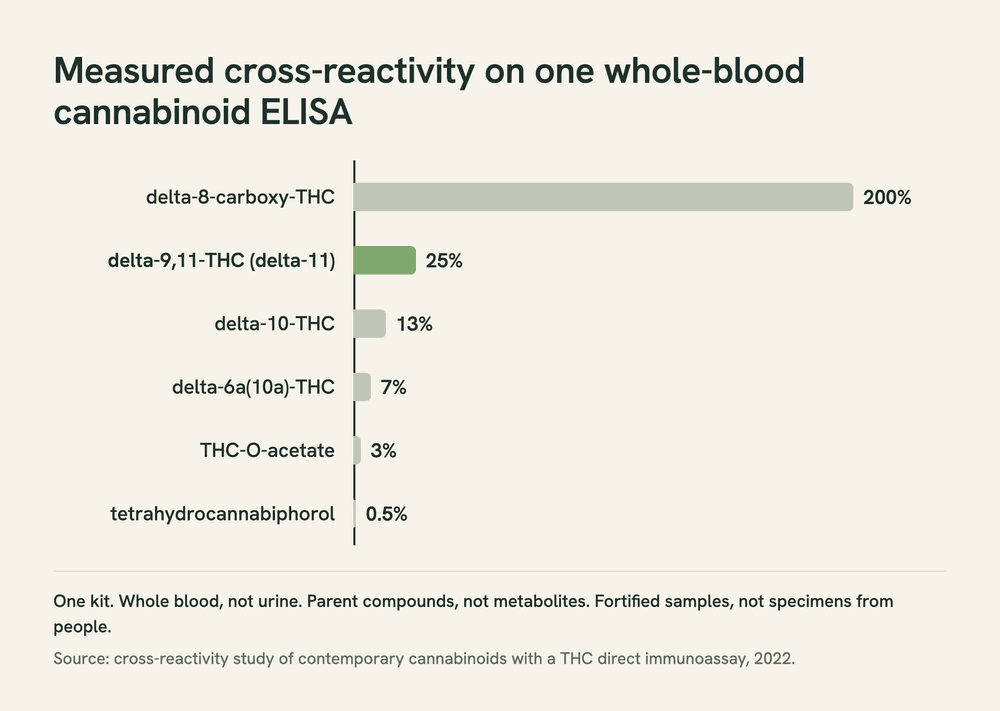
For delta-11 there is exactly one published number. A 2022 laboratory study fortified whole blood with contemporary cannabinoids and measured cross-reactivity on a commercial cannabinoid direct ELISA: 200% for delta-8-carboxy-THC, 25% for delta-9,11-THC, 13% for delta-10-THC, 7% for delta-6a(10a)-THC, 3% for THC-O-acetate and 0.5% for tetrahydrocannabiphorol. Four limits travel with that 25%, and they matter more than the figure. It is one kit. It is whole blood, not urine. It is the parent compound, not a metabolite. And it is fortified samples, meaning a known amount added to blood in a laboratory, not specimens from people who used a product. Beyond that one measurement, the AFMES LC-MS-MS panel mentioned earlier confirms Δ9,11-THC qualitatively in blood and urine and explicitly separates it from synthesis byproducts; its analyte list includes no exo-THC carboxy metabolite, which is an observation about that panel and not proof that no such metabolite exists.
Everything else is unmeasured. Whether delta-11 produces a urinary metabolite that cross-reacts on a workplace screen has not been published, and neither has how long it stays detectable in anyone. A page that answers either question is answering it from nowhere. The pattern is the same one we work through for other novel cannabinoids, where the useful move is to understand what the panel is actually looking for rather than hunt for a yes or a no; the same reasoning applies to a cannabinoid the panel was never built for.
What is still unknown, in counts
The most useful thing to know about delta-11 is the shape of the hole in the evidence. These counts come from PubMed and Federal Register searches run on November 25, 2026, with controls on each one so the zeros are bounded rather than asserted. A keyword search is a floor, not a census, and a count that reads zero today can read one tomorrow. Re-run them if the answer matters to you.
- 0 published human administration studies of delta-11-THC. WHO's review states that none of the other isomers have been tested in humans, only delta-8 and delta-6a(10a), and a fresh search found nothing added since.
- 0 assessments of its dependence or abuse liability, in animals or in people, per the same review.
- 0 published CB1 or CB2 binding constants for the molecule itself.
- 0 DEA documents naming delta-11-THC or exo-THC in a scheduling action, against 5 Federal Register documents for hexahydrocannabinol as a control.
- 0 published toxicology studies, which is exactly why no sentence on this page calls the molecule safe or unsafe.
- 1 published immunoassay measurement, in fortified whole blood, on one kit.
- 2 in-vitro metabolism papers, both in animal liver microsomes, covering seven species between them and no human tissue.
- 5 animal pharmacology papers, all published between 1985 and 1993, before CB1 pharmacology had the tools it has now.
That is the whole file. One molecule, three names, a 1971 synthesis, a small animal literature that agrees on direction, one immunoassay number, a reference standard, a general regulation with an arguable clause, and two dates in 2026. Everything beyond that list is somebody's inference, including the inferences in this article, which are labeled. If delta-11 is one stop on a longer tour, the rest of the map is in the wider cannabinoid atlas.
No. Two names, two molecules. Delta-11 is an isomer of THC with its double bond at C-11; 11-hydroxy-THC is a metabolite your liver makes out of delta-9-THC. Because delta-11's double bond already occupies C-11, the hydroxylation that creates 11-OH-THC is not available to it. When Harvey mapped delta-11's metabolism in liver microsomes from seven species in 1990, including three separate mouse strains, eleven metabolites turned up and 11-hydroxy-THC was not among them. This mix-up is the root of most of the exaggerated potency talk online, because 11-OH-THC genuinely is the metabolite people study after edibles.
Not according to the only authoritative table of THC isomers. WHO's 2018 critical review catalogues the seven double-bond isomers of THC and their thirty stereoisomers with a natural-occurrence column, and only delta-8-THC and delta-9-THC are marked yes. The delta-9,11 row is marked no. WHO records it as prepared from delta-8-THC, and FDA's forensic laboratory groups it with the unnatural THC isomers it identifies in vaping liquids. One precision: that table records no reported natural occurrence, which is the strongest evidence available but is not the same as a proof that no molecule of it has ever occurred in a plant. Either way, nothing supports the claim that it is extracted from hemp at useful quantities.
No published study says so. In rats trained on delta-9 it substituted fully but at roughly 3-fold less potency by WHO's reading (ED50 3.2 mg/kg against 1 mg/kg), and about 7-fold less in an earlier rat study. In rhesus monkeys it was 8 to 100 times less potent at suppressing operant responding, and produced no ptosis, sedation or ataxia at all. In anesthetized rats it was about 8-fold weaker at lowering blood pressure. All of that is animal data, measured intraperitoneally or intravenously, and none of it translates to a human serving. No human has been dosed with it in the published record, so there is no human potency figure to compare with anything.
Nobody has measured that in people, so no honest answer is available in either direction. The one laboratory number: in fortified whole blood, delta-9,11-THC cross-reacted at 25% on one commercial cannabinoid direct ELISA, well below delta-8-carboxy-THC's 200% on the same kit. That is one kit, whole blood rather than urine, the parent compound rather than a metabolite, and samples spiked in a laboratory rather than taken from people who used a product. Standard workplace urine screens target THC-COOH, and whether delta-11 produces a cross-reacting urinary metabolite has not been published. No product and no article can promise you a test result.
This is not legal advice, and the answer moved twice in 2026. There is no federal listing that names delta-11 or exo-THC. The Schedule I entry for tetrahydrocannabinols reaches isomers with similar chemical structure and pharmacological activity to the plant's cannabinoids, says the numbering of atomic positions does not matter, and excludes anything meeting the federal definition of hemp. That hemp definition was rewritten by Public Law 119-37, and Public Law 119-103 split the start dates: since November 12, 2026 the exclusion for cannabinoids not capable of being naturally produced by a Cannabis sativa L. plant is in force, and the remaining amendments, including the 0.4 milligram combined total per container figure, arrive on December 11, 2026. FDA has not published the cannabinoid lists the law calls for. State law is separate and often stricter.
The same molecule, under the name analytical chemists use, because the double bond sits outside the ring. FDA's forensic laboratory and the Armed Forces Medical Examiner System both call it exo-THC, and a 2025 military toxicology paper writes the identity as "Δ9,11-THC (exo-THC)" so there is no ambiguity about it. If you see exo-THC on a laboratory document and delta-11 on a product label, you are looking at one compound described by two communities.
From delta-8-THC. WHO records only a short list of routes, and the two it names both start there: ultraviolet irradiation of delta-8-THC, with a reported 30% yield, or an acid treatment followed by a strong base. The first published synthesis appeared in 1971. It also appears without anyone trying: FDA's forensic chemists propose chemical and thermal treatments during manufacturing as the reason unnatural THC isomers including exo-THC turn up in vaping liquids, and Japanese government analysts reported a delta-11 compound as a synthesis byproduct in oil products bought online. This article deliberately stops at naming the chemistry and prints no procedure.
Writing about hemp, wellness and the small rituals that keep us balanced.