What Is PHC? Four Sellers, Four Answers, One Acronym
PHC is a label, not a settled molecule. On one search page, four sellers gave four incompatible chemistries for the same three letters, and the name does not resolve in PubMed, PubChem, MeSH, ClinicalTrials.gov, DEA's list or the patent literature.
What is PHC? Search the PHC cannabinoid and the first screen of results answers you four different ways, and the four answers do not fit together. One page says PHC is delta-9 THC acetate, which is THC-O under another name. A second says it is made by adding an acetate to delta-9 THC. A third says explicitly that PHC is not a lab-created substance like THC-O. A fourth says it is a naturally occurring cannabinoid the plant makes, with the full name phenethylhydroxycannabinol. Those cannot all be true at the same time.
Here is the short answer, up front. PHC is a label, not an identified molecule. We read every reachable page-one result on September 7, 2026, and then looked the name up in seven places where a real compound leaves a trace: the medical literature, the NIH chemical database, the NIH controlled vocabulary, the federal clinical-trials registry, the DEA's alphabetical list of controlled substances, the two peer-reviewed reviews that cover this exact corner of cannabinoid chemistry, and the granted US patent people point at when they talk about hydrogenating cannabis oil. The name does not resolve in any of them. That is not a claim that products sold under this name contain nothing. It is something narrower and more useful to you: the word PHC carries no chemical identity, so it cannot tell you what is in a bottle, and no certificate of analysis can confirm it.
Four sellers, four answers, one acronym
We read every reachable result on the first screen for the PHC cannabinoid on September 7, 2026. Three would not open to us at all: two returned a 403 to an automated request and one sat behind an age gate, so nothing below describes them. We are not naming or ranking any of the pages that did open. Naming a company would turn a fact about a market into an accusation about a business, and that is not the finding here. The finding is that the pages disagree, and that a shopper reading any one of them on its own would never know it.
| Page type | What the page says PHC is, in its own words | What that would make PHC |
|---|---|---|
| A retailer blog | "a synthetic compound derived from delta-9 (D9) acetate, also known as THCO or sometimes abbreviated as D9o" | An acetate ester. In other words, THC-O under a new name |
| A second retailer blog | "PHC is created by adding an acetate to delta 9 THC" | The same acetate ester, described as a process rather than a product |
| A third retailer blog | "the term 'synthetic' in the context of PHC does not imply it's a wholly lab-created substance like THC-O", made by "converting Delta 9 acetate, which is a naturally occurring cannabinoid, into PHC" | Not the ester the first two rows name, and delta-9 acetate treated as a plant compound |
| A dispensary blog | "PHC, or Phenethylhydroxycannabinol, is one of the many naturally occurring cannabinoids present in the cannabis plant" | A phytocannabinoid the plant produces, which is incompatible with all three rows above |
Four pages, four answers, and they describe at least three different chemical classes: a manufactured ester, something the third page insists is not that ester, and a compound the plant is said to make on its own. A fifth page manages the whole disagreement by itself. It is a marketing blog that happens to be hosted on a university's public blogging subdomain, which makes it look academic and does not make it academic, and in three consecutive sentences it says PHC is "classified as a synthetic cannabinoid", that "Synthetic doesn't mean it was concocted in a lab; PHC occurs naturally in the cannabis plant", and that "PHC is derived from delta 9 THC acetate".
Then there is the name itself. The expansion offered most often for PHC is the trade name hydrox4PHC, which contains the acronym it is supposed to define. That is not how a chemical name works. A chemical name tells you what is attached to what: 11-hydroxy-THC is a THC molecule with a hydroxyl group at position 11, and you can draw it from the name. hydrox4PHC tells you that somebody wanted the word hydroxy in the product name, and nothing else.
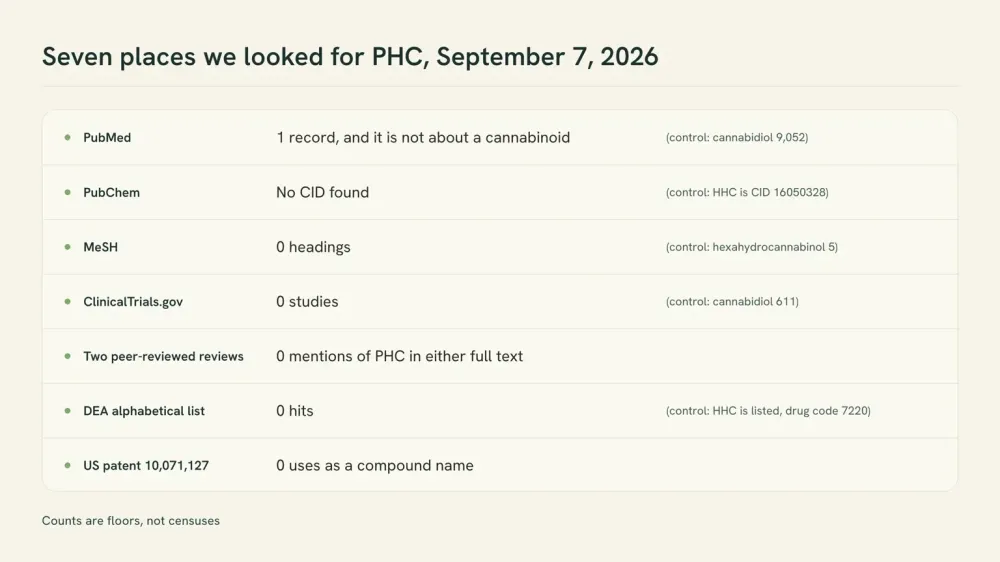
We looked the name up in seven places. It is not in any of them
Proving that something is absent is harder than proving it is present, so one search is not enough. We ran seven, chosen so that their failure modes do not overlap: a literature index, a chemical structure database, a controlled vocabulary, a trials registry, a federal list of controlled substances, two peer-reviewed reviews of the exact chemistry PHC is supposed to belong to, and the granted patent that covers hydrogenating cannabis oil. Every query and every date is printed below, and every row carries a control, because a search that returns nothing is only evidence when you can watch the same tool return something.
| Where we looked | What we searched | Result | Control on the same tool |
|---|---|---|---|
| PubMed | PHC cannabinoid; hydrox4phc; "para-hydroxy-THC" | 1, 0 and 0. The single record is not about a cannabinoid (see below) | cannabidiol returns 9,052; "11-hydroxy-THC" returns 129 |
| PubChem, the NIH chemical database | Name lookups for hydrox4phc, PHC, phenethylhydroxycannabinol and 4-hydroxy-THC | "No CID found" for all four names | Hexahydrocannabinol is CID 16050328; THC-O-acetate is CID 198013 |
| MeSH, the NIH controlled vocabulary | hydrox4phc; phenethylhydroxycannabinol | 0 and 0 headings | hexahydrocannabinol returns 5 headings |
| ClinicalTrials.gov | hydrox4phc; PHC cannabinoid | 0 and 0 registered studies | cannabidiol returns 611. Hexahydrocannabinol also returns 0 |
| Two peer-reviewed reviews of saturated and hydrogenated cannabinoids | The string PHC in both full texts | 0 in both | Both name HHC, H4CBD and their epimers throughout |
| DEA's alphabetical list of controlled substances, revision printed 27-Aug-26 | PHC; hydrox4; phenethylhydroxy | 0, 0 and 0 | "Hexahydrocannabinol; HHC", drug code 7220, Schedule I, is on the list |
| US patent 10,071,127, "Hydrogenation of cannabis oil" | The string PHC in the full description | 1 hit, inside PHCBD, which the patent defines as partially hydrogenated cannabidiol | The stem hydrogenat- appears 78 times in the same document |
The single PubMed hit is worth opening, because opening it sharpens the honest sentence rather than softening it. PMID 23728690 is a 2013 Cochrane review titled "Pharmacological interventions for smoking cessation: an overview and network meta-analysis". It matched PHC because a corresponding author's email address ends in phc.ox.ac.uk, the domain of Oxford's Department of Primary Care Health Sciences, and it matched cannabinoid because the review covers rimonabant, a drug that acts at a cannabinoid receptor. Search PubMed for PHC and cannabis together and you get five more records: a cystic fibrosis survey, two studies of primary healthcare services, a mental health unit profile and a screening study. In all five, PHC means primary health care. So the count is one, and the number of papers about a cannabinoid called PHC is zero.
One row in that table needs a warning label, and it is the DEA row. A name missing from DEA's alphabetical list of controlled substances is a fact about names. The Controlled Substances Act reaches substances by chemical identity, not by the acronym a seller prints on a box, so "not on the list" is not "lawful", it is "the list does not use this word". Read that row as evidence that the name is unrecognized, which is the argument of this page, and not as evidence about anybody's legal position. Nothing here is legal advice.
If PHC means a hydroxylated cannabinoid
Four readings of the name are worth working through, and here they are in one place: that PHC is a hydroxylated THC, that it is a hydrogenated one, that it is the acetate ester most of the pages above describe, and that it is a cannabinoid the plant simply makes. Three of them get a section each. The fourth was answered by the last section: a plant compound that anyone has identified has a chemical record, and this name has none. So start with the reading the trade name proposes, which is that PHC is a THC molecule carrying an extra hydroxyl group.
Hydroxylated THCs are not hypothetical, which is exactly the problem with this reading. The hydroxylated THC people actually study is 11-hydroxy-THC, which has its own PubChem record as C21H30O3, CID 37482, and 129 records in PubMed against zero for "para-hydroxy-THC". It is also not an ingredient anybody needs to manufacture: it is what your liver makes out of THC. If a seller means that, the interesting question is why you would buy a metabolite. We wrote that molecule up on its own page, and the metabolite belongs there, not here.
The trade name has a second problem. hydrox4PHC implies a hydroxyl group at position 4, and PubChem answers "No CID found" for 4-hydroxy-THC. So the specific molecule the name describes has no compound record at all, while the general molecule it gestures at already has a name, a CID, a literature and a metabolic origin. Neither branch of that fork ends at a new cannabinoid.
If PHC means a hydrogenated hemp extract
The second reading treats PHC as a hydrogenated product: a cannabinoid with hydrogen atoms added across a double bond. That chemistry is real, it is published, and the molecule it produces is HHC. We cover what hydrogenation does, and what it does not do, in our comparison of HHC and CBD, and we are not going to repeat it here. What matters for a label question is that this family already has a documented naming problem, and it is not our observation. A 2023 review of saturated cannabinoids in Molecules says it in the paper's own words.
“Commonly confused with HHC (Hexahydrocannabinol) that is in research and consumer markets, due to the nomenclature used, no detailed information is focused on the hydrogenated derivatives of various cannabinoids such as CBD, THC, THCV (Tetrahydrocannabivarin), and CBDV (Cannabidivarin).”
That review is a narrative review rather than new experimental data, and it is about hydrogenated cannabinoids generally, not about PHC. The letters PHC do not appear in it once. The same is true of the second review we read: of HHC, a 2023 review of hexahydrocannabinol pharmacology, toxicology and analysis in Current Neuropharmacology writes that "potency, efficacy, and adverse effects are largely unknown, putting public health and safety at risk", and that "The HHC in vivo effects on humans have not been described yet". Note what that means for the reading: HHC is the documented member of this family, it has a PubChem compound record of its own, a MeSH heading and a DEA entry, and even for HHC two reviews describe the basics as unknown. PHC has none of the three records.
The patent that gets waved at for this chemistry does not know the word either. US patent 10,071,127, "Hydrogenation of cannabis oil" was filed on June 5, 2017 and granted on September 11, 2018 to inventor Mark Andrew Scialdone, with Research Grow Labs as the current assignee, and it describes hydrogenating cannabis oil at length: the stem hydrogenat- appears 78 times in its description. It carries three granted claims, and all three of them are to isolated hexahydrocannabinoids. The letters PHC appear exactly once in the whole document, inside PHCBD, which the patent itself defines as partially hydrogenated cannabidiol. That is a different compound and it is not being used as a name for anything sold today. A granted patent is a property right, not evidence that a molecule works, is safe, or is in any bottle.
If PHC means THC-O acetate under a new name
This is the reading most page-one sellers give, in their own words: derived from delta-9 acetate, also known as THCO. Unlike PHC, that compound is not a mystery. Delta-9-THC acetate has a PubChem record of its own, CID 198013, it appears by name in laboratory paperwork, and we have written a full article about it: what an acetate ester actually is, and what the added group does. If a product sold as PHC really is that ester, then everything on that page applies to it, including the part that has nothing to do with marketing.
Now put the third seller back on the table. That page says in plain words that PHC does not imply "a wholly lab-created substance like THC-O", while two of its competitors say the acetate is exactly what it is. You cannot resolve that with a better search engine, and reading a fourth product page will not settle it either. Only an instrument can settle it, so the next question is what an instrument can actually do here.

What a certificate of analysis can and cannot settle
Here is the part you can check on our own paperwork in about a minute. Batch 260320 of our Broad Spectrum Mango and Peach tincture was collected on March 27, 2026, certified on April 1, 2026, and tested by Infinite Chemical Analysis Labs in San Diego on a UHPLC. Its potency panel names thirteen compounds: CBC, CBD, CBDA, CBDV, CBG, CBGA, CBL, CBN, CBT, delta-8-THC, delta-9-THC, THCA and THCV. THC-O-acetate does appear on that certificate, but only as one term inside the Total THC formula the laboratory prints for itself. The word PHC appears nowhere on it. It appears nowhere on anybody else's certificate either, and the reason is structural rather than suspicious.
A cannabinoid potency panel is a targeted test. The laboratory buys a reference standard for each compound it intends to report, runs it, and matches your sample against those known peaks. Every analyte on the list exists on the list because somebody sells a certified standard for it. There is no PHC reference standard, on our panel or on anyone else's, so there is nothing for an instrument to match a peak against. A certificate cannot confirm a word that no laboratory has a standard for.
- It can tell you how much of each named analyte is present, because the laboratory bought a reference standard for that analyte and matched your sample against it.
- It can tell you what one batch measured on one date on one instrument. It says nothing about the next batch, and a certificate with no batch number on it is not about your bottle.
- It cannot confirm a compound the panel has no line for. If nobody sells a certified standard under a name, no laboratory can report a result under that name.
- It cannot tell you what an unidentified peak is. An untargeted method can show that something is present; putting a name on it is a separate and much harder job.
- It cannot turn a marketing word into a chemical identity. A certificate answers how much of what we measured, never whether the story on the box is true.
Two limits on that argument, because they matter more than the argument. First, the absence of an analyte row is not a statement that a compound is absent from anything, and nothing here is an allegation about any other company's product; it is a statement about what this kind of test is able to answer. Second, this is not a claim that our panel is better than anyone else's. Thirteen analytes is an ordinary potency panel and the same structural limit applies to every certificate you will ever be shown, ours included. If you want the mechanics field by field, our guide to reading a certificate of analysis walks through them, and every batch we sell is posted on our lab results page.
What happened the last time somebody tested one of these acronyms
There is one precedent for what happens when a laboratory finally tests an invented cannabinoid acronym, and it was published in February 2026. Chemists at Portland State University bought five US vape products sold as containing THC-JD and ran them by gas chromatography and mass spectrometry against a purchased delta-8-THC-JD reference standard. Their result sentence says "no THC-JD was detected in any of the five commercial samples". The most prevalent compound in four of the five was delta-8-THC instead. The paper ran in the journal Cannabis, 2026;9(1):1-5, PMID 41853707, with NIH grant support and no declared conflicts.
Both of those numbers need their limits stated in the same breath. The Portland State analysis is five products, one laboratory and one reference standard, and it is about THC-JD, not about PHC. It is an analogy for how invented acronyms behave, not a measurement of anything sold under this name. The same authors also record that a previous peer-reviewed report did identify both THC-JD isomers in online products sold in Japan, so the paper does not say this molecule is never in anything. The labeling survey is a different study on a different continent: 186 CBD and related cannabinoid oils collected over about a decade in Europe, reported in Analytical and Bioanalytical Chemistry online on August 18, 2026 (PMID 42611266), which found that 86 of 181 did not contain the declared amount of CBD and that hexahydrocannabinol turned up in a product marketed as full spectrum. That is a European market and a ten-year collection, not a US snapshot. Its relevance here is narrow and it is enough: the gap between what a cannabinoid label says and what is in the bottle is measurable, and it has been measured.
The legal layer, dated
Legal answers on this topic are dated rather than permanent, and none of what follows is legal advice. Section 781 of Public Law 119-37, enacted on November 12, 2025, takes effect 365 days after enactment, which is November 12, 2026. It excludes from the federal definition of hemp products containing cannabinoids that are "not capable of being naturally produced by a Cannabis sativa L. plant", and separately those that are capable of being naturally produced but "were synthesized or manufactured outside the plant". Three of the four readings of the name this page has worked through describe a compound made outside a plant, and the fourth, the one that says the plant makes it, is the reading with no chemical record behind it. What that clause will mean for any specific product is not something this page can tell you, and it is not something the state-by-state legality lists on seller pages can tell you either.
A second law changed the calendar. The enrolled text signed on September 2, 2026, now numbered Public Law 119-103, contains one short section beginning "Until December 11, 2026, the amendments made by section 781", which limits those amendments to two of the listed paragraphs until that date. The practical effect is two dates instead of one. What lands on November 12, 2026 is the exclusion for cannabinoids not capable of being naturally produced by a Cannabis sativa L. plant; the rest of section 781, including the clause about cannabinoids that are capable of being naturally produced but were synthesized or manufactured outside the plant, lands on December 11, 2026. The arithmetic and the mechanics belong to two other articles of ours, the 2026 hemp law read clause by clause and why part of it moved to December 11.
And the document that would actually answer the question is missing. Section 781 directed the FDA to publish lists fixing which cannabinoids the new definition names, within 90 days of enactment, which was February 10, 2026. As of September 7, 2026, 209 days past that deadline, they have not been published. We checked the Federal Register two ways and read FDA's own cannabis page the same day: that page still states the 0.3 percent standard from 2018 and contains no mention of Public Law 119-37, of section 781, of total tetrahydrocannabinol, or of either 2026 date. "Has not been published" is the whole of what we can say: not rejected, not abandoned, not expected. For the wider federal picture, start with our overview of where CBD stands legally.
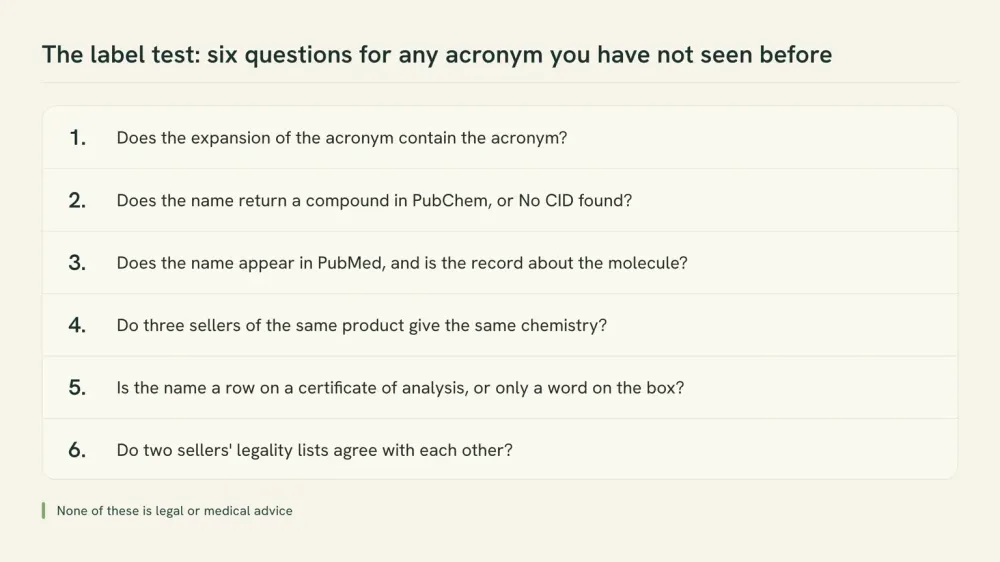
The label test: six questions for any acronym you have not seen before
None of this needs a chemistry degree, and none of it needs our conclusions. Every check below runs in a browser in a couple of minutes, all six are the checks we ran on PHC in this article, and they work just as well on the next three letters somebody invents.
- 1Does the acronym have an expansion, and does that expansion contain the acronym? hydrox4PHC fails this: it is a trade name wearing a chemical name's clothes.
- 2Type the name into PubChem's search box. A compound with an identity has a CID number. "No CID found" is an answer, and it is the answer for every name PHC is sold under.
- 3Search PubMed for the name, then open the records. A count is not evidence until you read the titles: the one hit for PHC cannabinoid is a smoking-cessation review that matched an email address.
- 4Read three sellers before you believe any one of them. If two pages describing the same product give incompatible chemistries, the disagreement is the fact, and neither page is the exception.
- 5Ask whether the name is a row on a certificate of analysis or only a word on the box. A potency panel names compounds, and if the name is not a row, no certificate can confirm it.
- 6Compare two sellers' state-by-state legality lists. If they disagree, neither one is reliable, and neither one was legal advice in the first place.
What is actually known about the PHC cannabinoid, in counts
Here is the whole public knowledge base for this name in one place, with a date on it. Every figure comes from a search we ran on September 7, 2026 that anyone can re-run, and every one of them is a floor rather than a census: a keyword search finds documents that use a word, and a substance can exist for a while before anybody publishes on it. That is the honest limit of the method, and it does not rescue the label, because the same limit applies to HHC and to THC-O-acetate and both of those return records.
| Question | What we found on September 7, 2026 |
|---|---|
| Peer-reviewed papers about a cannabinoid called PHC | 0. PubMed returns one record for PHC cannabinoid and it is a 2013 Cochrane review of smoking-cessation drugs |
| Compound records under any name PHC is sold under | 0 in PubChem. Hexahydrocannabinol, THC-O-acetate and 11-hydroxy-THC each have one |
| Controlled-vocabulary headings for the name | 0 in MeSH for hydrox4phc and for phenethylhydroxycannabinol. Hexahydrocannabinol returns 5 |
| Registered clinical trials naming it | 0. Hexahydrocannabinol is also 0 and cannabidiol is 611, so this measures the novel-cannabinoid market, not PHC alone |
| Mentions in the two peer-reviewed reviews of this exact chemistry | 0 in both full texts |
| Uses as a compound name in US patent 10,071,127 | 0. One appearance of the letters, inside PHCBD, which that document defines as partially hydrogenated cannabidiol |
| Reference standards a laboratory could test a sample against | None we could find, which is why no potency panel we have seen carries the row |
What would change this is small and specific: one compound record, one certified reference standard, one paper that names the molecule and measures it. Any of the three would move PHC from a marketing word to a chemical entity, and we would update this page when it happens. Until then the honest answer to what is PHC is that the people selling it have not told you, and they do not agree with each other about what they are not telling you. If you want the map of how cannabinoids are named and grouped in the first place, start with our guide to what cannabinoids are; if you are here because of a workplace test, the difference between a screening immunoassay and a confirmation test is covered in our piece on delta-8 and drug testing. Otherwise, the next step this page recommends is the one above: run the six checks yourself, on whatever acronym you meet next.
There is no settled answer, which is the finding rather than a gap in our research. The expansion sellers offer most often is the trade name hydrox4PHC, which contains the acronym it is supposed to define, so it explains nothing. One page-one retailer instead expands it to Phenethylhydroxycannabinol. We searched that name in PubChem and in MeSH on September 7, 2026 and both return nothing, while hexahydrocannabinol returns a compound record and five MeSH headings on the same tools.
Several page-one sellers say yes, in those words: PHC is derived from delta-9 acetate, also known as THCO. At least one page-one seller says explicitly that PHC does not imply a wholly lab-created substance like THC-O. Both statements were on the first screen of the same search on the same day, September 7, 2026. We cannot settle it for you and neither can they. What we can say is that if a given product really is an acetate ester, then everything we published about THC-O, including the hazard that is created by heating it, applies to that product.
Sellers answer both ways, and one marketing page answers both ways inside three consecutive sentences: that PHC is classified as a synthetic cannabinoid, that synthetic does not mean it was made in a lab because PHC occurs naturally in the plant, and that it is derived from delta-9 THC acetate. No chemical database we searched carries a natural-product record under any of the names PHC is sold under. A compound the plant makes, that anyone has identified, has a record.
No, and the reason is structural rather than suspicious. A cannabinoid potency panel measures named compounds against a purchased reference standard for each one. Our own batch 260320 certificate names thirteen. There is no PHC reference standard, on our panel or on anyone else's, so there is nothing for an instrument to match a peak against. That is not a claim that any product is empty. It is a statement about what this kind of test is able to answer, and it is true of every certificate you will be shown, ours included.
That question is dated, not permanent, and nothing here is legal advice. As of September 7, 2026: section 781 of Public Law 119-37, enacted November 12, 2025, takes effect on November 12, 2026 and excludes from hemp products containing cannabinoids not capable of being naturally produced by a Cannabis sativa L. plant. A second law, signed September 2, 2026 and numbered Public Law 119-103, moved the rest of section 781 to December 11, 2026. The FDA lists that would say which cannabinoids the first clause actually names have not been published, 209 days after their statutory deadline of February 10, 2026. We are not going to predict how any of that will be applied to any product.
We cannot answer that, and honestly nobody can, because the question assumes you know which molecule is in the product and the whole point of this page is that the label does not tell you. A workplace urine screen looks for a THC metabolite with an antibody, and a confirmation test looks for specific named compounds against reference standards. No page, ours included, can promise a test outcome for any product, in either direction. If a test matters to you, the variable that decides it is what is actually in the bottle, which is exactly the thing this label does not disclose.
Writing about hemp, wellness and the small rituals that keep us balanced.