Hemp Flour: What's in It and How Much THC It Can Carry
Hemp flour is the cake left after hemp seed is pressed for oil, milled and sifted. Why panels run from 33 to 50 g of protein, the THC limits in the EU, Canada and the US, what gluten-free must mean on a US label, and the shares bread studies tested.
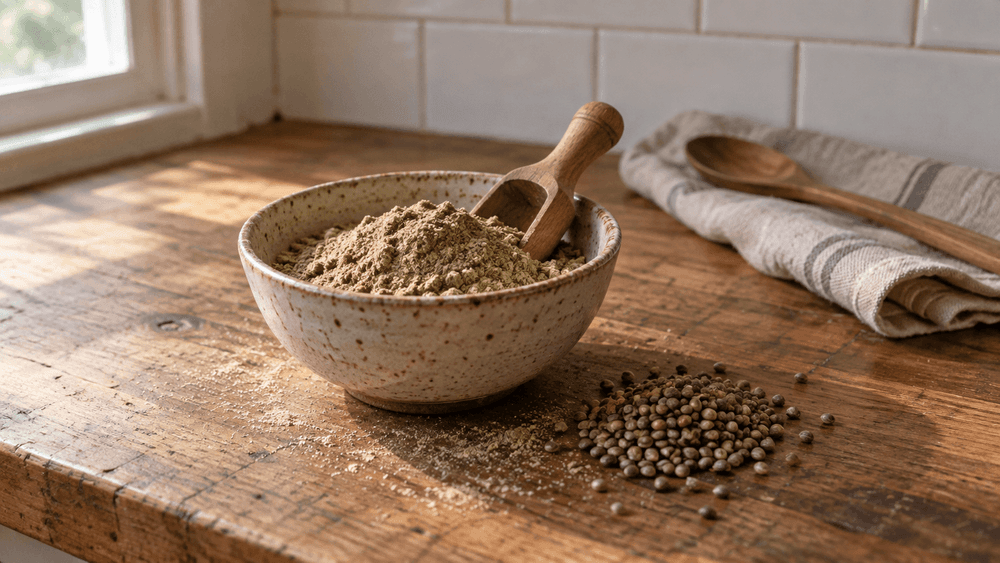
Hemp flour is hemp seed with the oil pressed out, then milled. Without the oil it is high in protein and fiber, and how finely it is sifted can move protein from about 33 to 50 grams per 100 grams. It can carry trace THC: the EU caps it at 3.0 mg/kg, Canada dropped its limit in 2025, and the US sets no number for the flour itself. Hemp is not a gluten grain, but only a bag labeled gluten-free has to meet FDA's limit.
The pages that rank for hemp flour are mostly European mills and shops, and their nutrition panels disagree with one another, sometimes by several-fold. Below you get the reason, in numbers from a filing one company sent the FDA; a side-by-side with whole wheat flour, almond flour, hulled hemp seed and hemp protein powder; the THC rules in the EU, Canada and the US, each tied to its primary source; what "gluten-free" has to mean on a US label; and the substitution levels that peer-reviewed bread studies actually tested. This is food composition, labeling and baking, not a health claim, and hemp flour is not a CBD product.
What hemp flour actually is
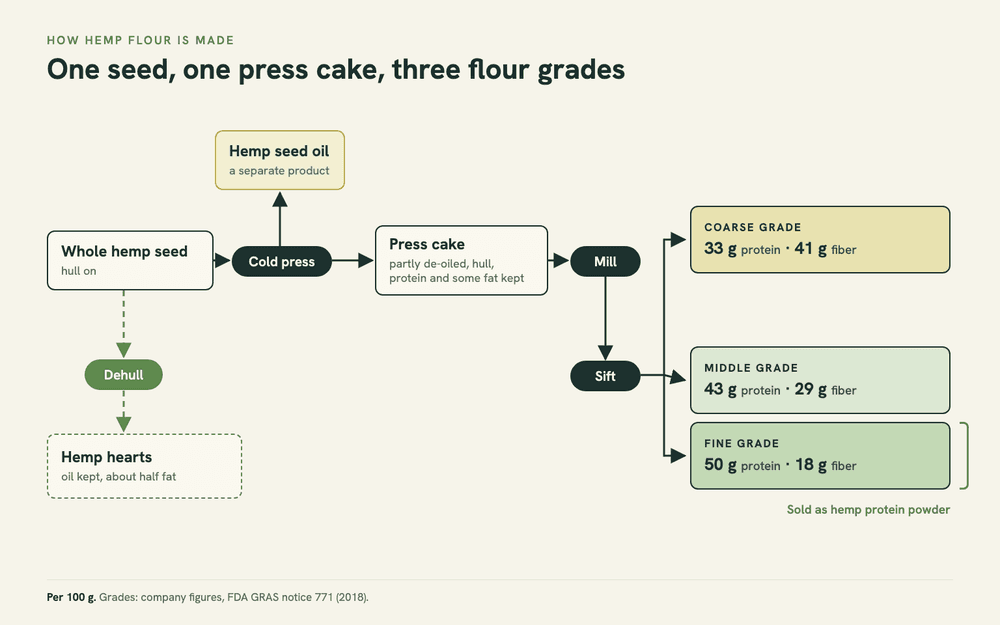
Hemp flour starts as the same small seed sold as hemp hearts and pressed into hemp seed oil. In the process one Canadian company described to the FDA, whole seeds are cold pressed, and the cake left behind is milled and sifted into powders of different particle sizes and protein grades. The oil goes one way. The cake, which still holds the hull, the protein and some of the fat, goes the other. Pressing does not remove all the oil, which is why hemp flour labels and lab analyses still show roughly 8 to 11 grams of fat per 100 grams. In order, the path looks like this:
- 1Whole hemp seed, hull on, goes into a cold press.
- 2Oil runs out one side. That becomes hemp seed oil, a separate kitchen product.
- 3The pressed cake, partly de-oiled, comes out the other side.
- 4The cake is milled into a powder.
- 5Sifting splits the powder by particle size. Fractions richer in fiber and fractions richer in protein sort differently, so one cake yields several grades.
- 6The highest-protein grades, or a water-extracted concentrate, are sold as hemp protein powder rather than flour.
Two side branches use the same seed differently. Hemp hearts are the seed with the hull removed and the oil left in, which is why they are about half fat. And some brands grind whole, unpressed seed and sell it under a flour-like name; that product keeps the seed's full fat load and behaves more like a nut meal than a flour. The same press cake also leaves the human food chain entirely as animal feed, a separate regulatory story covered in whether chickens can eat hemp seed and cake. Hemp flour is one small branch of a much bigger crop, and our overview of everything hemp is grown and used for maps the rest.
What's in hemp flour, and why two bags disagree
USDA's FoodData Central, the federal nutrient database, has no hemp flour entry; its only generic hemp record is hulled seed. So the hemp flour rows below come from two named non-USDA sources, and every other row carries its USDA FDC ID. All figures are per 100 grams. Carbohydrate includes fiber, as on a US label.
| Per 100 g | Protein | Fat | Carbohydrate | Fiber | Calories |
|---|---|---|---|---|---|
| Milled hemp seed cake, 33% protein grade (GRN 771) | 33 g | 9 g | 48.5 g | 41 g | 374 |
| Milled hemp seed cake, 43% protein grade (GRN 771) | 43 g | 10.5 g | 31 g | 29 g | 387 |
| Milled hemp seed cake, 50% protein grade (GRN 771) | 50 g | 10.5 g | 24 g | 18 g | 400 |
| Hemp seed cake flour, lab-measured, dry basis (Capcanari 2025) | 31.6 g | 8.2 g | Not reported | 43.8 g | Not reported |
| Hemp protein powder, Bob's Red Mill (FDC 2671792, label data) | 38.7 g | 6.45 g | 41.9 g | 35.5 g | 387 |
| Hulled hemp seed, or hemp hearts (FDC 170148) | 31.6 g | 48.8 g | 8.67 g | 4.0 g | 553 |
| Whole wheat flour (FDC 790085) | 15.1 g | 2.73 g | 71.2 g | 10.6 g | 370 |
| Almond flour (FDC 2261420) | 26.2 g | 50.2 g | 16.2 g | 9.3 g | 622 |
The three GRN 771 rows explain the whole spread. In the nutrition table one company filed with the FDA, the same press cake, sifted three ways, comes out at 33, 43 or 50 grams of protein per 100 grams, while fiber falls from 41 to 18 grams. Sifting does not add protein; it separates particles, and the protein-rich and fiber-rich parts of the cake sort differently by size. That is why one bag of hemp flour can declare about 29 grams of protein (a German mill's partly de-oiled flour lists 28.7 grams) while a UK mill's "fine" flour declares about 50. Both can be honest. Independent numbers land near the coarse end: a university lab that measured the composition of a hemp seed cake flour found about 32% protein, 8% fat and 44% dietary fiber on a dry basis, which reads slightly higher than an as-sold label would. If a hemp flour panel shows a number far outside this range, such as single-digit protein, treat it as a question for the seller, not a fact about hemp.
Protein quantity is not protein quality. In a 2010 analysis of 30 commercial Canadian hemp products, hemp seed meal, which is the pressed cake, scored 0.46 to 0.51 on PDCAAS, the standard protein-quality score where 1.0 is the top. Lysine, an essential amino acid, was the first limiting amino acid in every product tested. Hulled seed scored 0.63 to 0.66. The meal's digestibility was high, 90.8 to 97.5%, but it was measured in rats, the samples are from 2010, and one co-author works in the hemp food sector. In plain terms: hemp flour brings a lot of protein per gram, and that protein is short on lysine, so the grams on the panel overstate its quality.
Does hemp flour contain THC?
Start with the plant. FDA's questions and answers on cannabis-derived products say hemp seeds do not naturally contain THC, but that the hemp seed ingredients in its 2018 GRAS notices contain only trace amounts of THC and CBD, which the seeds may pick up during harvesting and processing, and that consuming those ingredients is not capable of making consumers "high". So trace THC in hemp flour is normal, and the useful question is how much is allowed. A 2026 global review of cannabis-derived foods frames it the same way: hemp seeds, oils, flours and proteins provide nutrients but require control of cannabinoid contamination, particularly total delta-9-THC. The answer depends on where you live.
| Where | What the rule covers | THC number for hemp flour | Primary source |
|---|---|---|---|
| European Union | Ground hemp seeds, (partially) defatted hemp seeds and other products derived from hemp seeds | 3.0 mg/kg of delta-9-THC equivalents (THC plus 0.877 times THCA). Whole hemp seeds: also 3.0 mg/kg. Hemp seed oil: 7.5 mg/kg | Regulation (EU) 2023/915, entry 2.6.2; first applied January 1, 2023, under Regulation (EU) 2022/1393 |
| Canada, until March 11, 2025 | Products made by processing only the grain of industrial hemp | 10 µg/g (10 mg/kg) or less, with a testing requirement | Industrial Hemp Regulations, section 2 (archived version) |
| Canada, since March 12, 2025 | The same grain-only foods | No numeric limit, and the testing requirement is gone. The crop is still capped at 0.3% THC in flowering heads and leaves, and the food must meet the Food and Drug Regulations | SOR/2025-43, Canada Gazette Part II |
| United States, federal | The hemp plant | No number for a finished seed food. The 0.3% delta-9-THC (dry weight) figure defines the plant, not the flour | 2018 Farm Bill definition, as quoted by FDA |
| United States, one company's GRAS filing | That company's own milled, sifted seed cake | 4 mg/kg of THC plus THCA: a company specification, not a federal limit | FDA GRAS notice 771 |
Some context for those numbers. Three milligrams per kilogram is the same as 3 micrograms per gram, or 3 parts per million, so 100 grams of hemp flour at the EU ceiling would hold at most 0.3 mg of delta-9-THC equivalents. The EU counts THCA, the acid form that turns into THC with heat, at 0.877 because it loses mass when it converts. The ceiling was first set in 2022 and now sits in Commission Regulation (EU) 2023/915, where hemp flour falls under entry 2.6.2 for ground and (partially) defatted hemp seeds. Before Europe set it, EFSA's occurrence data, from samples collected between 2000 and 2018 (most from 2016 on), put the median of 127 hemp seed samples at 0.39 mg/kg of total THC, with the top 5% above 3.96 mg/kg.
Canada went the other way. Until March 2025, a product made only from hemp grain was exempt from the Cannabis Act if its THC concentration after production was 10 micrograms per gram or less. Since March 12, 2025, Canada no longer sets a THC number for foods made only from hemp grain, and it dropped the testing rule that went with it. The government's reasoning is that once grain is processed, through oil extraction or grinding, it typically becomes non-viable and falls outside the definition of cannabis. Those foods still have to meet Canada's Food and Drug Regulations. If you see a 10 ppm figure quoted for Canada, it is the old rule.
In the US, the number most people quote, 0.3% delta-9-THC on a dry-weight basis, is the 2018 Farm Bill's definition of the hemp plant. It is a crop standard, not a limit printed for a bag of flour, and no FDA rule sets a THC number for hemp flour. Seed from that crop is low in THC to begin with; how hemp and marijuana differ comes down largely to that threshold. On the text of the 2025 federal law that will rewrite the hemp definition, food made from the seed's grain, oil or cake will count as industrial hemp, while the new limits for hemp-derived cannabinoid products are written for hemp other than industrial hemp. That section is not in effect yet. With timing set by a later law, Public Law 119-103, it starts in two steps: a narrow piece on November 12, 2026, and the rest, including the industrial hemp definition, on December 11, 2026, as explained in our piece on the delayed hemp ban. As of October 2026, no agency has issued guidance on how this will apply to seed foods; this is our reading of the text, not legal advice.
Is hemp flour GRAS?
You may read that hemp flour is "GRAS", generally recognized as safe. That is not accurate as written. FDA's GRAS notice inventory lists four hemp seed records: hemp seed oil (GRN 778), hemp seed protein (GRN 771) and dehulled hemp seed (GRN 765), all answered with "no questions" letters on December 20, 2018, plus a 2000 hempseed oil notice (GRN 35) that FDA said did not provide a basis for a GRAS determination. None is called hemp flour. The closest, GRN 771, covers one company's cold-pressed, milled and sifted hemp seed cake, sold as protein powder, with the company's own ceiling of 4 mg of THC per kilogram (counting THCA) and its own gluten specification of under 20 ppm. FDA said at the time that "the GRAS conclusions can apply to ingredients from other companies, if they are manufactured in a way that is consistent with the notices and they meet the listed specifications." That is not the same as FDA approving a bag of flour. A "no questions" letter is not an FDA affirmation that an ingredient is GRAS, and a whole seed ground without pressing, or a flour outside those specifications, is not described by GRN 771 at all.
What the studies on hemp seed foods and drug tests actually measured, and what they cannot tell you about today's products, is in our review of whether hemp seed foods can trigger a positive drug test.
Is hemp flour gluten-free?
Hemp is not a gluten grain. Under FDA's rule, the gluten-containing grains are wheat, rye, barley and their crossbred hybrids, and hemp is none of those. The issue is cross-contact: the same fields, trucks and mills that handle wheat can leave gluten in a seed or flour that has none of its own. One German hemp flour mill says on its own product page that it cannot technically guarantee its flour is 100% gluten-free, and that it may contain traces of gluten-containing cereals. Under 21 CFR 101.91, the federal gluten-free rule, a "gluten-free" claim on a US bag means all of the following:
- No ingredient is wheat, rye, barley or a crossbred hybrid of them, or made from one without removing the gluten; or the food is inherently free of gluten.
- Any gluten that gets in unavoidably, from shared fields, trucks or mills, stays below 20 parts per million.
- The same rule covers "no gluten", "free of gluten" and "without gluten" on the front of the bag.
- It is a rule for labels. A flour with no gluten-free claim has not promised anything either way.
How often does cross-contact happen? The best US number is not about hemp. When researchers tested 22 naturally gluten-free grains, seeds and flours bought in US stores in 2009 without a gluten-free label, 13 came in below the test's 5 ppm quantification limit, but 7 had 20 ppm of gluten or more, and one reached 2,925 ppm. It was a small pilot and does not say which products, if any, were hemp; what it shows is that shared fields and mills matter. If you have celiac disease or otherwise need to avoid gluten strictly, buy only hemp flour labeled gluten-free, treat a third-party gluten-free certification as an extra check, and ask your dietitian if you are unsure. FDA's consumer page on gluten-free labeling explains the 2013 rule behind that definition.
Baking with hemp flour: what the studies tested
Most baking advice for hemp flour is folklore: 8 to 10% of the flour from one mill, 15 to 25% from a vendor guide, a third to a half from another seller. Peer-reviewed bread studies give a narrower answer, with conditions. Three papers from one University of Parma research network baked wheat bread with 10, 15 and 25% hemp flour in place of wheat. In the group's chemistry and sensory paper, made with flour from the Felina 32 and Futura 75 hemp varieties, the hemp loaves carried more linoleic acid and more of the amino acids lysine, leucine and phenylalanine, and tasters accepted them despite a minor bitter note. In the same group's loaf-technology tests, the 10 and 15% breads rose higher and stayed softer than plain wheat bread over 7 days of storage: specific volume was 4.1 and 3.8 liters per kilogram against 3.4 for the plain loaf, while the 25% loaf came out smaller, at 3.1. The authors called 15% a satisfactory compromise. A third paper from the network, which also ran the breads through a laboratory digestion model (in vitro, with no people involved, so it says nothing about health), found that color, moisture, water activity and texture shifted with hemp, and landed on 10 to 15% as the best balance between nutritional attributes and acceptable technical performance.
For a wider range, the Moldovan lab that measured the cake flour above baked dry pretzels with 5 to 40% hemp seed cake. Up to 10% still tasted like a traditional pretzel; at 30% and above, tasters found them nuttier and denser. Across that range, protein rose from 7.49 to 12.62% and fiber from 0.90 to 11.78%. (The paper's "source of protein" framing is an EU labeling rule, not a US one.) Even the company behind GRN 771 assumed hemp would replace only part of the flour: its filing lists baked goods at 1 to 12%. One caution on all of this: the Parma chemistry and digestion papers are paywalled, so for those two we report the direction and the authors' choices from their abstracts, not sensory or texture scores we could not check.
| Study | What was baked | Hemp share tested | What changed |
|---|---|---|---|
| Del Vecchio 2025, Food Research International | Wheat bread | 10, 15, 25% | More linoleic acid, lysine, leucine and phenylalanine; tasters accepted it, with a minor bitter note |
| Del Vecchio 2025, European Food Research and Technology | Wheat bread, stored 7 days | 10, 15, 25% | 10 and 15%: higher specific volume (4.1 and 3.8 L/kg vs 3.4 plain), lower hardness, slower firming; 25% smaller (3.1); 15% called the compromise |
| Mussio 2026, Food Chemistry | Wheat bread, plus in vitro digestion | 10, 15, 25% | Color, moisture, water activity and texture shifted; 10 to 15% the best balance |
| Capcanari and Covaliov 2025, Foods | Dry pretzels | 5 to 40% | Up to 10% tasted traditional; 30% and above nuttier and denser |
How to start in your own kitchen
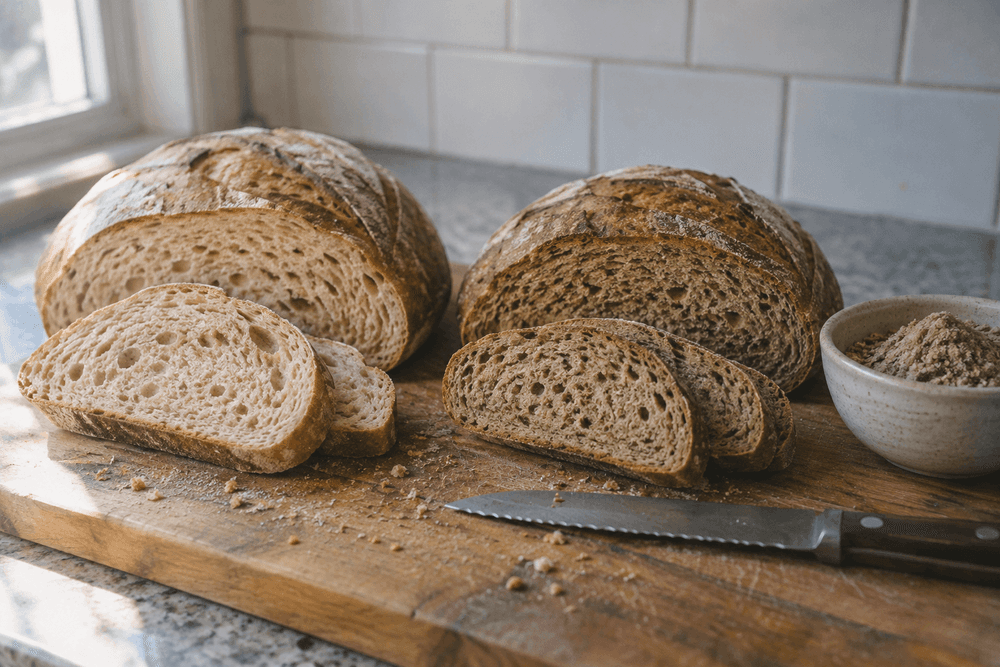
- 1Replace 10% of the flour by weight with hemp flour in your first loaf. If you like it, try 15%. Past that, expect a denser, nuttier result.
- 2Weigh rather than measure by the cup, so your percentage is real.
- 3Have a little extra water ready. Fiber-rich flour absorbs water, and the pretzel researchers adjusted water as the hemp share rose.
- 4Keep wheat or another gluten-forming flour as the base of a yeast bread. Hemp flour has no gluten, so it cannot hold the rise on its own.
- 5Expect a darker crumb and a nutty, slightly bitter note that grows with the hemp share.
- 6In gluten-free baking, use it as one part of a blend, not the base flour, and choose a bag labeled gluten-free if gluten matters to you.
These are starting points drawn from lab bakes with set recipes, not guarantees for your oven. Quick breads, crackers and pancakes, which do not depend on gluten for structure, are more forgiving, but no study we found tested them, so treat any share above 15% there as your own experiment.
Hemp flour vs hemp hearts vs hemp protein powder
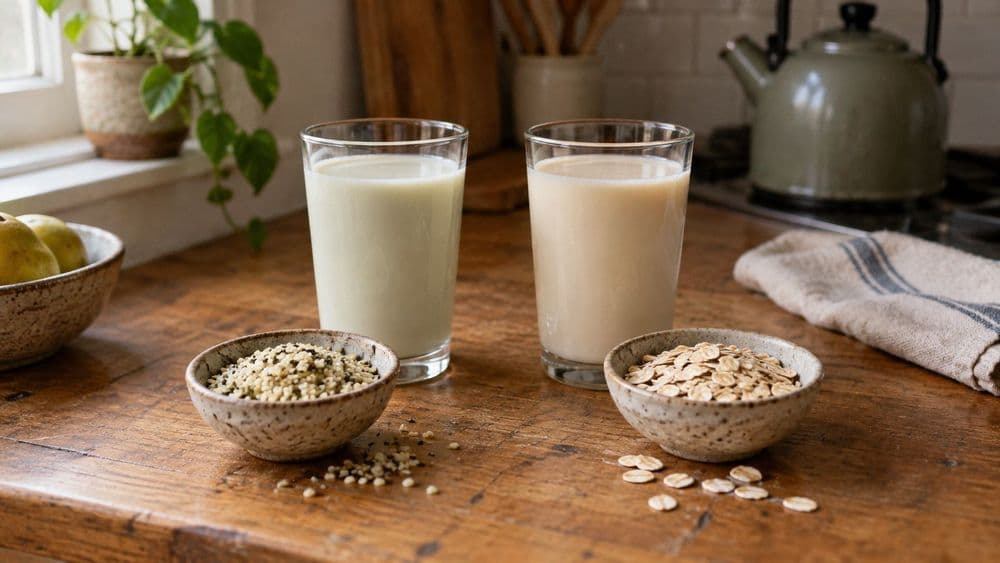
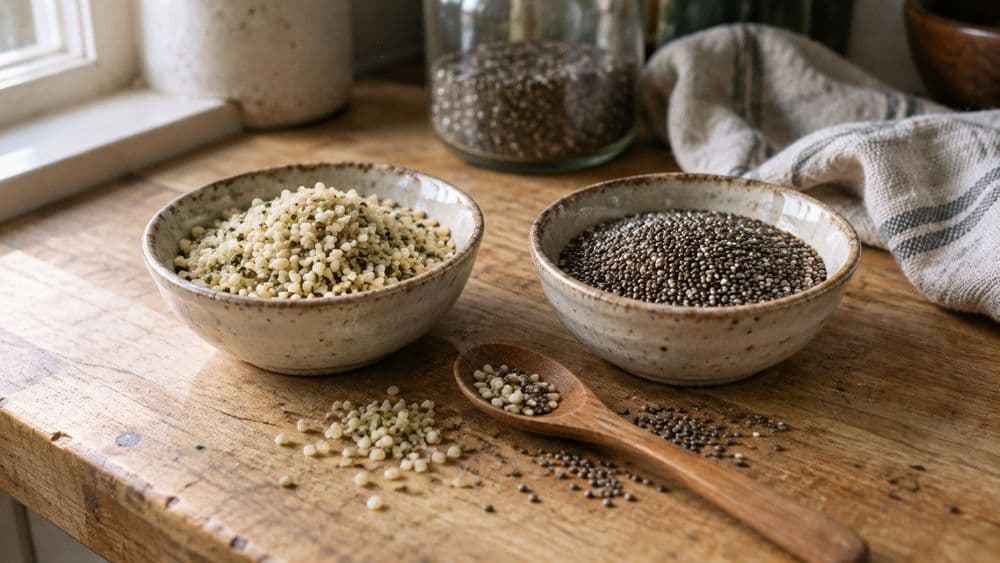
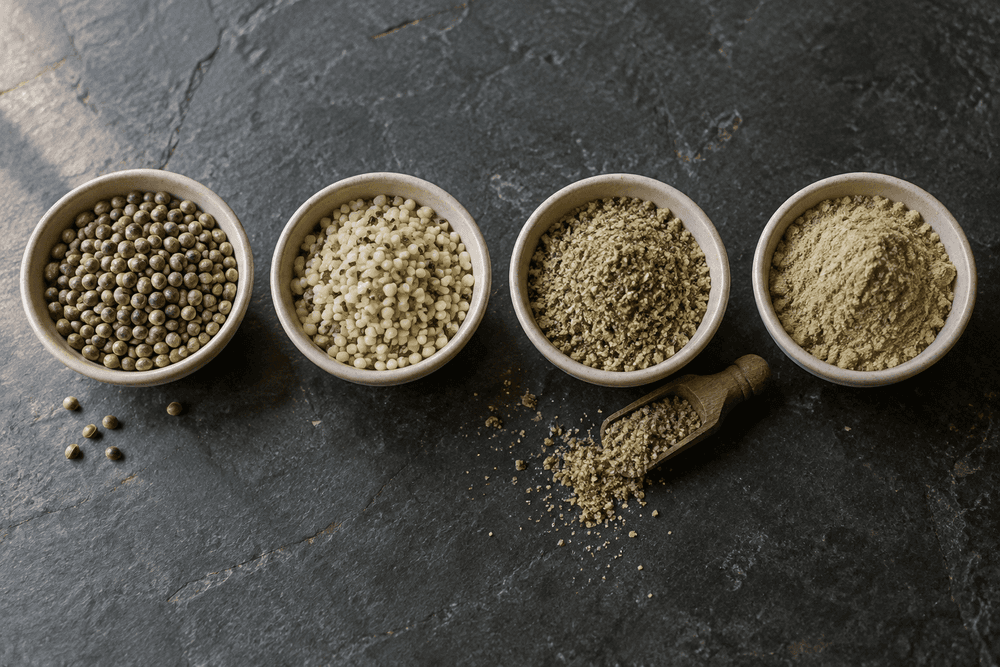
They are the same seed cut three ways. Hemp hearts are the seed with its hull removed and its oil kept, so they are about half fat and low in fiber: 48.8 grams of fat and 4 grams of fiber per 100 grams in USDA's entry. Our side-by-side of hemp hearts and chia seeds, gram for gram covers the hulled seed in detail. Hemp flour is the pressed cake, hull included, so protein and fiber are high and fat is low. Hemp protein powder is that cake sifted finer or concentrated further, which is why the GRN 771 grades climb to 50 grams of protein and the company's water-extracted concentrate goes above 64.5%. If you want protein for training rather than baking, our look at hemp protein, cannabis and muscle gains is the better read. Hemp milk is a fourth product again, hulled seed blended with water and strained, compared in hemp milk vs oat milk, cup for cup. And the oil pressed out of the flour's cake is hemp seed oil, a food oil, not CBD oil; how hemp seed oil and CBD oil differ comes down to which part of the plant is used.
Mold toxins, storage and the label checklist
One contaminant question is specific to flour. When an Italian team cold-pressed naturally contaminated hemp seed, about nine-tenths of three Alternaria mold toxins stayed in the cake, the part that becomes flour: 89.1% of tenuazonic acid, 93.3% of alternariol and 91.9% of alternariol monomethyl ether. Sifting at 450 micrometers did not remove them. Of three hemp flours the team bought in Italian shops, one carried 2,282 micrograms of tenuazonic acid per kilogram and the others 320.5 and 614, while the oils carried almost none. The EU sets no legal limit for these toxins, only indicative monitoring levels for other foods, and the study is small and Italian. It does not show that US hemp flour is unsafe. It shows that whatever mold toxins a seed lot carries end up concentrated in the flour, which makes contaminant testing a fair thing to ask a brand about. For aflatoxin, a different mold toxin, FDA's action level in foods is 20 ppb, and a 2020 FDA follow-up letter on the hemp seed GRAS notices corrects the aflatoxin specification in the three hemp seed notices from under 0.5 to under 5 ppb.
Storage matters because pressing leaves some oil behind. In the GRN 771 filing, 7 of the 9 grams of fat in the coarse grade are polyunsaturated, and the German mill's flour lists 7.4 of 9.4 grams; polyunsaturated fat is the kind that goes rancid fastest. Keep the bag sealed, cool and dry (the same mill warns that humidity can cause clumping and mold), and smell it before you bake: if it smells sharp or off, it has turned. We found no shelf-life study on hemp flour, so we will not give you a months figure. On allergies, FDA's GRN 771 letter notes that allergic reactions to hemp seed-derived ingredients have been documented in the scientific literature. Hemp is not one of FDA's nine major allergens, so it will not appear in a "Contains" statement; FDA says hemp seed ingredients must be declared by name in the ingredient list instead.
Before you buy, read the bag for six things. If an organic claim matters to you, what "organic" on a hemp label does and does not guarantee is worth a look too.
- 1The ingredient name: hemp seed flour, hemp seed cake or hemp seed protein. FDA says hemp seed ingredients must be declared by name.
- 2Protein and fiber: about 30 g protein with about 40 g fiber per 100 g is a coarse cake flour; near 50 g protein is a fine grade or a protein powder.
- 3Fat: a figure far above about 10 g per 100 g suggests ground whole seed rather than pressed cake.
- 4A gluten-free claim, or its absence. Only a labeled claim has to meet the under 20 ppm rule.
- 5The allergen cross-contact line, such as "may contain" wheat, tree nuts or sesame.
- 6A lot number and best-by date, and whether the brand publishes THC or contaminant test results.
What the research doesn't tell you
No study of hemp flour in people's everyday diets backs any health effect, and this page makes none: grams of protein and fiber are composition, not outcomes. The bread studies are Italian lab bakes with fixed recipes, and for two of the three we could read only the abstracts. The protein-quality numbers come from rats and 2010 samples. USDA has no hemp flour entry, so the flour rows rest on one company's filing and one lab's measurement. We found no US market survey of THC or mold toxins in hemp flour, so nobody can say what a typical US bag carries. And the 2025 US hemp law has not taken full effect and has no agency guidance yet. What the evidence does support is practical: read the panel, look for a gluten-free claim if you need one, start at 10 to 15% in bread, and keep the bag cool and sealed.
Frequently asked questions
The pressed cake left after hemp seeds are cold pressed for their oil, then milled and usually sifted. Because most of the oil is gone, it is high in protein and fiber and low in fat. Some brands instead grind whole, unpressed seed; that is closer to ground hemp seed and much higher in fat, so check the fat line on the panel.
Here is the composition rather than a verdict. Per 100 grams, a coarse hemp cake flour carries roughly 31 to 33 grams of protein, about 40 grams of fiber and under 10 grams of fat; finer grades reach 50 grams of protein with less fiber. Whole wheat flour carries 15.1 grams of protein and 10.6 grams of fiber. Hemp protein scores lower on quality than its quantity suggests, because it is short on lysine. Whether that fits your diet is your call, and a dietitian can help.
Not at food levels, according to FDA. It says the hemp seed ingredients in its 2018 GRAS notices contain only trace THC, picked up during harvesting and processing, and that eating them is not capable of making consumers high. Trace is not zero, though: the EU allows up to 3.0 mg/kg of delta-9-THC equivalents in hemp flour, the US sets no number for the flour, and no food can guarantee a drug-test result.
Hemp is not a gluten grain, but hemp flour can pick up gluten from shared fields, trucks and mills. Only a bag labeled gluten-free has to meet FDA's rule of under 20 parts per million of gluten. If you need to avoid gluten strictly, buy a bag that carries the claim.
Not cup for cup. In peer-reviewed wheat-bread studies, replacing 10 to 15% of the flour with hemp flour gave the best balance, and loaves at 10 and 15% rose higher and stayed softer than plain wheat bread over a week. In a pretzel study, up to 10% still tasted traditional, while 30% or more was nuttier and denser. Start at 10% by weight.
They behave like different ingredients. Per 100 grams, almond flour carries 50.2 grams of fat, 26.2 grams of protein and 9.3 grams of fiber (USDA FDC 2261420). A coarse hemp cake flour carries about 9 grams of fat, roughly 31 to 33 grams of protein and about 40 grams of fiber. Almond flour is rich and tender; hemp flour absorbs water and darkens the crumb, so it works best as a partial swap.
Yes, though most people use it unheated. One maker's FDA filing describes hemp seed oil as about 77% polyunsaturated fat, the kind that oxidizes fastest, so it is usually kept for dressings, dips and drizzles rather than high-heat frying. It is a food oil, not a CBD product.
Curious where hemp flour fits in the bigger picture? It is one product from a crop that also gives fiber, seed oil, hemp hearts and animal feed. Our guide to the many uses of the hemp plant follows the crop from field to shelf, so you can see where the flour sits next to everything else the same plant becomes.
Writing about hemp, wellness and the small rituals that keep us balanced.