Can Dentists Tell If You Smoke Weed? What They See, What They Can Prove
Your dentist can suspect cannabis use from smell, dry mouth, a fast pulse or gum changes, but an exam cannot prove it. Here is what the studies measured, what HIPAA lets them share, and why telling them matters for your numbing shot.
If you smoke weed and have a dental appointment coming up, "can dentists tell if you smoke weed?" is usually two questions: will my dentist notice, and what happens if they do? The honest answer is that a dentist can often suspect cannabis use from what they see, smell and measure, cannot prove it from an exam, and has a better reason to want to know than you might expect: the numbing shot, and the decision to go ahead with treatment at all.
The short answer: a dentist may notice signs that fit cannabis use, such as smoke smell, red eyes, a dry mouth, a fast pulse or long-term gum changes. None of those signs is specific to cannabis, and a routine dental visit does not normally include a drug test, so most of what your dentist knows comes from what you write on the health history form. Under the HIPAA Privacy Rule, that information is protected health information: the practice uses it for your treatment, billing and running the office, and beyond that, for adults, it is shared mainly with your authorization or under specific exceptions. The reason to tell them anyway is practical: the American Dental Association (ADA) warns that recent use changes how a dentist should approach anesthetic, and a dentist may postpone non-emergency work if you arrive high.
Can dentists tell if you smoke weed? Suspicion, not proof
Start with how dentists are actually taught to find out. The ADA's guidance page on cannabis and oral health, last updated October 26, 2023, is built around asking, not testing. It tells dentists to include questions about cannabis use in a thorough dental and medical history, and it admits that patients "may be unwilling to self-report marijuana use or unable to answer reliably." Nothing in that guidance describes drug-testing patients. When the ADA surveyed 760 member dentists for its 2021 trend report, 61% said they screen patients for marijuana use or vaping, and in a dental office, screening means the questions on your intake form and the conversation in the chair. The same report described the data available for clinical guidance as limited.
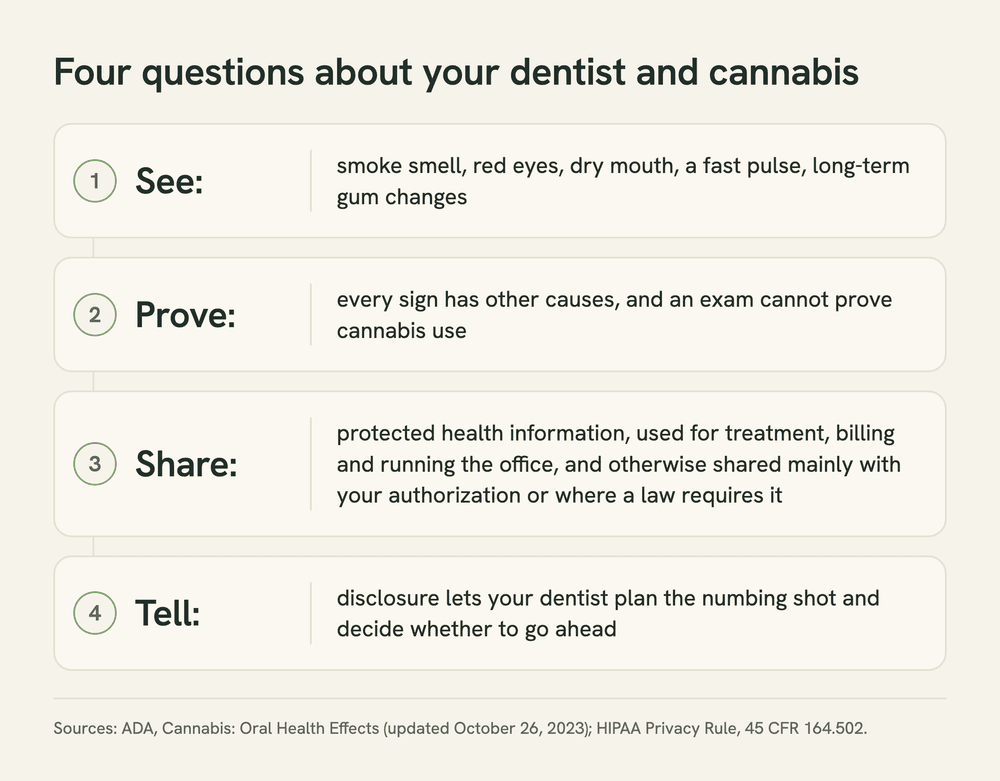
So the realistic picture has two layers. The first is suspicion: a dentist sees and smells a lot in a working day, and some of it fits cannabis use. The second is proof, and an exam does not get there, because every sign on the list below also comes from something else. Lab tests for cannabis exist, but they belong to other settings. Saliva tests, for example, are mostly a workplace and roadside tool, which we cover in how far back a mouth swab test for weed reaches. A clinic could order a test in an unusual situation, but nothing in the ADA material describes one as part of a routine cleaning or filling. That leaves four questions worth answering in order: what a dentist can see, what it proves, what they can share, and why telling them changes the visit.
What a dentist can see, smell or measure
Here is what can show up during an ordinary visit, how long each sign tends to last, and what else produces it. Read the last column first: every row ends in suspicion, not proof. The timescales come from the ADA's guidance and one lab study, and they are here to explain what a dentist might notice, not to plan a visit around. The safer move, as the rest of this article explains, is to tell them.
| Sign | Timescale | Other common causes | What it can show |
|---|---|---|---|
| Smoke smell on breath, hair or clothes | Varies; can cling to fabric and hair | Being around someone else's smoke | That you were near smoke, not that you used anything |
| Red eyes | Varies | A long list of everyday causes unrelated to cannabis | Nothing specific on its own |
| Dry mouth | The ADA cites roughly 1 to 6 hours after use | Many medications, tobacco, alcohol, mouth breathing | Nothing specific on its own |
| Fast pulse on the cuff | Short-lived; in one lab study heart rate peaked within 30 minutes of inhaling | Nerves about the visit | A reason to ask, not proof |
| Euphoria, restlessness, paranoia | The ADA says acute effects are reported to fade within 2 to 3 hours | Anxiety, other substances | A reason to ask, not proof |
| Gum overgrowth, white or red patches on the cheek lining, thrush | Months to years of regular smoking | Tobacco, some medications, other conditions | An association seen in regular smokers, not a diagnosis of cannabis use |
Three of those signs need a word of context. Dry mouth is the best-known effect of cannabis on the mouth, and the mechanism, along with why it matters for your teeth, has its own page: why weed makes your mouth dry. NIH's dental research institute notes that tobacco and alcohol also dry out the mouth and that many medications do the same, so a dry mouth on its own points nowhere in particular. Red eyes have their own list of lookalikes, covered in what actually makes eyes red after smoking. Smoke smell on breath, hair or clothes is the most obvious clue of all, and also the least precise: it tells someone you were around cannabis smoke, not whether you used anything yourself.
The pulse is worth a sentence too. If your dentist checks your pulse or blood pressure before treatment, a recent session can show up there: in a controlled dosing study of 17 healthy adults who used cannabis infrequently, heart rate peaked within 30 minutes of inhaling. A nervous patient can have a fast pulse too, which is why the reading suggests nothing on its own. The ADA also lists signs of someone who is currently high, including euphoria, hyperactivity, a racing heart and paranoia, and none of them is specific either. The longer-term findings are different in kind. Over months or years, the ADA lists changes that are more common in people who smoke cannabis: gum overgrowth, white or red patches on the cheek lining, thrush and dry mouth. Each also has other causes, from tobacco to medications, and those are the findings the research below tries to pin down.
What the gum and tooth studies measured, and what they cannot show
Gum and tooth findings get repeated online as proof that a dentist can "see" cannabis. The studies behind them are more careful than that, and they measure something narrower. The strongest design comes from New Zealand, where researchers followed 903 people born in Dunedin in 1972 and 1973, asked about cannabis at ages 18, 21, 26 and 32, and examined their gums at 26 and 32. Between those two exams, new gum attachment loss (the gum pulling away from the tooth) turned up in 6.5% of people with no cannabis exposure, 11.2% of those with some and 23.6% of those with the highest exposure. The gap held after the researchers accounted for tobacco pack-years, sex, plaque and irregular dental visits. Even so, the authors concluded only that cannabis smoking "may be" a risk factor for gum disease.
Two US analyses drew on the National Health and Nutrition Examination Survey (NHANES), a federal health survey that includes a dental exam. A 2017 analysis in the Journal of Periodontology (Shariff and colleagues, DOI 10.1902/jop.2016.160370) examined 1,938 adults: people who used cannabis at least monthly for a year had more sites with deep gum pockets, and among people who had never used tobacco, frequent users had nearly twice the odds of severe gum disease (odds ratio 1.9) after adjusting for diabetes, alcohol and other factors. A one-time snapshot like this cannot show which came first. A 2025 study in the Journal of the American Dental Association looked at teeth rather than gums in 5,656 adults aged 18 to 59 and found that at-least-monthly users were 17% more likely to have untreated cavities, with higher odds of root cavities (odds ratio 1.55) and severe tooth loss (odds ratio 1.41, a result at the edge of statistical significance). That analysis did not account for tobacco, diet or brushing, and its lead author, in the university's announcement, called it "just a snapshot in time."
The cavity finding also has a counterweight drawn from the same survey. An earlier analysis of NHANES 2011 to 2014 also found more decayed, missing and filled teeth among people who smoked marijuana, 9.87 on average against 8.72, but the difference disappeared once diet, tobacco and other factors were accounted for. That split is why a 2020 Canadian rapid evidence review of 23 articles judged the gum findings consistent and the cavity findings "sparse and inconsistent." Dental bodies treat regular use as a cavity risk; the population studies are split. The better-established link runs through dry mouth, which NIH's dental institute says raises the risk of tooth decay and fungal infections in the mouth.
Why telling your dentist changes what happens in the chair
Dentists are not asking out of curiosity, and they see this often. In an ADA survey announced November 3, 2022, 52% of 557 dentists said patients had arrived for appointments high on marijuana or another drug, 56% said they had limited treatment for those patients, and 46% said they sometimes needed more anesthetic. That last figure is the dentists' own impression, not a measurement. The same survey polled 1,006 US adults: 39% said they used marijuana, 25% vaped, 51% of those vapers vaped marijuana, and 67% of patients said they were comfortable discussing it with their dentist. The ADA's response was two requests: it suggests patients refrain from using marijuana before dental visits, and it recommends dentists discuss marijuana use while reviewing the health history.
“It can also increase heart rate and has unwanted respiratory side effects, which increases the risk of using local anesthetics for pain control.”
The strongest version of the warning is the ADA's own. Its guidance page says the cardiorespiratory effects of cannabis make the use of epinephrine in local anesthetics, the standard numbing shots used for procedural pain control, "potentially life-threatening" for a patient who is high. Dental reviews repeat the point: the 2020 Canadian review says interactions between smoked cannabis and adrenaline-containing local anesthetics "can result in life-threatening consequences," and a 2005 review in the Australian Dental Journal (Cho and colleagues) warned that epinephrine "may seriously prolong tachycardia," a racing heart, already brought on by cannabis. The concern is about the heart, and the evidence on cannabis, heart rate and blood pressure is laid out in what the blood pressure studies actually measured.
Here is the part other pages skip: the warning is plausible but thinly tested. The Canadian review states it without citing a study, and its text does not go on to examine local anesthetics. When we searched PubMed on November 25, 2026 for cannabis or THC combined with epinephrine in local anesthetics, 6 records came back and 4 were relevant; none established a safe interval between using cannabis and receiving epinephrine. In the only controlled oral-surgery study we found, a 1976 series of trials in Anesthesia and Analgesia (Gregg and colleagues, DOI 10.1213/00000539-197603000-00017) in which THC was given by IV before oral surgery, THC raised heart rate, surgical stress pushed the peak 24.1% above non-surgical controls, and the epinephrine in the local anesthetic did not change THC's effect on the heart. That is one old study with injected THC, so it does not settle the question either way, and the same authors concluded that THC interacted undesirably with other anesthetic medications. It is not evidence that the combination is safe. It is a reason the decision belongs with a dentist who knows what you used and when.
What about the idea that cannabis users need much more anesthetic? Pages that put a specific multiple on it cite nothing. The closest real data is a 2022 pilot study of 35 healthy adults, 18 regular cannabis users and 17 non-users, all of whom had abstained for at least 24 hours. After a standard injection of 1.7 mL of 2% lidocaine with 1:100,000 epinephrine, numbing worked in 61% of the users against 88% of the non-users, a gap that was not statistically significant in a group that small. Onset was about 3 minutes in both groups, and numbness lasted 30.8 against 32.8 minutes. The study recorded no heart-rate data, and the authors say larger studies are needed. If you want the broader picture for sedation and general anesthesia, what to tell your anesthesiologist about cannabis and CBD covers it.
If you arrive high: what your dentist may do
ADA guidance gives your dentist options if you show up high. The dentist may decline to treat you, or postpone non-emergency treatment for at least 24 hours, and the guidance notes there may be legal implications for the validity of informed consent given while intoxicated. In plain terms, saying yes to a procedure while high may not count as a fully informed yes. Ontario's dental regulator, writing for Canadian dentists in 2019, makes the same points: impaired decision-making can affect a patient's ability to give informed consent, a faster heart rate may influence the choice of anesthetic, and someone who is high may be less able to drive or get home unescorted afterward. It suggests a delay may be appropriate without naming an interval.
The decision can feel personal, and the literature admits that. A 2016 case report in the Journal of the American Dental Association describes a 27-year-old man booked for a molar extraction who said he had used a cannabis concentrate, a "dab," about 5 hours earlier. No treatment was given that day. He was offered a next-day appointment and refused, citing bias. The authors' conclusion cuts both ways: they urged dentists to base these decisions on scientific evidence, not on the societal stigma around cannabis. If your appointment is an extraction, ask your dentist directly what they want you to avoid afterward; aftercare is their call, not this article's. The same disclosure logic runs through other procedures, as in smoking weed after getting a tattoo.
What your dentist can share, and with whom
This section explains the rule; it is not legal advice. HIPAA's privacy rule covers health care providers who send health information electronically for things like insurance billing (the definition sits in 45 CFR 160.103), which describes most dental offices, though not necessarily every practice. Under the HIPAA Privacy Rule's section on uses and disclosures, 45 CFR 164.502, what you tell your dentist is protected health information. The practice can use and share it for treatment, payment and running the office, for example with a specialist it refers you to or with your insurer. Beyond that, it can share it mainly with your written authorization or under specific exceptions the rule lists, such as when a law requires it. Telling your employer or school is not one of those treatment, payment or operations routes, so it would generally need your authorization. The rule is issued and enforced by the US Department of Health and Human Services.
If you are under 18, the answer depends on your state. HIPAA treats a parent as the person who can see a minor's records when the parent has authority over that care, which is the usual case for a routine dental visit, because a parent normally consents to it. Section 164.502(g) makes exceptions where the minor can legally consent to the care alone, or where a parent agreed to keep that care confidential, and it defers to state law on what can or cannot be shared with parents. Where a parent is not the personal representative and state law is silent, the rule leaves access to a licensed professional's judgment. We are not printing a state-by-state table, because the outcome turns on the specific law and the specific care. If this worries you, ask the office about its confidentiality policy before you answer.
- Treatment, payment and running the practice: permitted uses of your health information without a separate authorization.
- Your employer or school: not a treatment, payment or operations route; sharing with them would generally need your written authorization.
- When a law requires disclosure: one of the specific exceptions the rule lists, so the rule is not a promise of total secrecy.
- Parents of a minor: usually the personal representative for routine dental care, with exceptions that depend on state law.
Vaping, edibles and "only once"
How you use cannabis changes what a dentist could notice. Smoke smell drops out with edibles. Dry mouth does not: it comes from the THC itself, not the smoke, and Oregon's cannabis regulator puts it plainly: "Whether you smoke it, vape, or use edibles, Cannabis can cause Cotton Mouth." A fast pulse is not smoke-specific either. Edibles add a timing twist, because the ADA notes their effects can be delayed by one to three hours, which is how someone can feel fine leaving home and high in the chair; the reasons are in why edibles take so long to kick in. Vaping is common enough that the ADA counts it: in its 2022 survey, a quarter of adults vaped and about half of them vaped marijuana.
After a single use, the only signs that could tip off a dentist are the short-lived ones from the table above. The gum and tooth findings come from people who smoked regularly; nobody has measured them after a single use, a vape or an edible. That is the honest answer to "can they tell if I smoked once": possibly, from passing signs, and there is no evidence that it would show in your gums. It is also why the disclosure question matters more than the detection question. If you used recently, including the night before, it is still worth mentioning, because your dentist is the one who decides whether it matters for your anesthetic.
A disclosure checklist for your next visit
Disclosure works best as plain facts on the form, not a confession. Here is what helps your dentist most, roughly in the order they will want it. It takes about two minutes, and every item maps to something earlier in this article: the anesthetic decision, consent, interactions or privacy.
- 1What you use: smoked flower, vape, concentrate, edible or CBD. Write it on the health history form the same way you list a medication or supplement.
- 2How often: daily, weekly or occasionally. Regular use is what the gum research looked at, so frequency is useful context for your dentist.
- 3When you last used it, especially if it was today. If you used before the appointment, say so at check-in, not halfway through the procedure.
- 4Every other medication and supplement you take, including CBD, so your dentist can check for interactions.
- 5Ask whether the planned numbing shot contains epinephrine, and whether they want to change anything given what you told them.
- 6If you are under 18, ask about the office's confidentiality policy.
- 7Arrange a ride if sedation is planned, or if you are not sure you are clear-headed enough to get home on your own.
What about CBD?
CBD belongs on the form too, for a different reason. The ADA's guidance notes that CBD is non-psychotropic, so it does not cause a high. But NIH's National Center for Complementary and Integrative Health notes that CBD use has been associated with interactions with other drugs, among other safety concerns, and it advises telling your health care providers about any complementary health approaches you use. So list CBD the same way you list a supplement. The details are in how CBD interacts with common medications and what to expect from CBD side effects, and if the compound is new to you, start with our complete guide to cannabidiol. This page makes no claim that CBD does anything for your teeth or gums.
Possibly, from short-lived signs such as smoke smell, red eyes, a dry mouth or a fast pulse, but none of those is specific to cannabis, and none proves anything. The gum and tooth changes linked to cannabis in research were measured in people who smoked regularly, not after a single use. A routine dental visit does not normally include a drug test. Whether it was once or last night, the useful step is the same: mention it, so your dentist can plan the anesthetic.
Vaping takes smoke out of the picture, so smoke-related clues are less likely. Dry mouth and a faster pulse come from the THC itself, so they can show up whichever way you use it. The research on gum disease and cavities studied smokers, so it says nothing specific about vaping. The ADA does count vaping when it screens: in its 2022 survey, 25% of adults vaped and about half of those vaped marijuana.
Smoke smell on breath, hair or clothes is the most obvious clue a dentist can notice. There is no study of dentists detecting it, and on its own it only tells someone you were around smoke. It is a reason for a dentist to ask, not proof of anything.
It depends on your age and your state, and this is not legal advice. For adults, HIPAA limits sharing to treatment, payment and running the practice, your authorization, or specific exceptions such as a legal requirement. For patients under 18, HIPAA usually treats a parent who consents to routine dental care as the person who can see those records, with exceptions where the minor can legally consent alone or a parent agreed to confidentiality, and it defers to state law on what can be shared with parents. Ask the office about its confidentiality policy if this worries you.
Nothing in the ADA's cannabis guidance describes drug-testing patients. It tells dentists to ask about cannabis in the health history, and in a 2021 ADA survey 61% of member dentists said they screen for marijuana use or vaping, which in a dental office means questions, not a lab test. A clinic could order a test in an unusual situation, but nothing in that guidance makes one part of a routine cleaning or filling.
Yes. It is the information your dentist needs to plan your anesthetic and decide whether to go ahead. The ADA recommends dentists discuss marijuana use during the health history, and its guidance warns about epinephrine-containing numbing shots for patients who are high. If you arrive high, your dentist may postpone non-emergency work. What you tell them is protected health information under HIPAA, and in the ADA's 2022 survey 67% of patients said they were comfortable discussing it.
The ADA's guidance says that for someone who is high, the epinephrine in standard numbing shots can be potentially life-threatening, because of what cannabis does to heart rate. The controlled evidence behind that warning is thin and old: one 1976 study with intravenous THC did not find that epinephrine changed THC's effect on the heart, which does not show the combination is safe either. No study has established a safe interval between using cannabis and receiving epinephrine. Tell your dentist what you used and when, and let them choose the anesthetic and the timing.
The same logic applies. Signs can suggest cannabis use, only a test confirms it, and a test needs a reason and usually your consent.
Writing about hemp, wellness and the small rituals that keep us balanced.