Shotgunning Weed: What It Is and What It Can Spread
Shotgunning weed means breathing in someone else's exhaled smoke. What the studies show about the receiver's high, which germs can pass between two people by breath and by saliva, and what no one has measured.

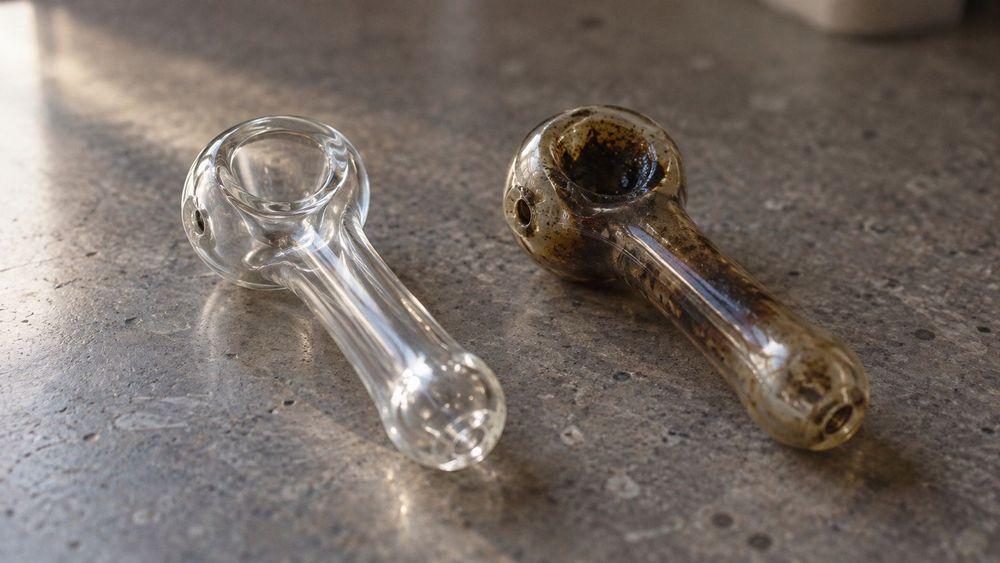
Shotgunning weed means one person inhales cannabis smoke and exhales it into another person's mouth, so the second person breathes it in. People mostly say they do it for a more intense high, but no study has ever measured how much THC the receiver actually gets. What researchers have studied is what a shared breath can carry: germs that travel on exhaled air, like tuberculosis and flu, and germs that travel on saliva, like the cold-sore virus. And both people are still inhaling smoke.
If you have been offered a shotgun hit, or watched one, the pages that rank for the term mostly explain how to do it, and none of them cite a study. There is a small medical literature on shotgunning, written mostly by infectious-disease researchers in New York and Baltimore. This page uses it: what the practice is, why people say they do it, what pharmacology can and cannot say about the receiver's dose, what can pass between two people, and what nobody has measured. It is general information for adults 21 and over, not medical advice, and not a guide to doing it.
What shotgunning weed means
The medical definition comes from a 1997 New York study in the Journal of Substance Abuse Treatment, the earliest study of the practice we found in PubMed. Its authors defined shotgunning as "the practice of inhaling smoke and then exhaling it into another individual's mouth", and in the same sentence called it "a practice with the potential for the efficient transmission of respiratory pathogens." That framing, a drug-use habit studied as an infection route, runs through nearly everything written about it since.
A 2012 Baltimore study in the American Journal on Addictions describes two forms people report. In the more common one, the smoke is drawn into the giver's mouth, held there briefly and passed on, so it has barely reached the giver's lungs. In the other, the smoke is inhaled into the giver's lungs first and then exhaled. That difference is the only detail that matters here, because it changes what the smoke can still contain by the time the second person breathes it in.
Why "shotgun"? The Baltimore researchers wrote that the term "may have originated" with soldiers smoking through an actual shotgun during the Vietnam War. That story has never been documented, and other accounts date the slang differently, so treat it as folklore. Two things shotgunning is not: it is not hotboxing, which means smoking in a closed car or room so everyone breathes the same air (our guide to secondhand smoke and drug tests covers that), and it has nothing to do with shotgunning a can of beer. It is also a THC practice. The high people are after comes from THC, not from CBD, which does not cause intoxication; our explainer on what CBD is covers the difference.
How common it is, and why people say they do it
The first numbers come from that 1997 New York survey of 354 people recruited from a syringe exchange and a detox program. Of them, 59 (17%) said they had shotgunned. Of those 59, 68% had done it with crack cocaine, 41% with marijuana and 2% with heroin, so many had used more than one drug this way. About a decade later, from 2006 to 2008, the Baltimore team interviewed 236 adults living with a serious mental illness and a substance use disorder. In that group, 145 (61%) had ever shotgunned, and 13 of them (9%) had done it in the past six months, with marijuana and crack each named by 7 of those 13.
Among the 145 Baltimore participants who had shotgunned, most (69%) had both given and received, 26.2% had only received and 4.8% had only given. A more intense high was the most common reason, and 49% named it as their main reason. Only 8% (11 of 145) understood that shotgunning could transmit disease. Keep the population in view: both studies sampled people in drug treatment or mental-health care, many of whom used crack. They show that the practice exists and why people say they do it. They do not tell you how common it is among typical adults who use cannabis, and the 17% figure should never be read that way.
Does a shotgun get you higher?
The honest answer is that nobody knows, because nobody has measured it. What pharmacology can tell you is where the THC in smoke goes. In a 1980 study of 11 healthy volunteers who received THC by vein, by smoking and by mouth, about 18% (plus or minus 6%) of the THC in a smoked cigarette reached the bloodstream. A review of human cannabinoid pharmacokinetics by a National Institute on Drug Abuse scientist reports figures from 2% to 56% across studies, depending on how people smoke, with a typical estimate of about 8% to 24%. It also explains where the rest goes: heat destroys some THC, some drifts away as side-stream smoke from the burning tip, and some stays in the unsmoked butt.
That leaves the question of what is still in a breath that has been through someone's lungs. The only human measurement of THC breathed back out comes from a 2006 evaluation of a vaporizer using pure THC: on average, about 35% of the THC people inhaled was exhaled again. That was vapor, not smoke, and it says nothing about a second person. Ordinary breath carries far less. In a 2011 study of 10 regular users, THC was detectable in exhaled breath 1 to 12 hours after smoking, at 9.0 to 77.3 picograms (trillionths of a gram) per minute. So the THC in a shotgun comes from the smoke being passed, not from the giver's breath itself.
Put those pieces together and you get reasoning, not a measurement. A lung-exhaled shotgun can only carry THC the giver did not absorb, so nothing in the pharmacology explains how passing it on would add THC. A mouth-held shotgun has barely met the giver's lungs, so the giver has had little chance to absorb its THC. Neither form has been tested in a lab, so neither has been shown to deliver more or less THC than a puff of your own. What did move blood THC and the reported high in controlled studies was how much smoke went in: a 1995 controlled study of puff volume and breath-holding found puff volume produced dose-related changes in both, while holding the smoke in longer raised blood THC but not the high. Our guide to why weed makes you cough walks through those breath-hold experiments. For a shotgun, the practical point is simple: the receiver cannot see how big the hit is, and cannot pace it.
| Question | What the evidence says | Source and limits |
|---|---|---|
| How much smoked THC reaches the blood | About 18% (plus or minus 6%) | 1980 study of 11 healthy people; low-potency cannabis of the time |
| How much that varies | 2% to 56% reported; about 8% to 24% estimated | NIDA review; depends on puffs, hold and losses to heat and side-stream smoke |
| THC breathed back out right after inhaling | About 35% of inhaled THC, on average | Vaporizer study with pure THC vapor, not smoke |
| THC in ordinary breath hours later | 9.0 to 77.3 picograms per minute | 2011 study of 10 regular users |
| THC reaching the receiver of a shotgun | Never measured | No study found in PubMed, searched November 26, 2026 |
| Whether the receiver feels more or less high | Never measured | Only self-reported reasons for doing it exist |

What can pass from one person to the next
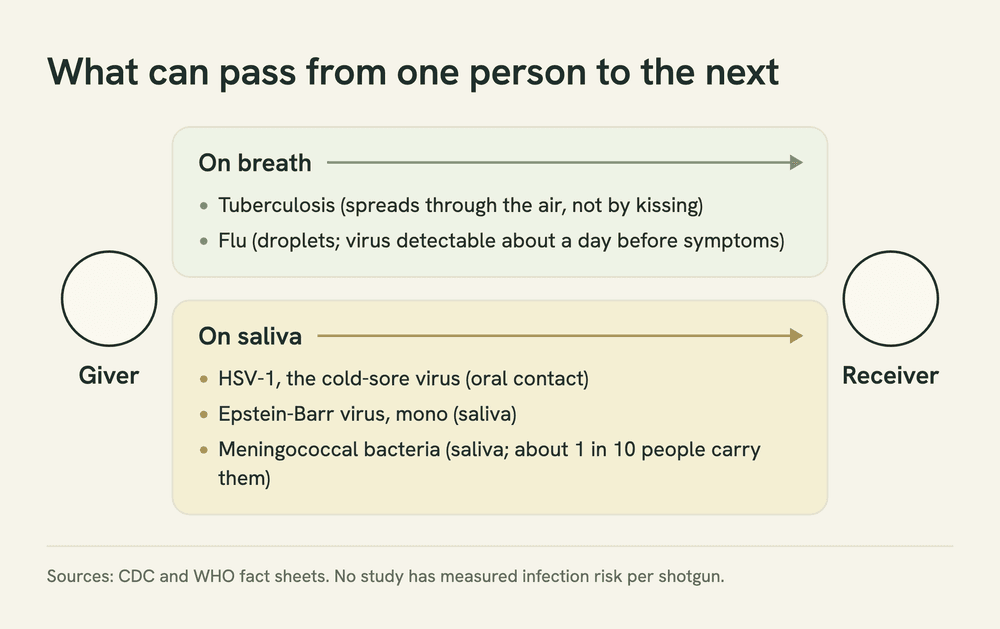
No study has counted infections per shotgun. What exists is two kinds of evidence: public-health fact sheets on how specific germs spread, and outbreak investigations in which shared smoking came up. The useful way to read them is by route. Some germs ride on exhaled breath. Others need saliva or direct mouth contact. Depending on how close two people get, a shotgun can involve both.
Germs that travel on breath: TB and flu
According to the CDC's page on how TB spreads, TB germs get into the air when a person with active TB disease of the lungs or throat coughs, speaks or sings. The same page lists kissing and sharing food or drink among the ways TB does not spread. So with a shotgun, the TB concern is not the mouths touching: it is breathing in someone's exhaled air from a few inches away. Investigators have seen versions of that pattern. In a CDC investigation of a 2004 Seattle outbreak, 11 young people with the same TB strain had all smoked marijuana together in closed cars. Among their friends, 14 of 22 (64%) tested positive for TB infection, compared with 6 of 26 (23%) of other contacts. That was hotboxing, not shotgunning, but the investigators compared the two directly: both mean sharing exhaled smoke and air. In a separate CDC analysis of an outbreak with 19 adult TB cases, 4 of the 9 women with TB reported shotgunning; as the 2019 review below notes, all of them used crack cocaine, and it is not clear how many also used cannabis.
Sharing smoking gear shows up too. In a Thai case-control study of 148 people with active tuberculosis and 117 controls, smoking from a shared bong was linked to higher odds of TB (odds ratio 4.22), in a region where TB is common. That study did not look at shotguns. Pulling these threads together, a 2019 systematic review in BMC Public Health of 11 studies called the evidence linking cannabis use to TB weak, and pointed to shared practices like bong sharing and shotgunning as the plausible route, because they involve close, prolonged contact with someone who is sick. And the one study that checked its own participants, the Baltimore study, found shotgunning was not associated with TB, a past positive TB skin test, HIV or hepatitis C in its sample.
Flu moves on breath as well. The CDC says most experts think flu viruses spread mainly by droplets made when people with flu cough, sneeze or talk, and that the virus can be detected about a day before symptoms start. Feeling fine is not a guarantee that the person handing you a shotgun is not contagious.
Germs that travel on saliva: cold sores, mono, meningococcus
If lips touch, a shotgun is oral contact. The World Health Organization's herpes simplex fact sheet estimates that 3.8 billion people under 50 (64%) have HSV-1, the virus behind most cold sores, says it mostly spreads by oral contact, and notes it can pass from oral or skin surfaces that look normal. The CDC says Epstein-Barr virus, the usual cause of mono and one of the most common human viruses in the world, spreads most commonly through saliva, as with kissing or sharing drinks. And the CDC's meningococcal disease page says those bacteria spread through saliva or spit during close or lengthy contact such as kissing, and that about 1 in 10 people carry them in the throat without being sick. None of these sources mentions shotguns. They describe how each germ moves, and a shotgun where mouths touch fits that description.
| Germ | How the authority says it spreads | What that means for a shotgun | Evidence type |
|---|---|---|---|
| Tuberculosis | Through the air when someone with active TB coughs, speaks or sings; not by kissing (CDC) | The concern is exhaled breath at close range, not the mouths touching | Fact sheet, plus outbreak reports tied to shared smoking |
| Flu | Mainly by droplets when people cough, sneeze or talk; detectable about a day before symptoms (CDC) | Face-to-face breathing; the giver can be contagious before feeling sick | General fact sheet |
| HSV-1 (cold sores) | Mostly by oral contact, including from skin that looks normal (WHO) | Applies when mouths touch | General fact sheet |
| Epstein-Barr virus (mono) | Mostly through saliva, as with kissing or sharing drinks (CDC) | Applies when saliva is shared | General fact sheet |
| Meningococcal bacteria | Through saliva or spit with close or lengthy contact; about 1 in 10 carry them without being sick (CDC) | Applies when saliva is shared; a carrier can look healthy | General fact sheet |
It is still smoke, for both people
The giver takes a full hit of smoke. The receiver breathes smoke that may feel cooler and, if it came from the giver's lungs, has had some of its THC absorbed along the way, but it has not been cleaned: the tar, carbon monoxide and irritants come from burning the plant, not from the THC. In a 1988 New England Journal of Medicine study of 15 men who smoked both, a marijuana cigarette delivered about three times the tar of a similar amount of tobacco, largely because of larger puffs, deeper inhalation and longer breath-holds, and tar delivery was only slightly influenced by how much THC the cannabis contained. One seller's guide on the first page of search results says shotgunning "potentially reduces some smoke exposure." It cites nothing, and we found no study that measured smoke exposure from shotgunning in either direction.
Shotguns usually happen inside longer shared sessions, which bring their own exposure: our guide to smoking weed from a hookah covers long sessions and a shared hose. If the thing being passed around is a blunt, its wrap adds tobacco smoke on top of cannabis smoke, as our comparison of blunts and joints explains. And if the goal is less smoke, how dry-herb vaporizers compare with smoking is the relevant read: less smoke, not less THC.
Consent, dose and when to skip it
A shotgun is close physical contact, so it takes a clear yes from both people, each time, and a no ends the conversation. It also hands the dose to someone else: the receiver cannot see how much smoke is coming or slow it down. That matters most for someone who has never used THC, or who is already very high. Too much THC at once is how people end up greening out, and an unmetered hit is an easy way to get there. If it is your first time, our guide to smoking weed for the first time is a better starting point than someone else's exhale.
- Either of you has not clearly agreed to the close contact.
- The receiver has never used THC before.
- Either of you is already very high, dizzy or nauseous.
- Either of you has a cold sore. HSV-1 can also spread from skin that looks normal, so no sore is not a guarantee.
- Either of you has a fever, flu-like symptoms or a new cough.
- Either of you has had a cough for 3 weeks or longer, or is being checked for TB.
- Either of you is under 21.
The list above is when to skip it, as the giver or the receiver. If you live with a condition or take a medicine that weakens your immune system, ask your clinician before sharing smoke or mouthpieces with anyone; our article on what studies show about THC and the immune system covers the cannabis side of that question.
Red flags after a shared session
Most shared sessions end without anyone getting sick, and a cough right after inhaling smoke is expected. Some symptoms are different. The CDC's list of TB signs and symptoms includes a bad cough that lasts 3 weeks or longer, pain in the chest, and coughing up blood or sputum (phlegm) from deep inside the lungs. Those are reasons to see a clinician whatever the cause, and it helps to say that you shared smoke. If someone you shared with is later diagnosed with TB, tell a doctor: close contacts are tested, the way the Seattle investigators tested each patient's friends.

What nobody has measured
A PubMed search for "shotgunning" we ran on November 26, 2026, returned 7 records. Four were about this practice (the two New York papers, the Baltimore study and a single case report involving crack cocaine), and none measured a dose or counted infections per shotgun. Searches pairing cannabis with exhaled smoke found no study of cannabinoids in exhaled smoke or in a second person. That leaves real gaps:
- How much THC reaches the receiver, from either form of shotgun.
- Whether the receiver feels more high, less high or the same as from their own puff.
- How mouth-held and lung-exhaled shotguns differ in THC, tar or carbon monoxide.
- The infection risk of a single shotgun, for any germ.
- Anything about passing vapor instead of smoke.
- Who does it today: both surveys date from the 1990s and 2000s and sampled people in drug treatment or mental-health care.
- Whether the outbreak signals hold up: the Baltimore study found no link to TB, HIV or hepatitis C, and the 2019 review rated the cannabis and TB evidence weak.
Questions people ask about shotgunning weed
It means one person inhales cannabis smoke and exhales it into another person's mouth, so the second person breathes it in. Researchers describe two forms: smoke held in the mouth and passed on, or smoke exhaled from the lungs. It is different from hotboxing, which is smoking in a closed space, and from shotgunning a beer.
No one knows. A more intense high was the most common reason people gave in a Baltimore study (62.8%), but no study has measured THC in the receiver's blood. Smoke from someone's lungs can only carry THC they did not absorb; in a vaporizer study with pure THC, about a third of the inhaled THC came back out.
It is the same thing: the puff of exhaled smoke the receiver breathes in during a shotgun. The receiver cannot see or control how big it is, which is why it is a poor choice for a first-timer or anyone already very high.
If mouths touch, it is oral contact. WHO says HSV-1, the cold-sore virus, mostly spreads by oral contact, even from skin that looks normal, and CDC says Epstein-Barr virus, the usual cause of mono, spreads mostly through saliva. No study has counted cases caused by shotguns.
TB spreads through the air when someone with active TB coughs, speaks or sings, and CDC says it does not spread by kissing. Shared-smoke practices have come up in outbreak investigations, including one where 4 of 9 women with TB reported shotgunning, all of them crack users. A 2019 review still called the cannabis and TB evidence weak.
No. Hotboxing means smoking in a closed car or room so everyone breathes the same smoky air. Shotgunning passes exhaled smoke directly from one person to another. CDC investigators of a Seattle TB outbreak compared the two because both involve breathing someone else's exhaled smoke.
Every study of shotgunning defined it with smoke, so there is no data on vapor. Exhaled vapor still carries the giver's breath, so the same breath and saliva routes for germs apply, and the receiver's dose is just as unmeasured.
Researchers say the name may come from Vietnam-era soldiers smoking through an actual shotgun. The story has never been documented, and other accounts date the slang differently.
Shotgunning is one corner of a bigger question: what smoke does to the people breathing it, whoever exhaled it first. The next honest read is what the lung and breath-hold studies found about cannabis smoke, including why holding it in did not make people higher.
Writing about hemp, wellness and the small rituals that keep us balanced.