Can You Smoke Resin? What's in Pipe Resin and Why It's Harsh
Pipe and bong resin is burned smoke tar, not a concentrate. Here is what the one lab analysis of real pipe residue found, whether it still gets you high, why it is so harsh on your airway, and what nobody has measured yet.
Can you smoke resin? People do, and it can still contain some THC. But pipe and bong resin is not a concentrate. It is tar: the sticky, burned residue that cannabis smoke leaves on the inside of a bowl, stem or water chamber. The one published lab analysis of real pipe residue we found detected THC and its breakdown product CBN in that tar, along with combustion chemicals and a mutagenic signal in a bacterial test. It did not measure how much THC was there, and no study has followed people who smoke resin. Smoking it means burning smoke residue a second time.
Most pages that rank for this question are written by glass and packaging sellers, and most of them explain how to collect and smoke resin without citing a single measurement. One measurement does exist: a 1992 study of the tar inside 19 cannabis pipes seized by Tokyo police, run by researchers at Jikei University with the Tokyo Metropolitan Police forensic laboratory. This page explains what it found, what larger studies of cannabis smoke measured, and what nobody has measured yet. It is general information for adults 21 and over, not medical advice, and it gives no instructions for smoking resin.
Smoking resin: what pipe resin actually is
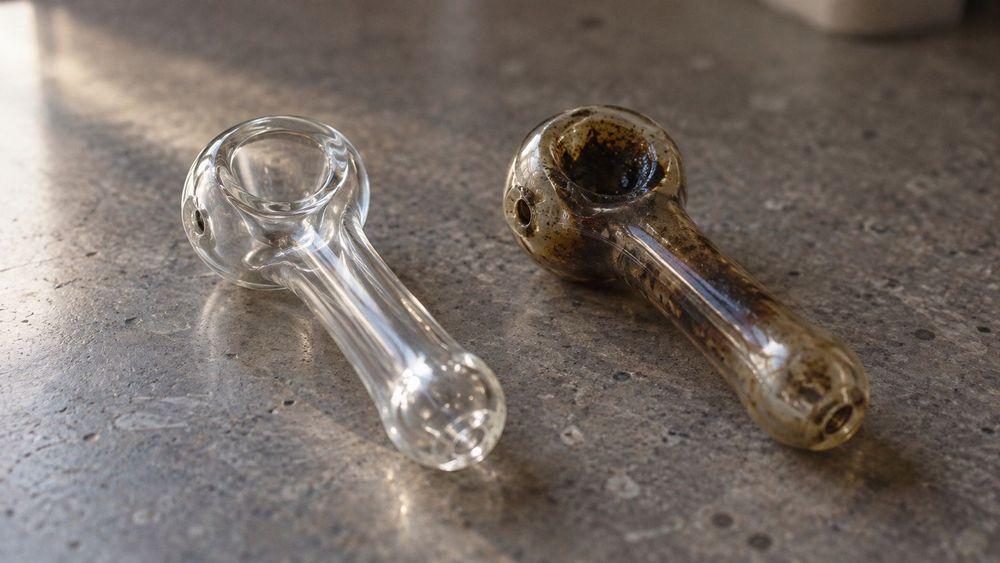
When you burn cannabis in a pipe or bong, most of the smoke ends up in your lungs or in the room. Some of it cools and condenses on the glass, metal or wood it passes through. Over many sessions that film builds into a dark brown to black, sticky layer in the bowl, the stem, the downstem and the bong water. That layer is what people mean by pipe resin or bong resin. It is a combustion product: tar, mixed with ash, fine bits of charred plant matter and whatever cannabinoids and breakdown products condensed along with the smoke. Nobody has published a percentage breakdown of that mix, so treat any composition figure you read for it as a guess.
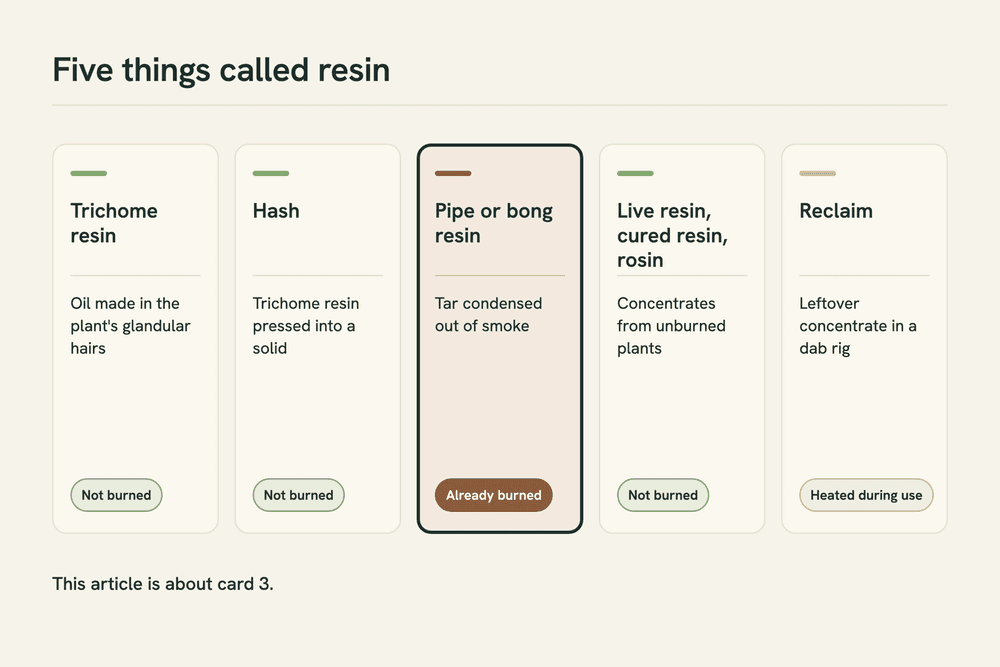
The word itself causes most of the confusion, because cannabis has at least five things called resin. Only one of them is the residue in your pipe, and it is the only one on the list that has already been burned.
| Name | What it is | Already burned? | Where it comes from |
|---|---|---|---|
| Trichome resin (plant resin) | The sticky oil made in the plant's tiny glandular hairs, where THC and terpenes are produced | No | Living or dried flower |
| Hash (called "cannabis resin" in laws and lab papers) | Trichome resin collected from the plant and pressed into a solid | No | Sifted or separated trichomes |
| Pipe or bong resin (this page) | Tar and residue condensed out of smoke | Yes | The inside of a pipe, bowl, downstem or bong |
| Live resin, cured resin and rosin | Concentrates extracted from unburned plants, with a solvent (the resins) or with heat and pressure (rosin) | No | An extraction lab or a press |
| Reclaim | Leftover concentrate that collects inside a dab rig | Heated during use | The inside of a dab rig |
If you came here for one of the other four, our guide to trichomes covers the plant's own resin, our explainer on what hash is and how it is made covers the pressed kind, and the dabs vs flower comparison covers live resin, cured resin and rosin. Reclaim is a concentrate leftover, and this page does not cover it further. Some of the research below uses "resin" to mean hash rather than pipe residue, so we flag which sense each study uses.
Can you smoke resin, and does it get you high?
People do, and it can still contain THC. The Tokyo study confirmed THC in the tar of seized pipes, so the residue is not inert, and some people who smoke it report feeling an effect. What the study did not do is measure how much THC was there. It identified THC and CBN by their chemical signatures, with no milligrams and no percentage, and we found no later study that has measured it. So when a seller page tells you resin is concentrated THC, there is no measurement behind the claim. Our guide to roaches, the stub at the end of a joint, reaches the same verdict about the joint version of this myth and rates it misleading.
Two lines of older research explain why old residue is unlikely to hold the THC it started with, although neither tested pipe residue. First, most of it never reaches the smoke. When Swiss researchers machine-smoked cigarettes loaded with THC and CBD in 1971, only 21 to 23% of the starting amount came through in the smoke, and the share of CBN rose as heat partly converted the other cannabinoids. Some of the rest is destroyed, some drifts off, and some condenses on whatever the smoke passes through. Second, THC keeps breaking down after it settles. A 1976 storage study of herbal cannabis and hashish (hashish being the "resin" in that paper) found that light destroys THC without producing CBN, while air oxidation in the dark turns it into CBN. And a 2022 study of THC breakdown and CBN formation in dried cannabis resin, again meaning raw plant resin rather than pipe residue, found that the cannabinoids changed faster as the temperature rose across the 50 to 80 °C it tested.
Put together, those findings point one way: residue that has been burned, exposed to air and heated over and over is unlikely to be the THC it started as. That is direction, not a number for your pipe. CBN is a separate cannabinoid with its own, much thinner research record, which our CBN explainer walks through, and the same slow breakdown is why old weed loses potency as it ages.
What's in pipe resin: the one study that measured it
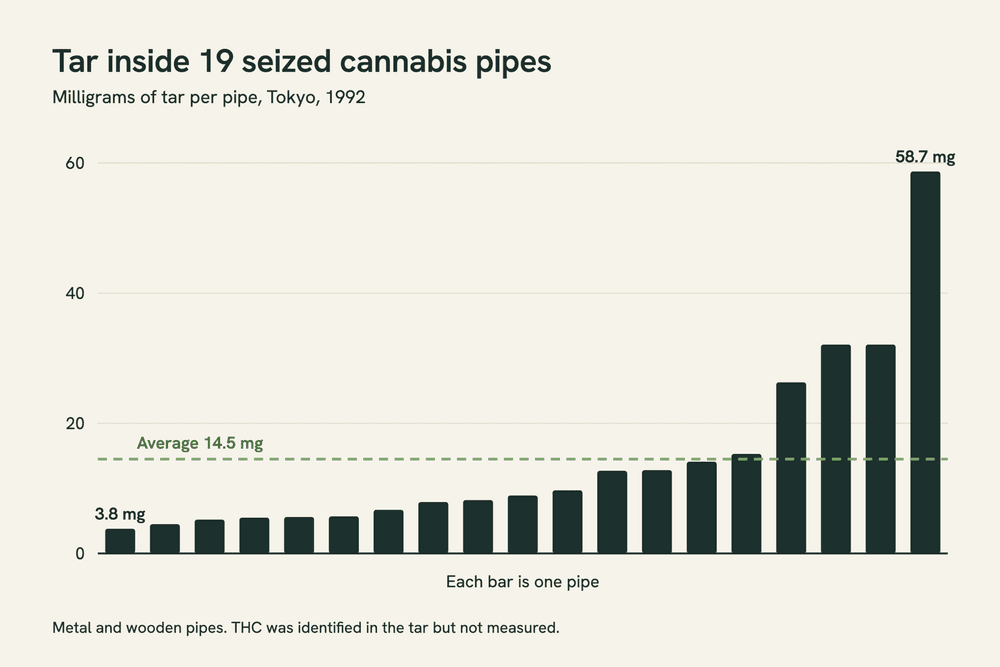
The Tokyo team worked with an unusual sample: 19 cannabis pipes seized by police, 11 made of aluminum, 6 of other metals and 2 of wood. They removed and weighed the tar in each one. Each pipe held between 3.8 and 58.7 milligrams of tar, an average of 14.5 mg, a roughly 15-fold spread. Thin-layer chromatography, confirmed by gas chromatography-mass spectrometry, identified THC and CBN in the tar. Nicotine was not detected, which suggests the tar came from cannabis alone rather than from tobacco mixed in.
Next they looked for seven polycyclic aromatic hydrocarbons (PAHs), a family of chemicals that forms when organic material burns. Five turned up. Pyrene was the most abundant, averaging 33.8 nanograms per milligram of tar (up to 171), followed by fluoranthene at 15.5 ng/mg (up to 77.7). Benzo[a]pyrene, a known carcinogen, averaged 4.1 ng/mg (up to 16.5). Benzo[e]pyrene and perylene were not detected, apart from a trace of each in one sample. The amounts varied a great deal from pipe to pipe: two samples had all seven at trace levels or below.
Finally, they ran the Ames test, a standard lab screen in which bacteria show whether a substance damages DNA. Extract from all 19 pipes caused mutations in one bacterial strain (TA98) once it was activated by liver enzymes, the step that mimics how the body processes chemicals. It did not do so in a second strain (TA100), and its potency varied about 53-fold between pipes. That is a lab signal, not proof of harm in people.
Read the study for what it is. It is from 1992. The pipes were metal and wood, not glass, and came from illicit users whose habits, amounts and burn temperatures are unknown. The full text is in Japanese, with an English abstract and tables. It found THC but never measured how much. The authors closed by saying users face a risk of developing cancer, as with tobacco. That is their inference from a bacterial test, not something the study measured, and the population data in the National Academies section below point a different way. You may also see the paper's PAH figures set beside figures for tobacco smoke. We do not make that comparison, because residue collected from a pipe and smoke drawn into a lung are different materials.
What the smoke studies measured, and what they didn't
Pipe resin is what cannabis smoke leaves behind, so studies of the smoke itself are the nearest relevant evidence. They measured smoke from flower, not resin, so read them as direction, not as numbers for resin. When Health Canada machine-smoked cannabis and tobacco cigarettes prepared the same way, the mainstream cannabis smoke (the smoke drawn through the cigarette) carried up to 20 times the ammonia of tobacco smoke. In the same tests, hydrogen cyanide, nitric oxide, nitrogen oxides and some aromatic amines came in at 3 to 5 times tobacco levels. PAHs went the other way: lower in mainstream cannabis smoke, higher in the sidestream smoke drifting off the tip. Known carcinogens were present in both.
A 2020 study in Scientific Reports went broader, detecting 2,575 compounds in machine-smoked cannabis joints. Of those, 110 are known to cause negative health effects, 69 of them shared with tobacco smoke, and fresh cannabis smoke carried about 3.4 times the particle mass of the tobacco smoke tested. The joints were unfiltered and the reference cigarettes were filtered, which tilts that comparison, and the authors presented the work as a guide for future health studies, not a risk assessment. Neither study tested residue. How people smoke matters too. In a 1988 study of 15 men who smoked both, a marijuana cigarette delivered about three times the tar of a tobacco cigarette, and a third more of that tar was retained in the airways.
| Study | What was smoked or sampled | What it measured | Did it test pipe resin? |
|---|---|---|---|
| Shimizu et al., 1992 | Tar from 19 seized metal and wooden pipes | THC and CBN (identified, not measured), 7 PAHs, bacterial mutagenicity | Yes, but no THC amount |
| Mikes and Waser, 1971 | Cigarettes loaded with THC and CBD, machine-smoked | Share of each cannabinoid reaching the smoke (21 to 23%) | No |
| Moir et al., 2008 | Cannabis and tobacco cigarettes, machine-smoked the same way | Ammonia, hydrogen cyanide, nitrogen oxides, aromatic amines, PAHs | No |
| Graves et al., 2020 | Unfiltered cannabis joints vs filtered reference cigarettes | 2,575 compounds, 110 with known health effects | No |
| Wu et al., 1988 | Marijuana and tobacco cigarettes, smoked by 15 men | Tar inhaled and retained, carbon monoxide | No |
Why resin hits are so harsh
Resin is already-burned material, so lighting it means burning combustion residue a second time. People describe the result as harsh, and that fits what is known about smoke and airways, although no study has measured resin smoke itself. A 2008 review in the journal Physiology describes a sensor on airway nerves, called TRPA1, that is activated by noxious constituents of smoke and helps set off the cough reflex. Resin smoke has not been tested, but it is smoke. Over the longer term, a 2018 review and meta-analysis of 22 studies in Annals of Internal Medicine found that, pooling the two studies that followed people over time, cannabis use roughly doubled the risk of cough (risk ratio 2.04), with the evidence graded low-strength. Our explainer on why weed makes you cough covers the reflex and the long-term lung data in depth.
Plastic is a separate and worse question. A 2021 report in Inhalation Toxicology described bleeding into the lungs' air sacs, called alveolar hemorrhage, in a 19-year-old who used a homemade plastic-bottle bong, and found four earlier cases, all young men, in the same circumstances. He recovered after steroid treatment and giving up the bong. These are case reports and the mechanism is not proven, but residue inside a plastic piece is not something to put a flame to.
Bong resin and bong water
In a bong, resin builds up in the downstem and the water chamber, and the water itself turns brown as smoke bubbles through it. Water cools the smoke, which may make it feel smoother, but no controlled study has shown a bong reduces the tar that reaches the lungs. Smoother is not the same as safer. A PubMed search we ran on November 22, 2026, for bong water or cannabis water-pipe filtration returned a single record, a case report on an unrelated question.
The best-documented risk in a bong is sharing it. In a case-control study from southern Thailand of 148 people with active tuberculosis and 117 controls, smoking cannabis from a shared bong was linked to about four times the odds of TB (odds ratio 4.22, 95% confidence interval 1.47 to 12.07). The estimate is imprecise and comes from a region where TB is common. Separately, doctors in Malaysia reported a case of severe Pseudomonas pneumonia that they said could potentially be linked to bong use. That is one case report.
- Do not share a mouthpiece. The tuberculosis link above is about sharing, not about resin.
- Do not leave old, brown water standing in a piece between uses.
- Clean the whole piece regularly, downstem included, so residue never builds up in the first place.
- Retire a homemade plastic piece rather than cleaning it and using it again.
Those are hygiene points, not a way to make resin safer to smoke. If you have wondered about other water pipes, our look at smoking weed out of a hookah covers the shisha version of the same questions.
What the big health reviews say
The most cited summary of cannabis health research is a 2017 report from the National Academies of Sciences, Engineering, and Medicine. Its chapter on respiratory disease found "substantial evidence of a statistical association between long-term cannabis smoking and worse respiratory symptoms and more frequent chronic bronchitis episodes," and "moderate evidence of a statistical association between cessation of cannabis smoking and improvements in respiratory symptoms." Its chapter on cancer reached these two conclusions:
“There is moderate evidence of no statistical association between cannabis smoking and the incidence of lung cancer. There is moderate evidence of no statistical association between cannabis use and the incidence of head and neck cancers.”
Set those beside the Tokyo pipe study and neither overstates the other. The bacterial test says the tar contains material that damages DNA in a lab test. The National Academies review, built on evidence up to 2016 and mostly on light to moderate users, found moderate evidence of no association between smoking cannabis and lung or head and neck cancer. Neither looked at people who smoke resin. The American Lung Association states its own position plainly: marijuana smoke has been shown to contain many of the same toxins, irritants and carcinogens as tobacco smoke.
Better options than smoking resin
If resin is all that is left, the useful question is not how to smoke it but what to do instead. Here is a short checklist.
- 1Clean the piece rather than smoking what is in it. Residue that never builds up is never a temptation.
- 2Treat an empty stash as a natural pause instead of a reason to burn tar.
- 3If you are reaching for resin because your usual amount no longer feels like enough, that is a tolerance question, not a resin question.
- 4If you want less smoke in general, read the evidence on vaporizing flower. Vapor is not clean air either, and the human data are thin.
- 5If you have asthma, another lung condition or a cough that will not settle, skip the resin and talk to your clinician.
The cleaning section of our one-hitter guide walks through cleaning a small pipe with isopropyl alcohol and salt. If your tolerance has crept up, our guide to taking a tolerance break explains what a few days or weeks off actually changes.
When to see a doctor
A cough right after you inhale smoke is expected. A cough that stays is a different matter. MedlinePlus, the National Library of Medicine's health encyclopedia, says to contact your provider right away if you have a cough along with any of the following, among others:
- A cough that lasts longer than 10 to 14 days
- A cough that produces blood
- A fever
- Unintentional weight loss or night sweats
- Thick, foul-smelling, yellowish-green phlegm
- Contact with someone who has tuberculosis
What is still unknown
As of November 2026, the 1992 Tokyo study is the only published analysis of real pipe residue we found. Our PubMed searches on November 22, 2026, for cannabis pipe or bong residue with any measured cannabinoid content returned no records, and a broader search for cannabis pipe or bong residue, resin, tar or deposits returned five, of which only the Tokyo study analyzed pipe residue. The gaps that matter most:
- How much THC or CBN pipe resin holds. Never measured.
- Glass pipes and bongs. The one analysis used metal and wooden pipes.
- Human exposure. No study has measured what people absorb from smoking resin or followed them over time.
- Resin smoke versus flower smoke. No study has compared them, so any claim that one carries more carcinogens than the other is unmeasured.
- Bong water. No controlled study has shown that water reduces the tar reaching the lungs.
Questions people ask about smoking resin
People do. In a pipe or a bong it is the same material: tar condensed from smoke, with some THC and CBN and combustion chemicals in it. This page explains what is known about it rather than how to do it, because no evidence shows a way to make burning tar safe.
It can, because the one analysis of real pipe residue confirmed THC in it. How much has never been measured, and part of the THC in old residue has likely oxidized into CBN. There is no evidence that resin is more potent than flower.
It means inhaling re-burned smoke tar. The only lab analysis of pipe tar found PAHs, including benzo[a]pyrene, and a mutagenic signal in a bacterial test. Long-term cannabis smoking is linked to worse respiratory symptoms and more frequent chronic bronchitis episodes, and quitting is linked to improved symptoms (National Academies, 2017). No study has followed people who smoke resin.
No. Rosin, live resin and cured resin are concentrates made from unburned plant material. Pipe resin is residue left behind by smoke. Hash is also called cannabis resin in laws and lab papers, and it is unburned too.
The residue at the end of a joint is the same kind of smoke tar, with the same unknowns. Our guide to roaches covers what is left at the end of a joint and why the concentrated-THC idea does not hold up.
Water cools the smoke, which may make it feel smoother, but no controlled study has shown a bong reduces the tar that reaches the lungs. Smoother is not the same as safer. Sharing a bong was linked to higher odds of tuberculosis in one Thai study.
Because you are burning smoke residue a second time. The nerves in your airway carry sensors that respond to irritants in smoke and trigger coughing. Resin smoke itself has never been measured, but it is smoke.
If what you really want is less smoke, the honest next read is our comparison of dry-herb vaporizers and smoking: what changes when you heat flower instead of burning it, and what the evidence still cannot tell you. And if you are curious about cannabinoids that involve no inhaling at all, our guide to choosing a CBD oil explains how to read a label and a lab report before you buy anything.
Writing about hemp, wellness and the small rituals that keep us balanced.