Faint Line on a Drug Test: Is It Positive or Negative?
On most rapid drug tests, any visible test line, even a faint one, is read as negative at that device's cutoff. Here is how the strip works, what FDA review data show right at the cutoff, why THC lines run faint, and why a home read is a screen, not a result.
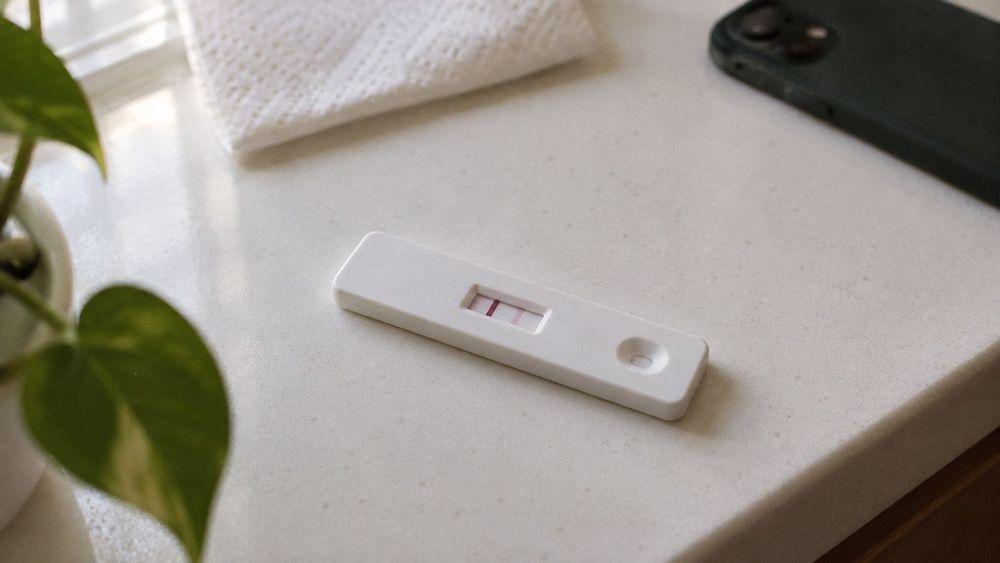
You ran a rapid drug test, the control line is clear, and next to it sits a pale, barely-there test line. Is a faint line on a drug test positive or negative? On most rapid urine cups and cassettes, any visible test line that shows up inside the read window is read as negative for that drug at that device's cutoff. That is the device's answer on that sample. It is a screen, not a result an employer, court or clinic relies on, and it cannot predict any other test.
The short answer. A drug test strip works backward from a COVID or pregnancy test: a line means the drug was not found above the cutoff, and a missing line means it may have been. A faint line still counts as a line. What it does not do is measure anything. The FDA's consumer page on home drug tests (content current as of September 27, 2018) calls them qualitative tests: "you find out if a particular drug may be in the urine, but not how much is present." Below is why the strip behaves this way, what FDA review data show when a sample sits right at the cutoff, why the THC line is the one most often faint, and what happens next in a test that actually counts.
Why a line means negative on a drug test
Most rapid urine cups and cassettes are competitive lateral-flow immunoassays. The name sounds technical, but the parts are simple. The test line (T) is printed with the drug itself, or a drug-like molecule, fixed in place. Near the sample end sit antibodies tagged with colored particles. When urine wicks up the strip, it carries those antibodies along. If the urine holds little or none of the drug, the antibodies are free, they grab the drug fixed at the T line, and color builds up there. If the urine holds enough drug, the drug occupies the antibodies first, and they flow past the T line without stopping. No color, no line. In the FDA review file for one over-the-counter test cup (K222667), the maker puts it plainly: below the cutoff, "a visible colored band will be formed on the test line region"; above it, "no colored band will be formed." A band should form on the control line (C) "regardless of the presence of target drug or metabolite in the sample to indicate that the tests have been performed properly."
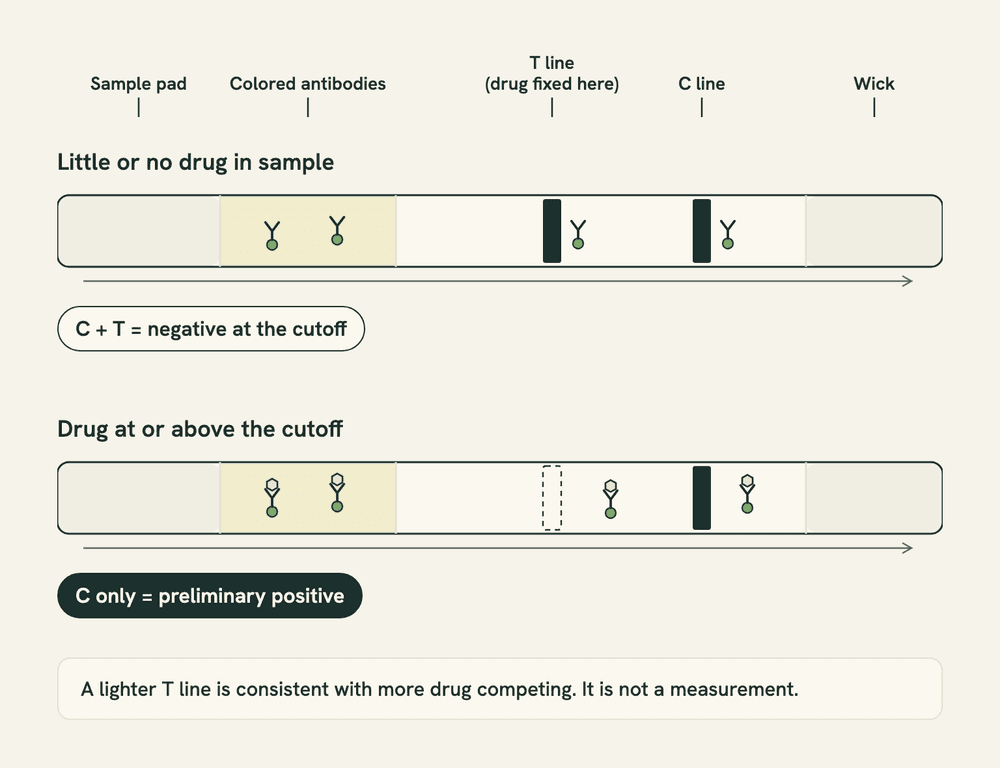
Why build a test backward? A 2021 review of drug-test strips in the journal Molecules explains that "the competitive format is usually very useful for small molecules, such as psychotropic drugs," while the two-antibody sandwich format is used for larger molecules. In the competitive format, the review notes, "the signal intensity is inversely proportional to the concentration" of drug in the sample. More drug, lighter line, until there is no line at all. Because the habit from other home tests runs the other way, the logic is easy to flip: a small 2024 student study at Seattle University listed "switching the sign of a positive and negative result" among the reading errors its testers made. If you came here about testing a CBD product rather than a person, that is a different kind of test, covered in our guide to CBD test kits.
Is a faint line on a drug test positive or negative?
Negative, on the device's own terms. Manufacturers write the faint-line rule straight into their instructions. The Abbott Toxicology product FAQ is one example:
“The shade of line in the test region will vary, but it should be considered negative, even if there is a faint line.”
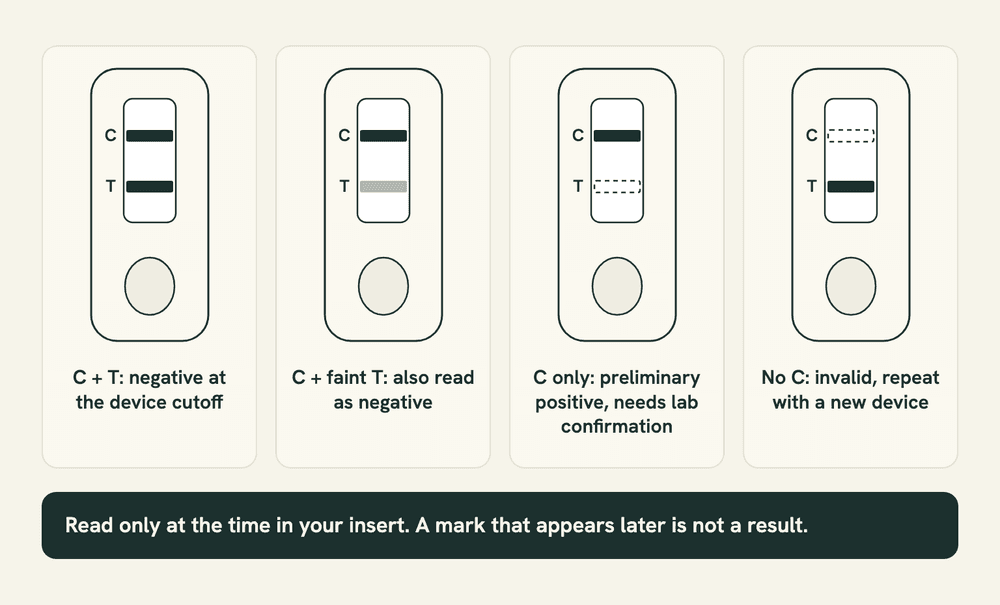
The same FAQ says that if no line appears in the control region you should "repeat the test with a new testing strip," and that "all positive results are presumptive." Wording and read times belong to each product, so your own insert is the instruction that applies. The honest answer has two halves, and you need both. First, a visible T line, even a faint one, is read as negative at that device's cutoff, on that sample. Second, that read is not a measurement and not a guarantee about any other test, for reasons the next section makes concrete. Here is how each pattern in the result window is read.
| What you see | How it is read | What it means next |
|---|---|---|
| C line plus a T line, any shade, inside the read window | Negative for that drug at the device's cutoff | A screen result on that sample; not a measurement and not a prediction of any other test |
| C line, no T line for a drug | Preliminary positive for that drug | Needs a lab confirmation; FDA advises taking no serious action before the lab result |
| No C line, with or without a T line | Invalid | Repeat with a new device |
| A mark that appears only after the read window | Not a result on that device | Use only what you saw at the stated read time |
| A T line that is patchy or very hard to see | Check your insert; do not guess | The manufacturer instruction quoted above counts any visible shade in the test region as a line |
Why the line can be faint: what happens near the cutoff
Because more drug means a lighter line, a faint line is consistent with some drug competing for the antibody. That is as far as the mechanism goes. None of the sources we reviewed maps a shade of line to a concentration, and FDA's review files record each read as positive or negative, not how dark the line was. Pages that print a number for "a faint line" do not cite one. What the FDA files do show is how a cup behaves at and around its cutoff. In the K222667 file, the THC cutoff is 50 ng/mL of THC-COOH, the same level federal programs use for their initial urine screen under the HHS authorized testing panels. The maker spiked drug-free urine to known levels, verified each by mass spectrometry, and read 150 tests at each level across 3 lots over 25 days.
Read those numbers together. A quarter below or above the cutoff, every run agreed. At the cutoff itself, the cup was a coin flip, because the cutoff is the point where the test is designed to be undecided. Real urine blurs the edge further. In the same file, 3 operators used the prescription version of the cup on 80 unaltered urine samples whose THC-COOH had been measured by mass spectrometry. The cup called a 47.8 ng/mL sample, just under the cutoff, positive and a 53.9 ng/mL sample, just over it, negative; two samples just above the cutoff split between operators. Away from the cutoff, it made no errors. FDA's lay-user study gave the cup and its instructions to 280 adults from the general public. Of the 20 who read a sample 25% below the cutoff, 2 called it positive; of the 20 who read a sample 25% above it, 1 called it negative. Both cup configurations tested showed the same split.
This is not one device's quirk. A 2001 study in the Journal of Analytical Toxicology built a deliberately hard set of real urine samples near the cutoffs for five drug classes and ran them through five rapid devices, each read by a scientist and a non-scientist. Measured against GC-MS, the devices were right about 70% of the time (66% to 74%), close to the 80% a benchtop lab analyzer scored on the same set. That 70% is a near-cutoff stress test, not a routine accuracy figure, and the devices date from 2001. The lesson still holds: near the cutoff, every screen struggles, which is exactly the zone where a faint line lives, and exactly what lab confirmation is for.
Faint line on a THC drug test: why cannabis lines run faint
A urine THC test does not look for THC. It looks for THC-COOH, an inactive metabolite your body makes as it breaks THC down. A review of cannabinoid testing by Marilyn Huestis notes that a positive urine cannabinoid test "indicates only that drug exposure has occurred," not when it happened or how impaired someone was. Most US urine cups screen the metabolite at the cutoff above, though some are made at lower cutoffs, so the number printed on your device is the one that applies.
The metabolite leaves slowly, and it does not leave in a straight line. When NIDA researchers kept 60 cannabis users abstinent on a closed, secure research unit and screened 6,158 urine specimens by immunoassay at that same cutoff, with GC-MS confirmation, they reported that "alternate positive and negative urine test results may occur in consecutive specimens." They noted that this makes it hard to tell whether a positive result reflects new use. A 1985 study of 86 chronic users under supervised abstinence found the same shape with an older lab immunoassay: most had runs of negative results followed by at least one more positive while they were not using.
Put those findings together and the faint THC line makes sense. A metabolite level drifting down through a slow tail can hover near the cutoff for a stretch, so the T line can look faint one day, absent the next and faint again, with no new use in between. The cannabis line works the same way whatever the panel size, as our 10-panel drug test explainer notes. How long the metabolite tends to linger is a separate question with its own page: how long THC stays in your system. How concentrated or dilute a sample is also shifts the level a cup sees, which is why labs measure dilution; our page on a negative-dilute result covers what a lab flags.
How long to read a drug test, late lines and invalid results
FDA's consumer page says that "with most test kits, the result must be visually read within a certain number of minutes after the test is started." The number is not universal. The K222667 cup lists a test time of 5 minutes. In the FDA file for a redesigned ALFA test cup (K173303), the earlier version's read time was 4 to 7 minutes, and the new cup was cleared for 2 to 120 minutes after "a study to evaluate the new read time." The same file explains the control line: it "should always appear" if enough sample was added and it "correctly migrated up the test strip," and users are told the test is invalid if it does not. In that file's 400-person lay-user study, 8 of the 10 lay users given a sample 25% above the THC cutoff correctly called it positive.
You may see the phrase "evaporation line" on other pages. It comes from kit sellers and pregnancy-test forums; we found no primary source that describes one for drug tests, so we will not guess at its chemistry. What is sourced is simpler: a mark that appears only after your insert's read window is not a result on that device. The checklist below is about reading a test you already have correctly. It is not a way to predict another test.
- 1Check the expiration date on the device and read the insert before you start. Note the read time it gives.
- 2Start a timer when the test starts, as the insert defines it.
- 3At the stated time, read in good, even light with the device lying flat.
- 4Find the control line (C) first. If it is missing, the test is invalid: repeat with a new device.
- 5Then check each drug's test line (T). Any visible shade counts as a line unless your insert says otherwise.
- 6If you need a record, photograph the window at the read time.
- 7Do not reinterpret the device later. Lines that change or appear after the window are not results.
Your cassette is a screen: what an employer or court test does next
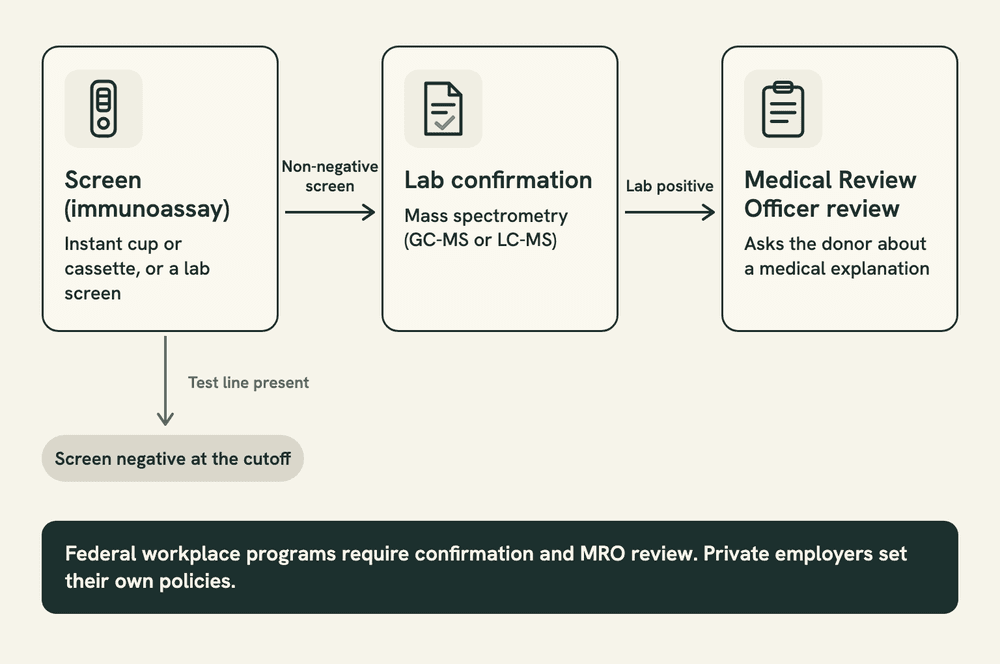
FDA describes home testing as two steps: a quick test at home, then, "if the test suggests that drugs may be present, you send the sample to a laboratory." Its advice for the meantime is "take no serious actions until you get the laboratory's result," and it adds that "no drug test of this type is 100% accurate." The K222667 file says the same from the maker's side: the tests "provide only preliminary results," and "GC/MS or LC/MS is the recommended confirmatory method."
Workplace testing follows that shape. In federal programs, a urine sample that screens non-negative goes to a confirmation test that, under the HHS mandatory guidelines for urine testing, "must use mass spectrometric identification," with the THC metabolite confirmed at 15 ng/mL. A Medical Review Officer then reviews a lab positive and must contact the donor to ask about any legitimate medical explanation. Our walkthrough of the screen, confirmation and MRO steps covers that path. Private employers outside federal programs choose their own devices and policies, so this page is not legal advice about any one workplace. Two recent federal moves leave the marijuana cutoffs where they are: FDA's October 2026 order changes how test systems for federal programs reach the market, not the cutoffs, as explained in what the drug-test 510(k) exemption changes, and a proposal HHS published on October 29, 2026 would not change them either.
Faint lines on mouth swab tests
Oral-fluid cassettes use the same competitive design, so a faint THC line on a mouth swab device is read the same way: a visible test line inside the read window is negative at that device's cutoff. What changes is the target and the numbers. A swab looks for delta-9 THC itself, not the urine metabolite, and the federal oral-fluid cutoffs in the HHS panels are 4 ng/mL to screen and 2 ng/mL to confirm. On the device, a failed mouth swab looks like a control line with no line in the THC test zone: a preliminary result that a lab confirms. How long THC shows up in saliva, and why on-site readers and labs can disagree, is covered in our mouth swab drug test guide.
CBD users and a faint THC line
The strip cannot tell where THC-COOH came from. In a 2020 study funded by SAMHSA and NIDA, six adults took 100 mg of pure CBD, orally or vaporized, and none of 218 urine samples confirmed positive. After they vaporized CBD-dominant cannabis carrying 3.7 mg of THC, four urine samples did. It was a small study of single doses, but the logic is clear: the test looks for THC's metabolite, so the THC in a product is the variable. Full-spectrum hemp products contain trace THC below 0.3%, and broad-spectrum batches may report THC as non-detected on their certificate of analysis. Neither guarantees a drug-test result. A faint line is not proof that you took "CBD only," and a clean T line today is not a promise about the next test. Our CBD and drug testing guide covers product types and the residual risk in detail.
What this page can't tell you
- What your line's shade means in numbers. No source we found converts line intensity into a concentration, and FDA files record positive or negative calls only.
- How every device behaves. The cutoff data come from two FDA-reviewed cups tested with spiked urine under study conditions; other devices, lots and cutoffs differ.
- Your read window or cutoff. Both are set device by device. Your insert is the rule that applies.
- How long cannabis will show up for you. Detection windows depend on use pattern, specimen and cutoff, and they live on our specimen pages, not here.
- What your employer, court or clinic will decide. Policies and legal consequences vary; this is general information, not legal or medical advice.
For the legal backdrop to hemp, CBD and THC limits, start with our overview of whether CBD is legal.
Frequently asked questions
On most rapid tests it is read as negative, as long as it appears inside the read window and the control line is there too. Manufacturer instructions say any shade in the test region counts as a line. That is a negative at that device's cutoff, on that sample. It is not a measurement, and it does not guarantee the result of any other test.
The design makes the line lighter as more drug competes for the antibody, so a faint line is consistent with some drug being present. But no source converts a shade into a number, and FDA review data show a cup is essentially undecided right at its cutoff: 76 negative and 74 positive reads out of 150. Treat a faint line as a negative read, not a measurement.
Read it at the time your insert gives. Read times are set device by device: FDA files list 5 minutes for one cup, 4 to 7 minutes for another, and 2 to 120 minutes for a redesigned one. A line that appears only after your device's window is not a result.
If the one line is the control line (C), that drug's test line did not form, which is a preliminary positive for that drug and needs a lab confirmation. If the control line is missing, with or without a test line, the test is invalid and should be repeated with a new device.
It is a kit-seller and pregnancy-test term for a mark that shows up after the read window. We found no primary source describing it for drug tests. What is clear is that anything appearing only after your insert's read time is not a result on that device.
Manufacturer instructions, such as Abbott's, say any visible test line counts as negative at that device's cutoff. What an employer does with an instant result is its own policy, and we found no source on how employers handle faint lines. In federal workplace programs, a non-negative screen is confirmed by mass spectrometry and reviewed by a Medical Review Officer. No home result predicts or guarantees an employer's result.
On an oral-fluid device, a control line with no line in the THC test zone. Like a urine cup, that is a preliminary result that a lab confirms. Our mouth swab drug test guide covers saliva testing in detail.
Only through THC. The test looks for THC's metabolite, and in a 2020 study of six adults pure CBD produced no confirmed-positive urine samples, while vaporized CBD-dominant cannabis carrying 3.7 mg of THC produced four. Full-spectrum products carry trace THC below 0.3%, and no product can guarantee a drug-test result.
If you use CBD and get tested, the next question is where a THC line comes from in the first place. Our guide to whether CBD shows up on a drug test covers trace THC, product types and the residual risk no label removes.
Writing about hemp, wellness and the small rituals that keep us balanced.