Does Amazon Drug Test for Weed? What Its Policy Says, and Who Is Still Tested
Amazon still runs a pre-hire drug test for warehouse jobs, but since June 2021 it has left marijuana off that screen for most roles DOT does not regulate. Here is what Amazon actually wrote, who is still tested, and why delivery drivers are a different answer.
You applied at Amazon, or you just got an offer, and you want to know one thing: does Amazon drug test, and could a cannabis result cost you the job? The answer depends on the job, who employs you and when the test happens. Here is what Amazon's own records say, and where the answer changes.
The short answer: yes, Amazon drug tests. Its own hiring page, live in November 2026, makes hourly warehouse offers contingent on a drug test. Since June 1, 2021, Amazon has said marijuana is no longer part of that screen for positions not regulated by the Department of Transportation (DOT), and that it treats cannabis like alcohol. Four groups sit outside that change: jobs covered by federal DOT rules, Amazon Air roles, Amazon Pharmacy staff, and anyone tested after an incident. Drivers in Amazon's Delivery Service Partner program are employed by independent businesses that set their own policy.
Does Amazon drug test for weed? What Amazon itself wrote
Most pages on this question repeat three lines from June 2021 news coverage. The primary record is Amazon's own post, a message to U.S. operations employees from Dave Clark, then the company's consumer chief, published on Amazon's news site on June 1, 2021. The sentence everyone paraphrases reads in full:
“We will no longer include marijuana in our comprehensive drug screening program for any positions not regulated by the Department of Transportation, and will instead treat it the same as alcohol use.”
The same message kept two things in place: "We will continue to do impairment checks on the job and will test for all drugs and alcohol after any incident." "All drugs" includes marijuana. Clark explained the change this way: "In the past, like many employers, we've disqualified people from working at Amazon if they tested positive for marijuana use." Then, he wrote, "given where state laws are moving across the U.S., we've changed course." Amazon also said it would lobby for the MORE Act, a federal legalization bill that never became law.
Amazon followed up with a second post on its cannabis policy, first published September 21, 2021 and last updated June 8, 2023. Almost no one cites it, and it is more precise than the first. It describes the exclusion as covering Amazon's "comprehensive pre-employment drug screening program for unregulated positions (e.g., positions not regulated by the Department of Transportation), and those not within Amazon Air." So the change was about the test before you start, and it carved out aviation as well as DOT jobs. The post also says: "We also reinstated the employment eligibility for former employees and applicants who were previously terminated or deferred during random or pre-employment marijuana screenings." That describes a 2021 action, not an ongoing rehire promise.
Amazon gave three reasons. First, state legalization made one national program hard to keep "equitable, consistent." Second, it wrote that "publicly available national data indicates that pre-employment marijuana testing disproportionately impacts people of color." Third, it said "eliminating pre-employment testing for cannabis allows us to expand our applicant pool." Those are Amazon's stated reasons. The post does not name the data it refers to.
Yes, Amazon still drug tests: the pre-hire screen in 2026
Many search results read as "Amazon stopped drug testing." Amazon's own hiring pages say otherwise. Amazon's hiring process page, live in November 2026, tells applicants for an hourly warehouse role to "Check the status on your contingent offer, including background check and drug test results. Once you pass, accept the formal job offer and complete employment paperwork." So the honest answer to "does Amazon drug test" is yes.
Amazon's hiring FAQ also lists the drug test among the factors that can end an application: "Some of the details we review include your work history, the questions you answered during the application process, and the results of your background check and drug test. We cannot give details about these factors."
What Amazon does not publish matters just as much. Neither page names the specimen (urine or mouth swab), the panel size, the cutoffs or the lab. Pages that say Amazon uses a particular cup or a particular swab are guessing. If you want to know what a standard workplace panel looks for, our walkthrough of the 10-panel drug test covers each line, and the cannabis line is the same on every panel size. For saliva-based testing, see how a mouth swab drug test works.
Who is still tested for marijuana, and under which rule
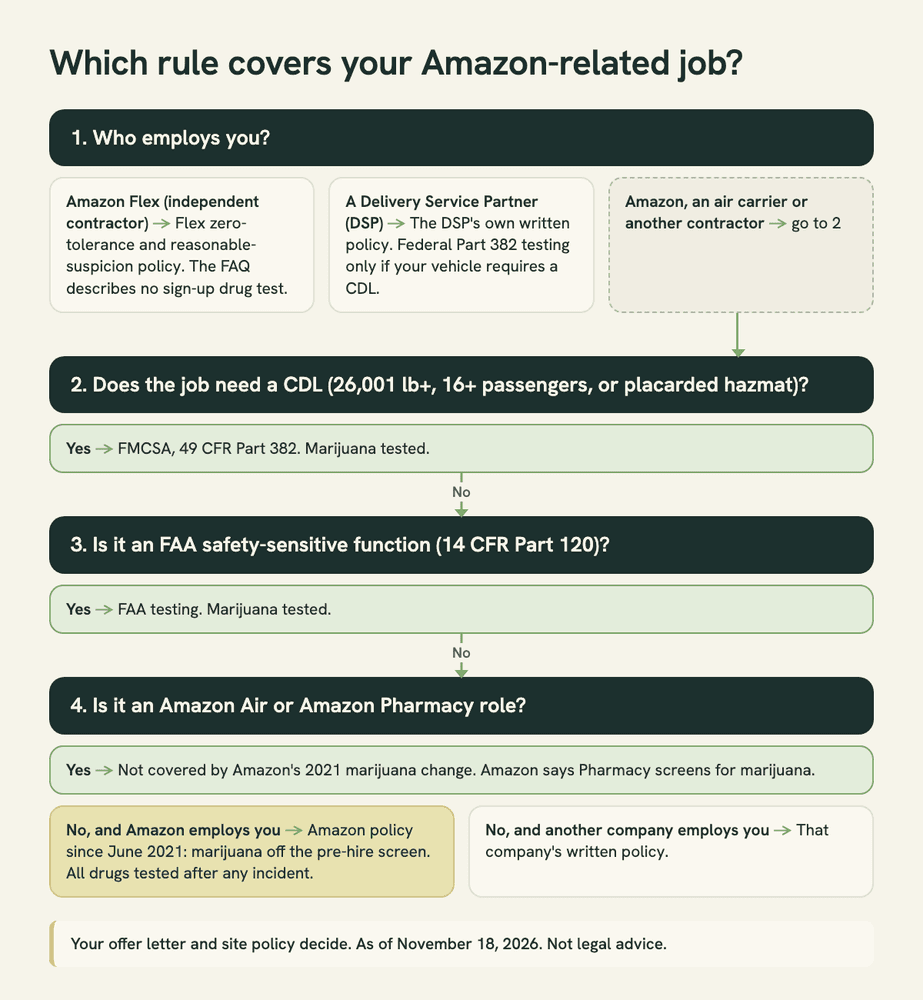
Whether marijuana is on your test depends on two things: who employs you, and whether a federal rule covers your job. The table sorts the roles people ask about. Every cell comes from an Amazon page or the federal regulation named in it, and each is explained in the sections below.
| Role | Who employs you | Rule that applies | Marijuana on the test? |
|---|---|---|---|
| Amazon jobs not regulated by DOT and not within Amazon Air (for example hourly warehouse roles) | Amazon | Amazon policy: pre-hire drug test, impairment checks on the job, testing for all drugs and alcohol after any incident | Off the pre-hire screen since June 2021, per Amazon. Included in post-incident tests (all drugs) |
| Driver who needs a CDL: vehicle rated 26,001 lb or more, 16 or more passengers including the driver, or placarded hazmat | Amazon or the carrier that hires you | FMCSA, 49 CFR Part 382, with DOT lab procedures in 49 CFR Part 40 (urine or oral fluid) | Yes |
| Safety-sensitive aviation function (flight crew, dispatch, aircraft maintenance, ground security coordination and others) | The air carrier, or a contractor at any tier | FAA, 14 CFR Part 120. Amazon also excludes Amazon Air roles from its 2021 marijuana change | Yes |
| Amazon Pharmacy employee | Amazon | Amazon policy (2023 update): comprehensive drug testing | Yes, per Amazon |
| Delivery Service Partner (DSP) driver | The DSP, an independent business, not Amazon | The DSP's own written policy. Part 382 only if the vehicle requires a CDL | Varies by DSP |
| Amazon Flex delivery partner | No employer: you are an independent contractor | Flex zero-tolerance policy and reasonable-suspicion process | The Flex FAQ describes no drug test at sign-up |
Two rows rest on Amazon's own wording, not on a federal rule. On pharmacy staff, the 2023 update says: "Amazon Pharmacy conducts comprehensive drug testing for employees, including screenings for marijuana, to ensure full compliance with industry standards, regulations, and accreditation." On aviation, it names Amazon Air as an exception without listing which jobs that means.
Amazon Air and the FAA rule
The federal rule behind aviation testing, 14 CFR Part 120, covers eight safety-sensitive functions: flight crewmember, flight attendant, flight instruction, aircraft dispatcher, aircraft maintenance and preventive maintenance, ground security coordinator, aviation screening, and air traffic control duties. It applies whether the work is done directly or "by contract (including by subcontract at any tier)," and it covers "full-time, part-time, temporary, and intermittent employees." We found no Amazon source that says which Amazon Air jobs fall under it or who employs the people doing them. If you are hired at an air hub, ask whether your role is one of those eight functions.
Does Amazon drug test delivery drivers? It depends who employs you
This is where many online answers go wrong. Several summaries say Amazon still tests "truck and delivery van drivers" for marijuana. We could not find that sentence in either Amazon post or in the original wire coverage. The real answer starts with who hires you. Amazon's DSP driver job page says: "Amazon contracts with Delivery Service Partners (DSP) to obtain delivery services. Each DSP is an independent third-party business." And: "DSP delivery drivers are employed by individual DSPs (not Amazon). Each DSP is independently responsible for the hiring, performance management, and termination of its employees." Amazon's 2024 explainer on the DSP program describes DSPs the same way, as independent businesses that "hire and manage their own employees." Amazon's 2021 announcement was about Amazon's employees. It does not decide a DSP's policy.
Next comes the vehicle. The same listing says that "for driver roles, a valid driver's license is required (non CDL driver's license okay)." That matters because the federal drug and alcohol testing rule for drivers, 49 CFR Part 382, applies to people who operate a commercial motor vehicle and are subject to the commercial driver's license (CDL) rules. For Part 382, the regulation's own definition of a commercial motor vehicle is one with a gross vehicle weight rating or gross vehicle weight of 26,001 pounds or more, one designed to carry 16 or more passengers including the driver, or one of any size carrying hazardous materials that must be placarded. A driver who needs no CDL for the vehicle they drive is outside Part 382, even if the job is still subject to other FMCSA rules.
You may still see "DOT" in a van job listing. FMCSA uses a lower 10,001-pound line for other safety rules, which is why "DOT" can appear on a van job that has no federal drug-testing requirement. Amazon's DSP listing also advertises an "Opportunity to obtain DOT certification" without explaining what that means, which is a good reason to ask the DSP which federal rules apply to your route. We have not seen a primary source for the weight rating of any particular delivery van, so we do not state one here.
Did Amazon tell its delivery partners to stop testing? In September 2021, SHRM, citing Bloomberg, reported that Amazon was "recommending that its small-business partners that operate delivery vans stop testing drivers for marijuana use." The same report added: "Other delivery company owners, however, say they plan to continue screening applicants." A recommendation is not a policy. The DSP that hires you decides, and its written policy is the one to read.
Amazon's 2023 update adds one passage aimed at delivery work: "In addition to following all Department of Transportation regulations, our policy on zero tolerance for impairment while working has not changed. If a delivery associate is impaired at work and tests positive post-accident or due to reasonable suspicion, that person would no longer be permitted to perform services for Amazon." The post does not define "delivery associate." Ask your DSP how it applies that rule.
Does Amazon Flex drug test?
Amazon Flex drivers are not employees. The Amazon Flex FAQ addresses them as independent contractors ("As an independent contractor, you are free to decide how to best to prepare for your block") and lists a background check that "includes, but is not limited to, a review of motor vehicle records." It also states: "Amazon has a strict zero-tolerance drug and alcohol policy. You must not be under the influence of drugs or alcohol while delivering with Amazon Flex." The FAQ does not describe a drug test at sign-up. That is something the FAQ leaves out, not a promise.
The Flex reasonable suspicion policy, last updated November 20, 2023, describes reports and an investigation: "Any Amazon Flex delivery partner who is reasonably suspected to be providing delivery services while under the influence of drugs or alcohol will have their account inactivated." And: "If we determine that an Amazon Flex delivery partner was under the influence, it is grounds for immediate termination of the delivery partner's contract." The policy does not mention a test.
After an accident or on suspicion: the tests Amazon kept
The 2021 change was about the pre-hire screen, not about incidents: Amazon's June 2021 post kept testing "for all drugs and alcohol after any incident." The post does not define "incident," and Amazon does not publish the panel or cutoffs a post-incident test uses. Impairment checks on the job also continue, so being impaired at work was never covered by the 2021 change.
Here is the limit worth knowing. A post-incident urine test can show you used cannabis at some point. It cannot show you were high at work. A 2007 review of how the body handles THC, written by a NIDA scientist, put it plainly: a positive urine test for cannabinoids "indicates only that drug exposure has occurred" and gives no information on "the degree of impairment." New York's labor department said the same in its October 2021 guidance for employers in that state: "a test for cannabis usage cannot serve as a basis for an employer's conclusion that an employee was impaired by the use of cannabis, since such tests do not currently demonstrate impairment." For the technology aimed at recent use rather than past exposure, see our explainer on whether a weed breathalyzer can measure impairment.
Post-incident testing outside DOT is generally allowed under federal workplace-safety rules unless it is used to punish injury reporting. Our guide to random drug tests at work explains OSHA's October 2018 memo behind that position, along with the federal post-accident rules for DOT-covered drivers.
State law sits on top of Amazon's policy
A state law can give you more protection than Amazon's policy does. California's Government Code section 12954, added by AB 2188 and last amended by SB 700 in 2023, has since January 1, 2024 barred most employers from penalizing off-the-job cannabis use. New York's Labor Law section 201-d, as currently in force, protects lawful off-duty cannabis use but lets employers act when federal or state law requires it, or on "specific articulable symptoms" of impairment at work. Federally required tests, like DOT's, sit outside those protections. Our parent guide, can you get fired for failing a drug test, has the state-by-state table and explains how states treat a result that reflects past use rather than impairment.
Schedule III in 2026: what it changed for tested roles
Since April 28, 2026, a DEA final rule has placed state-licensed medical marijuana in Schedule III. Marijuana outside that scope remains a Schedule I controlled substance, and the rule is being challenged in court. For DOT-covered jobs, DOT's December 2025 notice on marijuana testing said that "until the rescheduling process is complete, the Department of Transportation's drug testing process and regulations will not change." The details sit in the Schedule III section of our random drug test guide, and our explainer on the medical marijuana Schedule III ruling tracks the litigation. We found no Amazon statement tying its own policy to rescheduling.
Using CBD or hemp in a tested role
If your job is one where marijuana is still on the test (a CDL driving job, an FAA-covered function, Amazon Pharmacy, or any post-incident test), CBD is not a safe harbor. The test looks for THC, not for where it came from, and full-spectrum hemp products can contain trace THC. In a 2020 study run with SAMHSA scientists, six adults took 100 mg of pure CBD and none of 218 urine samples confirmed positive. After a CBD-dominant cannabis containing 3.7 mg of THC, four of 108 samples, from two of the six adults, confirmed positive. The THC in a product is what matters, and no product can guarantee a drug-test result. If your worry is exposure without use, see whether you can fail a drug test from secondhand smoke.
For DOT-covered drivers, the federal position is in writing, in DOT's February 2020 notice on CBD to medical review officers (MROs):
Before you accept the offer: six questions to ask
A 2021 statement is not a promise about your site. These six questions turn the rules above into answers you can get in writing from the recruiter or HR before your first day.
- 1Is this role regulated by DOT or the FAA? If it needs a CDL or is an aviation safety-sensitive function, federal testing applies and marijuana is on the test.
- 2Who is my employer of record: Amazon, a Delivery Service Partner, or a contractor? Amazon's 2021 policy covers Amazon's own employees only.
- 3Is marijuana on the pre-hire panel for this site and this role?
- 4What does the written post-incident and reasonable-suspicion policy say, and what counts as an incident?
- 5Does my state limit discipline for off-duty cannabis use, and does that protection reach this job?
- 6Can I get the drug and alcohol policy that applies to me in writing?
For question 5, start with the state table in our guide on whether you can be fired over a failed test, then confirm with your state labor department if your situation is close.
What this page cannot tell you
The most recent public statement we could find from Amazon on marijuana screening is a post last updated June 8, 2023. Policies can change without a press post, sites and contractors vary, and Amazon does not publish its specimen, panel or cutoffs. Your offer letter and your site's written policy are what apply to you. If you have already failed a test, our guide on unemployment benefits after a failed drug test covers what comes next. And if you came here about buying CBD on Amazon's marketplace rather than working there, that is a different set of rules, covered in our guide to CBD on Amazon.
Frequently asked questions
For most jobs not regulated by DOT, Amazon said on June 1, 2021 that it removed marijuana from its pre-employment drug screen and treats it like alcohol use. It still tests for all drugs and alcohol after any incident, and DOT-regulated roles, Amazon Air roles and Amazon Pharmacy employees are exceptions. The latest public Amazon statement is dated 2023, so check your offer letter and site policy.
Yes. Amazon's hiring page, live in November 2026, says the offer for hourly warehouse roles is contingent on background check and drug test results, and that you accept the formal offer once you pass. What changed in 2021 is whether marijuana is on that screen for most jobs.
Amazon does not publish the specimen, panel, cutoffs or lab for its own screens. For DOT-covered driving jobs, tests follow DOT's procedures in 49 CFR Part 40 and use urine or oral fluid. Claims online about a specific cup or swab are not backed by any Amazon source we found.
Yes. Amazon's June 2021 post says it "will test for all drugs and alcohol after any incident," and all drugs includes marijuana. Keep in mind that a positive urine result shows past exposure, not whether you were impaired at the time.
Drivers in Amazon's Delivery Service Partner program are employed by independent DSPs, not Amazon, and each DSP sets its own hiring and testing policy. Federal FMCSA testing under 49 CFR Part 382 applies only when the vehicle requires a CDL. Amazon's 2023 update also says a delivery associate who is impaired at work and tests positive after an accident or on reasonable suspicion "would no longer be permitted to perform services for Amazon."
The Amazon Flex FAQ lists a background check that includes a review of motor vehicle records and states a strict zero-tolerance drug and alcohol policy. It does not describe a drug test at sign-up. Flex's reasonable suspicion policy, last updated November 20, 2023, describes reports, account inactivation and an investigation, not a test.
Amazon's hiring pages list seasonal jobs among its hourly roles and describe no separate screening process for them. Ask the recruiter whether the same pre-hire drug test applies to your seasonal role.
Amazon's hiring FAQ lists drug test results among the details it reviews when deciding on an application, and says it cannot give details about those factors. It does not publish a reapplication rule for failed tests. If you lost a job over a test, our guide on unemployment after a failed drug test covers your next question.
If you use CBD and your job is one where marijuana is still tested, the next thing to understand is how trace THC in hemp products shows up on a urine screen. Our guide to CBD and drug tests covers that in detail, and our hub on whether CBD is legal covers the federal and state rules behind it.
Writing about hemp, wellness and the small rituals that keep us balanced.