
Is Weed a Gateway Drug? What the Evidence Actually Shows
Weed usually comes before other illegal drugs, and people who use it are more likely to try others. Whether cannabis causes that is a separate question. Here are the three explanations, the strongest study for each, and the National Academies' exact verdict.

Is weed a gateway drug? The honest answer satisfies neither side of the argument. In US surveys, cannabis usually comes before other illegal drugs, and people who use it are more likely to use other drugs later. Both of those patterns are real. What has not been established is that cannabis causes the next step. Researchers have three competing explanations for the pattern, each with real evidence behind it, and one risk factor shows up under all three: starting young.
The question bundles together three questions that need different kinds of evidence. This page separates them, sets out the three main explanations with the strongest study for each, and quotes exactly what the National Academies of Sciences, Engineering, and Medicine concluded in 2017. It is general information for adults, not medical advice. If you want background on THC and the other compounds in the plant first, start with our overview of what cannabinoids are.
Is weed a gateway drug? Three questions inside one claim
"Gateway" can mean three different things, and each has a different answer. The first is sequence: does cannabis usually come before other illicit drugs? The second is association: are people who use cannabis more likely to use other drugs? The third is cause: does using cannabis itself make other drug use more likely, in a way that would not have happened otherwise? A yes to the first two does not answer the third. A shared cause, such as a personality that seeks risk or a neighborhood where drugs are easy to find, could produce both the sequence and the association without cannabis changing anything. The table sorts the evidence for each question; the sections after it walk through the studies.
| Question | What the data say | How strong | Key evidence |
|---|---|---|---|
| Sequence: does cannabis usually come first? | Usually yes in US data, after alcohol and tobacco. The order changes in countries where cannabis is rare. | Consistent in US surveys; not universal | Kandel's 1975 New York surveys; WHO World Mental Health Surveys in 17 countries |
| Association: do people who use cannabis use other drugs more often? | Yes. In one US survey, about 45% of people whose first drug was cannabis were projected to use another illicit drug at some point, so a majority would not. | Moderate for later substance-use disorders, per the National Academies | US NESARC survey analysis (2015); National Academies report (2017) |
| Cause: does cannabis itself raise the odds? | Not established. Twin studies leave room for a causal or social effect; a model with no causal link reproduces the same patterns. | Contested | Australian, Dutch and Virginia twin studies; RAND model (2002) |
Where the gateway drug theory came from
The scientific starting point is a 1975 paper in Science by Denise Kandel, which followed random samples of New York State high-school students in two longitudinal surveys. She described drug use moving through four stages, in this order: beer or wine, or both; cigarettes or hard liquor; marijuana; and other illicit drugs. Of the students who smoked and drank, 27% moved on to marijuana within a 5- to 6-month follow-up period, compared with 2% of those who had not used any legal substance. And 26% of marijuana users went on to LSD, amphetamines or heroin, compared with 4% of students who had used only legal drugs. The paper described a sequence in 1970s New York teenagers. It did not test whether any stage caused the next.
“The legal drugs are necessary intermediates between nonuse and marihuana.”
Two parts of the story are usually left out. First, the doubt is nearly as old as the idea. In the National Academies' summary, the Institute of Medicine's 1999 review of cannabis "questioned the designation of cannabis as a 'gateway' drug because its use is often preceded by underage drinking and tobacco use," and found no conclusive evidence of a causal link at that time. Second, Kandel kept working on the question and turned it toward nicotine. In a 2014 lecture published in the New England Journal of Medicine, written with Eric Kandel, the authors note that "the gateway hypothesis was developed by Denise Kandel" and that epidemiologic studies "cannot determine what causes the progression." To look for a mechanism, their group ran an experiment in mice. Mice given nicotine first showed a 98% larger increase in cocaine-induced movement (a measure called locomotor sensitization) and a 78% stronger preference for the place where they had received cocaine. Giving the drugs in the reverse order had no such effect. That is a preclinical finding in mice, and the authors framed it conditionally: "If our findings in mice apply to humans." When a major twin study on cannabis appeared in JAMA in 2003 (covered below), Kandel wrote the accompanying editorial, titled "Does marijuana use cause the use of other drugs?" For how cannabis law itself developed, see our timeline of when weed was made illegal.

Alcohol and nicotine usually come first
In US data, cannabis is rarely the first drug people use. Kandel's stages put beer, wine, cigarettes and liquor ahead of it, and later research agrees. The National Academies noted in 2017 that "tobacco use was associated with far greater odds of transitioning to cannabis use relative to non-tobacco users." In a French survey of about 29,000 17-year-olds summarized in the same report, only 2% of those who had used both tobacco and cannabis said cannabis came first. Kandel's 2014 lecture showed the same pattern for cocaine: among US adults aged 18 to 34 in 2012 who had ever used cocaine, 87.9% had smoked cigarettes before using it, 5.7% started both at about the same time, 3.5% used cocaine first and 2.9% had never smoked. By the gateway argument's own logic, alcohol and tobacco fit the description at least as well as cannabis does. If you want to compare the harms of drinking and cannabis directly, our side-by-side look at whether alcohol is worse than weed covers it, and our guide to being crossfaded explains what happens when people use both at once.
Do people who use weed go on to other drugs more often?
Yes, on average, and the size of the gap depends on how you count. Kandel's 1975 data already showed it (26% against 4%, above). A modern national estimate comes from an analysis of the US NESARC national survey, which looked at 6,624 adults whose first drug was cannabis. The researchers projected that 44.7% of them would use another illicit drug at some point in their lives. Three details matter. It is a projected lifetime probability, not a count of what had already happened. "Other illicit drug" includes any illicit drug, including misuse of prescription drugs, not only heroin or cocaine. And it means a majority would not. The people most likely to go on to other drugs were not a random slice of cannabis users: they were more likely to have mental-health disorders and more severe substance use already.
The federal research agency on drug use puts it in similar terms. NIDA's page on cannabis says that cannabis products "are among the first substances along with alcohol and tobacco that a person will likely encounter in their life," and that "people who use substances commonly use these before trying others. Still, most people who use or have used cannabis do not go on to use other substances later in life." It adds that "risk factors for cannabis use are similar to risk factors for use of other drugs with addiction potential." In the same section, NIDA writes: "In addition, using cannabis may cause brain changes that can make a person more likely to develop an addiction to other drugs." Note the word "may". An association this consistent needs an explanation, and researchers have three main ones. They are not mutually exclusive, and more than one can be true at once.
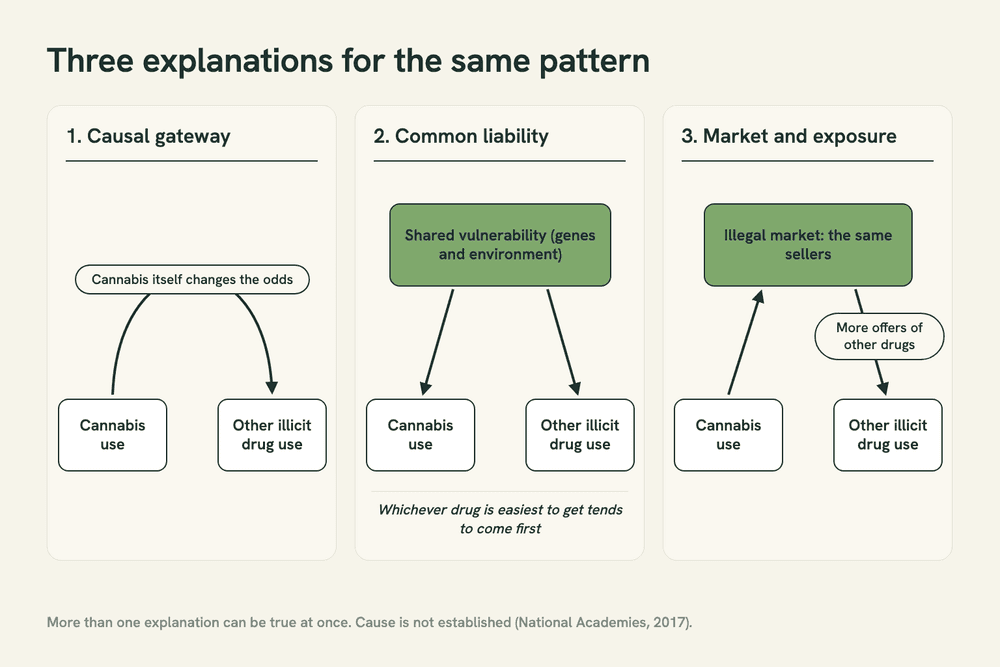
Explanation 1: cannabis itself changes the odds
The strongest human case for a causal or contextual effect comes from twins. Twins share their upbringing, and identical twins share their genes, so if one twin uses cannabis early and the other does not, any difference that follows cannot be blamed on family or genetics alone. In a 2003 JAMA study of 311 Australian twin pairs, surveyed between 1996 and 2000 at a median age of 30, one twin in each pair had used cannabis before age 17 and the other had not. The early-using twin had odds of other drug use, alcohol dependence and drug abuse or dependence that were 2.1 to 5.2 times higher than those of the co-twin. Adjusting for early alcohol and tobacco use, parental conflict, childhood sexual abuse, conduct disorder, depression and social anxiety "had only negligible effects," and identical and nonidentical pairs did not differ. The authors concluded that the link "cannot solely be explained by common predisposing genetic or shared environmental factors." Their own reading, though, was social rather than chemical. The association "may arise from the effects of the peer and social context within which cannabis is used and obtained," they wrote, and early use "may reduce perceived barriers against the use of other illegal drugs and provide access to these drugs."
Twin designs have limits of their own. Twins share a home but not always friends, so the peer influences the authors pointed to are not controlled. The Australian data were self-reported in a single survey, years after the teenage years in question. And no twin design can separate what cannabis does to the brain from where, and from whom, it was bought. Other twin studies point the same way with more caution. A Dutch study of 219 same-sex twin pairs in which one twin had used cannabis before 18 found higher odds for the early user of party drugs (odds ratio 7.4, 95% CI 2.3 to 23.4) and hard drugs (16.5, 95% CI 2.4 to 111.3), but not of regular cannabis use (1.3, not statistically significant). Those margins of error are very wide because the sample was small. A population-based Virginia twin study concluded that the relationship "arises largely due to correlated genetic and environmental influences with persisting evidence for some causal influences." And a New Zealand birth cohort of 1,265 people, assessed every year from 14 to 25, found the association persisted after controlling for many confounders. Its authors wrote that this "may support a general causal model such as the cannabis gateway hypothesis, but the actual causal mechanisms ... remain unclear."
Animal studies add a biological possibility. In a 2007 rat study, adolescent male Long-Evans rats were injected with THC (1.5 mg/kg into the abdominal cavity every third day, from postnatal day 28 to 49). Later, when the researchers let them self-administer heroin from postnatal day 57, the THC-treated rats took more heroin than controls, and their brains showed changes in opioid systems in limbic regions involved in emotion and reward. The Kandel group's mouse work above found something similar for nicotine before cocaine. Both are preclinical findings: they show a mechanism that could exist, not one that has been shown in human teenagers. If you want to know how THC acts on the brain's own signaling system in the first place, our guide to the endocannabinoid system maps it.
Explanation 2: common liability
The second explanation accepts the sequence but says the arrow points somewhere else. Common liability is the idea that the same underlying vulnerability, part genetic and part environmental, raises the risk of using and getting hooked on many substances, so whichever drug is easiest to get tends to come first. A 2012 review setting out the common liability model argues that the order in which people start drugs, the core of the gateway idea, "is variable and opportunistic rather than uniform and developmentally deterministic." Under this model, cannabis comes before cocaine for the same reason alcohol comes before cannabis: it is available sooner, not because one drug unlocks the next. The review's authors are proponents of the model, which is worth keeping in mind.
The most striking test is a simulation built from real survey numbers. In 2002, RAND researchers modeled a population using parameters drawn from US household surveys from 1982 to 1994. Each simulated person had one hidden trait, a general propensity to use drugs, linked both to how often they had the opportunity to use drugs and to whether they used them when the chance came. The model had no gateway in it: using marijuana had no effect at all on the chance of using hard drugs. It still reproduced the patterns used as evidence for a gateway. In the authors' words, "each of the phenomena used to support claims of a 'marijuana gateway effect' are reproduced by the model, even though marijuana use has no causal influence." They were careful not to overclaim. The paper says that "marijuana gateway effects may exist," and RAND's research brief on the study states: "The research does not disprove the gateway theory; it merely shows that another explanation is plausible." A model can show that an explanation is sufficient. It cannot show that the explanation is true.
Cross-country data offer a real-world version of the same test. If cannabis opened the door, it should come first wherever people use other drugs. The WHO World Mental Health Surveys, which covered 85,088 people in 17 countries, found instead that the order depends on the local drug scene. Among people who had used other illicit drugs, 11.4% in the United States and 12.7% in New Zealand had not used cannabis first. In Nigeria the figure was 77.8%, and in Japan, where cannabis is rare, it was 83.2%. The authors concluded that the gateway pattern "at least partially reflects unmeasured common causes rather than causal effects of specific drugs," and that efforts to prevent the use of so-called gateway drugs "may not in themselves lead to major reductions in the use of later drugs." These were retrospective self-reports, and survey conditions differed between countries. Even Kandel's 2014 lecture lands somewhere in between: "we believe that the gateway hypothesis and the common liability model are complementary."
Explanation 3: the illegal market puts other drugs within reach
The third explanation is about supply. Where cannabis is illegal, buying it can mean dealing with people who also sell other drugs, so cannabis users get more chances to try them. An analysis of four pooled US household surveys, covering 44,624 people aged 12 to 25, tested part of this directly. Young people who had smoked marijuana were more likely to have had an opportunity to use cocaine, and among those who had that opportunity, the ones who had used marijuana were more likely to use cocaine. The authors found that these associations "did not seem to arise solely" from marijuana users seeking out opportunities. That fits the Australian twin study authors' own reading, which pointed to the social context in which cannabis is "used and obtained." The design is cross-sectional and self-reported, so it cannot show the order of events in any one person's life.
The Netherlands offers a policy test. Dutch policy tolerates cannabis sales through coffeeshops, an approach meant partly to keep cannabis buyers apart from hard-drug sellers. Reviewing decades of Dutch data against other European countries and the US, Berkeley's Robert MacCoun concluded that the "separation of markets" "may indeed have somewhat weakened the link between cannabis use and the use of cocaine or amphetamines," and that coffeeshops "do not appear to encourage escalation into heavier use." That is a hedged, population-level finding, and the Dutch twin study above still found higher hard-drug odds for early users under the same system. Separating the markets may weaken the link. It has not been shown to remove it.
The three explanations side by side
Each explanation accounts for some of the evidence and struggles with some of it. Here they are in one place, with the strongest evidence for each and the finding it has the hardest time explaining.
| Explanation | What it says | Strongest evidence | What it struggles to explain |
|---|---|---|---|
| Causal gateway | Using cannabis itself, through changes in the brain or behavior, makes other drug use more likely | Australian twins: 2.1 to 5.2 times the odds for the twin who used before 17; rat and mouse priming studies (preclinical) | Why the order flips where cannabis is rare, as in Japan; why a model with no causal link reproduces the same patterns |
| Common liability | A shared vulnerability raises the risk of using many substances; availability sets the order | RAND simulation (2002); WHO surveys in 17 countries; Virginia twins, where the link was "largely" shared risk | Why the twin who used early still did worse than the co-twin who did not |
| Market and exposure | Illegal cannabis supply puts users in contact with other drugs | US surveys of 44,624 young people: more cocaine opportunities, and more use when offered; Dutch market-separation data | Why Dutch twins still showed the pattern under coffeeshop rules |
What the National Academies and NIDA concluded
The 2017 National Academies committee reviewed the research published since 1999. For its chapter on cannabis and other substances it drew on 12 primary studies, limited to longitudinal, prospective and case-control designs, and it graded three conclusions. On tobacco, Conclusion 14-1 reads: "There is limited evidence of a statistical association between cannabis use and the initiation of tobacco use." On other drug use, Conclusion 14-2 reads: "There is limited evidence of a statistical association between cannabis use and changes in the rates and use patterns of other licit and illicit substances." The third, Conclusion 14-3, is the strongest grade in the chapter:
“There is moderate evidence of a statistical association between cannabis use and the development of substance dependence and/or a substance abuse disorder for substances, including alcohol, tobacco, and other illicit drugs.”
Notice the words "statistical association" in all three. None is a finding that cannabis causes anything, and "moderate" applies to later dependence or substance-use disorder, not to starting other drugs. On starting other drugs, the committee was explicit: "The data do not provide compelling evidence that cannabis is associated with the initiation of other drugs of abuse, although this is one possibility. Other possibilities that could explain these findings include easier access to cannabis than to other illicit substances and common risk factors for both cannabis use and the use of other substances." That second sentence names the market and common-liability explanations above. The committee found no systematic review of fair or good quality on the question, and it listed causation as an open research gap, calling for studies to determine whether cannabis use is an independent risk factor for, or causally contributes to, later use of and dependence on other drugs. NIDA's current summary, quoted earlier, lands in the same place: most people who use cannabis do not go on to other substances, and its brain-change sentence says "may".
Did legalization lead to more hard-drug use?
Legal recreational markets created a natural experiment, and twins make it a sharper one. Researchers in Colorado and Minnesota surveyed 3,830 adult twins aged 24 to 49 between 2018 and 2021. In their analysis of other drug use, they focused on 232 twin pairs in which one twin lived in a state with recreational cannabis legalization and the other did not. Within those pairs, the twin in the legal state had higher odds of past-year cannabis use (odds ratio 1.56) and used on more days, but did not report more cannabis-related problems, and reported fewer alcohol-related problems. The result for other illicit drugs (stimulants, sedatives, cocaine, heroin, other opiates, synthetic cannabis and PCP) is worth reading slowly. Comparing families, those living in a legal state were 1.42 times more likely to report ever using another illicit drug. But that difference was not present within twin pairs, and there was no significant difference in past-year other illicit drug use. Because twins share genes and upbringing, the authors attributed the family-level gap to those shared factors, and they wrote that their results suggest legalization "does not cause" people to report more illicit drug use. A companion paper from the same twin cohorts, which studied only cannabis frequency in 111 identical twin pairs, estimated about a 20% average increase in how often people used cannabis that was attributable to legalization.
This is some of the best-controlled evidence so far on legalization and other drugs, and its limits are real. It tests a law, not whether cannabis itself leads to other drugs, so it is not a direct test of the gateway idea. The sample was mostly White and made up of adults aged 24 to 49, not teenagers. Fewer than 1% reported past-year opiate use, so the study had little power to detect small effects on hard drugs. It did not measure substance-use disorders or how long each twin had lived under legalization. What it supports is narrow: no within-pair difference in other illicit drug use was detected. It does not show that legalization reduced hard-drug use, and it does not show that legalization increased it. It is the kind of study the National Academies called for in 2017.

Age of first use is the variable that keeps coming back
Whichever explanation you favor, one variable shows up in all of them: how young someone was when they started. The Australian twin pairs were defined by use before 17, the Dutch pairs by use before 18. In the New Zealand birth cohort, the association between cannabis and other illicit drug use was "particularly strong during adolescence but declined rapidly as age increased." A later analysis of the same cohort, tabulated by the National Academies, put numbers on it. Weekly or more frequent cannabis use at ages 16 to 17 carried an adjusted odds ratio of about 92 for other illicit drug use (95% CI 46.5 to 182.7), compared with about 26 at ages 20 to 21 and about 7.5 at ages 24 to 25. Those margins are very wide, and the comparison is with people who did not use cannabis, but the direction is clear: the association shrinks with age. NIDA adds that "using these products at a younger age in particular increases the likelihood of developing a cannabis use disorder later in life."
Each model reads this differently. Under the causal model, a developing brain may be more sensitive. Under common liability, the people with the highest underlying risk tend to start earliest. Under the market model, the earlier someone starts buying from illegal sellers, the earlier other drugs are offered. All three point to the same practical conclusion: early, frequent use in adolescence is the pattern most worth avoiding or delaying. The adolescent-brain evidence is covered in detail in our review of whether weed kills brain cells, including why the teenage years are where researchers' concern concentrates. If you are an adult who wants to use less, our guide to using less cannabis is the practical next step.
What about CBD?
CBD comes from the same plant, so it sometimes gets pulled into this question. We found no study that frames CBD as a gateway drug, and the research above concerns THC-containing cannabis. The World Health Organization's 2018 review of CBD found that "in humans, CBD exhibits no effects indicative of any abuse or dependence potential." That review covered pure CBD. Full-spectrum CBD products contain trace THC (below 0.3%), so they are not identical to what the WHO reviewed. Nothing here suggests that CBD protects against other drug use, and no claim like that should be read into the WHO finding. For dependence and withdrawal, including why the answer is different for THC, see our guide to whether CBD is addictive.
How to read the next gateway headline
Headlines rarely carry the details that decide what a new study means. Before one changes your mind in either direction, run it through these questions:
- 1Which question is it answering? Sequence ("came before"), association ("more likely") and cause ("leads to") need different evidence. Watch for causal verbs attached to sequence data.
- 2More likely than whom? Users compared with non-users, with their own twin, or with people who share the same risk factors give very different numbers.
- 3Twins or siblings, or a general survey? Only a co-twin design rules out shared genes and upbringing, and even that leaves friends and local drug markets uncontrolled.
- 4Did the researchers account for alcohol, tobacco and mental health? In a Colorado twin cohort summarized by the National Academies, the cannabis links no longer reached significance after adjusting for alcohol and tobacco involvement.
- 5How old were people when they started? Findings about use before 17 do not describe someone who started at 30.
- 6Rats, mice or people? THC injected into adolescent rats is a preclinical signal, not a human result.
- 7Does it test a drug or a law? A legalization study measures what changed when a policy changed, not what cannabis does to the person using it.
- 8What counts as "other drugs"? "Any other illicit drug" can include misused prescription pills, which is not the same as heroin or cocaine.
Is weed a gateway drug? Questions people ask
Because in US surveys going back to Denise Kandel's 1975 study of New York high-school students, cannabis usually came before other illegal drugs, and people who used it were more likely to use others later. "Gateway" names that order. It does not by itself show that cannabis causes the next step, and in Kandel's own data, alcohol and tobacco came before cannabis.
By the same logic, at least as much as cannabis. Alcohol and tobacco usually come first, which is why the Institute of Medicine questioned the gateway label for cannabis in 1999. Among US adults aged 18 to 34 in 2012 who had ever used cocaine, 87.9% had smoked cigarettes first.
Most do not, according to NIDA. In a large US survey, researchers projected that about 45% of people whose first drug was cannabis would use another illicit drug at some point in their lives. That figure is a lifetime projection and counts any illicit drug, including misused prescription drugs, not only heroin or cocaine.
No, and it has not been confirmed either. The National Academies wrote in 2017 that the data "do not provide compelling evidence" that cannabis is associated with starting other drugs, "although this is one possibility." RAND, whose model reproduced the gateway patterns with no gateway built in, said its research "does not disprove the gateway theory." The honest status is unresolved.
One of the best-controlled studies so far, of 232 Colorado and Minnesota twin pairs in which one twin lived in a legal state, found no within-pair difference in other illicit drug use, though the legal-state twin did use cannabis more often. The study tests a law rather than the drug, covered adults aged 24 to 49, and included very few hard-drug users, so it could miss small effects.
It is the idea that one underlying vulnerability, part genetic and part environmental, raises the risk of using many substances, with the order set by which drug is easiest to get. In the WHO World Mental Health Surveys, 83.2% of people in Japan who had used other illicit drugs had not used cannabis first, compared with 11.4% in the US, which fits that idea.
We found no study that frames it that way. The WHO's 2018 review found that in humans, CBD "exhibits no effects indicative of any abuse or dependence potential." That review covered pure CBD. Full-spectrum CBD products contain trace THC below 0.3%, so they are not identical to what the WHO reviewed.
If this page has you rethinking your own use, the most useful next read is our practical guide to how to cut back on weed, which walks through what the lower-risk cannabis use guidelines say and how to apply them. If you want professional support instead, the federal treatment locator at findtreatment.gov lists services near you.
Writing about hemp, wellness and the small rituals that keep us balanced.