What Is Grabba? Fronto Leaf, Nicotine and Tobacco in Weed
Grabba is fronto leaf, an air-cured tobacco leaf, broken into pieces and mixed with cannabis. Here is where the words come from, what is and is not measured about its nicotine, what one trial found when tobacco was added to cannabis, and the tobacco laws that apply.
Grabba is tobacco. More precisely, it is fronto leaf, a whole, dark, air-cured tobacco leaf, broken into pieces and mixed into cannabis, most often in a spliff or a blunt. If you have heard the word in New York, in Caribbean-diaspora slang or in a song, or someone has offered you a spliff "with grabba," the short answer is that you are being offered tobacco and nicotine along with the weed.
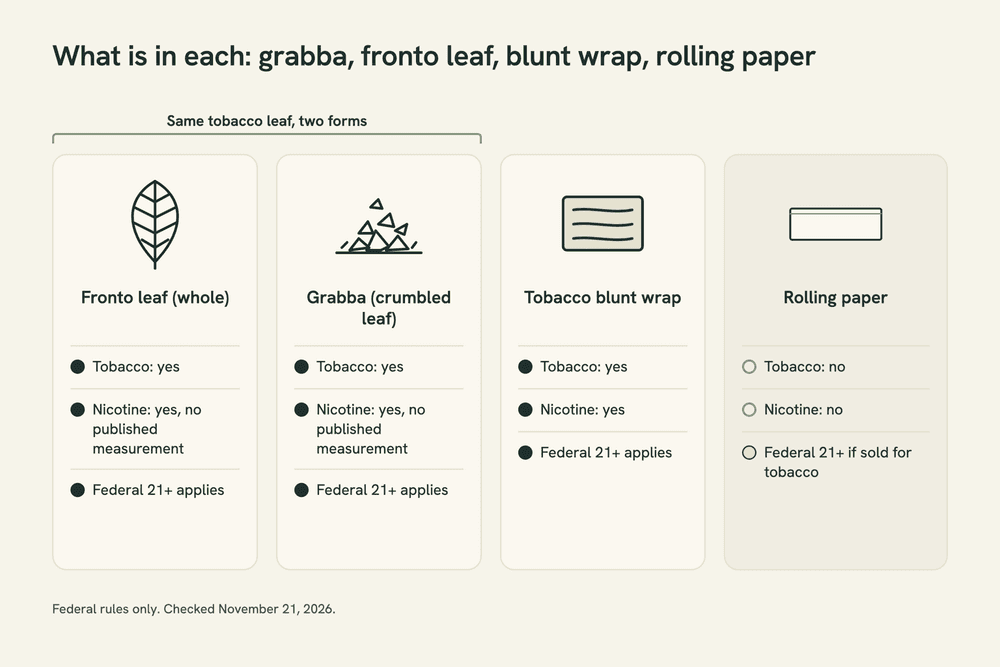
What is grabba, in one paragraph? Fronto leaf is the whole leaf, sold flat, folded or rolled, often in a pouch, and used by some people as a wrap. Grabba is the same leaf crumbled. Because both are tobacco leaf, both contain nicotine, but as of November 21, 2026 we could not find a single published lab measurement of how much is in either one. Both are sold under tobacco law, which means a federal minimum age of 21 and, in some places, limits on flavored versions. This page, written for adults 21 and over, covers what the two words mean and where they come from, what research on mixing tobacco with cannabis actually found, which rules apply, and what is still unknown. It does not cover how to use either one.
What is grabba, and what is fronto leaf?
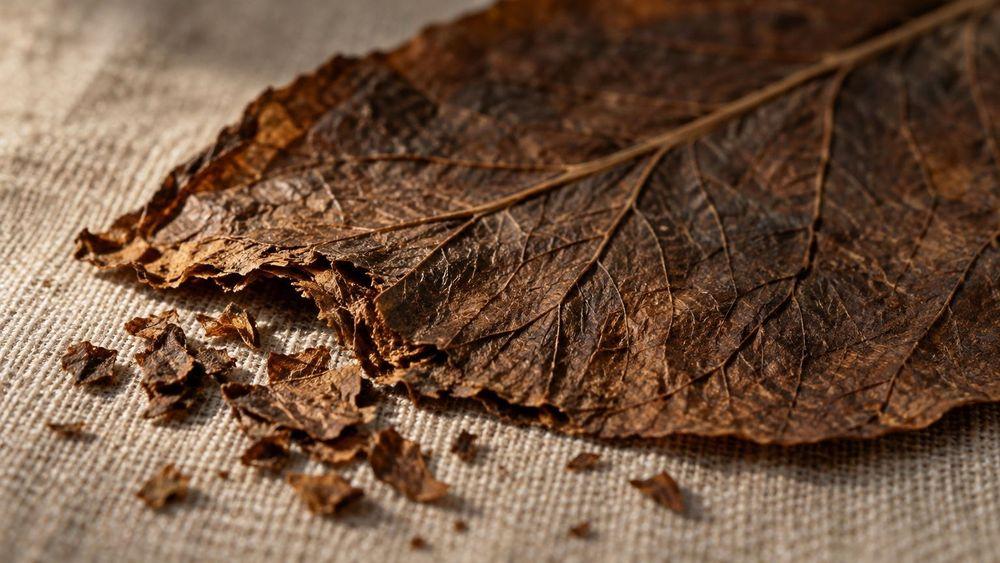
Fronto leaf is a whole tobacco leaf, usually described by sellers and slang guides as dark and air-cured. It is sold as leaf, not shredded the way cigarette tobacco is, and flavored versions exist. When the whole leaf is used as the wrap, the result is a kind of blunt. Grabba is the same leaf broken into small pieces and mixed into the cannabis in a spliff (a paper-rolled joint with tobacco added) or crumbled into a blunt. In practice the two words are used loosely, and some people say grabba for the whole leaf as well. Same plant, two forms.
Neither word appears in federal law, but the thing they describe is covered. The Food, Drug, and Cosmetic Act defines a tobacco product as "any product made or derived from tobacco" that is intended for human consumption, and a tobacco leaf sold to be smoked fits that plainly. FDA has acted on that basis. In February 2019, its Center for Tobacco Products wrote to a Massachusetts fronto importer saying its leaf and cigarillo products appeared to meet the legal definition of a tobacco product and may have been imported without the premarket authorization the law requires. The letter asked the company for details, including sub-brands, flavors and nicotine strengths, and for evidence within 30 days. It was a request for information, not a warning letter and not a finding, and the outcome is not part of that public record. One more distinction: FDA defines a cigar as a roll of tobacco wrapped in leaf tobacco or in a substance that contains tobacco. A loose leaf is not a cigar under that definition, but it is still a tobacco product.
Grabba vs fronto leaf vs blunt wrap vs hemp wrap vs rolling paper
| Item | What it is | Contains tobacco? | Contains nicotine? | Federal tobacco rules apply? |
|---|---|---|---|---|
| Grabba | Fronto leaf broken into pieces and mixed with cannabis | Yes | Yes; no published measurement of how much | Yes, as a tobacco product; federal 21+ |
| Fronto leaf | A whole air-cured tobacco leaf, used as a wrap | Yes | Yes; no published measurement of how much | Yes, as a tobacco product; federal 21+ applies to the leaf |
| Cigarillo or tobacco blunt wrap | A small cigar, or a wrap made from tobacco leaf or reconstituted tobacco | Yes | Yes; 5 cigar wrappers tested in 2016 held 1.2-6.0 mg each | Yes, regulated by FDA; federal 21+ |
| Hemp wrap sold as tobacco-free | A wrap made from hemp and sold for rolling cannabis | Not according to its label | Not unless tobacco or nicotine is added | No, FDA does not regulate it as a tobacco product; state age rules vary |
| Rolling paper | A thin sheet of plant fiber such as wood pulp, rice, hemp or flax | No | No | Papers sold for tobacco count as tobacco components (21+); FDA has not addressed papers sold only for cannabis |
The table separates two questions people often blur: what the wrap is made of, and what ends up in the smoke. A blunt rolled in fronto leaf and a spliff with grabba both deliver tobacco smoke and nicotine. A joint in a plain paper does not, unless tobacco was mixed in. Our comparison of blunts, joints and spliffs covers how those three differ, and our guide to what rolling papers are made of covers the paper side. A wrap labeled tobacco-free only tells you what the manufacturer put in the wrap; it does not tell you whether someone added grabba before lighting it. For smokables made from hemp with no tobacco at all, see our explainer on CBD cigarettes and how they differ from tobacco cigarettes. Leaving tobacco out removes the nicotine, not the smoke.
Where the words grabba and fronto come from
Neither word has a documented origin. Green's Dictionary of Slang lists "fronto" as US drug slang and dates its earliest citation, a rap lyric, to 2016. It has no entry for "grabba" at all. Community-edited dictionaries record grabba as Jamaican slang for tobacco added to cannabis, but none of them gives a documented origin, and their own etymology sections are marked as missing. Here is how Green's defines fronto:
“a natural leaf used for rolling marijuana cigarettes (rather than chemically imbued papers)”
Two things about that definition. First, "natural" there means a leaf instead of a paper. It is a description, not a safety rating, and the dictionary does not even say the leaf is tobacco (it is, as the section above shows). Second, the stories you will find online, that grabba comes from Jamaican patois or from people saying "grab a piece," are folklore. They may turn out to be true, but nobody has documented them, so we do not repeat them as history. If you are learning the vocabulary of the smoking shelf, our page on what a roach is and where the word comes from covers another term people use without defining.
Does grabba have nicotine? What is measured and what is not
Yes. Grabba and fronto leaf are tobacco leaf, and tobacco leaf contains nicotine. What nobody has published is how much. On November 21, 2026 we searched PubMed for both words: "grabba" returned zero records, and every result for "fronto" was an unrelated medical term such as fronto-limbic or fronto-orbital. A wider web search turned up no government or independent lab report either. So as of that date there is no published lab measurement of the nicotine in a fronto leaf or a bag of grabba, and any exact figure you see online for grabba is a guess.
The closest measured relatives are cigars and cigar wrappers, which are also made from tobacco leaf. Read the numbers above only as context: they are cigar data, not grabba data. A 2016 lab analysis of cigar wrappers found that the wrapper by itself made up 8% to 18% of a cigar's weight and held 1.2 to 6.0 mg of nicotine across three large cigars and two cigarillos. A 1999 analysis of 17 US cigar brands found total nicotine ranging from 5.9 to 335.2 mg per cigar, a 57-fold spread, and concluded that cigar size was not an accurate predictor of how much nicotine a cigar could deliver. A 2018 study co-authored by FDA scientists found that nicotine content varied widely across large cigars and cigarillos, and even between batches of the same brand. The lesson for grabba: leaf tobacco is not one standard dose. And the nicotine a leaf contains is not the same as the amount a person absorbs from smoking it.
Not inhaling does not avoid it. The National Cancer Institute's fact sheet on cigar smoking and cancer (last reviewed in 2010) notes that nicotine is absorbed through the lining of the mouth even when the smoke is not inhaled. Tobacco in a blunt also shows up in the body when people do not think of themselves as tobacco users: in a 2026 study of young men who smoked blunts and said they used no tobacco, 54.3% of the 46 who gave saliva samples had at least one sample with cotinine, a nicotine breakdown product, above 10 ng/mL. That study was about blunts, not grabba. Our explainer on where the nicotine in a blunt comes from covers it in detail.
What grabba in weed does: tobacco and cannabis together
Adding grabba to weed means smoking two drugs at once: nicotine, along with the rest of tobacco smoke, plus THC. No study has tested grabba itself. The closest controlled evidence comes from a 2017 double-blind trial in London in which 24 adults who used both cannabis and tobacco, none of them dependent on either, smoked joints containing cannabis, tobacco, both, or matched placebos in separate sessions. The tobacco was cigarette tobacco, not fronto leaf, and each session was a single dose. Here is what changed and what did not:
- Cannabis impaired verbal memory and working memory, as expected.
- Tobacco did not change how stoned or dizzy people felt, or the unusual, psychosis-like effects cannabis can cause.
- Tobacco improved working memory on its own.
- A hint that tobacco offset cannabis's effect on delayed recall did not hold up in the main statistical model, so the authors called it preliminary.
- Each drug raised heart rate independently. Diastolic blood pressure rose after dosing, but less with both drugs together than with either one alone.
- Tobacco did not make cannabis more rewarding in the moment: liking, craving and demand for more did not change.
That last result comes from a companion paper on the same 24 participants, not from a separate trial. It found no evidence that tobacco, alone or combined with cannabis, changed how much people liked the drug, craved it or wanted more of it. So the trial does not support the idea that adding tobacco makes a high stronger. Nor is the sharper-memory finding a reason to add it. The authors warned that by reducing some of the cognitive impairment from cannabis, tobacco co-administration "may perpetuate use despite adverse health consequences." And because the participants were 24 non-dependent adults given single doses of cigarette tobacco, the results tell you little about regular grabba use.
Outside the lab, the evidence is observational. In a 2025 survey of 2,978 adults in states with legal recreational cannabis, all of whom had used cannabis in the past 30 days, two-thirds also used tobacco, and over half reported simultaneous use (both in the same smoke), mostly in blunts. People who combined them that way scored higher on the CUDIT-R, a standard screening questionnaire for problem cannabis use, than people who used cannabis alone, even after the researchers accounted for how often they used. A screening score is not a diagnosis, and a survey taken at one point in time cannot show that the tobacco caused the higher scores.
That pattern matches the wider literature. A 2017 systematic review of 45 studies on blunts, spliffs and mulled cigarettes found co-use linked to lower perceived risk, to dependence on both nicotine and cannabis, and to greater subjective effects. But only 11 of those 45 studies looked at spliffs or mulled cigarettes, the formats closest to grabba, only 5 used designs that could test cause and effect, and most of the research was about blunts. Tobacco and cannabis also meet in hookah bowls; our page on smoking weed out of a hookah covers that setting.
Is grabba bad for you? Natural leaf is not a safety rating
Seller pages often pitch fronto as a whole, unprocessed, additive-free leaf, as if that made it a cleaner way to smoke. Regulators have heard that argument before. In 2000 the Federal Trade Commission announced a consent agreement with a cigarette maker that advertised its tobacco as containing no additives, and the proposed order required its ads to carry a disclosure. The FTC's complaint alleged that the smoke from those cigarettes, like the smoke from all cigarettes, contains numerous carcinogens and toxins, including tar and carbon monoxide. The same logic applies to a leaf sold without additives: what you inhale is still tobacco smoke.
On the health side, the sources are not ambiguous. The National Cancer Institute says cigar smoking causes cancers of the mouth, larynx, esophagus and lungs, and that there is no safe level of tobacco use. FDA states that cigars are not a safe alternative to cigarettes. Cigars are the closest studied relative of leaf smoked in a blunt. Perception is part of the risk, too. In 2021 focus groups with 43 adults who smoke little cigars or cigarillos, people tended to associate nicotine with cigarettes rather than cigarillos, and treated using cigarillos for marijuana as a sign they were not addicted. The study's title, "I crave a blunt, I don't crave a cigarillo," paraphrases one participant. It was a small qualitative study of cigarillo smokers, not grabba users, but the same blind spot is easy to fall into with a leaf you think of as part of your weed. For the smoke-irritation side of the question, see our page on why weed makes you cough.
If you want to cut back on tobacco, including the tobacco in your spliffs, 1-800-QUIT-NOW (1-800-784-8669) connects you to your state's free quitline, as listed on the National Cancer Institute's Smokefree.gov.
Is grabba legal? Tobacco rules, not cannabis rules
Grabba and fronto leaf are regulated as tobacco, whatever you mix them with, so the rules that matter for buying them are tobacco rules. FDA's summary of the federal Tobacco 21 law sets out the first of them. Three apply, separate from any cannabis law where you live:
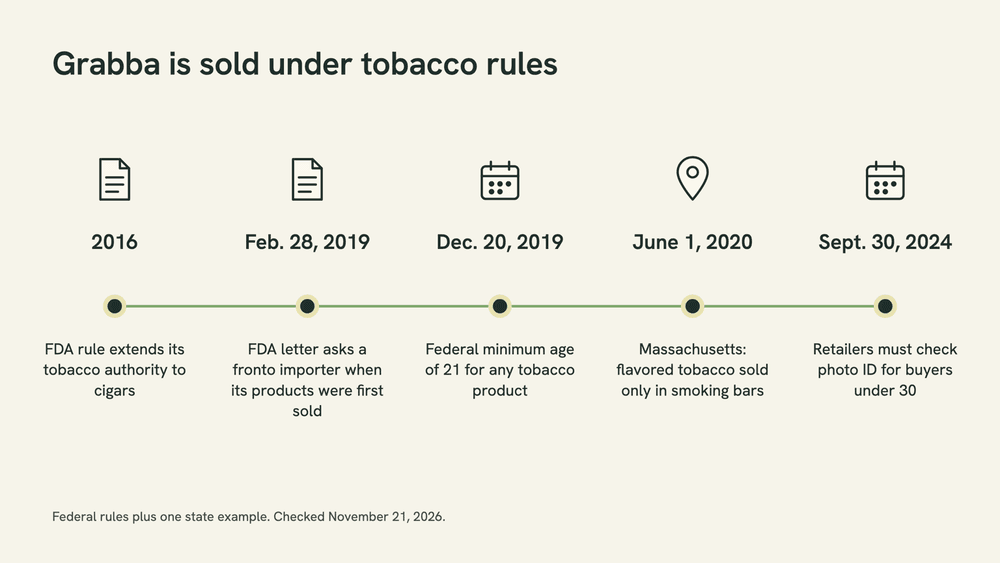
- 1Age 21. Since December 20, 2019, federal law has barred retailers from selling any tobacco product to anyone under 21, and since September 30, 2024 they must check photo ID for buyers under 30. Fronto and grabba are tobacco leaf.
- 2FDA premarket authorization. FDA has regulated cigars since a 2016 rule. Its 2019 letter told a fronto importer that FDA's extended deadlines applied only to products on the market by August 8, 2016, and asked when its products were first sold.
- 3Flavor limits in some places. Since June 1, 2020, Massachusetts has allowed flavored tobacco products to be sold only in smoking bars, for use on site. A flavored fronto leaf is a flavored tobacco product there.
Massachusetts was the first state to ban flavored tobacco this way; the state health department's chart of where and what tobacco products can be sold in Massachusetts explains the smoking-bar exception, and the state's law defines a tobacco product as one containing, made or derived from tobacco or nicotine. Other states and many cities have their own flavor rules, and they change, so check the rules where you live rather than relying on a national list. The cannabis inside the spliff is a separate legal question that depends on your state; our guide to whether CBD and hemp are legal explains how federal and state cannabis rules fit together.
What is still unknown about grabba
- How much nicotine is in fronto leaf or grabba. We found no published lab measurement as of November 21, 2026.
- What grabba users experience. No study we found has recruited grabba or fronto users specifically; the data come from blunt, spliff, cigarillo and cigarette users.
- What is in flavored fronto. We found no published analysis of the flavor additives in flavored leaf.
- How tobacco in a spliff affects people over time. The controlled trial described above used single doses of cigarette tobacco in 24 non-dependent adults.
- Whether spliff findings match blunt findings. Most co-use research is about blunts; only 11 of 45 studies in the 2017 review looked at spliffs or mulled cigarettes.
Those gaps are why this page sticks to what has been measured. When a seller, a forum or a song tells you something specific about how strong grabba is or how safe it is, the honest default is that nobody has checked.
Frequently asked questions about grabba
Yes. Fronto leaf is tobacco leaf, and tobacco contains nicotine. As of November 21, 2026 we found no published lab measurement of how much a fronto leaf contains. Cigar tobacco, the closest measured relative, varies widely: a 1999 analysis of 17 US cigar brands found 5.9 to 335.2 mg of total nicotine per cigar. That is cigar data, not fronto data.
It adds tobacco smoke and nicotine to the cannabis. In a double-blind trial of the combination (24 non-dependent adults, cigarette tobacco rather than fronto), tobacco did not change how stoned people felt or how much they liked or craved cannabis, but it improved working memory, which the researchers warned may make continued use easier. Surveys link mixing tobacco into cannabis with higher scores on problem-use screens, without showing cause.
Grabba is tobacco, and you smoke it. The National Cancer Institute says cigar smoking causes cancers of the mouth, larynx, esophagus and lungs, and that there is no safe level of tobacco use. A leaf sold as unprocessed or additive-free is not safer; the FTC once required an additive-free cigarette brand to say exactly that in its ads.
They are the same tobacco in two forms. Fronto leaf is the whole air-cured leaf, used as a wrap. Grabba is that leaf broken into pieces and mixed into cannabis. Many people also use the two words interchangeably.
Grabba is slang for crumbled tobacco leaf mixed with cannabis. It is often linked to New York, but we found no dictionary that documents where it is used most or where it came from. Community dictionaries record it as Jamaican slang. Green's Dictionary of Slang lists fronto as US drug slang, first cited in a 2016 rap lyric, and has no entry for grabba. The "grab a piece" origin story is folklore.
Yes. Since December 20, 2019, federal law has barred retailers from selling any tobacco product to anyone under 21, and fronto and grabba are tobacco. Some places also restrict flavored versions: since June 1, 2020, Massachusetts has allowed flavored tobacco to be sold only in smoking bars.
No. A blunt is cannabis wrapped in tobacco leaf or a cigar wrapper; a spliff is cannabis and tobacco mixed together in a paper. Grabba usually ends up in a spliff, and a whole fronto leaf used as the wrap makes a blunt. Either way, you are smoking tobacco.
Next: blunt vs joint vs spliff. If grabba came up because someone offered you a spliff or a blunt, the most useful next read is our side-by-side of blunts, joints and spliffs and what is actually in each. It covers cigarillo wraps, what "tobacco-free" on a wrap does and does not mean, and the controlled comparison of joints and blunts. For the wider series on reading labels and lab reports for hemp products, start with our guide to choosing a CBD oil.
Writing about hemp, wellness and the small rituals that keep us balanced.