Hitting a Blinker: What It Means and What a Long Hit Does
Hitting a blinker means one continuous draw on a vape until its light flashes and the heat cuts off. Here is what sets that cutoff, what the light can also mean, what a long draw does to the coil and your dose, and what nobody has measured yet.
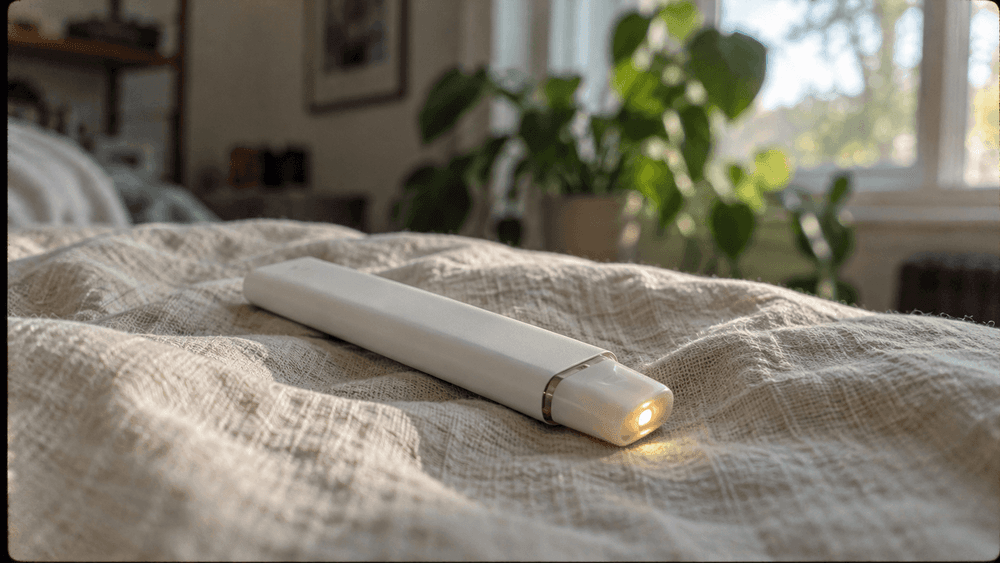
Hitting a blinker means taking one continuous draw on a vape until its small light starts flashing and the device stops heating. The flash is the vape's automatic cutoff, and what happens in the seconds before it is worth understanding, both inside the device and in your body.
The short answer: a blinker is a single long pull that runs until the battery's built-in timer cuts the heat. On the cart batteries whose manuals we read, that timer is 10 seconds; devices tested in a lab ranged from 4 to 15 seconds. A draw that long probably carries more aerosol, and so more THC, than a normal puff, but how much more has never been measured for a cannabis cart. This page is for adults 21 and over who heard the term, or whose vape flashed mid-draw and want to know why. It explains what is going on; it does not teach the move. Planntz does not make or sell vapes or cartridges. We make hemp CBD tinctures, and if that is what you are weighing up, our guide to choosing a CBD oil is a better place to start.
What is a weed blinker?
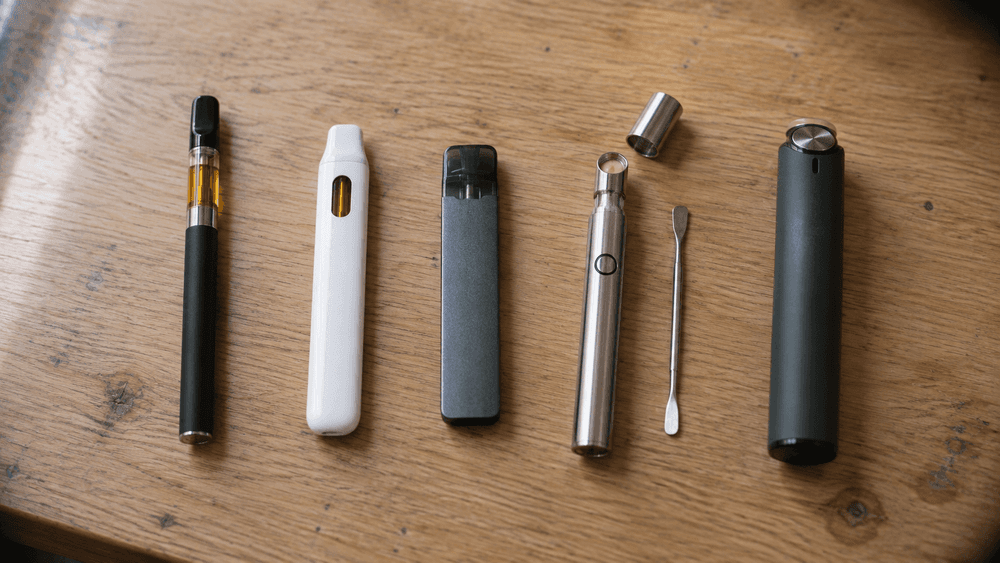
In the slang, a blinker is the length of a hit, measured by the device itself. Many cartridge batteries and disposable vapes have a small LED, often at the tip or the base, that lights while someone draws on them. If a single draw runs past the point the device allows, the light flashes, the heat switches off and the vapor stops. "Hitting a blinker" means a draw that runs all the way to that flash. The word names the light, not a product or a strain: people use it about THC cartridges, all-in-one THC disposables and nicotine vapes alike. If you are not sure what kind of device you have, our walkthrough of what a weed pen looks like and how it differs from a nicotine vape covers the parts and the tells.
The term did not start with cannabis. It was in use on social media by 2017, in posts about nicotine e-cigarettes, and spread widely through short videos from 2022. Somewhere along the way it became shorthand for a big hit, which is where most of the confusion comes from.
Why your vape blinks: the built-in cutoff
Many draw-activated vapes run a timer. Once a single puff passes a set length, the battery stops sending power to the coil and flashes the light to show why. Manufacturers describe the feature in their own words. CCELL's manual for its Palm battery and the one for its M3B Pro battery both say the "inhale protection function will cut off any session over 10 seconds." On Pulsar's 510 DL 2.0, the battery's manual says that after 10 continuous seconds the red light flashes four times and the heat shuts off, a feature it files under "battery life/cartridge protection." Even button-fired devices time out: the manual for one button-heated extract device says its heat cycle stops after 15 seconds "to prevent burning the coils." None of these manuals says the light means the device is about to hurt you. They describe the cutoff as protection for the battery, the cartridge and the coil.
Ten seconds is common, but it is not a rule. In a 2022 PLOS ONE study that filmed vape coils with a thermal camera, scientists employed by PAX Labs, in a study their company funded, ran puffs on three devices (two cartridge batteries and a pod system) for as long as each device allowed. The automatic cutoff ranged from 4 seconds to 15 seconds, and on one adjustable battery it got shorter at the higher setting. So there is no single answer to "how long is a blinker." It is whatever your device's timer is set to, and the manual is where that number lives.
For context, a normal vape puff is not short to begin with. A 2026 review of how inhaled THC is delivered, in Expert Review of Clinical Pharmacology, citing a survey of 557 people who vape cannabis, put the typical vaped puff at about 5 to 6 seconds, already several times longer than the roughly 1.3 seconds the review gives for a puff of smoked cannabis. On a device with a 10-second cutoff, a blinker is close to double a typical vaped puff in time. Time is not the same thing as dose, as the next sections explain, but it shows where a blinker sits.
What the light can mean (it is not always a blinker)
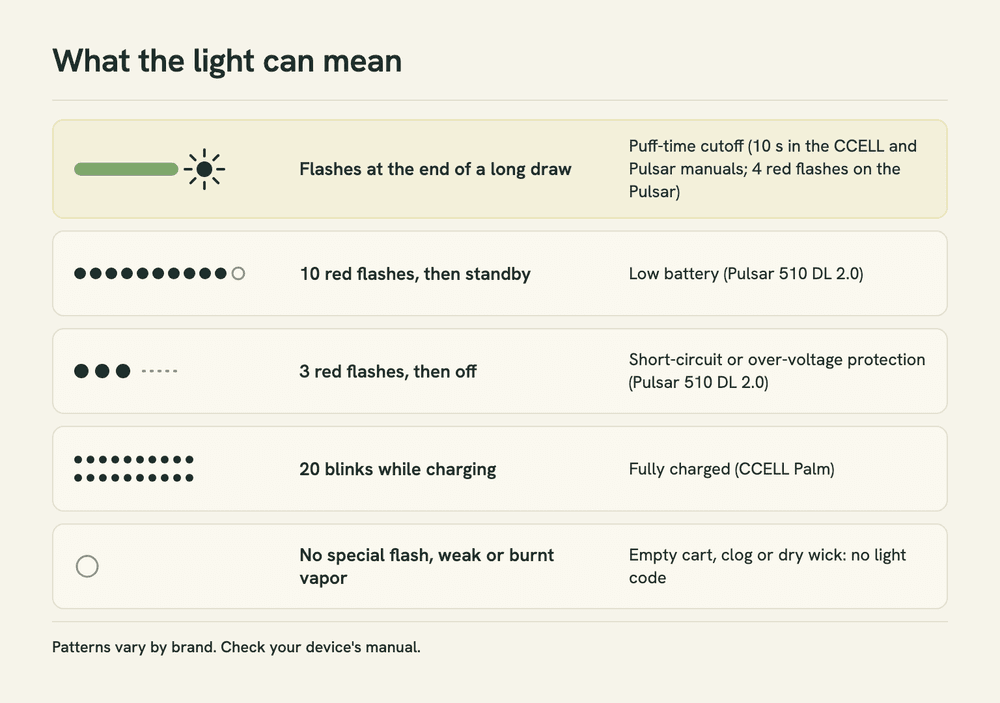
A flashing light only means "the timer ran out" when it happens at the end of a long draw. The same LED reports other things, and the codes differ from brand to brand. Three blinks, for example, mean a short circuit on the Pulsar 510 DL 2.0 but simply that the charging cable was unplugged on the CCELL Palm. The table below uses the codes printed in those two manuals, plus the problems that have no light code at all.
| What you see | What it usually means | Where that comes from |
|---|---|---|
| The light flashes at the end of a long draw and the vapor stops | The automatic puff-time cutoff, which is what people call a blinker | CCELL Palm and M3B Pro manuals (cutoff at 10 seconds; no light pattern given); Pulsar 510 DL 2.0 manual (10 seconds, then 4 red flashes) |
| The red light flashes 10 times | Low battery; the device then goes into standby | Pulsar 510 DL 2.0 manual |
| The red light flashes 3 times and the device turns off | Over-voltage or short-circuit protection | Pulsar 510 DL 2.0 manual |
| The light blinks 20 times while plugged in | Fully charged (a light that stays on means it is still charging) | CCELL Palm manual |
| The light blinks 3 times when the charging cable comes out | The cable was disconnected, not a fault | CCELL Palm manual |
| No unusual flash, but little or no vapor, or a burnt taste | An empty cart, a clog or a dry wick; there is no light code for these | Not a battery signal; see the cart guides linked below |
If the problem is the cart and not the battery, two of our guides go further: how long a cart lasts and the signs it is nearly empty, and what a burnt-tasting cart is telling you, which covers dry wicks and coil chemistry in depth. For the battery itself, FDA's advice on avoiding vape battery fires and explosions is to replace batteries that get damaged or wet, and the agency asks people to report a vape fire, explosion or any other health or quality problem with a vape to FDA.
What a long draw does inside the device
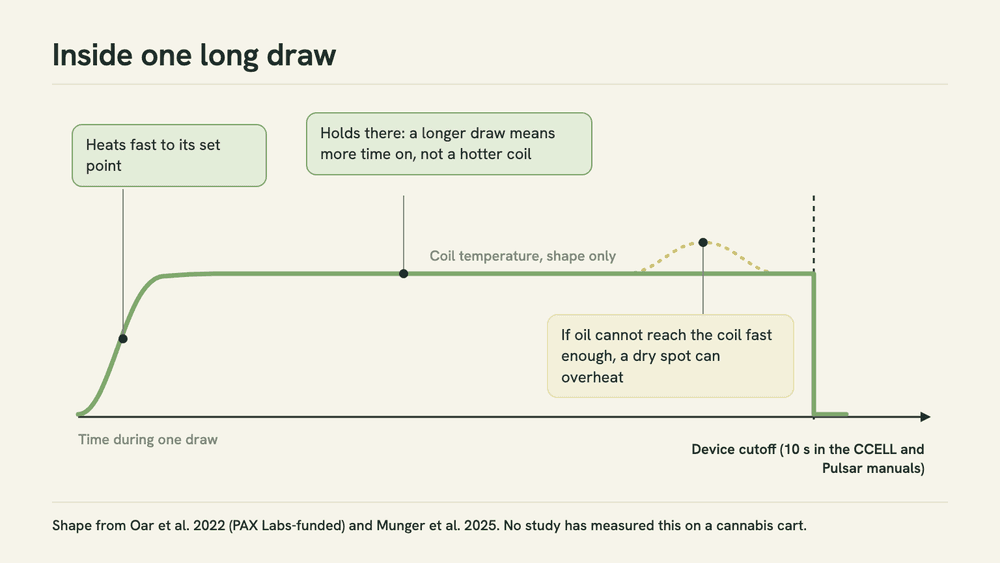
It is easy to assume that the longer a draw runs, the hotter the coil gets. The thermal-camera study points somewhere more specific. In those measurements, "the measured coil temperature rapidly rises until the set temperature or set voltage is reached" at the start of a puff, and then stays level at that set point for the rest of the puff. So a long draw mostly means the coil is on for more time at the same heat. The authors added one important exception: a drying wick can change the coil's temperature during a puff. They also found that a battery's voltage setting alone was a poor indicator of how hot the coil actually ran.
That makes the wick the part that matters. In a cartridge, a porous wick soaks up oil and keeps it in contact with the coil, which turns it into aerosol. If oil cannot reach the coil as fast as it is being used, part of the heating element runs dry, and oil touching that dry spot is exposed to much higher heat. A 2025 review of cannabis concentrate vaping chemistry in Frontiers in Toxicology names this as a central problem:
“Inefficient wicking is a major cause of toxicant formation during vaping since it can result in exposure of a sample to excessive temperatures via contact with a dry region of a heating element.”
Puff length is one of the things that can make a wick fall behind, and the clearest measurements come from nicotine products. In a 2020 machine study of four nicotine e-cigarettes, carbonyl and carbon monoxide emissions rose nearly in step with puff length from 2 to 5 seconds, and on one device they climbed faster than that, which the authors linked to the wick not keeping up. That was nicotine e-liquid, and no puff longer than 5 seconds was tested. No study has tested whether a 10-second draw on a cannabis cart outruns its wick.
What forms when cannabis oil itself overheats has been studied on the bench. In a 2021 RSC Advances study that heated THC, with and without a common terpene, in a ceramic cartridge, four small volatile breakdown products together made up 18% to 30% of the aerosol's gas phase. That work used machine puffs set at 3 seconds and no people, and one of its authors founded an Oregon hemp company. The fuller chemistry of a burnt hit lives in our explainer on burnt carts and coil heat. The honest summary for a blinker is "more time with the coil on, and more chance the wick falls behind," not "a hotter coil."
Does hitting a blinker get you higher?
Probably more per draw, by an amount nobody has measured for a cart. That is the honest answer, and it rests on evidence that points one way without giving a number. The older work is on smoke. A 2008 machine-smoking study varied how cannabis cigarettes were puffed and found that the method of smoke production influences the amount of THC produced, "e.g., longer puff length yielding a higher amount of THC." That was smoke, not vapor, but it points the same way. In people, a 1995 Johns Hopkins study of controlled cannabis smoking had seven regular users take puffs of set sizes: the bigger the puff, the higher their blood THC and the stronger the reported high. Holding the smoke in raised blood THC but did not make the high stronger. Those were 1990s joints, not vape carts, and the study varied the size of each puff, not its length.
The most direct numbers on puff length come, again, from nicotine. In a 2015 machine study of a nicotine e-cigarette, 8-second puffs delivered a little more than twice the nicotine of 4-second puffs, and the authors wrote that increasing the puff duration "resulted in systematically higher nicotine delivery." That is what a machine collected, not what a body absorbed, and the liquid was nicotine e-liquid. It is the clearest measurement we found of how puff length changes the active ingredient a vape delivers, and it has not been repeated with cannabis oil.
For cannabis vapes, the gap is stated plainly. The authors of the 2026 review expect "the way a consumer uses the product" to be the most significant factor in how much THC a person gets, more than any feature of the cartridge, though they label that a hypothesis. And as of that review, whose authors searched through November 2025, no human study had measured how THC from a vape cart moves through the body. Even measuring what people take in is hard: a 2024 Colorado study of adults using cannabis as they normally would concluded that weighing how much product disappears is a poor predictor of how much THC a person actually takes in, and daily users took in far more than occasional ones.
Put together, several things decide how much THC one draw delivers, and a blinker pushes only the first of them to its limit:
- Puff length: how long the coil is on and aerosol is being pulled. A blinker runs this out to the device's cutoff.
- Puff size: how much air moves through the device. In the 1995 study, bigger puffs meant higher blood THC.
- Oil strength: cart oil is a concentrate. The oil in the 2022 thermal-camera study was a dispensary extract that tested at 87% THC.
- The device: coils, wicks and power differ, and the cutoff alone ranged from 4 to 15 seconds across three devices.
- The person: tolerance and how often someone uses cannabis change how much they take in and how a given amount feels.
Two more facts make a blinker less predictable than it sounds. First, vapor can hit harder than people expect: in a 2018 Johns Hopkins trial with 17 adults who rarely used cannabis, vaporized cannabis produced stronger effects than smoking the same amount, and at the highest amount tested two people vomited. That was flower in a lab vaporizer, not a cart; our comparison of dry-herb vaporizers and smoking covers that difference. Second, inhaled THC acts fast, with blood levels and heart rate peaking within about 30 minutes in that trial, so a second long draw taken before the first has fully landed stacks on top of it. Because cart oil is so concentrated (our explainer on what THC distillate is and how it is made walks through why), one blinker can be a larger, less predictable amount than a short puff, and nobody can tell you by how much. If that amount turns out to be too much, our guide to greening out and what to do about it is the place to go, and how long a weed high lasts covers the timeline. People who want less per session, not more, tend to go the opposite way, which is the idea behind microdosing THC.
Is hitting a blinker bad for you?
No study has looked at a blinker specifically, so nobody can name an injury that one long draw is known to cause. But several downsides follow from what is known. The first is harshness: a long pull of hot aerosol can be rough on the throat and set off coughing, for reasons our article on why weed makes you cough explains. The second is the amount: on a concentrated cart, a blinker is likely a bigger, less predictable amount in one go, and repeats can stack before the first has fully landed, which can end in greening out, the nausea and anxiety of too much THC. The third is the coil: a draw that runs to the cutoff gives the wick the most time to fall behind, the mechanism the 2025 review ties to toxicant formation, though nobody has measured that on a cannabis cart. If the device is a nicotine disposable, the same habit raises how much nicotine each puff carries, as the 2015 nicotine e-cigarette study found.
Then there is the question many people mean when they ask whether vaping is dangerous. In the 2019-2020 lung-injury outbreak known as EVALI, CDC's archived outbreak page counted 2,807 hospitalized cases or deaths and 68 confirmed deaths as of February 18, 2020. CDC says vitamin E acetate, a thickener found in THC vape products mostly from informal sources, is "strongly linked" to the outbreak, while noting the evidence could not rule out other chemicals. A 2025 review in Chemical Research in Toxicology adds that a definitive mechanism of injury has not been established and that cases continue to be reported. The outbreak was tied to an additive in mostly informal-market products, not to how long anyone puffed. Our guide to spotting a fake or counterfeit cart covers that side of the market.
The warning signs below come from CDC's clinical guidance during the 2019 lung-injury response and the warning signs of a medical emergency that MedlinePlus lists.

What nobody has measured yet
When we searched PubMed in November 2026, we found no study that used the word 'blinker' in a vaping or cannabis context, and no study that measured how much THC, or which breakdown products, a cannabis cart or disposable releases as a single puff gets longer. The closest work filmed coil temperatures through full-length puffs (without testing the vapor) or tested nicotine e-cigarettes with puffs no longer than 8 seconds. That leaves these questions open, whatever you read online in either direction:
- How much THC a 10-second draw on a cannabis cart delivers compared with a typical puff. No one has measured it, so any number you see for the dose of a blinker is a guess.
- What a 10-second puff does to the breakdown chemistry of cannabis oil, as opposed to nicotine e-liquid.
- Whether repeated full-length draws wear out a battery or coil faster. We found no study, and the manuals describe the cutoff only as protection.
- How all-in-one cannabis disposables, specifically, behave across a full-length draw.
- Whether a blinker is no stronger than a normal hit, a claim some sites make. The evidence points the other way, but it has not been measured either.
Frequently asked questions
It means one unbroken draw on a vape until its light flashes and the device stops heating. The flash is the automatic puff-time cutoff built into many vape batteries. The term started with nicotine e-cigarettes and is now used for THC vapes too.
As long as your device's cutoff. The CCELL Palm, CCELL M3B Pro and Pulsar 510 DL 2.0 manuals all put it at 10 seconds. Across three devices tested in a 2022 study funded by PAX Labs, the cutoff ranged from 4 to 15 seconds, and on one battery it changed with the setting. Your manual has the number for your device.
Probably more per draw, but nobody has measured how much more for a cannabis cart. Machine studies found longer puffs carried more THC in cannabis smoke and more nicotine from a nicotine e-cigarette, and bigger puffs raised blood THC in people smoking joints. In a controlled trial, blood THC peaked within about 30 minutes of inhaling, so a second blinker can stack on the first.
No study has measured harm from a blinker specifically. What is known: a long draw is harsher, it is likely a larger and less predictable amount of THC in one go, and it gives the wick more time to fall behind, the mechanism behind burnt hits. Illicit carts also carry the EVALI history. Shortness of breath, chest pain or a worsening cough after vaping are reasons to get medical care promptly.
Usually it is reporting something else. On the Pulsar 510 DL 2.0, 10 red flashes mean a low battery and 3 mean short-circuit or over-voltage protection. On the CCELL Palm, 20 blinks mean a full charge and 3 blinks mean the charging cable was unplugged. Codes differ by brand, so your device's manual is the only reliable key.
The slang started with nicotine e-cigarettes, and the idea is the same: a draw that runs until the device cuts off. The manuals we read were for cannabis cart batteries, so we cannot give a cutoff for nicotine devices. A disposable has a fixed battery, so its cutoff is whatever the maker set, and it may not be printed anywhere. On a nicotine e-cigarette, a 2015 machine study found 8-second puffs delivered a little more than twice the nicotine of 4-second puffs.
We found no study on whether repeated full-length draws wear out a battery or coil. The manuals we read describe the cutoff as protection: CCELL calls it inhale protection, Pulsar files it under battery life and cartridge protection, and one button-fired device times out to prevent burning the coils.
A light on a vape can tell you when a timer ran out. It cannot tell you what is in the oil. For any cannabis product, that answer is on a lab report, and our guide to reading a certificate of analysis shows what a COA does and does not tell you.
Writing about hemp, wellness and the small rituals that keep us balanced.