Why Does My House Smell Like Weed? Check for Gas First
If your house smells like weed and no one smokes, rule out a gas leak first: gas odorants and cannabis's skunky note are both sulfur compounds. Then check for a neighbor's drifting smoke, residue on things you brought home, and lookalike smells.
When your house smells like weed and nobody in it smokes, the common explanations are smoke drifting in from a neighbor, residue on something that came into the house, or a different smell built on similar chemistry. But natural gas is odorized with sulfur compounds too, and the chemical reference entry for one widely used gas odorant describes it as a heavy skunk odor. So before you go looking for a neighbor, rule out a gas leak.
Once gas is off the table, the question gets easier. A weed smell you didn't make usually traces back to one of four things: a neighbor's smoke moving through shared walls, vents and hallways; smoke residue carried in on furniture, a car or clothing; one of the plants, foods or drinks that share cannabis's skunky molecule; or, outdoors, a skunk or a skunk-scented plant. This guide takes them in order of risk, explains the chemistry that makes them easy to confuse, gives you the measured numbers on how smoke moves between apartments, and ends with a room-by-room checklist to find the source.
First, rule out a gas leak
Natural gas has no smell of its own, as Connecticut's utility regulator notes in its guidance on what to do if you smell gas. The smell you know is added on purpose. A federal pipeline-safety rule, 49 CFR 192.625, requires gas in distribution lines to be odorized so that "at a concentration in air of one-fifth of the lower explosive limit, the gas is readily detectable by a person with a normal sense of smell." The rule dates to 1970. For methane, the main ingredient of natural gas, the lower flammable limit is 5.3% by volume according to the PubChem record for methane, so one-fifth of it is roughly 1% gas in air, far below the level at which it can ignite. Utilities meet the rule by adding sulfur compounds called mercaptans, and the Connecticut regulator describes the result as a distinctive "rotten egg" smell.
Three things make a gas smell easy to misjudge. Peoples Gas, the Chicago-area utility, warns on its safety page that "continued exposure to the odorant can desensitize the sense of smell," that "the smell of natural gas can be masked by other odors in the area," and that the odorant itself can fade. So a faint smell, a smell you stopped noticing, or a smell mixed in with cooking or smoke is not a reason to relax. Peoples Gas tells customers to report the situation to 911 and then call its 24/7 hotline, and not to try to find or stop the leak. Poison Control's page on natural gas adds that methane is a simple asphyxiant, meaning it takes the place of the oxygen you would otherwise breathe, and lists nausea, vomiting, headache, dizziness and confusion among the symptoms. Treat a smell as a possible gas leak if any of these is true:
- The smell is strongest near a gas stove, furnace, water heater, dryer or the gas meter.
- It reads as sulfur or rotten eggs, or you honestly can't say what it is.
- Anyone in the home has a headache, nausea, dizziness or confusion along with the smell.
- It comes and goes, or seemed strong and then faded: utilities warn that the odorant can fade and that your nose can stop registering it.
- It is outside, near the meter or along the street. Report it to the utility and let them find it.
Why gas, skunks and weed can smell alike
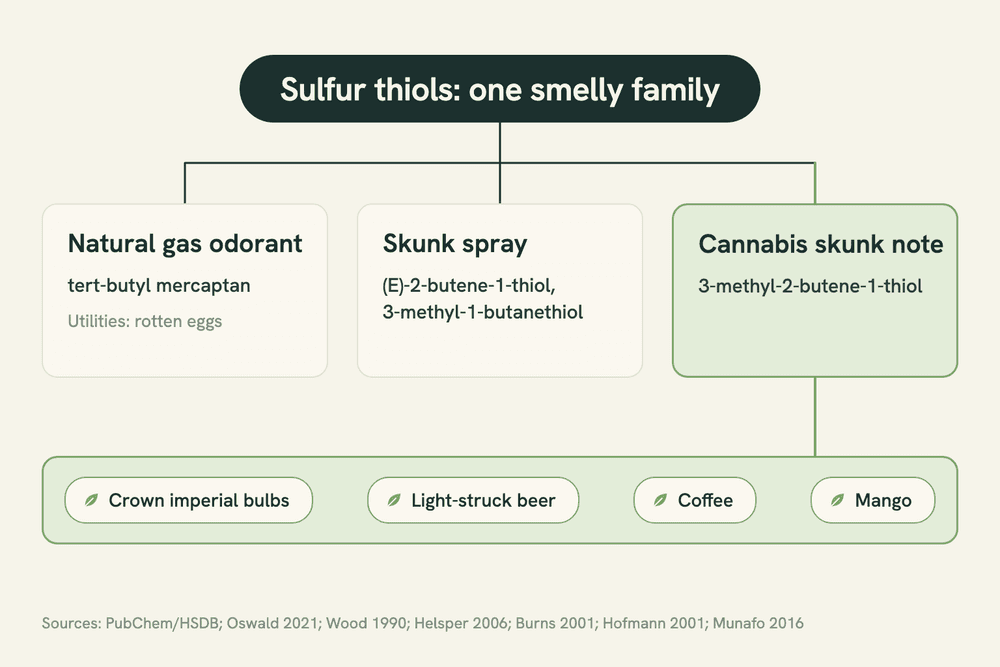
The overlap is chemistry, not coincidence. Mercaptans belong to a family chemists call thiols: small molecules built around a sulfur atom bonded to hydrogen, and famous for being smelly at tiny amounts. Cannabis's skunky note comes from the same family. In a 2021 ACS Omega analysis of 13 dispensary cultivars, researchers identified a thiol called 3-methyl-2-butene-1-thiol as the primary odorant behind the skunk note, rather than a terpene. Our explainer on why weed smells like skunk covers that finding in depth. Gas odorants are close relatives. Utilities describe their smell as rotten eggs, but the PubChem chemical record for tert-butyl mercaptan, one widely used odorant, describes it as a "heavy skunk odor," citing the Merck Index. And a 1990 chemical analysis of striped skunk spray found a skunk's defense built on thiols too, but different ones, including (E)-2-butene-1-thiol and 3-methyl-1-butanethiol.
Thiols also register at vanishingly small amounts. A 2012 study of the cannabis-skunk thiol in wine put its odor threshold at 0.5 to 1 ng/L, which is half a billionth to one billionth of a gram in a liter. That was measured in wine, not room air, but it shows why a trace of any of these compounds can reach you. Your nose reports "sulfur, skunky, something off." It does not report the molecule's name. That is the gap that lets a gas smell and a weed smell blur together, and it is why the rule only runs one way: if you can't place a sulfur smell, treat it as gas. Never assume the reverse.
Things that smell like weed but aren't
Several ordinary things carry the exact molecule behind cannabis's skunk note, and the most surprising is a garden bulb. Crown imperial (Fritillaria imperialis) is a tall ornamental lily relative known for a foxy smell. In a 2006 study of bulbs from six Fritillaria types, researchers traced that "foxy odor" to a single compound, identified as 3-methyl-2-butene-1-thiol. The strength varied by plant: very strong in the variety 'Premier', strong in 'Lutea', and absent in the subspecies inodora. That is the same molecule, measured in the bulbs, though no study has tested whether people actually mistake the plant for cannabis. The table sorts the common lookalikes by what is behind the smell.
| Source | Where you'd meet it | What's behind the smell | Same molecule as cannabis's skunk note? | What to do |
|---|---|---|---|---|
| Natural gas odorant | Near a gas stove, furnace, water heater, dryer or the meter | Added sulfur odorants, such as tert-butyl mercaptan; utilities describe rotten eggs | No, a related sulfur compound | Treat as gas: leave, then call 911 or the utility from outside |
| Skunk | Outdoors, around decks, sheds, crawl spaces and yards | A mix of thiols, including (E)-2-butene-1-thiol and 3-methyl-1-butanethiol | No, cousin thiols | Check outside first, especially around decks and crawl spaces |
| Crown imperial (Fritillaria imperialis) | Garden beds and stored bulbs | 3-methyl-2-butene-1-thiol, the single compound behind the bulbs' foxy odor; strength varies by variety | Yes | Check flower beds, bulb bags and the garage |
| Light-struck (skunked) beer | Open bottles, the recycling bin, beer left in light | Light breaks down hop bitter acids; the product is 3-methyl-2-butene-1-thiol | Yes | Rinse and empty the recycling |
| Fresh-ground coffee | Kitchen, grinder, coffee grounds in the trash | A trace of 3-methyl-2-butene-1-thiol among many coffee odorants | Yes, as a trace | Notice whether the smell tracks brewing |
| Mango | Ripe fruit on the counter or in the trash | One of 15 compounds that recreated 'Haden' mango aroma in a lab model | Yes, as one note | Check the fruit bowl and compost |
| Eastern skunk cabbage | Wetlands and damp woods, blooming in late winter | Nitrogen- and sulfur-containing compounds; not shown to include the cannabis thiol | Not shown | Outdoors only; it will not explain an indoor smell |
| Cannabis smoke from elsewhere | Shared walls, hallways, vents, windows | 3-methyl-2-butene-1-thiol plus the rest of cannabis's aroma | It is the source | See the drift section and checklist below |
Beer is the best-documented case. A 2001 photochemistry study of skunky beer traced the skunky note to light breaking down the bitter acids that come from hops, and the thiol that forms is the one the 2021 team found in cannabis. Our article on why some beers smell like weed explains the hops connection. Coffee carries a trace: a 2001 study of coffee aroma compounds lists 3-methyl-2-butene-1-thiol among three well-known coffee odorants, and a 2006 screen of a synthetic thiol library found that this thiol, "naturally present in beer and coffee," was the most powerful odorant in the set. Aroma research on 'Haden' mangoes included it in a 15-compound model that recreated the fruit's smell, which our piece on mango and weed picks up. In a kitchen, coffee and mango usually just smell like coffee and mango, because the thiol is one note among many. Outdoors, eastern skunk cabbage has a fetid scent built partly on nitrogen- and sulfur-containing compounds, according to a 2024 study of the plant's floral scent, but that study does not name the cannabis thiol.

How a neighbor's smoke gets into your home
If you live in an apartment, condo or duplex, the air in your unit is not entirely your own. In a tracer-gas study of six Minnesota apartment buildings, researchers released tracer gases in individual units and measured where they turned up. A median of about 4% of the air entering a unit had come from other units, from 2.1% in a new condo up to 35.3% in a 1930s duplex. Sealing gaps and running continuous exhaust ventilation cut the transferred share by a median of 29%, and the authors concluded that transfer "can be reduced but not eliminated." The study also tracked tobacco nicotine, which moved at about one-sixth the tracer's rate. These were tracer and tobacco measurements, not cannabis; we cite them because they show how much air moves between units at all.
Hallways are a common route. In a 2008-09 study of 11 apartment buildings in Buffalo, New York, particle monitors detected tobacco smoke moving into 2 of 14 smoke-free units and 6 of 8 shared hallways. Median fine-particle levels between 4 PM and midnight were 10.2 micrograms per cubic meter in smoke-free units, 18.9 in hallways and 29.4 in units where smoking was allowed, so the hallways carried smoke more often than neighboring units did. Inside a single house, the spread is wider. In a 2022 experiment in a two-story house, one machine-smoked joint in the living room raised fine particles in all nine rooms for five hours, to about 4.4 times a cigarette's level, and opening three windows about five inches cut that by two-thirds. So smoke from one room of a house can reach every other room. Both studies measured particles, not smell, and neither measured health effects.
Smoke travels through any opening that connects your space to someone else's. The usual paths between units and floors are:
- Gaps around electrical outlets, switches and light fixtures on shared walls and ceilings.
- Openings for pipes and wiring under sinks, behind toilets and inside closets.
- Shared ventilation: kitchen and bathroom exhaust ducts, and central heating and cooling.
- The gap under your front door and around its frame, fed by the hallway.
- Open windows, balconies and patios close to a neighbor's.
- In a house: stairwells, floor registers and return-air vents between floors.
Smoke also outlasts the smoking. In eight real bong sessions in one living room, particles took about 90 minutes after smoking stopped to fall to half their peak, and in the one session tracked overnight the air still held more than ten times its normal particle level 12 hours later. That is why a smell can show up long after anyone lit anything, or seem to come from nowhere. If your real worry is a drug test rather than the smell, our guide on whether secondhand smoke can make you fail a drug test walks through what the testing research found.
How common is smelling a neighbor's weed?
You are far from alone, but read each number for what it is. The largest is a 2019 International Cannabis Policy Study survey of 15,634 apartment and condo residents in the US and Canada, an online panel. About one in four in US states with legal adult-use cannabis (26.6%) said smoke from another unit or outside reached their home at least monthly, compared with 25.7% in Canada and 20.1% in US states where it was illegal. That is a report of smell, not a measurement of exposure. A 2018 survey of 1,030 residents in 21 New York City subsidized high-rises found 67% had smelled marijuana smoke in their home in the past year that came from another apartment or from outside, more than the 60% who said the same of cigarette smoke. Only about a third of those invited took part, so the result may not hold for every resident. And in a 2018-19 survey of 382 parents at four New York City pediatric practices, 30.9% reported marijuana smoke coming into their home while they were with their child, close to the 33.5% who reported tobacco smoke. It was a convenience sample, so it describes those clinics, not all parents. All three asked about smell. None measured what the smoke did to anyone.
When the smell came in with something
Sometimes the source is an object, not a neighbor. Smoke leaves behind residue, often called thirdhand smoke, that a 2022 review of thirdhand smoke chemistry describes as persisting indoors after the smoking ends. A used couch, a secondhand car, a rug, a thrifted jacket, or clothes and shoes someone wore in a smoky room can carry it into your home. The clearest measurement of that last route comes from tobacco: in a 2020 study in a non-smoking movie theater, thirdhand tobacco smoke chemicals off-gassed from moviegoers' clothes and bodies into the room. What this means for health is not known for cannabis. A 2017 systematic review of passive cannabis smoke exposure found no evidence, up to its search date, assessing exposure to thirdhand marijuana smoke or its health effects. That makes the honest answer "unknown": not that the residue is harmless, and not that it is harmful. For cleaning it out, and why surfaces matter if you have small kids, see our section on thirdhand residue in the weed-smell removal guide.
A room-by-room checklist to find the source
Work through these in order. The first step is the only urgent one; the rest are about patterns, and patterns take a few days to show.
- 1Rule out gas. If the smell is near a gas appliance or the meter, or you can't place it, leave and call 911 or your utility from outside. Don't sniff around appliances to confirm it.
- 2Note when it happens: time of day, which days, whether it starts when a neighbor gets home, or when the heat, AC or a bathroom fan switches on.
- 3Note where it is strongest: outlets and switches on shared walls, under sinks, inside closets, at the front door or near vents.
- 4Compare inside and outside. Step out to the hallway, yard or street side. A smell outdoors near the meter goes to the utility.
- 5Think about what is new: a secondhand couch, rug or car, thrifted clothes, or gear borrowed from someone who smokes.
- 6Check the lookalikes: open beer bottles and the recycling bin, fresh coffee grounds, ripe mangoes, crown imperial bulbs in a bed or in storage.
- 7Keep a dated log of times, rooms and strength for a week or two. A pattern points to a source, and a written record is easier to share than a memory.
- 8Call the right person: the gas utility for anything gas-like, your landlord or building manager for smoke drifting from another unit.
If it is cannabis and you rent
If your checklist points to a neighbor's smoke, the next questions are practical, not chemical. Whether smoking is allowed in your building depends on your lease, your building's rules and your state's law, and those vary widely. Our guide on whether you can get evicted for smoking weed covers the tenancy side, and the piece on whether the smell of weed counts as probable cause covers the legal meaning of the smell itself. Take your log to your landlord or building manager rather than guessing which unit it is, since smoke can travel through hallways and shared ducts and may not come from the door next to yours.
What we still don't know
The evidence here has real gaps, and you should know them. No study we found measures cannabis odor moving between apartments: the building studies used tracer gas and tobacco, and the cannabis studies measured particles in one house each. The surveys are self-reported smell, and two of the three were limited samples: a low-response survey of 21 New York City buildings and a convenience sample of parents at four clinics. We found no study testing how often people mistake a gas leak for cannabis, or crown imperial for cannabis, so the overlap in this guide is chemical, not behavioral. The cannabis thiol threshold was measured in wine, not air. The 2021 cannabis aroma paper analyzed 13 cultivars and came from authors affiliated with a cannabis aroma company. And we found no study that ranks the causes of an unexplained weed smell at home, which is why this guide orders them by risk, starting with gas, rather than by how often they happen.
Why does my house smell like weed? Common questions
Several things share cannabis's skunky sulfur chemistry. Crown imperial bulbs, light-struck (skunked) beer, fresh coffee and mango all contain the same molecule behind cannabis's skunk note, 3-methyl-2-butene-1-thiol, though in coffee and mango it is one note among many. Skunk spray and natural gas odorants are related sulfur compounds rather than the same molecule. Eastern skunk cabbage, a wetland plant, has sulfur compounds in its scent too, but they have not been shown to include the cannabis thiol.
Utilities describe the gas odorant as smelling like rotten eggs or sulfur. The chemical reference entry for one widely used odorant, tert-butyl mercaptan, describes it as a heavy skunk odor, and cannabis's skunky note is also a sulfur compound. Because the two belong to the same chemical family, don't try to tell them apart. If you can't place a sulfur or skunky smell, especially near a gas appliance or the meter, leave and call 911 or your utility from outside.
Outdoors, the usual candidates are a neighbor smoking on a porch, balcony or yard, a skunk, crown imperial in a nearby garden, or, near wetlands in late winter, eastern skunk cabbage. A gas smell outside, especially near the meter or along the street, is different: report it to your utility right away and do not try to find the source yourself, as gas regulators advise.
Air certainly can. In a tracer-gas study of six Minnesota buildings, a median of about 4% of the air entering a unit came from other units, and over 35% in an old duplex. In a Buffalo, New York, study, tobacco smoke reached 6 of 8 shared hallways and 2 of 14 smoke-free units. Both measured tobacco or tracer gas rather than cannabis odor, but smoke follows the same paths: outlets, pipe openings, shared ducts and door gaps.
No study we found measured when cannabis smoke drifts most. Two simple explanations fit: evenings are when many people are home, and smoke lingers, with particles in one bong study taking about 90 minutes to halve after smoking stopped. By our reasoning, heating, cooling or a bathroom fan switching on may also shift air between spaces. A dated log of when and where you notice it is the best way to find the pattern.
The answer depends on the kind of test and how much smoke you were around, so we keep it in one place: our separate guide on whether secondhand smoke can make you fail a drug test covers what the controlled studies found and where their limits are.
Smoke residue, often called thirdhand smoke, persists indoors after the smoking ends and can cling to upholstery, carpet and fabric. A secondhand car, couch or rug can carry it from a previous owner. Our weed-smell removal guide covers how to clean it out.
The studies in this guide measured exposure, not harm. Surveys counted how often people smell it, and air studies counted fine particles; none of them measured health effects of smoke drifting between homes. A 2017 systematic review also found no studies, up to its search date, on exposure to or health effects of thirdhand cannabis smoke. So the honest answer is that it is not well studied. If you have a baby, asthma or another concern, it is reasonable to raise it with your landlord and your doctor.
If the smell turns out to be your own, our guide on clearing weed smell from a room and how long it lasts covers removal step by step. For the full chemistry of the skunky note, read what makes cannabis smell like a skunk. And if you arrived here from the CBD side of things, our guide to what CBD is and how it differs from THC is the place to start.
Writing about hemp, wellness and the small rituals that keep us balanced.