CBD Honey: What's in the Jar, and Can Bees Make It?
Most CBD honey is ordinary honey with hemp extract added. Hemp gives bees pollen, not nectar, and the "bee-made" versions come from hives fed a cannabis feed. Here is the per-teaspoon math, why even mixing is an open question, what FDA says, and how to check a jar.
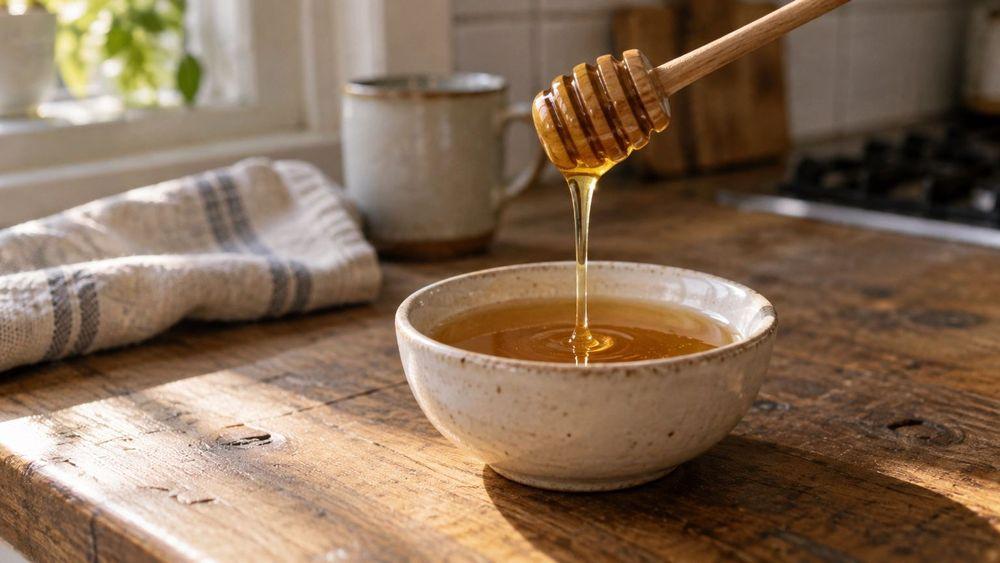
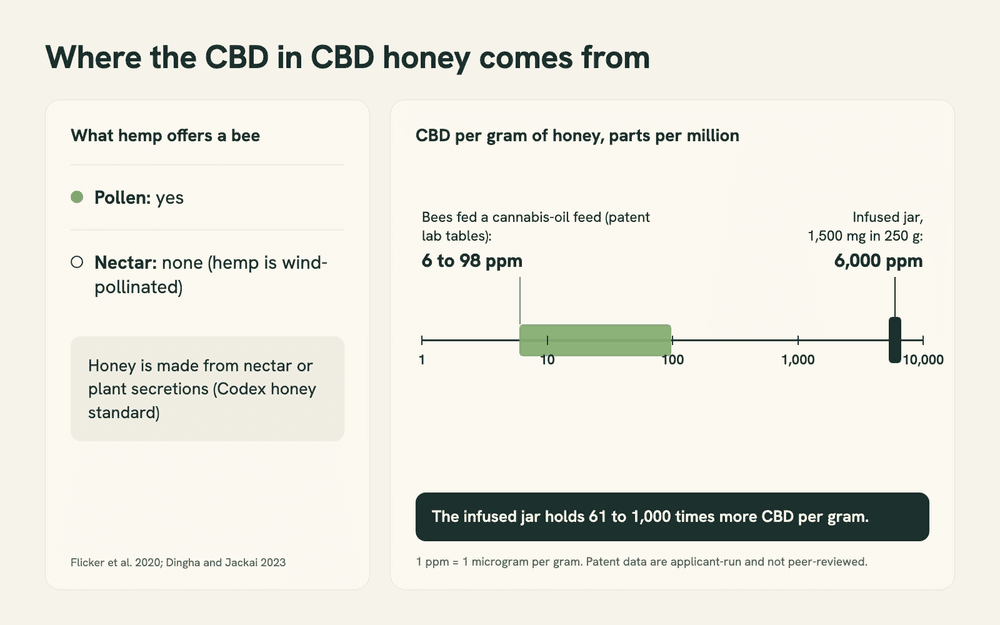
CBD honey is, in almost every jar you will find, ordinary honey with hemp extract stirred in. Hemp is a wind-pollinated plant that offers bees pollen but no nectar, and honey is made from nectar. The "made by bees" versions come from hives fed a syrup mixed with cannabis oil, and a US patent for that method, which publishes lab numbers, puts their CBD at a small fraction of an infused jar. So the CBD on the label is added extract, and the label plus the batch lab report are how you check it.
This guide is for the shopper holding a jar or a honey stick and wondering what is actually in it. Page one for this search is mostly seller blogs, a recipe and a paid "bee-made" story, and most of it accepts the premise without checking. Below we test the bee claim against pollen research and a US patent, do the per-teaspoon arithmetic, explain why "evenly mixed" is an open question, lay out what FDA has said about CBD in food, and end with a four-step jar check. It applies the same reading skills as our guide to choosing a CBD oil to a food format. This is label reading, not a health claim: we make none for honey or for CBD.
What CBD honey actually is, and what the label should say
The international honey standard defines honey as "the natural sweet substance produced by honey bees from the nectar of plants" or from plant secretions, and says honey sold as honey shall have nothing else added to it. By that definition, honey plus hemp extract is a blend, not plain honey. The standard is voluntary and is not US law, but FDA's honey labeling guidance points the same way. That guidance is advisory. It says a package of only honey is labeled "honey" and needs no ingredient statement, while a blend should carry a name that accurately describes the food and an ingredient statement that lists each ingredient. Its examples are sweeteners and flavors, not CBD, but the reading rule carries over: a CBD honey's ingredient line should name the hemp extract.
You will meet three formats on a shelf or a product page:
- Jars: honey with a stated CBD total per jar. The jars we read ran from 250 mg to 1,500 mg. That is the whole jar; the amount per spoon is yours to work out.
- Sticks and straws: single-serve tubes of honey, sold with a per-stick figure such as 10 mg.
- "Bee-made" honey: honey from hives fed a cannabinoid feed, marketed as made by the bees. The next section looks at what that means.
If you have read our walk-through of a CBD label, the same lines matter here: total mg, mg per serving, the spectrum, a batch number and a link to the lab report. One more thing to separate: "hemp" on a food label does not mean CBD. Hemp seed butter, for example, is ground seed with no added CBD.
Can bees make CBD honey? What the pollen research shows
Start with the plant. In a Cornell field survey of bees on New York hemp farms, which recorded 16 bee species visiting the crop, the entomologists described hemp in one sentence:
“As an exclusively wind-pollinated crop, hemp lacks nectar but produces an abundance of pollen.”
Bees do collect pollen, but by the honey standard quoted above, honey is made from nectar or plant secretions, not from pollen. A second field study points the same way. In a North Carolina study of bees on four hemp varieties, honey bees were fewer than 1 in 100 of the 1,826 bees counted (0.8%), against 84.7% sweat bees and 14.6% bumble bees. The paper also notes that hemp for CBD is usually grown as all-female plants, because pollination lowers CBD yield, and states it plainly: "The flowers produce pollen but not nectar." Two limits apply. That study measured pollen nutrients, not cannabinoids, and it ran at one site for one season on fiber and grain varieties. Other studies it discusses found a larger honey-bee share.
Could pollen carry cannabinoids into a hive anyway? Researchers have taken the question seriously. An Italian team published the first validated method for measuring CBD in honey in 2019, partly because bees can transfer hemp pollen into their hives and so into hive products. We read the abstract only, so we do not report what they found in specific honeys. Nothing we read shows foraging bees putting label-strength CBD into honey.
So where does "made by bees" come from? The method is spelled out in a US patent granted in May 2019: feed the bees a composition that is at least 50% bee food and contains 0.1 to 5% cannabis oil, then collect the honey. The patent's own background notes that the plant "does not produce nectar". Its lab tables put CBD in the resulting honey at 30 to 98 parts per million by one method (gas chromatography) and 6.0 to 8.3 by another (liquid chromatography). One named inventor also co-founded a company that describes feeding hives a "cannabinoid-infused nectar". A 2022 story about honey "made completely by bees alone", which still ranks on page one for this search, was labeled as an ad by the honey brand, and said its bees "eat a blend of hemp nectar". Since hemp makes no nectar, that can only be a prepared feed.
Patent figures are the applicant's own, from a handful of samples, and the two methods disagree by roughly ten times. Still, they set the scale. One part per million is one microgram per gram. An infused jar of 1,500 mg in 250 g holds 6,000 parts per million, which is 61 to 1,000 times the CBD per gram of the patent's bee-fed honey. Any CBD at label strength comes from added extract.
You may also see headlines linking CBD and bee health. Those come from Polish experiments that fed CBD to honey bees and measured enzymes in the bees, with a 2022 follow-up and a 2023 study of antioxidant markers. Those papers are about bees. None measured CBD in the honey, and none says anything about people.
How much CBD is in a teaspoon? The per-serving math
Labels usually print one big number, the CBD per jar. To compare products, convert it to a serving. FDA's reference serving for honey is 1 tablespoon. USDA's FoodData Central entry for honey (FDC ID 169640) gives 1 tablespoon as 21 g, so a teaspoon is about 7 g. The math takes three steps: divide the label's total mg by the jar's weight in grams, multiply by 7 for a teaspoon, then divide the price by the total mg for cost per mg.
| Format | Label total | Per gram | Per teaspoon (about 7 g) | Per tablespoon (21 g) | Price per mg |
|---|---|---|---|---|---|
| UK infused jar, 250 g, £30 | 1,500 mg | 6.0 mg | About 42 mg | About 126 mg | £0.020 |
| US jar featured on local TV in 2019, $39 | 250 mg | Not stated | 14 mg (seller figure) | About 42 mg | $0.156 |
| Same line, larger jar, $59 | 500 mg | Not stated | 28 mg (seller figure) | About 84 mg | $0.118 |
| Honey stick, $1.50 (2023 buyer's guide) | 10 mg per stick | Not stated | One stick | n/a | $0.15 |
| "Bee-made" honey (patent lab tables) | Not stated | 0.006-0.098 mg | About 0.04-0.69 mg | About 0.13-2.1 mg | n/a |
| For comparison: Planntz tincture, 60 mL, $80 | 15,000 mg | 250 mg per mL | About 12.5 mg per drop | n/a | $0.0053 |
Three things fall out of the table. First, a spoon adds up fast. The UK's food regulators advise healthy adults to limit CBD from food to 10 mg a day, a precautionary figure. At 6 mg per gram, that is about 1.7 g of the UK jar, roughly a quarter teaspoon. That is UK advice, not a US dose and not a recommendation; it shows the scale. Second, per mg, the two US jars cost 22 to 29 times what the tincture does. Our cost-per-mg method explains the division, and the CBD per drop calculator handles the tincture side. Third, the US jars' 14 and 28 mg per teaspoon came from the seller, and you cannot check them without a net weight. If a label gives only a jar total and no weight, you cannot do the math at all.
Is every spoonful the same dose?
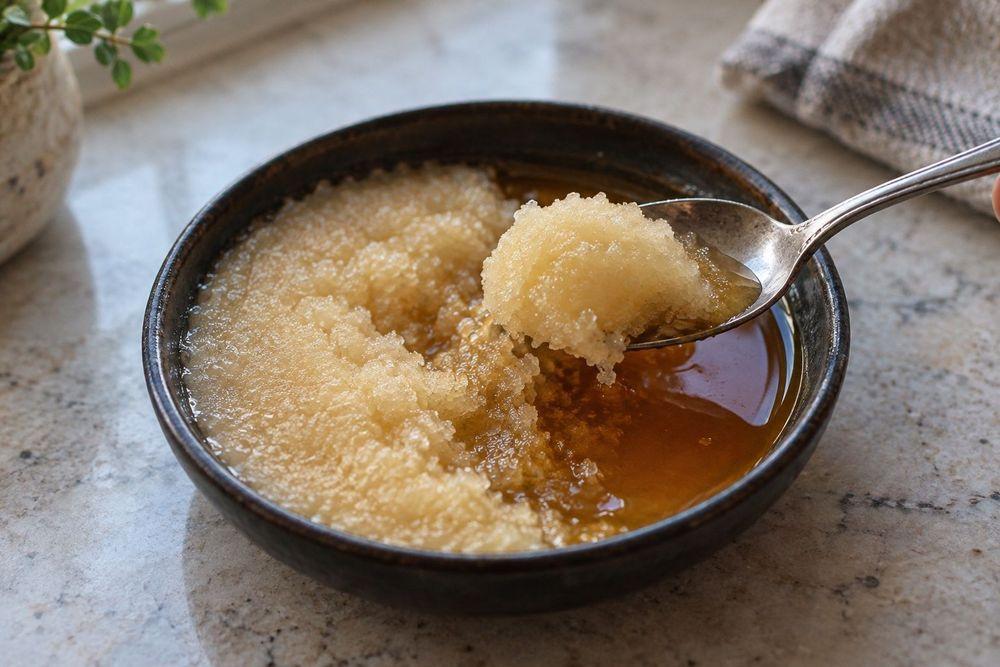
Nobody can tell you for a given jar without testing it, and that is the honest answer. Here is why it is a real question. The label of the only FDA-approved CBD medicine states that CBD "is insoluble in water". USDA's entry puts honey at about 17% water, with most of the rest fructose and glucose. So an oil extract in honey is a dispersion, droplets spread through a thick syrup, not a solution. Whether those droplets stay evenly spread depends on the maker's process, and the label will not tell you.
Honey also changes in the jar. In a 2021 storage study of Romanian honeys, untreated samples had begun to crystallize within the first month. That study used plain honey, not CBD honey, so it does not show what crystals do to an extract. It does show that the texture of a jar is not fixed over its shelf life.
When we searched PubMed on November 7, 2026, we found no study that tested whether CBD stays evenly spread through a jar of honey. A search pairing honey with homogeneity or label accuracy and cannabidiol returned 0 records. A broader honey and cannabinoid search returned 13, and none was a within-jar uniformity study. That is a search result, not proof that nothing exists. The same question for gummies, and how a lab checks it, is covered in our section on whether every gummy carries the same dose.
Why a honey COA is harder than an oil COA
A COA, or certificate of analysis, is the lab report for a batch. Measuring CBD in honey is not routine: the 2019 Italian method above was the first validated one for this food. A 2024 Japanese method used honey, chocolate and gummies as test materials and could quantify cannabinoids down to 10 to 40 micrograms per gram, with accuracy within 10%. That is plenty for an infused jar at about 6,000 micrograms per gram. It is not much headroom for a "bee-made" honey at 6 to 98: a validated 2024 method could not have put a number on the lowest patent values. Other labs may go lower, so check what limit a report used.
FDA's own testing shows why a number matters. In 2016, FDA tested a six-ounce "CannaHoney with CBD". The label gave no CBD amount, and FDA's results table shows a dash where the CBD number would go. One product, ten years ago, from a firm already under scrutiny: a warning sign, not a rate. A honey COA worth trusting shows:
- The honey product name and batch number, not only the source oil. A report on the extract tells you what went in, not what is in your jar.
- CBD reported per gram or per serving, so you can check the label's math.
- Total THC, ideally in mg, with the lab's limits of detection and quantification.
- The lab's name, the test date and a way to verify the report.
A THC percentage needs care on a food. The 250 g UK jar in the table says "less than 0.2% THC". Read against the jar weight, that would allow up to 500 mg. Read against the extract, it depends on how much extract went in, which the page does not say. The number you need is total THC in milligrams per container, from the lab report. Our COA reading guide shows where each figure sits. (That jar is sold in the UK and is not subject to US law; it is here to teach the arithmetic, not to judge it.)
What the FDA says about CBD in honey, and the two 2026 hemp dates
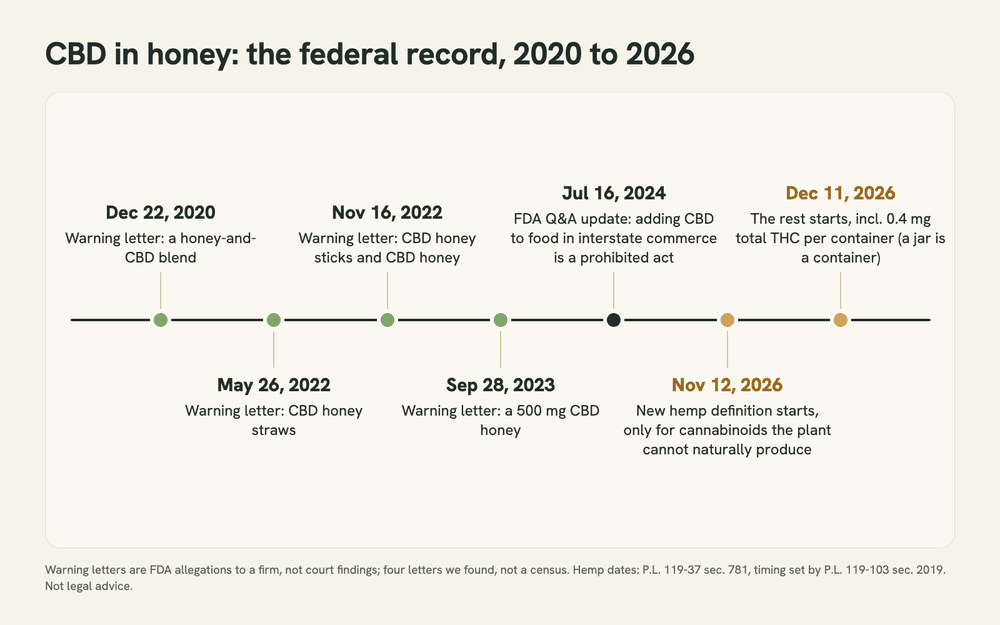
FDA's position on CBD in food is direct. Its cannabis Q&A, as of the page's July 16, 2024 update, says:
“FDA has therefore concluded that it is a prohibited act to introduce or deliver for introduction into interstate commerce any food (including any animal food or feed) to which THC or CBD has been added.”
The agency could allow an exception by regulation, and the same page notes: "To date, no such regulation has been issued for any substance." Honey with CBD added is a food with CBD added. That is FDA's conclusion, not a court ruling, and state rules on hemp in food differ. Our overview of where CBD is legal covers the state layer, and the rest of FDA's position on CBD is explained separately. None of this is legal advice.
FDA has also named honey products in at least four warning letters since 2020, and each one says the named honey products are adulterated because they "bear or contain an unsafe food additive". Warning letters are allegations sent to a firm, not court findings, and these four are a sample we found, not a census:
- December 2020: a honey-and-CBD blend. The letter also quoted the seller's claims about multiple sclerosis, rheumatoid arthritis and Alzheimer's back to it. The same product line had been featured in a syndicated local-TV story in 2019.
- May 2022: CBD honey straws. FDA said they could not be dietary supplements despite carrying Supplement Facts panels.
- November 2022: CBD honey sticks and CBD honey, which FDA listed among products consumers may confuse with traditional foods, with "a risk of unintended consumption".
- September 2023: a 500 mg CBD honey. In FDA's words, "There is no food additive regulation which authorizes the use of CBD."
You can read each letter on FDA's site: the December 2020 letter on a honey blend, the May 2022 letter on honey straws, the November 2022 letter on honey sticks and the September 2023 letter on a CBD honey.
Federal hemp law is changing too. Public Law 119-103 split the start of the new hemp definition written in Public Law 119-37 into two dates. From November 12, 2026, the change will apply only to cannabinoids that are not capable of being naturally produced by the cannabis plant, meaning synthetic or converted ones. From December 11, 2026, the rest will apply, including a ceiling of 0.4 mg of combined total THC per container for a finished hemp product. The statute defines a container as the innermost vessel, "such as a jar, bottle, bag, box, packet, can, carton, or cartridge". For a CBD honey, that is the whole jar or the whole stick. Our explainer on the December 11 delay tracks the detail. We do not forecast how either date will be enforced.
Honey and babies: the safety rule most of page one skips
Most of the page-one results we read never mention this, and it matters most for sticks, which look like candy. FDA made a related point in its November 2022 letter: honey sticks are among the products consumers may confuse with traditional foods. The CDC's botulism prevention page is the source for the infant rule, and our page on CBD and children covers what is and is not known for older kids. FDA recommends keeping cannabis products out of reach of children. If a child eats one, FDA says to take the child to a physician or emergency department, especially if the child acts in an unusual way or feels sick. You can also call Poison Help at 1-800-222-1222.
A four-step jar check before you buy
Run these in order. If an early step fails, the later ones cannot rescue it.
- 1Mg per serving, and the serving unit. The label should give CBD per teaspoon, tablespoon or stick, not only per jar, plus a net weight so you can check it: jar mg divided by grams, times 7, is mg per teaspoon.
- 2A batch COA that names this honey product and this batch, from an independent lab, reporting CBD per gram or per serving. A report on the source oil alone is not enough.
- 3Total THC in mg per container on that COA. Full-spectrum extracts carry THC, and from December 11, 2026 the federal ceiling for a finished hemp product will be 0.4 mg per container.
- 4An ingredient line that names the hemp extract, no disease claims on the label or the seller's site, and a warning not to give honey to infants under 1.
Step 3 matters most if you are drug tested. Full-spectrum products carry trace THC, and no CBD product can guarantee a drug-test result. The four steps are the food version of the buying checklist you would use on any tincture: the format changes, the questions do not.
What we still don't know
Plenty. We found no study of whether CBD stays evenly mixed in honey, and no human study measuring how CBD in honey is absorbed compared with an oil. Claims that raw honey "boosts absorption" have nothing behind them that we could find. What is known about food and CBD uptake in general is on our page about taking CBD with food. The bee-fed numbers come from a patent, not a peer-reviewed study. And we read only the abstracts of the 2019 and 2024 honey methods, so we cannot tell you what they measured in the honeys they tested. What the record supports is narrow and practical: treat CBD honey as a food with added extract, do the math, and ask for the batch lab report.
Frequently asked questions
Not in the way the name suggests. Hemp is wind-pollinated and offers bees pollen, not nectar, and honey is made from nectar. The "bee-made" CBD honeys on sale describe bees fed a syrup mixed with cannabis oil. A US patent on that method reports 6 to 98 parts per million of CBD in the resulting honey, far below an infused jar at about 6,000.
Divide the label's total mg by the jar's weight in grams, then multiply by 7, since a teaspoon of honey weighs about 7 g. A 1,500 mg, 250 g jar works out to 6 mg per gram, or about 42 mg per teaspoon. If the label gives no net weight, look for a per-serving figure on the batch COA or ask the maker.
It depends on where and how it is sold, and this is not legal advice. FDA's Q&A, as of its July 16, 2024 update, says adding CBD to a food in interstate commerce is a prohibited act, and FDA has named CBD honey products in at least four warning letters since 2020. State rules differ. From December 11, 2026, a finished hemp product with more than 0.4 mg of total THC per container will fall outside the federal hemp definition, and the statute lists a jar as a container.
It can. Full-spectrum extracts contain THC, and no CBD product can guarantee a drug-test result. Check the batch COA for total THC in mg per container, and if you are tested for work or sport, weigh that before using any CBD product.
Never babies under 1: the CDC says not to feed honey, or products made with it, to infants. CBD has not been established as safe for children, and FDA recommends keeping cannabis products out of their reach. Sticks look like candy, so store them away from children. If a child eats one, call Poison Help at 1-800-222-1222 or seek medical care.
We found no human study comparing the two. Claims that honey improves absorption are not supported by anything we could find. For what is known about food and CBD absorption in general, see our page on taking CBD with food.
Planntz does not sell honey, so there is nothing here to buy. If you want to see what it looks like when a brand publishes its lab reports, our lab results page shows the COAs for the products we sell, and our line-by-line guide to reading a certificate of analysis shows what to look for in any of them, honey included.
Writing about hemp, wellness and the small rituals that keep us balanced.