Hydro Weed: What Hydroponic Weed Is and If It's Stronger
Hydroponic weed, or hydro weed, is cannabis grown with its roots in a nutrient solution or an inert medium instead of soil. Here is where the slang came from, what police and lab data show about potency, and how to judge a bag by its lab report.
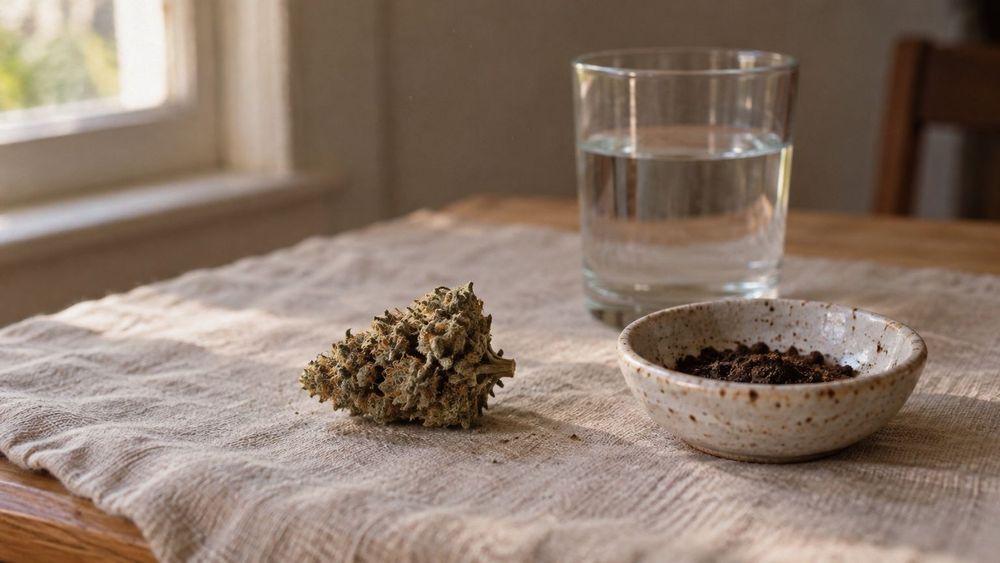
Hydroponic weed, usually shortened to hydro weed or just "dro," is cannabis grown without soil: its roots sit in a nutrient solution or in an inert material such as coco coir or rockwool. On menus and in slang, the word is sold as a promise of strength. The short answer is that "hydro" tells you how the roots were fed, not how strong the bag is.
Is hydro weed stronger? Not as a rule, and nobody has shown that it is. As of November 21, 2026, we could find no study that grew the same cannabis genetics in hydroponics and in soil and then compared the THC in the finished flower. What the measurements do show is that potency swings widely inside any one growing method, and that the cultivar, the harvest timing and what goes into the root zone move it far more than the name of the medium. This page, written for adults 21 and over where cannabis is legal, covers what the word means, where the slang came from, what police and lab data actually measured, how the main growing media compare from a buyer's side, and what a lab report can and cannot tell you. It is not a growing guide.
What is hydro weed?
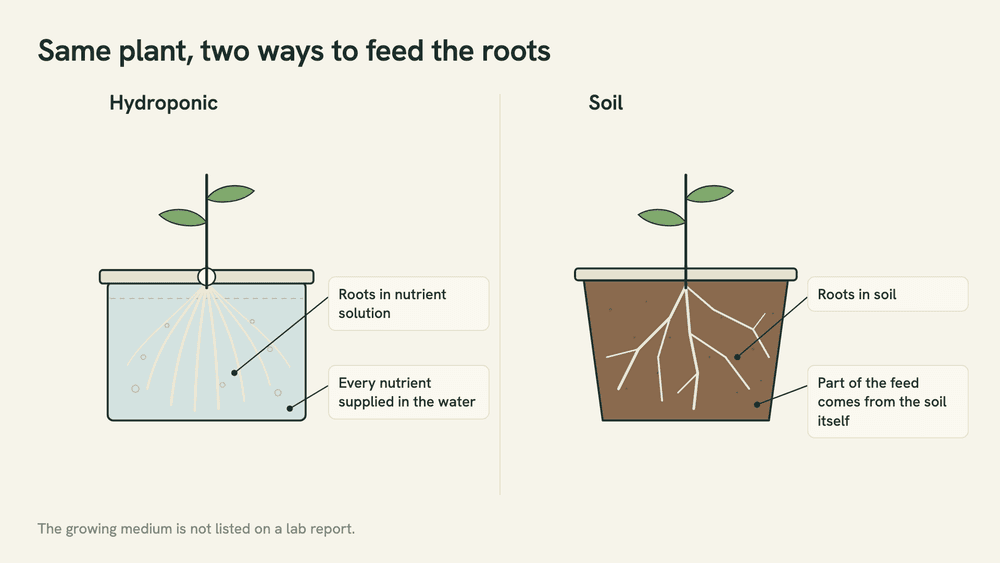
The USDA defines hydroponics as growing plants in a water-based nutrient solution rather than soil, sometimes with an inert growing medium such as coconut coir, perlite or vermiculite to hold the roots. That is the real difference from soil: in hydroponics every nutrient the plant gets is dissolved in the water the grower supplies, while in soil part of the feed comes from the soil itself and the life in it. In cannabis, the setups you will hear named on menus and in forums fall into a few families, and the growing media you will see on labels into a few more:
- Deep water culture: the roots hang in a tank of aerated nutrient solution.
- Drip systems: solution drips onto an inert medium such as rockwool or coco coir.
- Flood and drain (also called ebb and flow): a tray floods with solution, then drains away.
- Aeroponics: the roots hang in the air and are misted with solution.
- Soil: bagged or amended potting soil, usually with fertilizer added.
- Living soil: a grower's term for soil managed as an ecosystem of microbes and organic matter, often reused from crop to crop.
Two points trip people up. First, coco coir and rockwool are soilless, so by the USDA's definition most coco-grown weed is hydroponic too, even when nobody sells it as hydro. Second, "living soil" and "organic" are grower descriptions, not lab categories. The medium is also a separate question from the growing environment: hydro, coco and soil can all be used indoors, in a greenhouse or outside, and our guide to indoor, outdoor and greenhouse weed covers that side of the label. If you want the parts of the plant named on this page, roots included, see our illustrated tour of cannabis plant anatomy.
Why "hydro" became slang for strong weed
The word left the grow room a long time ago. In July 2018 the DEA published an intelligence report titled Slang Terms and Code Words: A Reference for Law Enforcement Personnel (document DEA-HOU-DIR-022-18), a 125-page glossary compiled from law enforcement and open sources. The DEA's 2018 slang reference for police lists "hydro" simply as marijuana, and flags "dro" and "droski" as hydroponic marijuana, along with several strain names such as Girl Scout Cookies and Skywalker. The same list uses "dro" and "hydros" for the painkiller hydrocodone, so context matters. Note what the document is not: it is a glossary of street words, and it says nothing about how strong anything is. Its own summary warns that, because the drug scene keeps changing, "subsequent additions, deletions, and corrections are inevitable."
In Australia, the word is still a working category. Australia's long-running drug-trends survey, the Illicit Drug Reporting System run by the National Drug and Alcohol Research Centre at UNSW Sydney, asks participants about two kinds of cannabis separately:
“indoor-cultivated cannabis via a hydroponic system ('hydro'), outdoor-cultivated cannabis ('bush')”
In that usage, hydro means indoor and hydroponic, and bush means outdoor. The reputation for strength seems to travel with the indoor setting, which would explain how a word about roots ended up as shorthand for potent weed. Whether the reputation holds up is a separate question, and it is the one the data can actually speak to.
Is hydro weed stronger? What the measurements show
Start with what people believe. In the 2023 Sydney round of that survey (153 adults who inject drugs at least monthly, median age 47), 90% of the 99 recent cannabis users who answered had used hydro in the past six months, and 36% had used bush. Of those who rated hydro, 65% called it high potency; of those who rated bush, 36% did. Yet both sold for the same median $20 (Australian) a gram, a price the report says has held steady since monitoring began in 2003. Those are impressions from a small and specific group, not lab results, and they do not describe cannabis consumers in general. They do show how firmly the idea of hydro as the strong stuff is held.
Measured potency tells a more careful story. By 2000, claims that Australian cannabis had become many times stronger were already circulating. When Australian researchers checked the claim of a 30-fold rise in potency in 2000, the published data did not show a 30-fold increase; the clearest trend data, from the US, showed a more modest rise. A 2008 systematic review of cannabis potency studies went further: the spread between samples was so wide that a user could meet more variation in a single year than across years or decades, and the 20- or 30-fold claims were not supported by the evidence. Neither paper isolates hydroponics. They matter here because they show how far popular claims about stronger weed ran ahead of the measurements.
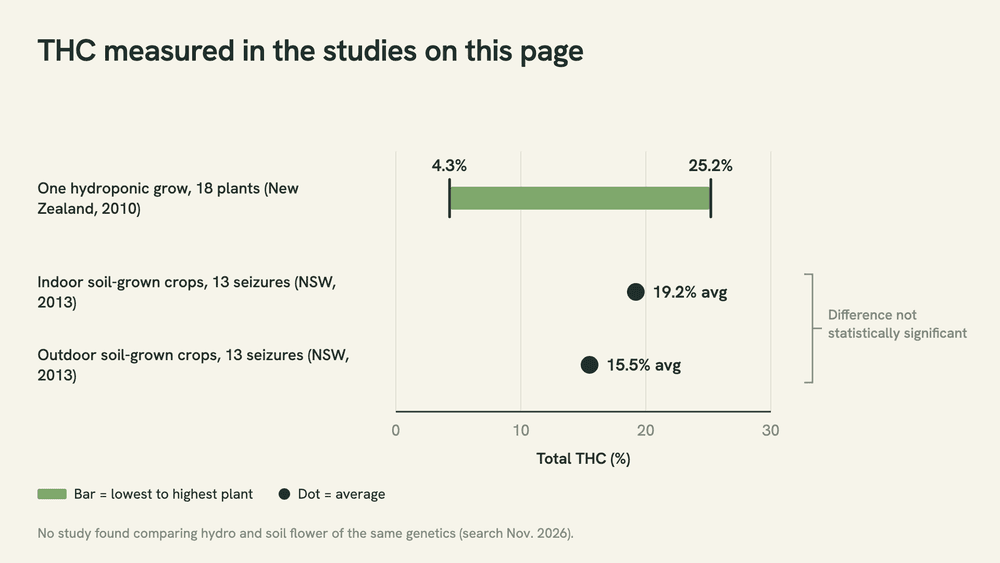
One study sometimes cited online as hydro evidence does not test hydro at all. In a 2013 analysis of police-seized cannabis in New South Wales, 206 street samples averaged 14.88% total THC. A second set of 26 samples of known origin compared 13 indoor crops with 13 outdoor crops: indoor averaged about 19.2% total THC and outdoor about 15.5%, a difference that was not statistically significant, though indoor trended higher and the two ranges overlapped heavily. The indoor crops were grown in soil, so the study cannot answer the hydro question. The authors suspected that the seed people choose matters most, writing that "this factor dominates cannabinoid profiles rather than the use of outdoor or indoor growing locations."
Inside hydroponics itself, the spread is huge. When New Zealand forensic scientists ran a typical hydroponic setup to help police estimate what seized grows could produce, their 18 plants, grown over three cycles in one year, ranged from 4.3% to 25.2% THC. The authors reported significant variation between parts of the same plant, as well as variation between varieties. Same method, same room: the variety and the individual plant mattered far more than the word hydro.
And the head-to-head test does not exist. We searched PubMed in November 2026 for studies that grew the same cannabis genetics in hydroponics and in soil and compared THC or terpenes in the finished flower, and found none. The nearest thing was a 2026 Turkish trial on fiber hemp, where one water-culture recipe produced more CBD in the leaves than soil and two produced less; it measured the leaves of a rope variety at about eight weeks, not buds. So when a grow shop says "studies show" hydro is stronger, or that there is no difference, ask which study. For what the THC number on a label does and does not tell you, see our explainer on whether THC percentage actually matters.
What actually moves potency and terpenes
If the medium's name does not set potency, what does? Studies that pull the variables apart keep finding the same order of importance. In a 2025 Spanish field trial of two hemp cultivars grown in Mallorca, the cultivar and the week of harvest explained most of the differences in the plants' chemistry, while planting density and fertilizer played smaller, more selective roles. A 2026 analytical comparison of three cultivars grown indoors, outdoors and in greenhouses found the cultivar accounted for about 24% of the variability and the cultivation method about 4%; our comparison of indoor and outdoor weed walks through that study. Put together, the variables that matter look like this:
- The cultivar. Genetics set the range a plant can reach and the shape of its chemical profile.
- Harvest timing. Cannabinoid and terpene levels keep changing week by week through flowering.
- What goes into the root zone. The form and amount of nutrients can push cannabinoids and terpenes up or down.
- What else is in the water. Unwanted dissolved salts can lower potency.
- Light and environment. These belong to the indoor vs outdoor question, and the word hydro does not tell you about them.
The root-zone items are where hydroponics and soil differ in practice, and they cut both ways. In a 2022 Israeli trial on a licensed medical cultivar grown in perlite, an inert soilless medium, simply changing the form of nitrogen in the feed shifted both cannabinoid and terpene levels. Hydroponic plants also take up whatever else is in the water: a 2020 trial at the University of Guelph in Canada found that THCA fell steadily as salt was added to hydroponic and aquaponic nutrient solutions. Both were single-cultivar studies. The point for a buyer is not the recipe, which this page does not cover, but that the label on the pot tells you nothing about what the recipe was.
Hydro vs soil weed vs coco vs living soil: a buyer's comparison
Here is how the four media you are most likely to see named compare from the side of the person buying the flower, not the person growing it. Where a cell says "grower claim," that is what growers say, not something we found measured.
| Question | Hydro (water culture) | Coco or rockwool (soilless) | Soil | Living soil or organic |
|---|---|---|---|---|
| What it is | Roots in aerated or circulating nutrient solution | An inert medium holds the roots; all feed comes from the solution | Potting soil, usually with added fertilizer | Soil managed as a microbial ecosystem, often reused |
| How much the grower controls the feed | High: every nutrient is supplied in the water | High: same as hydro | Moderate: some feed comes from the soil | Lower: much of the feed comes from soil life (grower claim) |
| Shown to raise THC vs another medium? | No study with matched genetics | No study with matched genetics | No study with matched genetics | No study with matched genetics |
| Taste difference shown? | No blinded taste test found | No blinded taste test found | No blinded taste test found | No blinded taste test found |
| Contamination routes found in research | Pythium and Fusarium root rots; plant diseases can spread through recirculated water | Unpasteurized coco fiber flagged as a possible mold source | No medium-specific comparison found | 2 organic greenhouse samples carried more fungal DNA than 5 hydroponic ones (too few for statistics) |
| Chemical fertilizer use (2018 grower survey) | Without soil, under lamps: about 12 times the odds of soil growers under the sun | Not separated in that survey | Soil under the sun: the comparison group | Not measured |
| What the lab report says about it | Nothing: no field for growing medium | Nothing: no field for growing medium | Nothing: no field for growing medium | Nothing: no field for growing medium |
Three rows in that table read the same in every column, and they are the ones that matter most to a buyer: no medium has been shown to produce stronger flower than another with the same genetics, no medium has been shown to taste better in a blind test, and none of them appears on a lab report. Water use and energy are left out on purpose. The water-saving percentages on grow-shop pages come from sellers, and we found no independent cannabis measurement behind them; energy belongs to the indoor vs outdoor question.
Is hydroponic weed cleaner or safer?
Neither method is clean by default, and the evidence on each points at different risks. On chemicals, a 2018 survey of 1,722 small-scale growers in Australia, Denmark and the UK found that 44% used some chemical fertilizer, supplement or insecticide, and that hydroponic growers had about 12 times the odds of using chemical fertilizers compared with people growing in soil under the sun. The researchers could not tell which products held growth regulators, because the labels did not say. Using a fertilizer is not the same as finding residue in the bud: the survey measured habits, not the flower. Our page on plant growth regulators in weed explains what that survey can and cannot tell you.
On microbes, soil-free does not mean germ-free. A Canadian plant-pathology team found Pythium and Fusarium root rots in hydroponically grown cannabis, causing root browning, stunting and in some cases plant death, and flagged fungal communities in unpasteurized coco fiber as potential sources of mold contamination on cannabis plants. In the other direction, a 2026 DNA survey of buds from commercial greenhouses found more fungal DNA in two organically grown samples than in five hydroponic ones, but the author says the sample was too small for statistics, and DNA reads are not the same as live mold. Drying alone cut fungal reads by 50% to 65%. It is a reason to read the microbial panel, not a ranking of methods. Recirculated water can also carry plant diseases: hop latent viroid, which stunts cannabis and can lower its resin, has been shown to spread root to root through shared hydroponic solution. Pesticides are a separate risk that depends on the grower rather than the medium; our page on myclobutanil, the fungicide found in tested cannabis covers the best-known example.
Does hydro weed taste different?
Soil growers often say their flower tastes better, and hydro growers say the opposite. We found no blinded taste test comparing the two. Taste and smell come largely from terpenes, which shift with the cultivar, with the feed (the Israeli nitrogen trial above moved terpene levels without changing the medium) and with how the flower is dried and cured. Complaints about a harsh or "chemical" taste in hydro flower usually come with a story about flushing, the grower practice of giving plants only plain water before harvest, and about ash color; our guide to white ash vs black ash and the flushing debate looks at what that evidence actually shows. For what the terpene numbers on a label mean, see our explainer on terpene percentage and how to read it.
Can you tell if weed is hydro? A buyer's checklist
Not reliably. No look, smell or ash test separates hydro from soil-grown flower. Appearance tells you about trimming, curing and freshness, which our guide to what good weed looks like covers, and ash color does not reveal the medium either. The lab report does not tell you directly. California's rule on what a licensed cannabis certificate of analysis must contain lists 14 required items, including the lab, the name, address and license number of the licensed cultivator (or manufacturer), and a batch number that must match the one on packaged product. None of the 14 is the growing method or medium. So here is what you can actually do:
- 1Treat "hydro" on a menu as a description of the roots, not a strength claim.
- 2Read the cannabinoid panel for total THC (and CBD) instead of trusting the word on the jar.
- 3Check that the microbial, pesticide and heavy-metal results each show a pass.
- 4Match the batch number on the certificate to the batch number on your package.
- 5Note the licensed cultivator named on the certificate. If the growing method matters to you, that is who to ask.
- 6Treat "living soil," "organic" or "hydro-grown" as grower claims unless the seller can document them.
Our step-by-step guide to reading a certificate of analysis shows where each of those items sits on a real report.
What about CBD and hemp products?
Almost all the hemp that becomes CBD is a field crop, so the hydro question rarely comes up. USDA's National Hemp Report for the 2025 crop, released April 16, 2026, counted 33.2 million pounds of floral hemp grown in the open against about 168,000 pounds grown under protection (under cover rather than in open fields). That works out to roughly 99.5% in the open. USDA does not track soil versus hydroponics at all. For an oil, a gummy or any other extract, the growing medium matters less than the batch's certificate, because potency, contaminants and THC content are measured on the finished product. If you are choosing a CBD product, our guide to choosing a CBD oil walks through what to check.
What is still unknown about hydro vs soil
- Whether the same genetics grown in hydroponics and in soil differ in THC or terpenes in the finished flower. We found no study as of November 2026.
- Whether hydro or soil flower tastes different in a blinded test. We found none.
- Whether hydroponic or soil-grown flower carries more residue on average. The 2018 survey measured fertilizer habits, not residue in the bud.
- Whether one medium carries more live mold on finished buds. The only DNA comparison we found had 7 samples.
- How much US licensed cannabis is grown in each medium. We found no public figure.
Those gaps are why this page sticks to what has been measured. When a seller or a forum tells you something specific about how much stronger, cleaner or tastier one medium is, the honest default is that nobody has checked.
Frequently asked questions about hydro weed
Hydro is short for hydroponic: cannabis grown with its roots in a nutrient solution or an inert medium such as rockwool or coco coir instead of soil. As slang it often just means weed: in Australia's drug-trends survey it is the standard word for indoor hydroponic cannabis, and it carries a reputation for strength that no direct comparison has tested. The DEA's 2018 slang reference lists "hydro" as marijuana and "dro" as hydroponic marijuana; "dro" and "hydros" can also mean the painkiller hydrocodone, so context matters.
Not as a rule. We found no study comparing THC in hydro and soil-grown flower of the same genetics. In one typical hydroponic grow studied by New Zealand forensic scientists, plants ranged from 4.3% to 25.2% THC. Potency follows the cultivar, harvest timing and the feed, so check the total THC on the batch's lab report rather than the word hydro.
Neither method is cleaner by default. In a 2018 survey, hydroponic growers had about 12 times the odds of using chemical fertilizers compared with soil growers under the sun, though that measured habits, not residue in the flower. Hydroponic crops have their own root diseases, and coco fiber and organic systems can carry molds. Only the contaminant panels on a batch's lab report tell you about the flower in front of you.
We found no blinded taste test comparing hydro and soil-grown flower, and grower claims go both ways. Taste comes largely from terpenes, which shift with the cultivar, the feed and how the flower is dried and cured. The word hydro tells you none of those.
No. There is no reliable look, smell or ash test for growing medium, and lab reports have no field for it. In California the certificate must name the licensed cultivator or manufacturer, so if the method matters to you, that is who to ask.
By the USDA's definition, yes. Hydroponics includes growing in a water-based nutrient solution with an inert medium such as coconut coir, perlite or vermiculite holding the roots. Coco-grown flower is soilless even when it is not sold as hydro.
Living soil is a grower's term for cannabis grown in soil managed as an ecosystem of microbes and organic matter, often reused between crops, with growers describing that soil life as a main source of the plant's feed. It is a cultivation style, not a lab category: we found no study showing it changes potency or taste, and it does not appear on a lab report.
Not necessarily. In Sydney's 2023 drug-trends survey, hydro and outdoor-grown bush both sold for a median of $20 (Australian) a gram, the same price recorded since 2003, even though more participants rated hydro as high potency. We found no comparable figure for US legal markets.
Next: read the label that actually measures something. The word hydro tells you about the roots; the certificate of analysis tells you about the flower. Our guide on how to read a COA in a few minutes shows where to find total THC, the contaminant panels and the batch number, so you can judge any product by its results rather than its growing story.
Writing about hemp, wellness and the small rituals that keep us balanced.