Infused Pre-Rolls: What's Added and How Much THC Is in One
An infused pre-roll is ordinary flower with concentrate added inside or on the outside. Here is the arithmetic sellers skip: how much THC one holds, which line on the label to read, what lab audits found about pre-roll labels, and how to treat a stronger stick.
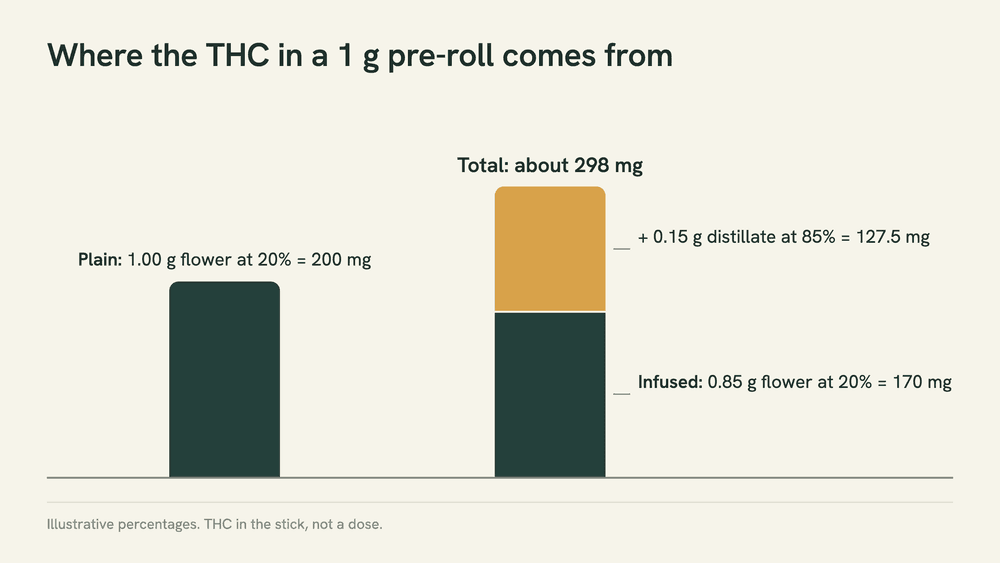
An infused pre-roll is a pre-rolled joint with cannabis concentrate added to the flower: distillate, hash, kief, rosin or crystallized THCA, mixed inside or coated on the outside. Is it stronger? By content, usually yes, and the reason is weight, not the headline percentage. In a 1 gram stick, replacing 15% of the flower with an 85% THC oil takes the THC in the stick from 200 mg to about 298 mg.
Most guides on page one are written by stores, and they quote figures like "30-50% THC" for infused pre-rolls with no source. We searched PubMed in November 2026 and found no study that lab-tests infused pre-rolls as a category; the closest are audits of ordinary flower and one survey of store listings. So instead of a potency range, this guide gives you the arithmetic to work out what is in the stick you are holding, the line on the label that matters, what label audits have found, and how to treat a higher-THC product. It is written for adults 21 and over in places where cannabis is legal, and state rules vary. Planntz does not make or sell pre-rolls or any smokable product.
What makes a pre-roll "infused"
A pre-roll is a joint that comes already rolled, usually in a cone of paper with a filter tip, and the format questions it raises are the same as any joint's (our blunt vs joint comparison covers wraps and smoke). "Infused" means something more concentrated than flower has been added. Manufacturers do that in one of two broad ways, and the label does not always say which. A hash hole, a newer variation, puts the concentrate in the core instead of on the outside. The same idea scaled up to cigar size shows up in infused cannagars.
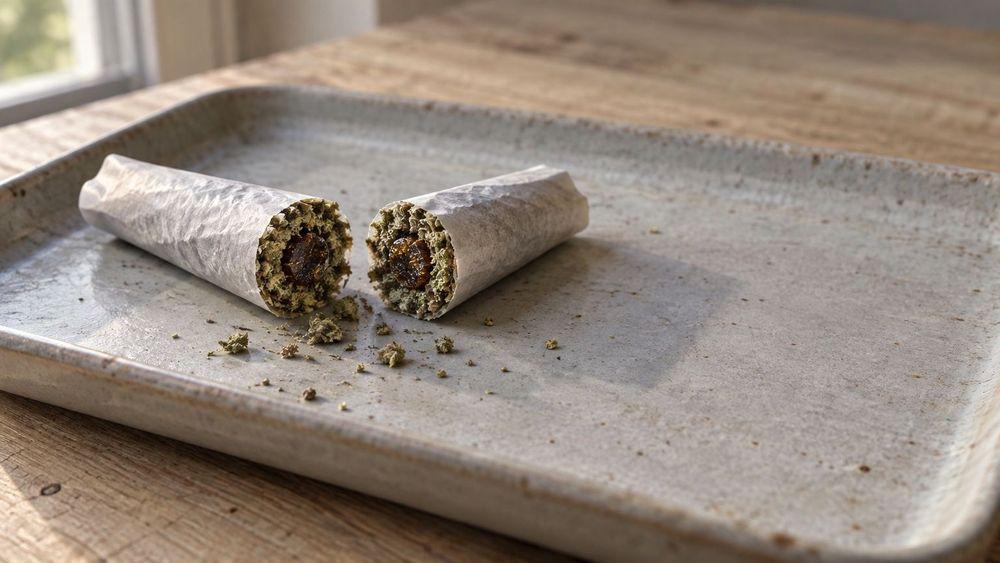
- Blended inside: oil, hash or crystals in among the ground flower, or a seam of concentrate running through it. From the outside it can look like any pre-roll.
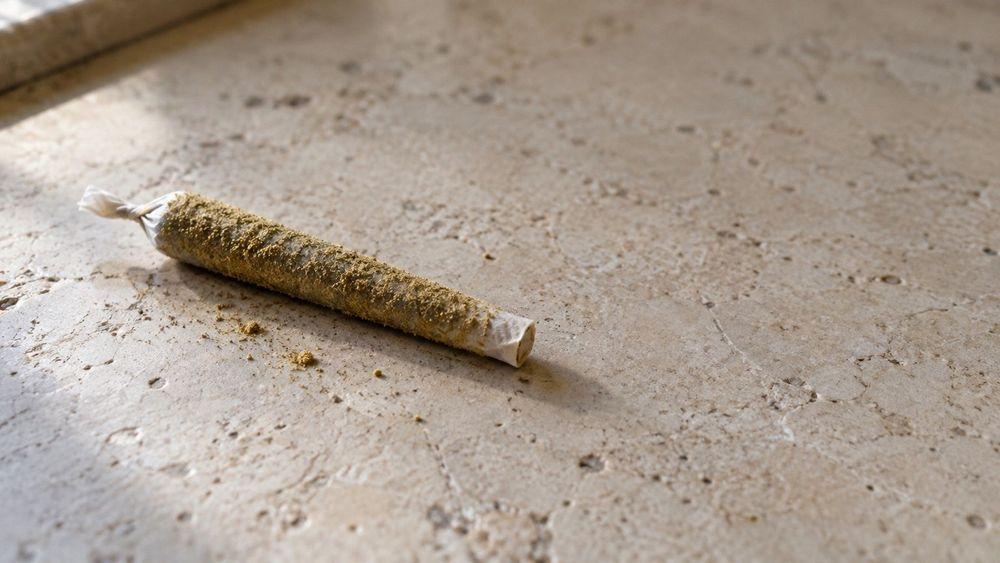
- Coated outside: a sticky layer of oil and kief over the paper, the golden style sometimes called "caviar". You can usually see this one.
- Either way, the flower is still most of the weight. The added material is a smaller mass at a much higher concentration.
The word itself is looser in marketing than in law. Under California's cannabis definitions, a pre-roll is "any combination of the following rolled in paper: flower, shake, leaf, or kief", and an infused pre-roll is one "into which cannabis concentrate (other than kief) or other ingredients have been incorporated." So in California a pre-roll can already contain kief; it only becomes an "infused pre-roll" when concentrate other than kief, or another ingredient, is added. Sellers use the word more loosely, and a "kief-infused" stick on a store page may be a plain pre-roll by that state's rules.
What gets added, and how strong each material is
The best public numbers we found for the materials come from two places. A 2026 study of every product listed by Ontario's government cannabis wholesaler averaged the THC ranges shown on 1,727 product listings from January to April 2024, including 143 "infused flower" products and 338 pre-rolls. Those are the numbers on the listings, not lab re-tests, and they come from one market. Washington's cannabis regulator adds a US view: concentrates sold there averaged 69% THC in 2022 against 21% for flower, with wax, rosin, shatter and hash oil generally at 60 to 90% and kief and hash at 50 to 80%.
| Material | What it is | Ontario listed average | Washington regulator range |
|---|---|---|---|
| Kief and sift | Loose resin glands sifted off dried flower | 36% | 50-80% (kief and hash) |
| Hash | Resin glands pressed together | 44% | 50-80% (kief and hash) |
| Rosin | Resin pressed out with heat and pressure | 54% | 60-90% |
| Shatter | Solvent-extracted, glassy concentrate | 67% | 60-90% |
| Resin | Extracted concentrate | 80% | not listed separately |
| Distillate | Refined THC oil | not listed separately | not listed by name (hash oil: 60-90%) |
| THCA diamonds | Crystallized THCA | not listed | no figure; purity claims are the seller's |
| For comparison: dried flower | Plain bud | 26% | 21% average (2022) |
| For comparison: ordinary pre-rolls | Plain flower, pre-rolled | 25% | not reported |
| Ontario "infused flower" | Flower with concentrate added | 38% (range 9-56%) | not reported |
Two of those materials have their own guides. Distillate, the refined oil that is the most common infusion, is covered in our explainer on THC distillate, including why its purity varies. Kief and hash, which are the same resin glands in loose and pressed form, are covered in what hash is and how it differs from kief. THCA diamonds need one caution. They are crystals of THCA, the acid form of THC that raw cannabis makes, and sellers often describe them as 99% pure. We found no independent measurement of diamond purity, so the worked example below uses an illustrative 95% and says so. Note also that Ontario's "infused flower" category is a concentrate subcategory, not a list of infused pre-rolls only, so read its 38% average as a market signal, not a rule for any one stick.
How much THC is actually in one: the math
Every infused pre-roll is a weighted average of two materials. The THC in the stick is (grams of flower x flower THC%) plus (grams of concentrate x concentrate THC%), times 1,000 to get milligrams. Use total THC percentages, the figure labs report. Raw flower holds most of its THC as THCA, which turns into THC when heated, and USDA's hemp rule writes the conversion out: Total THC = (0.877 x THCA) + THC. The 0.877 accounts for the mass THCA loses when heat turns it into THC. California's lab definition of Total THC goes further and counts delta-9, delta-8 and both acid forms, with the acids multiplied by 0.877. If you want the plain-flower version of this conversion first, our guide to whether THC percentage matters starts from the same 1 g, 20% stick.
| Stick (1.0 g total) | Flower part | Added part | Total THC in the stick |
|---|---|---|---|
| Plain pre-roll (illustrative) | 1,000 mg x 20% = 200 mg | none | 200 mg |
| Kief-coated (illustrative flower) | 900 mg x 20% = 180 mg | 100 mg kief x 36% = 36 mg | 216 mg |
| Distillate-infused (illustrative) | 850 mg x 20% = 170 mg | 150 mg x 85% = 127.5 mg | about 298 mg |
| THCA-diamond-coated (illustrative 95% THCA) | 850 mg x 20% = 170 mg | 150 mg x (0.95 x 0.877 = 83.3%) = 125 mg | about 295 mg |
| Ontario infused flower, listed average | 1,000 mg x 38% | already blended | about 380 mg listed |
Three things fall out of that table. First, mass drives the jump: 15% of the weight as distillate added about 50% more THC, while a light kief coat added about 8%. Second, the headline percentage misleads in both directions. A stick can be sold on its flower's 20% and still hold nearly 300 mg, and a big number for a coating means little if the coating weighs a tenth of a gram. Third, do not apply 0.877 twice. A lab's Total THC line has already done the conversion, so you only multiply by 0.877 yourself when a label shows raw THCA alone, which is the step the diamond row shows.
Read every number above as THC in the stick, not THC in you. In a machine-smoking study of 12 cannabis samples, joints delivered on average about 13% of their THC in the smoke (range 7.2 to 28.0%). That was a machine with no filter, not a person. In people, a review of cannabinoid pharmacokinetics estimated that roughly 8% to 24% of smoked THC reaches the bloodstream, depending largely on how experienced the smoker is. So the label number is for comparing products, not for calculating what you will feel.
How to read an infused pre-roll label
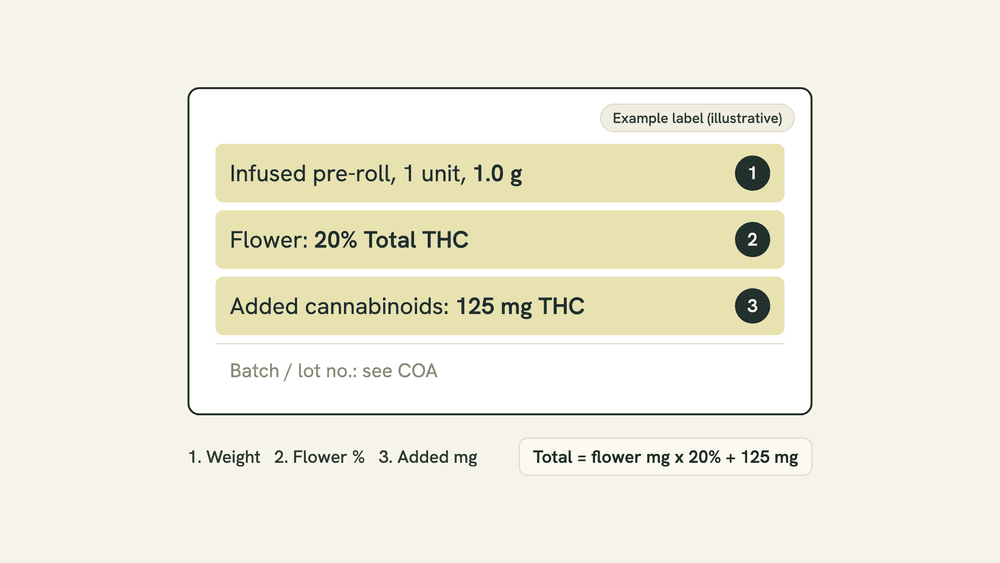
Because an infused pre-roll mixes two materials, a single percentage on the package does not describe it. California's labeling rule handles this directly: packages of infused pre-rolls must show either the cannabinoid content in milligrams, or the cannabinoid content of the dried flower as a percentage plus the added cannabinoid content in milligrams. Plain flower shows total THC as a percentage. If you see the second format, you add them yourself. Take a 1.0 g stick labeled "Flower: 20% Total THC" and "Added: 125 mg THC". If the label also gives the flower's weight, say 0.85 g, the stick holds 170 + 125 = 295 mg. If it does not, you can only bound it: assuming the whole gram is flower gives 200 + 125 = 325 mg, an upper estimate. A package that prints the total in milligrams saves you that guesswork. Other states use different formats, so check your state regulator's rules.
- 1Unit weight: grams per pre-roll, and how many pre-rolls are in the pack.
- 2The THC line: total milligrams per unit, or the flower's total THC % plus the added milligrams.
- 3Total THC versus separate THC and THCA lines. Total THC already includes THCA. If only raw THCA is shown, multiply it by 0.877 once.
- 4The infusion material named: distillate, rosin, hash, kief, diamonds. "Infused" alone tells you little.
- 5A batch or lot number that matches a certificate of analysis (COA), with a test date.
- 6The COA's contaminant results: pesticides, and for products meant to be smoked in California, a pass on the Aspergillus mold screen.
The last two checks are where the COA comes in, and our guide on reading a certificate of analysis line by line shows where each result sits. The contaminant line is not academic for this format. California's cannabis recall portal has listed infused pre-rolls among its recalls for paclobutrazol, a plant growth regulator, in 2024 and 2025, and in 2026 it listed pre-roll recalls for Aspergillus mold. A recall is not a rate, but it is a reason to read the COA's pesticide and mold lines.
What testing has found about the number on the package
Start with what is missing. In a PubMed search in November 2026, the phrases "infused pre-roll" and "infused preroll" returned no studies, and "infused pre-rolls" returned one, the Ontario listing survey above, which did not re-test anything. No published study we found has bought infused pre-rolls and measured them against their labels. What does exist are audits of flower and concentrates, and they point in a consistent direction.
In a Colorado audit published in 2026 that re-tested 265 flower products bought from 59 dispensaries between November 2022 and March 2025, only 51.7% of flower products were within 15% of their labeled THC. Pre-rolls were the flower format most likely to carry a THC number higher than what the lab measured: 59.3% were over-labeled, and they had the largest gap, 19.6%. The authors connect this to products subject to greater handling by dispensaries. Those were ordinary flower pre-rolls, 27 of them, and the paper does not test infused ones. We have read only the abstract, and two of the authors work for a licensed Colorado cannabis company.
Concentrates did better. In a blinded purchase audit at 52 Colorado dispensaries, concentrates matched their labels within the state's 15% tolerance 96% of the time (95 of 99), against 56.7% for flower (101 of 178); flower averaged 22.5% on the label and 20.8% measured. An earlier, smaller Colorado test of 23 flower samples from 10 dispensaries found 16 of them, about 70%, more than 15% below the lowest labeled value. Our reading, not a finding from any study: in an infused pre-roll, the flower is usually the larger share of the weight, and it is the less reliable half of the number. If the 20% flower in our distillate example actually measured 15% lower, at 17%, the flower would hold about 145 mg instead of 170, and the stick about 272 mg instead of 298.
Using an infused pre-roll carefully
It helps to see what controlled research treats as a strong amount. In a 2018 Johns Hopkins trial of 17 adults who had used cannabis before but had not used it for about a year on average, the highest dose, 25 mg of THC, came from 0.19 grams of 13.4% flower, and at that dose two of the 17 vomited and one had a hallucination. Inhaled effects peaked within about 30 minutes, mostly returned to baseline in 3 to 4 hours, and some impairment lasted up to about 6 hours. The authors note that pre-rolls commonly contain roughly 1.0 g, often above 18%. That trial arm is a study condition for 17 people, not a serving size, and nothing here should be read as a way to split a pre-roll into doses. The point is scale.
How you smoke matters as much as what you smoke. In a 1992 lab study of seven men who smoked regularly, blood THC after smoking rose with both the number of puffs and the strength of the cigarette. In a 2020 study of 121 regular users in Colorado, people using concentrates had about twice the blood THC of flower users (0.32 versus 0.14 micrograms per milliliter of plasma) while reporting a similar high, and the authors flagged long-term concerns. Over the longer run, a 2025 review of 42 studies called the link between higher-potency cannabis and problem use "suggestive" and rated its certainty "very low"; it cannot show that potency causes harm. Taken together: a higher-THC stick does not adjust itself for you.
- Take fewer, smaller draws than you would from a plain joint, and count them.
- Wait before taking more. In the Hopkins trial, inhaled effects peaked within about 30 minutes.
- Share it, or put it out and stop. You do not have to finish a stick in one session.
- Skip alcohol and other substances in the same session.
- Never drive or operate machinery afterward, and keep cannabis away from children and pets.
- If you are new to cannabis, an infused stick is the high-content end of the pre-roll shelf, not a starting point.
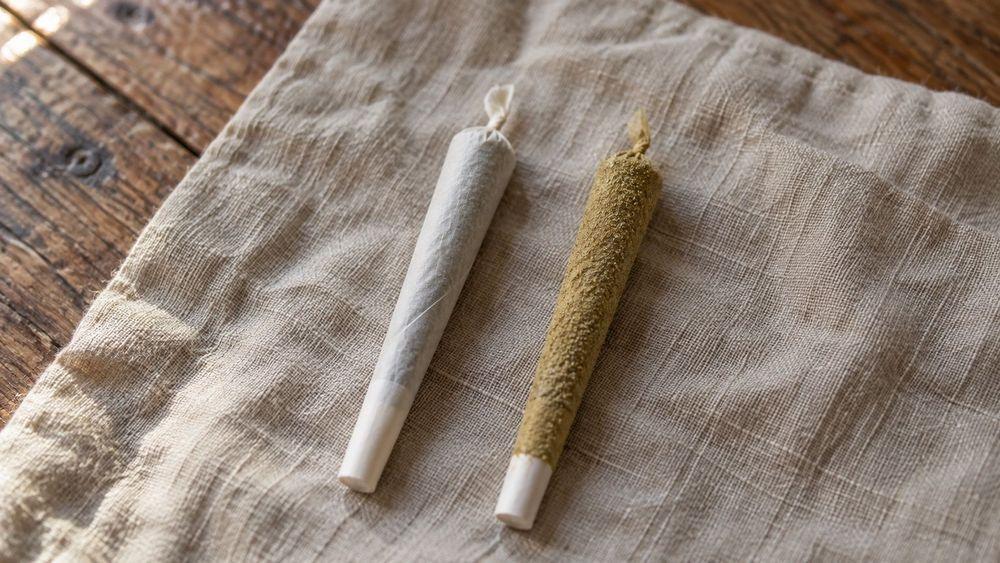
Sellers and smokers often say oily or coated pre-rolls burn slower or less evenly than plain ones. That is a report, not something we found measured. If you have little experience with cannabis at all, our guide to smoking weed for the first time is a better place to begin than any infused product. If one side of a joint races ahead of the other, our guide to joint canoeing explains the burn mechanics. And if a session goes further than you meant it to, what greening out looks like and what to do covers the signs and when to get help.
Hemp-derived infused pre-rolls and the 2026 federal change
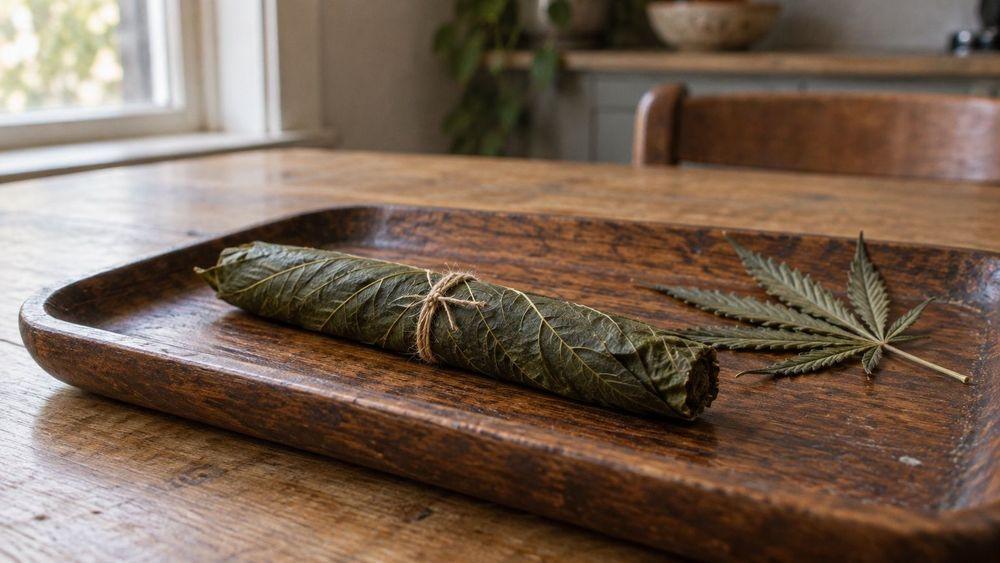
Some infused pre-rolls are sold as hemp, often hemp flower coated in THCA diamonds or kief. "Hemp" on that label is a legal category, not a potency ceiling. The arithmetic does not change: run the diamond row from the table above and a THCA-coated stick holds about 295 mg of total THC once heat converts the THCA. Sellers do not always frame it that way. A 2025 study of the top hemp-THC web shops found THCA was one of only two compounds sellers did not describe as psychoactive, often saying it depended on how it was used, even though heat converts it into THC. In a companion analysis of 804 hemp-derived psychoactive products listed on three top US sites in May 2023, pre-rolls made up 7%. Both are snapshots of listings, not measures of the market. If drug testing is your concern, see whether THCA shows up on a drug test.
The federal definition is in the middle of changing. A 2025 appropriations law, P.L. 119-37, section 781, rewrites the federal definition so that hemp is measured by total THC, THCA included, at no more than 0.3% on a dry-weight basis, and its definition of hemp-derived products reaches anything intended for use "through any means of application or administration, such as inhalation." It also excludes from "hemp" a final product with more than 0.4 mg combined total per container of total THC (including THCA) and similar cannabinoids. A 2026 law, P.L. 119-103, split the start date. Since November 12, 2026, the new definition has applied only to products with cannabinoids the plant cannot make naturally. The total-THC test, the piece that counts THCA toward the limit, and the 0.4 mg container limit apply from December 11, 2026, under the timing set by P.L. 119-103. As of November 28, 2026, when this guide was written, December 11 had not yet arrived. For scale: 1 g of flower at exactly 0.3% total THC holds 3 mg. How regulators will apply the container limit to smokable flower products is not something we will predict, and as of late November 2026 FDA had not published the cannabinoid lists the law calls for. This is a reading of the statute's words, not legal advice. Our explainer on the 2026 hemp law and the story of the December 11 date track what has changed.
What we don't know
More than store pages suggest. No study we found has lab-tested infused pre-rolls as a category, so there is no measured answer to how accurate their labels are; the Colorado audits cover ordinary flower, ordinary pre-rolls and concentrates, and the infused-product inference is ours. The material figures in the first table are Ontario listing averages and one US regulator's summary, not independent tests. The delivery figures come from a machine-smoking study and a review of older human work, and they vary widely from person to person. The labeling rules quoted are California's, and your state's may differ. Effects depend on tolerance, setting and how much you actually smoke. What holds up regardless is the habit: find the milligram line, do the weighted math when the label makes you, and check the COA. The same label-first approach works across categories, from smokables to choosing a CBD oil.
Frequently asked questions
It means a concentrate, such as distillate, hash, rosin, kief or THCA crystals, has been added to the flower, either mixed inside or coated on the outside. Legal definitions can be narrower: under California's rules, kief alone does not make a pre-roll "infused"; it takes concentrate other than kief or another ingredient.
By THC content, usually yes. In our worked example, a 1 g stick with 15% of its weight as 85% distillate holds about 298 mg of THC against 200 mg for plain 20% flower. Ontario's listings averaged 38% THC for infused flower against 25% for ordinary pre-rolls. Content is not what you inhale: only a fraction of a joint's THC reaches you, and that fraction varies.
A pre-roll with crystallized THCA added, usually on the outside. THCA turns into THC when heated, and a lab's Total THC line already accounts for that with the 0.877 factor. Purity figures like 99% are seller claims; we found no independent measurement of them.
A pre-roll with kief, the loose resin glands sifted from flower, rolled on or mixed in. In our table it is the smallest bump, about 216 mg against 200 mg for the same plain stick, because kief is less concentrated than oils and the coat is light. In California it is legally a plain pre-roll, not an infused one.
Total milligrams of THC per unit. If the package gives only the flower percentage plus added milligrams, multiply the flower's weight in grams by its percentage and by 1,000, then add the milligrams. Comparing a plain stick's 22% with an infused stick's flower percentage tells you almost nothing.
Take fewer and smaller draws than with a plain joint, wait about half an hour before deciding on more, and share it or put it out rather than finishing it. Skip alcohol, never drive afterward, and if one side burns faster than the other, our joint canoeing guide explains why.
A pre-roll built with a core of concentrate, usually hash or rosin, running down the center instead of coated on the outside. The same label rules and the same weighted math apply.
Before you trust the number on the front of any package, match it to the lab report behind it. Our guide on how to read a certificate of analysis shows where total THC, the batch number and the contaminant pass or fail lines sit on a real COA, and what a missing batch number tells you.
Writing about hemp, wellness and the small rituals that keep us balanced.