What the THC Symbol on Cannabis Packaging Means (and What It Doesn't)
No federal agency requires a THC symbol, so the mark on your package comes from a state rule. Here are the main state symbols side by side, what each one tells you, and what it can't prove about testing, potency or legality.
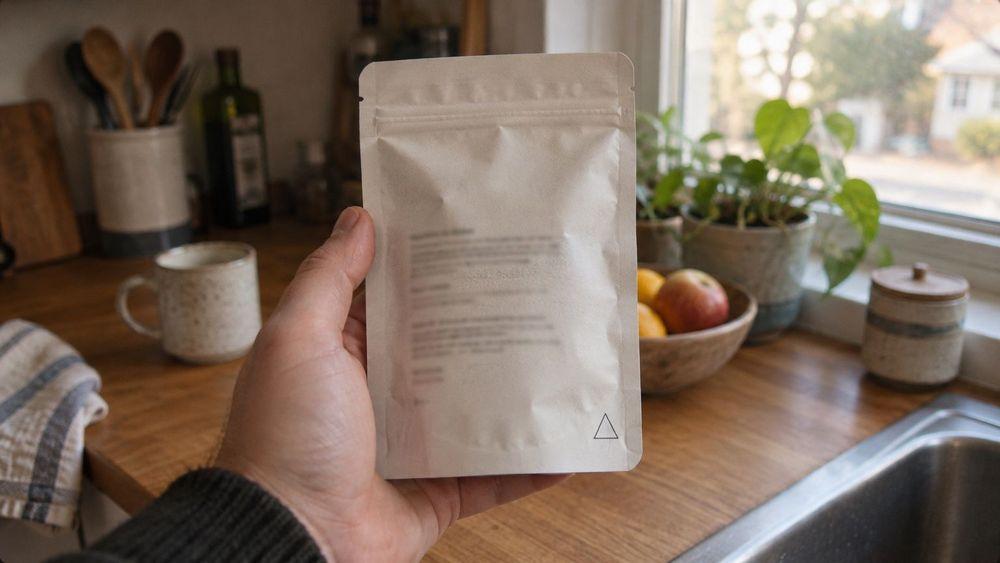
You turned over a gummy pouch or a vape box and found a small triangle, diamond or leaf mark. In short, that THC symbol tells you the product contains THC under the rules of the state that required it. It does not tell you how much THC is inside, whether the product was lab-tested, or whether it is legal where you are.
There is no single national THC symbol in the US. Each mark comes from a state rule, which is why a California package and a Colorado package look different. This guide puts the main state symbols side by side, described from each state's own rule or regulator files, with the date we checked it. We read every rule below on November 19 and 20, 2026, so this guide is current as of November 20, 2026. If you want the whole label decoded first, start with our guide to reading a CBD label; this page is its chapter on warning marks.
What the THC symbol means, and why there isn't one US symbol
A THC symbol, also called a cannabis warning symbol or universal symbol, is a small mark a state requires on cannabis packaging, and sometimes on the product itself. Its job is quick recognition: you, a parent or a poison center can tell at a glance that an item contains intoxicating cannabis, even after it is out of the box. No federal agency requires a cannabis symbol. Every mark in this guide rests on state law. California's rule, for example, describes the symbol established under the state's Business and Professions Code, not under any federal program.
The one design meant to cross state lines is a voluntary standard. ASTM D8441/D8441M, published in 2022, is titled "Standard Specification for International Symbol for Identifying Consumer Products Containing Intoxicating Cannabinoids." Its scope says it applies where a warning is "deemed necessary by the authority having jurisdiction," which means a regulator has to adopt it before anyone is required to use it. Compare Canada, where Health Canada requires one national symbol on the front of cannabis products that contain more than 10 micrograms of THC per gram. The US has no equivalent, so what you see depends on which state's rules the product was packaged for.
The main state symbols, side by side
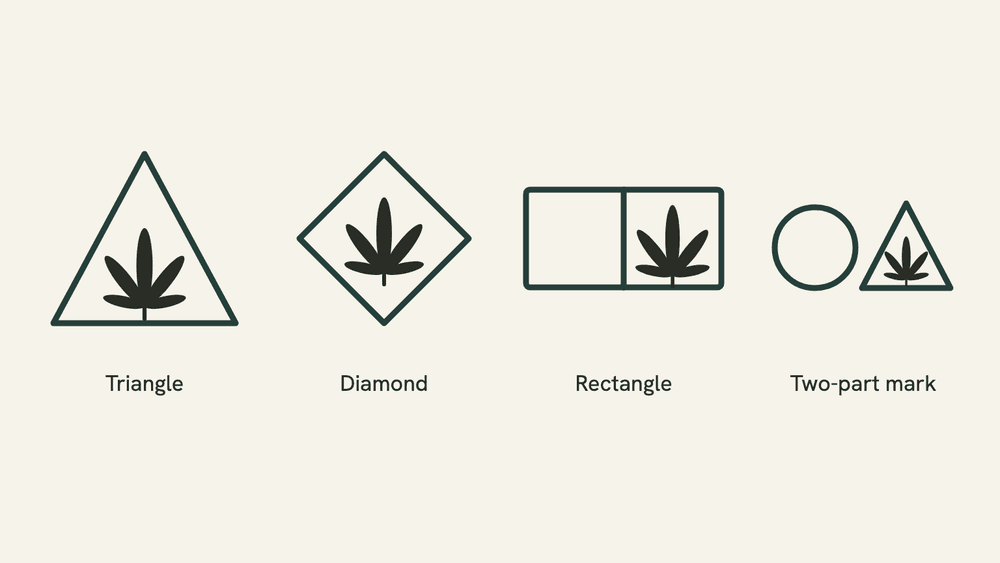
The table below describes each mark from the state's own rule or the regulator's published files. Sizes are minimums. Sources for each row: Colorado's Rule 3-1010 (Colorado's revised marijuana rules took effect November 1, 2026, and the symbol text did not change), Washington's WAC 314-55-106, Maine's Office of Cannabis Policy symbol page, Massachusetts' 935 CMR 500.105, Oregon's OAR 845-025-7030 and New Jersey's Cannabis Regulatory Commission symbol standards, plus California's rule linked above and Montana's rule linked in the ASTM section below.
| State | What the mark looks like | Minimum size | Where it goes | Rule and latest date checked |
|---|---|---|---|---|
| California | Triangle holding a cannabis leaf and an exclamation point, with CA beneath it, printed in black or white | 0.5 in tall; 0.25 x 0.25 in on vape cartridges | Front (primary) panel; may not be altered or cropped | 4 CCR 17410, current text effective Nov. 7, 2022 |
| Colorado | Diamond with an exclamation point over the letters THC, red on packaging, with "Contains Marijuana. Keep away from children." directly below | 0.5 x 0.5 in; 0.25 x 0.25 in on vape hardware | Front of the container and any marketing layer; stamped on many edibles | 1 CCR 212-3 Rule 3-1010; rules current as of Nov. 1, 2026 |
| Washington | Yellow diamond with a green leaf over a white band reading 21+ | 0.75 x 0.75 in | Front of every cannabis product sold at retail; edibles also carry a Poison Center mark | WAC 314-55-106, effective Jan. 7, 2025 |
| Maine | Red triangle with a black cannabis leaf on a white field, above the words CONTAINS THC | 0.5 x 0.5 in on packaging; 0.25 in on each edible serving | Packaging, and each edible serving or its wrapper | 18-691 C.M.R. ch. 30, sec. 5; regulator guidance revised April 2024 |
| Massachusetts | The same red CONTAINS THC triangle (Maine's regulator says the design was already in use in Massachusetts), plus a second Commission mark warning the product is harmful to children | Not stated in the rule text we read | Packaging, and each edible serving | 935 CMR 500.105, amended effective Nov. 22, 2024 |
| Montana | Yellow triangle with a black border and a black cannabis leaf, with the word MARIJUANA under it (the ASTM-style design) | 0.33 x 0.33 in; may not be colored by hand | Product label | ARM 42.39.314, effective Jan. 1, 2022, as amended through Aug. 2026 |
| Oregon (dispensary products) | Rectangle: a white exclamation point on black beside a white leaf on red | 0.48 in wide x 0.35 in high; color and shape may not be modified | Products sold in Oregon marijuana dispensaries | OAR 845-025-7030, amended effective Jan. 1, 2025 |
| New Jersey | Two-part mark combining a red stop hand and a yellow triangle with a cannabis leaf, with the words NOT SAFE FOR KIDS; edibles carry a triangle-with-leaf imprint | 0.75 x 0.5 in on packaging; 0.25 x 0.25 in on edibles | All packages of cannabis items; imprinted on edibles | N.J.A.C. 17:30-16.6 as adopted 2021, plus the CRC symbol standards |
Two more details are worth knowing. Michigan's rule, R 420.504, requires "the universal symbol for marihuana product published on the agency's website." We could not load the agency's current artwork page, and its title suggests the design has been updated, so we don't describe Michigan's mark here; check the Cannabis Regulatory Agency's site for the current version. And Washington edibles carry a second mark on top of the diamond: the Washington Poison Center's Not For Kids warning symbol, at least three-quarters of an inch tall and half an inch wide, which Washington's Liquor and Cannabis Board notes contains the Poison Center number, (800) 222-1222. On vape hardware, California and Colorado require a smaller version of their symbols; our guide to what a weed pen looks like shows where it sits.
Why the symbol is stamped on the gummy itself
Several states don't stop at the package. Once a piece of chocolate is out of its wrapper, the box can't warn anyone, so these rules put the mark on the food. Colorado's edible rule requires chocolate, soft confections, hard candies and lozenges, baked goods, and pressed pills and capsules to be "marked, stamped, or otherwise imprinted with the Universal Symbol," and in a multi-serving product each serving gets its own stamp. Liquids are exempt. Here is how the states in this guide handle the item itself:
- Colorado: the diamond is stamped directly on each serving of chocolate, gummies and other candies, baked goods, pills and capsules.
- Maine: each standardized serving is marked on at least one side, or on its wrapper or blister pack, at no less than a quarter of an inch.
- Massachusetts: each serving is marked, stamped or otherwise imprinted with the Commission's symbol.
- New Jersey: edibles carry a triangle-with-leaf imprint at least 0.25 x 0.25 in.
- Washington: edibles carry the Poison Center's Not For Kids mark on the label, in addition to the yellow diamond.
So if you find a loose piece of candy or chocolate with a stamped triangle or diamond in your home, treat it as a cannabis product until you know otherwise and keep it away from children and pets. The stamp tells you what it is. It says nothing about how strong that piece is.
Is there a universal THC symbol? The ASTM triangle
Not nationally. The closest thing is the ASTM design, often called the IICPS (International Intoxicating Cannabis Product Symbol). ASTM's catalogue lists the standard as last updated February 25, 2022. In the files Oregon's cannabis regulator posts for it, it is a black-bordered yellow warning triangle with a black cannabis leaf. Because ASTM standards are voluntary, the design only becomes required where a state writes it into its own rules, and a state can add its own words under it.
We confirmed three places that use it from the states' own documents. Montana's required symbol, under ARM 42.39.314 effective January 1, 2022, is the ASTM-style triangle with the word MARIJUANA under it. The rule itself calls it "the universal symbol, available from the department's website," and the state's download files are labeled IICPS. Montana's rule was among the first to require the design. Oregon requires the ASTM symbol on intoxicating hemp products (more on that below). And Minnesota's Office of Cannabis Management lists the International Intoxicating Cannabinoid Product Symbol among the universal symbols required on labels. Other states are sometimes listed online as adopters, but we did not find the ASTM name in their rules, so we leave them out rather than guess. The rest of the marks in the table above are each state's own design.
What the symbol tells you, and what it doesn't
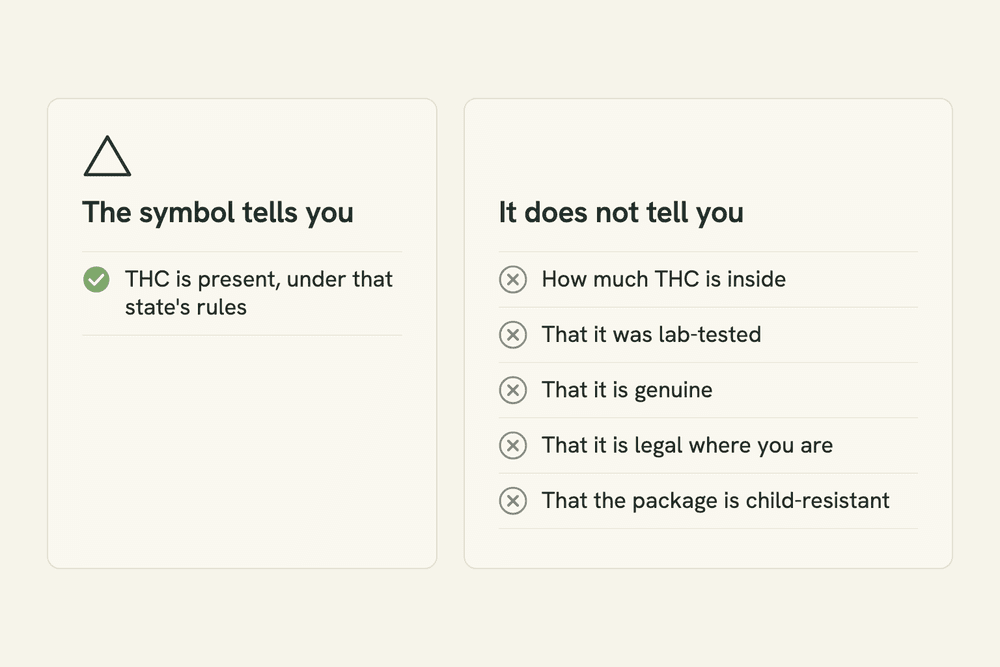
Read the mark as one fact, not a certificate. It answers a single question, and the rest of the label has to answer the others. Here is the split:
- It tells you: the product contains THC, or intoxicating cannabis, under the rules of the state whose mark it is.
- It suggests: the product was packaged for that state's regulated market, which is exactly why counterfeiters copy it.
- It does not tell you: how much THC is in a serving or in the whole package. That is the milligram line.
- It does not tell you: that the product was lab-tested. Testing is a duty of the license, not something the mark certifies.
- It does not tell you: that the package is child-resistant, that the product is genuine, or that it is legal where you are.
“You will see this symbol on all legal (state regulated), adult-use cannabis products. This symbol allows you to quickly know if a product contains THC. Note: Some illegal producers of cannabis have also placed this symbol on their packaging, making it appear that it comes from a state-licensed facility. To determine if the product was legally produced, consider other indicators, such as where it is sold, and whether the THC concentration in the product is within the state's legal limits.”
Oregon's regulator makes a similar point about the ASTM triangle. In its hemp registry FAQ, OLCC writes that "the ASTM symbol alone does not signify the product is an adult use cannabis item." Testing, meanwhile, comes from the license, not the label. Washington's Why Buy Legal page explains that cannabis sold in licensed stores "must be tested by a licensed laboratory before it can be sold," while cannabis from illegal sources "is not required to be tested or accurately labeled." To check a product, look past the symbol to the batch number and its certificate of analysis. Our guides on reading a certificate of analysis line by line and spotting fake or mislabeled products walk through what to look for.
Hemp-derived THC: why many products have no symbol
If you bought a delta-8 or hemp-derived delta-9 gummy at a smoke shop, a convenience store or online, there may be no state symbol on it at all. The rules in the table above are written for licensed marijuana businesses, and hemp products are generally regulated under separate hemp rules. Our explainer on how hemp-derived THC products are regulated covers why they sit in a different legal lane. That gap is narrowing in some states. Here are three we verified from current rules:
| State | Which hemp products are covered | What the rule requires | Source |
|---|---|---|---|
| Oregon | Hemp items with 0.5 mg or more of total delta-9 THC, or of any other THC including delta-8, in the whole unit of sale, or any amount of an artificially derived cannabinoid | Sold as 21-and-over items carrying the ASTM symbol (at least 0.5 x 0.5 in); other hemp items use the ASTM symbol or OLCC's Blue Hemp symbol, not both | OAR 845-026-0300 (effective Jan. 1, 2022); OLCC Hemp Registry Guide |
| Minnesota | Cannabis products, hemp-derived consumer products, THC topicals, and lower-potency hemp edibles that contain THC | The state's universal symbol on the label; hemp edibles with only approved nonintoxicating cannabinoids and no THC are exempt | Minn. Stat. 342.63, as amended through 2026 |
| Washington | Products with detectable amounts of THC | No hemp symbol; a 2023 law (E2SSB 5367) restricts what a business without a cannabis license may sell | Liquor and Cannabis Board retail guidance |
Oregon's details matter most for shoppers. Under OAR 845-026-0300, a hemp item becomes an adult use cannabis item if it "contains 0.5 milligrams or more" of total delta-9 THC or any other THC, including delta-8, or "any quantity of artificially derived cannabinoids." OLCC's Hemp Registry Guide then requires the ASTM symbol on those items and says a label "should not feature both symbols." Hemp items sold inside Oregon dispensaries follow OAR 845-025-7140, which calls for a hemp symbol and the statement "This product is derived from hemp and could contain THC. Keep out of reach of children." Minnesota's cannabis statute, section 342.63, applies its universal symbol to hemp-derived consumer products and to hemp edibles that contain THC. Washington took a different route: a 2023 law restricts sales of products with detectable amounts of THC by businesses that don't hold a cannabis license, and the Liquor and Cannabis Board's guide to that law lists what those businesses may not sell.
Outside states with a verified rule like these, don't expect a symbol on hemp THC products, and don't read its absence as a sign that a product is weak. A missing mark tells you about the rules, not the potency. Federal hemp rules are also changing. Our explainer on the 2026 federal hemp ban and the latest update on the delayed federal hemp rules track the timeline, and our piece on whether THC drinks are legal covers how beverages fit in.
Cannabis symbol vs the Prop 65 triangle vs the THC number
On a California package you may see two triangles. One is the cannabis symbol. The other is the Prop 65 warning, which 27 CCR 25603 describes as "a black exclamation point in a yellow equilateral triangle with a bold black outline." It is a chemical-exposure warning under a different law. In the rulemaking record that created California's Prop 65 cannabis warning regulations, OEHHA wrote in 2021 that while delta-9-THC is on the Proposition 65 list, cannabidiol and the other cannabinoids are not. Our Prop 65 warning explainer covers that box in full. Here is which mark answers which question:
| Mark | What it looks like | Which rule requires it | The question it answers |
|---|---|---|---|
| State cannabis symbol | Varies by state; California's is a black or white triangle with a leaf, an exclamation point and CA | That state's cannabis rules | Does this product contain THC under this state's rules? |
| Prop 65 warning | A black exclamation point in a yellow triangle with a bold black outline | California's Proposition 65 regulations (27 CCR 25603) | Does this product expose me to a chemical on California's Prop 65 list? |
| THC amount | A milligram figure per serving and per package | State labeling rules | How much THC is in one serving, and in the whole package? |
The milligram line is the only one of the three that tells you strength. Washington's Liquor and Cannabis Board, for example, says edibles list THC per serving and per package in milligrams and may contain no more than 10 mg per serving and 100 mg per package. For how to read those numbers and what a serving means, see our breakdown of the 10 mg edible.
What about CBD products?
A CBD product that isn't intoxicating is generally not what these symbols are for. The rules above target THC and intoxicating cannabinoids, and Minnesota's statute says it outright: a lower-potency hemp edible containing only approved nonintoxicating cannabinoids and no THC "is not required to include the universal symbol."
Full-spectrum products are the gray zone, because they contain some THC. Oregon is the clearest case. Its line is half a milligram of total THC in the whole unit of sale; at or above it, a hemp product, including a full-spectrum CBD product, is sold as 21-and-over and carries the ASTM symbol. Whether a given bottle crosses a line like that depends on its THC concentration and its package size, which is why the lab report matters more than the front of the box. Rules for CBD differ by state, so the reliable move is the same everywhere: find the batch's certificate of analysis and read the THC rows yourself.
A 30-second check for the package in your hand
- 1Identify the mark. Match its shape, colors and words to the state table above to see which state's rule it belongs to.
- 2Compare it with where you got it. A state's marijuana symbol on a product sold in another state, or outside a licensed store, is worth a second look. Oregon's ASTM triangle on hemp items is the exception covered above.
- 3Check the seller. Washington's regulator suggests weighing where the product is sold and whether its THC content is within the state's legal limits.
- 4Find the THC number. Look for milligrams per serving and per package, because the symbol won't tell you.
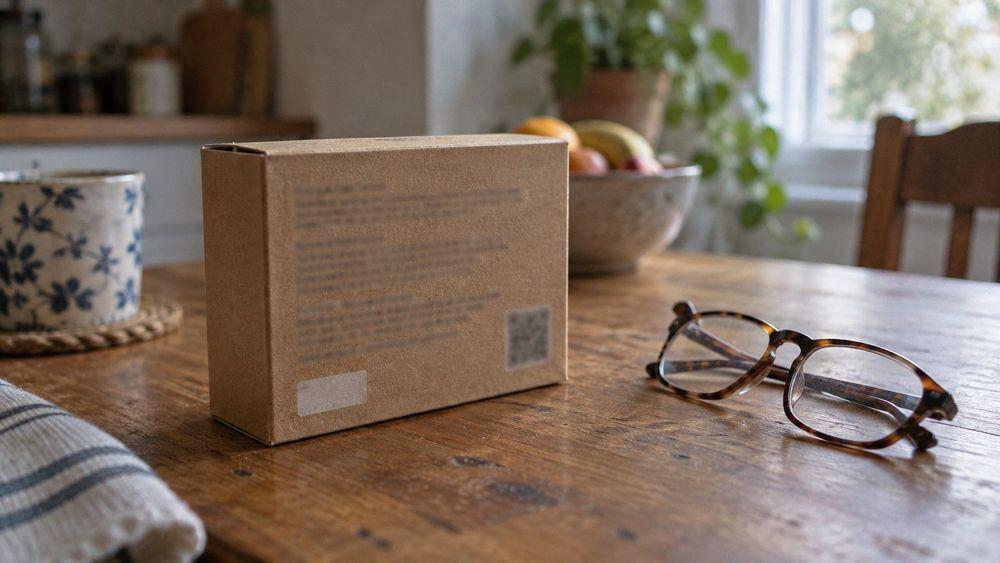
- 5Find the batch. Look for a batch or lot number and a QR code or link to a certificate of analysis that matches it.
- 6Treat a symbol with no batch number and no lab report as a red flag, not a reassurance.
What this guide can't tell you
State rules change, and this page is a snapshot as of November 20, 2026. We read each rule from the state or a legal mirror and dated it, but we cover the main symbols, not every one: states not in the table may have their own marks, and some states run separate medical and adult-use rules. We left out what we could not verify from a state document, including Michigan's current artwork and the lists of ASTM adopters that circulate online. Nothing here is legal advice for businesses. If you make or sell cannabis or hemp products, your state regulator's current rules are the authority.
Frequently asked questions
It means the product contains THC, or intoxicating cannabis, under the rules of the state that required the mark. It is a recognition signal for adults, parents and poison centers. It does not tell you the dose, that the product was tested, or that it is legal where you are.
Not a federal one. Each state sets its own mark, and many call it the universal symbol. The design meant to cross borders, ASTM D8441 from 2022, is voluntary and applies only where a regulator adopts it. Montana's and Minnesota's symbols are based on it, and Oregon requires it on intoxicating hemp items.
Some states require the mark on the food itself so a loose piece can still be identified once it is out of the package. Colorado requires its diamond on each serving of chocolate, candy, baked goods, pills and capsules, and Maine and Massachusetts require a mark on each serving too.
No. Washington's Liquor and Cannabis Board warns that some illegal producers put the symbol on their packaging to look state-licensed. Testing is a requirement of the license, not something the mark proves, so check where the product was sold and whether its batch has a matching lab report.
It depends on the state. Oregon requires the ASTM symbol on hemp items with 0.5 mg or more of THC in the whole unit of sale or any artificially derived cannabinoid, and Minnesota requires its universal symbol on hemp products that contain THC. Many states have no hemp symbol rule, so a missing symbol tells you nothing about strength.
No. The Prop 65 mark is a black exclamation point in a yellow triangle with a bold black outline, and it warns about exposure to a listed chemical under a different California law. California's cannabis symbol is a separate black or white triangle with a leaf, an exclamation point and CA. A package can carry both.
Usually not, because the rules target THC and intoxicating cannabinoids. Full-spectrum products are the case to watch: in Oregon, a hemp product with 0.5 mg or more of total THC in the unit of sale is sold as 21-and-over with the ASTM symbol. Check the batch's lab report for the THC numbers.
The symbol is the fastest thing to read on a cannabis label and the one that tells you the least. For the rest of the panel, from serving size to batch codes, go back to our complete walkthrough of label anatomy, then use our guide on how to choose a CBD oil to put the label and the lab report together before you buy.
Writing about hemp, wellness and the small rituals that keep us balanced.