What Does 710 Mean? Oil Day, Concentrates and 420 Compared
Read upside down, 710 spells OIL. Here is what the cannabis term means, what the dated record says about where it came from, how it compares with 420's 1971 origin, and why concentrates carry about three times the THC of flower.
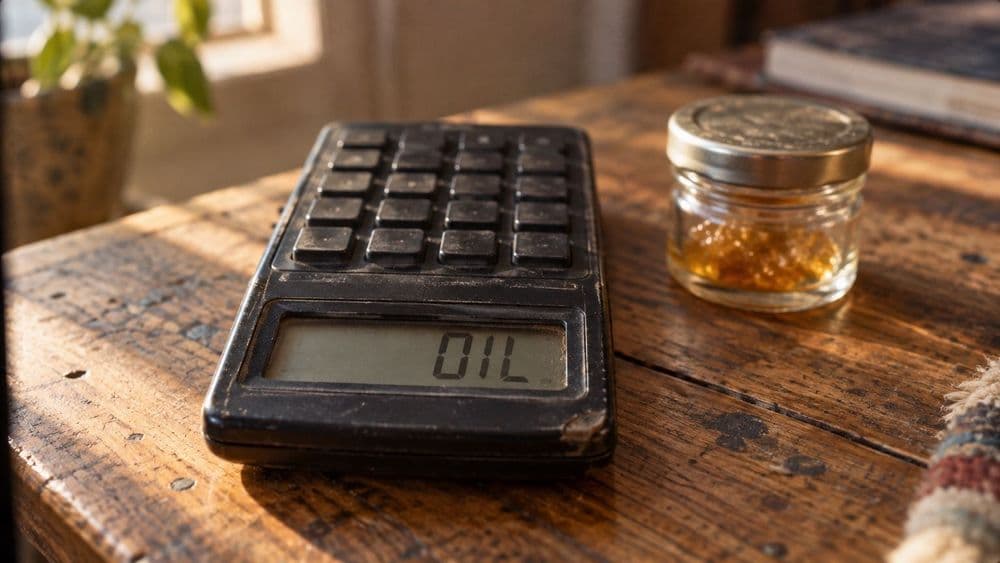
What does 710 mean? Turn the number 710 upside down and it spells OIL. In cannabis slang, 710 stands for cannabis oil and other concentrates such as wax, shatter and rosin, and July 10 (7/10) is the concentrate world's day, its answer to April 20. In Washington's legal market, those products average more than three times the THC of flower.
If you saw 710 on a dispensary sign or a post in July, that is the meaning. Below, we check the dates behind the origin story, explain what the "oil" is with measured potency numbers, and add the safety context a first-timer needs. One thing up front: marijuana concentrates remain controlled substances under federal law, and adult-use sales are legal only under state law, to adults 21 and over. This page is a definition and some history, not a guide to using them. Our page on what a roach is in weed treats another everyday slang term the same way.
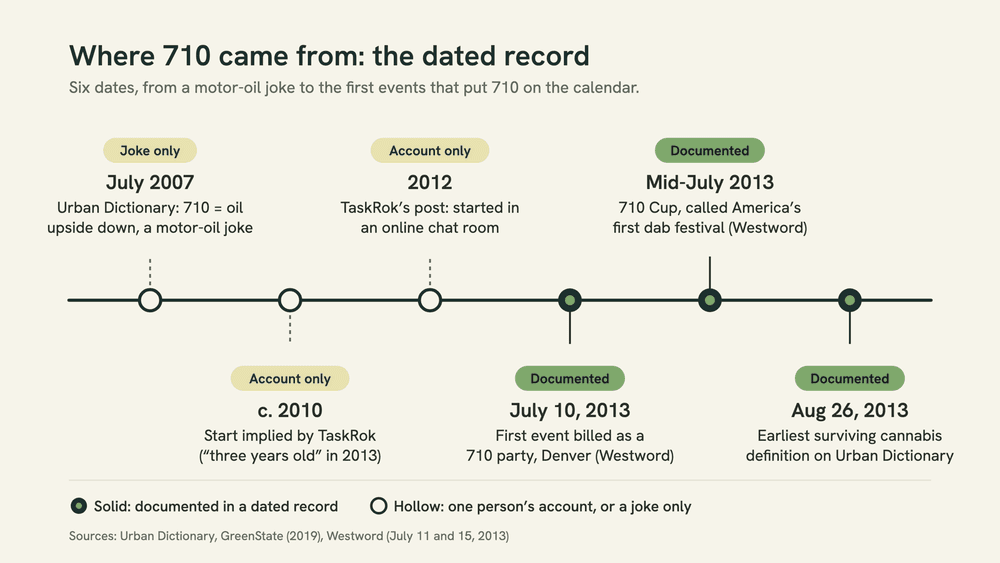
Where 710 came from: what is documented and what is folklore
The flip itself is older than the holiday. An Urban Dictionary entry dated July 2007 already defines 710 as "oil" upside down, as a joke about motor oil, with no cannabis in it. Crowd-written dictionaries are weak authority, but they date their entries. Most pages on this topic repeat a founding year (2007, 2010 or 2011) without checking it, so we went looking for the dated record.
The most-cited origin is one person's own account. The rapper TaskRok, quoted secondhand in a 2019 GreenState report on the holiday, wrote in a 2012 Facebook post that 710 "was started in TinyChat with me (and some friends)": an online chat room where a group of friends wanted their own time to dab. The same report quotes Daniel De Sailles, owner of Top Shelf Extracts, saying in 2015, "Task came up with 710, period." Treat that as TaskRok's account plus one supporter's endorsement: we could not retrieve the original post, and no documents back it the way they back 420.
The first dated, contemporaneous record we found comes from Denver. On July 10, 2013, an event at the Oriental Theater billed itself as the city's first 710 party. Westword's report from the next day called 710 a hash holiday because the number "looks like 'OIL' upside down," and quoted TaskRok, the evening's headliner: "710, as far as I know, is three years old," adding, "but this is the first time a group of people have celebrated." By his count, that puts the term's start around 2010. A few days later the same paper covered the 710 Cup, which it called America's first dab festival, held in Denver in mid-July 2013.
- July 2007: an Urban Dictionary entry defines 710 as oil read upside down, as a motor-oil joke. No cannabis meaning yet.
- Around 2010: the start date implied by TaskRok's July 2013 remark that the term was three years old.
- 2012: TaskRok's Facebook post, later quoted by GreenState, says 710 started in an online chat room with friends.
- July 10, 2013: the Denver event billed as the first 710 party, reported by Westword the next day.
- Mid-July 2013: the 710 Cup in Denver, which Westword called America's first dab festival.
- August 26, 2013: the earliest cannabis definition of 710 still listed on Urban Dictionary, which quotes the line "710 is the new 420."
Two cautions about that timeline. First, Urban Dictionary only shows entries that are still live, so the August 2013 entry is the earliest surviving cannabis definition of 710, not proof of first use. GreenState reported a 2010 entry that we could not see. Second, other stories circulate, including a 2011 forum post and a 2013 newspaper headline declaring 710 the new 420, but we could not find the originals, so we do not date anything by them. Some fans also tie the number to the Grateful Dead's old house at 710 Ashbury Street in San Francisco, where members of the band were once busted for marijuana. It is a coincidence, with no record linking the address to the oil meaning. Within four years of the Denver events the date had become a retail event too; a 2017 Phoenix New Times report wrote that the buzz was driven by concentrate sales and the businesses selling them. The honest summary: 710 as a cannabis term was in use by the early 2010s, and its documented history as a day starts in Denver in July 2013.
710 vs 420: two holidays, two very different paper trails
420 has a paper trail. According to AP's 2018 account of the holiday's roots, in the fall of 1971 five San Rafael High School students who called themselves the Waldos agreed to meet at 4:20 p.m. by the campus statue of Louis Pasteur. A classmate had given them a crude map to a pot patch near Point Reyes, said to belong to a Coast Guard reservist. They never found it, but the time became their code. The five men, named on the record, keep postmarked letters from the mid-1970s that use the code in a bank safe-deposit box, and the Oxford English Dictionary, after reviewing their records, credits students from San Rafael, according to AP and KQED's 2018 interview with the group. 710 has nothing comparable.
| 420 | 710 | |
|---|---|---|
| Date | April 20 (4/20), and the time 4:20 p.m. | July 10 (7/10) |
| What the number is | A meeting time | The word OIL, read upside down |
| What the day marks | Cannabis in general | Concentrates: hash oil, wax, shatter, rosin and similar |
| Documented origin | Fall 1971, San Rafael High School, five students known as the Waldos | Around 2010 by TaskRok's account; first billed 710 party July 10, 2013, in Denver |
| Best evidence | Postmarked mid-1970s letters, an Oxford English Dictionary credit, named founders on record | One self-account quoted secondhand, two 2013 Westword reports, dated dictionary entries |
| Common myth | That 420 is a California police code | That a fixed founding year (2007 or 2011) is documented |
The best-known 420 myth is the police code. According to AP, the number took off in the late 1980s, when flyers at Grateful Dead concerts called 420 the password of stoner culture and claimed it was California police code for marijuana smoking in progress. It never was. The Waldos' own documentation page notes that California's cannabis offenses sit in the Health and Safety Code, sections 11357 through 11362.9. The Waldos sell merchandise, so treat their page as an interested party; the AP and KQED reporting is the independent check. For the legal backdrop of that era, see our history of when weed was made illegal in the US.
What "oil" means on a menu: the concentrate glossary
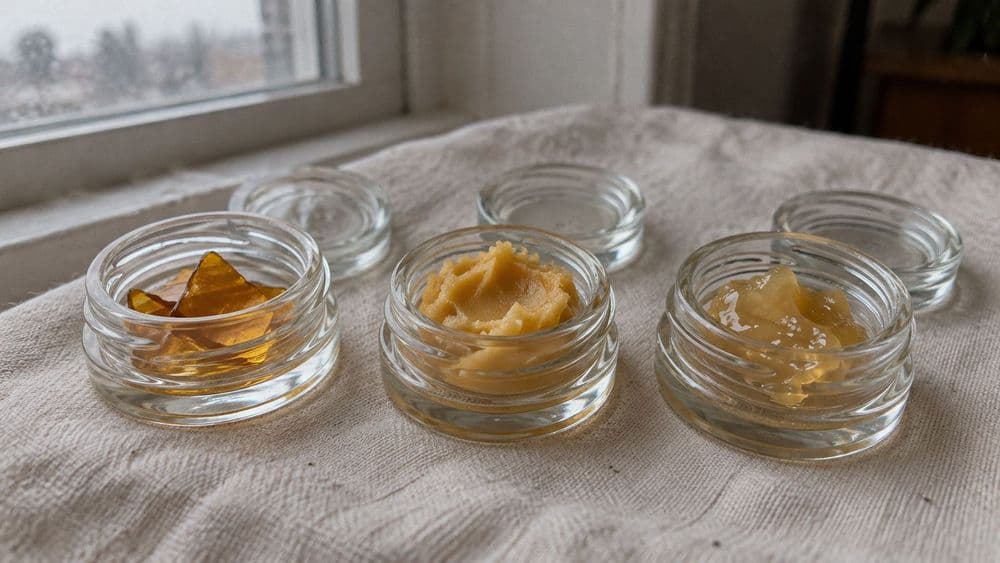
In 710 slang, "oil" is shorthand for cannabis concentrates: products that separate the resin from the plant and leave most of the plant matter behind. Researchers define the main families simply. A 2016 review from the federal potency-monitoring program describes hashish as "a concentrated resin cake or ball produced from pressed kief" and hash oil as oil "obtained from the cannabis plant by solvent extraction." A 2025 toxicology review defines rosin as a "solventless extract obtained through mechanical compression (heat and pressure)" and butane hash oil as the product of hydrocarbon extraction. Most of the other names you see on a menu (shatter, wax, budder, crumble) describe the texture a hydrocarbon extract ends up with, not a different substance.
| Name | What it is | Texture | Typical THC (measured or claimed) | Where we cover it |
|---|---|---|---|---|
| Kief and hash | Collected resin glands; hash is kief pressed into a cake or ball | Fine powder (kief); pressed block or ball (hash) | Generally 50-80% (Washington regulator) | What is hash |
| Shatter | Hydrocarbon (butane) extract | Glassy, brittle sheet | Concentrate class generally 60-90% (Washington regulator) | Dabs vs flower |
| Wax, budder, crumble | Hydrocarbon extract finished to a different texture | Soft and waxy, creamy, or dry and crumbly | Same class range; no separate public dataset for each texture | Dabs vs flower |
| Rosin | Solventless extract pressed out with heat and pressure | Sap-like to buttery | Named in the regulator's 60-90% class range | What is hash |
| Live resin | Trade name for extract made from plant frozen at harvest instead of dried | Varies by maker | No study has measured or compared it | Dabs vs flower |
| Distillate | Refined oil with most other plant compounds removed; often used in vape cartridges | Thick, clear to amber oil | 80-90% cannabinoids measured in New York's medical program; sellers' 90-99% is a claim | THC distillate |
| RSO (Rick Simpson oil) | Whole-plant solvent extract | Dark, thick, tar-like oil | No measured survey; sellers quote 60-90% | What is RSO |
Two things the table makes plain. First, the per-texture potency numbers you see quoted online mostly do not exist as measured data. Washington's cannabis regulator gives one class range, saying wax, rosin, shatter and hash oil "generally range from 60 - 90%" and that kief and hash "tend to range from 50 - 80%," and that is the best public figure we found. The distillate figure comes from a New York lab study of medical-program vape oils, not from a seller. Second, none of these names tells you a product is cleaner or safer. "Solventless" and "live" describe how something was made, not what is or is not in the jar; only a lab report speaks to that. Our comparison of dabs vs flower covers each format and its risks in depth, our explainer on what hash is and how it is made sorts out kief, hash and rosin, and separate pages cover THC distillate and its purity claims and Rick Simpson oil.
One more category shows up outside dispensaries: hemp-derived "THCA" and delta-8 concentrates. Under Public Law 119-103, signed September 2, 2026, an exclusion for cannabinoids not capable of being naturally produced by the plant is set to take effect on November 12, 2026, and a federal total-THC standard is set to apply from December 11, 2026. Our explainer on hemp-derived THC tracks that calendar. This is general information, not legal advice.
Why a dab is not a hit: the potency gap in numbers
The reason 710 has its own day is the same reason it deserves care: concentrates are a different order of strength. In Washington's legal market in 2022, concentrates averaged 69% THC against 21% for flower, according to the state regulator, which also notes that Washington does not cap THC in either. A RAND analysis of more than 30 million Washington sales from the state's first two years of legal retail (July 2014 to September 2016) found the same gap: extracts averaged 68.7% THC, "more than triple" flower's 20.6%, and the extracts' share of sales grew 145.8% to reach 21.2%. Those are label figures from one state, and labs vary. Federal potency monitoring of seized samples shows the climb over time: the mean THC of seized concentrates rose from 6.7% in 2008 to 55.7% in 2017.
Percent on a label is not the whole story; delivery matters too. In a Colorado study of 121 regular users, people who used 70% or 90% THC concentrates averaged 0.32 micrograms of THC per milliliter of plasma right after a session in which they chose how much to use, against 0.14 for people who used 16% or 24% flower: more than twice as much. Yet the concentrate group did not show more short-term impairment on the study's tests, and reported similar intoxication. The study was observational, people were not randomized to a format, and only regular users took part, so it says little about a first-timer. On a laboratory smoking rig, a dab of butane hash oil delivered about three quarters of its THC (75.5%) into the vapor, while smoked flower made roughly a fifth to a quarter of its THC available. That was a machine, not a person, but it points the same way. The federal National Institute on Drug Abuse puts it in one sentence:
“Dabbing can rapidly deliver large amounts of THC to the body, which increases the risk of negative side effects.”
That line comes from NIDA's cannabis research page, and it is why a dab is not comparable to a hit from a joint. If too much THC is the worry, our guide to greening out explains what overconsumption feels like and what to do about it. Over the longer term, a 2022 systematic review of 20 observational studies linked higher-potency cannabis with psychosis and cannabis use disorder; most of those studies measured strong flower, not concentrates, and they show association, not cause. For a fuller look at what the number on a label does and does not predict, see our guide on whether THC percentage matters.
Carts, oil and EVALI: what 2019 changed
Vape cartridges filled with THC oil belong to the same "oil" family, and they carry the most important safety lesson of the past decade. In 2019 a wave of serious lung injuries spread across the US, later named EVALI (e-cigarette or vaping product use-associated lung injury). CDC's outbreak page counted 2,807 hospitalized EVALI cases or deaths and 68 confirmed deaths, in 29 states and the District of Columbia, as of February 18, 2020. CDC says vitamin E acetate, a thickener found in some THC cartridges, is "strongly linked" to the outbreak, and that most cases involved THC vapes from informal sources like friends or dealers. In a 2020 New England Journal of Medicine study, vitamin E acetate turned up in lung fluid from 48 of 51 EVALI patients and in none of 99 comparison subjects. Our guide on how to tell if a cart is fake covers counterfeit packaging and what a real lab report looks like.
Why "make your own oil" is a burn-unit story
Some 710 content online drifts into homemade oil. This page does not, and the reason is documented in burn units. Butane hash oil is made with a pressurized, highly flammable solvent, and burn centers recorded the results as cannabis laws loosened. A Colorado burn center's case series admitted 29 people burned while making butane hash oil between January 2008 and August 2014, and none before medical marijuana was liberalized in the state. The median patient had burns over 10% of the body and stayed 10 days in the hospital; six needed a breathing tube to protect the airway, and 19 needed skin grafts. In Northern California, a UC Davis burn-center series counted 101 patients burned this way from 2007 to 2014, with burns covering 26.8% of the body on average, and three of them died. Both papers describe people injured during manufacture, at one center each, so they show what happens, not how often.
What does 710 mean outside cannabis? Area codes and angel numbers
If your search turned up odd results, you are not alone. In phone numbering, 710 is a federal area code: CISA's quick guide to its priority calling services lists the access number for GETS, the Government Emergency Telecommunications Service, as 1-710-627-4387. Numerology sites call 710 an "angel number"; that is a different search with nothing to do with cannabis. If you came here because of a dispensary sign or a July post, the cannabis meaning is the one you want. Just treat any confident founding year or "cleaner" kind of oil as unproven until someone shows a source you can open.
Frequently asked questions
710 is cannabis slang for oil, because the number 710 read upside down spells OIL. It refers to concentrates such as hash oil, wax, shatter, budder and rosin, and to dabbing, the practice of vaporizing them. You may also see "710 friendly", which means a place or group that is welcoming to concentrates.
710 Day is July 10 (7/10), the date concentrate fans treat as their counterpart to 4/20. The earliest dated records we found are from Denver: an event billed as the first 710 party on July 10, 2013, and the 710 Cup, called America's first dab festival, a few days later.
Flip the digits 7-1-0 upside down and they read OIL. The joke is older than the cannabis meaning: an Urban Dictionary entry from July 2007 uses it for motor oil. The cannabis sense was in use by the early 2010s, and the rapper TaskRok said in 2013 that the term was about three years old.
No, and 420 came first. 420 means cannabis in general and began in 1971 with five San Rafael High School students who met at 4:20 p.m.; it is backed by postmarked 1970s letters and an Oxford English Dictionary credit. 710 dates to around 2010 by TaskRok's account and marks concentrates specifically.
Yes, by a wide margin. In Washington's legal market in 2022, concentrates averaged 69% THC against 21% for flower. In a Colorado study of 121 regular users, concentrate users had more than twice the plasma THC of flower users after use. NIDA warns that dabbing can rapidly deliver large amounts of THC.
Marijuana concentrates remain controlled substances under federal law. Some states license adult-use sales to people 21 and over, and the rules differ from state to state. Hemp-derived concentrates face a separate federal total-THC standard that is set to apply from December 11, 2026. This is general information, not legal advice.
710 started as a joke about a number and became a date on the calendar. The products behind it are among the strongest in cannabis, federally controlled and sold for adult use only where a state allows it, to people 21 and over. If the potency gap is what stuck with you, our guide to what a THC percentage on a label does and does not predict is the natural next read. And if you are comparing hemp wellness products instead, our guide to choosing a CBD oil explains how to read a label and a lab report.
Writing about hemp, wellness and the small rituals that keep us balanced.