How Does CBD Work? What the Science Can and Cannot Say
The FDA label for Epidiolex says CBD's mechanism in humans is unknown. Here is every protein CBD touches in a lab, at what concentration, which effects were seen in animals or people, and two popular explanations that do not hold up.

How does CBD work? The honest short answer is that nobody knows exactly, and the FDA label for the only approved CBD medicine says so in writing. What researchers can tell you is which proteins CBD touches in a lab dish, at what concentration, and which of those effects were ever seen in an animal or a person. This page lists them target by target and checks the two explanations you will read most often against the papers.
Here is the short version. In cells, CBD (cannabidiol) interacts with dozens of proteins: the cannabinoid receptors, a serotonin receptor, ion channels that help nerve cells fire, a transporter for the messenger molecule adenosine, and more. Many of those lab effects were seen at concentrations well above the blood levels measured in people after small doses (the numbers are below). None of them has been proven to be the way CBD acts in a person. If you want background on the system CBD is usually tied to, start with our guide to the endocannabinoid system. This page covers that system's receptors and everything else CBD touches, so you can judge any "CBD works by..." sentence for yourself.
What the FDA label actually says
Epidiolex is the only CBD medicine the FDA has approved. It is a purified, prescription oral solution, and its prescribing information on DailyMed (label revised May 2026) lists a single use: "the treatment of seizures associated with Lennox-Gastaut syndrome (LGS), Dravet syndrome (DS), or tuberous sclerosis complex (TSC) in patients 1 year of age and older." Every US drug label has a Section 12.1 reserved for mechanism of action. For Epidiolex, that section reads in full:
“The precise mechanisms by which EPIDIOLEX exerts its anticonvulsant effect in humans are unknown. Cannabidiol does not appear to exert its anticonvulsant effects through interaction with cannabinoid receptors.”
Two things stand out. First, this is the most heavily reviewed document that exists about how CBD acts, and it says the mechanism is unknown. Second, it sets aside the explanation most people reach for first, the cannabinoid receptors. Keep the scope in mind, though. This is a sentence about seizures and a prescription drug, not about everything CBD does. It does not say CBD does nothing anywhere else; it says that for the one use where CBD was tested thoroughly enough to win approval, the "how" is still open. The differences between that medicine and a shelf product are laid out in our comparison of Epidiolex and CBD oil.
How does CBD work compared with THC?
THC has a fairly simple story. The IUPHAR/BPS Guide to PHARMACOLOGY entry for THC, a database curated by pharmacologists, describes it as a partial agonist at both cannabinoid receptors, CB1 and CB2. An agonist fits a receptor and switches it on; a partial agonist switches it on part of the way. One dominant target explains most of what THC does, which is why THC and the other cannabinoids are usually introduced through CB1.
CBD has no headline target. It has a long list of weak ones, and even the length of the list depends on who is counting. A 2015 systematic review of CBD's molecular pharmacology noted that more than 65 discrete molecular targets had been reported. A 2023 review in the journal Molecules identified "around 56 different molecular targets for CBD" and concluded that its pharmacology "has not yet been fully elucidated." The two counts differ because reviewers use different rules for what counts as a target, not because CBD changed between 2015 and 2023.
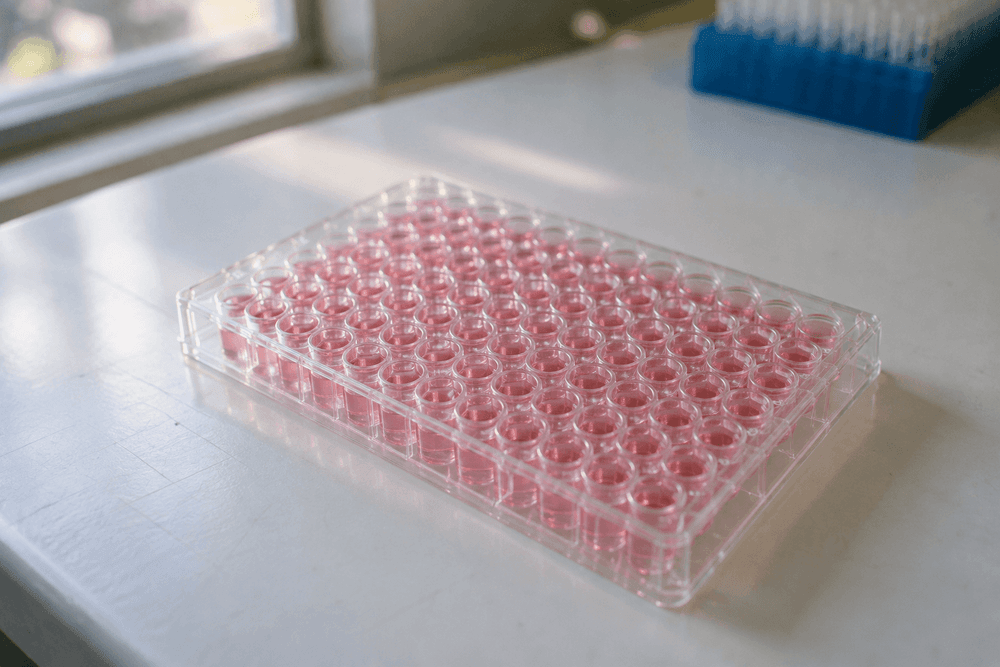
There is a deeper problem. A target is usually found in an isolated system: cells engineered to make one human receptor, or membranes taken from rat brain. A 2015 meta-analysis of CBD's receptor-binding data, whose first author was affiliated with GW Pharmaceuticals (the company that developed Epidiolex), put it plainly: "in vitro mechanistic studies do not always predict in vivo pharmacology." In vitro means in a dish or test tube; in vivo means in a living animal or person. Read everything below with that sentence in mind.
Every target CBD touches, in one table
This ledger lists the targets with the most published work behind them: what CBD did at each, what kind of evidence it is, and the concentration the source printed. Concentrations stay in each paper's own unit. nM is nanomolar and µM is micromolar (1 µM is 1,000 nM); a lower number means CBD acted at a lower concentration. Ki measures how tightly a molecule binds, and IC50 and EC50 are the concentrations at which half of a blocking or activating effect is reached.
| Target | What CBD did there | Where it was seen | Concentration in the source | Source |
|---|---|---|---|---|
| CB1 receptor | Negative allosteric modulator: turned down the signal from THC and 2-AG | Cells | Ki 3,245 nM (pooled data) | Laprairie 2015; McPartland 2015 |
| CB2 receptor | Weak binding; no curated database record | Cells and membranes | Ki 3,612 nM (pooled data) | McPartland 2015 |
| FAAH (the enzyme that breaks down anandamide) | Weakly inhibited the rat enzyme; did not inhibit the human enzyme | Rat brain tissue; human protein | IC50 27.5 µM (rat brain) | Bisogno 2001; Elmes 2015 |
| FABPs (carriers that move anandamide inside cells) | Bound human FABPs; may compete with anandamide for transport | Human proteins in the lab | Not reprinted here | Elmes 2015 |
| 5-HT1A (a serotonin receptor) | Activated it with modest affinity; a 5-HT1A blocker cancelled CBD's effects in rats | Cells; rats | 1, 10 and 20 mg/kg by injection (rats) | Russo 2005; Resstel 2009 |
| TRPV1 | Activated it, then desensitized it | Cells carrying the human receptor | EC50 3.2-3.5 µM | Bisogno 2001 |
| TRPV2, TRPV3, TRPA1, TRPM8 | Curated interactions | Cells | Not reprinted here | IUPHAR/BPS Guide to PHARMACOLOGY |
| GPR55 | Blocked its activation (antagonist); proposed as a mechanism in mice | Cells; mouse model | IC50 445 nM | Ryberg 2007; Kaplan 2017 |
| ENT1 (adenosine transporter) | Bound it and reduced adenosine uptake | Mouse cells; mice | Ki below 250 nM | Carrier 2006 |
| Sodium channels Nav1.1 to Nav1.7 | Inhibited their currents | Human cells in a dish | IC50 1.9-3.8 µM | Ghovanloo 2018 |
| GABA-A receptors | Positive allosteric modulator, not at the benzodiazepine site | Frog eggs carrying human receptors | Low micromolar; one subtype at 0.01-1 µM | Bakas 2017 |
| PPARγ | Activation reported | Cells and animals (review) | Not printed | O'Sullivan 2016 |
| Any of these, as the mechanism in people | Not established | No human proof | Not applicable | Epidiolex label, Section 12.1 |
A row is a place CBD was seen to act in a lab, not proof that it acts there in you. Databases and reviews also draw the map differently. As of September 2026, the IUPHAR/BPS Guide to PHARMACOLOGY's cannabidiol entry listed curated interactions with CB1 (as a negative allosteric modulator), GPR18 (as a partial agonist), GPR55 (as an antagonist), the TRP channels TRPA1, TRPM8, TRPV2 and TRPV3, and the sodium channels Nav1.1 to Nav1.8. It had no row for CB2, 5-HT1A or the PPARs, three targets you will see named on almost every page about how CBD works.
The targets, one family at a time
Each family below ends with the same question: where was this seen? Cells, animals and people are different kinds of evidence, and only the last one tells you what happens in a human body. None of these findings is a promise about how CBD will make you feel.
Cannabinoid receptors: CB1 and CB2
CBD binds both cannabinoid receptors weakly. The 2015 meta-analysis pooled the published binding data into a Ki of 3,245 nM at CB1 and 3,612 nM at CB2, and called CBD "a very low-affinity CB1 ligand" that can still affect CB1 activity indirectly. What CBD seems to do at CB1 is subtler than switching it on or off. In a 2015 cell-culture study using human kidney cells and a striatal cell model, "cannabidiol behaved as a non-competitive negative allosteric modulator of CB1 receptors." In plain terms, it attached to a different spot on the receptor and turned down the signal that THC and the body's own cannabinoid 2-AG produced there. Evidence level: cells and membranes.
Serotonin: the 5-HT1A receptor
This is the most repeated mechanism claim online, and it rests on two preclinical papers. In a 2005 cell-culture study (Russo and colleagues, Neurochemical Research, doi:10.1007/s11064-005-6978-1), CBD displaced a test compound from the cloned human 5-HT1A receptor and activated it. The authors described CBD as "a modest affinity agonist at the human 5-HT1a receptor" and wrote that additional work was required. The 2009 study most other pages cite is an experiment in male rats given injected CBD. The rats received 1, 10 or 20 mg/kg into the abdomen and were then put under restraint stress. A drug that blocks 5-HT1A, WAY100635, "blocked the effects of CBD" on their stress responses. That is good evidence that the receptor mattered in that rat model. It is not evidence about people: as of a PubMed search run on 24 October 2026, we found no human study that tested whether CBD acts through 5-HT1A by blocking that receptor. Evidence level: cells and rats. A related compound has been tested at the same receptor; see how CBDA compares with CBD, and if you take a medicine that works on serotonin, our page on CBD and buspirone covers the interaction questions.
TRP channels: TRPV1 and its relatives
TRP channels are gates in nerve-cell membranes that respond to heat, cold and irritants; TRPV1 is the one that capsaicin from chili peppers opens. In the 2001 study that first reported CBD at this channel, CBD "stimulated VR1 with EC50=3.2-3.5 microM" in cells engineered to carry the human receptor (VR1 was TRPV1's earlier name). At 10 µM it then desensitized the channel, leaving it less responsive. The curated database adds TRPV2, TRPV3, TRPA1 and TRPM8 to CBD's list. Evidence level: cells, at micromolar concentrations. Other cannabinoids touch the same channels, which our comparison of CBC and CBD walks through.
GPR55: blocked, not switched on
GPR55 is a receptor some researchers once proposed as a third cannabinoid receptor. You will often read that CBD activates it. The original paper says the opposite. In a 2007 study in human kidney cells engineered to carry GPR55, run by AstraZeneca scientists, "cannabidiol was without effect as an agonist" and instead blocked the receptor's activation by another cannabinoid, with an IC50 of 445 nM. In the same assays, CBD's IC50 at CB1 and CB2 was above 30,000 nM. Ten years later, a study in mice carrying a mutation in the Scn1a sodium-channel gene found that a GPR55 blocker mimicked CBD's effect on inhibitory nerve cells, and that with the blocker present CBD added nothing more. The authors proposed GPR55 as a candidate mechanism. That is a hypothesis from mouse work, not an established human mechanism, and GPR55 results have been inconsistent from lab to lab. Evidence level: cells and mice. GPR55 comes up again in our guide to palmitoylethanolamide (PEA).
Adenosine: the ENT1 transporter
Adenosine is a messenger molecule that cells release and then take back up through transporter proteins. In a 2006 study of mouse immune cells and mice, CBD bound the adenosine transporter ENT1 with a Ki below 250 nM and reduced adenosine uptake, which leaves more adenosine outside the cells. In live mice, the effect the researchers measured was "reversed with an A2A adenosine receptor antagonist and abolished in A2A receptor knockout mice," so it depended on one specific adenosine receptor. Evidence level: mouse cells and mice.
Ion channels and GABA-A receptors
Voltage-gated sodium channels are the switches that let nerve cells fire. In a 2018 study of sodium channels in human cells grown in a dish, including nerve cells made from human stem cells, "CBD inhibits hNav1.1-1.7 currents, with an IC50 of 1.9-3.8 μm." The authors thought much of the effect came from CBD dissolving into the cell membrane around the channel, alongside "undetermined direct interactions." Two of the authors worked at Xenon Pharmaceuticals, a company that develops sodium-channel drugs. Evidence level: human cells in a dish.
GABA-A receptors are the nervous system's main brake. In a 2017 study using frog eggs engineered to make human GABA-A receptors, CBD acted as a positive allosteric modulator "with low micromolar potencies": it boosted the receptor's response to GABA without using the site that benzodiazepine drugs bind. One subtype found outside synapses, α4β2δ, was enhanced at 0.01 to 1 µM. The study measured currents across an egg membrane; it did not measure behavior or mood. Evidence level: frog eggs carrying human receptors.
PPARγ: a receptor inside the nucleus
PPARs are receptors inside the cell nucleus that switch groups of genes on and off, many of them involved in how cells handle fat and energy. A 2016 review of cannabinoids and PPARs reported that "some cannabinoids activate the different isoforms of PPARs," mostly the alpha and gamma forms, with the CBD and PPARγ evidence coming from reporter-gene assays, binding studies, blocking drugs and knockout animals. Evidence level: cells and animals, summarized in a review; no curated database row.
Two explanations you will read everywhere, checked
Most of the pages that rank for "how does CBD work" lean on two stories. Both sound reasonable, and both come apart when you read the sources.
The 2015 study that compared human and rodent FAAH went on to propose a different route. CBD binds fatty acid binding proteins (FABPs), the carriers that move anandamide inside cells, and "competition for FABPs may in part or wholly explain" the rise in blood anandamide reported in people after taking CBD. That was protein biochemistry in a lab. It does not show that a typical serving changes your anandamide, or that it would matter if it did. For anandamide, FAAH and the endocannabinoid deficiency idea in more depth, see how the endocannabinoid system actually works.
A dish is not a person: the concentration gap
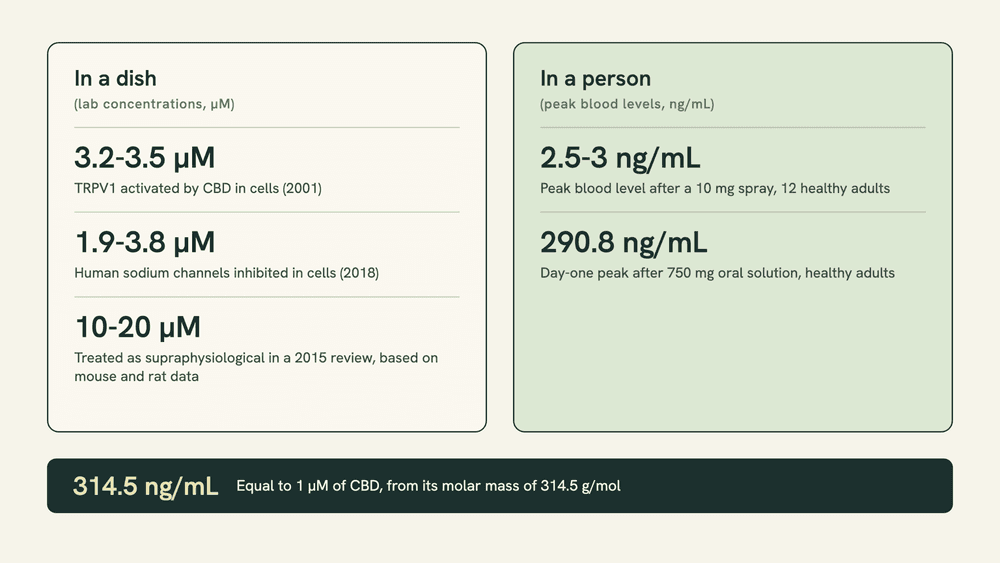
Every number in the ledger is a concentration in a dish. The question that matters for you is whether anything like it is reached in a person. No single source prints a lab potency and a human blood level in the same unit, so here are the numbers side by side, each in the unit its source used, plus the one conversion factor that connects them.
The human figures come from two places. A 2018 systematic review of CBD pharmacokinetics in humans reprints a small study in which 12 healthy adults took a 10 mg dose of a pharmaceutical mouth spray that contains both CBD and THC. Blood CBD peaked at 2.5 to 3.02 ng/mL depending on where in the mouth it was sprayed, and a 10 mg oral capsule of cannabis extract peaked at 2.47 ng/mL. At the other end, a 2018 GW-sponsored trial in healthy adults gave 750 mg of a pharmaceutical CBD oral solution, a dose roughly 75 times larger, to volunteers who had not eaten (9 people per group). Their day-one peak was 290.8 ng/mL.
To compare the two scales you need CBD's molar mass, which PubChem lists as 314.5 g/mol. That makes 1 µM of CBD about 314.5 ng/mL. On that scale, the 10 mg peak of roughly 3 ng/mL is about one-hundredth of a micromolar, and the 750 mg peak of 290.8 ng/mL is just under one micromolar. Those are total blood levels: the Epidiolex label reports that, in lab tests, CBD and its metabolites were more than 94% bound to plasma proteins, and blood is not the same as brain or any other tissue. The 2015 review drew the interpretive line itself, and one of its authors worked at GW Pharmaceuticals: "in vitro effects ... that require CBD concentrations ≥ 10-20 μM were considered supraphysiological," a threshold its authors based on mouse and rat data.
Two more facts widen the spread. The Epidiolex label reports that a high-fat meal raised peak blood levels 5-fold and total exposure 4-fold. And the 2018 review found that CBD's absolute oral bioavailability, the share of a swallowed dose that reaches the blood, has never been directly measured in people; the one absolute figure it found, 31%, was for smoking. So the same milligrams can produce very different blood levels in different people, products and meals. None of this is a dose to take, and it does not prove that a lab target is irrelevant at a small dose. It means the question has not been answered. For how servings and labels work, see our CBD dosage guide; for the meal effect, see whether to take CBD with food; and for timing, how long CBD takes to work.
How to read any "CBD works by" claim
You will keep meeting sentences that start "CBD works by..." on labels, in ads and in articles. Run each one through five questions before you believe it.
- 1Which species? Cells, rats, mice or people. A finding in a dish or a rodent is a lead, not an answer about you.
- 2Which concentration? Look for a number, and ask whether it is anywhere near the blood levels measured in people.
- 3Was the target blocked to prove it? The strongest mechanism studies, like the rat 5-HT1A work, block the receptor and show the effect disappears.
- 4Was it ever tested in a person? For every target on this page, none has been proven as CBD's mechanism in humans.
- 5Does the sentence jump from a receptor to a feeling? "Acts on a serotonin receptor" and "reduces anxiety" are two separate claims, and the second needs its own human trials.
That last question matters most. Whether CBD does anything for sleep or stress is an evidence question, answered by human trials, not by receptor studies. Our reviews of what sleep research on CBD has and has not shown and the evidence behind CBD's claimed benefits take that question on directly.
Why CBD does not get you high
THC is intoxicating largely because it partially switches on CB1 receptors in the brain. CBD does not do that: the curated database lists it as a negative allosteric modulator of CB1, and in cells it turned the receptor's signal down, not up. That is the short version. The human studies are covered in why CBD does not get you high, and our side-by-side of CBD and THC compares the two molecules on effects, law and testing.
The other way CBD works: your liver
For drug interactions, the most relevant "how" is not a receptor at all. The Epidiolex label says CBD is metabolized in the liver and the gut, primarily the liver, by the enzymes CYP2C19 and CYP3A4 along with several UGT enzymes. The same label reports a half-life of 56 to 61 hours after 7 days of twice-daily dosing, and a time to peak of 2.5 to 5 hours at steady state. Because CBD shares these enzymes with many prescription medicines, it can change their levels, and they can change its levels. Our guide to CBD and medications explains which drug groups are affected and why.

What is still unknown
- Which target, if any, explains what CBD does in people. The Epidiolex label calls the mechanism of its approved use unknown, and the 2015 review found "no causal proof yet exists" for VDAC1, GPR55 or CaV3.x calcium channels.
- Whether small servings reach any target. Blood levels measured after 10 mg doses sit well below most of the lab potencies, and no study has shown which target, if any, is engaged at that level.
- Whether 5-HT1A matters in humans. As of 24 October 2026 we found no human study that tested it by blocking the receptor.
- What GPR55 really does. Results differ from lab to lab, and the GPR55 mechanism proposal comes from mice.
- How many targets there are. Reviews say "more than 65" and "around 56," and a curated database lists far fewer.
- Who funded the work. Several key papers had authors at GW Pharmaceuticals, AstraZeneca or Xenon Pharmaceuticals. That does not make them wrong, but it is worth knowing.
Two practical questions sit just outside this page. If you want to judge whether CBD is doing anything for you personally, our guide to telling whether CBD is working offers a fair way to check. If you wonder whether whole-plant products behave differently from CBD alone, that is the question the entourage effect covers, with its own evidence.
Frequently asked questions
Only weakly. Pooled lab data put its binding strength (Ki) at 3,245 nM for CB1 and 3,612 nM for CB2, which reviewers describe as very low affinity. In cells, CBD acted at CB1 as a negative allosteric modulator, turning the receptor's signal down rather than switching it on. As of September 2026, the IUPHAR/BPS Guide to PHARMACOLOGY had no curated CB2 entry for CBD, and the Epidiolex label says CBD does not appear to act through cannabinoid receptors for its approved use.
In lab studies, CBD touches several proteins found on brain cells: CB1 (indirectly, as a modulator), the serotonin receptor 5-HT1A, GABA-A receptors, sodium channels and GPR55. Which of those, if any, matter inside a human brain is not known. The FDA label for Epidiolex states that the precise mechanisms behind its effect in humans are unknown. Lab findings like these do not tell you how CBD will feel.
In a 2005 cell-culture study, CBD activated the human 5-HT1A receptor with modest affinity. In a 2009 study, rats given injected CBD showed effects on stress responses that a 5-HT1A blocker cancelled. As of a PubMed search run on 24 October 2026, we found no human study that tested whether CBD acts through 5-HT1A by blocking that receptor, so the serotonin explanation is preclinical. If you take a medicine that acts on serotonin, ask your doctor or pharmacist before using CBD.
Nobody knows, and that is the second question, not the first. The first is whether CBD does anything reliable for sleep or anxiety in people, which only human trials can answer, and human evidence on both is limited and mixed. Our guides to CBD and sleep and to the research on CBD's benefits go through what those trials have and have not shown. A receptor on this page is not evidence of an effect.
Part of the answer is how much reaches the blood. The Epidiolex label reports that a high-fat meal raised peak CBD levels 5-fold, and CBD's absolute oral bioavailability has never been directly measured in people. Product type, dose, meals and timing all change exposure. Our guide to telling whether CBD is working covers how to judge your own experience fairly.
The CBD in Epidiolex is a purified single molecule, and the lab studies on this page tested CBD on its own, so CBD's targets are not a THC story. Whether other hemp compounds change what CBD does in people is the entourage-effect question, which has its own, separate evidence.
If you are newer to CBD, the natural next step is our plain-language overview of what CBD is, and when you are comparing products, our guide to choosing a CBD oil shows how to check the label and the lab report. Planntz products are for adults 21 and over, and nothing on this page describes how any product acts in your body.
Writing about hemp, wellness and the small rituals that keep us balanced.