What Does Weed Taste Like? The Chemistry Behind Every Flavor
Most of what you call the taste of weed is smell. Here is what a trained nose reports for pine, citrus and skunk, what the only consumer study of strain aroma found, and why the same flower tastes different smoked, vaped or eaten.
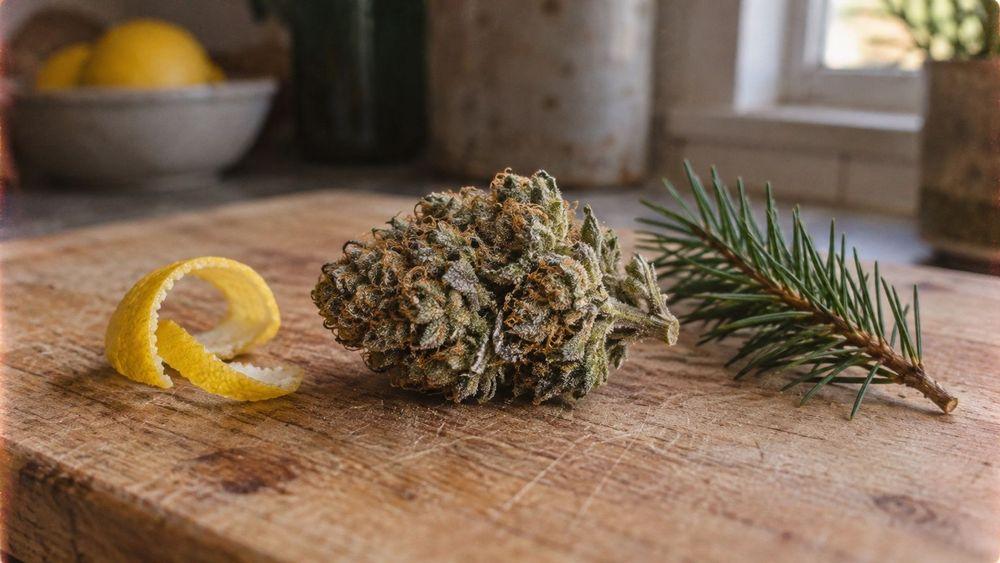
Ask ten people what weed tastes like and most will say earthy, herbal and a little bitter, with something sharper on top: pine, lemon, skunk, diesel, sometimes cheese. That is a fair description. The surprising part is that almost none of it is taste in the strict sense. Your tongue reports the bitterness. The pine, citrus and gas are smells, reaching your nose from the back of your mouth.
What does weed taste like? Cannabis flower tastes earthy, woody and herbal, with a bitter finish on the tongue and, depending on the plant, top notes of pine, citrus, fruit, skunk or fuel. Those top notes come from volatile compounds: mostly terpenes, plus a handful of sulfur compounds and other trace molecules. They are separate from the plant's cannabinoids, and THC itself has no smell. How strongly you notice them depends on how you take it. Vapor carries the lighter notes best at first, smoke adds a harsh, toasted edge of its own, a vape cart tastes mostly of whatever terpene blend was added, and edibles usually bury the plant under sugar, fat and flavoring. This page walks through each of those, with the studies behind them and the places where nobody has measured anything yet.
What does weed taste like? The plain-words answer
The best evidence for how people actually describe cannabis comes from a single study. In a 2018 PLoS One study of consumer perceptions of strain aroma, 61 adults in Colorado sniffed 13 samples of 11 retail strains, including two duplicates, and ticked any of 48 descriptive words that applied. Earthy was the word they reached for most: 328 endorsements, 7.9% of all choices. The 11 most-used words accounted for just over half (51.5%) of everything people ticked. The strains sorted into two broad families, earthy, woody and herbal on one side and citrus, lemon, sweet and pungent on the other. Duplicate jars of G13 landed together, and so did Durban Poison bought from two different dispensaries. Two limits matter. Nobody in the study smoked or tasted anything (the instructions were 'no touching, no smoking, no eating'), and the work was funded by a sensory consulting company founded by its first author.
Put into everyday terms, these are the families of words people use for cannabis flavor:
- Earthy, woody and herbal: the baseline note, and the single most common description.
- Citrus, lemon and sweet: the brighter family in the consumer study.
- Pine: sharp and resinous, like a fresh-cut conifer branch.
- Skunk, gas, diesel and pungent: the loud, sulfurous end of the range.
- Cheese and savory: less common, though cheese was among the words consumers ticked most.
- Spicy, floral and fruity: the words that fill out the rest of the vocabulary.
- Bitter: the finish on your tongue, and the only item on this list that is strictly a taste.
What none of these words tells you is strength. The same Colorado study measured THC and found that people's smell-based guesses at potency did not line up with it, and THC itself is odorless. Our explainer on why weed smells like skunk covers that potency myth and the aroma chemistry in depth. This page stays with the next question: what happens to those smells once the flower, or its smoke or vapor, is in your mouth.
Taste vs flavor: most of what you notice is smell
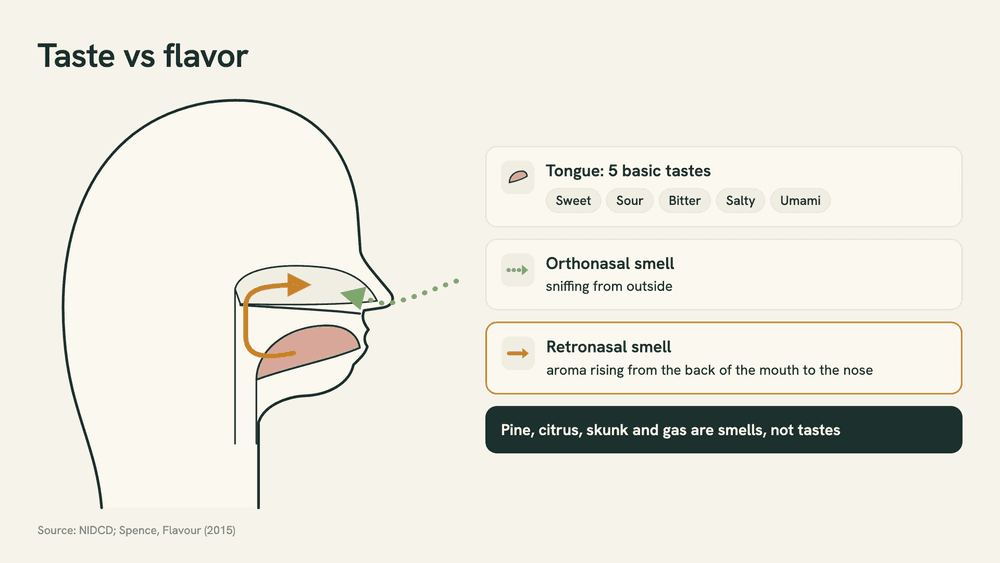
Taste, in the strict sense, is what your tongue does, and it does surprisingly little. According to the National Institute on Deafness and Other Communication Disorders (NIDCD), taste cells respond to at least five basic qualities: sweet, sour, bitter, salty and umami. Those combine with aroma, texture, temperature and what NIDCD calls the common chemical sense (the burn of chili, the cool of mint) to produce flavor. When you chew, aromas reach your sense of smell 'by way of a special channel that connects the roof of the throat to the nose', and the agency notes that most people who think they have a taste disorder actually have a problem with smell.
Scientists split smell into two routes. Orthonasal smell is sniffing from the outside, the way you smell an open jar of flower. Retronasal smell is the air that rises from your mouth to the back of your nose as you eat, drink or breathe out. Pine, lemon, diesel and skunk are not on the tongue's list of five, so when you notice them during a draw or an exhale, you are noticing them retronasally. It is the same reason a stuffed nose makes food taste of almost nothing.
You have probably read that 80% of taste is smell (some versions say 75% to 95%). A 2015 review by Oxford psychologist Charles Spence, Just how much of what we taste derives from the sense of smell?, traced that number back and found almost nothing under it. The study usually cited, by Murphy, Cain and Bartoshuk in 1977, had six trained panelists rate a solution of sodium saccharin, a sweetener, mixed with ethyl butyrate, a fruity-smelling ester. With their nostrils closed, 'as much as 80% of the taste' of that one mixture disappeared. That is a finding about one sweet, fruity solution and six people, not a law of flavor. Spence's own conclusion is blunt:
“[I]t is pretty much meaningless to try and put a precise value, or even a narrow range of values, around the relative contribution of olfactory cues to multisensory flavour perception.”
He also notes that most researchers agree smell plays a 'dominant' role. So the direction is right and the number is not. For cannabis this matters, because nearly every flavor word people use for it describes an aroma, not a taste. When you breathe vapor or smoke out through your nose, you send the aroma along the same retronasal route NIDCD describes for chewing, which is a reasonable explanation for why the flavor often seems strongest on the exhale. No cannabis study has measured that directly, as you will see further down.
The molecules behind each flavor
Most cannabis flavor guides hand you a list: myrcene is earthy, limonene is citrus, caryophyllene is peppery. Those labels come from general odor chemistry and seller copy, and some of them do not hold up when someone actually smells the isolated molecule. The best test available comes from food chemistry. In a 2025 gas chromatography-olfactometry study of CBD hemp cultivars, researchers separated the volatile compounds of six CBD-rich hemp flowers and had trained panelists sniff each one as it came off the instrument, then describe it. They found 52 odor-active compounds. Pine and citrus held up as expected. Myrcene, which strain sites usually call earthy, was described as hop-like. Beta-caryophyllene, usually sold as peppery, came across as moldy. Two of the authors are at Puregene AG, the commercial firm that also supplied the hemp. If you want the basics of what terpenes are first, our guide to how cannabinoids and terpenes differ starts there.
The skunk and gas notes are the clearest example of a flavor that is not a terpene at all. A 2021 ACS Omega study that identified the main skunky odorant in cannabis traced it to a sulfur compound, 3-methyl-2-butene-1-thiol, the same molecule behind the flavor of light-struck, 'skunked' beer. A 2023 follow-up on minor, non-terpene volatiles, which analyzed 31 hash rosins with a panel of 7 untrained users, found that savory and 'chemical' varieties carried skatole, while varieties with a sharp petroleum-citrus note carried a different family of sulfur compounds. Terpene profiles across very different-smelling samples looked remarkably similar, and the authors concluded that the importance of terpenes to cannabis aroma 'has been overemphasized'. Both papers come from researchers at Abstrax, a flavor company that has filed patents in this area, so read them as strong leads rather than settled science. Our deep dive on the skunk smell covers the thiol chemistry; the table below maps the rest.
| Flavor word you read online | Compound linked to it | What a trained nose reported | Evidence note |
|---|---|---|---|
| Pine | Alpha-pinene | Pine-like | A strong odorant in all six hemp cultivars (dilution factor 1,024) (Tran 2025) |
| Citrus | Limonene; linalool | Citrus-like; citrus-like, floral | Hemp flower, sniffed at the instrument (Tran 2025) |
| Sharp or petroleum citrus | 3-mercaptohexyl sulfur compounds (thiols) | Petroleum- or sulfuric citrus-like | Hash rosin, 7 untrained users, correlational (Oswald 2023) |
| Earthy | 3-isobutyl-2-methoxypyrazine | Earthy, bell pepper-like | Earthy was the consumer study's top word; myrcene was not described as earthy (Tran 2025) |
| Hoppy | Myrcene; alpha-humulene | Hop-like | Myrcene is usually sold online as earthy or musky (Tran 2025) |
| Peppery or spicy | Beta-caryophyllene; eugenol | Moldy; clove-like, sweet | Online lists call caryophyllene peppery; the isolated molecule did not smell that way here (Tran 2025) |
| Skunk or gas | 3-methyl-2-butene-1-thiol | Hemp, beer | A sulfur compound, not a terpene (Oswald 2021; Tran 2025) |
| Savory or chemical | Skatole (3-methylindole) | Highly pungent | Linked to savory and chemical varieties of hash rosin (Oswald 2023) |
| Tropical or fruity | 3-sulfanylhexyl acetate; several esters | Passion fruit; fruity | Hemp flower (Tran 2025) |
| Sweet or caramel | Furaneol; methyl anthranilate | Caramel-like; sweet | Hemp flower (Tran 2025) |
| Smoky | p-Cresol | Phenolic, smoky | Found in the dried flower itself, before any burning (Tran 2025) |
Read that table with its limits in mind. The descriptors are odor words for single molecules sniffed at a lab instrument, not what a whole bud tastes like in your mouth. The hemp was CBD-type, not THC-type. The dilution numbers rank how potent an odor is, not how much of a compound is there. And some terpenes that get plenty of attention online, terpinolene and ocimene among them, were not odor-active at all in that study.
A separate line of work points the same way. A 2025 PLoS One paper proposing a sensory lexicon for cannabis aroma, in which an Oregon State panel of 21 to 24 trained people smelled 91 samples, found that terpene profiles alone poorly predicted how a sample actually smelled. That study was funded by Vectura Fertin Pharma. The practical lesson: a terpene readout on a label is a hint about aroma, not a flavor guarantee.
The one part of cannabis flavor that is truly taste is the bitterness on your tongue, and it comes from compounds that do not evaporate. A 2025 review of cannabis aroma and flavor chemistry lists non-volatile flavonoids and phenolic compounds among the plant's taste-active molecules; its authors are tied to a commercial company, Aspeya. Our explainer on cannabis flavonoids covers that non-volatile side of the plant.
Smoke, vapor, carts and edibles: why the same weed tastes different
Same flower, four very different experiences. The route changes which compounds reach you, in what order, and what new ones get made along the way.
Smoke: the flower plus whatever the fire makes
A joint or a pipe does more than release the flower's aroma: it burns the flower, and fire makes new compounds that were never in the plant. When Health Canada scientists machine-smoked cannabis and tobacco prepared the same way, the mainstream cannabis smoke (the smoke drawn through the joint) carried up to 20 times the ammonia of tobacco smoke, and the cannabis smoke carried hydrogen cyanide and nitrogen oxides at 3 to 5 times tobacco's levels. Those are irritants, which helps explain why smoke tastes harsh and why the lighter pine and citrus notes get lost under a toasted, ashy edge. That was a machine study with no flavor measurement, so treat it as chemistry, not a tasting note. Dryness adds harshness too. In a 2025 trade-journal study on water activity and smokability, an industry project that was not peer-reviewed and used a single hemp cultivar, 315 consumers rated very dry pre-rolls as more irritating, with no real difference in flavor. Ash color, for what it is worth, is not a flavor or quality signal; we cover why in white ash vs black ash.
Dry-herb vapor: the light notes leave first
A dry-herb vaporizer heats flower without burning it, so you taste more of what was already there, in the order it boils off. A 2023 bench study on vapor pressure and vaping heated ground flower to 180 C (356 F) in a vaporizer and found that monoterpenes, the light molecules behind pine and citrus, 'almost completely evaporate following 20 sec'. At that temperature, linalool evaporated about 2,200 times faster than THC, beta-myrcene more than 3,500 times faster and beta-caryophyllene about 380 times faster. In the authors' words, 'on vaping, terpenes are inhaled before cannabinoids do'. That helps explain why the first draws from a vaporizer carry most of the flavor and later ones taste flatter and toastier. The authors work for Bazelet, an Israeli medical cannabis manufacturer, and the study measured what left the flower, not how it tasted.
Users notice the difference. In an online survey of 2,910 US cannabis users, 1,783 (61%) had tried a vaporizer, and 55% of them said vaping tasted better than smoking. That is a stated preference from a self-selected, mostly male sample recruited through social media ads, not a measurement, but it lines up with the chemistry. For the wider trade-offs, see our comparison of dry-herb vaporizers and smoking, and for the temperatures at which individual compounds boil off, our page on THC's boiling point.
Vape carts: mostly added terpenes
A cart filled with distillate, a refined cannabinoid oil, is a different product again. Distillation sorts molecules by how easily they boil off, and terpenes go first. In a 2021 Scientific Reports study of steam-distilling hemp, distillation pulled the terpenes out while the cannabinoids stayed behind in the plant material. Steam distillation of plant matter is not the same process used to make THC distillate, but the principle is why refined distillate carries little of the plant's own aroma, and why cart makers add terpenes back for flavor. Our guide to THC distillate covers how it is made.
When FDA's forensic chemists analyzed cannabis vape liquids from the 2019 lung-injury outbreak, about 85% of roughly 300 samples contained terpenes. A New York State lab analysis of patient cartridges and flavoring additives found that 9 commercial flavoring additives were mostly terpenes, with caryophyllene in 8 of the 9. Both analyses were tied to that outbreak, and about half of the FDA samples were linked to patients who fell ill, so neither is a survey of today's legal carts. The practical point holds anyway: in a cart, the flavor you taste is largely the terpene blend someone chose to add. Our explainer on what a terpene percentage on a label means helps you read that number. And if a cart suddenly tastes burnt or acrid, what is in it is breaking down under heat; why your cart tastes burnt explains the causes.
Edibles: the plant is usually hidden
Edibles are the one route where you mostly do not want to taste the plant. The herbal, bitter note of cannabis comes through most in homemade, butter-based edibles made from whole flower. Commercial gummies and chocolates are usually built to hide it under sugar, fat, sour coatings and strong flavors, so many taste like ordinary candy with, at most, a faint herbal or bitter aftertaste. That is common experience rather than a finding: when we searched PubMed in November 2026, none of the 13 records pairing cannabis edibles with taste or flavor was a sensory study of how the plant tastes in food. If you are trying to cover the taste of a CBD oil instead, our page on what CBD oil tastes like has the masking tips.
| Route | What you mostly taste | Why |
|---|---|---|
| Joint or pipe | Earthy, toasted and bitter, with a harsh edge; lighter notes partly lost | Combustion creates new irritant compounds; very dry flower smokes harsher |
| Dry-herb vaporizer | Brighter pine, citrus and herbal notes at first, then flatter and toastier | Monoterpenes leave the flower within seconds, well ahead of cannabinoids |
| Vape cart | Mostly the added terpene blend; burnt or acrid if it overheats | Distillate carries little native aroma, so flavor is added back |
| Edible | Usually the candy, chocolate or baked good, with a faint herbal or bitter aftertaste | Formulated to mask the plant; homemade butter edibles taste the most of it |
| CBD hemp flower | Similar families to THC flower, more often citrus, fruity or candy-like | Same plant and compound families; sniffing panels show heavy overlap |
Why your weed might not taste the way you expected
If a strain did not taste the way its name or menu description promised, there are ordinary reasons. Freshness is the big one. In a year-long storage study of Israeli medical cannabis, terpenoid levels were found to 'decrease rapidly under all storage conditions'. In the stored flower, alpha-pinene and beta-caryophyllene fell significantly within four months, and ground samples ended up lower in terpenoids than whole buds. That helps explain why old weed tastes flat and hay-like. Expectation counts too. In a 2009 balanced-placebo pilot with 20 young cannabis smokers, simply being told a joint contained THC changed how people rated its taste and smell, whatever was actually in it. With 20 people split across four groups it is a small study, but the authors reported large expectancy effects on taste and smell ratings.
Before you blame the strain, run through this checklist:
- 1Age and storage: terpenes fade within months, and ground flower loses them faster than whole buds.
- 2Dryness: over-dry flower smokes harsher, even when the flavor itself is similar.
- 3Route: the same bud tastes brighter vaporized than smoked, and a cart tastes mostly of its added terpenes.
- 4Strain name: a weak guide. Even the consumer study only checked one pair of same-name jars from different shops.
- 5Expectation: what you were told about a product can shift how you rate its taste and smell.
- 6Type: THC-type flower is more often skunky or musty than CBD-type hemp, though the two overlap.
- 7Your own nose: a cold or congestion mutes flavor, because most of what you notice is smell.
When the taste is a warning
Musty or damp. A musty, damp or ammonia smell is one of several reasons to discard flower, but taste is never how you check for mold, and no study we found measures what mold tastes like in cannabis. Check by eye and smell, and when in doubt, throw it out. Our guide to whether weed goes bad covers the signs and how storage prevents them.
Burnt or acrid. A sudden harsh, burnt hit from a cart means something in it is breaking down under heat. Stop and let it rest rather than pushing through; the burnt-cart troubleshooting guide walks through what is happening.
Chemical or off. A strange chemical taste is worth taking seriously, but it is not a test. In its 2021 review of synthetic cannabinoids, the EU drugs agency (EMCDDA) wrote of low-THC cannabis adulterated with synthetic cannabinoids that 'in terms of look, smell and flavour, these adulterated products would be very difficult to distinguish' from genuine cannabis. That is why signs checklists fail, and why a lab, not your palate, is the real check. Our page on how to tell if weed is laced explains what you can and cannot learn without one.
Does CBD or hemp flower taste like weed?
Close enough to be confusing, which makes sense: hemp and marijuana are the same plant, and they carry the same families of aroma compounds. The Oregon State lexicon panel mentioned above smelled 32 THC-type and 59 CBD-type samples and found that the two overlapped. THC-type flower was more often described as skunky, musty and animalic, and CBD-type hemp more often as citrus, fruity and candy-like. That is a tendency across a panel, not a rule for any single jar, and it was done by sniffing. Since THC itself has no smell, any difference you notice comes from the other volatiles, not from the THC. If you are curious about the legal side of hemp flower, our explainer on whether CBD flower is legal covers it.
CBD oil is a step further from the flower. Extraction, the carrier oil and any added flavoring all change the taste, which is why an unflavored hemp extract tends to taste earthy and bitter while a flavored one tastes mostly of the flavoring. Planntz tinctures, for example, come in Natural (unflavored), Mango & Peach and Lemon & Raspberry, all in a coconut MCT carrier. Our guide to how CBD oil tastes and why covers the rest.
What nobody has measured yet
Here is the strange part. Almost every chemistry and sensory study on this page was done by sniffing, or by measuring what leaves the flower. The few that involved actually smoking or vaping are thin: a 20-person expectancy pilot, a self-report survey, and a trade-journal pre-roll test that was not peer-reviewed. On November 20, 2026, we searched PubMed titles and abstracts for cannabis, marijuana or hemp together with 'retronasal' and found 0 records. A search for a sensory panel on the flavor of cannabis smoke also returned 0, and none of 13 records on edibles and taste or flavor was a sensory study of how the plant tastes in food. So, as far as we can find, no peer-reviewed tasting panel has described how cannabis tastes in the mouth. That is one database and a dated search, not proof that nothing exists, but it means nearly every flavor claim on this page, ours included, is built on aroma.
It is also worth knowing who funds this research. The hemp descriptor study has authors at a commercial firm, the skunk and rosin papers come from a flavor company with patents, the consumer study was funded by its first author's company, the vaporizer study came from a medical cannabis manufacturer, and the Oregon State lexicon was funded by a pharmaceutical company. None of that makes the findings wrong. It does mean independent replication, ideally by tasting rather than sniffing, is the missing piece.
Frequently asked questions
Mostly, yes, because most of what you call its taste is smell reaching your nose from the back of your mouth. Your tongue adds the bitterness. The match is not exact: heat drives off the lightest terpenes first and burning creates new compounds, so the inhale rarely tastes quite like the jar smells.
Earthy, herbal and bitter, with a toasted, ashy edge and some harshness. Combustion creates irritant compounds that were never in the flower and partly covers the lighter pine and citrus notes. Very dry flower tends to smoke harsher without tasting much different.
It depends on the kind. A dry-herb vaporizer gives brighter pine, citrus and herbal notes on the first draws, then flatter, toastier ones as the terpenes run out. A cart tastes mostly of the terpene blend added to the distillate. A burnt or acrid cart hit is a sign to stop, not a flavor.
Usually like the candy, chocolate or baked good they are made in, with at most a faint herbal or bitter aftertaste. Homemade butter-based edibles taste more of the plant. We found no published sensory study of how the plant tastes in food, so this is common experience rather than data.
Often similar, because hemp and marijuana share the same families of aroma compounds. In a 2025 sniffing panel of 91 samples, THC-type flower was more often called skunky or musty, and CBD-type hemp more often citrus, fruity or candy-like, with plenty of overlap. CBD oil also tastes of its carrier oil and any flavoring.
Pine is mostly alpha-pinene, and citrus mostly limonene and linalool. Skunk and gas notes come from trace sulfur compounds rather than terpenes. None of these tells you how strong the flower is or how it will feel: flavor words describe odor, not effects.
Stale weed tastes flat or like hay because terpenes fade within months of storage. A musty, damp or ammonia smell is different: treat it as a reason to throw the flower out, not something to taste-test, since taste cannot confirm mold.
Nobody has a solid number. The figure traces back to a 1977 study of six trained panelists tasting one sweetened, fruity solution. Researchers agree smell dominates flavor, but a 2015 review in the journal Flavour called pinning a precise percentage on it pretty much meaningless.
If this page left you wondering what terpenes actually are, how they differ from cannabinoids and what the evidence does and does not say about them working together, the natural next read is our explainer on cannabinoids vs terpenes. It picks up exactly where flavor leaves off.
Writing about hemp, wellness and the small rituals that keep us balanced.