Weed Derealization: Why THC Can Make the World Feel Unreal
Feeling unreal, detached or like you are watching yourself while high has a name, and researchers have produced it with THC under placebo control. Here is what the trials found, how long it usually lasts, how rare the lasting form is, and what to do right now.

You are high, or you were a few hours ago, and something is off. The room looks like a film set. Your hands do not feel like yours, your voice sounds far away, and time is moving strangely. This has a name: derealization when the world feels unreal, depersonalization when you feel detached from yourself. Weed derealization and depersonalization are real, measurable effects: scientists have produced them with THC on purpose, scored them on a standard scale and watched them fade as the high wore off.
The short answer: yes, weed can make you dissociate. In placebo-controlled lab studies, smoked, intravenous and swallowed THC all raised standardized scores for depersonalization and derealization, and where those studies reported timing, the feeling was transient and faded with the high. Briefly feeling unreal is common; the lasting disorder is rare, though cannabis is one of the triggers most often reported by people who develop it. If it is happening to you right now, the short version of the advice further down is: stop using, get somewhere calm, and remind yourself that knowing it feels unreal is a sign your insight is intact.
What derealization and depersonalization actually are
The two words describe two sides of one experience. The MSD Manual's clinical entry on depersonalization-derealization disorder describes depersonalization as feeling detached from your own body or mental processes, usually like an outside observer of your own life, and derealization as feeling detached from your surroundings, so the world seems unreal or dreamlike. The key detail: people having it know the feeling is not real. That awareness, which clinicians call intact reality testing, is what separates it from psychosis, where a person comes to believe the altered experience. Our page on whether weed is a depressant, a stimulant or a hallucinogen explains why cannabis can alter perception without usually producing true hallucinations; this feeling sits in that same territory.
- The room, the street or the people around you look flat, distant, foggy or staged, like a film set or a cartoon.
- Your body, hands or voice do not feel like your own, as if you are watching yourself from the outside.
- Your thoughts feel distant, as if you are observing your own mind instead of being in it.
- Time stretches, skips or stops making sense.
- Through all of it, part of you knows that this is only a feeling.
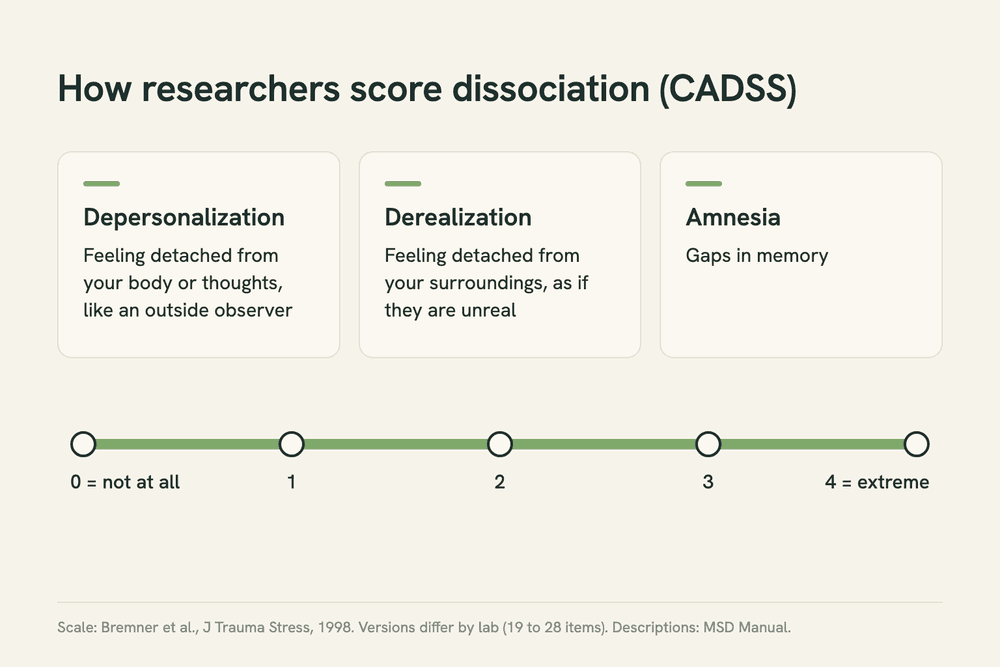
Researchers do not have to rely on descriptions alone. The standard yardstick in lab studies is the Clinician-Administered Dissociative States Scale, or CADSS, first published by Bremner and colleagues in 1998. It asks about depersonalization, derealization and gaps in memory, with each item rated from 0 (not at all) to 4 (extreme). Labs use slightly different versions, some with only self-rated items and some with observer-rated items added, so a score from one study cannot be laid directly on top of a score from another. What the scale gives researchers is a way to compare THC against placebo in the same people, and that is exactly what the trials below did.
Does weed make you dissociate? What the THC trials measured
The first controlled answer came from Duke University. In a 1993 double-blind study of depersonalization after marijuana smoking, 35 healthy volunteers smoked a high-potency, a low-potency and a placebo cigarette on three visits at least a week apart, without knowing which was which. Real marijuana, not placebo, produced measurable depersonalization, strongest about 30 minutes after the high-potency cigarette. It also raised anxiety, tension and confusion, along with what the authors called a "disintegration of time sense". The published abstract does not give the cigarettes' THC content or how long the feeling took to clear, so we do not print either.
Yale's psychiatry group then moved to intravenous THC, which lets researchers control the dose precisely. In their 2004 trial in Neuropsychopharmacology, 22 healthy volunteers received 0, 2.5 or 5 mg of intravenous THC on separate days in random order. THC altered perception and raised anxiety, effects the authors described as transient. Later work from the same lab put a clock on it. In a 2022 placebo-controlled study of 42 healthy people with limited cannabis experience, given 0.015 or 0.03 mg/kg of THC over 10 minutes, the researchers note that peak effects start about 10 to 15 minutes after the infusion begins and last up to roughly 60 to 80 minutes, and CADSS scores rose with THC. Women reported feeling more high at the lower dose; the authors found no other sex differences.
Swallowed THC has been tested too. In a 2024 randomized crossover trial of oral THC, 56 healthy adults with prior cannabis experience took a single 10 mg dose of oral THC (dronabinol, a pharmaceutical form) or placebo. THC significantly raised dissociation scores, both self-rated and observer-rated, in women and men alike. A Dutch team reached the same conclusion from a different angle. Scoring dissociation in 21 volunteers given THC at 300 micrograms per kilogram, the 2015 study found cannabis-induced CADSS scores that were higher than typical scores in people with schizophrenia, similar to those of Special Forces soldiers in survival training, and lower than those produced by ketamine. Those comparisons are against published values from other studies, not head-to-head tests, but they give a sense of scale: a real, measurable shift, well short of what a dissociative anesthetic does.
The largest dataset here pools Yale's work. A 2020 mega-analysis of 10 intravenous THC studies combined 239 healthy people and 400 THC infusions, at doses the authors describe as roughly a quarter of a joint to a full joint. Perceptual and dissociative changes on the CADSS rose with the dose, and they tracked psychosis-like symptoms. People who used cannabis frequently had weaker psychosis-like reactions. Response also varied a lot from person to person: among 114 participants who received two or more doses, 41 (about 36%) did not have a significant psychosis-like reaction at any dose. That figure describes psychosis-like symptoms, not dissociation, so it is not a dissociation rate. It is a reminder that the same dose lands differently in different people.
| Study | People | THC route and dose | What it found |
|---|---|---|---|
| Mathew et al. 1993 (Duke) | 35 | Smoked: high-potency, low-potency and placebo cigarettes | Depersonalization with marijuana, not placebo; strongest about 30 minutes after the high-potency cigarette |
| Mathew et al. 1999 (Duke) | 59 | Intravenous; dose not stated in the abstract | More depersonalization went with more blood flow in the right frontal lobe and anterior cingulate |
| D'Souza et al. 2004 (Yale) | 22 | Intravenous: 0, 2.5 and 5 mg | Altered perception and raised anxiety, described as transient |
| van Heugten-Van der Kloet et al. 2015 (Netherlands) | 21 | 300 micrograms per kg | CADSS rose; above typical schizophrenia scores, below ketamine |
| Ganesh et al. 2020 (Yale, pooled) | 239 (400 infusions) | Intravenous: 0.015-0.07 mg/kg | CADSS changes rose with dose; frequent users had weaker psychosis-like reactions |
| Bassir Nia et al. 2022 (Yale) | 42 | Intravenous: 0.015 and 0.03 mg/kg over 10 minutes | CADSS rose with THC; peak effects from about 10-15 minutes, lasting up to about 60-80 minutes |
| Mohammad Aghaei et al. 2024 (Yale) | 56 | Oral: 10 mg dronabinol | Self-rated and observer-rated CADSS rose vs placebo, in women and men |
Read the table with its limits in mind. These were healthy, screened adults in a lab, mostly given THC intravenously, a route nobody uses at home, and several of the papers could only be checked at the abstract level. What carries over is the direction: across routes, doses and three decades of work, THC produced the feeling, and in the studies that reported timing, it was transient.
Why THC can make the world feel unreal
Nobody has a complete explanation, but the trials point at a few pieces. The first is dose: the effect grew with it in the pooled Yale data and was strongest after the high-potency cigarette at Duke. The second is time. The 1993 Duke team measured several possible ingredients of the experience and found that one stood out above the rest: a breakdown in the sense of time.
“Multiple regression identified temporal disintegration as the most significant predictor of depersonalization.”
The third piece is the brain. In a 1999 brain-imaging study of 59 volunteers, the same Duke group used PET scans after intravenous THC and found that blood flow rose across the brain, more so in the right hemisphere, the frontal lobes and the anterior cingulate. The more depersonalized people felt, the more blood flow rose in the right frontal lobe and anterior cingulate, areas involved in self-awareness. It is a correlation, not a full explanation, and it says nothing about harm. THC acts mainly through CB1 receptors in the brain; our guide to the endocannabinoid system covers how that signaling normally works.
Anxiety travels with it. In the 1993 study, the same cigarettes that produced depersonalization also raised anxiety and tension, and a review of depersonalization epidemiology by Hunter, Sierra and David found the feeling is frequent in panic disorder. That link can run in a loop. A 1986 report of six people who first felt depersonalized while using marijuana, and later without it, described how fear of that "uncontrolled" feeling brought anticipatory anxiety and panic attacks; all six eventually sought treatment for agoraphobia. The author noted that a link in time does not prove one thing caused the other. If the same high also leaves you suspicious or on edge, that is the subject of our page on why weed makes some people paranoid, and the wider range of mood effects is covered in does weed make you emotional.

How common is it, and who is more likely to feel it
No study has measured how often recreational cannabis users feel depersonalized, so any "X% of users" figure you see online is a guess. What exists is general-population data. According to the MSD Manual's consumer guide to the condition, about half of people have felt detached from themselves or their surroundings at some point, and the feeling often comes after taking certain drugs, marijuana among them. The Hunter review put lifetime rates of at least one brief episode at 26% to 74% across surveys, and clinically significant, persistent symptoms in the region of 1% to 2%. When the disorder does develop, it usually starts young: the mean age at onset is 16.
Several things seem to shift the odds of feeling it while high. Dose is the clearest, as above. In the pooled Yale analysis, frequent users also had weaker psychosis-like reactions. That finding was not reported separately for dissociation, but it suggests that if you rarely use cannabis, or it is your first time smoking weed, you have less tolerance working in your favor. Age may matter too. In a 2011 survey of 3,809 German teenagers, about 1 in 8 (11.9%) scored in the clinically significant range for depersonalization, and those teens were more likely to smoke and use cannabis. The survey cannot say which came first. And in the London clinic series described below, people whose chronic symptoms began with drug use were younger and more often male than other patients.
Will weed derealization go away? The temporary state and the lasting one
For most people, the answer from the trials is yes, along with the high. In the controlled studies above that reported timing, the effect was tied to the drug, and the timing depended mostly on how the THC got into the body. Inhaled and infused THC produced the feeling within minutes and it faded as the high did; swallowed THC starts later and lasts longer. That is the same pattern described in our guide to how long a weed high lasts.
| Route | Study | When it started or peaked | How long it lasted |
|---|---|---|---|
| Smoked | Mathew et al. 1993, 35 people | Strongest about 30 minutes after the high-potency cigarette | Not reported in the abstract |
| Intravenous | Bassir Nia et al. 2022, 42 people | Peak effects from about 10-15 minutes after the infusion began | Up to about 60-80 minutes |
| Oral, 10 mg | Mohammad Aghaei et al. 2024, 56 people | Oral THC effects begin 30-120 minutes after a dose | Longer than inhaled THC; the exact duration of dissociation is not given |
| Inhaled synthetic (JWH-018) | Theunissen et al. 2022, 24 people | Depersonalization and derealization rose after dosing | Wore off over the test day |
If you ate an edible, plan for the long version. Our explainer on why edibles take so long to kick in covers why the same THC behaves so differently when swallowed. The common mistake is taking more because the first dose seems slow, which can stack a larger dose on top of one that has not peaked yet.
A smaller group of people keep feeling unreal long after the drug is gone. That lasting form is documented, and it is uncommon. At a London clinic specializing in depersonalization, 40 of 164 patients with chronic symptoms traced the start to a drug experience; the published summary does not say which drugs. Apart from being younger and more often male, they looked like everyone else with the disorder, and the authors concluded that drug-triggered depersonalization does not appear to be a distinct syndrome. In a 2009 online survey of 394 adults with lasting depersonalization, 196 said a drug had set it off, most often cannabis or hallucinogens, followed by ecstasy. Most had modest use histories before it started and did not take the drug again afterward. Encouragingly, that drug-triggered group reported more improvement over time than people whose symptoms started some other way.
Those numbers need careful reading. Both groups came from a specialist clinic or a self-selected survey, so 40 of 164 and 196 of 394 describe who showed up, not how often cannabis leads to lasting symptoms in the people who use it. A series of 117 adults with the disorder found marijuana among the five most common immediate triggers, along with severe stress, depression, panic and hallucinogens. In Switzerland, a 2012 report described six teenagers who developed lasting depersonalization after cannabis; two were severely affected. Six cases cannot tell you how often this happens, only that it does. Psychiatrists have been describing it since at least 1981, when a report of four prolonged cases noted that each began during a stressful period in the person's life.
What to do if it is happening right now
None of these steps has been tested as a way to end a high faster. They are calm, low-risk things to do while the THC wears off, and one of them is a technique clinicians describe for depersonalization in general.
- 1Stop using for now. Do not take more to push through it, and if you ate an edible, do not take a second one.
- 2Get somewhere calm and familiar, ideally with someone you trust who can stay with you. Turn down anything overwhelming.
- 3Name what is happening: this is depersonalization from THC. Knowing it feels unreal is a sign your insight is intact.
- 4Ground yourself through your senses: hold an ice cube or a cold glass, or put on music loud enough to focus on.
- 5Check the clock against the route. In the lab, inhaled and infused THC peaked within about half an hour; swallowed THC can take 30-120 minutes to start and lasts longer.
- 6Rest, or sleep if you feel safe and someone can check on you.
- 7If you have chest pain, faint, have a seizure or cannot stop vomiting, get medical help now (see the warning below).
Step 4 comes from clinical practice. The MSD Manual describes grounding techniques that use the five senses, such as placing a piece of ice in the hand or playing loud music, to help people feel more connected and more real in the moment. In the 117-patient series above, people with the disorder also said that comforting interaction with others, intense stimulation and relaxation tended to ease their symptoms. Neither source tested these steps during a high, so think of them as ways to get through the next hour, not a switch that turns the feeling off. If the bigger problem is simply too much THC, our guide to greening out walks through that situation in more detail.
When to get help
The emergency signs in that box follow MedlinePlus's guide to recognizing medical emergencies, which says not to delay in those situations. Outside those emergencies, the reasons to see a clinician are time and pattern. The disorder that clinical references describe is depersonalization or derealization that is persistent or recurrent and gets in the way of daily life, not a single strange evening. Book an appointment with a doctor or mental health professional if any of these apply to you:
- The feeling is still there days after your last use.
- It comes back at times when you have not used cannabis.
- It is getting in the way of school, work, sleep or relationships.
- You are avoiding places or situations because you fear the feeling returning.
A clinician can look at the whole picture, including ruling out other conditions such as seizure disorders, which is part of how the disorder is assessed. According to the MSD Manual, treatment centers on psychotherapy, and although various medications have been used, none has clearly demonstrated efficacy for the disorder itself. We are not going to suggest a specific therapy or drug: that is a conversation for you and someone who knows your history. If you have decided to take a break or use less, our guides to taking a tolerance break and cutting back on weed are practical places to start.
Edibles, potency and synthetic cannabinoids
Three things are worth knowing about what you actually used. First, edibles. The 2024 Yale trial used a single 10 mg oral dose, in the range of a common edible serving, and it still raised dissociation scores in a controlled lab. Second, strength. The lab data show that more THC produces a stronger acute effect. No study we found links the potency of products on the market to lasting depersonalization, so read what a THC percentage does and does not tell you with that limit in mind.
Third, not everything sold as cannabis is THC. Synthetic cannabinoids can produce the feeling too. In a placebo-controlled trial published in 2022, one synthetic cannabinoid, JWH-018, inhaled by 24 healthy volunteers, produced marked depersonalization and derealization that wore off over the test day. A 2016 letter in the American Journal of Psychiatry reported persistent depersonalization-derealization disorder after synthetic cannabinoid use. Our comparison of K2 and natural weed explains why these compounds behave so differently from plant THC.
Semi-synthetic cannabinoids raise the same question. A case report in the Journal of Medical Toxicology describes a 32-year-old man who took one gummy sold as a THC product. Blood tests found HHC and no other psychoactive substance, and his dissociative state resolved within eight hours. In an Irish web survey of people who use drugs, 11.9% reported dissociation or depersonalization as a negative consequence of using HHC. One is a single case and the other is self-reported, but together they are a reason to know what is in the product. Our explainer on whether HHC gets you high covers the compound itself.
Does CBD prevent or reverse it?
You will see CBD suggested for this online. The evidence does not support it. We searched PubMed on November 23, 2026 for controlled human studies that paired CBD with any measure of depersonalization, derealization or dissociation after THC, and found none. The closest experiment used ketamine instead of THC: in a 2011 crossover study of 10 healthy men, 600 mg of CBD taken before ketamine showed a trend toward less depersonalization that was not statistically significant, while making ketamine's activating effects stronger.
Trials of CBD against THC's broader psychiatric effects are not encouraging either. A 2020 Lancet Psychiatry meta-analysis found that, of four controlled studies testing whether CBD dampens THC's psychiatric effects, only one found that it did. None of them measured depersonalization. At the ratios real products contain, a 2023 trial of 46 people found that adding 10 to 30 mg of CBD to 10 mg of vaporized THC did not change THC's effects, and a 2024 trial found that 450 mg of CBD taken with 9 mg of oral THC made people feel about 60% more high. The absence of a study is not proof that CBD has no effect, but there is no basis for using it as a fix. For how the two compounds differ in general, see our CBD versus THC comparison.
What is still unknown
- How often recreational users feel it. No study has measured the rate of THC-induced depersonalization among people using cannabis outside a lab.
- How many brief episodes turn into lasting symptoms. No prospective study has followed people after a single bad experience.
- Whether the lasting cases we know about are typical. They come from specialist clinics and self-selected surveys, which may not represent everyone who has had an episode.
- What helps cannabis-triggered cases specifically. No trial has tested any approach in this group.
- Why some people feel it and others do not, even at the same dose in the same lab.
- Whether frequent use protects or sensitizes. The pooled Yale data show only weaker acute psychosis-like reactions in frequent users.
Frequently asked questions
It can. In placebo-controlled lab studies, smoked, intravenous and oral THC all raised standardized dissociation scores, including depersonalization and derealization. Not everyone feels it: the effect grew with the dose, and in Yale's pooled data, people's reactions to the same dose varied widely.
In the lab it tracked the high. After smoking it was strongest at about 30 minutes; with intravenous THC, peak effects began about 10 to 15 minutes into the infusion and lasted up to about 60 to 80 minutes. Edibles start 30 to 120 minutes after you take them and last longer. If you still feel unreal days after your last use, see a clinician.
Lasting depersonalization after cannabis is documented in case series and surveys, but it is uncommon: the disorder affects about 1 to 2% of people, from any trigger. In the largest survey, people whose symptoms began with a drug reported more improvement over time than others, and clinical references note that complete recovery is possible for many. The evidence shows it can persist and can improve, not that it is fixed for life.
Not by itself. Knowing the feeling is not real, what clinicians call intact reality testing, is what separates depersonalization from psychosis. Hearing or seeing things you believe are real is different and needs prompt medical attention.
A large dose or an edible can produce effects that last longer than you expect, and worry about the episode can keep the feeling going: depersonalization is frequent in panic, and fear of the feeling can feed it. If it lasts for days or returns when you have not used cannabis, see a doctor or mental health professional.
There is no evidence that it does. No controlled study has tested CBD against THC-induced depersonalization. In a 2023 trial, adding 10 to 30 mg of CBD to 10 mg of vaporized THC did not change THC's acute effects, and a 2024 trial found that 450 mg of CBD taken with 9 mg of oral THC made the high stronger.
No study has tested what happens when people use cannabis again after THC-triggered depersonalization. In the 2009 survey, most people whose lasting symptoms followed a drug did not take it again. If your symptoms lasted beyond the high, make that decision with a clinician who knows your history.
Depersonalization is often one part of a broader anxious reaction to THC. If the unreal feeling came with racing thoughts or a sense that people were watching you, read what the research says about why weed makes you paranoid, the companion to this page. For the wider science of how THC and its relatives work, start from our overview of cannabinoids.
Writing about hemp, wellness and the small rituals that keep us balanced.