Alternatives to Weed: What People Use Instead, and What Each One Actually Does
Looking for an alternative to weed? It depends on why you are asking. Here is what the research says about exercise, sleep routines and structured help, what CBD does and does not do, and the evidence, federal status and main risk of the intoxicants sold as legal weed.
Most alternatives to weed fall into three groups. Some replace the job cannabis was doing in your day: the evening wind-down, the sleep routine, the stress valve, the social habit. Some are non-intoxicating hemp products like CBD, which do not reproduce a high. And some are other intoxicants sold as "legal weed", several of which carry risks that cannabis does not. Which group fits depends on why you are asking, so this guide starts there.
People type the same three words for three different reasons. Every option below gets its evidence, its federal status as of November 26, 2026 and its main documented risk. Find your reason, then jump to the part that answers it:
- You are cutting back or quitting, and something has to fill the evening: start with the non-substance options and the CBD section, then read what withdrawal looks like and when it is worth getting help.
- You live where cannabis is not legal: go to the comparison table of products sold as legal alternatives, then the section on what you can smoke instead.
- You have a drug test coming up: skip to the drug-test section. The short version is that nothing on this page is a reliable way to pass.
What you actually want from an alternative to weed
Start with what cannabis was doing for you. For most regular users it does several jobs at once: it marks the end of the workday, makes falling asleep feel easier, fills boredom, takes the edge off a stressful week and is part of how some friendships work. A substitute that ignores the job tends to fail, because the evening, the stress and the friends are all still there. So the useful question is not "what gives me a similar feeling?" but "which job do I need covered, and what covers it?" Most people find one or two jobs matter far more than the rest, and those are the ones to plan for.
Using less also counts, not just stopping. The 2022 Lower-Risk Cannabis Use Guidelines, an expert review of the evidence, start from the position that there is "no universally safe level of use" and then rank what lowers risk: using less often, choosing lower-THC products, not smoking and never using before driving. Our step-by-step guide to cutting back on weed turns those guidelines into a plan. Partial change may be worth something: in a 2017 analysis of 302 adults in a cannabis treatment trial, people whose use went down, not necessarily to zero, reported larger improvements in anxiety, depression and sleep-quality scores than people whose use went up. That is an association in people seeking treatment, not proof that cutting back will change your mood or sleep.
Natural alternatives to weed that are not substances, graded
These are the options with research behind them. None was designed as a cannabis substitute and each has gaps in its evidence, so the last column says what the studies actually support rather than what wellness sites claim.
| Option | What it replaces | Best evidence | Honest grade |
|---|---|---|---|
| Aerobic exercise | Restlessness, stress, the evening slot | An uncontrolled pilot of 12 adults (use fell during the program); a 2026 controlled trial of 46 adults (no difference from stretching on withdrawal or craving) | Mixed. Worth doing for its own sake; not shown to work as a substitute |
| Sleep routine and CBT for insomnia | Using to fall asleep | Insomnia guidelines name CBT-I as the first treatment for chronic insomnia | Strong for insomnia; not tested as a cannabis substitute |
| Structured help (CBT, motivational therapy, contingency management) | A habit that is hard to change alone | NIDA summary; a 2026 network meta-analysis of 57 studies | The best-supported option for people who are struggling, though certainty is low |
| Online programs with mindfulness | Self-guided change | One positive 301-person trial; three other mindfulness trials found no effect | Promising, unconfirmed |
| Habit rules (weekends only, not early in the day, track spending) | Automatic, all-day use | A survey of 210 students linking more of these habits to less use | Correlational; practical and low-cost |
| Social and ritual swaps (tea, a walk, a different evening plan) | The ritual and the company | No trial | Practical, untested |
Exercise has the most interesting story, because its two best studies point in different directions. In a 2011 pilot study, 12 sedentary, cannabis-dependent adults did 10 supervised 30-minute treadmill sessions over two weeks. Their use fell from 5.9 joints a day in the week before to 2.8 during the exercise period, and craving scores dropped after each session. But there was no control group, use crept back up to 4.1 joints a day in follow-up, and the authors called for larger controlled trials. When one was run, the picture got more modest. In a 2026 inpatient trial, 46 adults going through cannabis withdrawal did 35 minutes a day of either aerobic cycling or stretching for seven days. Withdrawal and craving fell in both groups, with no difference between them. Stretching is not "nothing", so the fair reading is that both kinds of movement went along with improvement, and cycling did not beat stretching. Exercise is feasible and good for you, but it has not been shown to work as a replacement for cannabis. If a walk or a ride fills the slot where you used to smoke, that is a win on its own terms, and a planned tolerance break is a natural moment to start.
For people who find the habit hard to change alone, talking treatments have the strongest support. NIDA's cannabis research summary states that behavioral treatments, including cognitive behavioral therapy, motivational enhancement therapy and contingency management (structured rewards for verified abstinence), "can be effective in treating cannabis use disorder", and that there are currently no FDA-approved medications for it. A 2026 network meta-analysis of 57 studies found low-certainty evidence that dialectical behavior therapy or acceptance and commitment therapy, and motivational CBT combined with contingency management, reduced how often people used, while evidence that medications reduce use was "very uncertain". Those trials enrolled people 16 and older with cannabis use disorder, not casual users looking for a change, so read them as the evidence for the hard cases.
Self-guided options have thinner support. In a 301-person Swiss trial, adding mindfulness to an automated online CBT program was associated with fewer self-reported use days at six months. But only 31.6% of one group stayed in the study, recruitment stopped at 301 of a planned 630, and three other mindfulness trials found no effect. Our write-up of the mindfulness trial covers the detail.
For sleep, the evidence is strong, just not about cannabis. The American College of Physicians guideline names cognitive behavioral therapy for insomnia (CBT-I) as the first treatment for chronic insomnia, and NCCIH's sleep disorders overview cites a 2020 review that found "insufficient evidence to support the use of cannabinoid therapies for treating any sleep disorder". Our page on whether it is bad to sleep high covers what THC does to sleep itself. The habit rules in the table come from a 2016 study of 210 college students that measured strategies such as "Limit use to weekends" and "Keep track of your costs"; students who used more of them used less. It is a correlation, not a tested program, but the rules cost nothing to try.
Is CBD an alternative to weed? What it does and does not do
CBD (cannabidiol) is the non-intoxicating cannabinoid in hemp, and it is the product most often suggested as a legal alternative to weed. The first thing to know is that it does not get you high. In a 2017 NIDA-supported study of 31 frequent cannabis users, single oral doses of CBD at 200, 400 and 800 mg were "placebo-like on all measures collected", while smoked cannabis reliably produced the effects linked to misuse. That is the point of CBD, and also its limit here: if what you want from an alternative is the high, CBD does not supply it. Our plain-English guide to what CBD is covers the basics, and our overview of CBD research covers what human studies have and have not shown.
There is also clinical research on prescription-grade CBD as a medicine for cannabis use disorder, and it is early. The 2025 Cochrane review of medications for cannabis use disorder, covering 37 trials and 3,201 people, found that abstinence "may be no more likely" with cannabidiol than with placebo. That estimate rests on a single small study (68 people in the analysis), the evidence is low certainty, and the review says every medication tested so far "should still be considered experimental". The trial behind it, a 2020 phase 2a study in Lancet Psychiatry, gave 82 adults with cannabis use disorder who were trying to quit four weeks of pharmaceutical CBD at 200, 400 or 800 mg, or placebo, alongside counseling. The 400 mg dose was associated with fewer cannabis-positive urine tests and about half a day more abstinence per week. Pharmaceutical doses of 400 to 800 mg are far above typical consumer servings, everyone also received counseling, and CBD is not approved for this use. It does not show that a CBD product helps anyone cut back.
Two more facts finish the picture. FDA's page on cannabis and CBD regulation states that the agency "has not approved a marketing application for cannabis for the treatment of any disease or condition"; it has approved one cannabis-derived drug, Epidiolex. And full-spectrum CBD contains trace THC, so drug-test outcomes can vary. If what you want to replace is an evening drink rather than a joint, our look at using CBD instead of alcohol covers that question.
Legal alternatives to weed that get you high: what each one actually is
Most pages list these products without their risks. The table below explains what each one is. It does not recommend any of them and has no "best for" column on purpose: several carry risks that cannabis does not, and synthetic cannabinoids have killed people. Federal status is dated to November 26, 2026. State law is separate and often stricter, and nothing here tells you whether a product is lawful where you live.
| Product | What it is | Federal status (Nov 26, 2026) | Main documented risk |
|---|---|---|---|
| Hemp-derived THC (delta-8, hemp delta-9 gummies) | THC or a close relative, from hemp; most delta-8 is manufactured outside the plant. FDA says delta-8 is intoxicating | Narrowed new hemp definition in force since Nov 12, 2026; total-THC test and 0.4 mg per container cap will take effect Dec 11, 2026 | Adverse-event and poison-center reports, 41% of the poison-center cases in people under 18 |
| Synthetic cannabinoids (K2, Spice) | Lab-made chemicals sold as cannabis substitutes; NIDA says effects are often very different | Schedule I as "cannabimimetic agents" since 2012; new compounds can lag the lists | About 30 times the emergency-treatment risk per day of use in one survey; outbreaks with severe bleeding and deaths |
| Kratom | Plant product, not a cannabinoid; NIDA reports stimulant-like and opioid- or sedative-like effects | Not federally scheduled; FDA says not lawfully marketed as a supplement or food; DEA proposed 7-OH controls Oct 14, 2026, and no order has been published | FDA warns of liver toxicity, seizures and substance use disorder; poison-center reports rose from 258 (2015) to 3,434 (2025) |
| Kava | A traditional drink and supplement used for relaxation; not a cannabinoid | Sold as a supplement; FDA's food-additive office concluded in 2020 it is an unapproved additive in conventional foods | Liver injury: graded A for likelihood by LiverTox, though estimated as rare |
| Kanna | A botanical sold as a supplement ingredient; not a cannabinoid | FDA objected to it as a new supplement ingredient in 2011; that was not a ban | Little human data: all five placebo-controlled trials tested one branded extract in healthy volunteers |
| Salvia divinorum | A plant whose active compound acts at the kappa-opioid receptor, not CB1 | Not controlled under federal law; of 16 state codes we checked, 12 schedule it and 4 restrict it | Dissociation, memory lapses and often unresponsiveness at higher doses in a supervised lab study |
| Nutmeg | A kitchen spice taken in large amounts to get intoxicated | Sold as a food spice | In California poison-center data, 61.6% of intentional cases needed medical evaluation |
| Herbal smoking blends | Tobacco-free, THC-free dried herbs; replaces the act of smoking, not the high | Not a controlled substance | Smoke: one tested herbal cigarette gave off about twice the carbon monoxide of a comparable tobacco cigarette |
Start with the products closest to the real thing. Hemp-derived THC is THC. FDA's consumer update on delta-8 says delta-8 "has psychoactive and intoxicating effects", and between December 2020 and February 2022 the agency received 104 adverse-event reports while poison centers logged 2,362 exposure cases, about 41% of them in people under 18. Those are passive reports with no denominator, from a 2022 page, but they are a reminder that a hemp label does not make a product mild. Our comparison of delta-8 and CBD explains how the two differ.
The federal rules for these products changed in November 2026, in two steps. Section 781 of Public Law 119-37 took effect on November 12, 2026, but Section 2019 of Public Law 119-103, signed September 2, 2026, narrowed it so that until December 11, 2026 it reaches only cannabinoids "not capable of being naturally produced by a Cannabis sativa L. plant". On December 11, 2026, the total-THC test, the clause covering cannabinoids that occur in the plant but "were synthesized or manufactured outside the plant" (which is how most delta-8 is made) and a cap of 0.4 mg per container for final products will take effect. How that applies to a particular delta-8 or hemp gummy is our reading of the statute's words, not legal advice. Our explainer on the December 11 hemp deadline walks through the dates, and what "hemp-derived" actually means covers the products.
Synthetic cannabinoids are the clearest case of a substitute that is worse than the thing it replaces. NIDA's page on synthetic cannabinoids describes them as lab-made chemicals that "often produce very different effects" from cannabis, and notes that people "reported using these products because they were sometimes cheaper and more accessible alternatives to cannabis and are mostly undetected by routine urine drug screens". NIDA adds that their use "is associated with severe health problems and can be life-threatening". In a 2015 survey of 22,289 people, the risk of needing emergency treatment per day of use was about 30 times higher for synthetic cannabinoids than for cannabis, although the numbers behind it were small (21 synthetic users and 37 cannabis users sought care) and the authors say to treat the figure with caution. By April 25, 2018, Illinois had counted 155 bleeding cases and four deaths after synthetic cannabinoid use, with brodifacoum, an anticoagulant used in rat poison, found in all 81 samples analyzed. The class has been in Schedule I as "cannabimimetic agents" since the Synthetic Drug Abuse Prevention Act of 2012, although new compounds can lag behind the lists. Our comparison of K2 and natural weed goes further.
Kratom is not a cannabinoid at all. NIDA's kratom overview reports that people describe "stimulant-like effects" and "effects that are similar to opioids and sedatives". Kratom leaf and its main alkaloid, mitragynine, are not federally scheduled, but FDA's kratom page says kratom "is not lawfully marketed in the U.S. as a drug product, a dietary supplement, or a food additive in conventional food" and warns consumers not to use it "because of the risk of serious adverse events, including liver toxicity, seizures, and substance use disorder (SUD)". Poison centers logged 14,449 kratom exposure reports from 2015 to 2025, rising from 258 a year to 3,434, and 184 of the 233 associated deaths involved more than one substance; reports are calls, not confirmed harms, and not a rate. The legal picture is also moving. On October 14, 2026, DEA published a notice of intent to temporarily control 7-hydroxymitragynine (7-OH) and a related compound above a threshold. As of November 26, 2026, no order for 7-OH has been published. Our page on kratom and weed covers the detail.
Kava has a liver question that has never been fully settled. In an August 2020 FDA memo, the agency's food-additive office concluded that "indiscriminate use of kava either as a 'recreational' or 'relaxation' beverage is not safe for human consumption" and that kava is an unapproved additive in conventional foods, though it is still sold as a supplement. The NIH LiverTox entry on kava gives the liver-injury link its top likelihood grade (A) while estimating fewer than 1 case per 1,000,000 daily doses, and notes that spontaneous reporting probably captures less than 1% of severe events. Our page on mixing kava and weed covers the combination.
The remaining botanicals have less data, not more reassurance. FDA objected to kanna as a new supplement ingredient in 2011, an objection to one filing rather than a ban, and a 2026 review of kanna research found that all five placebo-controlled trials tested one branded extract in healthy volunteers; our guide to whether kanna is legal has the rest. DEA's salvia fact sheet says salvia and salvinorin A "are not controlled under the CSA", but in a Johns Hopkins study of 8 screened volunteers, higher inhaled doses caused dissociation, memory lapses and often unresponsiveness, and 12 of the 16 state codes we checked schedule it, as our state-by-state salvia guide shows. Nutmeg is a kitchen spice with a poison-center record: in ten years of California poison-center data, most intentional exposures involved people aged 13 to 20, and 61.6% of them needed medical evaluation, although there were no deaths. Our page on nutmeg as a high covers the rest.
What can I smoke instead of weed?
If the part you miss is the act of smoking, the honest answer is that anything you burn produces smoke. Herbal smoking blends are free of tobacco and THC, but when Korean researchers machine-smoked an herbal cigarette, it had no detectable nicotine yet gave off 12.3 mg of carbon monoxide per cigarette, about twice the 6.1 mg of a tobacco cigarette with similar labeled tar. That is one product, but the point is not new: in 2000 the Federal Trade Commission settled with an herbal cigarette maker and required it to print the warning "Herbal cigarettes are dangerous to your health. They produce tar and carbon monoxide." Our guide to herbal smoking blends covers the common herbs one by one.
If what you are really after is the hand-to-mouth ritual, a replacement you do not burn (a cup of tea on the porch, a walk at the time you used to step out) avoids the smoke entirely. And if the substitute you are weighing is a drink, our look at going California sober covers that trade-off; this page does not rebuild it.
Alternatives and drug tests: none is a reliable way to pass
If you are searching because a drug test is coming, the answer is short: no product on this page is a reliable way to pass one, and several of them can cause a positive result. Standard cannabinoid screens look for THC metabolites, and the hemp products closest to weed produce them.
- Delta-8 THC: in a lab study, its main metabolite cross-reacted with cannabinoid immunoassays at 87% to 112%, so delta-8 use can trigger a standard THC screen.
- Hemp-derived delta-9 THC: it is the same THC found in cannabis, whatever the label says about hemp.
- Full-spectrum CBD: it contains trace THC, so outcomes vary, and no product can guarantee a drug-test result.
- Synthetic cannabinoids: not an answer to anything, given the emergency and outbreak record above.
The delta-8 figure comes from a 2023 study by a SAMHSA-affiliated laboratory that tested kits against urine samples fortified with the metabolite, so it describes how the kits behave rather than any one person's result. Our guides to delta-8 and drug tests and whether CBD shows up on a drug test cover detection in more depth. If a test matters for your job or your license, the only dependable plan is not using THC-containing products, and asking the employer or program what they test for.
What to expect if you stop: withdrawal, briefly
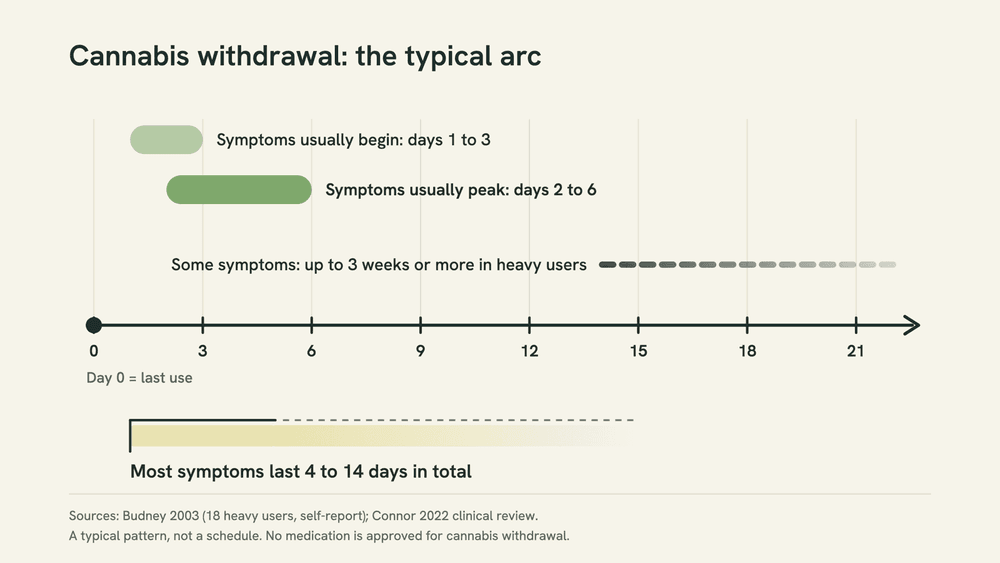
Part of why people search for alternatives at night is withdrawal. NIDA notes that symptoms can follow "stopping or significantly decreasing heavy or long-term cannabis use, even if they don't have cannabis use disorder". A 2022 clinical review estimates that withdrawal occurs in "approximately half of regular and dependent cannabis users", with some symptoms lasting "up to 3 weeks or more" in heavy users. Occasional users rarely notice much; daily, long-term users often do.
The timeline is fairly predictable. In a 2003 study that followed 18 heavy users through 45 days without cannabis, symptoms such as irritability, anxiety, poor sleep and low appetite followed a clear arc:
- 1Days 1 to 3: symptoms usually begin.
- 2Days 2 to 6: symptoms usually peak.
- 3Most symptoms last 4 to 14 days in total.
- 4Some symptoms can linger for up to 3 weeks or more in heavy users, according to the 2022 review.
That study was small and relied on self-report, so treat the days as a typical pattern, not a schedule. No medication is approved for cannabis withdrawal. The arc is a reason a break is hard, not a reason to switch to another substance, and it is why the first two weeks are the time to lean hardest on the non-substance options: plan the evenings, protect your sleep routine, move every day and tell someone what you are doing.
When an alternative is not the answer
Sometimes the search for a substitute is really a sign that cutting back has not worked. NIDA describes cannabis use disorder as use that "leads to clinically significant impairment or distress", with two or more of a set of symptoms within 12 months. NIDA lists these among the criteria clinicians use. Only a professional can assess them, but they are signs worth taking seriously:
- "Persistent desire or unsuccessful efforts to cut down or control cannabis use"
- Craving, or a strong urge to use
- Using more, or for longer, than you meant to
- Use that is causing real problems or distress at work, at home or with your health
This is common and under-treated. In a 2024 analysis of the 2022 US national drug use survey, 30.3% of people who used cannabis in the past year met the criteria for cannabis use disorder, and only 16.5% of those received any treatment. The Lower-Risk Cannabis Use Guidelines put the threshold plainly: people whose "own attempts to control or substantially reduce their cannabis use fail, should seek professional assessment and care". NIDA's cannabis page lists the SAMHSA National Helpline and the 988 crisis line, and FindTreatment.gov is the federal site for finding treatment services.
Frequently asked questions
No plant reproduces THC's effects without risks of its own. The natural options with research behind them replace a job rather than a molecule: exercise, a sleep routine or CBT for insomnia, and structured help. That research is mixed or low-certainty. Botanicals sold as natural substitutes, such as kratom, kava, kanna, salvia and nutmeg, each carry their own risk record.
Some products are sold that way, but none is a low-risk version of cannabis. Hemp-derived THC is THC, and the federal hemp definition will tighten on December 11, 2026, when a total-THC test and a 0.4 mg per container cap take effect. Kratom is not federally scheduled, but FDA warns consumers not to use it. Salvia is not federally controlled, but 12 of the 16 state codes we checked schedule it. Synthetic cannabinoids are Schedule I and have the worst record of all.
Not as a replacement for a high. In a study of 31 frequent cannabis users, CBD doses up to 800 mg were placebo-like on every measure. A 2025 Cochrane review calls research on prescription-grade CBD for cannabis use disorder experimental, and that research does not show that a CBD product helps anyone cut back. Full-spectrum products also contain trace THC.
Kratom is not a cannabinoid and does not do what weed does: NIDA reports stimulant-like effects and effects similar to opioids and sedatives. FDA warns consumers not to use it because of the risk of liver toxicity, seizures and substance use disorder. DEA proposed temporary controls on the related compound 7-OH on October 14, 2026; as of November 26, 2026, no order has been published.
Some will. Delta-8 can trigger a standard THC screen, hemp-derived delta-9 is THC, and full-spectrum CBD carries a residual risk because of trace THC. Nothing on this page is a reliable way to pass a test, and no product can guarantee a result.
Behavioral approaches have the best support, though the certainty is low: NIDA says CBT, motivational enhancement therapy and contingency management can be effective, and there is no FDA-approved medication for cannabis use disorder. Exercise trials are mixed, and a 2026 controlled trial found aerobic cycling no better than stretching. If your own attempts keep failing, the Lower-Risk Cannabis Use Guidelines say to seek professional assessment and care.
In a study of 18 heavy users, symptoms usually began within 1 to 3 days, peaked between days 2 and 6 and mostly lasted 4 to 14 days. A 2022 clinical review notes that some symptoms can last up to 3 weeks or more in heavy users. No medication is approved for cannabis withdrawal.
If you are looking for an alternative to weed because you want to use less, the most useful next step on this site is our practical plan for using less cannabis, built on the Lower-Risk Cannabis Use Guidelines. If cutting back has not worked, the help resources above are the better next step. This page is educational and is not medical or legal advice.
Writing about hemp, wellness and the small rituals that keep us balanced.