
Prenatal Cannabis and Tobacco: What a 79-Study Review Found
A 79-study review published November 13, 2026 found small-for-gestational-age and low birth weight links to prenatal cannabis held when smoking was balanced, while preterm birth and NICU links lost significance. Every result is very low certainty.

A systematic review published on November 13, 2026 in BMJ Paediatrics Open pooled 79 observational studies of prenatal cannabis exposure and newborn outcomes, the most studies of any review so far. It went after the question every earlier review has argued about: how much of the link with poor newborn outcomes travels with cigarettes? The answer was split. When both groups smoked tobacco at similar rates, small-for-gestational-age births and low birth weight stayed associated with cannabis exposure, while preterm birth and NICU admission were no longer statistically significant. The authors rate every result very low certainty.
Here is the short version. In the new meta-analysis by Sainz, Marchand and colleagues, the wider the gap in tobacco smoking between the cannabis group and the comparison group, the stronger the association with poor newborn outcomes looked. In studies where the two groups smoked at similar rates, preterm birth and admission to a neonatal intensive care unit (NICU) were no longer significantly increased. But small for gestational age (a baby smaller than expected for the number of weeks of pregnancy) and low birth weight still were. Perinatal mortality, meaning deaths around the time of birth, was the one outcome whose association did not track smoking at all, though too few balanced studies measured it to say more. None of this is about CBD products, and none of it shows that cannabis use in pregnancy is safe.
What the review did
The paper is titled "Prenatal cannabis exposure and adverse neonatal outcomes: a systematic review and meta-analysis with meta-regression on tobacco co-use." It appeared in BMJ Paediatrics Open (volume 10, article e004876; doi 10.1136/bmjpo-2026-004876) after being received in April 2026 and accepted on October 13. The first author, Sainz, works in neonatology at Dartmouth Hitchcock; the senior author, Marchand, is with the Marchand Institute in Mesa, Arizona, and the team includes researchers at Fayoum University. The protocol was registered on PROSPERO, the international registry for systematic reviews, as CRD420251065325, and amended on September 21 and 30, 2026. The team searched eight databases through September 20, 2026, with no language restriction, and included only observational studies. As they put it, "Randomised trials were excluded on ethical grounds." The authors declare no competing interests and no specific funding, and the paper is open access.
Two of those numbers need a footnote. The 18.2 million is an upper bound: the authors count each cohort once, but note that a national administrative sample covering 1999 to 2013 overlaps a California registry, so some pregnancies may appear twice. And only about 180,000 of them were exposed to cannabis. Exposure was confirmed with a biological test in 39 studies, taken from self-report in 35 and from a diagnostic code in 5. Sixty-one studies reported tobacco use in both the cannabis and the comparison group, which is what made the central analysis possible. One more flag: that central analysis, built on the tobacco gap described below, was specified after the review began, and the authors label it post-hoc. That does not make it wrong, but it was not part of the original plan.
Why tobacco has muddied every answer
Tobacco is the obvious confounder here, meaning a third factor that could create or exaggerate a link. The review notes that between half and nine-tenths of pregnant people who use cannabis also use tobacco, and calls maternal smoking "among the strongest modifiable causes of fetal growth restriction and perinatal death." The CDC's page on cigarettes and reproductive health is just as direct: "Smoking slows a baby's growth before birth," and pregnant women who smoke are at greater risk of stillbirth and of delivering before 37 weeks. If people who use cannabis in pregnancy also smoke cigarettes more often than the people they are compared with, part of what looks like a cannabis association could be a cigarette association.
Most source studies try to handle this by adjusting for tobacco. The authors' critique is that the adjustment is usually crude: tobacco is often recorded once, as a yes-or-no, ever-or-never variable that cannot capture how much someone smoked or when. An association that survives adjustment for a blunt variable like that is weaker evidence than it sounds. So instead of leaning on each study's adjustment, the team pooled the unadjusted results and asked a different question of every study: how big was the gap in tobacco use between the cannabis arm and the comparison arm? A study where both groups smoke at similar rates is not confounded by smoking, however much they smoke. A study where the cannabis group smokes far more is.
That gap turned out to matter for four outcomes. For each 10-percentage-point widening of the tobacco gap, the pooled risk ratio rose by a factor of 1.12 for small for gestational age, 1.15 for low birth weight, 1.11 for preterm birth and 1.16 for NICU admission, and birth weight fell by a further 31 g. The gap accounted for 59%, 43%, 32% and 50% of the between-study variance for those four outcomes, and 24% for birth weight. Read that carefully: it is a share of how much the studies disagreed with each other, not a share of the risk. The pattern held when study size was added to the model and when studies were dropped one at a time. The older approach, which looked only at how common smoking was in the cannabis arm, explained less and behaved inconsistently (it explained 38% for small for gestational age but only 9% for preterm birth, and nothing significant for low birth weight), which helps explain why earlier reviews missed the pattern.
Cannabis in pregnancy: the result, outcome by outcome
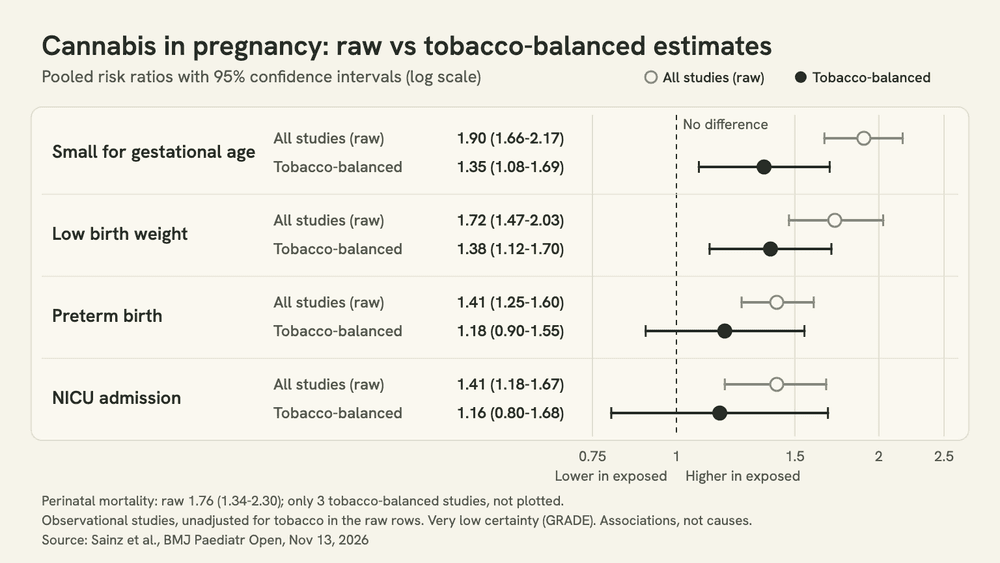
Before any tobacco analysis, the raw pooled numbers looked like this. Cannabis exposure was associated with a risk ratio of 1.90 for small for gestational age (95% confidence interval 1.66 to 2.17, 33 studies), 1.72 for low birth weight (1.47 to 2.03, 35 studies), 1.76 for perinatal mortality (1.34 to 2.30, 18 studies), and 1.41 for both preterm birth (1.25 to 1.60, 48 studies) and NICU admission (1.18 to 1.67, 28 studies). Average birth weight was 166 g lower. A risk ratio of 1.90 means the outcome was 1.9 times as common in the exposed group; the confidence interval is the range of values the data are compatible with, and when it crosses 1.0 the difference is not statistically significant. Heterogeneity, the degree to which studies disagreed, was high, with I² values from 74% to 98%. The table puts the raw numbers beside what happened once tobacco was taken into account.
| Outcome | Raw risk ratio (studies) | Raw per 1,000: unexposed vs exposed | Tobacco-balanced studies | Lab-verified exposure | Tracked the tobacco gap? |
|---|---|---|---|---|---|
| Small for gestational age | 1.90 (33) | 81 vs about 154 | 1.35 (1.08-1.69), still raised | 1.79 (1.54-2.07), raised | Yes, 59% of between-study variance |
| Low birth weight | 1.72 (35) | 37 vs about 63 | 1.38 (1.12-1.70), still raised | 1.66 (1.41-1.95), raised | Yes, 43% |
| Preterm birth | 1.41 (48) | 68 vs about 96 | 1.18 (0.90-1.55), not significant, 6 studies | 1.32 (1.10-1.59), raised | Yes, 32% |
| NICU admission | 1.41 (28) | 92 vs about 130 | 1.16 (0.80-1.68), not significant, 10 studies | 1.25 (1.11-1.42), raised | Yes, 50% |
| Perinatal mortality | 1.76 (18) | 5.2 vs about 9.1 | Too few studies (3) to interpret | Not reported in this split | No (p = 0.21) |
The per-1,000 column is the most honest scale in the paper, and it comes with one caveat. In the full paper's certainty-of-evidence table (the paper is open access as PMC13775691), about 154 of every 1,000 exposed babies were small for gestational age, against about 81 of every 1,000 unexposed babies, and perinatal deaths were about 9.1 per 1,000 against 5.2. The unexposed figure is the pooled rate in the comparison groups. Those absolute figures come from the unadjusted risk ratios, so they include whatever tobacco contributes. Treat them as a ceiling, not as the cannabis-only excess. The review also found, on average, gestational age 0.18 weeks shorter, birth length 0.90 cm shorter and head circumference 0.34 cm smaller in exposed babies.
What held up, and what that does and does not mean
Fetal growth is where the association held. In the tobacco-balanced studies, those in which the two groups' smoking rates were within 10 percentage points of each other, small for gestational age (1.35, 1.08 to 1.69) and low birth weight (1.38, 1.12 to 1.70) stayed significantly raised, though well below the 2.00 and 1.79 seen in the other studies. Average birth weight in the balanced studies was 93 g lower, with an interval running from 209 g lower to 24 g higher, so that shift was not significant (against 154 g lower in the rest). The authors' reading: "Restricted fetal growth is therefore the association that withstands tobacco control, and it does so as the proportion of infants born small rather than as the group mean." Put simply, more exposed babies fell into the small category, even though the shift in average weight was not clear-cut.
Preterm birth and NICU admission went the other way. In the balanced studies their risk ratios fell to 1.18 (0.90 to 1.55, 6 studies) and 1.16 (0.80 to 1.68, 10 studies), against 1.46 and 1.50 in the rest. Both intervals cross 1.0, so neither is statistically significant, and both are wide. Of the balanced-versus-unbalanced contrasts, only the one for small for gestational age was significant on its own (p = 0.03). Perinatal mortality is the odd one out. Its association did not rise with the tobacco gap (p = 0.21), so the authors conclude tobacco does not account for it. But only three balanced studies reported it, too few to confirm or rule out an excess directly.
The 39 studies that confirmed cannabis exposure with a biological test answer a different worry: that people under-report cannabis use, blurring the line between exposed and unexposed groups. In those studies, low birth weight (1.66, 1.41 to 1.95), small for gestational age (1.79, 1.54 to 2.07), preterm birth (1.32, 1.10 to 1.59) and NICU admission (1.25, 1.11 to 1.42) all stayed raised, and birth weight was 176 g lower. The authors conclude that for the growth outcomes, "neither is an artefact of under-reporting." These studies were not balanced for tobacco, though, and the authors are explicit that the verified-exposure results "say nothing about tobacco."
How this compares with the 2025 JAMA Pediatrics review
The review this one most directly disagrees with is a 2025 JAMA Pediatrics meta-analysis by Lo, Ayers, Yeddala and colleagues, published online May 5, 2025. It pooled 51 studies with 21,146,938 participants, searched through April 2024, and combined each study's adjusted estimates, meaning results the source authors had already adjusted for confounders such as tobacco co-use. Its adjusted odds ratios were 1.75 for low birth weight, 1.52 for preterm birth and 1.57 for small for gestational age, and its authors raised their confidence in those three from low to moderate because the associations survived adjustment. Perinatal mortality (1.29) stayed at low certainty. So Lo 2025 had more participants and the 2026 review has more studies, which is why we describe the new paper as the largest review by number of studies, not the largest overall. The 2026 authors also do not claim the numbers clash: "Our estimates are of the same order, so the disagreement is about what surviving adjustment shows."
| Review | Studies (participants) | How tobacco was handled | What it found on tobacco | Certainty |
|---|---|---|---|---|
| Conner 2016, Obstet Gynecol | 31 | Pooled tobacco-adjusted estimates | After adjustment, low birth weight 1.16 and preterm 1.08, not significant | Not GRADE-rated in the abstract |
| Marchand 2022, JAMA Netw Open | 16 (59,138) | Unadjusted pooling | Seven outcomes raised; discussion said tobacco could be confidently excluded | Not stated in the abstract |
| Lo 2025, JAMA Pediatr | 51 (21.1 million) | Pooled source-study adjusted odds ratios | Low birth weight 1.75, preterm 1.52, SGA 1.57 survived adjustment | Moderate (3 outcomes); low (mortality) |
| Bailey 2025, Matern Child Health J | 13 | Studies at high risk of bias excluded | SGA and low birth weight significant; preterm and NICU inconclusive | Not stated in the abstract |
| Sainz 2026, BMJ Paediatr Open | 79 (up to about 18.2 million; about 180,000 exposed) | Meta-regression on the between-arm tobacco gap; balanced studies pooled separately | Preterm and NICU not significant when balanced; SGA and low birth weight held; mortality showed no gradient | Very low (all outcomes) |
Why can the same associations earn moderate certainty in one review and very low in another? The new review tested the adjustment argument directly. Fifteen studies reported both an unadjusted and an adjusted estimate for the same outcome, 41 pairs in all. After four pairs that were not on the harmful side of the null were set aside, the remaining 37 pooled to a ratio of risk ratios of 0.78 (0.71 to 0.86). In plain terms: inside the same studies, adjusting for smoking and other factors moved the risk ratio down by about a fifth. Across the 31 pairs where it could be computed, the median reduction on the log scale was 55%, and individual pairs ranged anywhere from strengthening the association to erasing it. Only five pairs, from two studies, differed by the tobacco term alone, and those pooled to 0.89 (0.80 to 0.996). So 0.78 is not "the tobacco effect." The authors say it measures "whatever separates the two models."
This argument has swung before. A 2016 Obstetrics & Gynecology meta-analysis by Conner and colleagues pooled 31 studies and found that unadjusted risk ratios for low birth weight (1.43) and preterm birth (1.32) were no longer significant after adjustment for tobacco and other confounders (1.16 and 1.08), and concluded that maternal marijuana use was "not an independent risk factor." Then a 2022 JAMA Network Open review led by Marchand, the same senior author as the new paper, pooled 16 studies and 59,138 patients, found low birth weight (2.06), small for gestational age (1.61), preterm birth (1.28) and NICU admission (1.38) all raised, and wrote that newer data "afford us robust enough numbers to confidently exclude tobacco as a confounding factor." The 2026 paper, from the same group, now concludes: "Much of that association is attributable to tobacco." A research team revising its own earlier reading in print is the clearest sign of what actually changed. In between, a smaller 2025 meta-analysis of 13 studies in the Maternal and Child Health Journal had found significant associations for small for gestational age and low birth weight but inconclusive ones for preterm birth and NICU admission.

What did not change
A new pooled analysis shifts the picture at the edges, and most of the rest stays where it was. Professional guidance has not moved. ACOG Clinical Consensus No. 10 on cannabis use during pregnancy and lactation, published in Obstetrics & Gynecology in October 2025 and replacing the 2017 Committee Opinion 722, says clinicians "should advise cessation of cannabis use during pregnancy and lactation" and that "there are no medical indications for cannabis use during pregnancy and the postpartum period." It also says that "continued cannabis use is not a contraindication to breastfeeding, and breastfeeding should not be discouraged." And the FDA's consumer guidance on cannabis and CBD in pregnancy and breastfeeding, current as of October 16, 2019, "strongly advises against the use of cannabidiol (CBD), tetrahydrocannabinol (THC), and marijuana in any form during pregnancy or while breastfeeding."
- The fetal growth associations (small for gestational age, low birth weight) remain, including in studies with lab-verified exposure.
- Nothing in the review says cannabis use in pregnancy is safe or harmless.
- No randomized trial exists or could ethically be run, so causation cannot be tested directly. Every finding here is an association.
- ACOG's and the FDA's positions on cannabis in pregnancy are the same as before the paper.
- Hospital newborn testing and reporting rules depend on hospital policy and state law, and this paper did not change them.
- The exposure studied was cannabis, not CBD products and not hemp foods.
On that last point: the exposure in these studies was cannabis, measured mostly by self-report or by tests for THC metabolites, and the paper tested no CBD product. Our side-by-side of how CBD and THC differ explains why one cannot stand in for the other in a finding like this, and hemp seeds are a separate question again, covered in our look at eating hemp seeds while pregnant. The evidence and official positions specific to CBD live in our evergreen guide to CBD during pregnancy and breastfeeding. And if your question is whether a hospital will test a newborn, that is set by hospital policy and state law, not by this paper; we cover it in how newborn drug testing works in hospitals.
The limits the authors put on their own work
- Heterogeneity was high, with I² from 74% to 98%: the studies disagreed a lot.
- About half the studies relied on self-reported cannabis use.
- Residual confounding by socioeconomic factors and other substances is possible.
- The tobacco-gap analysis is ecological, done at the level of whole studies rather than individuals, and in the authors' words the covariate can stand in for anything that travels with it.
- Few studies reported dose, timing or potency.
- Seven reports could not be retrieved, and some national datasets overlap.
- Most studies came from high-income North American and European settings.
- Odds ratios were pooled as approximations of risk ratios.
One check pointed in an uncomfortable direction. Trim-and-fill, a method that estimates what missing small studies might look like, raised the preterm estimate to 1.52, NICU admission to 1.50 and perinatal mortality to 1.85, and found no sign of missing studies for low birth weight or small for gestational age. If studies are missing, the missing ones would push the preterm and mortality estimates up, not down. The authors are also clear about the ceiling of their method: "The proportion of the remaining association that tobacco causes cannot be determined from study-level data." Every outcome started at low certainty because the studies are observational, then was downgraded to very low for residual tobacco confounding and inconsistency, with no upgrades.
“Counselling should address both substances.”
That is the authors' practical line, and it is written for clinicians. They add that "Counselling for cannabis abstinence remains appropriate" and that "certainty remains very low and further evidence is needed." We are not telling you to start, continue or stop anything; that conversation belongs with your own clinician, who knows your history. For how we read pooled observational studies more generally, our recent report on a meta-analysis of cannabis and sperm quality ran into many of the same limits.
Questions readers are asking
Partly. The gap in smoking between groups tracked a large share of the differences between studies, and in tobacco-balanced studies preterm birth and NICU admission were no longer significantly increased. But small for gestational age and low birth weight stayed raised. The authors write that the share of the remaining association that tobacco causes cannot be determined from study-level data.
The data are associations from observational studies, rated very low certainty, so they cannot show cause. Low birth weight and small-for-gestational-age births remained associated with cannabis exposure in tobacco-balanced studies and in studies that verified exposure with a lab test. No randomized trial exists or could ethically be run.
A baby who is smaller than expected for the number of weeks of pregnancy, typically below the 10th centile for that age, as the review defined it. It differs from low birth weight (under 2,500 g), which can also reflect being born early.
The 2025 JAMA Pediatrics review pooled estimates already adjusted for tobacco and raised certainty because the associations survived. The 2026 review argues that adjustment was mostly a crude ever-or-never variable, and found the associations tracked the tobacco gap. Its authors say the estimates are of the same order; the disagreement is about what surviving adjustment shows.
No. The exposure was cannabis, measured mostly by self-report or THC-metabolite tests, and the paper tested no CBD product. The FDA's 2019 consumer guidance advises against CBD, THC and marijuana in any form during pregnancy and breastfeeding, and our evergreen guide covers the CBD-specific evidence.
That depends on hospital policy and state law, not on this paper. ACOG Clinical Consensus No. 10 says biologic drug testing should not be used as a screening assessment and that consent should be obtained. Our guide to newborn drug testing explains how the process usually works.
This review cannot say. The authors note that few of the included studies reported dose, timing or potency, so it gives no answer on trimester, frequency or product strength.
For the questions this news item does not cover, including what is and is not known about CBD itself during pregnancy and breastfeeding, the next read is our full guide to CBD, pregnancy and breastfeeding. If you want to talk a specific situation through with a specialist, MotherToBaby's free ask-an-expert service answers questions about exposures in pregnancy and breastfeeding by phone at 866.626.6847 or by text at 855.999.3525.
Writing about hemp, wellness and the small rituals that keep us balanced.