323 THC Drinks at Alcohol Retailers vs the 0.4 mg Limit
Researchers counted 323 canned THC drinks from 142 brands listed by six US online alcohol retailers in late 2025, averaging 7.4 mg of listed THC per can. What the study shows, what it cannot, and how those numbers sit against the 0.4 mg limit scheduled for December 11, 2026.
Researchers counted 323 different canned THC drinks listed for sale by six US online alcohol retailers in late 2025, from 142 brands, at an average of 7.4 mg of listed THC per can. The study was published online on November 26, 2026 in the journal Addiction, 15 days before a federal limit of 0.4 mg of total THC per container is scheduled to apply. By our arithmetic, even the lowest-listed can in the dataset listed 3.75 times that figure.
If you have a THC seltzer in your fridge that came from a liquor store, this is the first peer-reviewed count we have found of what established alcohol retailers were actually offering. The paper, a survey by LoParco and colleagues of THC beverages sold by online alcohol retailers, recorded what product listings said; the abstract describes no purchases and no lab testing. It describes October to December 2025, not today. And it does not rule on whether any product is legal. The full text sits behind a paywall (doi:10.1111/add.70726), so every study figure below comes from the published abstract and the PubMed record, and we flag the gaps where they matter.
What the study counted: THC drinks at online alcohol retailers
Between October and December 2025, the team searched the websites of eight US alcohol retailers. They picked them on purpose to differ in two ways: whether the state controls alcohol sales, and how the state treats cannabis and hemp-derived cannabis products. One national retail chain was also included. Searches ran in an incognito browser window using five terms: "delta", "thc", "tetrahydrocannabinol", "cbd" and "hemp". A PhD-level researcher then coded each listing for brand, THC content, package size, container size, price, and whether it listed other cannabinoids or so-called functional ingredients. The abstract does not name the retailers or their states.
| Format | Retailers listing it | Products | Brands | Listed THC, mean (range) | Price, mean (range) | Price per mg THC, mean (range) |
|---|---|---|---|---|---|---|
| Cans | 6 | 323 | 142 | 7.4 mg (1.5-20 mg) | $21.36 per package ($4.99-$54.99) | $0.74 ($0.25-$2.90) |
| Shots | 3 | 25 | 15 | 7.36 mg (2-10 mg) | $4.59 ($1.50-$7.49) | $0.71 ($0.30-$2.00) |
| Spirits | 2 | 24 | 12 | Mostly not listed | $34.49 ($21.99-$64.99) | Cannot be calculated |
Two details in that table are easy to misread. First, the can price is per package, and the abstract does not say how many cans a package held, so you cannot turn $21.36 into a price per can. The price-per-milligram column avoids that problem, which makes it the fairer comparison: listed THC in cans and in shots cost about the same, roughly 71 to 74 cents per milligram on average. Second, the spirits row. Most of those 24 products did not list how much THC they held, so they cannot be set against any milligram figure, including the federal one below. Put that row aside when you read the arithmetic.
The two retailers that listed none
Two of the eight retailers were state-owned and operated liquor store chains, and neither listed a single THC beverage. The other six all listed cans; three also listed shots and two listed spirits. The abstract reports the zero without explaining it, and we will not guess at a reason. What we can say is that the sample was chosen to cover retailers in states with different alcohol control systems and different cannabis laws, so it was set up to surface differences like this one. Some context: the jurisdictions where government controls alcohol sales directly are home to about 24.7% of the US population, and 13 of them also control retail sales for off-premises drinking through government-operated stores or designated agents, according to the National Alcohol Beverage Control Association, the trade group for those state agencies. Whether a store near you can carry a THC drink is a state question first, and our guide to how federal and state rules stack up for THC beverages shows you how to look up yours.
How every listed can compares with the December 11 limit
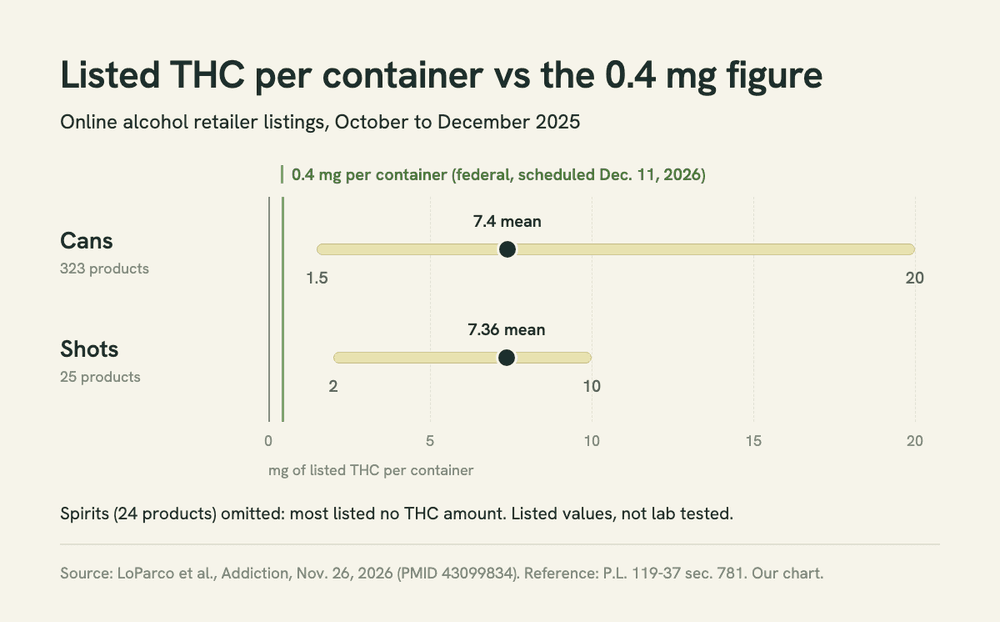
Here is the federal figure the study's numbers run into. Section 781 of Public Law 119-37, the November 2025 law that rewrote the federal definition of hemp, takes a finished hemp-derived cannabinoid product out of the definition of hemp if it holds more than 0.4 milligrams per container of total THC combined with other cannabinoids that have similar effects. The law defines a container as the innermost wrapping, packaging or vessel in direct contact with the product, "such as a jar, bottle, bag, box, packet, can, carton, or cartridge." A can is named. The timing is split. Under Public Law 119-103, section 2019, only the piece covering cannabinoids not capable of being naturally produced by the plant applied from November 12, 2026. As of November 29, 2026, the 0.4 mg per container limit is scheduled to apply from December 11, 2026, and no law passed since has changed that date. Our explainer on why the hemp rules arrive on two different dates walks through both, and our breakdown of the section 781 rewrite covers the rest of the new definition.
| Item in the dataset | Listed THC | Times the 0.4 mg figure (our arithmetic) |
|---|---|---|
| Lowest-listed can | 1.5 mg | 3.75x |
| Average can | 7.4 mg | 18.5x |
| Highest-listed can | 20 mg | 50x |
| Lowest-listed shot | 2 mg | 5x |
| Average shot | 7.36 mg | 18.4x |
| Highest-listed shot | 10 mg | 25x |
| Spirits | Mostly not listed | Cannot be calculated |
So the plain reading is this: every one of the 323 cans in this late-2025 dataset listed more THC than 0.4 mg, because the lowest listing was 1.5 mg. That is a statement about those listings, not about the can in your fridge today. The researchers have also written about how drinks like these fit under the older federal test, which measured hemp by delta-9 THC concentration on a dry weight basis, 0.3%. In a 2024 commentary in the same journal, all four of this study's authors and a fifth colleague pointed out that liquid is heavy, so a drink can hold a lot of THC and still sit under a percentage-by-weight test. They also noted brands selling multi-serving cans and argued that policies should set THC limits per fluid ounce. For finished products, the per-container milligram cap works differently: the weight of the liquid does not enter that calculation, only the milligrams in the can. Our guide to total THC and the difference between a serving and a package shows why that distinction changes the math.
What a listing count cannot tell you
| What the study counted | What it did not measure |
|---|---|
| THC amounts as listed on retailer product pages | THC measured by a lab in the actual drink |
| Online listings at eight alcohol retailers | What sat on physical store shelves |
| October to December 2025 | What is for sale today, after November 12, 2026 |
| Alcohol retailers | Dispensaries, gas stations, convenience stores or brand websites |
| How many milligrams of THC a listing gave | Which form of THC: the abstract does not say delta-9, delta-8 or other |
| Milligrams per can, as listed | Servings per can or per-serving figures, which the abstract does not report |
The label-versus-lab gap is the one with a track record. This study, as its abstract describes it, tested no drinks, but other researchers have tested drinks in other markets. A 2024 critical review of 29 studies on cannabis beverages notes that Canada sets no standard drink size, with products there running from 30 mL shots to more than 500 mL. It also tabulated earlier US label testing in which 61.5% of 13 dispensary beverages were over-labeled, meaning they held less THC than the label said, and 15.4% held more. Those were mostly dispensary and Canadian products, not hemp cans from alcohol retailers, and the review itself notes a "paucity and inconsistency of available research." The lesson is narrow but useful: a printed milligram number is a claim, and a certificate of analysis is how you check it. Our guide to reading a certificate of analysis line by line shows where the THC figure sits, our piece on why a printed potency number is not the whole story explains the gaps, and what a 10 mg figure on a label actually tells you puts milligram numbers in plain terms.
The extras on the ingredient list
THC was not the only thing on these labels. Across all products, more than 30% listed non-intoxicating cannabinoids, and a few listed added ingredients that are often marketed for "functional" effects. The abstract does not say how many "a few" means, so we will not put a number on it. Here is what it names:
- Other cannabinoids, listed by more than 30% of products: CBD, CBG, CBN and CBC.
- Mushrooms: lion's mane, reishi and cordyceps.
- Plants and plant extracts: blue lotus, maca, rhodiola and chamomile.
- Other add-ins: caffeine, L-theanine, tryptophan, melatonin, magnesium and electrolytes.
We are listing these, not recommending them. The abstract makes no claim about what any of these add-ins do in a THC drink, and neither do we. What is worth knowing is simply that a THC can may list more than THC, so the full ingredient panel deserves a read before you open one, especially if it names caffeine or melatonin. One of the add-ins, blue lotus, has its own regulatory story, which we cover in our look at whether blue lotus is legal.
What did not change
- The federal dates. As of November 29, 2026, the 0.4 mg per container limit is scheduled to apply from December 11, 2026. Congress can still change that; this study does not.
- The FDA's position. The agency still answers "No" to whether a food with added THC or CBD can be sold in interstate commerce.
- State law. States still decide whether and where these drinks may be sold, so the answer can differ from one state to the next.
- The timeframe. The data are a late-2025 snapshot of online listings, not a measure of what is on shelves today.
- The alcohol warning. Drinking THC and alcohol together is still the combination we advise against.
On the federal side, the Congressional Research Service's September 2026 update on the hemp definition confirms the delay to December 11, 2026 and notes that, as of September 28, the list of cannabinoids with similar effects had not been published; we found none in the Federal Register as of November 29. A bill introduced November 17, S. 5736, would rewrite this definition; as of November 29 it sits in committee and has not passed either chamber. On the FDA side, the agency's Q&A on cannabis and cannabis-derived products answers "No" when asked whether a food with added THC or CBD can be sold across state lines. That is the guidance the study's authors point to when they write that these drinks have spread "despite Food and Drug Administration guidance indicating they are being sold unlawfully." It is agency guidance, not a court ruling, and it does not decide the status of any single product. Our summary of where the FDA stands on cannabinoids in food and drinks has the fuller picture.
The alcohol point deserves more than one line, because these drinks were listed by the same stores that sell beer and wine. In an on-road driving study of 18 adults, THC combined with a low level of alcohol, a blood alcohol concentration of about 0.04%, "dramatically impaired driving performance," more than either did alone. The study was small and used smoked THC, not a drink, so treat it as a warning sign rather than a precise measure. Our guide to being crossfaded covers what is known about mixing the two.
Who did the study, and its limits
The authors are C. R. LoParco, K. K. Tillett, M. E. Rossheim and C. J. Berg. LoParco and Berg are in the Department of Prevention and Community Health at the Milken Institute School of Public Health, George Washington University (Berg is also with the GW Cancer Center). Tillett and Rossheim are in the Department of Health Administration and Health Policy at the University of North Texas Health Science Center. The work was funded by a National Institute on Drug Abuse career award to the lead author (K01DA061973), for a project on how marketing of derived psychoactive cannabis products shapes perceptions and use among young adults. The manuscript was received February 27, 2026, accepted October 28 and published online November 26. We could not read the paper's conflict-of-interest declarations, which are in the paywalled full text. The authors close with an interpretation, not a measured result:
“The accessibility of THC beverages in the United States through established alcohol retailers may facilitate normalization and market expansion.”
Notice the verb. "May facilitate" is a hypothesis the authors raise; the study counted listings and did not measure normalization or market growth. Here are the limits a careful reader should keep in mind, from the abstract's own description of the method:
- Eight retailers, online only. Physical stores and other kinds of sellers were not part of the count.
- One coder. A single researcher recorded the listings; the abstract describes no second coder or agreement check.
- Listings, not lab tests. Every THC figure is what a product page said.
- A late-2025 snapshot, collected before any part of the new federal hemp definition took effect.
- Unnamed retailers and states, and no detail on which form of THC the listings meant.
- Abstract only, on our side. The paper's own limitations section and declarations were not available to us.
Frequently asked questions
It depends on the state. In this study, six of eight online alcohol retailers listed THC drinks in late 2025, and the two state-run liquor chains listed none. State rules come first; federal law and FDA guidance add separate layers on top.
In this dataset, listed amounts ran from 1.5 to 20 mg per can, with a mean of 7.4 mg. Those are label figures. Testing in other markets has found drinks that held less, and sometimes more, THC than printed, so a lab certificate of analysis is the way to check a specific product.
Per container. The statute defines a container as the innermost wrapping, packaging or vessel in direct contact with the product and names a can as an example, so on the statute's text a canned drink is read against each can, not the whole pack. The law also directed FDA to publish more information on the term; the Congressional Research Service reported it had not done so as of September 28, 2026.
As of November 29, 2026, the federal 0.4 mg of total THC per container limit is scheduled to apply from that date. Congress can still change it, and states have their own rules. This study does not predict what any brand or retailer does next, and it is not a verdict on any product.
They point to FDA guidance. The FDA's Q&A answers "No" to whether a food with added THC or CBD can be sold in interstate commerce. That is the agency's stated position, not a court ruling on any specific drink.
We advise against it. In a small on-road study, THC combined with a low level of alcohol impaired driving more than either alone. Do not drive after either, and keep both away from anyone under 21.
The study does not explain pricing. It reports price per listed milligram of THC: a mean of $0.74 for cans and $0.71 for shots, with shots listed for as little as $1.50. Remember that listed milligrams are not tested milligrams.
If you are holding a THC drink and wondering where it stands after December 11, start with our state-by-state method for checking whether THC drinks are legal where you live, then use our guide to reading a hemp drink can to find the per-container THC figure on the label. We will update this report if the federal date moves or if we are able to read the full paper.
Writing about hemp, wellness and the small rituals that keep us balanced.