THC vs Alcohol in a Driving Simulator: Different, Not Zero
A Kentucky study published November 21, 2026 tested inhaled THC and, on separate days, alcohol in a driving simulator with nine near-daily cannabis users. Alcohol hit lane control; THC changed braking and lowered confidence. Small and preliminary.
On November 21, 2026, a University of Kentucky team published a placebo-controlled study that put nine near-daily cannabis users in a driving simulator after inhaled THC and, on a separate day, after an intoxicating dose of alcohol. The short version: the two drugs impaired different parts of driving. Alcohol hurt lane control. Cannabis changed how hard people braked and the distance they kept. Every active dose also lowered people's confidence in their own driving. In the authors' words, cannabis "did not produce profound alcohol-like driving impairment", but "driving impairment was evident".
If you came here to find out whether driving high is safer than driving drunk, this study does not give you a ranking, and the authors do not offer one. What it gives you is a profile: which driving skills moved under each drug, measured in the same people under the same conditions. That matters, because the wider comparison of how alcohol and cannabis stack up on harm overall tends to get flattened into a single winner. One note on what we read: the full paper sits behind a paywall. This report is based on the published abstract, the paper's declarations and the trial's record on ClinicalTrials.gov. Where the abstract is silent, we say so instead of guessing.
How the Kentucky driving simulator study worked
The paper is a randomized, double-blind, placebo-controlled human laboratory study by first author M. M. Stafford, senior author Shanna Babalonis and five colleagues at the University of Kentucky, published online in Psychopharmacology on November 21, 2026 (doi 10.1007/s00213-026-07202-9). Its title is Inhaled cannabis and oral alcohol: driving performance and subjective driving confidence in a human laboratory study. Nine healthy adults who used cannabis completed it. It was a within-subject design, which means every person went through every condition, so each participant serves as their own comparison. Each person came in for five outpatient sessions and was measured before dosing and for 7.5 hours after:
- Placebo: inactive cannabis and an inactive drink
- 15 mg THC, inhaled
- 30 mg THC, inhaled
- 15 mg THC plus 7.5 mg CBD, inhaled
- Alcohol at 0.8 g per kg of body weight, by mouth (15% less for women)
The design is called double-dummy. In every session, participants received both a cannabis dose and a drink, and at most one of the two was active, so nobody could tell from the routine which drug they had that day. That detail rules out something a quick headline might blur: cannabis and alcohol were never given together. Each drug had its own day. This was not a test of mixing them, a separate question covered in our guide to what happens when you combine alcohol and cannabis. The abstract says the cannabis was inhaled. It does not name a device, so we do not either.
The trial itself is older than the paper. The authors write that it was registered on ClinicalTrials.gov under NCT03699540, and the trial's registry record and posted results show that its main data collection ran from July 2019 to December 2022, with summary results posted in July 2024. Ten people started; nine completed and one was lost to follow-up, which matches the paper's n = 9. Eligible participants were healthy adults aged 21 to 50 with a history of both cannabis and alcohol use, and the nine completers averaged about 33 years old. What is new on November 21, 2026 is the peer-reviewed analysis.
What changed behind the wheel
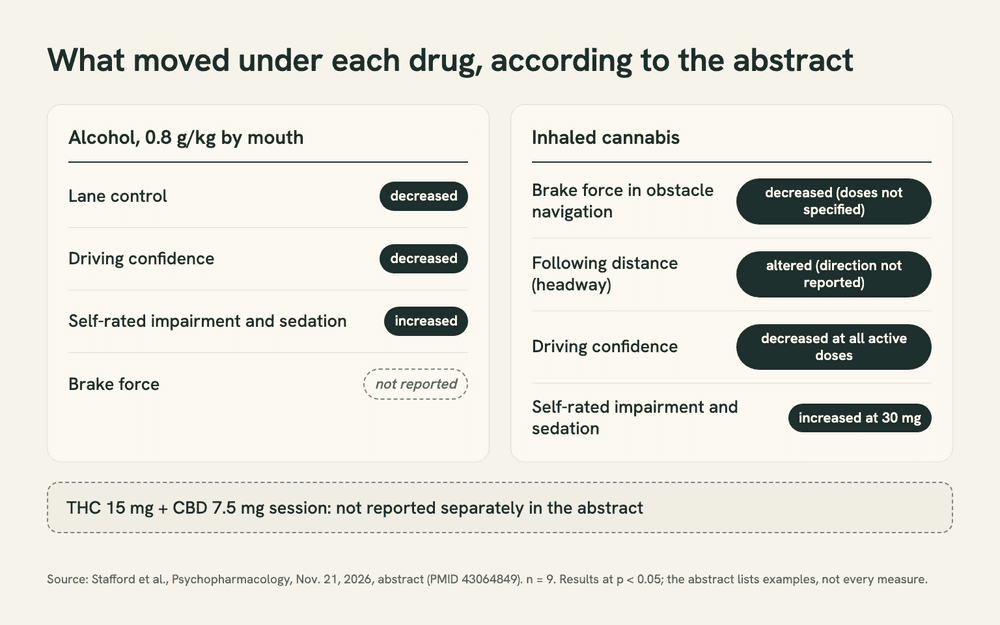
Start with alcohol. The authors describe its effect on simulated driving as robust impairment, including decreased lateral control (p < 0.05). Lateral control is how well you keep the car centered in its lane. Researchers usually measure it as the standard deviation of lateral position, or SDLP, often called lane weaving: the more your position drifts side to side, the higher the number. The abstract does not report the blood alcohol level participants reached, so we cannot tell you how this dose compares with a legal limit.
Cannabis moved different measures. During obstacle navigation in the simulator, it decreased brake force and altered headway distance (p < 0.05). In plain terms, drivers pressed the brake less hard, and they kept a different following distance. The abstract does not say which direction headway moved, and it does not say which THC doses produced those two changes, so we do not assign them to one. It also does not report when the effects wore off. And the abstract introduces several of its results with "e.g.", which tells you the paper measured more outcomes than the abstract names.
Those last two figures come from the summary results posted on ClinicalTrials.gov in 2024, not from the paper, and no statistical tests were posted with them. They line up with the abstract: alcohol's peak lane weaving sat about a third above placebo, while the three cannabis sessions sat within about 7% of it. We print ratios instead of raw values on purpose. The registry's unit label for this measure does not match the scale lane-weaving numbers normally run on, so the raw values are easy to misread and should not be compared with other studies.
“Cannabis did not produce profound alcohol-like driving impairment; however, it was not without risk, and driving impairment was evident.”
Read both halves of that sentence together. The first half is what a headline will take. The second is where the authors chose to land, adding that cannabis impaired driving "even in a sample of near-daily cannabis users": people in whom tolerance might be expected to blunt effects. The authors also open the abstract by noting that cannabis is the most commonly detected drug, second only to alcohol, among crash-involved drivers. Being detected in a driver is not the same as causing a crash, and that gap is exactly why controlled studies like this one are worth having.
What drivers believed about their own driving
The finding most useful for everyday decisions may be the one about confidence. According to the abstract, "All active doses of cannabis and alcohol decreased driving confidence", including participants' willingness to operate a real vehicle (p < 0.05). The same sentence reports higher ratings of abuse potential, with drug liking as its example; researchers use such ratings as a laboratory marker of how appealing a drug's effects are. The abstract reports that the 30 mg THC dose and alcohol increased people's own ratings of impairment and sedation. It does not report that for the 15 mg dose. The registry posted the self-ratings below for each session.
| Session | Self-rated driving difficulty (0-100) | Self-rated drug or alcohol effect (0-100) | Difficulty concentrating (0-4) |
|---|---|---|---|
| Placebo | 7 | 6 | 0.4 |
| THC 15 mg | 34 | 32 | 1.1 |
| THC 30 mg | 41 | 69 | 2.2 |
| THC 15 mg + CBD 7.5 mg | 30 | 38 | 0.8 |
| Alcohol 0.8 g/kg | 72 | 71 | 3.9 |
Why does this matter? A common belief among regular users is "I drive fine high." In this study, the regular users themselves did not fully agree. On placebo, they rated driving difficulty at about 7 out of 100; in the cannabis sessions, at about 30 to 41. Alcohol, at about 72, was rated harder still. Keep two cautions in mind. These are self-ratings, and how hard driving feels is not the same as how well you drive. And the registry posted no statistical tests, so treat the gaps as descriptive. Still, the pattern runs one way: people felt less able to drive after cannabis, and the simulator recorded changes in their braking.
The THC-plus-CBD session
Few driving studies include a session where CBD is added to THC, so this arm will draw attention. Here is exactly what can be said. The abstract does not report the THC-plus-CBD session separately, and the paper's own analysis of it is behind the paywall. The registry's summary figures are the only numbers available. In those, adding 7.5 mg of CBD to 15 mg of THC did not visibly change the picture: self-rated driving difficulty was about 30 of 100, against about 34 for THC alone and 7 on placebo, and peak lane weaving was nearly identical to THC alone. On some measures the combination sat slightly lower than THC alone, on others slightly higher. On the two 0-100 self-rating scales those gaps, about 4 and 6 points, were smaller than the standard errors of about 8 to 11 points. No statistical comparison was posted.
The earlier evidence points the same way. In a 2019 simulator trial of 14 light cannabis users, Arkell and colleagues found that vaporized cannabis with equal amounts of THC and CBD increased lane weaving just as THC-dominant cannabis did, and they wrote that the CBD-equivalent cannabis "appears no less impairing." Our full explainer on what driving trials have measured with CBD, and why CBD does not cancel out THC walks through that research, the blood-test problem and the legal side for CBD-only products.
How it compares with earlier driving trials
Two earlier controlled trials give the new paper context. Besides the 2019 simulator study, the same research group ran a 2020 on-road trial published in JAMA, in which 26 occasional users drove 100 km on public roads in the Netherlands after vaporized cannabis or placebo. Neither earlier trial had an alcohol arm, which is what makes the Kentucky design unusual.
| Study | Participants | Cannabis given | Setting | CBD arm | Alcohol arm | Main driving finding |
|---|---|---|---|---|---|---|
| Arkell et al., Psychopharmacology, 2019 | 14 light users | Vaporized, about 13.75 mg THC with under 1% or 11% CBD, or placebo | Simulator | Yes: equal THC and CBD | No | Both active types increased lane weaving; equal-CBD cannabis "appears no less impairing" |
| Arkell et al., JAMA, 2020 | 26 occasional users | Vaporized: THC-dominant, equal THC and CBD (13.75 mg THC each), CBD-dominant, or placebo | On-road, 100 km | Yes: equal THC and CBD, and CBD-dominant | No | THC-dominant and equal THC/CBD both increased lane weaving; CBD-dominant did not |
| Stafford et al., Psychopharmacology, 2026 | 9 near-daily users (8 men) | Inhaled: 15 or 30 mg THC, 15 mg THC plus 7.5 mg CBD, or placebo | Simulator | Yes, not reported separately in the abstract | Yes: 0.8 g/kg, on its own day | Alcohol impaired lane control; cannabis changed brake force and headway; all active doses lowered confidence |
Set side by side, the three trials show why a small new paper is still worth reading. The earlier trials studied light or occasional users. This one studied near-daily users, whose tolerance might be expected to blunt effects, and it still found changes. It is also the only one of the three to put an intoxicating alcohol dose next to THC in the same people, which is what lets it describe a different profile instead of a bigger or smaller one.
What this study does not tell you
- It is small. Nine people completed it, and the placebo session in the registry results has eight.
- Eight of the nine were men, so it says almost nothing about women. The 15% lower alcohol dose for women applied to one of the nine completers.
- Participants used cannabis nearly every day. Occasional users may be affected differently.
- It was a simulator, not a road, and each condition was a single session.
- THC was inhaled. Edibles start later and last longer, so these results cannot be assumed to apply to them.
- Cannabis and alcohol were never combined.
- The abstract does not report peak blood alcohol, blood THC, when effects wore off, or which simulator measures did not change.
- The registry's prespecified primary outcome was lane weaving. The braking and following-distance results come from the paper's wider simulator measures.
- We read the abstract, the declarations and the registry, not the full paper.
- It is not a guide to a safe dose or a safe wait before driving.
Two of those limits deserve a closer look. Route changes timing a great deal: our guide to how long a cannabis high lasts by route explains why an edible behaves so differently from inhaled cannabis. And how often you use changes how THC feels: in a UCLA trial that compared frequent and occasional users, frequent users had more THC in their blood at one strength, yet only occasional users showed sedation above placebo. That was a single-session, exploratory finding, but it is one reason a near-daily sample cannot speak for everyone.
What did not change
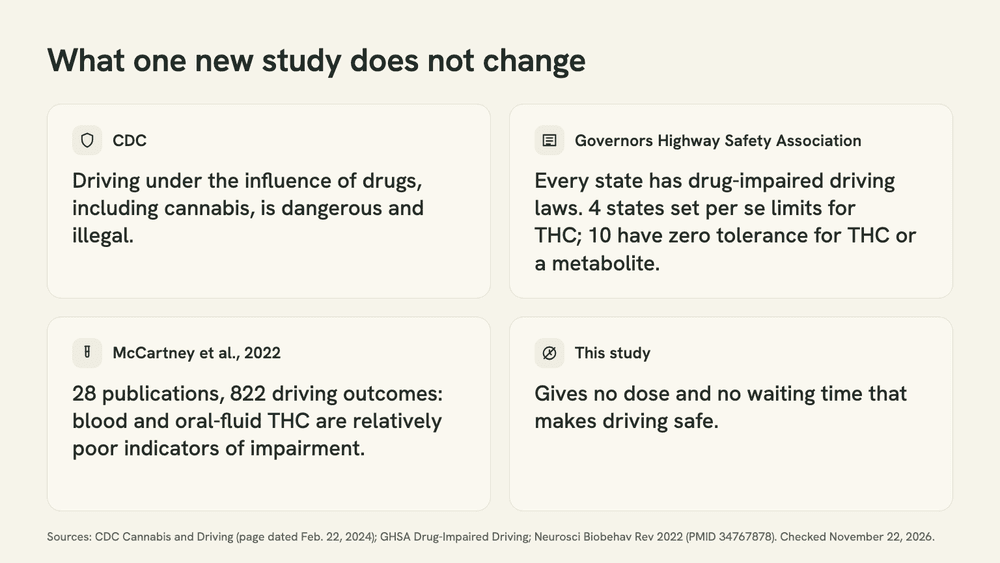
One new paper does not move the basics. The CDC's page on cannabis and driving states that "Driving under the influence of drugs, including cannabis, is also dangerous and illegal." It lists how cannabis can impair the skills driving needs, by slowing reaction time and the ability to make decisions, impairing coordination and distorting perception. It adds that studies have shown using multiple substances, such as cannabis and alcohol, at the same time can increase impairment. Its advice for anyone planning to drive is direct: "If you intend to drive, the safest option is not to use any alcohol or drugs, including cannabis."
The law has not moved either. The Governors Highway Safety Association, a nonprofit that represents state highway safety offices, notes that "Every state has laws dealing with alcohol-impaired driving and drug-impaired driving," and that 4 states have specific per se limits for THC: a set blood level that counts as an offense by itself. It also counts 10 states with zero tolerance for THC or a metabolite. Legal cannabis where you live does not change those laws.
Testing has not changed. A 2022 meta-regression of 28 publications and 822 driving-related outcomes by McCartney and colleagues concluded that blood and oral fluid THC concentrations are relatively poor indicators of cannabis-induced impairment. In regular users (weekly or more often), it found no significant relationship between those levels and performance, though the authors note those analyses were less robust. That is a scientific finding, not a legal defense: where a statute sets a number, the number is the offense. Our explainer on why a weed breathalyzer is so much harder to build than an alcohol one covers the roadside side of the problem.
Who ran it and who paid
The work came from the University of Kentucky College of Medicine and its Center on Drug and Alcohol Research, with Shanna Babalonis as corresponding author and the trial's principal investigator. Funding came from the National Institute on Drug Abuse (R21DA045101), the National Center for Advancing Translational Sciences (UL1TR001998) and the Commonwealth of Kentucky (KRS164.983). The paper's declarations state that the university's ethics board approved the study, that an FDA investigational new drug application and all necessary DEA permissions were obtained, that all participants were paid, and that "The authors declare no competing interests."
Frequently asked questions
The study does not rank them, and neither do the authors. In nine near-daily users, alcohol impaired lane control, while cannabis changed brake force and following distance. The authors say cannabis "did not produce profound alcohol-like driving impairment", but that it "was not without risk, and driving impairment was evident." Different impairment is still impairment.
This study does not show that. The abstract does not report the THC-plus-CBD session separately, and the registry's untested summary figures show it looking much like THC alone. An earlier simulator trial concluded that cannabis with equal THC and CBD appeared no less impairing than THC-dominant cannabis.
No. Each session had one active drug or none, so cannabis and alcohol were never combined. The CDC notes that using them at the same time can increase impairment.
This study cannot tell you, and we will not give you a number. The abstract does not report when effects wore off, the participants were near-daily users, and THC was inhaled; edibles start later and last longer. The CDC's advice: if you intend to drive, the safest option is not to use any alcohol or drugs, including cannabis.
Legal cannabis does not make impaired driving legal. The CDC calls driving under the influence of drugs, including cannabis, dangerous and illegal, and the Governors Highway Safety Association notes that every state has drug-impaired driving laws, with 4 states setting specific per se limits for THC and 10 with zero tolerance for THC or a metabolite.
Not reliably. A 2022 meta-regression of 28 publications found blood and oral fluid THC levels are relatively poor indicators of impairment, with no significant relationship in weekly-or-more users, in analyses the authors call less robust. That does not help you legally: in states with a per se THC limit or a zero-tolerance rule, the test result itself can be the offense.
If you use CBD or THC products and drive, the most complete next read is our guide to CBD, THC and driving, which brings the trials, the blood-test problem and the statutes together in one place. We will update this report if the full paper adds results the abstract leaves out, including its analysis of the THC-plus-CBD session.
Writing about hemp, wellness and the small rituals that keep us balanced.